ONE-STOP-SHOPS
IN VIET NAM
FOR IMPROVED DELIVERY
CONTENTS
INTRODUCTION . . . .1
IMPROVING THE DELIVERY OF ADMINISTRATIVE SERVICES . . . .2
ONE-STOP-SHOPS _ ONE DOOR FOR MANY SERVICES . . . .3
MAIN SUCCESS FACTORS AND IMPACT OF OSS . . . .5
TWO MANAGEMENT MODELS FOR ONE-STOP-SHOPS . . . .6
AN APPLICATION OF GOOD GOVERNANCE PRINCIPLES . . . .7
WIN-WIN SITUATION FOR ALL STAKEHOLDERS . . . .8
SDC SUPPORT TO ONE-STOP-SHOPS IN VIET NAM . . . .9
FIGURES FIGURE 1: THE PRINCIPLE OF ADMINISTRATIVE SERVICES DELIVERY IN ONE-STOP-SHOPS . . . .4
FIGURE 2: IMPACT OF THE ONE-STOP-SHOP CONCEPT . . . .5
FIGURE 3: SDC SUPPORT BY PROVINCE (STATUS JULY 2003) . . . .10
INTRODUCTION
One of the strategic objectives of the Public Administration Reform in Viet Nam is to enhance the delivery of administrative services to the people.
First implemented as a pilot endeavour, One-Stop-Shops (OSS) are now recognised as an integrated part of the country’s public administration system.
One-Stop-Shops are administrative service centres that provide several administrative services through a single office or "one door". They are conveniently located and equipped with modern facilities. Fees, procedures and time needed for a specific request are clearly defined and publicised.
After the introduction of One-Stop-Shops, administrative services in many provinces, cities and rural districts have significantly improved in terms of accessibility, transparency, effectiveness and efficiency. Improved administrative services have an important impact on socio-economic development.
The Government has decided to implement the One-Stop-Shop mechanism nation-wide “aiming at a radical change in the relationship between public administrative agencies and citizens, organisations, and in working procedures used by the former when addressing affairs of the latter, with a view to reducing inconvenience for the latter, preventing bureaucratic and corrupt practices and authoritarian behaviours of some cadres and civil servants, and improving state management efficiency and effectiveness”.
SDC provides support to the development and implementation of the One-Stop-Shop concept, and promotes its accelerated national replication.
IMPROVING THE DELIVERY OF ADMINISTRATIVE SERVICES
In the "Comprehensive Poverty Reduction and Growth Strategy", the Government of Viet Nam calls for promotion of pro-poor governance, ensuring a more transparent, responsive, service-oriented, convenient, and less time-consuming public service delivery. The Public Administrative Reform Master Programme 2001- 2010 of the Government of Viet Nam states that: "The 'One-Stop-Shop' will be applied widely by public administrative institutions at all levels in delivering services for the people and businesses". The programme aims at having One-Stop-Shops operating in all districts in Viet Nam by the end of 2004.
What are Administrative Services?
Administrative Services are services provided to individuals or organisations that are considered to be a typical public or government affair. The decision for granting or denying a request falls directly under the competence of the authorities, and is normally taken following legally defined procedures. Administrative services should be distinguished from other types of services the state might provide such as utility services (e.g. water supply, electricity) and commercial services (e.g. banking, insurances, consultancy). Examples of administrative services include:
Business registration; Cultural activities licenses; Construction permits; Land administration; Social affairs;
Notarisations and confirmations; Public information.
The Need for Improving the Delivery of Administrative Services
It has often been hard to access administrative services in Viet Nam. In order to get one service from the People's Committee, for example a business
registration, many stamps from various offices were required.
Frequently, officials in charge were absent or did not have a clear schedule for receiving requests. Procedures were complex and cumbersome. For the people requesting administrative services such as a construction permit, it was difficult to find out:
Where do I have to go? Whom do I have to meet? When will this official be available? What are the documents to submit? How long will the procedures take? How much are the service fees? This practice has seriously hampered the efforts of the people and businesses to pursue their socio-economic objectives. Poor people have particularly suffered from corruption, bureaucracy, unnecessary delays and other obstacles, as they do not have the money to "arrange their case".
This is one of the main reasons why many people finally gave up their efforts to obtain the necessary government approvals, for instance a construction permit or a land use right certificate. This resulted in poor implementation of the law.
In a typical "One-Stop-Shop", a number of different types of administrative services, involving different bureaus or departments, are provided through a single office. One-Stop-Shops are conveniently located, easily accessible and equipped with modern facilities. Knowledgeable and motivated staff are able to provide a customer-oriented service. Procedures are streamlined. Fees, procedures and time needed for processing a specific request are clearly defined and publicised.
ONE-STOP-SHOPS - ONE DOOR FOR MANY SERVICES
The Concept of Administrative Service Centres
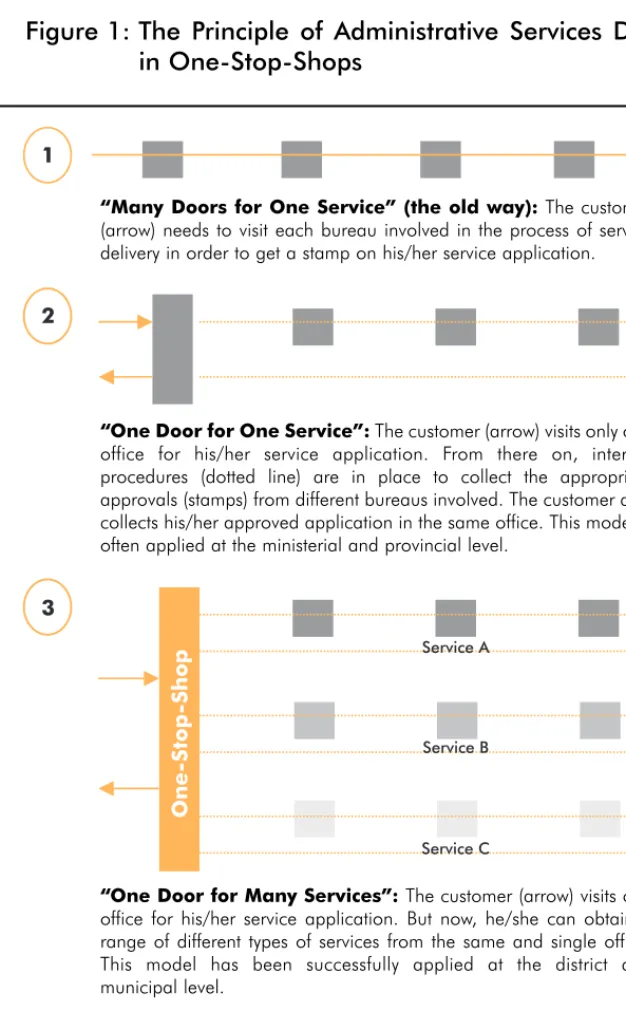
The basic idea is to change the way administrative services are provided from "many doors for one service" to "one door for many services" (see Figure 1, page 4). In a One-Stop-Shop, the provision of a number of different types of administrative services is concentrated in one office. In such administrative service centres, requests of customers are received, processed and returned to the customers.
To receive, for example, a permit to construct an additional floor on his/her house, the customer no longer needs to visit a number of bureaus and officials to receive stamps. Furthermore, this customer can apply for a license to open a shop on the first floor of his building in the same office.
One-Stop-Shops aim at:
Serving as a clear, accessible and recognisable entry point for people who need administrative services; Increasing transparency and clarity of service regulations, procedures and fees;
Improving the quality and effectiveness of administrative services;
Saving time and money by streamlining procedures of administrative service delivery;
Reducing the administrative burden from the leaders of the municipality.
Transparent Procedures
For each specific type of service such as a business registration, the public receives advice and assistance regarding the procedures, including:
What documents are required? What are the procedures? How long does it take?
How much are the fees to be paid? Procedures are streamlined, i.e. unnecessary or redundant steps are reduced, and procedures are made simpler, shorter and clearer to everyone.
Convenient Location, modern Facilities and well-trained Staff
Modern, clean facilities in a central location not only increase the work productivity, but also create a sense of pride, innovation and motivation for the staff working at the One-Stop-Shops. The working area has an important psychological impact on both staff and customers. One-Stop-Shop staff are trained to solve a customer's request in a quick and fair way, and following clear steps. They provide a warm and welcoming reception to customers, are knowledgeable about the existing administrative services and can replace their colleagues in case of absence.
One
-Stop
-S
hop
Service A Service B Service C1
2
3
ONE-STOP-SHOPS - ONE DOOR FOR MANY SERVICES
“Many Doors for One Service” (the old way): The customer
(arrow) needs to visit each bureau involved in the process of service delivery in order to get a stamp on his/her service application.
“One Door for One Service”: The customer (arrow) visits only one
office for his/her service application. From there on, internal procedures (dotted line) are in place to collect the appropriate approvals (stamps) from different bureaus involved. The customer also collects his/her approved application in the same office. This model is often applied at the ministerial and provincial level.
“One Door for Many Services”: The customer (arrow) visits one
office for his/her service application. But now, he/she can obtain a range of different types of services from the same and single office. This model has been successfully applied at the district and municipal level.
Figure 1: The Principle of Administrative Services Delivery
in One-Stop-Shops
Government commitment, human resource development, adequate facilities, and financial sustainability can be identified as the four main decisive factors for successful implementation of the One-Stop-Shop concept.
MAIN SUCCESS FACTORS AND IMPACT OF OSS
Commitment from the highest Level
Commitment from the highest level is a condition for the successful establishment and operation of One-Stop-Shops. Commitment is the degree to which a senior official not only supports a policy or an initiative, but also puts a great deal of effort and energy into its realisation. In most cases, the People's Committees were actually the initiators of the One-Stop-Shop concept, often after being exposed to other already functioning models in the country.
Human Resource Development
Building the capacity of the staff is the backbone of the Public Administration Reform process. Only knowledgeable and skilled staff are able to provide a good service. Much attention should therefore be paid to the training of the staff. Besides improved understanding of the legally required administrative procedures, capacity building should include customer-relation skills. It is a definite advantage if the staff has a broad range of knowledge and is able to replace colleagues during their absence. Salary reform and an incentive system increase the motivation for One-Stop-Shop staff.
Modern Facilities in a central Location
Convenient facilities and modern equipment not only increase the work productivity, but also create a sense of pride, innovation and motivation for One-Stop-Shop staff.
Financial Sustainability
Last but not least, financial sustainability is a crucial success factor for One-Stop-Shops.
Figure 2:
Impact of the One-Stop-Shop Concept Before Introduction of After Introduction of
One-Stop-Shops One-Stop-Shops Procedure
Unclear, unofficial; Clear and transparent; Complex; Simple;
Too many steps; Few steps (streamlined); Visit of many offices. Visit of one office only.
Processing Time
Slow; Faster;
No fixed deadline; Fixed Deadline; Results in waste of time. Results in saving time.
Fees
Official fees plus extra Fees are officially expenses. publicised, no "hidden
cost".
People (Customers) Difficult to access; Easy to access; unclear where and everyone knows where how to obtain and how to obtain a specific service. a specific service.
Government Staff
Lack of responsibility; Initiative, responsible; Bureaucratic; Customer-minded; Limited skills. Competent.
Easier to establish because of few changes in terms of staffing, salaries and management responsibilities; Less additional coordination between OSS and bureaus is needed; Changes in regulations are easier to incorporate in service delivery; Specialists are serving customers; Fewer additional training needs for OSS staff to clarify regulations and procedures.
More difficult to adapt to changing workload. OSS staff are overloaded more quickly; Less willingness among OSS staff to share one another's workload; Danger of weaker service culture due to less control over OSS operations by the head of the OSS; less sense of belonging to the OSS among staff;
Potential dominance of professional bureau culture.
TWO MANAGEMENT MODELS FOR ONE-STOP-SHOPS
Easier to adjust number of staff to actual peaks and declines in service demand;
Greater flexibility of staff to share one another's workload;
Easier to introduce new service areas into the OSS as this does not necessarily require extra staff; Stronger control by head of OSS to improve the service culture.
More difficult to establish as more resources have to be allocated to OSS and powers and responsibilities are taken from the bureaus; Additional coordination is needed between OSS and bureaus; Changes in regulations are more difficult to incorporate;
Staff are less specialised and therefore less capable of serving customers properly;
More additional training for OSS staff is needed. Reception Processing Return (RPR) Processing of Requests included in OSS Reception Return (RR) Processing of Requests not included in OSS
Model Advantages Disadvantages
The Office of the People’s Committee is in charge of Stop-Shops. One-Stop-Shops can be organised according to two basic models, which have their own distinctive ways of operation in terms of who actually undertakes reception, processing and return of service requests.
In the first model, referred to as “Reception, Processing, Return” (RPR), most One-Stop-Shop staff are professionals from different bureaus. They are not only in charge of receiving and returning, but also in charge of processing the requests;
In the second model, referred to as “Reception, Return” (RR), One-Stop-Shop staff are only responsible for properly receiving, documenting and returning the files after they have been processed. Once received, the file is forwarded to the relevant bureaus for processing.
The introduction of the One-Stop-Shop Concept has not only served as a vehicle for quicker and more convenient delivery of administrative services, but also for the application of principles of good governance, accountability, equality, and public participation. Main results achieved are higher accessibility, transparency, fairness, efficiency, effectiveness, and customer satisfaction.
AN APPLICATION OF GOOD GOVERNANCE PRINCIPLES
Better Accessibility
Everyone who needs a certain administrative service knows where to obtain it. People no longer have to work with several offices. Better accessibility results in an increased use of administrative services. This contributes significantly to proper implementation of the law and regulations. For example: If a business registration is easier to obtain, more people register their businesses properly. This leads to an improved perception of the business climate.
Increased Transparency
Transparency is the degree to which internal processes and factors determining administrative decisions within the Government or within a governmental organisation are visible and clear to everybody. The publication of procedures and fees in One-Stop-Shops has remarkably enhanced the transparency of the administration.
More Fairness and Equality
Equality is the application of the administrative principle that similar cases should receive similar treatment. In other words, an administrative decision should be based only on conditions laid down in the relevant regulations, or other conditions that are applied equally to all applicants for this service. Typically, corrupt decisions are based
on the ability of the applicant to pay an extra fee to speed up a service or receive approval of his/her request. This is not equal and fair to those who cannot afford such "fees". Clearly defined, standardised procedures have led to more fairness and equality.
Increased Efficiency
Efficiency measures the costs implied in the achievement of a goal. The lower the costs for producing the same service are, the more efficient the service is provided. Experience shows that after the introduction of One-Stop-Shops, the same number of staff can handle more cases. The cost per service request processed has thus decreased.
Increased Effectiveness
Effectiveness is the degree to which goals are achieved. The better the service reaches its goals, the higher its effectiveness is. The introduction of the One-Stop-Shop concept has resulted in fewer cases remaining unsolved, getting lost somewhere in the bureaucracy, or remaining on an official's desk for too long.
Increased Customer Satisfaction
Surveys show that the majority of people applying for administrative services are very satisfied with the level of service provided at One-Stop-Shops. The customers view it as a significant and welcome improvement.
Main stakeholders of One-Stop-Shops are the people, local People's Committees, local government officials, One-Stop-Shop staff, and the Government. Streamlining administrative procedures through the establishment of One-Stop-Shops is beneficial to all stakeholders. Generally, improved administrative services have a positive impact on socio-economic development and poverty reduction.
WIN-WIN SITUATION FOR ALL STAKEHOLDERS
Benefits for the People
The people are the first to benefit from effective, transparent and fair administrative services. Poor people are particularly at a disadvantage in corrupt administrations since they do not have the resources to "arrange their case". The less time people spend on applying for administrative services, the more time they have available to engage in income generating activities. This improves their economic position. Ineffective, inefficient and corrupt service delivery is a serious constraint to socio-economic development and poverty reduction.
Benefits for local People's Committees and the local Government in general
Improved service delivery and socio-economic development contribute to the legitimacy of and support for the People's Committee and the local Government in general.
Furthermore, easy-to-access and simple administrative procedures motivate the people to abide by laws and regulations. This facilitates proper implementation of the law and regulations.
Benefits for Officials of Professional Bureaus
An efficient system of service delivery also reduces the workload of officials in public administration, and gives them more time for strategic planning and management.
One-Stop-Shops are a clear contact point with the people and will enable officials to better understand the demands of the people.
Benefits for One-Stop-Shop Staff
Working in a One-Stop-Shop requires high commitment and energy from the staff. Obviously, they want to see something in return for their energy, overtime and commitment. A renovated office, good facilities, and satisfied customers are an incentive for them. One-Stop-Shop staff have a clear interest that services customers apply for are indeed granted in a satisfactory manner.
Benefits for the Government
The Ministry of Home Affairs (MoHA) is the main organisation in charge of the Public Administration Reform Master Programme. Improved service delivery is a clearly visible result of the Public Administration Reform for everyone and has an immediate impact on the daily life of the people. This contributes significantly to a positive perception of the Government and its role as a partner in socio-economic development.
Moreover, the implementation of the One-Stop-Shops is a trigger for additional reforms of the public apparatus initiated by the Vietnamese Government.
SDC SUPPORT TO ONE-STOP-SHOPS IN VIET NAM
Background
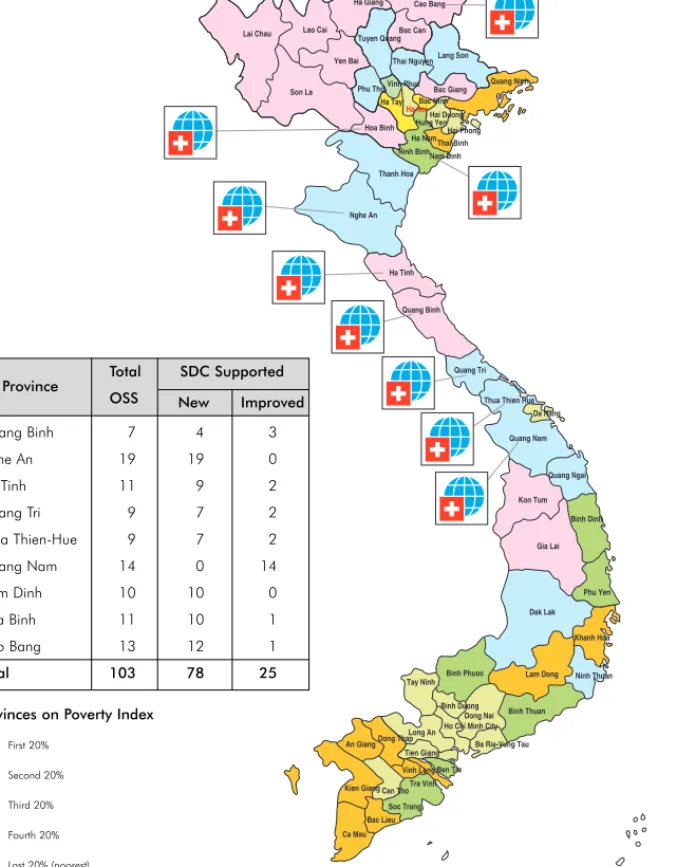
In 2000, SDC promoted the One-Stop-Shop model in Dong Hoi Town and Quang Binh Province. Since then, eight provinces and over 90 districts have requested SDC support to open or improve One-Stop-Shops. In 2002, SDC supported the Ministry of Home Affairs in assessing and evaluating all One-Stop-Shop pilot models in Viet Nam, as well as developing recommendations for its nation-wide replication.
The rapid increase of local demand for One-Stop-Shop replication is due to the success of the experiences made so far and to the Government's decision to implement the One-Stop-Shop mechanism in central cities and provinces, in districts, towns and cities, and in communes and wards. The Government aims at having One-Stop-Shop operational in all 631 districts by the end of 2004.
Main Challenges
The main challenges to address include: The adaptation of the One-Stop-Shop concept to poor districts, especially those with a large number of ethnic minorities; The financial sustainability of One-Stop-Shops;
The extension of One-Stop-Shop services to communes;
The process of improving the quality and enlarging the number of services provided through One-Stop-Shops.
Objectives
The objectives of the SDC support to the nation-wide One-Stop-Shop replication is threefold:
Efficient, effective, sustainable, transparent and customer-oriented One-Stop-Shops are operating in all districts;
A mechanism/procedure for continuous improvement of the quality and expansion of services provided in the operating One-Stop-Shops is developed and applied nation-wide;
A national network facilitating the sharing of information among district One-Stop-Shops as well as providing feedback to the national policies is established.
Approach
At the national level, SDC works closely with the Ministry of Home Affairs to facilitate and coordinate the national replication process through exchanging experience, monitoring, assessment and dissemination of the lessons learned.
SDC also works with other line ministries to streamline and decentralise service delivery procedures, in order to allow more services to be provided through the district One-Stop-Shops. At the local level, SDC provides assistance to local authorities to facilitate the process of replication, continuous improvement, and service expansion of the district One-Stop-Shops. SDC support focuses primarily on the poor provinces, especially the mountainous regions with a large percentage of ethnic minorities, and concerts its efforts with other donors.
Scope
SDC support covers the following three broad groups of activities:
Establishment: Introduction of the One-Stop-Shop concept to local authorities, facilitation of the preparations for establishment, and provision of basic equipment and training;
Improvement: Development and application of a performance monitoring system, compilation of operational guidelines, staff training, facilitating the introduction of new services, and upgrading facilities;
Enhancing coordination: Inputs to the strategy for nation-wide replication of One-Stop-Shops, contributions to the support package for its implementation, facilitation of national assessment and dissemination of lessons learned.
Lai Chau Lao Cai Lang Son Vinh Phuc Phu Tho Hoa Binh Hai Duong Hai Phong Ha NamThai Binh Ninh Binh Nam Dinh Thanh Hoa Nghe An Ha Tinh Quang Binh Quang Tri Quang Nam Quang Ngai Kon Tum Binh Dinh Gia Lai Phu Yen Dak Lak Khanh Hoa
Lam Dong Ninh Thuan
Binh Thuan Binh Duong
Dong Nai Ho Chi Minh City
Ba Ria-Vung Tau Long An
Dong Thap An Giang
Kien Giang Can Tho Soc Trang Bac Lieu Ca Mau
Tien Giang Vinh Long Ben Tre
Tra Vinh Binh Phuoc Tay Ninh
Thua Thien Hue Da Nang Hung Yen Quang Ninh Ha Tay Ha Noi Ha Giang Son La Yen Bai Tuyen Quang Thai Nguyen Bac Can Bac Giang Bac Ninh Cao Bang
Figure 3: SDC Support by Province (Status July 2003)
SDC SUPPORT TO ONE-STOP-SHOPS IN VIET NAM
Province
Total SDC Supported OSS New Improved
Quang Binh 7 4 3 Nghe An 19 19 0 Ha Tinh 11 9 2 Quang Tri 9 7 2 Thua Thien-Hue 9 7 2 Quang Nam 14 0 14 Nam Dinh 10 10 0 Hoa Binh 11 10 1 Cao Bang 13 12 1 Total 103 78 25
Provinces on Poverty Index
First 20% Second 20% Third 20% Fourth 20% Last 20% (poorest)
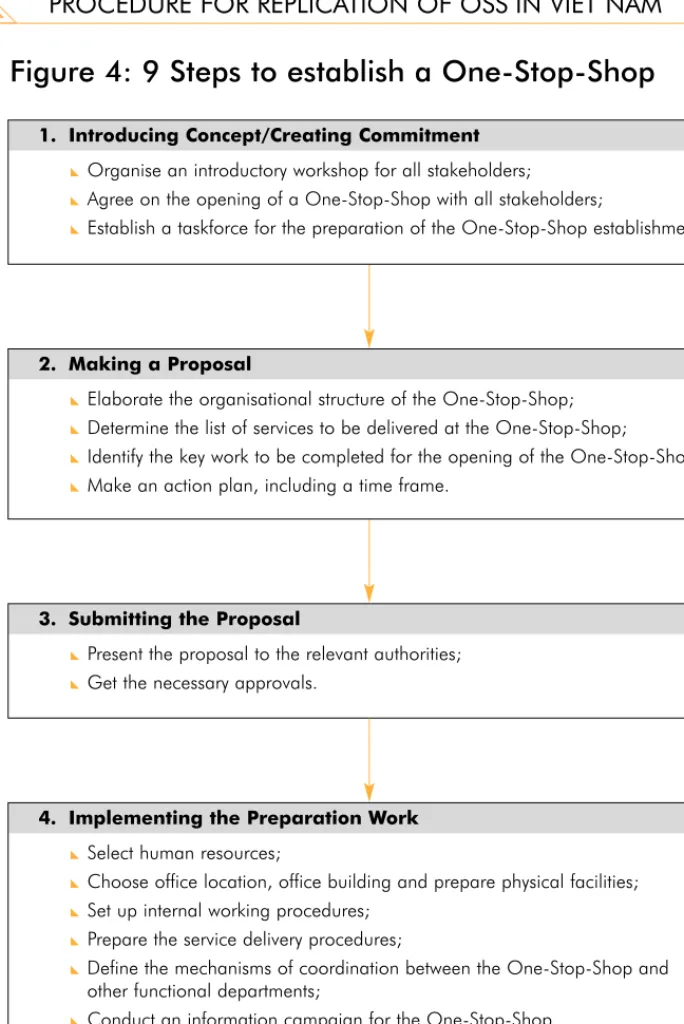
Figure 4: 9 Steps to establish a One-Stop-Shop
PROCEDURE FOR REPLICATION OF OSS IN VIET NAM
1. Introducing Concept/Creating Commitment
Organise an introductory workshop for all stakeholders;
Agree on the opening of a One-Stop-Shop with all stakeholders;
Establish a taskforce for the preparation of the One-Stop-Shop establishment.
2. Making a Proposal
Elaborate the organisational structure of the One-Stop-Shop; Determine the list of services to be delivered at the One-Stop-Shop;
Identify the key work to be completed for the opening of the One-Stop-Shop; Make an action plan, including a time frame.
3. Submitting the Proposal
Present the proposal to the relevant authorities; Get the necessary approvals.
4. Implementing the Preparation Work
Select human resources;
Choose office location, office building and prepare physical facilities; Set up internal working procedures;
Prepare the service delivery procedures;
Define the mechanisms of coordination between the One-Stop-Shop and other functional departments;
PROCEDURE FOR REPLICATION OF OSS IN VIET NAM
5. Opening the One-Stop-Shop
Organise the launching ceremony; Organise a press conference.
6. Monitoring the Performance
Set up a monitoring system;
Conduct regular monitoring (controlling); Identify problems that need to be solved.
7. Improving the Performance
Analyse possible problems; Define solutions;
Solve problems.
8. Expanding Services
Analyse service demand, reform process that offer new options; Identify new services that should be added;
Implement the preparation work for delivering new services; Launch the new services.
9. Linking to the Network
Share experience with other One-Stop-Shops;
Learn from experience gained in other One-Stop-Shops; Participate in the national assessment and evaluation.
The Swiss Agency for Development and Cooperation (SDC)
Is a division of the Swiss Ministry of Foreign Affairs, focusing on international development cooperation. Website: www.sdc.admin.ch
Authors
Walter Meyer, SDC Country Director
Dao Minh Chau, Senior Programme Officer, SDC
Luu Phuoc Dung, Programme Officer, Urban Forum Support, SDC Nguyen Thi Bich Lien, Programme Officer, SDC
Daniel P. Keller, Director, Swiss Consulting Co. Ltd., Hanoi
Contact
Mr. Walter Meyer, SDC Country Director Swiss Cooperation Office - Mekong Region
Hanoi Central Office Building, 16thfloor
44B Ly Thuong Kiet Street Hanoi - Viet Nam
Tel.: +84 4 934 66 27
Fax: +84 4 934 66 33
E-mail: [email protected]
Website: www.sdc.org.vn
Information and Publications
Website of Urban Forum
www.un.org.vn/donor/urbforum/index.htm
© July 2003, Swiss Agency for Development and Cooperation Printed in the Socialist Republic of Viet Nam