Annals of Oncology 24: 391–397, 2013 doi:10.1093/annonc/mds288 Published online 27 September 2012
Patient
–doctor agreement on recall of clinical trial
discussion across cultures
J. Bernhard
1,2*, J. Aldridge
3, P. N. Butow
4,5, P. Zoller
1, R. Brown
6, A. Smith
5& I. Juraskova
41
IBCSG Coordinating Center, Bern;2
Department of Medical Oncology, Inselspital, Bern University Hospital, Bern, Switzerland;3
IBCSG Statistical Center, Department of Biostatistics and Computational Biology, Dana-Farber Cancer Institute, Boston, USA;4
School of Psychology, Centre for Medical Psychology and Evidence-based Decision-making (CeMPED);5
Psycho-Oncology Co-operative Research Group (PoCoG), University of Sydney, Sydney, Australia;6
Department of Social and Behavioral Health, School of Medicine, Virginia Commonwealth University, Richmond, USA
Received 13 April 2012; revised 3 July 2012; accepted 5 July 2012
Background:
The purpose was to investigate patient–doctor agreement on clinical trial discussion cross-culturally.Methods:
In the International Breast Cancer Study Group Trial 33-03 on shared decision-making for early breast cancer in Australian/New Zealand (ANZ) and Swiss/German/Austrian (SGA) centers, doctor and patient characteristics plus doctor stress and burnout were assessed. Within 2 weeks post-consultation about treatment options, the doctor and patient reported independently, whether a trial was discussed. Odds ratios of agreement for covariables were estimated by generalized estimating equations for each language cohort, with doctor as a random effect.Results:
In ANZ, 21 doctors and 339 patients were eligible; in SGA, 41 doctors and 427 patients. In cases where the doctor indicated‘no trial discussed’, 82% of both ANZ and SGA patients agreed; if the doctor indicated ‘trialdiscussed’, 50% of ANZ and 38% of SGA patients agreed, respectively. Factors associated with higher agreement were: low tumor grade and fewer patients recruited into clinical trials in SGA; public institution, patient born in ANZ (versus other), higher doctor depersonalization and personal accomplishment in ANZ.
Conclusion:
There is discordance between oncologists and their patients regarding clinical trial discussion,particularly when the doctor indicates that a trial was discussed. Factors contributing to this agreement vary by culture. Key words: breast cancer, communication skills training, cross-cultural differences, patient–doctor agreement, shared decision-making
introduction
Clinical trial discussions are challenging for both patients and
doctors. Patient understanding of trial issues is poor [
1
]. Many
patients have negative attitudes to trials, which may potentially
compromise informed consent. These attitudes are a key issue
to be addressed by doctors [
2
]. Both patients and doctors may
be concerned about further issues, such as the admission of
medical uncertainty or the relocation of the treatment decision
from the doctor–patient relationship to computerized random
assignment [
3
]. Doctors may be reluctant to present the option
of a trial to patients. Albrecht et al. [
4
] reported on two urban,
National Cancer Institute-designated comprehensive cancer
centers, where only a minority (20%) of potentially eligible
patients was explicitly offered a trial. When offered a trial, most
patients (75%) agreed to participate.
In trial discussions, the quality and quantity of
communication between the oncologist, patient, and family or
companion are important to the patient
’s decision-making
process [
4
]. The role of emotions regarding trial participation
has rarely been investigated [
5
,
6
]. In elderly cancer patients,
the type of nurses
’ response to their emotions has been shown
to impact on information recall [
7
]. Whether such factors
influence patients’ decision-making is not known. One
fundamental indication of whether information about trials
has been adequately clear is whether there is agreement
between the patient and the doctor on whether they discussed
a trial at all. Disagreement on trial discussions may
compromise informed consent. Further, if we can identify
factors associated with such agreement we may be able to
identify the patient and doctor characteristics indicative of a
need for greater care in explaining trials. This information may
help tailor training in trial discussion for doctors.
Our objective was to cross-culturally examine agreement
between patients with early breast cancer and their doctors
regarding whether a trial discussion had taken place in
consultations about adjuvant therapy. These consultations were
studied within an international randomized, controlled trial of
a communication skills training to increase the quality of
shared decision-making [
8
]. We investigated factors related to
patients, doctors and the local setting associated with patient
–
doctor agreement on trial discussion, and the association
*Correspondence to: Prof J. Bernhard, International Breast Cancer Study Group Coordinating Center, Effingerstrasse 40, 3008 Bern, Switzerland. Tel: +41-31-3899391; Fax: +41-31-3899239; E-mail: [email protected]
© The Author 2012. Published by Oxford University Press on behalf of the European Society for Medical Oncology. All rights reserved. For permissions, please email: [email protected].
between patient–doctor agreement and patient decision
outcomes. In a subsample, we explored the association between
this agreement and cognitive and emotional aspects of
decision-making.
patients, doctors, and methods
The International Breast Cancer Study Group conducted Trial 33-03 in centers in Australia and New Zealand (referred to as ANZ), and
Switzerland, Germany, and Austria (referred to as SGA), with the doctor as the unit of block randomization after stratification for the center. The training consisted of a 7-h interactive workshop with 1–2 follow-up telephone calls over 2 months. The elements of this training were evidence-based [9], incorporating presentation of principles [10], a video modeling ideal behavior, and role play practice focusing on four key concepts: ensuring a shared decision-making framework; structuring information into a sequence or order; ensuring the inclusion of different, specific types of information in a clear manner; and considering the disclosure of specific controversial information and avoiding coercive communication [10]. The details are described elsewhere [8]. The ethics committees of all
participating centers (See Appendix) approved the protocol.
Medical, surgical, radiation and gynecological oncologists, involved in the treatment of patients with early breast cancer at major cancer centers or clinics (including private oncologists), and their patients for whom adjuvant therapy for breast cancer was indicated, were eligible. The following additional patient criteria were required: lower age limit of 18 years, adequate knowledge of the local language (English or German), and being mentally and physically capable of participating. Doctor participation was independent of previous or concurrent participation in other types of communication training.
procedures and measures
After giving informed consent, doctors at participating centers were concurrently enrolled. Following baseline assessment and before the scheduled training workshop, they were randomly assigned to the experimental (training workshop) or control (no training workshop) group. Patients of enrolled doctors were recruited before their doctors were randomized ( pre-randomization cohort) and after the workshop, if assigned, or at an equivalent time-point, if not assigned (
post-randomization cohort). The local staff identified eligible patients within a flexible time window of ∼12 months in each randomization cohort. For each doctor, 5–10 patients were to be enrolled in the pre-randomization cohorts and eight or more in the post-randomization cohorts.
Trial outcomes were selected based on studies that evaluated decision aids designed to facilitate shared decision-making [11]. Two weeks before their initial consultation discussing treatment options, patients gave informed consent and completed a baseline questionnaire gathering demographics and self-report measures including state anxiety by Spielberger [12].
Two weeks after the consultation, patients were mailed a questionnaire with a pre-paid, addressed return envelope. In addition to the baseline measures, patients were asked whether a trial discussion had taken place in their consultation, besides other disease and treatment factors. The questionnaire further included measures of satisfaction with: (i) decision [13]; (ii) consultation (adapted from Roter [14] and Korsch et al. [15]); and (iii) doctor communication regarding standard treatment options [9] and clinical trials [9]; plus decisional conflict [16]. Patient measures were in English for ANZ and German for SGA centers. Before randomization doctors completed the Maslach Burnout Inventory (three subscales: depersonalization, emotional exhaustion, and personal accomplishment) as used by Ramirez et al. [17] in English.
Further information was obtained within each language cohort. In ANZ centers, cognitive and emotional aspects of shared decision-making were coded in a subsample of audio-taped consultations, using the OPTION scale [18], the RECC coding system [19], and a rating for doctor blocking and facilitating behavior [20]. In SGA centers, the doctors recorded the duration of each consultation.
statistical analysis
We investigated factors associated with agreement between patients and their doctors regarding whether or not a trial was discussed. The primary end point, patient–doctor agreement, was defined at the patient level. The patients were dichotomized into those who agreed with their doctor about whether a trial had been discussed (agreement) and those who did not agree. Given the explorative nature of this investigation, we chose a conservative approach to missingness: when either the doctor or the patient reported missing information for trial discussion, the patient was
considered not to have agreement with her doctor. When both had missing information for trial discussion, patient–doctor agreement was considered missing, and the patient was excluded from the analysis. For reasons of consistency, we examined the proportion of agreement also in the subgroup of pairs without missing information. All analyses were presented separately by the language cohort.
Baseline characteristics of doctors and patients were reported. Trial discussion responses were cross-tabulated by patients and their doctors. Odds ratios of patient–doctor agreement for selected covariables were estimated by generalized estimated equations (GEEs), with doctor as a random effect. GEEs were used to account for the clustering of patients within doctor and to ensure that the variability of parameter estimates and testing accounted for this effect. To determine which of the doctor and patient characteristics were to be considered in the models, the two-sided Fisher’s exact test was used to compare categorical variables between patient–doctor agreement groups, and the two-sided Wilcoxon Rank-Sum test was used to compare continuous variables between these groups. Both the Fisher’s exact test and the Wilcoxon Rank-Sum test assume
independence of patients. Results from Fisher’s exact tests and Wilcoxon Rank-Sum tests were considered, and doctor and patient characteristics that differed between patient–doctor agreement groups were included in the initial model. Stepwise selection was used to determine the best GEEfit model. Odds ratios, standard errors, and 95% confidence intervals of the covariates are reported. No alpha adjustments were made because we intend ourfindings to be hypothesis generating and therefore descriptive only, and P-values should be regarded as such.
results
sample description and patient characteristics
For the present analysis, 769 patients from 62 doctors were
eligible. For three patients, both doctor and patient data
regarding discussion of a trial were missing, leaving 766
patients. Ten patients had missing doctor assessments, and 65
patients had missing patient assessments. The doctors
documented that a trial was available in 68 patients (20%)
from the ANZ cohort and in 150 (35%) from the SGA cohort,
respectively.
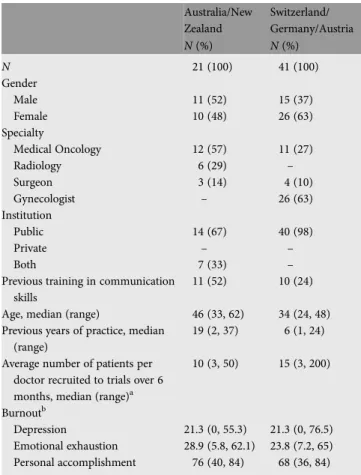
The baseline characteristics of eligible doctors are shown in
Table
1
. They were balanced between randomization arms.
With a few exceptions, the baseline characteristics of eligible
patients of these doctors were also balanced between
randomization arms (Table
2
, randomization arms not shown).
patient
–doctor agreement
The patient
–doctor agreement on trial discussion is
summarized in Table
3
. These numbers do not account for the
effect of multiple patients per doctor. The overall proportion of
concordant responses regarding whether or not a clinical trial
was discussed was 75% for ANZ and 66% for SGA,
respectively. In patients without missing data, the
corresponding proportions were 84% for ANZ and 72% for
SGA, respectively.
In cases where the doctor indicated
‘trial not discussed’, 82%
of both ANZ and SGA patients agreed. In those cases where
the doctor indicated
‘trial discussed’, the agreement was lower,
with 50% and 38% of ANZ and SGA patients agreeing,
respectively. These
findings were consistent in patients without
missing data.
predictors for patient
–doctor agreement
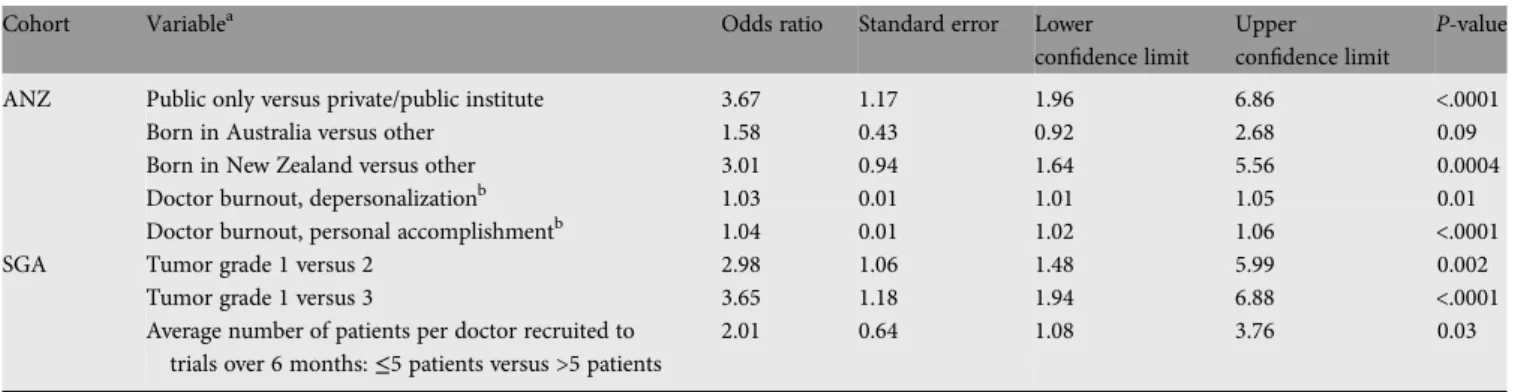
The predictors for patient
–doctor agreement in our GEE
model are summarized in Table
4
. In the ANZ cohort,
treatment in a public institution was associated with better
agreement (P < 0.0001). Patients born in New Zealand (versus
other; P = 0.0004) and Australia (versus other; P = 0.09)
showed better agreement. Doctors who indicated more
personal accomplishment had better agreement P < 0.0001).
Those who indicated more depersonalization showed a
Table 1. Baseline characteristics for eligible doctors by culture Australia/New Zealand Switzerland/ Germany/Austria N (%) N (%) N 21 (100) 41 (100) Gender Male 11 (52) 15 (37) Female 10 (48) 26 (63) Specialty Medical Oncology 12 (57) 11 (27) Radiology 6 (29) – Surgeon 3 (14) 4 (10) Gynecologist – 26 (63) Institution Public 14 (67) 40 (98) Private – – Both 7 (33) –
Previous training in communication skills
11 (52) 10 (24)
Age, median (range) 46 (33, 62) 34 (24, 48) Previous years of practice, median
(range)
19 (2, 37) 6 (1, 24)
Average number of patients per doctor recruited to trials over 6 months, median (range)a
10 (3, 50) 15 (3, 200)
Burnoutb
Depression 21.3 (0, 55.3) 21.3 (0, 76.5) Emotional exhaustion 28.9 (5.8, 62.1) 23.8 (7.2, 65) Personal accomplishment 76 (40, 84) 68 (36, 84)
aRefers to any trial, six Swiss/German/Austrian (SGA) doctors have
missing recruitment information.
bNine SGA doctors have missing burnout information.
Table 2. Patient baseline characteristics by culture, for assessable patients Australia/New Zealand Switzerland/Germany/ Austria N (%) N (%) N 339 (100) 427 (100) Stage of tumor Missing 8 (2) 10 (2)
Localized (node negative) 196 (58) 267 (63) Advanced (node positive) 135 (40) 150 (35) Number of nodes Missing 8 (2) 10 (2) 0 196 (58) 267 (63) 1–3 85 (25) 73 (17) 4–10 27 (8) 44 (10) >10 8 (2) 12 (3) Unknown 15 (4) 21 (5) Grade of tumor Missing 16 (5) 11 (3) 1 68 (20) 58 (14) 2 142 (42) 184 (43) 3 113 (33) 174 (41)
Hormone receptor status
Missing – – Negative 77 (23) 78 (18) Positive 218 (64) 328 (77) Unclear at time of consultation 39 (12) 15 (4) Country of birth Missing – 14 (3) Australia 161 (47) – New Zealand 78 (23) – Switzerland – 90 (21) Germany – 165 (39) Austria – 105 (25) Other 99 (29) 52 (12) Language Missing – 5 (1) English 307 (91) 3 (1) German – 380 (89) French – 3 (1) Italian – 7 (2) Other 31 (9) 29 (7) Medical training 73 (22) 66 (15) Education Missing 9 (3) 16 (4)
Did not graduate HS or equivalent
109 (32) 165 (39)
HS diploma or equivalent 135 (40) 182 (43) University degree 57 (17) 59 (14) Graduate degree 29 (9) 5 (1) Age, median (range) 52 (27, 83) 58 (24, 88) Tumor size, median (range) 2 (0.1, 40) 2 (0, 12) Anxietya, median (range) 44 (20, 80) 45 (20, 78)
aAnxiety was measured pre-consultation. HS, high school.
marginal although statistically significant association with
better agreement (P = 0.01).
In the SGA cohort, a lower tumor grade was associated with
better agreement (grade 1 versus 2: P = 0.002; grade 1 versus 3:
P < 0.0001). Those doctors who recruited less patients into
clinical trials had better agreement with their patients
(P = 0.03). When looking at percentages of patients, more
patients with positive hormone receptor status, less positive
lymph nodes, and less anxiety had better agreement, and
patients
’ country of birth and education were associated with
agreement; however, these effects were no longer substantial
when accounting for multiple patients per doctor.
The remaining patient and doctor characteristics (Tables
1
and
2
) were not associated with patient
–doctor agreement in
either cohort. In particular, there was no indication that
agreement was influenced by the randomized communication
intervention. The negative effect of a higher number of patients
recruited into clinical trials by the participating doctors was
not driven by those doctors recruiting no patients to clinical
trials or by the number of patients the doctors enrolled into
the present trial. A separate investigation of predictors
according to agreement on trial discussed and
‘not discussed’
showed little variation and was consistent overall (data not
shown).
patient
–doctor agreement and patient decision
outcomes
The association between patient–doctor agreement and patient
decision outcomes (i.e. decisional con
flict, satisfaction with
decision, satisfaction with consultation, satisfaction with doctor
communication overall, and regarding a clinical trial) was
investigated. Whether patients agreed or not with their doctors
on trial discussion was not associated with patient decision
outcomes in the ANZ or in the SGA cohort (data not shown).
further explorative analyses
In the ANZ cohort, we explored cognitive and emotional
aspects of shared decision-making based on blind interview
ratings. Quantitative and qualitative data were available from
70 audio-taped consultations. After removing cases with
incomplete transcripts (due to recording problems), or
insuf
ficient patient data (due to non-return of questionnaires),
a total of 55 consultations from 20 doctors were assessable. No
differences in demographics or patient outcomes were found
between the 55 complete cases and the 12 cases with
incomplete data.
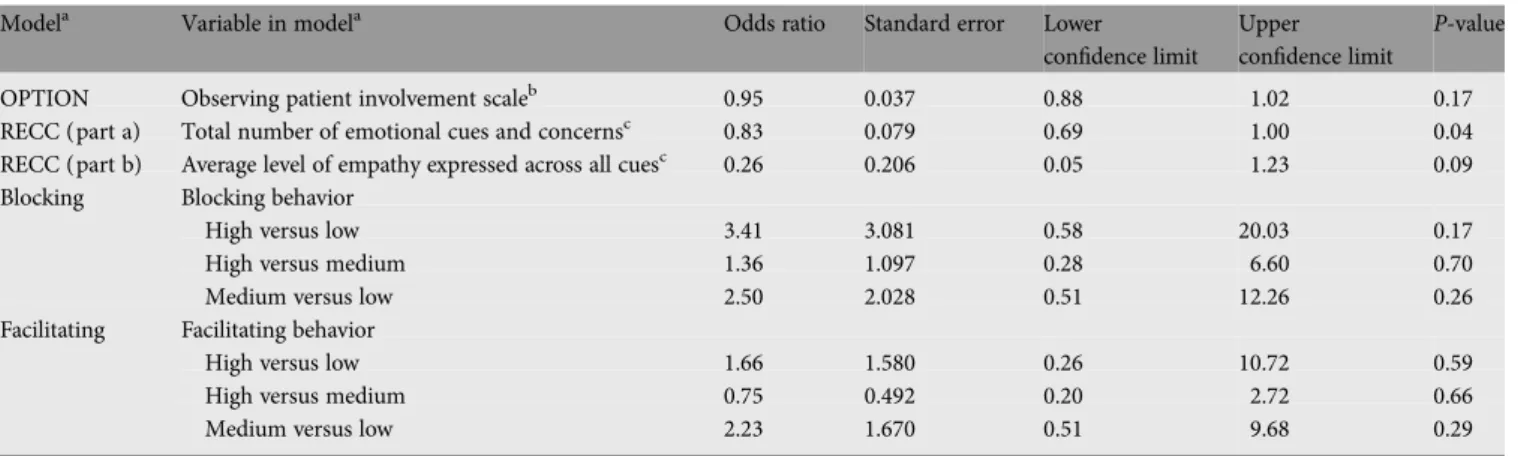
A higher total number of emotional cues and concerns in
the consultation (initiated either by the patient or the doctor)
was associated with less patient–doctor agreement (P = 0.04;
Table
5
). A higher average level of the doctors
’ empathy in
response to all cues and concerns showed a tendency in the
same direction, with less empathy being associated with better
agreement (P = 0.09). Of note, neither the doctors’ level of
Table 3. Cross tabulations of patient–doctor agreement information on trial being discussed by language cohort, for all patients
Patient(below)/doctor (right)
Missing Trial not discussed Trial discussed Total Australian/New Zealand Missing – 26 7 33
Trial not discussed 3 219 27 249
Trial discussed 1 22 34 57
Total 4 267 68 339a
Swiss/German/Austrian
Missing – 24 8 32
Trial not discussed 4 225 84 313
Trial discussed 2 24 56 82
Total 6 273 148 427b
aExcludes one patient with both doctor and patient assessments missing. b
Excludes two patients with both doctor and patient assessments missing.
Table 4. Odds ratios for patient–doctor agreement versus disagreement. Generalized estimated equations by language cohort for eligible doctors and their assessable patientsa
Cohort Variablea Odds ratio Standard error Lower
confidence limit
Upper confidence limit
P-value ANZ Public only versus private/public institute 3.67 1.17 1.96 6.86 <.0001
Born in Australia versus other 1.58 0.43 0.92 2.68 0.09
Born in New Zealand versus other 3.01 0.94 1.64 5.56 0.0004
Doctor burnout, depersonalizationb 1.03 0.01 1.01 1.05 0.01
Doctor burnout, personal accomplishmentb 1.04 0.01 1.02 1.06 <.0001
SGA Tumor grade 1 versus 2 2.98 1.06 1.48 5.99 0.002
Tumor grade 1 versus 3 3.65 1.18 1.94 6.88 <.0001
Average number of patients per doctor recruited to trials over 6 months:≤5 patients versus >5 patients
2.01 0.64 1.08 3.76 0.03
The ANZ cohort includes 21 doctors and 339 patients. The SGA cohort includes 41 doctors and 427 patients. SGA, Swiss/German/Austrian; ANZ, Australian/New Zealand.
aAccounting for the randomization group and pre- or post-randomization cohort. b
For doctor burnout variables, depersonalization and personal accomplishment, higher scores correspond to higher degrees of depersonalization and personal accomplishment, respectively. Thus, an odds ratio >1 indicates that the odds of agreement increase when the average response score increases by one unit (doctor depersonalization range: 0–102; doctor personal accomplishment range: 0–84).
behavior exhibiting competent shared decision-making
(OPTION) nor blocking or facilitating behavior was associated
with patient–doctor agreement.
In the SGA cohort, the association between the duration of
the consultation and the patient
–doctor agreement was
explored. The median duration was 40 min (N = 415, range:
15–125). There was moderate variation among Austrian,
Germany, and Swiss centers with a median (range) of 30 (15
–
90), 35 (15
–125), and 60 (30–100) min, respectively. There was
no association between the duration of consultation and
agreement.
discussion
Two weeks after their consultation, a moderate percentage of
doctors and their patients with early breast cancer were in
agreement on whether or not they had discussed a clinical trial.
Agreement includes the components of both
‘discussed’ and
‘not discussed’. The agreement between doctors and patients
was good on
‘trial not discussed’ but poor on trial discussed.
Thus, if a trial was introduced into the discussion as a real
option, the recollection of this discussion clearly diverged
between patients and their doctors. This observation was
consistent between the ANZ and the SGA cohorts. It is
suggestive of a selective patient perception that clinical trials
are not discussed. Many patients may have perceived a trial as
less important in this particular situation. Based on this
assumption, we would expect an impact of patient
–doctor
agreement on actual decision-making.
Factors predicting patient–doctor agreement were not
consistent between the ANZ and the SGA cohorts. In SGA,
poorer prognostic factors and in particular a high tumor grade
were associated with poorer agreement, perhaps because these
factors made the trial discussion more demanding. It is
possible that patients struggling with the bad news of a poor
prognosis may have heard, understood, and recalled less of the
consultation [
21
]. The factor of fewer patients recruited into
clinical trials by the doctor was also associated with better
agreement in SGA only. Enrolling patients on a routine basis
does not imply an increase in agreement. The reason for this
unexpected
finding was not determined by those doctors
recruiting no patients into trials and, therefore, remains
unclear.
The doctors’ perceived personal accomplishment was
associated with better agreement in ANZ only, as was
treatment in a public institution and being born in the country
of recruitment. It is possible that doctors who explain trials
more clearly achieve not only greater agreement with their
patients but also feel a greater sense of personal
accomplishment. Patients not born in the country of
recruitment, perhaps struggling with cultural and language
differences, may
find it harder to understand what their doctor
is saying, including information about clinical trials [
22
]. The
differences between ANZ and SGA in factors associated with
agreement point to the critical impact of cultural factors and
the local setting, whereas doctors’ gender, age, or the years of
professional experience, and patients
’ age were not related to
agreement in either cohort.
In the ANZ cohort, we explored the doctors
’ shared
decision-making behavior and its association with agreement.
It is important to note that this analysis was restricted to a
selected and underpowered subsample for investigating
multiple predictors by our GEE model. The less emotional cues
and psychosocial concerns were emitted in the consultation,
the higher the agreement on trial discussion. Doctors
’
empathy, a key communication skill, appeared to be rather
Table 5. Odds ratios for patient–doctor agreement versus not, generalized estimated equations for assessable ANZ audio-taped consultation participants only,five separate modelsa
Modela Variable in modela Odds ratio Standard error Lower
confidence limit
Upper confidence limit
P-value OPTION Observing patient involvement scaleb 0.95 0.037 0.88 1.02 0.17 RECC (part a) Total number of emotional cues and concernsc 0.83 0.079 0.69 1.00 0.04
RECC (part b) Average level of empathy expressed across all cuesc 0.26 0.206 0.05 1.23 0.09 Blocking Blocking behavior
High versus low 3.41 3.081 0.58 20.03 0.17
High versus medium 1.36 1.097 0.28 6.60 0.70
Medium versus low 2.50 2.028 0.51 12.26 0.26
Facilitating Facilitating behavior
High versus low 1.66 1.580 0.26 10.72 0.59
High versus medium 0.75 0.492 0.20 2.72 0.66
Medium versus low 2.23 1.670 0.51 9.68 0.29
The ANZ audio-taped consultation cohort includes 20 doctors and 55 patients. ANZ, Australian/New Zealand.
aEach model accounts for randomization group and pre- or post-randomization cohort and doctor as a random effect. b
For the variable, OPTION, higher scores correspond to a higher level of behavior exhibiting the competencies of share decision-making; thus, an odds ratio <1 indicates that the odds of agreement decrease when the average response score increases by one unit [OPTION scale: 0–100].
c
For the variables, RECC (a), and RECC (b), higher scores correspond to a higher level of empathy provision to cues/concerns; thus, an odds ratio <1 indicates that the odds of agreement decrease when the average response score increases by one unit [RECC scale: 0–3].
hindering for this particular outcome. It is possible that with
greater emotion present, patients were less able to focus on the
discussion and recall what was said later. The patients who
emitted more cues and concerns, and subsequently received
more empathy, were more distressed. This has been shown to
limit information recall [
23
]. Cognitive and emotional aspects
of shared decision-making have different effects on various
patient outcomes, as previously suggested in this
subsample [
24
].
Agreement on trial discussions is likely to be higher if
information provision is clearer. Clarity is enabled by short
information units provided in a clear and explicit structure.
Interestingly, since the duration of the consultation was not
associated with agreement in the SGA cohort, simply talking
longer does not appear to result in greater clarity and,
therefore, greater agreement.
Our communication training did not affect the patient–
doctor agreement. A more targeted and intensive training is
needed to ensure that clinicians are able to tailor their
consultations to their patients’ information needs about
treatment options and clinical trials. Elwyn et al. [
25
] have
summarized the main conditions for shared decision-making
to become part of mainstream clinical practice: ready access to
evidence-based information about treatment options; guidance
on how to weigh up the pros and cons of different options; and
a supportive clinical culture that facilitates patient engagement.
We feel that these conditions are similarly important for trial
discussions. The impact of these conditions may be moderated
by selected patient and doctor characteristics as suggested by
our
findings. As discussed elsewhere, we propose interventions
more speci
fically adapted to local needs with an individual
follow-up based on real-time supervision of the doctors’
communication with their patients [
8
]. Skills uptake may be
improved by practicing trial discussions related to a speci
fic
trial currently recruiting in the center.
Overall, our
findings confirm that there is substantial
discordance between oncologists and their breast cancer
patients on treatment information conveyed and received [
26
].
Similar
findings were reported in lung [
27
] and other cancer
patients. Our study shows that this is true for clinical trial
discussions also [
28
].
Several limitations have to be considered. Although the
question on trial discussion has obvious face validity, it would
need to be de
fined more exactly for a further investigation. For
the particular setting of phase I trial discussions, Jenkins et al.
[
29
] pointed recently to the omissions of important
information, such as prognosis. Audio recording as
independent reference material, and thus a comprehensive
analysis of concordance [
27
,
30
], was not feasible for our total
sample. We have no information on whether patients received
study information (handout with trial description, web-link,
consent form), which may impact on patients’ recollection of
trial discussions. Finally, whether the doctors were more
reluctant to clearly address the option of a trial because they
felt monitored on their communication cannot be excluded.
In conclusion, there is discordance between oncologists and
their patients regarding clinical trial discussion, particularly
when the doctor indicates that a trial was discussed. In contrast
to well established international standards of clinical trial
methodology, the discussion about trials is also related to the
local setting and to cultural factors. These issues are relevant
for communication skills training and have not received
suf
ficient attention in studies on decision-making in oncology.
acknowledgements
This trial was a collaborative effort between the Centre for
Medical Psychology and Evidence-based Decision-making,
School of Psychology, University of Sydney, and the
International Breast Cancer Study Group (IBCSG). It needed
considerable logistic efforts. We thank the physicians who
participated in the trial, the patients who took the time to
complete the questionnaires, the data managers and local
coordinators in the participating centers (see Appendix), and
Peter Zoller, Cornelia Zuberbühler, Monika Dzidowska,
Gwynneth Wong, Gina Bark, and Anna-Lena Lopez for central
trial coordination. This study was orally presented at the
International Psycho-Oncology Society (IPOS) World
Congress, October 16
–20, 2011, Antalya, Turkey.
funding
We thank the National Breast Cancer Foundation of Australia
(no grant number), Oncosuisse/Swiss Cancer League
(OCS—01165-09-2001/KLS—01648-02-2005), Deutsche
Krebshilfe (106668), and IBCSG for funding this trial. The
IBCSG Statistical Center (JA) is partially funded through a
grant from the US National Cancer Institute (CA-75362).
disclosure
The authors have declared no con
flicts of interest.
references
1. Olver IN, Buchanan L, Laidlaw C et al. The adequacy of consent forms for informing patients entering oncological clinical trials. Ann Oncol 1995; 6: 867–870. 2. Fleissig A, Jenkins V, Fallowfield L. Results of an intervention study to improve
communication about randomised clinical trials of cancer therapy. Eur J Cancer 2001; 37: 322–331.
3. Jenkins V, Fallowfield L. Reasons for accepting or declining to participate in randomized clinical trials for cancer therapy. Br J Cancer 2000; 82: 1783–1788. 4. Albrecht TL, Eggly SS, Gleason ME et al. Influence of clinical communication on
patients’ decision making on participation in clinical trials. J Clin Oncol 2008; 26: 2666–2673.
5. Todd AM, Laird BJ, Boyle D et al. A systematic review examining the literature on attitudes of patients with advanced cancer toward research. J Pain Symptom Manage 2009; 37: 1078–1085.
6. Luschin G, Habersack M, Gerlich IA. Reasons for and against participation in studies of medicinal therapies for women with breast cancer: a debate. BMC Med Res Methodol 2012; 12: 25.
7. Jansen J, van Weert JC, de Groot J et al. Emotional and informational patient cues: the impact of nurses’ responses on recall. Patient Educ Couns 2010; 79: 218–224. 8. Bernhard J, Butow P, Aldridge J et al. Communication about standard treatment
options and clinical trials: can we teach doctors new skills to improve patient outcomes? Psychooncology 2011. doi:10.1002/pon.2044
9. Brown RF, Butow PN, Boyle F et al. Seeking informed consent to cancer clinical trials; evaluating the efficacy of doctor communication skills training. Psychooncology 2007; 16: 507–516.
10. Brown RF, Butow PN, Butt DG et al. Developing ethical strategies to assist oncologists in seeking informed consent to cancer clinical trials. Soc Sci Med 2004; 58: 379–390.
11. O’Connor AM, Stacey D, Entwistle V et al. Decision aids for people facing health treatment or screening decisions. Cochrane Database Syst Rev 2003; 2: CD001431.
12. Spielberger CD. Manual for the State-Trait Anxiety Inventory STAI (Form Y). Palo Alto, CA: Consulting Psychologists Press 1983.
13. Holmes-Rovner M, Kroll J, Schmitt N et al. Patient satisfaction with health care decisions: the satisfaction with decision scale. Med Decis Making 1996; 16: 58–64.
14. Roter D. Patient participation in the patient-provider interaction: the effects of patient question asking on the quality of interaction, satisfaction and compliance. Health Educ Monogr 1977; 5: 281–315.
15. Korsch BM, Gozzi EK, Francis V. Gaps in doctor-patient communication. 1. Doctor-patient interaction and patient satisfaction. Pediatrics 1968; 42: 855–871.
16. O’Connor AM. Validation of a decisional conflict scale. Med Decis Making 1995; 15: 25–30.
17. Ramirez AJ, Graham J, Richards MA et al. Mental health of hospital consultants: the effects of stress and satisfaction at work. Lancet 1996; 347: 724–728. 18. Elwyn G, Hutchings H, Edwards A et al. The OPTION scale: measuring the extent
that clinicians involve patients in decision-making tasks. Health Expect 2005; 8: 34–42.
19. Butow PN, Brown RF, Cogar S et al. Oncologists’ reactions to cancer patients’ verbal cues. Psychooncology 2002; 11: 47–58.
20. Butow P, Cockburn J, Girgis A et al. Increasing oncologists’ skills in eliciting and responding to emotional cues: evaluation of a communication skills training program. Psychooncology 2008; 17: 209–218.
21. Jansen J, Butow PN, van Weert JC et al. Does age really matter? Recall of information presented to newly referred patients with cancer. J Clin Oncol 2008; 26: 5450–5457.
22. Butow PN, Sze M, Dugal-Beri P et al. From inside the bubble: migrants’ perceptions of communication with the cancer team. Support Care Cancer 2010; 19: 281–290.
23. Kessels RP. Patients’ memory for medical information. J R Soc Med 2003; 96: 219–222.
24. Smith A, Juraskova I, Butow P et al. Sharing vs. caring–the relative impact of sharing decisions versus managing emotions on patient outcomes. Patient Educ Couns 2011; 82: 233–239.
25. Elwyn G, Laitner S, Coulter A et al. Implementing shared decision making in the NHS. BMJ 2010; 341: c5146.
26. Brown RF, Hill C, Burant CJ et al. Satisfaction of early breast cancer patients with discussions during initial oncology consultations with a medical oncologist. Psychooncology 2009; 18: 42–49.
27. Gabrijel S, Grize L, Helfenstein E et al. Receiving the diagnosis of lung cancer: patient recall of information and satisfaction with physician communication. J Clin Oncol 2008; 26: 297–302.
28. Albrecht TL, Eggly SS, Gleeson MEJ et al. Influence of clinical communication on patients’ decision making on participation in clinical trials. J Clin Oncol 2008; 26: 2666–2673.
29. Jenkins V, Solis-Trapala I, Langridge C et al. What oncologists believe they said and what patients believe they heard: an analysis of phase I trial discussions. J Clin Oncol 2011; 29: 61–68.
30. Albrecht TL, Penner LA, Cline RJ et al. Studying the process of clinical communication: issues of context, concepts, and research directions. J Health Commun 2009; 14(Suppl 1): 47–56.