Impact of Apple Rust Mite (Acari: Eriophyiidae) Feeding on Apple
Leaf Gas Exchange and Leaf Color Associated with Changes
in Leaf Tissue
FREDY SPIESER,l BEN NO GRAF,I PAUL WALTHER,2 ANDJOSEF NOESBERGER3
Environ.Entomol.2i(5): 1149-1156(1998)
ABSTRACT The impact of the apple rust mite, Aculus schlechtendali (Nalepa), on net CO2 exchange, transpiration rate, and leaf color of field-grown Jonagold and Golden Delicious apples was investigated. Apple rust mite feeding causes leaf browning. Changes in leaf color were measured to assess the cumulative leaf damage. Significant negative relationships were found between cumulative leaf damage and single-leaf net CO2exchange as well as transpiration rate. The same trends were observed on both varieties, but the effect of apple rust mite feeding was more severe on Jonagold than on Golden Delicious. Leaf tissue injury was analyzed by cryoscanning electron microscopy and light microscopy. The pictures show that apple rust mites penetrate epidermal cells with their stylets, causing multiple puncture wounds. On heavily infested leaves, apple rust mite feeding causes desiccation of the epidemlis and the spongy parenchyma. The resulting malfunction of the stomata and problems in gas exchange within the spongy parenchyma are likely to be the main reason for the reduction of gas exchange.
KEY WORDS Aculus schlechtendali, apple, photosynthesis, transpiration, leaf injury, Eriophyiidae
The effects of the apple nIst mite, Aculus
schlechten-dati (Nalepa), feeding on plant ecophysio]ogy are not well understood. Another acarine apple system that is more intensively studied is the spider mite (Tet-ranychidae) apple complex where various studies have been done on the impact of spider mite feeding on ecophysiological processes such as gas exchange (Hall and Ferree 1975, Campbell et al. 1990a, Mobley and Marini 1990, Francesconi et aL 1996, Lakso et al. 1996). However, in contrast to spider mites which are mesophyll feeders, rust mites (Eriophyiidae) can pen-etrate only epidermal cells with their small mouth-parts (McCoy and A]brigo 1975, McCoy 1976, Easter-brook and Fuller 1986, Andersen and Mizell 1987, Royalty and Peering 1988). Therefore, tissue injury and plant reactions caused by nIst mites and spider mites are expected to be different.
Rust mites can be found on a wide range of host plants such as apple, pear, tomato, peach, plum, and citnIs. Although the species are different, the symp-toms on the host plants are quite similar. Most nIst mite studies investigated the interactions between cit-rus and the citcit-rus cit-rust mite (McCoy and A]brigo 1975; McCoy 1976; Achor et al. 1991; Yang et aL 1994; Yang et al. 1995a, b). Some studies focused on the impact of tomato russet mite Aculops lycopersid (Massee) on tomatoes (Za]om et a1.1986; Royalty and Peering 1988,
ISwissFederalResearchStationforFruit-Growing,Viticultureand
HOIticulture,CH-8820Wiidenswil,Switzerland.
2Laboratoryfor Electron Microscopy1, ETH Zentrum, CH-8092 ZUrich,Switzerland.
3Institute of Plant Sciences,ETH
Zentrul1l,CH-8092ZUrich,Swit-zerland.
1989; Stout et aL 1994). However, not much work has been done on the apple rust mite apple system.
App]e rust mite is a leaf vagrant eriophyoid and feeds on flowers, fruits and, leaves of apple. It is a typical epidermis feeder with sty]ets of "'"13 JLm that penetrate just the outermost cell layer. App]e rust mite causes various symptoms on apple: leavesroll up ]on-gitudinally and become rusty brown on the lower side (Jeppson et al. 1975; Hahn and Hapli 1990). Another damage is fruit russeting caused by mite feeding on flower receptacles and fruit]ets, resulting in epidermal cell damage (Easterbrook and Fuller 1986).
Since the late 1960s, the pest status of apple rust mite has increased in many countries. This is probably be-cause of a combination of factors including an in-creased use of nonacaricida] fungicides, intensive management in modern apple orchards, and the use of pesticides toxic to predators (Easterbrook 1996). A thorough understanding of apple rust mite-apple tree interactions is a prerequisite for sustainable manage-ment strategies in commercial orchards. In this study the mechanisms of apple rust mite feeding and its effect on gas exchange and leaf injury were investi-gated.
Materials and Methods
Trees. The experiments were carried out with plants grown under field conditions and artificially infested with apple rust mites. The experimental plot was sit-uated on the premises of the Swiss Federal Research Station Wadenswil. In October 1994, 300 one-year-old apple trees-150 Jonagold and 150 Golden Deli-0046-225X/98/1149-1156$02.00/0©1998EntomologicalSocietyof America
1150 ENVIRONMENTAL ENTOMOLOGY Vol. 27, no. 5
Table 1. Scaling key between a*vallles (green-red axi.) and damage units
Healthy\eaf---... Damagedleaf
Green ---. Brown Damageunit a·values
o
-14.0 1 -12.8 2 -11.6 3 -10.4 4 -9.2 5 -8.0 6 -6.8 7 -5.6 8 -4.4 9 -3.2 10 -2.0cious-on rootstock M9 were planted in 2 rows in
buried 24-liter pots. Three plots containing 15 trees within each row were chosen as control and were kept free of mites. In summer, the trees were irrigated by drip irrigation to ensure water was not a limiting factor for growth. A slow-release fertilizer (Osmocot, 13% nitrogen) at a rate of 10-12 g per tree was applied in spring 1995and 1996.The number of flowers and fruits per tree were equalized manually each spring to pro-vide more homogeneous apple trees.
Overview of Measurements. On single leaves, the rust mite densities were counted, the changes in leaf color as indicator for damage, and the physiological parameters net CO2 exchange and transpiration were measured. All these parameters were recorded on the
same leaf. In addition, cryoscanning electron and
brightfield light microscopy were used to investigate changes in leaf tissue.
Mite Management and Sampling. The objective of the mite management treatments was to produce a population as high as possible on infested trees (some thousands of mites per leaf) and a population on non-infested trees (as low as possible) to measure differ-ences in gas exchange, leaf color, and leaf tissue. Be-fore bud break in spring 1995, apple rust mite populations were established on all trees
by
means of infested shoots from a neighboring orchard. One ran-domly chosen plot per block was treated with brom-propylate 250g/liter EC on 16 May and 9 July 1996 to obtain noninfested trees. The plant protection spray program contained 9 applications of fungicides (cop-per, dithianon, captan, pyrifenox, bupirimate) and 3 applications of insecticides (pirimicarb, fenoxycarb,tebufenozide) between May and July 1996.
The apple rust mite populations were sampled 8 times on Jonagold and three times on Golden Deli-cious between 6 June and 19 July 1996. On every sampling day, 1 leaf per tree from =20 infested and 10 noninfested trees were chosen. The 5th leaf from the top of a growing shoot was selected to standardize the sample. Apple rust mite populations were estimated on detached leaves using a stereo microscope at 40X magnification. A grid was placed on the lower side of the leaf and the apple rust mites were counted in every
square (16-mm2) in a row perpendicular from the
midrib to the edge of the leaf, at the same place where the gas exchange rate was measured. Six to 10 squares per leaf were sampled depending on the width of the leaf. The average of all counts was used for further calculations.
Indicator of Leaf Damage. One visible symptom of apple rust mite infestations is a rusty brown color on the lower surface of the leaf (Jeppson et a1.1975;Hahn and Hapli 1990). This brownness is caused by cell
damage and oxidation processes within the cell (El-stner 1990). The color of the lower leaf surface was measured 8 times on Jonagold and 3 times on Golden Delicious between 14 June and 21 July 1996 using a
Minolta chromameter (CR-300, D65). The colors are
described in the L*a*b* color system. L* is the light-ness variable, and a* and b* are the chromaticity co-ordinates and describe the green-red and the blue-yellow axes, respectively. Color measurements were repeated 6 times on the same leaf area where the gas exchange parameters and the rust mite densities were recorded. The average of the 6a*values (green-red) was used as an indicator of leaf damage. For a better understanding, the a*values were scaled in damage units from 0 (no danlage) to 10 (severe damage). The
scaling key between a*values and damageunits is
shown in Table 1.
Gas Exchange Measurements. Apple rust mites
might change leaf tissue by feeding on it. Therefore, an impact on gas exchange can be expected. For
sin-gle-leaf gas exchange measurements, a portable
LCA-4 infrared gas analyzer system with a portable light unit (Analytical Development, Hoddesdon, En-gland) was used. The 5th leaf from the top of a growing shoot exposed to the sun was selected to measure gas exchange. The leaves were detached for measurement and gas exchange was recorded within <2 min. For
standardization, all measurements were made
be-tween 1000 and 1200 hours. During measurement, the leaf was exposed to saturated and constant light from an artificial light source, which allowed the measure-ments to be taken in the shade and hence to prevent strong temperature fluctuations within the leaf cu-vette. After gas exchange measurement, the leaf was stored in a thermal isolated box for recording leaf color and assessing apple rust mite density. The gas ex-change measurements were carried out 7 times on Jonagold and 3 times on Golden Delicious between 14 June and 19 July 1996. On each sampling day, 14-32 infested and 8-11 noninfested leaves were chosen.
An additional experiment was carried out to check whether gas exchange measurements were affected by leaf detachment. The selection of the leaves and the
measurement method were similar to those
men-tioned above. On August 18 and on September 18, the measurements were carried out in the aeld on 16 and 15 noninfested Jonagold trees, respectively. The gas exchange was measured on the nondetached leaf first. After taking the leaf out of the cuvette and waiting for 5 min to prevent a cuvette influence, the measurement was repeated on the detached leaves. Neither net CO2
exchange rate nor transpiration rate showed any
sig-nificant differences between detached and
15
brown turned to intensive brown from early June to early July. Unlike the apple rust mite populations, the brownness did not disappear at the end of July.
23
July13 23 3 13
June June July July
Calender date (1996) -4 -8
-5
(i) -6 -7 (/) Q) c: 6:t:: c: -7 0 c:~
::J .0 -852l,
'iii ellE:!
-9 4{l Q) ::l 'iii 1ii -10 Q) > -3...J•
I ell -11 2 -12 -1 3 13 23 3 13 23June June June July July July
Calender date (1996)
o
3 June C\I E E1Q <0.•...
•...
Q) 0-til .l!!'E
1il 5 :::Ja:
Fig.2. Development of a*-value (left scale) and leaf damage (right scale) on the2apple varieties,Jonagold (full symbols) and Golden Delicious (open symbols): squares show samplesof trees that were treated with an acaricide; circlesshowsamplesof untreated trees. Medianswith inter-quartilerangeswereusedbecausethisstatisticisnot assensitive to extremevaluesand thereforedescribesmore robustcenter valuesof highvariabilityparametersthan means.
Fig.1. Populationdevelopmentof applerust miteon the
2apple varieties,Jonagold (full symbols)and Golden Deli-cious (open symbols):squares show samplesof trees that were treated with an acaricide;circles show samplesof un-treated trees. Medianswith interquartile ranges were used becausethis statisticis not as sensitiveto extremevaluesand therefore describes more robust center valuesof high vari-abilityparameters than means.
Results
Population Development. The development of
populations on the 2 apple varieties was similar (Fig. 1). A small initial population of apple rust mites oc-cUlTedon the untreated trees at the beginning of June 1996 «1 mite per 16 mm2leaf area; <400 mites per
leaf). On mid-June, the population reached a level of ""'10 apple rust mites per 16 mm2 (i.e., 4,000-5,000
mites per leaf) within only a few days. Until mid-July the population was at a very high but more or less constant level. On mid-July ""'2wk after the
comple-tion of shoot growth, the population decreased
quickly. On trees that were treated with brompropy-late, some apple rust mites were found at the begin-ning of June. However, no outbreak was observed in mid-June and the population remained at a low level. Browning of Leaves. Leaves that were infested with apple rust mites turn brownish, whereas noninfested
leaves hardly changed color (Fig. 2). The color
changes on infested leaves occurred simultaneously with the apple rust mite population increase-light
We also tested whether the acaricide (brompropy-late) used to control apple rust mite density influences gas exchange parameters. The selection of the leaves and the measurement method were similar to those mentioned above. In July 1996, measurements were carried out in the field on 35 noninfested Jonagold trees. On July 12, gas exchange was recorded the 1st time. Afterward on the same day, 17 trees were treated
with brompropylate. On July 16, the gas exchange
measurements were repeated on the same leaves. We measured no significant difference in gas exchange
parameters between treated and untreated leaves
(F
=
1.0; df=
1,33; P< 0.05).Cryoscanning Electron Microscopy. It is likely that apple rust mites leave behind traces of their feeding activity on leaf surfaces. Therefore, mechanical dam-age was analyzed by means of cryoscanning electron and light microscopy. For electron microscopy, leaf samples were punched out with an ophta\mo\ogical punch and frozen in liquid nitrogen. Frozen samples were mounted on a GATAN cryoholder and cryosput-ter-coated with 7 nm of platinum at a temperature of
140 K in a MED 020 (Bal-Tec, Liechtenstein). The
samples were cryotransfened in liquid nitrogen to a Hitachi S-900 in-lens field emission scanning electron microscope. Images of the frozen hydrated samples were recorded digitally at a temperature of 1400K and
an accelerating voltage of 10 kV using the backscat-tered electron signal as described by Walther and Mi.iller (1997).
Brightfield Light Microscopy. Leaves were fixed chemically overnight with 3% glutaraldehyde in ca-codylate buffer and for 2 h in 2% osmium tetroxide in cacodylate buffer. Samples were then dehydrated in a graded series of ethanol and embedded stepwise in epon-araldyte (Fluka, Buchs, Switzerland). Sections of 1 /-tm were cut with a Reichert ultracut E (Leica) and a Histo diamond knife (Diatome, Biel, Switzer-land). Sections were stained with methylene blue.
1152 ENVIRONMENTAL ENTOMOLOGY Vol. 27, no. 5
Single Leaf Gas Exchange. The data show that the relationship between gas exchange and leaf damage might be nonlinear. However, for reasons of simplicity a linear model was chosen to descdbe this relation-ship. We found a significant correlation between leaf
brownness and single leaf net CO2 exchange; the
browner the lower leaf surface, the lower the net CO2 Fig.3. Effect of leaf damagecaused by apple rust mites on net CO2exchange(AandB)andtranspirationrate (C and D) on Jonagold(A; C) and Golden Delicious (B;D). The figures show95% CIon the linear regression lines. The equations for the linear regressionare as follows:(A) y= 14.998 - 1.53lx, n = 219,,J. = 0.63, P<0.001; (B) y = 3.861 - 0.359x, n = 219, ,J. = 0.39, P<0.001; (C) y = 11.174 -0.924x, n
=
94;,J.=
0.56, P<0.001; (D) y=
3.044 - O.l88x, n=
94,,J.=
0.29, P<
0.001.Jonagold exchange. This negative relationship was observed in
both varieties but obviously stronger for leaves of
J
onagold (Fig. 3). Similarly, there was a significant correlation between leaf brownness and leaf transpi-ration rate-the browner the lower leaf surface, the lower the transpiration rate. This correlation was again stronger for Jonagold than for Golden Delicious leaves(Fig. 3).
Changes in Leaf Tissue. The abaxial (lower) epi-dermis of un infested leaves showed a smooth and
nondisrupted surface. The stomata were closed and
the guard cells turgescent (Fig. 4a). In contrast, the abaxial surface of infested leaves was uneven. The stomata were partially open and the guard cells had lost turgor (Fig. 4b). With the cryoscanning micro-scopy, we observed that the punctured wounds on the abaxial surface of infested leaves (Fig. 5 a and b) were caused by apple rust mite feeding. An apple rust mite
was captured dudng feeding by cryoflxation; the
mite's stylet was just penetrating the leaf surface (Fig. 6a). The diameter of the apple rust mite stylet is =0.5
/Lm, similar to that of the feeding holes (Fig. 6b). The feeding holes were distdbuted in patches, suggesting that apple rust mites penetrate the same cell more than once.
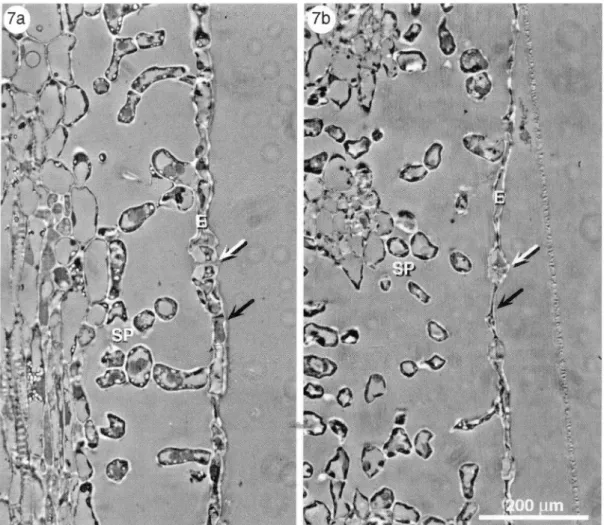
Cross sections of infested (leaf damage level of6-7) and noninfested leaves (Fig. 7 a and b) demonstrated the effect of apple rust mite feeding on the abaxial epidermis and spongy parenchyma. The epidermal cells, including the guard cells, of damaged leaves were desiccated. Compared with an uninfested leaf, the epidermis layer of an infested leaf is only a thin remnant of epidermis and guard cells. Such damaged epidermis and guard cells are likely unable to fulfill their functions.
The photomicrographs showed also a visible differ-ence in the spongy parenchyma of infested and
non-2 4 6 8 10
leaf damage unit
B
Golden DeliciousA
2 4 6 8
leaf damage unit
o
a; z 16o
Q) -<U"':" ~ III <: .Q ~ ~ E ·~o 2 <: E .•. ~ E I-~Figs. 5 and 6. (5) General view of an infested lower apple leaf surface. (a) Containing punctured wounds. (b) Detail of content of white rectangle in Fig. 5a showing puncture wounds. (6) (a) Apple rust mite on lower apple leaf surface penetrating epidemlis with its stylet. (b) Detail of content of white rectangle in Fig. 6a showing stylet piercing leaf tissue.
infested leaves. Apple rust mite feeding caused the desiccation of the spongy parenchyma cells. There were no cell organelles visible and the cells lost turgor. Consequently, apple rust mites seem to have an in-fluence on spongy parenchyma cells as well, even though they cannot reach deeper celllayers with their' stylets. Therefore, reduction of gas exchange might be caused by a malfunction of the stomata (direct effect) but also because of problems of gas exchange within the spongy parenchyma (indirect effect).
Discussion
Rust Mite Populations. In this study, the apple rust mite populations on untreated trees reached very high levels (some thousands) compared with other studies (some hundreds) (Solhoy 1991, Hengstberger 1993, Easterbrook 1996) and with common populations in commercial apple orchards (Herbert 1974; Gottwald
and Kruger 1996). However, the pattern of develop-ment of apple rust mite populations on the experi-mental trees in 1996 is typical for eriophyoids. Apple rust mites may build up populations very rapidly be-cause of a short generation time and a high fecundity
(Easterbrook 1979, 1984; Schliesske 1985). The pop-ulation declined rapidly after the completion of shoot growth; a phenomenon that has already been reported
(Hengstberger 1993).
Browning of Leaves. High growth rates, mobility of apple rust mites within plants, and drift through the air (Schliesske 1989) may cause rapid populatio!l changes on a single leaf. Therefore, the mite population present on a leaf at anyone moment gives only an imprecise assessment of the effective impact history and the influence on ecophysiological processes of the investigated leaf. There are 2 possibilities to integrate the historical impact of mite feeding on a leaf. One is to calculate the cumulative mite days by using several
1154 ENVIRONMENTAL ENTOMOLOGY Vol. 27, no. 5
Fig. 7. Cross sections of a noninfested (a) and an infested apple leaf (b). E, lower epidermis; SP, spongy parenchyma. In contrast to noninfested leaves, the epidermis (black arrows) with stomata (white arrows) of infested leaves is completely desiccated. Symptoms of desiccation in the spongy parenchyma of infested leaves are visible.
counts of mite densities on the same leaf. Another possibility is to measure once the cumulative leaf dam-age directly. Unfortunately, the mite counting method used in this study did not allow us to calculate the cumulative mite days on the single leaf level because a new different leaf was used for each set of measure-ments. However, our results confirmed that apple rust mite feeding results in irreversible browning of the leaf (Figs. 1 and 2). Hence, the brownness of infested leaves is a measure of cumulative leaf damage and it was used as a very rapid method to assess the impact of apple rust mite feeding on leaf performance.
Gas Exchange Associated with Changes in Leaf Tis-sue. Studies with tetranychid mites and
greenhouse-grown apple have demonstrated that gas exchange
parameters are reduced by mite feeding (Hall and Ferree 1975,Campbell et a1.1990a,Mobley and Marini 1990). There are studies that show similar results for
European red mite, Panonychus ulmi (Koch), and
field-grown apple trees (Francesconi et a1.1996,Lakso et al. 1996). Spider mites pierce the leaf epidermis with needlelike mouthparts and feed primarily on
meso-phyll and palisade layers of leaf (Avery and Briggs 1968, Tanigoshi and Davis 1978, Campbell et al. 1990b). Thus, photosynthesis is influenced directly. Because rust mites have shorter stylet lengths, they are not capable of feeding on the photosynthetically ac-tive mesophyll and palisade layers (Jeppson et al.1975,
Easterbrook and Fuller 1986, Royalty and Peering
1988). Another important difference between spider mites and rust mites is the potential density per leaf. Populations of rust mites may reach levels several times higher than those reached by spider mite pop-ulations. Therefore, the amount and distribution of penetration damage is expected to be different.
Easterbrook and Palmer (1996) investigated the
relationship between early-season leaf feeding by ap-ple rust mites and photosynthesis of field-grown apap-ple. They found no effect of apple rust mite feeding on photosynthesis. However, the apple rust mite density «100 apple rust mites per leaf) was probably too low to cause any significant effect on photosynthesis. Roy-alty and Peering (1989) and Andersen and Mizell (1987) investigated the effect of other eriophyoids on
gas exchange rate on tomato and peach and postulated reductions in gas exchange as high as 50 and 44%, respectively.
In this study, very strong relationships were found between gas exchange rates of apple leaves and brownness ofleaves caused by apple rust mite feeding (Fig. 3). The gas exchange rate of heavily infested leaves was reduced up to 65%. The reduction of net CO2 exchange rate caused by apple rust mite feeding recorded by the described method might even be underestimated. For measurements, leaves were spread out in the cuvette and were fully expanded and exposed to the light. However, in nature, infested leaves are rolled up longitudinally, and therefore in-tercept less light than healthy leaves.
Apple rust mites produce multiple punctured wounds by the penetration of sty lets into epidermis cells (Fig. 6 a and b). Similar punctured wounds were found for Aceria cladophthi1"US (Nalepa) on Solanum dulcamare L. (Westphal and Manson 1996) and for citrus rust mite on citrus (McCoy and Albrigo 1975; Achor at al. 1991). The penetration and partial evac-uation of epidermal cells by apple rust mites causes desiccation of the epidermis. Probably, undamaged cells (e.g., guard cells) may be affected indirectly by reduction in water or nutrient transport. This damage to the epidermis caused by apple rust mites is similar to that caused by Act/lops lycopersici (Massee) (an-other free-living gall mite) feeding on tomato (Roy-alty and Peering 1988). The desiccation of the epi-dermis leads to malfunction of the stomata. Royalty and Peering (1988) and Andersen and Mizell (1987) observed a similar mechanism in tomato and peach leaves, respectively. They suggested that epidermal feeding by tomato russet mites and peach silver mites may permanently impair stomatal functions. In the apple rust mite-apple system, epidermis damage is palticularly dramatic because apple rust mites feed on the abaxial leaf surface where the stomata are located. REM-pictures of infested leaves show some damaged stomata that are open and some that are closed (Fig. 4 a and b). Consequently, transpiration and net CO2 exchange might be reduced but it would be difficult to quantify the extent of reduction.
Cross sections of heavily infested apple leaves show that spongy parenchyma cells are desiccated. Cells lost turgor and cell organelles were destroyed (Fig. 7 a and b). A similar effect was observed on citrus, where feeding by the citms mst mite caused mesophyll col-lapse and defoliation (McCoy 1976). We also observed that heavily infested leaves dry up on the tree, al-though water supply was not limited. Hence, we infer there is resistance to water transport within the leaf. The damaged spongy parenchyma might cause this resistance. It is also possible that there is resistance to water transport in the midrib and that the damage of the spongy parenchyma is a consequence of water deficiency.
Apple mst mites may influence photosynthetic ac-tivity indirectly without feeding on the mesophyll or palisade tissue. In addition to the mechanical damage of the epidermis, apple mst mites or the plant itself
might trigger a defence mechanism against apple mst mites, water loss, or secondary infections (fungus, herbivores). Stout et al. (1994) investigated induced enzyme activity by A. lycopersici on tomato and dem-onstrated that tomato responded to mst mite feeding with elevated activity of peroxidase and lipoxygenase. Another explanation for the change in spongy paren-chyma is the collapse of the internal water and ion transport caused by the damaged epidermis. Saliva of apple rust mites may be another explanation for cell damage in the spongy parenchyma. Based on mor-phological examinations oftomato leaves, Royalty and Peering (1988) excluded the involvement of phyto-toxins in the A. lycopersici-tomato interactions. Yang et al. (1995b) speculated that dtms mst mites inject digestive enzymes into cells while feeding. Westphal and Manson (1996) demonstrated with histochemical methods that chitin fragments or chitosan are intro-duced by the mst mite Thamnacus solani (Boczek & Michalska) into the epidermal cells of Solanum dul-camare L.
Although the damage mechanisms and their triggers (e.g., mechanical damage or saliva) are not fully un-derstood, our study has demonstrated that on heavily infested apple trees, apple mst mite feeding causes epidermial and spongy parenchyma damage and re-duces gas exchange.
Acknowledgments
We thank Heinrich Hahn for many helpful discussions and Hans Ueli Hopli for the photographs of the brightfield mi-croscopy. We further acknowledge the help of Alfred Hu-sistein and his field crew. Mirjam Probst and Francesca Ballmeli assisted the field work in 1995 and 1996. The study was supported by the Swiss National Science Foundation with Grant No. 31-40340.94.
References Cited
Achor, D. S., L. G. Albrigo, and C. W. McCoy. 1991. De-velopmental anatomy of lesions on 'Sunburst' mandarin leaves initiated by citrus rust mite feeding. J. Am. Soc. Hottic. Sci. 116: 663-668.
Andersen, P. C., and R. F. Mizell III. 1987. Impact of the peach silver mite,Aculus comutus (Acari: Eriophyiidae), on leaf gas exchange of 'Flordaking' and 'June Gold' peach trees. Environ. Entomol. 16: 660-663.
Avery, D,J., andJ. B. Briggs. 1968. Damage to leaves caused by fruit tree red spider mite,Panonychus ulmi (Koch). J. Hortic. Sci. 43: 463-473.
Campbell, R.
J.,
K. N. Mobley, and R. P. Marini. 1990a. Growing conditions influence mite damage on apple and peach leaves. HortScience 25: 445-448.Campbell, R.
J.,
R. L. Grayson, and R. P. Marini. 1990b. Surface and ultrastructural feeding injury to strawberry leaves by the twospotted spider mite. HortScience 25: 948-95l.Easterbrook, M. A. 1979. The life-history of the eriophyoid mite Aculus schlechtendali on apple in South-east En-gland. Ann. Appl. BioI. 91: 287-296.
1984. The biology and control of the rust mites Aculus schlechtendali andEpitnrnerus pin on apple and pear in England, pp. 797-803. InD. A. Griffiths and C. E. Bowman
1156 ENVlRONMENTAL ENTOMOLOGY Vol. 27, no. 5
1996. Damage and control of eriophyoid mites in apple and pear, pp 527-541.InE. E. Lindquist, M. W. Sabelis and J. Bruin [eds.], World crop pests, eriophyoid mites-their biology, natural enemies and control, vol. 6. Elsevier, Amsterdam.
Easterbrook, M. A., and M. M. Fuller. 1986. Russeting of apples caused by apple rust mite Aculus schlechtendali
(Acarina: Eriophyiidae). Ann. Appl. BioI. 109: 1-9. Easterbrook, M. A., andJ. W. Palmer. 1996. The relationship
between early-season leaf feeding by apple rust mite,
Aculus schlechtendali (Nal.), and fruit set and photosyn-thesis of apple. J. Hortic. Sci. 71: 939-944.
Elstner, E. F. 1990. Der Sauerstoff: Biochemie, Biologie, Medizin, pp. 485-489. BI-Wiss.-Verl. Mannheim. Francesconi, A.H.D., A. N. Lakso,J. P. Nyrop,J. Barnard, and
S. Denning. 1996. Carbon balance as a physiological ba-sis for the interactions of European red mite and crop load on 'Starkrimson Delicious' apple trees. J. Am. Soc. Hortic. Sci. 121: 959-966.
Gottwald, R., and F. Kruger. 1996. Methodische Untersu-chungen zur Ermittlung des Befalls durch die Obstbaum-spinnmilbe, Panonychus 1IImi (Koch), und die Apfelrost-milbe, Aculus schlechtendali (Nalepa), an B1iittern unterschiedlicher AItersstufen. Nachrichtenbl. Deut. Pflanzenschutzd. 48(4): 69-72.
Hall, F. R., and D. C. Ferree. 1975. Influence of twospotted spider mite populations on photosynthesis of apple leaves. J. Econ. Entomol. 68: 517-520.
Hengstberger, K. 1993. Beitriige zur Biologie der Apfelrost-milbeAculus schlechtendali (Nalepa) im ostereichischen Obstbau. Ph.D. dissertation, University of Wien, Austria. Herbert, H. J. 1974. Notes on the biology of the apple rust mite,Aculus schlechtendali (Prostigmata: Eriophyiidae), and its density on several cuItivars of apple in Nova Scotia. Can. Entomol. 106: 1035-1038.
Hohn, H., and H. U. HopJi. 1990. Die Apfelrostmilbe - oft uberschiitzt, aber kaum prognostizierbar! Schweiz. Z. Obst Weinbau 126: 259-266.
Jeppson, L. R., H. H. Keifer, and E. W. Baker. 1975. Mites injurious to economic plants. University of California Press, Berkeley.
Lakso, A. N., G. B. Mattii, J. P. Nyrop, and S. S. Denning. 1996. Influence of European red mite on leaf and whole-canopy carbon dioxide exchange, yield, fruit size, quality, and return cropping in 'Starkrimson Delicious' apple trees. J. Am. Soc. Hortic. Sci. 121(5): 954-958. McCoy, C. W. 1976. Leaf injury and defoliation caused by
the citrus rust mite,Phyllocoptruta oleivora. Fla. Entomo\. 59: 403-410.
McCoy, C. W., and L. G. Albrigo. 1975. Feeding behaviour and nature of injury to the orange caused by citrus rust mite, Phyllocoptruta oleivora (Prostigmata: Eriophyi-idae). Ann. Entomo\. Soc. Am. 68: 289-297.
Mobley, K. N., and R. P. Marini. 1990. Gas exchange char-acteristics of apple and peach leaves influenced by Eu-ropean red mite and twospotted spider mite. J. Am. Soc. Hortic. Sci. 115: 757-761.
Royalty, R. N., and T. M. Peering. 1988. Morphological anal-ysis of damage to tomato russet mite (Acari: Eriophyi-idae). J. Econ. Entomol. 81: 816-820.
1989. Reduction in photosynthesis of tomato leaflets caused by tomato russet mite (Acari: Eriophyiidae). En-viron. Entomo!. 18: 256-260.
Rutz, Ch., U. Hugentobler, H. Chi, J. U. Baumgartner, and J. J. OertJi. 1990. Energy flow in apple plant-aphid
(Aphis pomi De Geer) (Homoptera: Aphididae) ecosys-tem, with respect to nitrogen fertilization, pp. 625- 631.In
M. L. Van Beusichem [ed.], Plant nutrition-physiology and applications. Kluwer, New York.
Schliesske, J. 1985. Zur Biologie und zum Schadauftreten der Gallmilben Aculus schlechtendali (Nalepa) (Acari: Eriophyiidae) an Malus spp. Erwerbsobstbau 27: 195-197. Schliesske, J. 1989. Ausbreitungsmodi von Gallmilben
(Acari: Eriophyiidae). Mitt. Dtsch. Ges. AUg. Angew. Entomo!. 7: 166-168.
Solhoy, T., E. Dybwad, K. Hesjedal, M. Hossain, and B. Hovland. 1991. Observations on Aculus schlechtendali
(Nal.) (Acari: Eriophyiidae) in apple orchards in western Norway, pp. 533-538.InF. Dusabek and V. Bukva [eds.], Modern acarology, vol. 1. Academia, Prague.
Stout,M.J.,J.Workman, and S. S. Duffey. 1994. Differential induction of tomato foliar proteins by arthropod herbi-vores. J. Chern. Ecol. 10: 2575-2594
Tanigoshi, L. K., and R. W. Davis. 1978. An ultrastructural study of Tetmnychus mcdanieli feeding injury to the leaves of 'Red Delicious' apple (Acari: Tetranychidae). Int. J. Acarol. 4(1): 47-56.
Walther, P., and M. Miiller, 1997. Double layer coating for field emission cryo-scanning electron microscopy -present state and applications. Scanning 19: 343-348. Welter, S. C. 1989. Arthropod impact on plant gas exchange,
vol. I. pp. 135-164. In E. A. Bernays [ed.], Insect-plant interactions. CRC, Boca Raton, FL.
Westphal, E., and D.C.M. Manson. 1996. Feeding effects on host plants: gall formation and other distortions, vol. 6, pp.
231-242. In E. E. Lindquist, M. W. Sabelis, and J. Bruin [eds.], World crop pests, eriophyoid mites-their biol-ogy, natural enemies and control. Elsevier, Amsterdam. Yang, Y., J. C. Allen, J. L. Knapp, and P. A. Stansly. 1994.
Citrus rust mite (Acari: Eriophyiidae) damage effects on 'Hamlin' orange fruit growth and drop. Environ. Entomol. 23: 224-247.
1995a. Frequency distribution of citrus rust mite (Acari: Eriophyiidae) damage on fruit in 'Hamlin' orange trees. Environ. Entomol. 24: 1018-1023.
1995b. Relationship between population density of citrus rust mite (Acari: Eriophyiidae) and damage to 'Hamlin' orange fruit. Environ. Entomol. 24: 1024-1031. Zalom, F. G., J. Kitzmiller, L. T. Wilson, and P. Gutien'ez.
1986. Observation of tomato russet mite (Acari: Erio-phyiidae) damage symptoms in relation to tomato plant development. J. Econ. Entomol. 79: 940-942.
Received for publication 7January 1998; accepted 15June