HAL Id: hal-00910965
https://hal.inria.fr/hal-00910965
Submitted on 28 Nov 2013
HAL is a multi-disciplinary open access
archive for the deposit and dissemination of
sci-entific research documents, whether they are
pub-lished or not. The documents may come from
teaching and research institutions in France or
L’archive ouverte pluridisciplinaire HAL, est
destinée au dépôt et à la diffusion de documents
scientifiques de niveau recherche, publiés ou non,
émanant des établissements d’enseignement et de
recherche français ou étrangers, des laboratoires
Resource Discovery in the Arigatoni Overlay Network
Raphael Chand, Luigi Liquori, Michel Cosnard
To cite this version:
Raphael Chand, Luigi Liquori, Michel Cosnard. Resource Discovery in the Arigatoni Overlay Network.
10th International Conference on Innovative Internet Community Services (I2CS), Jubilee Edition
2010, June 3-5, 2010, Bangkok, Thailand, Jun 2010, Bangkok, Thailand. pp.437-449. �hal-00910965�
Resource Discovery in the
Arigatoni Overlay Network
Raphael Chand, Luigi Liquori, and Michel CosnardINRIA, France
[Raphael.Chand,Luigi.Liquori,Michel.Cosnard]@inria.fr
Abstract. Arigatoni is a lightweight Overlay Network for dynamic
and generic Resource Discovery. Entities in Arigatoni are organized in Colonies. A colony is a simple virtual organization composed by exactly one leader, offering some broker-like services, and some set of Individuals. Individuals are subcolonies of individuals, or basic units called Global Computers. Global computers communicate by first registering to the colony and then by mutually asking and offering services. The leader, called Global Broker, has the job to analyze service requests/responses coming from its own colony or arriving from a surrounding colony, and to route requests/responses to other individuals. After this discovery phase, individuals get in touch with each others without any further intervention from the system, typically in a P2P fashion. Communications over the behavioral units of the overlay network are performed by a simple Global Internet Protocol. Arigatoni provides fully decentralized, asynchronous and scalable resource discovery, that can be used for various purposes from P2P applications to more sophisticated Grid applications.
The main focus of this paper is to present the resource discovery algorithm used in Arigatoni, that is reminiscent to some algorithms employed in the publish/subscribe paradigm. We show some simulations that show that resource discovery in Arigatoni is efficient and scalable.
1
Introduction
Motivations. The Global Computing Communication Paradigm, i.e. computa-tion via a seamless, geographically distributed, open-ended network of bounded resources owned by agents acting with partial knowledge and no central coordi-nation is one of the most interesting challenges for the next decade. Aggregating many global computers sharing similar or different resources leads to a Virtual Organization. Moreover, organizing many overlay computers, using, e.g. tree- or graph-based topology leads to an Overlay Network.
The main challenge in this new field of research is how single resources, offered by the global/overlay computers are discovered. The process is called Resource Discovery: it requires an up-to-date information about widely-distributed resources. This is a challenging problem for very large distributed systems particularly when taking into account the continuously changing state of
resources offered by global/overlay computers and the possibility of tolerating intermittent participation and dynamically changing status and availability.
The first presentation of the Arigatoni overlay network was given in [2].
Reciprocity and hierarchical organization of the virtual organization in Colonies, governed by a clear leader (called Global Broker ) are the main achievements
of Arigatoni. Global computers belong to only one colony; requests for services
and resources located in the same/another colony traverse a broker-2-broker
negotiation which security is guaranteed via standard PKI mechanisms. Once
the resource offered by a global computer has been found, the real resource exchange is performed out of theArigatoniitself, e.g. in aP2Pfashion.
In this paper, we explain how Arigatoni offers decentralized, asynchronous,
and generic resource discovery. Once a global computer has issued a request for some services, Arigatoni finds some individuals that can offer the resources needed, and communicates their identities to the (client) global computer as soon as they are found.
The fact thatArigatonionly deals with resource discovery has one important
advantage: the complete generality and independence of any given requested
resource. Therefore, Arigatoni can fit with various scenarios in the global
computing arena, from classical P2P applications, like file sharing, or
band-sharing, to more sophisticatedGridapplications, like remote and distributed big (and small) computations, until possible, futuristic migration computations, i.e. transfer of a non completed local run in anotherGCU, the latter scenario being useful in case of catastrophic scenarios, like fire, terrorist attack, earthquake etc.
Arigatoniextends the pub/sub paradigm for resource discovery. Arigatoni
takes inspiration by the Publish/Subscribe paradigm [9]; several pub/sub have been developed recently, such asXNet[7, 6],Siena[3] or IBMGryphon[1]. In [10],
the authors propose to adapt the Siena publish/subscribe system to achieve
Gnutella-like resource discovery, by publishing queries to the notification service.
In contrast,Arigatoniimplements its own resource discovery algorithm, especially designed for generic and scalable resource lookup.
In Arigatoni, resource discovery works by asynchronously disseminating
request messages in the system until some individuals have been found. More precisely, when global computers log in the system (a colony), they declare the list of services that they can offer. When a global computer asks for some services, it issues a service request message to its leader, without addressing it to any particular receiver. The system disseminates the message according to the services included in it and according to the services that the other global computers have declared. As a consequence, the communication model
underlying Arigatoni extends conservatively pub/sub. Indeed, in the pub/sub
paradigm, consumers subscribe to the system (typically called the Notification Service) to specify the type of information that they are interested in receiving. Producers publish data to the system. The notification service disseminates the data to all (if possible) the consumers that are interested in receiving it, according to the content of the data and the interests declared by the consumers.
that they offer to serve. The same global computers also “publish” data in
the system when they issue service requests. Arigatoni disseminates the data
according to the services included in the requests and the services that the other global computers have declared.
The pub/sub like communication form used inArigatonifor resource discovery
has several advantages. First, it allows Arigatoni to realize a full decoupling, in time, space, and synchronization, between the global computers. Second, due to its asynchronous nature,Arigatoniis, potentially, more scalable and can work in “disconnected” mode (e.g., for mobile users and wireless devices). Third, indirect addressing makes it possible for the infrastructure to implement reliability, load balancing, fault-tolerance, persistence, or transactional semantics. More
practically, since Arigatoni has a tree-like topology, we can use the pub/sub
subscription mechanisms described in existing tree-based pub/sub systems such asXNet[6, 7, 4] orSiena[3], for subscription management, i.e., for the construction and the update of consistent routing tables in the system. In addition, we can use the reliability mechanisms described in [7] to allowArigatonito be fault-tolerant or to adapt to dynamic topology changes.
However, one major difference betweenArigatoniand classic pub/sub systems
lies in their functionality. Indeed, the classic pub/sub paradigm deals with the
publication of messages whereas Arigatoni focuses on pure resource discovery.
More precisely, classic pub/sub systems aim at disseminating published messages
to all interested consumers. In contrast, in Arigatoni, when a service request
is issued, the goal is to find one (or maybe some) individuals able to provide the services included in the request, but not all the potential individuals. As a consequence, a much smaller fraction of the system is traversed. Besides, the routing strategy of the colony leader consists in always trying to find potential reseources in its own colony first. If it fails, it then delegates the request to its leader. This strategy is reminiscent of the dynamic method lookup employed in all Object-Oriented languages, and increases resource encapsulation inside colonies, another concept strongly related to Object Orientation.
Another major difference lies in the nature of the published events in classic pub/sub systems and the nature of service requests inArigatoni. Indeed, in classic pub/sub systems, subscriptions are constraints on the set of all possible events. In contrast, in Arigatoni, service requests are also expressed as constraints. This latter point will be explained in more details in Section 3.
2
System units
Two different kinds of units compose the Arigatoni system: Global Computer
Units (GCU), and Global Broker Units (GBU).
• A GCUis the basic peer of the global computing paradigm. It is typically a
small device, like aPDA, or aPC, connected viaIP.
• A GBU is the basic unit devoted to register and unregister GCUs, to receive
service queries from clientGCUs, to contact potential servantGCUs, to negotiate with the latter the given services, to trust clients and servers and to send all
the information necessary to allow the client GCU, and the servants GCUs to
communicate. Every GCU can register to only one GBU, so that every GBU
controls a colony of collaborating global computers. Hence, communication
intra-colony is initiated via only one GBU, while communication inter-colonies is
initiated through a chain ofGBU-2-GBUmessage exchanges. In both cases, when
a client GCU receives an acknowledgment for a requested service (with trust
certificate) from the proper GBU, then the client will enjoy the service directly from the servant(s)GCU, i.e. without a further mediation of theGBUitself. • A Colony is a simple virtual organization composed by exactly one leader and some set (possibly empty) of individuals. Colonies are organized in a tree structure where the root of a colony is its leader. Individuals are global computers (think it as an Amoeba), or subcolonies (think it as a Protozoa). An individual
can be aGCUor aGBU(representing the leader of a a subcolony).GCUs cannot
have children in the hierarchy. As such,GBUs can have bothGBUs andGCUs as
their children. As such, a colony has exactly one leaderGBUand has at least one individual (theGBUitself), and may contains individuals (GCU’s, or colonies). • A Community is a raw set of colonies and global computers (think it as a soup
of colonies andGCUwithout a leader). Starting from a community, theArigatoni
protocol allows individuals to dynamically aggregate in colonies. This topic has been addressed and formalized in [8].
The possibility for individuals to log/delog from a colony, or the possibility for a colony’s leader to delog some “lazy” individuals makes de facto the network
topology dynamic. This dynamicity implies that if GBUs hold routing tables
about the services provided by their colony, particular care must be taken to maintain consistency when individuals log/delog. Moreover, due to the fact that individuals are not slaves but global computers with their own proper activity, a service request may lead to run-time failures. This happens when an individual gets busy by a local request, or when it suddenly delogs from the colony during the routing of the service request, or worst, when it gets hardware failures.
3
Resource discovery
Let R be the set of all possible resources (maybe infinite).GCUs provide resources by registering services to the system. A service S is a constraint on the set of
resources. Let match(S) ∈ R be the set of resources that satisfy S. A GCU X
that registers S announces that it can provide the set of resources match(S). A GCUY that issues a service request for service S′ is looking for a resource that
satisfies constraint S′, i.e., a resource in match(S′). If match(S)∩match(S′) 6= ∅,
then there exists a resource that satisfies both S and S′, and X can provide a
resource to Y. We say that S and S′ overlap iff match(S) ∩ match(S′) 6= ∅. For
example S = [Type = CPU] ∧ [Time<10s] and S′ = [Type = CPU] ∧ [Time>5s]
overlap, since any resource with attribute Time between 5s and 10s matches.
The principle of resource discovery in Arigatoni is as follows. When a GCU
sends a request for a set of services S1· · · Sn, it builds a “ServiceRequest”
Algorithm 1 The resource discovery algorithm in theArigatoni GIPprotocol
1: caseMessage is SREQ :
2: ReturnP ath{M essage.Id} ← M essage.Sender
3: SendList← SelectPeers(M essage.Services, search mode) 4: for each(P, Serv(P)) ∈ SendList do
5: Send ServiceRequest`Serv(P)´ to P 6: end for
7: for eachS∈M essage.Services such that ∄(P, Serv(P))∈SendList, S∈Serv(P) do 8: Append S to RejectList
9: end for
10: Send ServiceResponse({},RejectList) to ReturnP ath[Id] 11: SRESP :
12: for eachS∈M essage.AcceptedServices do
13: if `S was not already accepted ´ ∨ `EXHAUSTIVE REPLY is set´ then
14: Append S to AcceptList 15: end if
16: end for
17: SendList← SelectPeers(M essage.RejectedServices, intra Colony mode) 18: for each(P, Serv(P))∈SendList do
19: Send ServiceRequest(Serv(P)) to P 20: end for
21: for eachS∈M essage.RejectedServices such that ∄(P, S(P))∈SendList, S∈Serv(P) do
22: Append S to RejectList 23: end for
24: Send ServiceResponse(AcceptList,RejectList) to ReturnP ath[Id] 25: end case
message is then recursively processed by the GBUs in the system so as to find
some individuals able to serve the services included in the request. The main basic principle of the protocol is that every GBUthat receives a request always searches its own colony first to find the potential individuals able to serve the services included in the request. If no individuals are found, then the request is delegated to its leader GBU, and the process proceeds recursively. In addition,
if the GBUs maintain some information about the services provided by their
children, then they can transform a received request into sub-requests, so as to only ask a given child for the services that it (or its colony) provides.
The process eventually leads to some GCUs receiving a request. When one
such GCU receives a request for some services, it chooses the services that
it accepts to serve and the ones that it refuses to serve. It then sends a “ServiceResponse” message containing the list of accepted services and the list of rejected services, and sends it to its leader GBU. The response messages are then propagated recursively in the system, following the reverse path.
The resource discovery algorithm is the core of the GIP protocol; it is
described in pseudo-code in Algorithm 1 and explained as follows. We only
focused on the case of GBUs. The resource discovery algorithm in the case of
GCUs is similar and has been voluntarily omitted (see [2] for details). Indeed, the involvement of GCUs in the process of resource discovery is limited to directly replying to request messages.Arigatonionly deals with the discovery of resources,
while the real resource exchange is done in aP2Pfashion. Let GBUNreceive a
Case of Service Request (SREQ). We first consider the case of request
messages. A request message received by GBU N means that N is asked to
find some individuals to provide the services included in the request. For that purpose, N first maps the “Id” of the request included in the message to the sender of the message (line 2), so as to allow reply messages to follow the reverse path of the request.
Line 3: Various intra colony search modes. The leader N then calls function “SelectPeers”, taking as input the list of services included in the request message, M essage.Services (line 3). SelectPeers returns a list of pairs {(P, Serv(P))}, called SendList, where the first element P of a pair is the Id of a neighbor, and the second element Serv(P) is a list of services, subset of M essage.Services, that contains the list of services to ask to neighbor P. The search mode determines the way function SelectPeers determines the SendList. The search mode depends itself on whether P maintains some information about the services provided by its colony, i.e. a routing table. Currently, the following search mode are allowed: broadcast and selective, where the latter is itself sub-divided into three sub-modes: exhaustive, greedy random, and greedy ordered. If
P does not maintain a routing table, then it has no other choice than to ask
all its children for all the services included in the message, i.e., to broadcast the request message. We will refer to this search mode as the broadcast mode. Now if P maintains a routing table that indicates which child leads to a potential individual able to serve a given service, then P can selectively send customized requests to its children. More formally, P only asks a child for a service that overlaps a service that it advertised, i.e. there exists a resource that satisfies both the requested service and the advertised service. We will refer to this mode as the selective mode. Consequently, P can choose some children and send them a request for the services that overlap the ones that they advertised. The selective search mode can then be refined as follows. Consider a particular service S included in the request message.
• In the exhaustive mode, P sends a request for service S to all the children that can serve it (i.e., that contain potential individuals in their colony).
• In the greedy random mode, P sends a request for S to only one child that can serve the request, chosen uniformly at random.
• In the greedy ordered mode, P sends the request to only one child, chosen according to some predefined or ad hoc criteria (e.g., depending on network factors, or according to the quantity of services that were accepted by each child, `a la tit-for-tat).
In addition, we can refine even more the greedy modes, by introducing a parameter n, that defines the number of children to whom the request is sent. We could then define the n-greedy random or the n-greedy ordered modes. It is important to mention that the SendList variable can contain N’s leader, call it L. That is, it may contain a pair (L, Serv(L)). For a particular service S ∈ Serv(L), this happen when no child advertised some services that overlap S, i.e., there
delegates service S to its leaderGBU. To prevent routing loops, the sender of the request message is never considered as a service provider.
Lines 4 − 6: Forwarding service request messages. Consequently, for each pair (P, Serv(P)) in the SendList, N sends to neighbor P a service request message for services Serv(P) (lines 4 − 6).
Lines 7 − 9: Services rejection. Finally, each service S included in the request message, and such that no potential individual was found amongst N’s neighbors, is reported as rejected by N, to the original issuer of the request message (lines 7 − 10). Since N may only maintain information about its own colony (apart the Id of the leader), this may only happen if N is the root of the topology or if the request message originated from N’s leader.
Case of Service Response (SRESP). We now consider the case of reply
messages. As previously explained, the process of propagating SREQ messages
eventually leads to a certain number ofGCUs receiving a request. EachGCUsends a reply message to its leader, with the list of accepted and the list of rejected services, along with its Id. Consequently, a givenGBUNthat participated in the
propagation of theSREQmessage eventually receives a certain number ofSRESP
messages from each of its children that was sent an instance of the (maybe
transformed)SREQmessage. Consider now anSRESPmessage sent toGBUNby
a neighbor Q.
Lines 12 − 16 and 24: Reporting accepted services. For each accepted service S, there are two different possibilities: either Q is the first child that accepted to serve the service, or the service was already accepted by some child other than Q. In the first case, N sends the reply back to the original sender or the request, reporting that service S has been accepted (lines 14 and 29). Otherwise, some neighbor other than Q already accepted to serve service S (i.e.,
an individual in its colony). Then, if the EXHAUSTIVE REPLYparameter flag is
set (either in theGBUor included in the original request message), N also reports
the reply back. Consequently, in theEXHAUSTIVE REPLYmode, everyGCUthat
accepted to serve a given service will be reported back to theGCUthat issued the request. Otherwise, for each service asked in the request, only one single servant GCUwill be reported. Furthermore, it is easy to add more flexibility by including a threshold Tr>1 on the number of replies. For example eachGBUwould report
back Trreplies for the same service(s).
Lines 17: Finding other individuals for rejected services. We now consider the case of rejected services S. This means that in Q’s colony, no potential individuals serving service S could be found, or no individuals accepted to serve it. Then, N has to find other neighbors that might contain individuals for service S. Consequently, N calls again function SelectPeers, with the list of rejected services as input (line 17). The function works as previously explained, except that it does not consider the peers (including Q) that were already sent a particular service. Also, logically enough, the services that were previously accepted are ignored. Finally, the original sender of the request is not considered (i.e., ReturnP athId). Note that in the case where the exhaustive search mode is used, then the list SendList returned by function SelectPeers may only contain a
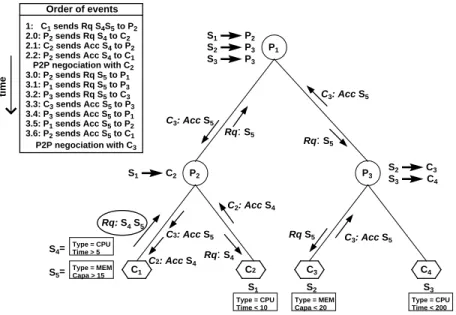
Rq: S4 S5 Rq: S4 Rq: S5 Rq: S5 P2 P1 P3 Rq S5 S1 S2 S3 C1 C2 C3 C4 C2: Acc S4 C3: Acc S5 C2: Acc S4 Order of events time 1: C1 sends Rq S4S5 to P2 2.0: P2 sends Rq S4 to C2 2.1: C2 sends Acc S4 to P2 2.2: P2 sends Acc S4 to C1 P2P negociation with C2 3.0: P2 sends Rq S5 to P1 3.1: P1 sends Rq S5 to P3 3.2: P3 sends Rq S5 to C3 3.3: C3 sends Acc S5 to P3 3.4: P3 sends Acc S5 to P1 3.5: P1 sends Acc S5 to P2 3.6: P2 sends Acc S5 to C1 P2P negociation with C3 S1 P2 S1 C2 S2 C3 C3: Acc S5 C3: Acc S5 C3: Acc S5 Type = CPU Time < 10 Type = MEM Capa < 20 Type = CPU Time < 200 S4= Type = CPU Time > 5 Type = MEM Capa > 15 S5= S2 P3 S3 P3 S3 C4
Fig. 1.Resource discovery scenario.
single pair (L, Serv(L)) (L is N’s leader). Indeed, in the exhaustive search mode, all possible children in N’s colony have already been asked for all the services included in the request message, that they can serve. Hence, rejected services are directly delegated to the leader L, if possible (i.e. if the latter was not the original sender of the request). The variable SendList contains a list of pairs (P, Serv(P)), where neighbor P is an individual that can potentially serve the services in Serv(P), and has not been sent a request for any of them yet.
Lines 18 − 20: Forwarding request messages for rejected services. Consequently, for each pair (P, Serv(P)) included in SendList, N sends to neighbor P a service request message for services Serv(P) (lines 18 − 20).
Lines 21 − 23 and 24: Service rejection. Finally, each service S included in the list of rejected services, and such that no additional potential individual could be found amongst N’s neighbors, is reported as rejected by N, to the original issuer of the request message (lines 21 − 24).
Example. Consider the example illustrated in Figure 1. Three GBUs are
represented, namely P1· · · P3, and 4 GCUs, namely C1· · · C4. GCUs C1 and C2
(resp. C3 and C4) have P2 (resp. P3) as their leader, while P1 is the leader
of GBUs P2 and P3. GCUs C2, C3 and C4 have registered services S1, S2
and S3, respectively, and the routing tables of the upstream GBUs have been
updated accordingly. In the example, resources are expressed as conjunctions of attribute/value pairs, and services are conjunctions of constraints on those attributes. We suppose that the search mode is set to selective, and we consider the scenario where GCU C1 issues a service request for services S4 and S5, to
its leader P2. Since S4 and S1 overlap (any resource with 5<Time<10 satisfies
both S1 and S4),GBU P2 forwards a service request for service S1 to GCUC2.
Note that given that S5and S1do not overlap, S5is not included in the request.
Since P2does not find anyGCUpotentially able to serve S5 (i.e., no services in
its routing table overlap with S5), it delegates it to its leader GBU P1. When
C2 accepts to serve S4, it sends a reply message with its Id and the accepted
service S4, back toGBUP2, which, in turn, forwards it back to C1. Then C1can
directly negotiate the resource with C2. When P1 receives the service request
for S5, it forwards it to P3 (since S2 and S5 overlap), which in turn forwards
it to GCU C3. When C3 accepts to serve S5, the same process then repeats as
forGCUC2. Eventually, C1 receives a reply message with the Id ofGCUC3 and
the accepted service, namely S5. We have an illustration of the asynchronous
communication (C1 received the reply messages independently of each others)
and the encapsulation of resources inArigatoni(GBUP2only searched for service
S4 in its own colony, i.e.GCUC2).
Discussions, load balancing, scalability. We mainly focused on the resource
discovery mechanism used in Arigatoni. Total decoupling betweenGCUs in space
(GCUs do not know each others), time (GCUs do not participate in the interaction at the same time), and synchronization (GCUs can issue service requests and do something else, or may be doing something else when being asked for services) is a major feature ofArigatoni. Another important property is the encapsulation of resources in colonies. Those properties play a major role in the scalability of resource discovery inArigatoni.
As stated before, the subscription mechanisms of classical tree-based pub/sub systems [6, 7, 4, 3] can be used for the maintenance and update of consistent routing tables. Furthermore, as for the reliability of subscription advertisement, we can adapt the reliability mechanisms described in [7] to allowArigatonito be fault-tolerant or to adapt to dynamic topology changes.
The reliability of the resource discovery mechanism itself, although desirable, is of lesser importance, given the fact that service provision is not guaranteed at all inArigatoni. In other words, when aGCUissues a service request, it is possible that no individual is found for some of the services included in the request. This
happens, for example, if those services were not declared by any GCUs in the
system, or if all theGCUs that declared themselves as potential individual refuse to serve them. However, at the cost of memory and bandwidth requirements, it is still possible (future work) to implement reliable resource discovery by using a
reliable transmission protocol (TCP), an acknowledgment scheme in combination
with a retransmission buffer, and persistent data storage.
As defined above, GBUs are organized as a dynamic tree structure. Each
GBU is a node of the tree, leader of its own subcolony and root of a subtree
corresponding to theGBUs of its colony. It is then natural to address scalability issues that arise from that tree structure. In [5], we show that, under reasonable
assumptions, theArigatoni model is scalable. However, a complete performance
evaluation is out of the scope of this paper and will rather be studied in a future work.
4
Protocol evaluation
To assess the effectiveness and the scalability of our resource discovery protocol, we have conducted simulations using large numbers of units and service requests.
Simulation setup. We have generated a network topology using the transit-stub model of the Georgia Tech Internetwork Topology Models package [11],
on top of which we added theArigatoni overlay network. The resulting network
topology, contains 103 GBUs. GCUs were not directly simulated in the network
topology. Instead, to simulate the population ofGCUs, we added aGCUagent to
eachGBUin the system. TheGCUagent of aGBUrepresents the local colony of
GCUs that are attached to thatGBUas their leader.
We considered a finite set of resources R1· · · Rr of variable size r, and
represented a service by a direct mapping to a resource. In other words, a service expresses the conditional presence of a single resource. We have a set of r services {S1· · · Sr}, where service Si expresses the conditional presence of resource Ri.
A GCUdeclaring service Si means that it can provide resource Ri. This simple
model is still generic and sufficient for the main purpose of our experiments, which is to study the scalability of resource discovery in our system.
To simulateGCUload, we then randomly added each service with probability
ρat eachGCUagent, and had it registered via the registration service ofArigatoni.
The routing tables of the GBUs were updated starting at the initial GBU and
ending at the root of the topology. In other words, it is as if each GBU has a
probability ρ of having aGCUwhich registered service Si, for any Si. Thus, the
parameter ρ can be seen as either the global availability of services, or as the
density of population of GCUs (since the more the number of GCUs, the more
likely it is that a given service is provided).
We then issued n service requests atGCUagents chosen uniformly at random.
Each request contained one service (requests with k services can be seen as
k service requests with one service), also chosen uniformly at random. Each
service request was then handled by the resource discovery mechanism ofArigatoni described in Section 3. We used a service acceptation probability of α = 75%,
which corresponds to the probability that a GCUthat receives a service request
and that declared itself as a potential individual for that service (i.e. that registered it), accepts to serve it.
The resource discovery algorithm was implemented in C++ and compiled using GNU C++ version 2.95.3. Experiments were conducted on a 3.0 Ghz Intel
Pentiummachine with 2 GB of main memory running Linux 2.4.28. The different
experimental parameters are summarized in Figure 2. Upon completion of the n requests, we measured for eachGBUits load as the number of requests (messages) that it received. We then computed the average load as the average value over
the population of GBUs in the system. We also computed the maximum load
as the maximum value of the load over all the GBUs in the system. Similarly,
we computed the average and maximum load fractions as the average and max loads divided by the number of requests. The average load represents the average
Vars Description Value
KNumber of GBUs 103
rSize of services pool 128
ρService availability 0.1% to 7%
αService accept. prob. 75%
nNumber of SREQ issued 100 to 50000
(a) 1000 1250 1500 1750 2000 1 2 3 4 5 6 7 20000 30000 40000 50000
Avg. Load (# messages) Max. Load (# messages)
ρ (%) Average Load Maximum Load (b) 3.2 3.4 3.6 3.8 4 0 10000 20000 30000 40000 50000 60 70 80
Avg. load (%) Max. load (%)
Number of requests Average load (ρ=1%) Average load (ρ=6%) Maximum load (ρ=1%) Maximum load (ρ=6%) (c) 10 20 30 40 50 60 70 80 90 100 1 2 3 4 5 6 7 Ratio (%) ρ (%)
Average service acceptation ratio
(d)
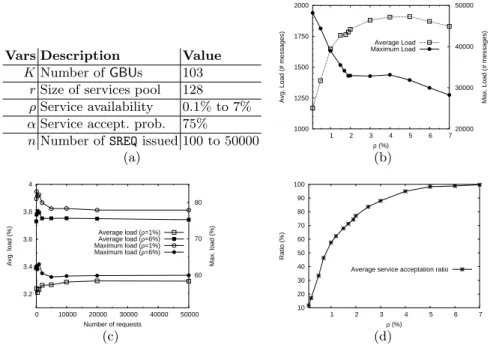
Fig. 2. (a) Parameters of the experiments. (b) Average and maximum load w.r.t.
service availability ρ. (c) Average and maximum load fraction w.r.t. the number of requests issued. (d) Average service acceptation ratio w.r.t. service availability ρ.
load of aGBUdue to the completion of the n requests. The average load fraction
represents the fraction of requests that aGBUserved, in average. The maximum
fraction represents the maximum fraction of the requests that a GBU served.
Note that since a GBU receives at most one request message corresponding to
a given service request, the average load fraction can be seen as the fraction of GBUs in the system involved in a service request, in average.
Finally, we computed the average service acceptation ratio as follows. For
each GCU agent, we computed the local acceptation ratio as the number of
service requests that yielded a positive response (i.e. the system found at least
one individual), over the number of service requests issued at that GCUagent.
We then computed the average acceptation ratio as the average value over the
number of GCUagents (that issued at least one service request).
We repeated the experiments for different values of ρ and n. Results are illustrated in Figure 2. Figure 2(b) and (d) were obtained with a fixed value of nof 50000 service requests.
Results and interpretations. Figure 2(b) shows the evolution of the average and maximum load when varying the service availability ρ. The maximum load
was obtained for GBUs at the top of the leader hierarchy in the tree topology.
It appears that the maximum load decreases with the service availability, while the average load increases. In other words, the load is more evenly distributed
amongst the GBUs in the system. This is due to the strategy of our resource discovery mechanism which consists in always searching for individuals in its own colony first before delegating to its leader. Indeed, as the service availability
increases, GBUs have a higher chance to find individuals in their own colony.
Hence, the root leader (say GBU Top) of the topology participate less in the
process of resource discovery, and the direct subleaders (say GBU SubTop)
participate more. In other words, the resource discovery mechanism used in
Arigatonidoes not overload superleaders in the tree topology.
We also observe in Figure 2(b), for values of 2%≤ρ≤4%, a “plateau” in the curve of the maximum load, followed by a decreasing phase (ρ>4%), but with a much lower slope than before (ρ<2%). This is due to the fact that for ρ<2%, the root leader Top of the whole topology has the maximum load in the system. For ρ>2%, however, the immediate direct subleader Subtop takes over. This transition can be explained by the fact that for higher values of ρ, less messages are delegated to Top. At some point (ρ≃2%), the load of Top becomes less important than that of SubTop, due to the high number of colonies that the latter manages. The constantness observed in the curve around that value is probably due to the fact that a transition phase is necessary for SubTop to be sensitive again to the increase of ρ. The following decreasing period with a lower slope corresponds to the fact that SubTop is less sensitive to an increase of ρ (indeed, SubTop is mostly concerned with the availability of services in its own colonies).
Finally, we observe that the average load stabilizes, which shows that the system scales to large number ofGCUs (since as previously mentioned, the service availability ρ can be assimilated to the number ofGCUs in the system).
Figure 2(c) shows the average and maximum load fractions w.r.t. the
number of service requests. It appears clearly that Arigatoni scales to large
numbers of requests. In fact, the average number of requests received by a
GBU increases linearly with the total number of requests, at a rate of ∼ 3.5%.
In other words, in average, a GBU only receives ∼ 3.5% of the total number
of requests. Equivalently, only 3.5% of the overall population of GBUs in the
system participate in the process of discovering a particular resource, in average. Figure 2(c) also shows that low levelGBUs in the topology are not particularly
overloaded (the most overloaded GBU manages 60% of the overall load for
ρ= 6%). Finally, it corroborates the assertion that higher values of ρ favor the maximum load over the average load, i.e., load balancing gets more effective.
Figure 2(d) shows that, unsurprisingly, the average service acceptation ratio increases exponentially with the availability of services. This shows thatArigatoni is efficient in searching individuals for requested services. Indeed, a service availability of 4% enables the system to achieve an acceptation rate of 90%.
In other words, the more the number of GCUs in the system, the more chances
5
Conclusion
In this paper, we presented theArigatonilightweight overlay network. We exposed
in details the mechanisms that allow Arigatoni to offer dynamic and generic
resource discovery. The main achievements are the complete decoupling between the different units in the system, and the encapsulation of resources in local
colonies, which enable Arigatoni to be potentially scalable to very large and
heterogeneous populations. We are currently improving Arigatoni with several
new features, such as the possibility to ask a certain number of instances of
a service (i.e., the system should find the specified number of GCUs capable
of providing that service), or the possibility to embed services in conjunctions
(i.e., the services in a conjunction should be provided by the same GCU). We
are also working on the implementation of a real prototype and the subsequent
deployment on the PlanetLab experimental platform, and/or on GRID5000, the
experimental platform available at theINRIA. As part of our ongoing research,
we are also working on a more complete statistical study of our system, based on more elaborate statistical models and realistic assumptions.
Acknowledgment. The authors would like to thank Philippe Nain for its
invaluable comments and interactions on theArigatoni performance model. This
work is supported by Aeolus FP6-2004-IST-FET Proactive.
References
1. G. Banavar, T. Chandra, B. Mukherjee, J. Nagarajarao, R.E. Strom, and D.C.
Sturman. An efficient multicast protocol for content-based publish-subscribe
systems. In Proc. of ICDCS, 1999.
2. D. Benza, M. Cosnard, L. Liquori, and M. Vesin. Arigatoni: A Simple
Programmable Overlay Network. In Proc. of John Vincent Atanasoff International Symposium on Modern Computing. IEEE, 2006. To appear. Also as INRIA RR 5805. 3. A. Carzaniga, D.S. Rosenblum, and A.L. Wolf. Design and Evaluation of a
Wide-Area Event Notification Service. ACM TOCS, 19(3), 2001.
4. R. Chand. Large scale diffusion of information in Publish/Subscribe systems. PhD thesis, University of Nice-Sophia Antipolis and Institut Eurecom, 2005.
5. R. Chand, M. Cosnard, and L. Liquori. Resource Discovery in the Arigatoni Model. Technical Report 5924, INRIA, 2006.
6. R. Chand and P. Felber. A scalable protocol for content-based routing in overlay networks. In Proc. of NCA, 2003.
7. R. Chand and P. Felber. XNet: A Reliable Content-Based Publish/Subscribe System. In SRDS 2004, 23rd Symposium on Reliable Distributed Systems, 2004. 8. M. Cosnard, L. Liquori, and R. Chand. Virtual Organizations in Arigatoni. DCM:
International Workshop on Developpment in Computational Models. Electr. Notes Theor. Comput. Sci., 2006. To appear.
9. P. Th. Eugster, P. Felber, R. Guerraoui, and A.M. Kermarrec. The many faces of publish/subscribe. Computing Survey, 35(2):114–131, 2003.
10. D. Heimbigner. Adapting publish/subscribe middleware to achieve gnutella-like functionality. In SAC ’01: Proc. of SAC, pages 176–181, 2001.
11. E.W. Zegura, K. Calvert, and S. Bhattacharjee. How to Model an Internetwork. In Proc. of INFOCOM, 1996.