3 9080 02878 8112
LIBRARY
OF THE
MASSACHUSETTS INSTITUTE
in
2011
with
funding
from
Boston
Library
Consortium
IVIember
Libraries
working paper
department
of
economics
ECONOMIC ANALYSIS IN AN ANTHROPOLOGICAL
SETTING: SOME METHODOLOGICAL CONSIDERATIONS
by Matthew Edel MASS. INST. rtCH. JUL
8
1968 DEWEY LIBRARY i Number 14 January 1968massachusetts
institute
of
technology
50
memorial
drive
Cambridge, mass.
02139
SETTING: SOME METHODOLOGICAL CONSIDERATIONS
by
Matthew Edel
MASS.INST. Itoil
JUL
8
1968DEWEY LIBRARY
Number 14 January 1968
The views expressed in this paper are the author's sole responsibility and do not represent those of the Department of Economics nor of the Massachusetts Institute of Technology.
ECONOMIC ANALYSIS IN AN ANTHROPOLOGICAL SETTING
Some Methodological Considerations
by Matthew Edel*
The debate over the role of economic theory in social science, and over the
place of an economy in society, is an old one. The issues agitated the economics
profession in the early part of this century, as the marginal utility school
con-fronted the institutionalists in the United States, and the historical school in
Germany. Since the Kinght-Herskovitz exchange (1941), however, anthropologists
have been among the principal debaters. Burling (1962), LeClair (1962) and others
have upheld the definition of economics as the study of "economizing" behavior,
the allocation of scarce means to multiple objectives. On the other hand Polanyi
(1957), Dalton (1961) and their followers have rejected the applicability of this
notion of economizing to non-market society and have espoused a definition of
economics as the study of the material means to man's existence, dealing with their
production, distribution and consumption. Recent contributions by Belshaw (1965),
Nash (1966), Cook (1966), Cancian (1966) and Vayda (1967), aimed at resolving the
debate, appear only to have left it in the realm of what Cook calls "split-level
dialogue," despite their noteworthy contributions to the instruments available to
thetwo camps
This paper attempts to clarify some of the issues in the
substantive-formal-ist debate through a more explicit presentation of the nature of economic
analy-sis, and through some concrete suggestions for its use in the treatment of
anthro-pological problems. It is the author's opinion that both sides in the controversy
have interpreted the nature of economic theory too narrowly. The proper question
only some of them, but rather what the range of problems is in any specific society
to which the analysis of this behavior may fruitfully be applied, and in what form
the analysis is applicable. There are almost certainly no societies for which this
analysis could never be appropriate; it should also be obvious that even in
west-ern marketized society, economic analysis cannot describe everything.
Economics, like most academic fiedls, encompasses a wide range of subjects.
The discipline draws its name from the Greek word for management of a household;
it was also applied to management of a state or its finances. In common discourse, economic activities are taken as the production, distribution and consumption of
goods and services. Smith (1776) defined economics as the enquiry into the causes
of the wealth of nations. However, at the core of economic science as it is taught
today, there is a body of technique so formalized in its nature as to allow the
definition, "economics is the study of interrelated quantities," (Hart, 1965).
This body of technique is called economic analysis; the use of these tools is the
subject of the first course in the curriculum of graduate economics departments and
it is the study whose relevance to anthropological questions will be espoused in this paper. Economic analysis has been described in operational terms by Samuelson
(1947, p. 7):
In every problem of economic theory certain variables (quantities, prices, etc.) are designated as unknowns, in whose determination we are interested. Their values emerge as a solution of a specified set of relationships imposed upon the unknowns by assumption or hypothesis. These functional relationships hold as of a given environment and milieu.
Problems in economic analysis can be set up in two ways. Either the problem
can be one of the allocation of limited resources to competing ends (the economic
problem as defined by Robbins, 1952) or the problem can be the determination of
whether certain targets, which are fixed, can be attained given the means at hand
(the form of anlysis used by Tinbergen, 1956). Mathematically, the two problems
are similar; in recent work in linear programming they have been shown to be
man, they may be separated. In what follows, the traditional problem in which
ends are competing will be presented first, at some length. In this treatment,
the approach of economic analysis willbe illustrated. The second formulation of
the problem, with fixed targets, will be presented with less detail.
In analyzing the allocation problem, an economic analyst takes as given
data three categories of information, each of which is conceptually viewed as a
mathematically defined quantity o r function. These are
1. A pattern of "wants and preferences." These are the things that the actors in the economic process desire to get or to maximize.
2. A set of technical production or exchange possibilities.
3. An inventory of available resources (and, save in the case of a one-man "Crusoe" economy, information on their ownership).
I
These will be considered in turn.
1. The pattern of preferences: In treating a problem of "economizing," the
econ-omist takes as given a set of desires on the part of the men in the economic
sys-tem. Most economists are content to take these as coming from outside the system,
or, sometimes, as "sovereign." The "neoclassical" school of laissez-faire
econo-mists put a positive ethical valuation on these wants, taken as independent for
each individual, and argued that an economic system "should" satisfy them as
ef-ficiently as possible. But this interpretation is not vital to economic analysis;
the wants may be seen as things people will try to satisfy, whether this be good
or bad, and analysis can study the results of their attempts. These wants or
pre-ferences may be much more complicated than a simple desire to maximize profit,
al-though most problems involving businesses can be based on this simple assumption.
Where the maximand is more than simply profit, and where there are several
I
different items which are valued, the wants and preferences of an individual, at
a given time and place, may be described by a series of "indifference curves."
I These are contours presenting different combinations of goods; each contour line
connects bundles of goods, the possession of any of which would leave the individual
I
Bushels of WheatI
k' 2-6 Bushels 1 PairV
6 Bushels 2 Pair 6 Bushels 3 PairX
Higher Utility 4 Bushels 3 Pair 2 Bushels 3 Pair Pairs of ShoesFigure I: An Indifference Map
Wheat
Higher Utility
Shoes
Figure II: Individual Equilibrium
between six bushels of wheat and one pair of shoes, on the one hand, and two bushels
plus three pair of shoes on the other. On the other hand with more of both shoes
and wheat, he is better off; that is, with six bushels and two pair, or, equally,
with four bushels and three pair, he enjoys a higher psychic income. The
individ-ual with this preference pattern becomes still better off as he attains a point
further from the origin, increasing his holding of both goods. These curves are
given numerical values, called utility following Bentham's usage. This can be
seen as a third dimension, and the indifference curves as iso-utility contours
connecting points of equal height. However, utility is now more often taken as
an ordinal index; an indifference curve further to the right indicates a position
in which the individual is better off, but one can't say by how much he is better
off.
Figure I gives the individual's pattern of preferences between only two goods
or wants. Any individual will no doubt have a far higher number of wants; a
lar-ger number of goods could make him feel well off. Thus a complete map of an
in-dividual's preferences would require many dimensions; instead of being graphed,
it could more easily be presented as a mathematical function. The utility function,
furthermore, need not only include tangible goods. Leisure, time spent in ritual,
the well-being of other people, prestige, or power over others all may enter the
utility function. While economists do not normally treat such cases (save for
that in which leisure is treated as a wanted good), conceptually there is no
rea-son why they should not be included.
The economist, as stated above, must take the preference function as given
in his problems. The anthropologist, however, is concerned with the explanation
of why values are held
—
and the indifference curve is a means of presenting the different strengths of competing values. Whether values are explained inhis-torical or in functional terms, they cannot be explained by economic analysis.
Thus a division of labor is required between economic analysis and anthropological
such as the meso-american fiesta system, economic analysis can be used to indicate
the shape of the preference map Involved in such a pattern, and to Indicate its
economic consequences (when it is combined with the resources and techniques
avail-able). But, it cannot be used to decide between alternative theories of how the
preference system developed: whether it was Mayan in origin (Vogt, 196A) or whether
it was introduced by the Spanish priests (Harris, 1964).
Some knowledge of social structure may also be required for proper
specifica-tion of the maximand or utility function in economic analysis. A classic example
of this is found in discussions of peasant family farms. Economists who viewed
the peasant as maximizing "profit," a hypothetical quantity from which the estimated
market value of their unpaid family labor was deducted, fell into error. This
was a misapplication of theories drawn from the behavior of the capitalists^,
de-scribed by Ricardo (1817). The hypothesis that the peasant family seeks to
max-imize an income including elements of both profit and labor incomes, proposed by
Chayanov (1966) has proven more accurate in predicting behavior. Chayanov has
at times been claimed as a believer in the inapplicability of economic theory to
peasant behavior; in fact his work, recently published in English for the first
time, does the opposite. His proper specification of the utility function, and
other recent efforts along the same line (Sen, 1966; Dean, 1966; Georgescu-Roegen,
1960) have made economic theory applicable to economics of peasant society.
2. The technology of a society is also taken by the economist as given. He con-ceives of it as the available set of means for transforming resources into those
goods which are valued by the individuals' preference systems. Thus, for example,
a number of hours of labor, seeds, bags of fertilizer, acres of soil, and inches
of rain are combined to produce corn according to one technique. As there are
several different combinations of goods in an individual's preference system that
may yield indifferent amounts of utility, there may be possibilities of utilizing
different combinations of inputs (resources) to get the same valued goods as
shoes and be at the same level of well-being as before the trade, a farmer may be
able to substitute more fertilizer for some of his weeding time and get the same
amount of corn at the harvest. For a man with access to a market, there are other
possibilities for trade-offs. He may spend his time making sandals for himself;
or work for wages and buy them; or grow corn and barter it for them.
The economists's notion of an individual's being in equilibrium is that he can no longer improve his lot by making any further available trade-off, either
through substituting the consumption of one good for another (given his preference
pattern), or through trading on the market (where his preferences interact with
those of other people) or through a process of production (where he trades with
nature, in effect). For example, in Figure II, imagine the individual starting
out with only wheat, with the number of bushels on hand putting him at point P.
He is confronted with the market opportunity to trade-off w
heat
for shoes bybar-ter at a constant rate, which can get
him
to any point on the straight line PE.He will in this circumstance, attain his highest possible level of utility by
bar-tering enough wheat to arrive at point E. At that point he is in equilibrium. An economy in turn is in equilibrium when all of the component individuals are.
In the sphere of technology, the economist usually considers production
pos-sibilities as if they were given to him by an engineer. Anthropologists' accounts
of technological processes, the original subjects for economic anthropologists,
could be used as well. But they would have to be combined with preference
func-tions to describe economic processes. What is more, in dealing with
anthropolog-ical problems, a further modification might be introduced. If a ritual has a
func-tion in agricultural production, time spent on it must be included in the
require-ments for this production. A more important modification is required in limiting
the number of applicable techniques. The
ecnomist
generally assumes that allmethods ever invented fall within the possible use of a given producer.
i
or ordering a blueprint. Thus, traditional agriculture is traditional only because
this small investment in bringing techniques to the peasants by means of an
exten-sion service has not been made. If techniques were introduced, the peasants would,
it is assumed, use those which raised their incomes (Schultz, 1964). The
anthro-pologist, however, has been concerned with the diffusion of techniques between
societies, and takes a less mechanical view of the matter. He may show that some
techniques are not accepted in a given society because they are in some sense in
conflict with other elements of a culture. Such techniques, the economist would
say, enter both into the production process and into the preference function.
These interconnections, whxh may be explained by the anthropologist, can be
ac-cepted as 'given' data for economic analysis. Although they complicate economic
analysis, they do not make it impossible.
3. The resources available for production have already been considered,
impli-citly,
in the discussion of individual equilibrium. This is perhaps the simplestset of data employed in analysis, but even here there are complications. As
eco-logical studies of S widdenagriculture show, land is not an unchanging element.
In addition, the land, water, minerals, wood and so on that can be used are
sub-ject to patterns of ownership. This is something that the economist takes for
granted, and does not subject to much attention. This neglect has led to serious
trouble in the use of economic analysis for evaluative or "welfare" studies of
economically advanced societies. The traditional definition of optimum welfare
took property ownership as given. The study of nature and causes of property
own-ership would seem to be part of the description of a society required before
eco-nomic analysis can be carried out, because, obviously, the total resources in a
geographical area may be different from those available to a particular producer
in that area. Such a prior study is often
omitted
in economics; anthropologists
-9-Labor, which is also included as a resource, has its own peculiarities.
Since labor refers to the working time of people, it cannot, in any culture, be
measured as simply as a stock of copper. However, if the various forms of leisure,
ritual and governmental activities which may be alternative uses of time to work
are included as "goods" in the preference function, with each produced by a
pro-duction process using labor time as an input, then total time available to each
age, sex and skill group may be taken as a resource.
4. Solution of the model. Once the maximandjor preference function, the
pro-duction function and the resource availabilities are given, the economist has a
system or "model" which can be solved mathematically (at least conceptually).
Let us take a simple case, involving no interpersonal differences in tastes or
property ownership, but rather assuming the society has a combined stock of
re-sources and a combined preference function. The model would consist of a
pref-erence function:
Utility=f^ (food, rituals)
two production functions
food=0 (T, M ,W ) rituals=e (M , W )
and an inventory of resources:
T=ayre-years of land available for the given year.
M=total number of manhours available, with
M
the number used in agriculture, and M„=M - M^ the number used in rituals.W=total number of woman-hours available, with W and W simi-larly defined.
If these functions, here presented in a general form, are specified more
ex-actly, then it is possible to solve for the optimal amounts of male and female
labor to allocate to rituals and to food production, respectively. The conditions
for maximization of utility in this, as in any problem, are those of elementary
-10-2
variables equal zero)
In practice, rituals and food production may not really be competing uses
of time for most groups, since work is a full-time activity in a growing season
and rituals are concentrated at other times. But the analysis of choice presented
in this model has other applications.
One could use a formulation like this in anthropology to answer a problem
like tixb : From other aspects of culture we might make the hypothesis that one
group is much more concerned with ritual and less with food than in some
comp-arable group. The hypothesis would then be that the value of B is much higher
than that of A in the preference function of the people being considered, as
compared with other groups (or, ignoring the comparison, in some absolute numerical
sense). From observation of rituals the values of F and G could be obtained; while
those of C, D and E could be estimated by the standard economic techniques for estimating an agricultural production function. (See Klein, 1962). The total
en-dowments of labor and the observed allocation of labor between ritual and
agricul-ture would provide all of the remaining data required to compute the values of A
and B from the two equations of the solution, and it could be determined whether
B was indeed as high as expected.
A concreteexample of such a procedure would be a test of the claim made
sev-eral times in the Reichel-Dolmatoff (1961) study of Aritama, Colombia, that "the prestige value of clothes is taught to all children from infancy and represents
the basic incentive for work." Operationally, this could be translated into the
statement that in the relevant range, at least, the preference function of an
Aritama resident puts a much higher value on clothing than would the function
which guides a peasant somewhere else. This should be a testable hypothesis.
Budget studies in other under-developed areas show the proportion of income spent
on clothing is typically 12% and ranges up to 18% (Houthakker, 1957). The two
figures which may be computed from budgets in Reichel-Dolmatoff's account are
I
spent 153.70 pesos on clothing in a year, out of a cash expenditure of 524 pesos
and a total income, including presumed income in kind of about 725 pesos; a more
well-to-do family spends 330,80 pesos on clothing, out of a cash income of 3685.36
pesos. This would cast some doubt on the importance of clothing, alone, as a
mo-tivating force for work at the current levels of income in Aritama.
The authors do, however, present some information which would indicate there
is a more complex preference pattern at work, in which clothing is only one of
several goods entering (others being land, food and conspicuous leisure), all of
which are valued, in part, because they have to demonstrate that "they were not
wild Indians as the government seemed to think." In maximizing prestige, each
individual is presented as an economic man: "Every individual has to know just
how far he can go in his efforts; just how much prestige he can afford to lose
in one sphere if he is to acquire it in another" (p. 260). However, since the observations of what the economic opportunities are that confront the villagers
remain in a fragmentary form, scattered throughout the book, it is hard to tell
exactly what goes into this expanded economizing process. Thus, although I
believe that the authors have conceptualized the problem in a form appropriate
to the use of economic analysis, such an analysis is impossible because they
lacked the economic tools to undertake it, and thus did not
gather
their datain a proper manner, for this end.
If data from a number of communities or cultures is available, it may also
be possible to determine whether differences between them with respect to some
measurable economic variable are statistically attributable only to differences
in resources, or whether differences in technique and in cultural preferences must
also be considered to account for the variation. This technique has been applied
to the adoption of cooperatives by Jamaican fishing villages (Edel, 1967), the
sources of entrepreneurship in Nigeria (Harris, 1967), and to community
Even if specific hypotheses about the preference function are not made, it may
be possible to determine some aspects of preferences by computing the costs actually
i
suffered by a group in achieving some end, such as the amount of additional food
that could be produced if some ritual were foregone. For this, of course, data
must be adequate.
I
II
The problems considered to this point have been those of maximization of
util-ity as defined by preference functions. However, a second formulation of the
prob-lem must also be considered. It is often said of primitive peoples (and even of
Western peoples) that they do not maximize in the sense of making conscious attempts
to wei^ alternatives, but rather operate according to fixed patterns of activity,
which they expect to yield certain minimal results. Only if the old patterns fail
to provide normal satisfactions is change considered. Some care must be taken
with the assumption of fixed targets in order to assure whether preferences are
truly rigid. It is possible that the observed actions of a group (even if these
are repeated unchanged over many years or even generations) may result from a
com-promise among competing ends, as represented by a curved preference function, rather
than from absolute preferences (Schultz, 1964). But assuming that fixed targets
are involved, as long as the activities being considered involve the relation of
some means (a production method and a stock of resources) to a given end (a
cus-tomary consumption level, if not a system of preferences), then the problem is
still one that can be treated by economic analysis.
Let us assume a set of fixed targets required for the survival of a society
in its present form. These may include a certain amount of food per year; a
cer-tain amount of time available for warfare; a certain amount for the raising of
children into the culture; a certain surplus to be distributed at rituals, and
so on. The economist can compare these targets with the production conditions
I
to sustain the culture. By projecting targets into the future, and applying a
similar method, he may determine whether the society is likely to come under
ec-onomic pressure in the future. The sort of response it will make to pressure,
and the original targets, however, cannot be explained by economic analysis.
To use another grain and rituals example, suppose a person requires 200 pounds
of grain a year to keep him well-fed, and the culture demands that he spend 165
days a year in rituals. The economist must try to solve for the amount of land,
that, given the available agricultural technique, is needed per-capita for 200
pounds of grain to be produced in less than 200 working days. If the land avail-I
" able is limited in quantity, it would be possible to solve for the maximum amount
of population growth that would be possible before pressure on either diets or
the ritual calendar were encountered.
A model of this form is used by Cancian (1965) in his study of the religious
"cargo system" in Zinacantan. Cancian takes as fixed (inelastic) the supply of
these ceremonial posts in Zinacantan, and computes, as alternative estimates, the
age at which men will hold their first office if everyone in Zinacantan is to
participate, and the percentage of men who will be left out if the first office
is held by the age of 35 by all who will participate. The average age of first
cargo holding is shown to rise from 41.2 years (1950) to 45.8 years (predicted
for 1980 on the basis of expected increase in population); while, under the
alternative model, the percentage bypassed increases from 30.7% to 47.3%.
Can-cian speculates that this will undermine the effectiveness of the cargo system
in fulfilling the function of providing cohesiveness and a focus for identity in
Zinacanteco society.
More complex models may, of course, also be constructed; in a formal sense
different time periods can be connected by the solution for the amount that must
be left aside from immediate consumption and invested if the resources in a future
period are to attain a certain target level; or the overall level of employment
compared with the desired target of full employment. This is the method used in
simple Keynesian models of Western societies. Another variant is a model that
views the economy as a closed circuit, without targets, but with observed
parame-ters assumed constant. Thus, if it were observed that the number of days of
ag-ricultural labor were a cultural constant, and other resources were given, the
production function could be used to determine total food production. If a given
level of consumption was found to be culturally established as normal, use of this
parameter ^^7ould allow a solution for the amount of production which remained as
~
a "surplus" for distribution in a potlatch system, or for other uses. Any
dis-cussion of surpluses requires use of such parameters and functions. There has
been a fairly full discussion of the normal consumption (subsistence level)
parame-ter, but not as much of the other parameters used in the problem. (See Pearson,
1957; Harris, 1959; Dalton, 1960; Wharton, 1963.)
In all of these problems, as in those in which it is assumed that individuals
act to maximize consumption or some sort of utility or psychic income, economic
analysis has been shown to be a system for casting information in a framework
amen-able to the manipulation of mathematical functions and values. In_ every society, some sort of fitting together of phsyical means of subsistence, and means for the
provision of other wants, with the ends of subsistence and satisfaction must take
place. Therefore, it is safe to conclide that there is in every society at least
some aspect that can be analyzed in the framework of economic analysis. It may
be, although this is less well established, that this fitting together takes the
form of maximiaation of some utility function in all societies; and it may even I
be that an aspect of such maximization permeates all human behavior. However,
the three elements (preference function, resources, technological possibilities)
which are brought together in economic analysis must be stimulated before such
an analysis takes place. Therefore, an economic analysis cannot be a complete
I
-15-\
of all parts of that system.
Two elements are missing from the economic analysis, which leave it
incom-plete as a description of a social system. The first is the historical background
,. of the functions. Except through the formal linkage of an investment model, which
only explains the history of the capital component of resource endox^^nents, economic
analysis is entirely anachronic. In the terminology of Lefebvere, it is part of
the study of "horizontal complexity," but not of "vertical complexity." (Lefebvere,
1953; cited in Sartre, 1963.) Culture history, encompassing both diffusion or
invention of technology, and the origins of the patterns of ownership and the
values system which gives rise to the preference function must be one additional I
study.
And even within the single time period with which economic analysis is
con-cerned, the economic process that it studies may not be the only system relating
the values, technology and ownership (if not the existence) of resources.
Dif-ferent values may in some way fit together to form a psychologically compatible
pattern, or they may be incompatible, even if the extreme patterning posited by
Benedict (1934) does not hold, social organization may be by a technological
pro-cess; and this organization may in turn be compatible only with some value systems.
Thus, an additional theory is needed to cover these interrelations. At its
simp-lest, it may be a behavioral psychological theory. But attempts that have been
made to theorize on a more abstract level as to the nature of systems which are
internally consistent have led to interesting enough findings to warrant further
study, if not the mathematical codification that has been possible of the economic
relationship. These include principally the work of the functionalist school in
examining what Goodenough (1963) refers to as "the systematic relationship of
cus-tom to custom," as distinct from "the utilitarian relationship of custom to need."
This latter is amenable to economic analysis; the former is not, though it may
have an inner logic which can be discovered by anthropological anlysis. Certain
which has already been treated at some length. Problems of psychological
compat-ibility between values and results (Festinger, 1957) or between language and
cul-tural preferences (Whorf, 1956) among others, also warrant attention.
How all of these different aspects of a combined social science may be
fit-ted together is hard to say. There may be some value to Levy-Strauss' (1953)
di-vision of relationships into economic, kinship and cybernetic, in terms of a
di-vision of labor between techniques of analysis. A very tentative schema of the
relation of economic analysis to the other analyses of relationships within a
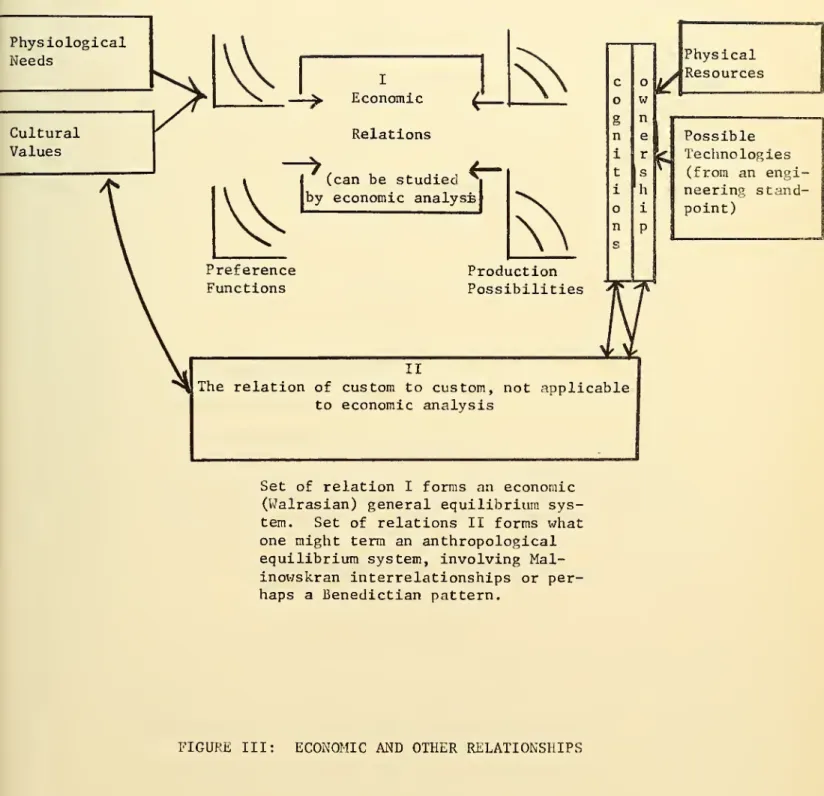
single time period is given in Figure III. A schema which would contain
histor-ical depth would obviously be more complex and could not be represented in two
dimensions.
Ill
The schema as presented, and the description of economic analysis given above,
allow a new perspective on the debate over the definition of economies and the
economy. In this controversy, as indicated above, two principal definitions were
presented. The first being that economics is the study of the material means to
man's existence: dealing with their production, distribution, and consumption.
The second, that economics is the study of "economizing" behavior: the allocation
of scarce means to multiple objectives. Other definitions suggested have been
(for economic anthropology) that it study in primitive societies what economists
study in western societies, and (for any economics) that it was simply what
econ-omists do.
A simple statement that "economic anthropolgy treats in primitive societies
what economists study in ours" is too broad to do much good, particularly since
some economists have begun speculating in psychological causation. (Hagen, 1962.)
However, the account of economic analysis as the core of economics should suggest
a related definition of what might be termed anthropological economics as
treat-ing the economic process in societies, with reference to the social milieu in
-17-Physiological Needs Cultural Values
>
Economic Relations^
(can be studied ' by economic analysB Preference Functions Production Possibilities Physical Resources Possible Technologies (from an engi-neering stand-point) IIThe relation of custom to custom, not applicable to economic analysis
Set of relation I forms an economic (Walrasian) general equilibrium
sys-tem. Set of relations II forms what one might term an anthropological equilibrium system, involving Mal-inov7skran interrelationships or per-haps a Benedictian pattern.
which it is fitted. The economy, or at any rate the area of activity to be treated
by economic analysis, may be defined heuristically. If economic analysis improves
our understanding of an area of behavior, then we may say it is included in the
ec-4
onomic process to a significant degree.
This statement might seem to leave open the implication that has been found
in Burling's position in the debate, namely that as larger and larger areas of hu-man behavior turn out to involve some sort of maximizing behavior, economics may
swallow the other social sciences. The considerations given above, in showing
that the "givens" for economic analysis have a historical dimension and other
re-lationships to each other that economic analysis cannot treat, would seem to me
to preclude such a possibility. From a substantive viewpoint, also, it would be possible to enumerate several possible levels, any of which could be termed "the
economy," if that proved useful. These domains,which are partially overlapping,
might include:
1. Acts involving subsistence goods.
2. Acts involving all material goods.
3. Activities commensurable with subsistence goods in the culture studied. 4. Activities commensurable with each other and some material goods but
not with subsistence goods in the culture studied, as in African cul-tures with a separate "economy" in which cattle, brides or prestige goods circulate.
5. Activities commensurable with subsistence goods in modern or capital-ist cultures.
6. Any activities involving maximizing behavior.
In a given society, economic analysis may be applicable to all, some or none
of these substantively defined "economies." Considering "the economy," those do-mains in which economic analysis improves understanding of activity to a
signifi-cant degree, would have the advan tage of demarcating areas of study for a
pos-sible division of labor. Such a division is itself, of course, supported by
ec-onomic analysis. Economists' techniques have a cost: they take time to learn;
in-dicate that the cost should be born when the return will be great enough to make
it worthwhile. Whether it is or is not in a particular case may be difficult to
determine; however, by making a few techniques of economic analysis more cheaply
available to the anthropologist, more applications can be brought into the range
where costs are justifiable. Perhaps, more anthropolgists will be able to gather
data in a form amenable to the drawing of some economic conclusions (as through
the taking of samples from which consumption or production functions can be
com-putedJ, This would also make anthropologists, who in most cases do the first scouting of non-industrial societies for the social sciences, more able to
de-termine in which cases a full-time practitioner of economic analysis would be
-20-Footnotes
* The author is assistant professor of economics at Massachusetts Institute of
Technology. A preliminary version of this paper was presented in a seminar conducted by Professor S.W. Mlntz at Yale University. Discussions with A.
Perey, J.R. Karris and M. Rothschild also aided in the formulation of several
I points.
1. Even this is an oversimplification in that nutrition and other factors influ-ence the ability to work.
2.
Additional
conditions involve second derivities or convexity of functions. An example can be constructed, if simplifications are made through the use»of
an additive utility function and production function for rituals. Nor-mally, we assume utility functions to be curved, and the productionfunc-tion for rituals in most cultures would, no doubt, require fixed proportions
of male and female participation. The food production function is of the exponenetial Cobb-Douglas form used in many models.
Here let Utility = U =aF.- bR (utility function)
c
ci Gwhere F = Food = T M^ W (production function for food) R = Rituals = gW
+
hM (production function for rituals)I and T = available land/year
M = M
+
M = available number of man-days W = W^ + W = available number of woman-days.The equations may be combined into a new function:
U = aT'l^'^W^ + bg(W-W ) t bh(M-M )
which when differentiated gives (setting derivitives = 0)
s,
-»-'"j«r'
- ^^ - °the solution of this would give
1 eh 1 . ea \ dgy
which gives the allocation of labor to farming; production of food, and of
Sartre (1963), opts for a three-level approach: phenomenological description, analytico-regressive movement, and synthetic-progressive movement. Economic analysis, which he would probably relegate to the first of these levels, would seem to relevant in all three.
This is a slightly different position from Nash's view (1966, p. 5) that "the institutional cluster where the strategy of economizing is the dominant mode
of choice is the economy," in that even if society does not consciously op-timize, but the limitations of scarcity and techniques combined with some cus-tomary wants work through an evolutionary process to create an equilibrium allocation of resources, so that economic analysis is useful, the sector might be termed an economy.
\
Belshaw, Cyril S.
1965 Traditional Exchange and Modern Markets. Englewood Cliffs, Prentice Hall.
Benedict, Ruth
1934 Patterns of Culture. Boston, Houghton Mifflin.
Burling, Robbins
1962 Maximization Theories and the Study of Economic Anthropology. American Anthropologist 64:4, 802-821.
Cancian, Frank
1965 Economics and Prestige in a Mayo Community. Stanford, Stanford Univer-sity Press.
1966 Maximization as Norm, Strategy and Theory: A Comment on Programmatic Statements in Economic Anthropology. American Anthropologist 68:2, 465-470.
Chayanov, A.V.
1966 The Theory of Peasant Economy, edited by Daniel
Thomer,
Basile Ker-blay and R.E.F. Smith. Homewood, 111.: Richard D. Irwin, 1966.Ori-I ginal Russian edition published 1923.
Cook, Scott
1966 The Obsolete "Anti-Market Mentality: A Critique of the Substantive Approach to Economic Anthropology." American Anthropologist 68:2,
323-345.
Dalton, George
1960 A Note of Clarification on
Economic
Surplus. American Anthropologist 62:3, 483-490.11961
Economic Theory and Primitive Society. American Anthropologist 63:1, 1-25.Dean, Edwin F.
1966 The Supply Responses of African Farmers. Amsterdam, North-Holland Publishing Co.
Edel, Matthew
1967 Jamaican Fishermen: Two Approaches in Economic Anthropology. Social and Economic Studies 16:4, 432-439.
1968 The Colombian Community Action Program: An Economic Analysis. Unpub-lished Ph.D. Dissertation: Yale University.
»Festinger, Leon
1957 A Theory of Cognitive Dissonance. Evanston, Row, Peterson.
Georges cu-Roegen, N.
1960 Economic Theory and Agrarian Economics. Oxford Economic Papers 12:1, 1-40.
Goodenough, Ward Hunt
Hagen,
1962 On the Theory of Social Change: How Economic Growth Begins. Homewood, Dorsey Press.
Hart, Albert G.
1965 Unpublished lecture notes, Columbia University.
Harris, John R.
1967 Socioeconomic Determinants of Entrepreneurial Success in Nigerian
Indus-try. Unpublished paper read before the Economietric Society.
Harris, Marvin
1959 "The Economy Has No Surplus?" American Anthropologist 61:2, 185-199.
1964 atterns of Race in the Americas. New York, Walker.
Herskovitz, Melville J.
1941 "Economics and Anthropology: A rejoinder," Journal of Political Economy, 49:2, 269-278.
Houthakker, H.S.
1957 An International Comparison of Household Expenditures Commemorating the Centenary of Engel's Law," Econometrics, XXV:4, 532-551.
Klein, Lawrence R.
I 1962 An Introduction to Econometrics. Englewood Cliffs, Prentice Hall
Knight, Frank H.
1941 Anthropology and Economics. Journal of Political Economy 49:2, 247-268.
LeClair, Edward E. , Jr.
1962 Economic Theory and Economic Anthropology. AA64:6, 1179-1200.
Lefebvre, Henri
1953 Perspective de sociologie rural. Cahiers de Sociologie Rural, Paris.
Levi-Strauss, Claude
1955 "Social Structure," A.L. Kroeber, ed.. Anthropology Today. Chicago, University of Chicago Press, 524-553.
Malinowski, Bronislaw
I 1961 Argonauts of the Western Pacific, paperback edition. New York, Dutton.
Martindale, Don A.
1965 Functionalism in the Social Sciences. Philadelphia, American Academic
of Political and Social Science. Monograph 5.
Nash, Manning
1966 Primitive and Peasant Economic Systems: San Francisco, Chandler.
Pearson, Henry W.
1957 "The Economy has No Surplus," Trade and Market in the Early Empires,
ed. by K. Polanyi, G.H. Arensberg and H. Pearson. Free Press of Glencoe, 320-341.
Polan)4 Karl, Conrad Arensberg and Henry W. Pearson
I 1957 Trade and Market in the Early Empires. Glencoe, The Free Press.
Reichel Dolmatoff, Gerardo and Alicia
1817 Principles of Political Economy and Taxation. Various reprint editions available.
Robbins, Lionel
1952 An Essay on the Nature and Significance of Economic Science. London, Macmillan.
Samuelson, Paul Anthony
1947 Foundations of Economic Analysis. Cambridge, Harvard Press.
Sartre, Jean-Paul
1963 Search for a Method. New York, Knopf.
Schultz, T.W.
1964 Transforming Traditional Agriculture. New Haven, Yale Press.
Sen, Amartya K.
1966 Peasants and Dualism with or without Surplus Labor. Journal of Political Economy. 74:5, 425-450.
Smith, Adam
1776 The Wealth of Nations. Various reprint editions since.
Tinbergen, Jan
1956 Economic Policy: Principles and Design. Amsterdam, North Holland Pub-lishing Co.
Vayda, Andrew P.
1967 "On the Anthropological Study of Economics," Journal of Evolutionary Ec-onomics 1:86-90.
f 1964 "Some implications of Zinacantan social structure for the study of the
Ancient Maya," Actas y memorias, XXXV Congreso International de American-istas, Mexico, 1962. 1:307-320.
Wharton, Clifton R. , Jr.
1965 "The Economic Meaning of Subsistence" Malayan Economic REview VIII:2,
46-58.
Whorf, Benjamin Lee
3 9080 02878 8112 MIT LIBRARIES 3 ^JUilU
UUJ
I HB31 inr ."'T1753054
.I.T. Dept. of Economics
^'
inff ". ers.
fp "1