JUNE 1989
LIDS-P-1887
THE DYNAMIC WEAPON-TARGET ASSIGNMENT PROBLEM Patrick Hosein
Michael Athans
Laboratory for Information and Decision Systems Massachusetts Institute of Technology
Cambridge, MA 02139
ABSTRACT will provide a heuristic for the dynamic problem and make per-formance comparisons of the static and dynamic strategies. We present a progress report on our recent results on the dynamic The resource allocation problem will typically be solved at a version of the Weapon to Target Assignment (WTA) problem. In C3 node and the results transmitted to the relevant resources. our previous paper (Hosein et. all) we presented results for the Each of these C3 nodes will therefore be of vital importance to Target-Based problem. In this paper we will present results for the defense since its destruction will in effect paralyze the re-the Asset-Based problem. sources over which it has control. These nodes must therefore be In the static Asset-Based WTA problem, the offense launches defended or replicated to increase the reliability of the system. A missiles at valuable assets of the defense. The defense must assign progress report on research on the problem of reliability can be its weapons to these missiles so as to minimize the damage they found in the paper by Walton and Athans3in these proceedings. incur. In the dynamic version, this allocation is done in time This paper is in effect a progress report on our research on stages such that the outcomes of the previous engagements can the resource commitment problem. The model we use is rich be used in making future assignments. enough to capture the nature of the mission (defense of the as-We will provide a suboptimal algorithm for the Static Asset- sets), enemy strength (number and effectiveness of the enemy's Based WTA problem for the case of a single class of defense missiles), defense strength (number and effectiveness of the de-weapons. We will also propose a heuristic for the dynamic ver- fense's weapons) and strategy and tactics (preferential defense, sion of the problem. Numerical results will be provided to show shoot-look- shoot etc.). It should be noted that basic research that a dynamic strategy offers a significant cost improvement studies on these topics are virtually non-existent.
over a static one.
Our work is motivated by military defense problems, two ex-amples of which are as follows. The first example involves the Anti-Aircraft Weapon (AAW) defense of Naval battle group or 1. INTRODUCTION battle force platforms. The assets being defended are aircraft carrier(s), escort warships and support ships each of which is of The long range objective of our research is the quantitative study some intrinsic value to the defense. The threat to these assets of the theory of distributed C3 organizations. Our present work are enemy missiles launched from submarines, surface ships and has been concentrated on certain aspects of situation assessment aircraft. These missiles may have different damage probabili-and resource commitment. ties which depend on the missile type, asset type, etc. The de-Situation assessment entails the use of sensors to detect and fense's weapons are different types of AAW interceptors launched track the enemy and its weapons (i.e missiles, tanks etc.). These from Aegis and other AAW ships. The kill probability of these sensors are geographically distributed so that distributed algo- weapons may also depend on the specific missile-interceptor pair. rithms are desirable. This problem can be formulated as a dis- The objective of the defense is to maximize the expected surviv-tributed hypothesis testing problem. Recent results of this re- ing value of the assets. The problem is to find which AAW inter-search may be found in the paper by Pothiawala et. al2in these ceptors should be assigned to each of the enemy missiles, when
proceedings. should they be launched and why. This formulation allows for
The resource commitment problem deals with the optimal as- a preferential defense where, in a heavy attack, it may be opti-signment of the defense's resources against the offense's forces so mal for the defense to leave "low" valued assets undefended and as to minimize the damage done to the defense's assets. If the concentrate its resources on saving the "high" valued assets. battle is such that the defense has a single opportunity to engage The second motivating example for our research is the mid-the enemy mid-then mid-the problem can be formulated as a static re- course phase of the Strategic Defense System. In this case the as-source allocation problem. If multiple engagements are possible sets are our (the defense's) population centers, Inter-Continental (as for example in the Strategic Defense System (SDS) scenario) Ballistic Missile (ICBM) silos, military installations, C3 nodes, then better use can be made of the defense's resources by as- etc. The threat to these assets are enemy re-entry vehicles (RV's), signing them dynamically (i.e observe the outcomes of previous surrounded by decoys. The defense's weapons are Space-based engagements before making further assignments). This is called kinetic-kill vehicles (SBKKV's) and ERIS interceptors. The ob-a shoot-look-shoot strob-ategy in the literob-ature. In this pob-aper we jective of the defense is the maximization of the expected total
To appear in Proc. 1989 Symposium on C
1
surviving value of the assets. The problem is the determination expected surviving value of asset k if Xk weapons are used to of the optimal weapon-target assignments and the timing of the defend it. We have:
interceptor launches.
Jk(Xk) = max Wk II (1 - ri(1 - pi)"X), (2)
fxi EZ+) iEGk
subject to E zi = Xk.
2. THE STATIC WTA PROBLEM subject to = X
In this section we will present the Static Asset-Based Weapon- The objective function is the expected surviving value of the Target Assignment problem and a sub-optimal algorithm for solv- asset. The original problem can be restated as:
ing it. We will also show how an upper bound on the optimal K
cost can be obtained. In this problem, missiles (the targets), are max J(X) = E Jk(Xk) (3) launched by the offense and are aimed at valuable assets of the {X(Z}K) k=l
defense. A value is assigned to each of these assets by the de- K
fense. The defense has a limited number of weapons with which subject to EXk = M.
to destroy these targets. Associated with each weapon-target k=l
pair is a kill probability which is the probability that a weapon Note that this problem has K variables as compared to the orig-destroys the target if it is fired at it. VWe assume that the action
inal problem which had N variables. of a weapon on a target is independent of all other weapons and
targets. Each of the attacking missiles are aimed at exactly one of the defended assets and, if not intercepted, destroys the asset
with some probability, which will be called the damage proba- We will first provide an optimal algorithm for the subproblem bility of the target. We will assume that the action of a target 2. This will provide us with the functions Jk(Xk). We will then on an asset is independent of all other targets and assets. The provide a sub-optimal algorithm for the problem as stated in the objective of the defense is to assign weapons to targets so as to form 3. We will also provide an upper bound on the optimal maximize the expected total value of the surviving assets. cost. This upper bound can be used to check the quality of the
solution provided by the suboptimal algorithm. 2.1 Problem Statement
2.2.1 Solution of the Subproblem
The following notation will be used: Since the logarithm function is monotonic then if we replace the
def objective function of problem 2 by its logarithm then the
opti-K = the number of assets being defended, mal assignment of the resulting problem will also be optimal for def
Wk =ef the value of asset k to the defense, the original problem. If we take the logarithm then the following
Gk the set of targets aimed for asset k, equivalent problem must be solved:
def
nk the sizeof max F(X) = ln(1 - ri(l - pi)f), (4)
7ri = the damage probability of target i, {Ez+}EG
def
Pi = the kill probability of a weapon on target i,
N d- f the number of targets, subject to zx; = Xk.
def iEGh
M = the number of weapons,
i def = the number of weapons assigned to target inumber of weapons assigned to target i Note that the function F(X) is a separable concave function.
def t Problem 4 can be solved by using a greedy algorithm. Such an
z = tthe N-dimensional vector [zl,.. XNl]T
de ' ' algorithm works by sequentially assigning weapons to the target
Xk = the no. of weapons assigned to defend asset k, for which the increase in the objective cost is maximum (see the .d the K-dimensional vector [X, ... , XK]T, thesis by Hosein4 for details). The assignment produced by such Z+ f the set of vectors with non-negative, integer elements. an algorithm will be optimal for the subproblem 2
The Asset-Based WTA problem can be stated as follows: 2.2.2 Solution of the Main Problem
A typical example of the function Jk(Xk) is given in figure 1. K
Kmax Wk II J(.)
>
Note that the function is convex for small values of Xk andcon-{-EZ+J') = w n(1 - (i -p i) (1) cave for large values. Let us define Jk to be the hull of the
function Jk (i.e Jk is the minimum concave function which is N greater than or equal to the function Jk). A good approximation subject to xzi = M. to this hull is the function which is the same as Jk for large values i=l of Xk and which is the tangent of Jk which passes through the The objective function is the total expected surviving asset value origin for small values of Xk. Let us now define the approximate and the constraint is due to the fact that the number of weapons problem to 3 as
assigned must equal the number of weapons available. K
Because problem 1 is separable with respect to the assets, it max J( = E E) Jk(Xk) (5) can be re-formulated as follows. Let Jk(Xk) denote the maximum {.Ez}K) k=l
(a)
x 0.5 ' 5
0 " 0 '
0 50 0 0.5 1
X P
Figure 1: Typical example of the function Jk(Xk) Figure 2: Plot of the cost and upper bound versus the kill prob-ability pi
K (b)
subject to JXk = M. 1o
k=l
Since this is a separable concave optimization problem one can
again show that a greedy algorithm is optimal (see Hosein4). Let 8 X denote the optimal solution of problem 5. By the nature of
the greedy algorithm, we can show that for all but one of the 7 assets
Jk(X) = Jk(X). 6
0 0.5 1
Let the asset for which this equality does not hold be asset v.
Also let X* denote the optimal solution to the original problem pi
3. One can show that Figure 3: Plot of the cost and upper bound versus the damage
__. * probability 7ri
(X ) + J(Xv) - J(Xv*) > J(£) > J(X ). (6)
Therefore the optimal solution to the approximate problem 5 can pi = .8, 7ri = 1, i = 1,..., N.
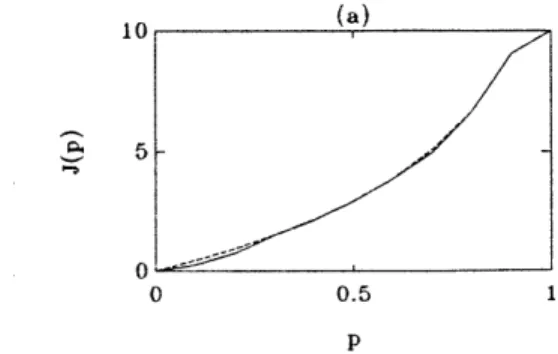
be used to obtain upper and lower bounds on the optimal cost of In figure 2 we have plotted the cost of the solution produced by
problem 3. the algorithm for various values of the kill probability p. The
Notice that the solution to the approximate problem 5 is a near dotted curve is the upper bound. Note that for kill probabilities optimal solution to problem 3. The difference in cost between greater than 0.5 the optimal cost is very sensitive to the value these two solutions is bounded by: of the kill probability. In figure 3 we have plotted the cost for various values of the damage probability 7r. Note that the cost J(X*) - J(X
<
J(X)- J(X,). (7) decrease almost linearly with the damage probability. Infig-. fig-. .. ure 4 we have plotted the cost for various numbers of weapons.
Note that if J(X,*) = J(X,*) then X is optimal for 3. It can Note that the cost increases almost linearly with the number of also be shown that if J(X,*)
$
J(X,*) then by slightly increasing weapons. In figure 5 we have plotted the cost for various values or slightly decreasing the number of resources one can obtain a of nk. For this case we used M = 2N = 20nk weapons.problem for which the solution to the approximate problem 5 is also optimal for 3.
2.3 Numerical Results
(c)
Example 10
Consider the following problem:
M = 200,N = 100, K = 10. 8
Vk=l,nk=10, k=1,...,K.
m' 6
Pi = .7,7ri = .8, i=1,...,N.
Solution obtained by algorithm:
X
= [, 0, 0, 20, 30, 30, 30, 30, 30, 30].J(X) = 5.30 2
Upper bound = 5.36 100 150 200 250 300
NOTE: If M = 180 or M = 210 then the algorithm produces the M
optimal solution.
Optimal cost Sensitivity Analysis Consider the following problem:
M = 200,N = 100,K = 10. Figure 4: Plot of the cost and upper bound versus the number
Vk = 1,nk = 10, k = 1,...,K. of weapons M
9 () A the individual target assignments can be obtained by spreading
the weapons assigned to the defense of an asset as evenly as
18
<possible among the targets aimed for the asset. In the secondstage one has to solve a static problem with M - ml weapons and with nk(2) targets aimed at asset k.
~ 6 We will refer to the vector ni(2) as the state of the system at
the beginning of stage 2. The state of each asset evolves
stochas-5 tically as follows. To simplify the expression we have left out the
5 10 15 subscript k.
nk
Figure 5: Plot of the cost and upper bound versus the number Pr[n(2) = jJX = X] =
of targets per asset i
Z(1 -p(l))t+' [-l)] [1 - (1 - p(1))[-)]x-,,0)[)J-t
3. THE DYNAMIC WTA PROBLEM
x[1 - (1 -p(l))*iJ]n(l)L[ J + n(l) + t - x - j In this section we will consider the dynamic version of the WTA
problem. We will see that a dynamic strategy increases the cost for
performance of the system at the expense of increased compu- J = 1, ... n(1)
tational complexity. The complexity can be reduced by making where
approximations. t = max{j + x - n(1)(Ln[-)J + 1),0}
In this section we will consider the dynamic version of the n(l)
Asset-Based Resource Allocation Problem. Because of the enor- and
mous complexity of this problem we will make the assumption e = min{X- n(1)LnX J,i} that the kill probability of a weapon- target pair depends solely
on the asset to which the target is aimed. We will also assume The state evolution simply states that the number of targets that the damage probability of a target depends solely on the which survive stage 1 is a random variable. The distribution of asset to which the target is aimed. Under these assumptions one this random variable is obtained by convolving two binomial dis-can show that for each stage and asset it is optimal to spread the tributions. The success probability of one of these distributions weapons assigned to defend an asset evenly among the targets is given by (1 - p(l))L["-)J . The success probability of the other aimed for the asset. Therefore with these assumptions we can binomial distribution is given by (1 - p(1))[r"-x1. Let us denote use the number of weapons assigned to the defense of an asset as the optimal cost for the static problem with state fn(2) and m2
the decision variable. This greatly reduces the dimensionality of weapons by J(ni(2),m2). The optimization problem may now the problem. We will only consider the case of two stages, how- be stated as
ever the results can easily be extended to more than two stages.
In this problem the results of the engagements of the first stage max Jd= E [J(in(2), m2)] (8) are observed before the assignments of the second stage are made. EZ {i(2)}
The problem is to choose the number of weapons to use in stage subject to the state evolution 8 and 1 as well as the assignment of these weapons to the targets. The
objective is to maximize the expected total value of the assets [Xkl + m2 = M.
which survive at the end of stage 2. Note that by the principal
which survive at the end of stage 2. Note that by the principal The objective is the expectation over all possible states of the op-of optimality, the optimal static assignment will be used in stage timal second stage cost given that state. The constraint says that
2. timal second stage cost given that state. The constraint says that
the number of weapons used in stage 1 (IXI) plus those used in
3.1 Problem Statement stage 2 (m2) must be equal to the total number of weapons. One
can see that even the statement of the problem is a formidable The following notation will be used. task even under the assumption that the kill probabilities are
def solely asset dependent.
K = the number of assets, The only decision variables over which the objective function is N =ef the number of targets at the start of stage 1, to be optimized are ml and X, which is the number of weapons
Gk(t)=d the set of targets aimed for asset k in stage t, to be used in the first stage ml and the assignment of these
()def e weapons to assets X. We will therefore denote the optimal cost
nk(t) f= the number of targets aimed for asset k in stage t, case which weapons are used
M = tdef nmeofwanfor the case in which m weapons are used in the first stage withn
M def=- thenumberofweapons, assignment X by Jd(ml,wX). The problem can therefore also be
mt = the number of weapons to be used in stage t. stated as:
Wk = the value of asset k,
def max max Jd(Ml,X) (9)
pk(t) =ef the kill probability on a target aimed for asset k, {mIEZ+) {EZK)} (9)
Xk d f the number of weapons assigned to defend asset k. K
subject to
E
XkA =m,0
1.195
4 6 8 10
ml
Figure 6: Plot of the expected two-stage cost versus the number of weapons used in stage 1.
and 0 < ml < M.
If we fix ml then the inner subproblem can be written as Figure 7: Jd(XI,X2)vs.[Xl,X2]
max Jd(ml,), (10)
K
subject to E Xk = ml.
k=I
This will be called the assignment subproblem. If we can solve the assignment subproblem then the original problem can be solved as follows. Let X* denote the optimal assignment of the subproblem 10. Note that this optimal assignment depends on the value of ml. However this is implicit in the solution since k=l Xk = ml. The solution to the original problem may now be obtained by solving the following:
max Jd(ml,Xg) (11)
{mEZ+)
subject to 0 < mi < M.
Each of the problems 10 and 11 will be considered separately. Figure 8: Jd(X1,X2)vs.[Xl,X2]
3.2 Solution of the Dynamic WTA Problem section we will provide a suboptimal algorithm for the dynamic problem.
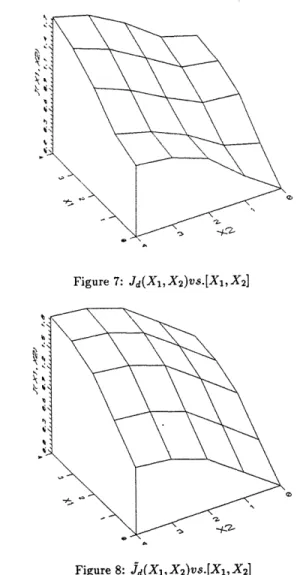
Our efforts will be concentrated on the solution of problem 10 The algorithm will be presented by applying it to a simple ex-since we will show that problem 11 has many local maxima and ample. Consider the case in which K = 2, n(1) = [10, 10],W = hence, in general, a global search will have to be done to obtain [1,1],pk(t) = 0.6. In figure 7 we have plotted the function the optimal solution. We can also obtain an upper bound on Jd(Xl,X2)VS.[XIX 2]. Note that this function is non-concave.
the optimal cost. Details of this upper bound can be found in Furthermore it is non-separable with respect to the assets. We
Hosein4. approximate Jd by a concave separable function Jd as follows.
Let Jd(XI, 0) be the hull of the function Jd(XI, 0). Similarly let 3.2.1 Optimization over mi Jd(O,X2) be the hull of the function Jd(O,X2). Finally let Let us assume that we can solve the subproblem 10. In figure
6 we have plotted the cost Jd(ml,X*) versus mnl for the case of Jd(Xl,X2) = Jd(Xl,0) + Jd(OX2).
K = 2, nl(2) = n2(2) = 2, p1(2) = p2(2) = pl(l) = P2(1) = 0.8,
W1 = W2 = 1, and M = 8. For this case the optimal decision The approximation Jd is plotted in figure 8. Note that the func-variables are m; = 4, X1 = X2 = 2. Because the objective tion Jd is concave and separable with respect to the assets. One function has many local maxima, the global maximum can only can now use a greedy algorithm to obtain the optimal assign-be found by doing a global search. ment of the problem with objective function Jd. This is the
sub-optimal solution. 3.2.2 Optimization over the Decision Variable X
In this section we will consider the assignment subproblem 10. In 3.3 Numerical Results this problem the number of weapons to be used in the first stage
is fixed and the objective is to assign these weapons optimally. Example 1
Recall that for the static version of this problem we were able to M = 200,N = 100,K = 10,nk = 10,pk(t) = .6,Vk = 1,7rk = 1. obtain a suboptimal algorithm but not an optimal one. In this STATIC STRATEGY:
8i X= [20,20,1010,10,10,10,10,10,10].
-6 ... Lower bound on solution X = 7.7
I -
namic
Upper bound on optimal solution = 8.5uW 4 /.namie Note that in case 1 less weapons are used in stage 1 because -static- the kill probability in this stage is smaller than that in the sec-2; 2
r
~-
2·-1
ond stage. Similarly, in case 2 more weapons are used in stage 1. Finally note that the performance obtained by using the more0/
1
effective weapons in stage 1 is considerably better than thatob-0 5 10 tained by using the more effective weapons in stage 2.
K
Figure 9: Expected cost vs. Number of defended Assets
4. CONCLUSIONS
Optimal static solution: X* = [0,0,0,0,0,40,40,40,40,40]. We have seen that the Dynamic Weapon Allocation problem is Optimal static cost = 3.9. considerably more difficult than the static one. However, the
DYNAMIC STRATEGY: introduction of feedback can significantly improve effectiveness
Solution obtained by algorithm: (by roughly a factor of two). By using simple approximations
ml = 100. for the dynamic problem we can significantly reduce the
com-X = [10,10,10,10,10,10,10,10,10,10]. putational complexity of the problem while maintaining the cost Lower bound on solution X9 = 7.1 performance advantage over the static strategy. The algorithms Upper bound on optimal solution = 7.9 we have proposed for both the static and dynamic problems are
Note that if a static strategy is used then 5 of the 10 assets efficient and produce near optimal solutions.
are defended while if a dynamic strategy is used all 10 assets are This paper has been a progress report of our ongoing research. defended. Also note that the performance of the dynamic strat- We plan to continue working on both analytical and numerical egy is almost twice as good as that of the static strategy. Finally studies with the intent of providing an intuitive understanding note that the solution produced by our sub-optimal algorithm is of the problems.
close to optimal.
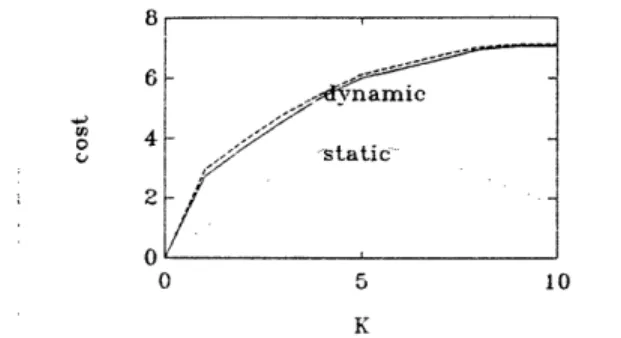
In figure 9 we have plotted the expected cost versus the number of assets defended for both the static and the dynamic strategies.
Note that the dynamic strategy is less sensitive to the number of ACKNOWLEDGMENT assets defended than the static strategy.
This research was supported by the Joint Directors of
Laborato-Example 2 .. ries (JDL), Basic Research Group on C3 Systems, under contract
STATICM =
100,N
STR = :00,K = n =lOp(t)
= .8,k = lrk =1.
with the Office of Naval Research, ONR/N00014-85-K-0782 and STATIC STRATEGY:ONR/N00014-84-K-0519. Optima static solution: X* = [0,0,0,0,0,20,20,20,20,20,20].
Optimal static cost = 3.3
DYNAMIC STRATEGY: REFERENCES
Solution obtained by algorithm:
ml = 70. 1. P. Hosein, J. Walton, and M. Athans, "Dynamic
Weapon-X = [0,0,0,10,10,10,10,10,10,10]. Target Assignment Problems with Vulnerable C3 Nodes," in Lower bound on solution X = 6.3 Proceedings of the 1988 Command and Control Symposium, Upper bound on optimal solution = 6.5 (Monterey, CA), June 1988.
Note that although the number of weapons is small, in the
Note in the that although the number 2. J. Pothiawala, J. Papastavrou, and M. Athans, "Designingof weapons is small, dynamic strategy 7 of the assets are defended in the first stage.
an Organization in a Hypothesis Testing Framework," in Also again note that our algorithm performs well.
Also again note that our algorithm performs well. Proceedings of the 1989 Command and Control Symposium, Example 3
(Washington, DC), June 1989.
M = 200, N = 100, K = 10, nk = 10, Vk = 1,rk = (Washington, DC), June 1989.
Case 1: 3. J. Walton and M. Athans, "Strategies for Asset Defense with
pk(1) = .5,pk(2) = .7 Precursor Attacks on the C3 System," in Proceedings of the
Solution obtained by algorithm: 1989 Command and Control Symposium, (Washington, DC),
ml = 90. June 1989.
X = [0,10,10,10,10,l,10,1o0,10,10]. .. 4. P. Hosein, A Class of Dynamic Nonlinear Resource Alloca-Lower bound on solution X = 6.9Lower bound on solution X =
6.9
tion Problems. PhD thesis, Massachusetts Institute of Tech-Upper bound on optimal solution = 7.2nology, Cambridge, MA. (In progress). Case 2:
pk(1) = .7,pk(2) = .5
Solution obtained by algorithm: ml = 120.
![Figure 5: Plot of the cost and upper bound versus the number Pr[n(2) = jJX = X] =](https://thumb-eu.123doks.com/thumbv2/123doknet/14754729.581949/4.933.139.399.94.267/figure-plot-cost-upper-bound-versus-number-pr.webp)