HAL Id: hal-01721502
https://hal.univ-grenoble-alpes.fr/hal-01721502
Submitted on 2 Mar 2018
HAL is a multi-disciplinary open access
archive for the deposit and dissemination of
sci-entific research documents, whether they are
pub-lished or not. The documents may come from
teaching and research institutions in France or
abroad, or from public or private research centers.
L’archive ouverte pluridisciplinaire HAL, est
destinée au dépôt et à la diffusion de documents
scientifiques de niveau recherche, publiés ou non,
émanant des établissements d’enseignement et de
recherche français ou étrangers, des laboratoires
publics ou privés.
BINSEC/SE: A Dynamic Symbolic Execution Toolkit
for Binary-level Analysis
Robin David, Sébastien Bardin, Thanh Ta, Josselin Feist, Laurent Mounier,
Marie-Laure Potet, Jean-Yves Marion
To cite this version:
Robin David, Sébastien Bardin, Thanh Ta, Josselin Feist, Laurent Mounier, et al.. BINSEC/SE: A
Dynamic Symbolic Execution Toolkit for Binary-level Analysis. 3rd IEEE International Conference
on Software Analysis, Evolution, and Reengineering, Mar 2016, Osaka, Japan. �hal-01721502�
BINSEC/SE: A Dynamic Symbolic Execution
Toolkit for Binary-level Analysis
?
Robin David,
S´ebastien Bardin
CEA LIST,
Software Safety and Security Laboratoy Saclay, France
Thanh Dinh Ta,
Josselin Feist,
Laurent Mounier,
Marie-Laure Potet
V´erimag, Grenoble, France [email protected]
Jean-Yves Marion
Universit´e de Lorraine, CNRS and Inria, LORIA, France
Abstract—When it comes to software analysis, several ap-proaches exist from heuristic techniques to formal methods, which are helpful at solving different kinds of problems. Un-fortunately very few initiative seek to aggregate this techniques in the same platform. BINSEC intend to fulfill this lack of binary analysis platform by allowing to perform modular analysis. This work focusses on BINSEC/SE, the new dynamic symbolic exe-cution engine (DSE) implemented in BINSEC. We will highlight the novelties of the engine, especially in terms of interactions between concrete and symbolic execution or optimization of formula generation. Finally, two reverse engineering applications are shown in order to emphasize the tool effectiveness.
I. INTRODUCTION
While security can be checked and enforced at different level, we focus here on binary-level security analyses, such as malware comprehension or vulnerability analysis. Reverse engineering of binary codes is a key component of these activities, yet it is notoriously difficult. Especially, low-level assembly constructs can deceive disassemblers, while dynamic execution explores only a few possible behaviors. Our long-term goal is to adapt formal methods, which have been very successful in source-level safety analysis, to binary-level secu-rity analysis. We present in this paper a binary-level dynamic symbolic execution engine, named BINSEC/SE, geared toward security analysis and especially reverse-engineering.
The main contribution is a highly configurable generic DSE engine toolkit, with a strong interaction between the tracer and the symbolic execution core, as well as heavy optimizations on the path predicate. Two reverse engineering applications are shown to emphasize the tool effectiveness.
II. BACKGROUND
Dynamic Symbolic Execution [5], [9] is a formal technique for exploring program paths in a systematic way. For each path, the technique computes a path predicate, i.e. a set of constraints on the program input that leads to follow that path at runtime. This predicate is then fed to an automatic solver: a solution to the predicate is a new test input exploring the targeted path. Systematic exploration is achieved through iterating on all (user-bounded) paths of the program.
?Work partially funded by ANR, under grant ANR-12-INSE-0002
BINSEC [8] is a recent platform for formal analysis of binary codes. The platform currently proposes a front-end from
x86(32bits)to a generic intermediate representation called DBA [8] (including decoding, disassembling, simplifications), a simulator and a static analysis engine (typically for dynamic jump resolution). The platform is written in OCaml (∼30,000 loc), and will be released under an open source license soon1. Our DSE engine BINSEC/SE is built upon BINSEC. The current tool paper describes only BINSEC/SE, a consequent add-on to BINSEC reusing only thex86-to-DBA translation.
III. USER VIEW
From a user point of view, the advantage of using a DSE engine is twofold. First, nowadays closed source binaries and malwares are so commonly widespread that having tools for working at binary level is mandatory. Second, recovering information from a binary can be a tedious task, especially in heavily obfuscated binaries. Therefore applying automatic techniques for recovering information is crucial with regard to the usual amount of code to review.
During a reverse-engineering task or an information retrieval task, the analyst can be interested in knowing information about the binaries, e.g. the register value at a given location, the possible values at a given memory address, whether a given branch can be covered or not or the possible targets of a dynamic jump. These problems can be addressed by DSE.
Various dynamic analyses are already implemented in BIN-SEC/SE and new ones can conveniently be written using a callback mechanism. An analysis takes a JSON configuration file as input and a trace file. Both the configuration and trace file formats are open and specified.
IV. BINSEC/SEARCHITECTURE
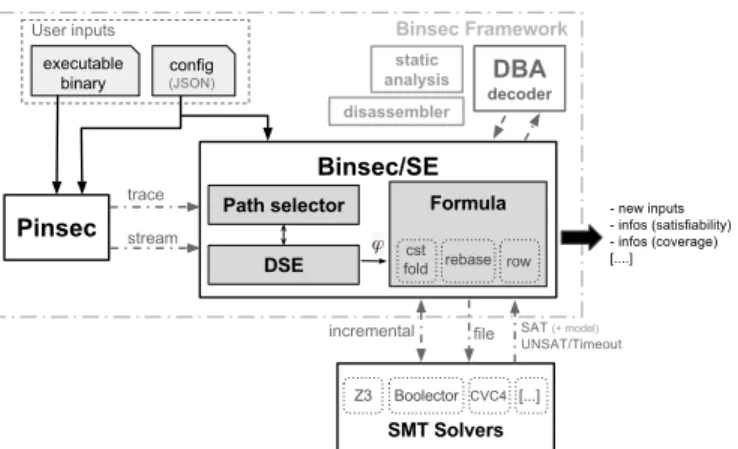
We describe hereafter the new module for DSE, named BINSEC/SE. Its implementation is made of three components, presented in Figure 1.
• a pintool named PINSEC, written in C++ (∼2,000 loc), based on the Pin DBI framework [10] for dynamic tracing;
• the core DSE engine written in OCaml(∼8,000 loc), whose tasks are to generate path predicates, to send them to a solver and to get back new input data;
• the path selector, written in OCaml(∼1,200 loc), in charge of choosing which path to explore next.
Fig. 1. BINSEC/SE architecture
A. The PINSEC tracer
The tracer, called PINSEC, is a pintool [10] specialized in analyzing x86 architectures. Its main purpose is to generate the execution trace used as input by BINSEC. It is designed to offer a generic and modular tracing for both Linux and Windows binaries, and to export results into a generic format, here protobuf2 which is usable with major programming languages. The tracing is parameterized via a JSON file whose format is also defined inprotobuf. The main parameters are:
• start and stop: addresses indicating where to begin and where to end the tracing,
• call_skips: address of calls for which the callee should not be traced,
• fun_skips: function addresses that should not be
traced.
Other command line parameters allow to limit the trace size, the tracing time or the instrumentation scope.
Advanced usage. What is differentiating PINSEC from other pintools are the following functionalities:
• the automatic retrieval of function parameters and return values for (some) libraries functions;
• the possible retrieval of the concrete value of any register or memory location, even if not part of the operands / results of the currently instrumented instruction;
• the injection of symbolic or concrete values in any register or memory location, at any step of the execution;
• a remote command and control system allowing the DSE core and PINSEC to exchange messages in an interactive, debugger-like manner, in order to dynamically tune the instrumentation.
A full-fledged example using some of these parameters is presented in Section VI.
2https://developers.google.com/protocol-buffers/
B. DSE engine
Our DSE engine (Figure 1) follows a classical workflow. From an input trace, x86 instructions are translated into DBA instructions [8] (such a translation can be seen in Figure 2) on which the path predicate is computed [12], and then used to generate a formula (theory of arrays and bitvectors) which is then exported to the SMTLIB2 format3, the standard input
of modern SMT solvers. A SMT solver is finally used to check the satisfiability of the formula and if so, to get back a solution (new input). We currently rely on Z3, CVC4 and Boolector. The connexion between BINSEC/SE and PINSEC easily allows to re-inject the new input to get a new trace. Implementation insight. Internally an analysis is represented as an OCaml class, which each analysis should inherit from. This class provides appropriate callbacks and data structures for implementing any trace-based analysis. These callbacks allow to apply specific actions at a specific step and/or location along the execution in a highly configurable manner. They help developing new analyses without a deep understanding of the whole inner-working of the DSE. Main callbacks are:
• pre_execution, post_execution triggered respec-tively once at the begining and the end of the analysis;
• visit_instr_before, visit_instr_aftertriggered before (resp. after) every asm instruction of the trace;
• visit_dbainstr_before, visit_dbainstr_after
triggered before (resp. after) every DBA instructions of an x86 instruction;
• input_message_received triggered when a message is received from PINSEC.
A summary of all callback location calls is given in Figure 2.
Fig. 2. BINSEC/SE callbacks
C. Path selection
Beside a fine-grained control of a single trace execution, automatic multiple paths exploration is also a desired feature of a DSE tool. Ideally, the path exploration engine should allow either to fulfill some standard coverage requirements, or to focus on specific parts of the code through dedicated (user-defined) search heuristics. The design of the explo-ration module of BINSEC/SE is inspired from the one of OSMOSE [2]. It relies on a simple API allowing to easily implement various exploration strategies. In particular this API offers a function select(S) returning the “best” trace from a set of traces S, w.r.t. a user-defined score function. Scores
are built from several (predefined or dynamically computed) trace characteristics, such as length, last instruction call-depth, distance to a given target, etc. This approach allows to precisely define a wide-range of exploration strategies. Several strategies are already implemented such as DFS, BFS, random path, MinCall-DFS and MinCall-BFS [1].
V. FORMULA GENERATION AND SOLVING
The bottom-line of DSE is path predicate generation. While we follow the standard approach [12], i.e. maintening a symbolic memory state along the computation together with the encountered path constraints (i.e. branching conditions), our method is original in several aspects:
• we can take into account constraints on the initial memory
state (cf. Section V-B);
• we provide callback mechanisms for fine-tuning of con-cretization and symbolization (cf. Section V-C);
• the path predicate is highly optimized, and we take advantage of incremental solving (cf. Section V-A). A. Optimizations
The core engine implements several optimizations of the path predicate, ranging from standard simplifications such as constant folding, local rewriting (e.g. a ⊕ a becomes 0) or pruning useless parts of the formula, to less common optimizations, such as Read-over-Write (RoW) simplifications over array load and store [4]. Finally, great care is taken in order to make these optimizations compatible with the incremental solving mode of modern SMT solvers, which is particularly well-suited to DSE, since path predicates are naturally built incrementally.
Table I shows the results of optimization on a set of malware samples (cf. Section VI-B), while Table II shows a more detailed view on a single trace taken from the Artelad malware. The timeout is set to 20 seconds on a Intel Core i7 2.7 GHz (16GB RAM) using the Z3 solver.
TABLE I
OPTIMIZATION BENCHMARKS
Malware #inst #br #Solved no-Incr Incr (#queries) no-opt pruning full-opt no-opt pruning full-opt Artelad 10K 1295 1295 42m36 31m27 18m18 12m34 11m57 9m6 Benny 10K 3150 3510 14m35 10m34 7m54 3.64 2.58 2.94 Bogus 10K 191 191 41m51 7.71 7.34 1.45 2.98 3.41 Cornad 404 32 21 4m10 4m10 4m5 4m43 4m40 4m37 Eva 1069 115 115 3.44 2.07 1.98 0.16 0.15 0.16 Htrip 2525 1410 1410 15m6 12m23 11m34 18.36 18.52 11.17 Total 303998 6193 6181 118m25 58m48 42m03 17m46 17m3 14m3 Avg/query 1.15 0.57 0.40 0.16 0.16 0.14
time in seconds, or minutes/seconds Avg/query: average time per query full-opt: all optimization turned on – no-opt: all optimizations turned off Incr: incremental solving – no-Incr: non-incremental solving
B. Initial memory state
Logical arrays are unconstrained by default. Hence, mod-elling the initial memory state as a logical array implies that the solver is free to give any value to any memory location of the initial state, possibly leading to meaningless results since the initial mapping of addresses in a real program is more complex. BINSEC/SE allows to specify constraints on the initial memory state (initial logical array).
TABLE II EFFECTS OF OPTIMIZATIONS
no-opt pruning full-opt #VarsDef 27375 8952 3026 #Constraints 1585 1581 379 #Memory operations 1589 1585 1136 #Operators 85805 6330 2278
C. Concretization/Symbolization
For scalability issues, the path predicate is often approxi-mated, either by forcing some logical values to their runtime values (observed by the tracer) – concretization, or by injecting fresh logical input – symbolization. Both operations reduce the complexity of the formula, at the price of completness and/or correctness. So choosing appropriately when and what to con-cretize/symbolize is a major practical issue. While most tools offer only hardcoded policies, BINSEC provides a complete set of callbacks to specify such choices. Such a mechanism allows, for instance, symbolic reasoning on memory pointers, where existing tools usually enforce memory addresses to be concrete.
VI. EXPERIMENTATIONS
A. Reverse engineering
In reverse-engineering, so-calledcrackmechallenges simu-late real world situations where binary programs are designed to make the analysis difficult. The goal is usually to find a string key (the flag) allowing to validate the challenge.
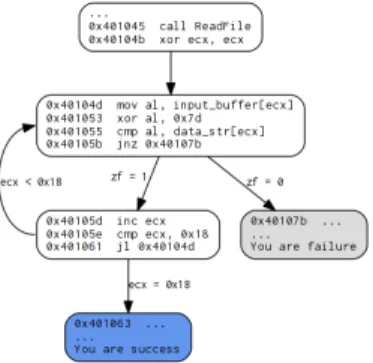
Flare-On is a reverse engineering challenge organized since 2014 by FireEye Security4. We analyse the first challenge of 2015 since it is straightforward enough to be discussed in detail. This crackme is a 32 bits Windows program which asks for a password and prints “You are success” or “You are failure” depending on the keyboard input. Each byte of the input (input_buffer) is xored with0x7d, the result is then checked against a key stored in the data section (data_str), cf. Figure 3.
Fig. 3. Flare-on #1 key loop computation
Solving the crackme by symbolic execution aims at check-ing that the predicateZF=1is true at location 0x40105b; and this, for every character of the key. If the generated formula is
satisfiable, then the right character can simply be retrieved in the formula solution at input_buffer[ecx]. One last remaining problem is the initial state. If none is specified, the solver is allowed to give any valuation to the content of data_str, while it is not user-controllable. Hence, an initial state constraining the value of the data_str bytes is required in order to get meaningful results forinput_buffer
(cf. SectionV-B). Finally, iterating overinput_buffercan be done in two ways:
1) From a trace taking the fail branch, we should solve
ZF=1 at 0x40105b to get the right char and inject it back as input via the configuration file for generating a new trace that will do a second loop iteration, repeating until the whole key is found;
2) Configure a breakpoint at 0x40105b (the address of
jnz), compute the right character value, send a com-mand to patch the ZF flag and resume to force the tracer to take the right branch and looping again. This method is fully automatic and allow to take advantage of incremental solving (cf. Section V-A).
We obtain the right key solving the challenge,
[email protected]. Note that we have solved
several other Flare-on challenges with the same principle. B. Malware exploration
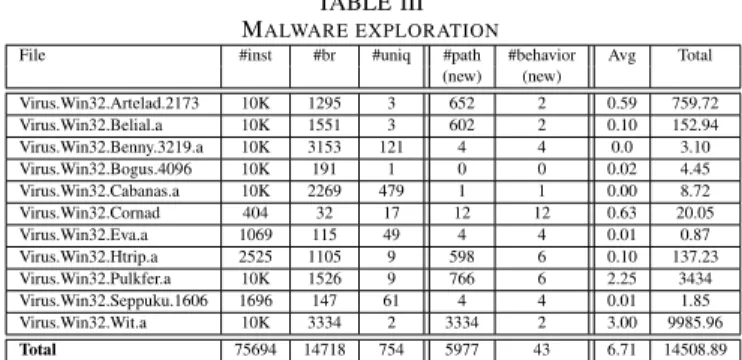
We are interested here in demonstrating the ability of BINSEC/SE to automatically discover new code areas of a program, which is especially crucial in malware analysis. We consider 11 malware programs taken from the VX Heaven database6 and used in recent works on deobfuscation [11]. Table III shows our results. We report the number of new explored paths (i.e. each time DSE manages to negate a branch of the original trace), and of new behaviors (i.e. each time DSE covers a branch not yet covered by the initial trace or by a generated one). Here, we are able to discover 43 new code areas in the malwares under consideration.
TABLE III MALWARE EXPLORATION
File #inst #br #uniq #path #behavior Avg Total (new) (new) Virus.Win32.Artelad.2173 10K 1295 3 652 2 0.59 759.72 Virus.Win32.Belial.a 10K 1551 3 602 2 0.10 152.94 Virus.Win32.Benny.3219.a 10K 3153 121 4 4 0.0 3.10 Virus.Win32.Bogus.4096 10K 191 1 0 0 0.02 4.45 Virus.Win32.Cabanas.a 10K 2269 479 1 1 0.00 8.72 Virus.Win32.Cornad 404 32 17 12 12 0.63 20.05 Virus.Win32.Eva.a 1069 115 49 4 4 0.01 0.87 Virus.Win32.Htrip.a 2525 1105 9 598 6 0.10 137.23 Virus.Win32.Pulkfer.a 10K 1526 9 766 6 2.25 3434 Virus.Win32.Seppuku.1606 1696 147 61 4 4 0.01 1.85 Virus.Win32.Wit.a 10K 3334 2 3334 2 3.00 9985.96 Total 75694 14718 754 5977 43 6.71 14508.89
br: number of branches – uniq: unique conditional jumps – path: number of new paths – behavior: new path covering a new code area – Avg: Average solving time per paths
VII. RELATED WORK
A few other initiatives aim at applying DSE on binary pro-grams for security purposes, most notably BAP [3], S2E [7],
5A complete demo is available at https://youtu.be/0xUc2jbpjQo 6http://vxheaven.org/
FuzzBall [6] or Triton [13]. All these approaches also rely on an intermediate representations similar to DBA. Regarding dynamic tracing, these tools are built either on Qemu or on Pin. In addition to a generic DSE engine, the novelties provided by BINSEC/SE are highly configurable path exploration strategies and concretization/symbolization policies, a strong interaction between the tracer and the DSE core and an optimized path predicate computation.
VIII. CONCLUSION
The dynamic symbolic execution implemented in the plat-form yields the interesting property of being modular w.r.t the analysis configuration and to provide a strong interaction between the DSE (BINSEC) and the tracer (PINSEC). Some functionalities like the formula optimizations makes it original from the existing state-of-the art tools. This platform comes really handy for reverse-engineering and information recovery tasks like it is the case for source-less programs and malwares.
REFERENCES
[1] S. Bardin, P. Baufreton, N. Cornuet, P. Herrmann, and S. Labb´e. Binary-level testing of embedded programs. In: QSIC 2013. IEEE, 2013. [2] S. Bardin and P. Herrmann. OSMOSE: Automatic Structural Testing of
Executables. Software Testing, Verification and Reliability, 21(1), 2011. [3] D. Brumley, I. Jager, T. Avgerinos, and E. J. Schwartz. BAP: A Binary
Analysis Platform. In: CAV 2011. Springer, 2011.
[4] C. Cadar, V. Ganesh, P. M. Pawlowski, D. L. Dill, and D. R. Engler. EXE: automatically generating inputs of death. In: CCS 2006. ACM, 2006.
[5] C. Cadar and K. Sen. Symbolic Execution for Software Testing: Three Decades Later. CACM, 56, 2013.
[6] D. Caselden, A. Bazhanyuk, M. Payer, L. Szekeres, S. McCamant, and D. Song. Transformation-aware Exploit Generation using a HI-CFG. Technical report, University of California, Berkeley, 2013.
[7] V. Chipounov, V. Kuznetsov, and G. Candea. S2E: A platform for in-vivo multi-path analysis of software systems. In: ASPLOS XVI. ACM, 2011.
[8] A. Djoudi and S. Bardin. BINSEC: Binary Code Analysis with Low-Level Regions. In: TACAS 2015. Springer, 2015.
[9] P. Godefroid, M. Levin, and D. Molnar. SAGE: Whitebox Fuzzing for Security Testing. Queue, 2012.
[10] C.-K. Luk, R. S. Cohn, R. Muth, H. Patil, A. Klauser, P. G. Lowney, S. Wallace, V. J. Reddi, and K. M. Hazelwood. Pin: Building Customized Program Analysis Tools with Dynamic Instrumentation. In: PLDI 2005. ACM, 2005.
[11] M. H. Nguyen, M. Ogawa, and T. Q. Thanh. Obfuscation code localization based on CFG generation of malware. In: FPS 2015. Springer, 2015.
[12] E. J. Schwartz, T. Avgerinos, and D. Brumley. All You Ever Wanted to Know About Dynamic Taint Analysis and Forward Symbolic Execution. In: SP 2010. IEEE, 2010.