HAL Id: inserm-00470784
https://www.hal.inserm.fr/inserm-00470784
Submitted on 27 Jul 2010HAL is a multi-disciplinary open access archive for the deposit and dissemination of sci-entific research documents, whether they are pub-lished or not. The documents may come from teaching and research institutions in France or abroad, or from public or private research centers.
L’archive ouverte pluridisciplinaire HAL, est destinée au dépôt et à la diffusion de documents scientifiques de niveau recherche, publiés ou non, émanant des établissements d’enseignement et de recherche français ou étrangers, des laboratoires publics ou privés.
free of severe disabilities: the Nord-Pas de Calais
Epipage cohort study.
Marie-Laure Charkaluk, Patrick Truffert, A. Fily, Pierre-Yves Ancel,
Véronique Pierrat, Epipage Study Group
To cite this version:
Marie-Laure Charkaluk, Patrick Truffert, A. Fily, Pierre-Yves Ancel, Véronique Pierrat, et al.. Neu-rodevelopment of children born very preterm and free of severe disabilities: the Nord-Pas de Calais Epipage cohort study.. Acta Paediatrica, Wiley, 2010, pp.1-5. �10.1111/j.0803-5253.2010.01695.x�. �inserm-00470784�
Neurodevelopment of children born very preterm and free of severe
disabilities: The Nord-Pas de Calais Epipage cohort study.
Charkaluk ML 1,3,4 ,Truffert P 2,3, Fily A 2, Ancel PY 3,4, Pierrat V 2,3 for the Epipage study group.
1 Clinique de pédiatrie Saint Antoine, Hôpital Saint Vincent de Paul, boulevard de Belfort, F-59020 Lille cedex, France.
2 Service de Médecine Néonatale, Hôpital Jeanne de Flandre, avenue Eugène Avinée, F-59037 Lille cedex, France.
3 INSERM, UMR S 953, IFR 69, Research Unit on Perinatal Health and Women’s and Children’s Health, F-94807,Villejuif, France.
4 UPMC Univ Paris 06, UMR S 953, F-75005, Paris, France.
Abstract word count: 201
Text word count (tables and figure not included): 3487
Number of tables: 3 (including 1 for supplementary material for online publication) Number of figures: 1
Corresponding Author: M L Charkaluk,
Clinique de pédiatrie Saint Antoine, Hôpital Saint Vincent de Paul Boulevard de Belfort BP 387 59020 Lille cedex France Email: [email protected] tel: 0033320877667 fax: 0033320877668
ABSTRACT
Aim: to describe the development of very preterm children free of cerebral palsy or severe sensory impairment in the domains of gross and fine motor functions, language and sociability at a corrected age of 2 years; to identify factors associated with performances in each domain.
Methods: 347 children born in 1997 before 33 weeks of gestation, part of the EPIPAGE population-based cohort study, had their psychomotor development assessed with the Brunet-Lezine scale. Results: The study population had a mean gestational age of 30.1 ± 2.0 weeks. Lower developmental quotients (DQ) were observed in the study group compared to the reference sample (96 ±13 vs 104 ± 8, p<0.01). Fine motor function, language and sociability were all affected with a p value <0.01. Multivariate analysis showed that duration of intubation and parents’ educational and occupational level were the only variables significantly related to each developmental domain (p<0.01).
Conclusions:
Children very preterm and free of severe disabilities had mild delays in multiple areas of development. The mechanisms by which neonatal factors played a role need further investigation. However socioeconomic status had a great impact on development and our results underline the need for improved support of socioeconomically disadvantaged parents after a preterm birth.Keywords: neurodevelopmental outcome; follow-up studies; premature infant; social-environmental risk factors
There is mounting public and professional concern worldwide regarding the long-term outcome of preterm babies. The prevalence of sequelae reported in different countries is very similar, with cognitive impairment being the most common disability.(1) Cognitive impairment now requires assessment that extends beyond traditional intelligence quotients (IQ).(2) Indeed, executive and sensorimotor functions, attention, language, visuospatial processes, memory, behavioral adjustment may all contribute to this deficit.(2)
Follow-up data available from epidemiological studies carried out in the first two years after a preterm birth mainly focus on detection of seriousimpairment: cerebral palsy (CP), severe sensory impairment or developmental delay. Recent epidemiological research is mainly directed towards children born at an extremely low gestational age (GA), because of ethical concerns about resuscitation of these children. Data available for this population around two years of age show that their mean
developmental quotient (DQ) is below 70 in 15 to 46 % of cases.(3) However, the vast majority of the prematurely born population with cognitive deficits and associated learning disorders is made up of children born at a greater GA. Most of the data available from population based cohorts of children born very preterm involve children who were born before prenatal corticotherapy and surfactants were widely used.(4,5). However it has been shown recently that neurodevelopmental impairments by the age of four years are still common in children born before 33 weeks of GA in the late 1990’s.(6,7) These data have to be confirmed by others in Europe. The Epipage population-based cohort provided large amounts of data on babies born before 33 weeks in 1997 in nine French areas. Overall, 2357 infants surviving at discharge were enrolled in a follow-up study. The overall outcome at 5 years has already been published.(8)In the Nord Pas-de-Calais area, one of the study areas, an evaluation of global development was made on children at a corrected age (CA) of two years.(9) The magnitude of the cohort allowed us to study in more detail the development of children free of CP or severe neurosensory impairment and who were therefore considered to have ‘normal’ development. We hypothesized that minor impairments could be observed in multiple domains as early as two years of age. We compared the results with those obtained from babies born at term, and tried to identify factors related to development in each domain studied.
METHODS Population
Our study population was described elsewhere.(9) During the study period, 634 children were born alive at a GA of less than 33 weeks. Two children with congenital anomalies interfering with development were excluded and 546 surviving children were included in the follow up. Evaluation at two years CA
Pediatricians from the neonatal teams performed standardized neurological examinations as well as an assessment of hearing and vision on children at a CA of two years. CP was defined according to the European Cerebral Palsy Network.(10)Severe sensory impairments were blindness or requirement of a hearing aid. The revised Brunet-Lézine (BLR) scale was used to evaluate development.(11)
Written informed consent was obtained from families of all children participating in the study. The study received the approval of the “Commission Nationale de l’Informatique et des Libertés”. The revised Brunet-Lézine scale (BLR scale)
This early childhood psychomotor development scale covers four domains of development: gross motor function (GM), fine motor function (FM), language (L), and sociability (S). Four separate DQs can be calculated for children aged 2 to 30 months that, combined, yield a global DQ. Means and standard deviations of sub scores according to age are available for each domain and for the global quotient.(11) The distribution of the differences between the global DQ and each of the separate DQ are tabulated, enabling children with specific patterns of developmental delay to be identified.
Children were considered to have an achievement discrepancy if the difference between the global DQ and at least one partial DQ was a value obtained by only 5 % of the reference sample. The test was revised between 1994 and 1996 on a sample of 1032 French children born at term, from single pregnancies with a birth weight greater than 2400g.(11)
Factors associated with global and partial DQs
The following variables were selected a priori and studied in relation to DQs: GA, sex, small for gestational age (SGA), clinical risk index for babies (CRIB), duration of intubation, educational level and parents’ occupation, severe cerebral ultrasound abnormalities, postnatal administration of
amenorrhea and was the best obstetric estimate based on the date of last menstrual period and an early prenatal ultrasound scan, which is a routine practice in France. Birth weight scores, as a function of sex and GA, were derived from our own population of admitted babies. Children SGA were defined as babies having a birth weight < 10th percentile for sex and GA. Severe cerebral ultrasound
abnormalities included cystic leukomalacia and severe intraventricular haemorrhage defined as
Papile’s grade III or IV.(12) These medical and social factors were selected because they are known to be associated with the overall neurological outcome of very preterm children, although their
relationship with development in each domain remains unknown.(9) Statistical analysis
We first described the population in terms of global and partial DQs. The Student’s t-test was used to compare results with those obtained by children of the reference sample. For all quantitative data, results were given as mean ± standard deviation (SD).
STATA, version 9.0, was used to perform univariate and multivariate regression analyses (Stata Corp, college Station, Texas, USA), to identify factors associated with variations in global and partial DQs. Relationships between each factor and the DQ were first studied using t-tests or analysis of variance. Factors associated with DQs with a p <0.20 were included in the multivariate model. GA had to be one of the variables, because of its central role.(1) The multivariate model presents mean variations of scores for each factor after adjustment for other factors.
RESULTS Population
The population is described in figure 1.A clinical examination was performed on 461 children with a CA of 24 months ± 5 weeks. Four hundred and sixteen were free of CP or neurosensory impairment. A BLR test was performed on 347 (83 % of those free of CP or neurosensory impairment). These 347 children were born at a mean GA of 30.1 ± 2.0 weeks with a mean birth weight of 1390 ± 403 g ; 80 % received corticosteroids antenatally, and 41 % received surfactant ; 177 (51 %) underwent intubation, with a mean duration of 7.7 ± 11.4 days (median = 3 days). Compared with these 347 children, the 45
children with CP and/or severe sensory impairment were born at a significantly lower GA of 29.0 ± 2.2 weeks (p<0.01).
Children lost to follow-up and who refused the test
Children lost to follow-up (N=85) together with children who refused the test (N=69) differed from those involved in the study in a number of ways: they were more frequently boys (p=0.03) and SGA (p=0.02). They had a higher CRIB score (p<0.01), and were more often diagnosed as having severe ultrasound abnormality (p=0.02). Their parents had a lower educational (p<0.01) and occupational (p<0.01) level.
Results of the BLR scale
Global DQ was significantly lower in the study population than that of the reference sample (p<0.01) (Table 1). Significant differences between very preterm babies and babies born at term were observed in all the domains except GM function. Eight children (2.3 %) had a DQ < 70 and 62 (17.9 %) had a DQ < 85.
Twenty-four children (6.9 %) had an achievement discrepancy in at least one developmental domain. All but one had a global DQ > 85. Six had a delay in only one domain (FM: n = 5, L: n =1). The 18 others showed high performance in at least one domain compared to the global DQ.
Factors associated with partial DQs
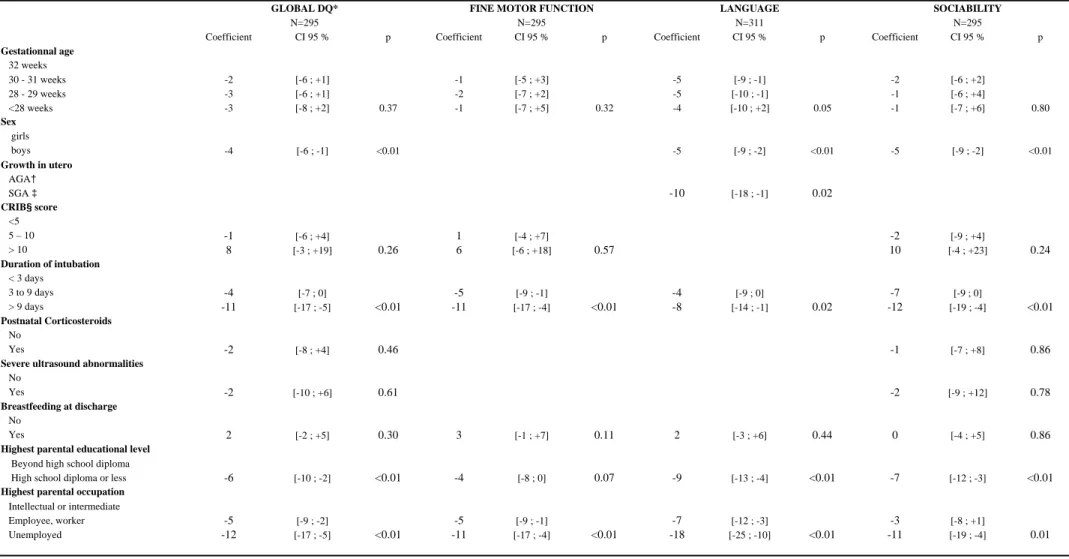
As no difference in GM function was observed between the study population and the reference sample, the analysis of risk factors focused on the three other domains evaluated with the BLR scale. Results of the univariate analysis are shown in Table S1 (in Supplementary Material online). All the factors studied, except being SGA, were related to global DQ (p <0.20). In the multivariate analysis (Table 2), global DQ was related to sex (p=0.01), duration of intubation, parental educational level and occupation (p<0.01). The three latter factors were all significantly related to FM, L and S DQs. LDQ was lower in babies born before 32 weeks (p=0.05), in boys (p<0.01) and in children born SGA (p=0.02). S DQ was higher in girls (p<0.01). Although breastfeeding at discharge was associated at p <0.20 with each of the partial DQs in the univariate analysis, this relation was no more significant after multiple adjustment.
DISCUSSION
This large cohort included children born very preterm in the late 1990’s, free of CP or severe sensory impairment. The mean DQ at 2 years CA was within the average range but approximately 0.5 SDs below the mean for term birth weight children born during the same period of time. Developmental delay, although small, was statistically significant and may be clinically meaningful for the
individuals.(13) All but one of the areas of development evaluated on the BLR scale were delayed. Factors consistentlyassociated with the partial DQs were: duration of intubation and parental level of education or occupation. GA < 32 weeks and being SGA were associated with lower LDQ. Language and sociability DQs were significantly lower in boys.
The results of this study indicating that very preterm birth is associated with deficiencies in a wide range of abilities are consistent with previous reports.(5,14) However, this is a cohort established in the post-surfactant era and not only extremely preterm babies were included but all very preterm children born up to 33 weeks GA. Recent Magnetic Resonance Imaging findings in preterm are in favor of a reduction in total tissue volume, and thus neuroimaging as well as neurodevelopmental abnormalities detected in preterm babies appear to be relatively diffuse, involving multiple neural systems.(15,16) The population was geographically determined and thus not subject to referral bias. Developmental delay was observed as early as 2 years of age and this may lead to early intervention. Only children free of CP or severe neurosensory impairment were included in our cohort. Although mild CP cannot always be diagnosed at 2 years CA, GMDQ of the study group was not different from the reference sample.(11) It has been shown that an assessment of gross motor function considerably increases the reliability of CP diagnosis, especially in mild CP.(17) Thus, underestimation of CP is mild in our cohort. We assume that most of the children with moderate developmental delay were excluded. Indeed, only 2.3% of the children had a DQ <70 which is considerably lower than described by others.(18) Moderate developmental delay have been shown to be over represented in children unable to perform the full test. These children, who represented 16.5 % of the study group, together with those lost to follow up may have contributed to an overestimation of the DQs for the global population.
We found no significant impact of GA on development, except in the domain of language. However our group of extremely preterm babies which is at highest risk of later cognitive impairment, was too small to observe any difference.(19) We observed apparent highest LDQ in children born at 32 weeks compared to children born earlier. Being SGA was also related to LDQ but not to performance in other domains. The temporal lobe which is responsible for language process is among the latest to develop mature gyri, and shows increased vulnerability to hypoxic injury.(20) This may explain partly why children born SGA or before 32 wks had lower LDQs, but this still has to be confirmed. Being a boy was related to language and sociability DQ. No sex differences were observed in the reference sample in the different domains.(11) There are several explanations for male vulnerability and for example the role of estrogens in brain maturation has been recently studied.(21, 22)
Much of the improvement in survival observed along the years is attributed to the increased use of antenatal steroids, more aggressive approaches to delivery room resuscitation and surfactant
replacement.(23) However, these measures did not appear to haveimproved the cognitive outcome of preterm babies.(24) The causes of adverse outcomes are multiple. Neonatal morbidity, social and environmental factors have to be considered, as well as the type of long-term problems experienced by children who require neonatal intensive care. In our group of children the duration of intubation was associated with a lower DQ in each of the domains studied. In a previous study, the total number of days of assisted ventilation was correlated with altered behavior around termin very preterm
infants.(25) The relationship between duration of intubation and outcome is complex, with numerous confounding factors. Duration of intubation is obviously linked to the severity of respiratory distress and associated disorders. It may also be a marker of stress and painful events experienced by the baby. The impact of pain on neurodevelopment has been the subject of recent research. Pain enhance
neuronal cell death and it has been suggested that cumulative brain damage during infancy leads to a reduction in brain volume, abnormal behavioral and neuroendocrine regulation, and poor cognitive outcomes in childhood and adolescence.(26) Decreasing stress in the Neonatal Intensive Care Units may improve the neurodevelopment of preterm babies and more research is required in this promising area.(27)
Socio economic status (SES) was also correlated with DQs. Other variables may have improved model accuracy. For example, the contribution to development of environmental factors, such as family functioning, social climate and resources, is well-known and found to be associated with outcome.(2) The lack of significant relation between breastfeeding and partial DQs in the multivariate analysis may be explained by the adjustment on SES.(28) It was suggested that socioeconomically disadvantaged groups have fewer personal resources to cope with strenuous life situations and that this influences breastfeeding duration in mothers of very preterm infants.(28, 29) This highlights the need for improved support for socioeconomically disadvantaged parents after a preterm birth.
It is unclear whether data collected at 2 years of age are predictive of later cognitive function. Twenty-four months is a critical transition period in cognitive development when skills in symbolic function, language development and early concept formation emerge.(30) Therelationship between
development at 2 years of age and cognitive function at 5 and 8 years is currently being studied in our cohort.
Our results suggest that preterm children born in the 1990s with essentially average development display subtle difficulties in multiple domains as early as 2 years CA which can only be traced by appropriate follow-up programs. In that group of children the influence of GA was minimal. Environmental factors after discharge appeared to have a major role in determining the outcome. Interventions aimed at enhancing parent-infant relationship and the self regulatorycompetence of the baby may give promising results with this population and require careful analysis.
ACKNOWLEDGEMENTS
Epipage Study group in Nord Pas-de-Calais : Neonatal Networks Artois: A Djebarra, S Lucidarme, C Morisot, S Racoussot.
Lille Métropole: A Bourlet, M Chenaud, S Enchéry, S Rousseau Littoral: AM Gournay, M Poher, E Robin
Hainaut : G Delebarre, B Pindi, C Zaoui-Grattepanche
We thank the psychologists for the Brunet-Lézine examinations: Mrs Decoopman, Delfosse, Delporte, Haleze, Hallosserie, Leblond, Lorthioir, Poulain and Soulignac.
CONTRIBUTORS
PT and VP were responsible for the protocol development, patient screening, enrollment and outcome assessment. AF participated in the analytic framework for the study. MLC, VP, PYA and PT analyzed and interpreted the results. MLC drafted the report. VP contributed to the writing of the manuscript. All authors participated in revision and critical review of the report, and all have seen and approved the final version
LIST OF ABREVIATIONS
IQ, intelligence quotient; CP, cerebral palsy; GA, gestational age; DQ, developmental quotient; CA, corrected age; BLR : revised Brunet-Lézine; GM, gross motor; FM, fine motor; L, language; S, sociability; SGA, small for gestational age; CRIB, clinical risk index for babies; SD, standard
deviation; MRI, magnetic resonance imaging; SES : socio economic status; NICU, neonatal intensive care unit.
REFERENCES
1. Saigal S, Doyle L. An overview of mortality and sequelae of preterm birth from infancy to adulthood. Lancet 2008;371:261-69.
2. Aylward G. Cognitive and neuropsychological outcomes: more than IQ scores. Ment Retard Dev Disabil Res Rev 2002;8:234-40.
3. Msall M. Neurodevelopmental surveillance in the first 2 years after extremely preterm birth: Evidence, challenges, and guideliness. Early Hum Dev 2006;82:157-66.
4. Veen S, Ens-Dokkum MH, Schreuder AM, Verloove-Vanhorick SP, Brand R, Ruys JH. Impairments, disabilities and handicaps of very preterm and very-low-birthweight infants at five years of age. The Collaborative Project on Preterm and Small for gestational age infants (POPS) in the Netherlands. Lancet 1991;338:33-6.
5. Wolke D, Meyer R. Cognitive status, language attainment and prereading skills of 6-year-old very preterm children and their peers: the Bavarian Longitudinal Study. Dev Med Child Neurol 1999;41:94-109.
6. Woodward LJ, Moor S, Hood KM, Champion PR, Foster-Cohen S, Inder TE et al. Very preterm children show multiple impairments accross multiple neurodevelopmental domains by age 4 years. Arch Dis Child Fetal Neonatal Ed. Published Online first: 22 March 2009.
doi:10.1138/adc.2008.146282
7. van Baar A, van Wassenaer AG, Briët JM, Dekker FW, Kok JH. Very preterm birth is associated with disabilities in multiple developmental domains. J Pediatr Psychol 2005;30:247-55.
8. Larroque B, Ancel PY, Marret S, Marchand L, André M, Arnaud C et al. Neurodevelopmental disabilities and special care for 5-year-old children born before 33 weeks of gestation (the EPIPAGE study): a longitudinal cohort study. Lancet 2008;371:813-20.
9. Fily A, Pierrat V, Delporte V, bréart G, Truffert P and the EPIPAGE Nord Pas de Calais Study Group. Factors associated with neurodevelopmental outcome at two years after preterm
birth: The population based Nord-Pas-de-Calais EPIPAGE cohort. Pediatrics 2006;117:357-66.
10. Surveillance of cerebral palsy in Europe. Surveillance of cerebral palsy in Europe: a
collaboration of cerebral palsy surveys and registers. Surveillance of Cerebral Palsy in Europe (SCPE). Dev Med Child Neurol 2000;42:816-24.
11. Josse, D. Brunet-Lezine révisé : Echelle de développement psychomoteur de la première enfance. Paris: Etablissements d'applications psychotechniques,1997.
12. Papile L, Burnstein J, Burnstein R, Koffler H. Incidence and evolution of subependymal and intraventricular hemorrhage: a study of infants with birth weights less than 1,500 gm. J Pediatr 1978;92:529-34.
13. Shonkoff J, Hauser-Cram P. Early intervention for disabled infants and their families: a quantitative analysis. Pediatrics 1987;80:650-8.
14. Wolke D, Samara M, Bracewell M, Marlow N, the EPIcure Study Group. Specific language difficulties and school achievement in children born at 25 weeks of gestation or less. J Pediatr 2007;152:256-62.
15. Inder T, Warfield DK, Wang H, Hüppi PS, Volpe JJ. Abnormal cerebral structure is present at term in premature infants. Pediatrics 2005;115:286-94.
16. Kesler SR, Ment LR, Vohr L, Pajot SK, Schneider KC, Katz KH et al. Volumetric analysis of regional cerebral development in preterm children;. Pediatr Neurol 2004;31:318-25
17. Paneth N, Qiu H, Rosenbaum P, Saigal S, Bishai S, Jetton J et al. Reliability of classification of cerebral palsy in low-birthweight children in four countries. Dev Med Child Neurol 2003;45:628-33.
18. Hack M, Taylor HG, Drotar D, Schluchter M, Cartar L, Wilson-Costello D et al. Poor predictive validity of the Bayley Scales of Infant Development for cognitive function of extremely low birth weight children at school age. Pediatrics 2005;116333-41.
19. Marlow N, Wolke D, Bracewell MA, Samara M, EPICure Study Group. Neurologic and developmental disability at six years of age after extremely preterm birth. N Engl J Med. 2005;352:9-19.
20. Kesler SR, Vohr B, Schneider CK, Katz KH, Makuch RW, Reiss AL et al. Increased temporal lobe gyrification in preterm children. Neuropsychologia 2006;44:445-53.
21. Kraemer S. The fragile male. BMJ 2000;321:1609-12.
22. McCarthy M. Estradiol and the developing brain. Physiol Rev 2008;88:91-124.
23. Hack M, Fanaroff A. Outcomes of children of extremely low birthweight and gestational age in the 1990's. Early Hum Dev 1999;53:193-218.
24. Roberts G, Anderson PJ, Doyle LW and the Victorian Collaborative Study Group.
Neurosensory disabilities at school age in geographic cohorts of extremely low birth weight children born between the 1970s and the 1990s. J Pediatr 2009;154:829-34.
25. Brown N, Doyle LW, Bear MJ, Inder TE. Alterations in neurobehavior at term reflect differing perinatal exposures in very preterm infants. Pediatrics 2006;118:2461-71. 26. Bhutta A, Anand K. Vulnerability of the developing brain. Neuronal mechanisms. Clin
Perinatol 2002;29:357-72.
27. Als H, Duffy FH, Mc Anulty GB, Rivkin MJ, Vajapeyam S, Mulkern RV et al. Early experience alters brain function and structure. Pediatrics 2004;113:846-57.
28. Flacking R, Wallin L, Ewald U. Perinatal and socioecomic determinants of breastfeeding duration in very preterm infants. Acta Paediatr 2007;96:1126-30.
29. Gallo L, Matthews K. Understanding the association between socioecomic status and physical health: do negative emotions play a role? Psychol Bull 2003;129:10-51.
30. Aylward GP. The relationship between environmental risk and developmental outcome. J Dev Behav Pediatr 1992;13:222-9.
Table 1: Results obtained with the Brunet-Lezine Revised-test for the study population and the reference sample.
Very preterm children Calibration sample p
N=347 N=57 Global DQ* 96 ± 13 104 ± 8 <0.01 Partials DQs* Gross motor 101 ± 15 102 ± 13 0.39 Fine motor 95 ± 14 102 ± 10 <0.01 Language 92 ± 17 101 ± 16 <0.01 Sociability 101 ±16 111 ± 9 <0.01 *: developmental quotient
Table 2: Multivariate analysis of the relationship between global DQ* and separate DQs* of the variables included (p<0.20 after univariate analysis).
Coefficient CI 95 % p Coefficient CI 95 % p Coefficient CI 95 % p Coefficient CI 95 % p
Gestationnal age 32 weeks 30 - 31 weeks -2 [-6 ; +1] -1 [-5 ; +3] -5 [-9 ; -1] -2 [-6 ; +2] 28 - 29 weeks -3 [-6 ; +1] -2 [-7 ; +2] -5 [-10 ; -1] -1 [-6 ; +4] <28 weeks -3 [-8 ; +2] 0.37 -1 [-7 ; +5] 0.32 -4 [-10 ; +2] 0.05 -1 [-7 ; +6] 0.80 Sex girls boys -4 [-6 ; -1] <0.01 -5 [-9 ; -2] <0.01 -5 [-9 ; -2] <0.01 Growth in utero AGA† SGA ‡ -10 [-18 ; -1] 0.02 CRIB§ score <5 5 – 10 -1 [-6 ; +4] 1 [-4 ; +7] -2 [-9 ; +4] > 10 8 [-3 ; +19] 0.26 6 [-6 ; +18] 0.57 10 [-4 ; +23] 0.24 Duration of intubation < 3 days 3 to 9 days -4 [-7 ; 0] -5 [-9 ; -1] -4 [-9 ; 0] -7 [-9 ; 0] > 9 days -11 [-17 ; -5] <0.01 -11 [-17 ; -4] <0.01 -8 [-14 ; -1] 0.02 -12 [-19 ; -4] <0.01 Postnatal Corticosteroids No Yes -2 [-8 ; +4] 0.46 -1 [-7 ; +8] 0.86
Severe ultrasound abnormalities
No
Yes -2 [-10 ; +6] 0.61 -2 [-9 ; +12] 0.78
Breastfeeding at discharge
No
Yes 2 [-2 ; +5] 0.30 3 [-1 ; +7] 0.11 2 [-3 ; +6] 0.44 0 [-4 ; +5] 0.86
Highest parental educational level
Beyond high school diploma
High school diploma or less -6 [-10 ; -2] <0.01 -4 [-8 ; 0] 0.07 -9 [-13 ; -4] <0.01 -7 [-12 ; -3] <0.01
Highest parental occupation Intellectual or intermediate
Employee, worker -5 [-9 ; -2] -5 [-9 ; -1] -7 [-12 ; -3] -3 [-8 ; +1]
Unemployed -12 [-17 ; -5] <0.01 -11 [-17 ; -4] <0.01 -18 [-25 ; -10] <0.01 -11 [-19 ; -4] 0.01
N=295 N=295 N=311 N=295
GLOBAL DQ* FINE MOTOR FUNCTION LANGUAGE SOCIABILITY