HAL Id: hal-03054098
https://hal.archives-ouvertes.fr/hal-03054098
Submitted on 11 Dec 2020
HAL is a multi-disciplinary open access
archive for the deposit and dissemination of
sci-entific research documents, whether they are
pub-lished or not. The documents may come from
teaching and research institutions in France or
abroad, or from public or private research centers.
L’archive ouverte pluridisciplinaire HAL, est
destinée au dépôt et à la diffusion de documents
scientifiques de niveau recherche, publiés ou non,
émanant des établissements d’enseignement et de
recherche français ou étrangers, des laboratoires
publics ou privés.
Nanostructured Nickel Aluminate as a Key Intermediate
for the Production of Highly Dispersed and Stable
Nickel Nanoparticles Supported within Mesoporous
Alumina for Dry Reforming of Methane
Leila Karam, Julien Reboul, Nissrine El Hassan, Jaysen Nelayah, Pascale
Massiani
To cite this version:
Leila Karam, Julien Reboul, Nissrine El Hassan, Jaysen Nelayah, Pascale Massiani. Nanostructured
Nickel Aluminate as a Key Intermediate for the Production of Highly Dispersed and Stable Nickel
Nanoparticles Supported within Mesoporous Alumina for Dry Reforming of Methane. Molecules,
MDPI, 2019, 24 (22), pp.4107. �10.3390/molecules24224107�. �hal-03054098�
Molecules 2019, 24, x; doi: FOR PEER REVIEW www.mdpi.com/journal/molecules
Nanostructured Nickel Aluminate as a Key
Intermediate for the Production of Highly Dispersed
and Stable Nickel Nanoparticles Supported within
Mesoporous Alumina for Dry Reforming of Methane
Leila Karam 1,2, Julien Reboul 1, Nissrine El Hassan 2, Jaysen Nelayah 3 and Pascale Massiani 1,*1 Sorbonne Université, Campus UPMC, CNRS UMR-7197, Laboratoire de Réactivité de Surface, 4 Place
Jussieu, F-75005 Paris, France; [email protected] (L.K.); [email protected] (J.R.)
2 Department of Chemical Engineering, Faculty of Engineering, University of Balamand, , P.O. Box 33,
Amioun, 33 El Koura, Lebanon; [email protected]
3 , Université de Paris, CNRS, F-75013 Paris, France;
[email protected] * Correspondence: [email protected]
Received: 2 October 2019; Accepted: 7 November 2019; Published: 13 November 2019
Abstract: Two routes of preparation of mesoporous Ni-alumina materials favoring the intermediate formation of nanostructured nickel-aluminate are presented. The first one involves an aluminum containing MOF precursor used as sacrificial template to deposit nickel while the second is based on a one-pot synthesis combined to an EISA method. As shown by a set of complementary techniques, the nickel-aluminate nanospecies formed after calcination are homogeneously distributed within the developed mesoporous alumina matrices whose porous characteristics vary depending on the preparation method. A special attention is paid to electron-microscopy observations using especially STEM imaging with high chemical sensitivity and EDS elemental mapping modes that help visualizing the extremely high nickel dispersion and highlight the strong metal anchoring to the support that persists after reduction. This leads to active nickel nanoparticles particularly stable in the reaction of dry reforming of methane.
Keywords: nickel aluminate; mesoporous alumina; heterogenous catalysis; MOF; HAADF; dry reforming of methane (DRM)
1. Introduction
Dry reforming of methane (DRM), a reaction that converts CH4 and CO2 into a mixture of CO
and H2 (synthesis gas), is gaining significant attention in the research sector. This process uses CH4
and CO2 (greenhouse gases) extracted from natural reserves or produced from renewable sources
such as municipal solid wastes, and converts them into valuable syngas that is a feedstock for the production of synthetic fuels and of chemical intermediates in petrochemical industries. As such, DRM serves as a promising alternative of the existing depleting fossil fuels and minimizes global warming [1–3]. However, the main problem that plagues this reaction from reaching the industrial scale is the challenges faced upon constructing an active and stable catalyst. Despite their good performance, catalysts involving noble metals such as Pt, Pd, Ru, Ir or Rh are avoided because they are expensive and scarcely available [4,5]. As an alternative, Ni-based catalysts are widely studied due to their lower price, high abundance, and good activity that make them industrially economical [6,7]. The drawback of such catalysts however is their tendency to deactivate at the high reaction temperatures required by the reaction that favor sintering of the supported Ni active phase and formation of coke deposition. Efforts have been put to strengthen the stability of such materials by several means, such as the addition of a second metal or promoter [8,9], altering the type of support used [10] or enhancing the interaction between Ni and its carrier [11].
Regarding the latter strategy, a way to improve Ni-support interaction is to intimately mix nickel cations within the metal oxide support from the first steps of preparation of the materials, namely before the calcination step leading to the formation of the targeted alumina. To this end, we recently developed two distinct synthesis routes of mesoporous nickel alumina DRM catalysts. In the first approach (Scheme 1A), a metal-organic-framework (MOF) of high surface area was used as sacrificial precursor (step a); it contained aluminum-hydroxyl nods bridged by organic linkers able to act as anchorage sites for nickel ions after impregnation (step b); after decomposing the linkers by thermal oxidation (step c) and then reducing the sample (step d), a porous nickel alumina catalyst w v y ll d g ly l N p cl d p d γ-Al2O3 layers was obtained
[12]. The second approach (Scheme 1B) consisted of the direct addition of nickel within the synthesis medium of the alumina matrix (one-p p c d , p ’) c d v p -induced self- ly (EISA) d ( p ’), l d g f l d v d c p f g c structuring agent (assemblies of block copolymers) to a hexagonally structured mesoporous Ni-alumina material with Ni2+ species occluded inside the Al2O3 w ll ( p c’) d g
gly c d pp f d c ( p d’) [13]. With both strategies, a key-step for obtaining highly stable metal nanoparticles in the reduced catalysts seemed to rely on the intermediate formation, after the thermal removal of the organic structuring agents or linkers present in the fresh materials, of nickel aluminate (NiAl2O4) nanodomains inserted within the thin
inorganic high specific surface alumina walls. The high specific area of the materials also played an important role by improving the accessibility of the reactants to the nickel active sites.
Scheme 1. Schematic representation of the (A) MOF-derived and (B) one-pot EISA synthesis routes consisting of four main steps: in (A), the parent MIL-53(Al) (step a) is impregnated with a Ni2+
precursor to obtain a nanostructured hybrid material where Ni2+ (in green)and Al3+ (in the nods, in
red) are in close proximity (step b), then calcination leads to a high surface area Ni-Al2O3 mixed oxide
(step c) that is finally reduced under H2 to give the porous Ni0-Al2O3 catalyst (step d); in (B), the
one-pot EISA route consists of mixing all materials components (Ni2+ and Al3+ precursors, organic
c g g d lv ) y g l ( p ’), l d g f v p hexagonally assembled hybrid Ni2+/Al3+ d l ( p ’) c lc d to liberate the
p y ( p c’) d f lly d c d f w ll-dispersed Ni0 c v p cl ( p d’).
However, the beneficial effect of such mixed oxide phase in the context of Ni0-based catalysts
for DRM is still subject of debate. Indeed, in agreement with our observations, some studies report that the intermediate nickel insertion in the form of NiAl2O4 strengthens the metal-support
interaction in the reduced catalyst and contributes to a decrease of Ni0 particles sizes compared to
those issued from the reduction of bulk NiO crystals located on the alumina surface [14–17]. Contrarily, other researchers consider that NiAl2O4 acts as an inert phase in the DRM reaction,
making also more difficult the reduction of Ni2+ into active Ni0 and obstructing the access to the
active sites [14,18,19]. In this context, the present contribution aims to highlight the positive effect of nickel aluminate species formed within high surface area mesoporous nickel-alumina materials obtained according to the routes illustrated in Scheme 1. To this end, two samples with 5 wt% Ni were prepared, according to conditions detailed in Section 3, and denominated Ni5wt%-Al2O3-MOF and
Ni5wt%-Al2O3-EISA for the MOF-derived and one-pot EISA strategies, respectively. Please note that
S c 3, l d “ l d d l g ”, l d c c f characterizations and conditions used for the catalytic tests. As a whole, this work targets a better understanding of the enhanced interactions between Ni and Al2O3 inducing high dispersion and
good catalytic performance. 2. Results and Discussion
2.1. Mesoporous Organizations and Morphologies
The porous characteristics of the freshly prepared (i.e., calcined) materials were first analyzed by N2 adsorption-desorption, a technique that informs on pores organization and surface area in the
materials (see details on measured parameters in Section 3). For both Ni5wt%-Al2O3-MOF and
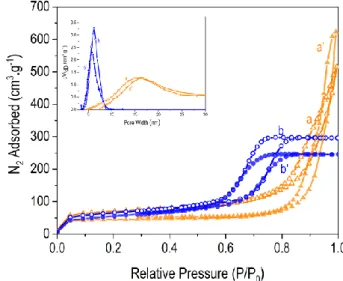
Ni5wt%-Al2O3-EISA materials, the isotherms are of type IV and show a hysteresis loop typical of the
presence of mesopores (Figure 1). However, the loops are quite distinct depending on the synthesis procedure, revealing different textural properties. For Ni5wt%-Al2O3-MOF (Figure 1a), the hysteresis
loop is of type H3, showing (i) a progressive increase of the adsorbed N2 volume at P/P0 higher than
0.75, (ii) a slit-type hysteresis spread over P/P0 values between 0.75 to 1 and (iii) an absence of
plateau at P/P0 between 0.9 and 1. This is characteristic of a layered material containing large
mesopores with a relatively polydisperse size distribution [15]. Such profile and the resulting BET specific surface of 240 m2·g−1 (S.A., Table 1) contrast with the conventional type I isotherms and very
high surface area (often above 500 m2·g−1) traditionally observed for organized high surface area
microporous MOF systems and specifically for MIL-53(Al) [16]. The presence of large mesopores in Ni5wt%-Al2O3-MOF is due to the organic linker degradation and simultaneous inorganic (alumina) oxide
formation that takes place during calcination of the impregnated MOF-based material at 500 °C (Scheme 1A, b,c).
Figure 1. N2 physisorption isotherms and pores sizes distribution (in inset) after degassing at 250 °C
The shape of the isotherm drastically differs for the Ni5wt%-Al2O3-EISA material that was prepared
in presence of amphiphilic block copolymers assemblies as structuring agent (see details on the one-pot EISA method in Section 3). Indeed, this sample exhibits a H1 hysteresis loop (between P/P0 =
0.57 and 0.80), indicative of uniform and well-organized cylindrical mesopores with an average pore diameter (Ø) and a pore volume (Vtot) smaller than in Ni5wt%-Al2O3-MOF (Table 1). Nevertheless, the
specific surface of Ni5wt%-Al2O3-EISA ((S.A = 230 m2·g−1, Table 1) is close to that of Ni5wt%-Al2O3-MOF. For
both samples, the porous characteristics are preserved after reduction at 800 °C (Figure 1 ’, ’) w however a small decrease of the specific surfaces and pore volumes easily explained by the high temperature treatment provoking some structural shrinkage (Table 1).
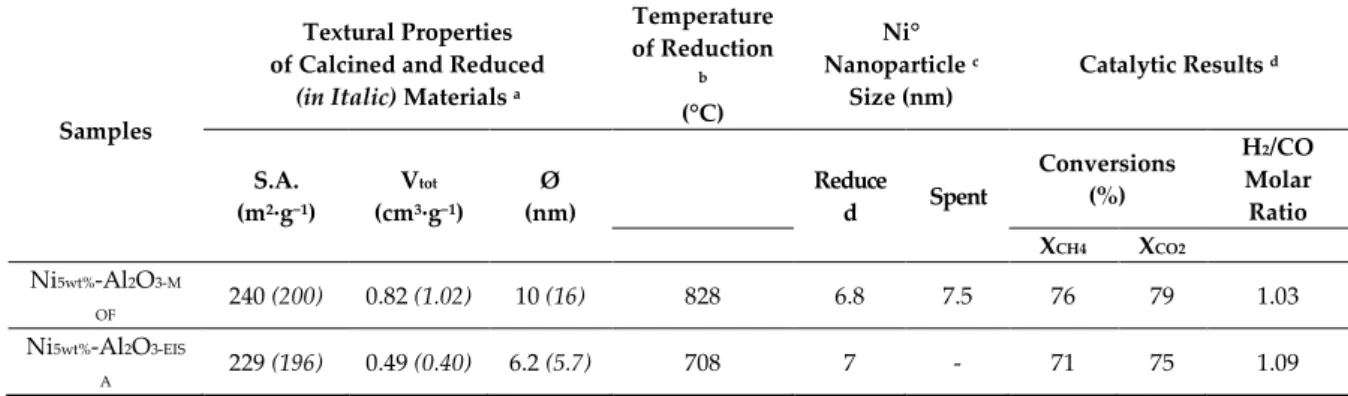
Table 1. Properties and catalytic performance of the Ni5wt%-Al2O3-MOF and Ni5wt%-Al2O3-EISA materials.
Samples
Textural Properties of Calcined and Reduced
(in Italic) Materials a
Temperature of Reduction b (°C) Ni° Nanoparticle c Size (nm) Catalytic Results d S.A. (m2·g−1) Vtot (cm3·g−1) Ø (nm) Reduce d Spent Conversions (%) H2/CO Molar Ratio XCH4 XCO2 Ni5wt%-Al2O3-M OF 240 (200) 0.82 (1.02) 10 (16) 828 6.8 7.5 76 79 1.03 Ni5wt%-Al2O3-EIS A 229 (196) 0.49 (0.40) 6.2 (5.7) 708 7 - 71 75 1.09
a: total surface area (S.A.), total pore volume (Vtot) and mean pore diameter (Ø) calculated from the N2
sorption isotherms. b: temperature at the maximum of TPR peaks. c: mean sizes of Ni0 nanoparticles
established from TEM histograms or from XRD patterns (in bracket). d: performance in dry reforming
of methane carried out at atmospheric pressure after 13 h at 650 °C and under a GHSV of 72 L.g−1·h−1.
Textural differences between the calcined Ni5wt%-Al2O3-MOF and Ni5wt%-Al2O3-EISA samples were
also confirmed by electron microcopy studies carried out in both scanning (Figure 2a,b) and transmission (Figure 2 ’, ’) d . F l , v w p f d l -thin microtomic sections in order to allow a correct identification of the porosities and of the nickel species expected to be present within the materials. In scanning mode, Ni5wt%-Al2O3-MOF depicts
slightly elongated aggregated nanograins with uniform sizes of approximately 20 nm in length (Figure 2a). STEM bright-field (STEM-BF) imaging shows that these grains are in fact constituted of fused ill-defined and defective alumina flakes composed of several randomly interwoven nanosheets (Figure 2 ’). T p l gy f lly g w l y d p c d d c d v f the isotherm. With respect to Ni5wt%-Al2O3-EISA, the grains observed at low magnification (SEM,
Figure 2b) seem to be bigger than in Ni5wt%-Al2O3-MOF, but a closer examination shows that they are
constituted of interconnected aggregates of small crystals containing ordered 2D p6mm hexagonal mesoporous channels. This is revealed by the pores’ apertures appearing on their surface (inset in Figure 2b) and by the very well resolved channels visible on STEM images visualizing alumina grains positioned with their channels either parallel (Figure 2 ’) or perpendicular (inset in Figure 2 ’) l c c . On the HR-TEM pictures; however, and despite the high resolution accessible on the used microscopes, nickel-based nanoparticles were never detected, neither in the pores nor in the alumina walls, and this was also the case in the Ni5wt%-Al2O3-MOF nanosheets. Since
nickel is known to be present in the two samples (because it was added during their synthesis), additional observations were made using the high angular dark field (STEM-HAADF) method which principle is to discriminate compounds with different atomic numbers (weights), thus helping to differentiate between the Ni (Z = 28) and Al (Z = 13) elements. The images thus recorded on the same zones as above (Figure 2 ”, ”) gly l d STE -BF mode (except for the reverse contrast due the specificity of each technique). Notably, they do not show any appearance of white spot that would have revealed local Ni enrichment or presence of NiO nanoparticles as is traditionally observed for such types of materials. This reveals an extremely high nickel dispersion within the alumina matrices, whatever the sample.
Figure 2. (a,b) SEM, (a’,b’) STEM-BF and (a”,b”) STEM-HAADF images of (a,a’,a”) Ni5wt%-Al2O3-MOF
and (b,b’,b”) Ni5wt%-Al2O3-EISA (calcined forms).
2.2. Evidence of a Nickel Aluminate Spinel Phase in the Calcined Materials
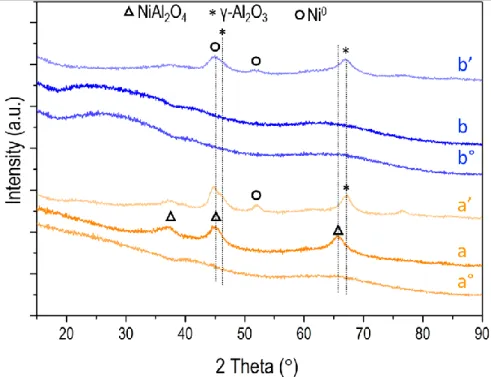
X-Ray diffraction was carried out to obtain information on crystalline phases present in the materials. The patterns of calcined Ni5wt%-Al2O3-MOF and Ni5wt%-Al2O3-EISA are shown in Figure 3
(curves a and b, respectively) together with those of their Ni-free Al2O3-MOF and Al2O3-EISA analogues
synthesized under the same conditions except for the absence of nickel (curves a° and b°, respectively). Both alumina supports (without Ni) displayed only very bro d d w k p k (2θ ranges 30–40° and 60–70°) assignable to amorphous alumina (Figure 3a°–b°). In the case of Ni5wt%-Al2O3-EISA, the addition of nickel did not affect the diffractogram (Figure 3b), indicating that
the formed Ni-based species were amorphous and/or highly dispersed. Together with above STEM data, this reveals that crystalline nickel nano-species, if present, have sizes below the size detection limit of the used equipment. In contrast, nickel addition provoked the appearance of few weak peaks 2θ f 37.0°, 44.9° d 65.5° when following the MOF-based synthesis route (Figure 3a). These positions slightly differ from the ones p c d f f c c d c c c ll f N O (2θ 37.2°, 43.1° and 62.8° for planes (111), (200) and (220), respectively, JCPDS: 01-071-4750) and rather correspond to a nickel aluminate NiAl2O4 spinel phase (JCPDS: 001-1299).
Figure 3. X-ray diffractograms of the prepared (a°,b°,a,b) calcined and (a’,b’) reduced materials: (a°) Al2O3-MOF, (b°) Al2O3-EISA, (a,a’), Ni5wt%-Al2O3-MOF and (b,b’) Ni5wt%-Al2O3-EISA.
Hence, the calcination step made to remove the organic linkers from the parent MOF material simultaneously induced a local structuring between the impregnated nickel ions and the aluminum hydroxyl nods brought close to each other within the MOF upon impregnation. Nickel aluminate is a crystalline spinel phase that belongs to a cubic system with Fd-3m space group and its structure consists of an ensemble of tetrahedral coordination occupied with bivalent Ni2+ and octahedral
coordination filled with trivalent Al3+ cations [17]. The formation of this phase relies on the diffusion
of Ni2+ and Al3+ at the interface between the metal oxides Al2O3 and the NiO formed at the early
stages of the thermal treatment. This cation diffusion is known to require a high energy input and NiAl2O4 is hence commonly obtained at temperatures above 550 °C [20]. The presence of such phase
in Ni5wt%-Al2O3-MOF although it was calcined only at 500 °C (the temperature used to decompose the
organic linker) is likely due to the close proximity between Ni2+ and the preformed AlO6 octahedra
composing the inorganic chains of the MOF framework that facilitates the cations diffusion and thereby decreases the energy of the spinel phase formation. The mean particle size of the crystalline NiAl2O4 domains estimated by Scherer equation in this MOF-based sample is around 4.6 nm, a little
bit smaller than the 5.1 nm NiAl2O4 crystallites reported earlier by Fan X. et al. in a study of a
mesoporous nickel-alumina material with 5 wt% Ni [21]. At this point, it can be added that such sizes keep rather small for species that contain both nickel and aluminum atoms, explaining why the Ni-based nanospecies could not be detected by TEM in the calcined materials, neither in Ni5wt%-Al2O3-MOF nor in Ni5wt%-Al2O3-EISA. Nevertheless, the presence of nickel and its homogeneous
distribution throughout the alumina matrices were totally confirmed by local TEM/EDS analyses in both calcined samples (data not detailed).
The presence of nickel and its content were also validated by temperature programed reduction (TPR) experiments during which oxidized nickel (Ni2+ ions or NiO) was transformed to Ni0 (the
active state for DRM). For both Ni5wt%-Al2O3-MOF and Ni5wt%-Al2O3-EISA samples, the TPR profiles
(Figure 4A) did not present any peak at temperatures below 500 °C where the reduction of bulk NiO deposited on alumina surfaces and weakly interacting with them is usually expected [11]. They rather exhibited a single and symmetric reduction peak at elevated temperature (above 700 °C) referring to the presence of nickel strongly interacting with the alumina support. The related H2
uptake was y c lly cl c l v l f 860 μ l·g−1 expected for 5 wt% Ni
Figure 4. (A) TPR profiles and (B) XPS spectra of samples (a) Ni5wt%-Al2O3-MOF and (b) Ni5wt%-Al2O3-EISA
(calcined forms).
The observed high reduction temperature fits well with the reduction of Ni2+ ions
homogeneously embedded into Al2O3 lattices and forming nanocrystalline NiAl2O4 spinel domains
[18,21,22] as depicted above by XRD. The slightly lower reduction temperature for Ni5wt%-Al2O3-EISA
compared to Ni5wt%-Al2O3-MOF, together with the absence of XRD peak for the former sample, might
indicate the formation of less structured or smaller mixed oxide species in the alumina walls of the hexagonally organized material, with slightly weakened nickel-alumina interaction. This might result from a higher nickel dispersion in the aqueous one-pot EISA synthesis medium than in the impregnated MOF sample, leading to especially well distributed and tiny (hence less structured) Ni-based species after calcination. Moreover, a further evidence of the formation of nickel aluminate spinel in the nickel alumina mixed layers or walls of the prepared materials is given by XPS spectra that show a main Ni2p3/2 peak centered at 856 eV accompanied by a shake-up satellite around 862 eV
(Figure 4B). Such positions confirm the formation of an intimate nickel-alumina oxide solution and exclude the presence of pure NiO which binding energy would be expected at 853 eV [23]. Besides, the quantitative analysis of XPS data confirmed as well the nickel content in both samples.
2.3. Resulting Ni0 Dispersion and Catalytic Performance of the Reduced Catalysts
Nickel, which was not visible in TEM images of calcined materials, became apparent after reduction, as visualized by the small dark spots contrasting with the grey color of the support in the TEM images of both reduced Ni5wt%-Al2O3-MOF (Figure 5a) and Ni5wt%-Al2O3-EISA (Figure 5b) catalysts.
For Ni5wt%-Al2O3-EISA, the Ni0 nanoparticles were very small, being hence better seen in HAADF mode
(Figure 5 ’) than in more conventional bright field mode (Figure 5b). The histograms of particle sizes established from high resolution TEM images after measuring the sizes of at least 500 nanoparticles led to mean Ni0 nanoparticles sizes of 6.8 and 7 nm in Ni5wt%-Al2O3-MOF and Ni5wt%-Al2O3-EISA,
respectively.
Figure 5. Micrographs of reduced (a) Ni5wt%-Al2O3-MOF and (b- ’) d c d Ni5wt%-Al2O3-EISA catalysts;
images recorded in (a) HR-TEM, (b) STEM-BF and (b’) STEM-HAADF modes.
B A
The presence of Ni0 nanoparticles in both reduced Ni5wt%-Al2O3-EISA (Figure 3 ’) and
Ni5wt%-Al2O3-MOF (Figure 3b’) was also demonstrated by X-ray diffraction. Thus, the patterns depicted
w d ff c p k c d 2θ = 44.5°, 51.9° d 76°, assignable to the (111), (200) and (220) planes of crystalline Ni0 (JCPDS: 04-850). Additional bands attributable to a structured
alumina-based phase appeared w ll, w p c c c f p γ-Al2O3 (identified by
an asterisk), and they substituted those of crystalline nickel aluminate present before reduction. Put together, these observations can be interpreted by a Ni2+ extraction from the oxide matrix towards
the pore surface during nickel reduction followed by an aggregation in the form of Ni0
nanoparticles. The mean Ni0 nanoparticle sizes estimated by applying the Scherrer equation to the
Ni0 fl c 2θ = 51.9° (c c f v l pp g w y g l) w 5
and 6 nm in both reduced Ni5wt%-Al2O3-MOF and Ni5wt%-Al2O3-EISA, which is in the range—even though
slightly below - the above values established from HR-TEM observations. This may be due to the uneasy identification of very small nanoparticles by microscopy.
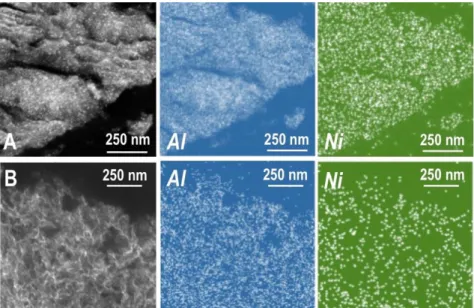
Importantly, all detected nickel nanoparticles appear homogeneously distributed over the alumina matrices (Figure 5) and this is further illustrated by STEM/EDS mappings that show Ni and Al elemental superimpositions in both catalysts (Figure 6). The alumina grains still appear as interwoven nanosheets in Ni5wt%-Al2O3-MOF (Figure 5a) and as hexagonally arranged mesoporous
parallel channels in Ni5wt%-Al2O3-EISA (Figure 5b). This preservation of morphologies after reduction is
also attested by textural properties, the N2 physisorption isotherm still showing type IV isotherms
with a slit-like hysteresis typical of a layered material composed of poorly organized interlayered pores for reduced Ni5wt%-Al2O3-MOF (Figure 1 ’) d w ll-defined H1 hysteresis loop for reduced
Ni5wt%-Al2O3-EISA resembling that before reduction (Figure 1 ’). T ll d c f c
reveals however some structural shrinkage due to the harsh high temperature reduction treatment (Table 1).
Figure 6. STEM (left images) and EDS mappings of Al (middle) and Ni (right) elements for representative grains of reduced (A) Ni5wt%-Al2O3-MOF and (B) Ni5wt%-Al2O3-EISA.
The performance of the reduced catalysts in dry reforming of methane carried out at atmospheric pressure, 650 °C and under a high space velocity (GHSV = 72 L·g−1·h−1) are given in
Table 1 as reactants conversions (CH4 and CO2) and H2/CO products ratio. With both catalysts,
conversions were remarkable, close to thermodynamic equilibrium, and higher by approximately 3 times than on a reference Ni-alumina catalyst prepared by a conventional wetness impregnation method and tested for comparison in the same conditions [12]. This is not only due to the excellent Ni0 dispersion providing a high number of active sites within the mesoporous Ni-alumina-based
catalysts (as also confirmed by H2-TPD, data not shown) but also to the high accessibility to the
CO2 compared to those of CH4 and the concomitant H2:CO products ratios slightly above 1 reveal the
occurrence of two side reactions frequently encountered at such high reaction temperatures, namely reverse water gas shift (RWGS, consuming CO2 and H2 to produce CO and H2O) and methane
decomposition (producing 2H2 per CH4 converted). Their extent was however limited and the
catalysts are especially stable, with no loss of activity and product selectivity when the catalytic tests are prolonged during 13 h (data not detailed).
To sum up, and considering all these data, it can be proposed that the improved stability of the Ni2+ ions isolated within nickel aluminate nanodomains in the calcined mesoporous materials with
high specific surface slows down their extraction from the support during the reducing step, thus contributing to the formation of numerous tiny Ni0 nuclei that grow on the alumina surface at a
limited extent to give small nanoparticles instead of a few nuclei evolving as large metal particles. The improved stability of these highly dispersed Ni0 nanoparticles should rely on the occurrence of a
certain amount of remaining nickel aluminate or related phases at the interface between the metal nanoparticle and the oxide support affording a particularly strong chemical interaction and hence c g “gl ” w p cl d l pp . I d d NiAl2O4 can be altered when
Ni2+ partially adopts octahedral site while the tetrahedral site hosts Al3+ together with Ni2+ ions
resulting in compounds of inverse spinel structure known as Ni1−x[NixAl2−x]O4 where 0 < x < 1. This
structure flexibility at the metal-support interface may enhance the interaction between Ni and the support, restrict the aggregation of metallic Ni sites, and increase their dispersion as mentioned in previous works [21,24,25]. In the conditions of DRM reaction, this inhibits not only nickel sintering but also the potential formation of carbon nanotubes which growth necessitates the presence of weakly attached reduced nickel particles able to move far away from the support itself by being embedded at the tip of the nanotubes while these nanotubes form [26]. We can also speculate that the nickel aluminate domains inserted in the nanostructured calcined intermediates as well as their resulting Ni0 active nanoparticles are all located on (or close to) the high area mesoporous surfaces,
being hence easily accessible to reactants during the reaction. 3. Materials and Methods
For the MOF-based preparation, a parent Al containing MIL-53(Al) sample (MOF family) was chosen and synthetized according to the method of Isaeva V. et al. [27]. Briefly, 1.21 g of AlCl3·6H2O
and 0.42 g of benzene-1,4-di-carboxylic acid were dissolved in a solution made of 3 mL water and 5 mL dimethylformamide (DMF). The mixture was transferred into a 50 mL tubular reactor and heated in a microwave oven for 30 min at 125 °C and a power of 200 W. The formed crystalline product was washed 6 times with 10 mL of DMF followed by rinsing with 10 mL of deionized water, and recovered each time by centrifugation. After drying for 24 h at 70 °C, the sample was calcined in air at 220 °C for 72 h to remove adsorbates from the pores, then impregnated with a Ni(NO3)2·6H2O
aqueous solution as to obtain a final nickel content of 5 wt%, and finally heated in a muffle furnace (thin bed conditions) at a rate of 0.5 °C·min−1 till keeping the temperature at 500 °C for 5 h (sample
Ni5wt%-Al2O3-MOF). For comparison, a reference Ni-free alumina sample was similarly synthesized
except for the impregnation step (sample Al2O3-MOF).
The other organized mesoporous catalyst was synthesized in presence of nickel ions using a one-pot evaporation induced self-assembly (EISA) method [13,28,29] as follows. 1 g of P123 Pluronic triblock copolymer was dissolved in 20 mL of absolute ethanol at ambient temperature (25 °C) under intense stirring, then 1.6 mL of HNO3, 5 mmol of Al[OCH(CH3)2]3 and 5 mmol of Ni(NO3)2·6H2O
were added still under stirring. The obtained mixture was covered with a polyethylene film (PE) and stirred overnight to reach a complete dissolution of the chemicals. Next, the solution was dried for 48 h at 60 °C to slowly evaporate ethanol and HNO3. The resulted Xerogels were finally calcined as
above at 500 °C under static air for 5 h (sample Ni5wt%-Al2O3-EISA). Again, a reference Ni-free alumina
material was prepared following the same procedure but without Ni addition (sample Al2O3-EISA).
N2 adsorption-desorption isotherms were recorded at −196 °C on an ASAP 2020 Micromeritics
apparatus. After insertion in the analysis tube, the sample was degassed under vacuum for 2 h at 250 °C then placed at liquid nitrogen temperature before plotting the N2-isotherm. Specific surfaces were
calculated from BET equation at a relative pressure between 0.05 and 0.25. The corresponding single point pore volumes were obtained from the sorption branch at a relative pressure of 0.99. Pore size distributions were calculated based on the BJH formula which was applied on the desorption branch.
Scanning Electron Microscopy (SEM) images were registered in mixed mode (70% secondary electrons and 30% retro-diffused signals) on a Hitachi SU-70 SEM-FEG microscope with an electron acceleration tension of 7 kV. High-Resolution transmission electron microscopy observations were done on 50–70 nm sections of the samples prepared by microtomic cutting as detailed elsewhere [12,13]. The TEM micrographs and EDS elemental mappings were registered on a JEOL-JEM 2020 electron microscope with LaB6 gun. The STEM images were acquired on a JEOL ARM 200F instrument (JEOL Ltd, Tokyo, Japan) operated at 200 kV as well, but equipped with a FEG source and an aberration corrector of the objective lens. The probe setting in STEM mode was 8c. The c d l p z d c l d w 30 μ d 6 c p c v ly. W settings, the corresponding convergence semiangle was 12 mrad, and the inner and outer collection semiangles on the STEM-HAADF detector were 90 and 390 mrad, respectively. Average sizes of nickel particles, when visible, were estimated using the ImageJ software and taking at least 500 particles into consideration.
Powder X-r y d ff c (XRD) w p f d 2θ g 20–90°on a AN ly c l X 3 d ff c g C Kα d (λ = 1.5405 nm), a voltage of 30 Kv, a current of 10 mA and a time step of 2 s. Known ICDD powder XRD files were used to identify crystalline phases and mean sizes of crystalline domains (nanoparticles) were calculated using the Sc ’ D kl = Kλ/βc θ, w K p f c f v g p c l c y ll , λ w v l g (1.5405 f C Kα), β f ll w d lf (FWH ) d θ peak position.
Hydrogen temperature programmed reduction (H2-TPR) was operated on an Autochem 2920
c c . A c (≈70 g) f c lc d pl w p U-shaped quartz reactor and heated (10 °C·min−1) from ambient temperature up to 900 °C under 25 mL·min−1 of 5 vol%
H2/Ar. The amount of H2 consumed was determined by TCD after passing the effluent gas in a tube
placed in a bath composed of ice and NaCl to trap any possible water formed during reaction (H2(g)+NiO(s)→ Ni0(s)+H2O(g)) and thus assert on the sole detection of H2 consumption.
XPS spectra were obtained on an Omicron (ESCA+) X-ray photoelectron spectrometer with an Al Kα ( ν = 1486.6 eV) X-ray source with a 300 W electron beam power. The sample was evacuated under a vacuum of less than 10-10 mbar, then a monochromatic X- y (Al Kα) d d pl
and excited the electrons. Surface compositions were determined by attributing the observed energy peaks to a specific element and quantifying their area using the Casa XPS software.
Stability tests during dry methane reforming reaction were conducted in a fixed bed reactor after in situ reduction of the calcined material at 800 °C for 2 h (heating rate 5 °C·min−1) under 30
mL·min−1 of 5 vol% H2/Ar. The tests were carried out at 650 °C and atmospheric pressure for 10 h
under a flowing reactant gas composed of an equimolar amount of CH4 and CO2 diluted in Ar
(atomic ratio 5/5/90). The hourly space velocity (GHSV) was chosen equal to 72 L·g−1·h−1 from
previous measurements [17,20]. Catalytic performance was established from the gas composition at the exit of the reactor monitored with an INFICON micro GC along with a TCD and two parallel channels (Molecular sieve and Plot U). The data are expressed as reactants (CH4 and CO2)
conversions and products (H2 and CO) mole ratios. 4. Conclusions
In view of this work, key features for preparing nickel alumina catalysts with high efficiency and stability for dry reforming of methane consists of: (i) preparing a nanostructured mesoporous hybrid material within which nickel cations efficiently dispersed in contact with the alumina precursors, (ii) calcining the material to remove the organic part (linkers or structuring agents) and finally (iii) reducing at high temperature (above 700 °C) to form small and stable Ni0 nanoparticles
dispersed within the alumina after the step of calcination tend to form small and homogeneously distributed nickel aluminate (NiAl2O4) nanodomains that are embedded within the high specific
surface area oxide matrix. Upon reduction, these NiAl2O4 nanospecies play a key role by boosting
the metal-support interaction that persists even after Ni0 extraction towards the alumina surface,
possibly because of the presence of a remaining mixed-metal phase at the metal-support interface. This stabilizes the supported Ni0 against sintering and protects the catalysts against development of
carbon nanotubes usually formed on external weakly anchored Ni0 particles.
Author Contributions: Conceptualization, J.R., N.E.H. and P.M.; Investigation, L.K. and J.R.; Methodology, J.N.; Project administration, P.M.; Supervision, N.E.H. and P.M.; Writing–original draft, L.K., J.R. and P.M. Funding: This research received funding through the SOL-CARE project (Energy-065, ERANETMED JC-Energy-2014 call) involving the European FP7 program, the national ANR (France) and CNRS-L (Lebanon) agencies and the UOB Research Council. Electron Microscopy studies also benefited from a financial support from the CNRS-CEA “ ETSA” F c w k (FR CNRS 3507) g v g cc pl f .
Acknowledgments: The authors are grateful to Sandra Casale and Antoine Miche from LRS (Laboratoire de Réactivité de surface) for their respective contributions regarding electron microscopy and XPS experiments. Conflicts of Interest: The authors declare no conflict of interest.
References
1. El Hassan, N.; Kaydouh, M.N.; Geagea, H.; El Zein, H.; Jabbour, K.; Casale, S.; El Zakhem, H.; Massiani, P. Low temperature dry reforming of methane on rhodium and cobalt-based catalysts: Active phase stabilization by confinement in mesoporous SBA-15. Appl. Catal. A Gen. 2016, 520, 114–121. doi:10.1016/j.apcata.2016.04.014.
2. Talyan, V.; Dahiya, R.P.; Anand, S.; Sreekrishnan, T.R. Quantification of methane emission from municipal solid waste disposal in Delhi. Resour. Conserv. Recycl. 2006, 50, 240–259. doi:10.1016/j.resconrec.2006.06.002. 3. Lavoie, J.; Labiano, F.G. Review of dry reforming of methane, a potentially more environmentally friendly approach to the increasing natural gas exploitation. Front. Chem. 2014, 2, 1–17. doi:10.3389/fchem.2014.00081
4. Pakhare, D.; Spivey, J. A review of dry (CO2) reforming of methane over noble metal catalysts. Chem. Soc.
Rev. 2014, 43, 7813–7837. doi:10.1039/c3cs60395d
5. M.C.J. Bradford, M.A. Vannice, CO2 Reforming of CH4. Catal. Rev. 1999, 41, 1–42.
doi:10.1081/CR-100101948. doi:10.1081/CR-100101948
6. Rostrup-Nielsen, R.; Hansen, J.B. CO2-reforming of methane over transition metals. J. Catal. 1993, 144,
38–49. doi:10.1006/jcat.1993.1312
7. Zhang, Z.L.; Verykios, X.E. Carbon dioxide reforming of methane to synthesis gas over supported Ni catalysts. Catal. Today 1994, 21, 589–595. doi:10.1016/0920-5861(94)80183-5
8. Karam, L.; El Hassan, N. Advantages of mesoporous silica-based catalysts in methane reforming by CO2
from kinetic perspective. J. Environ. Chem. Eng. 2018, 6, 4289-4297. doi:10.1016/j.jece.2018.06.031
9. Mahoney, E.G.; Pusel, J.M.; Stagg-Williams, S.M.; Faraji, S. The effects of Pt addition to supported Ni catalysts on dry (CO2) reforming of methane to syngas. J. CO2 Util. 2014, 6, 40–44.
doi:10.1016/j.jcou.2014.01.003
10. Wang, S. Lu, G.Q.M.; Millar, G.J. Carbon Dioxide Reforming of Methane To Produce Synthesis Gas over Metal-Supported Catalysts: State of the Art. Energy Fuels 1996, 896–904. doi:10.1021/ef950227t
11. Karam, L.; Casale, S.; El Zakhem, H.; El Hassan, N. Tuning the properties of nickel nanoparticles inside SBA-15 mesopores for enhanced stability in methane reforming. J. CO2 Util. 2017, 17, 119–124.
doi:10.1016/j.jcou.2016.12.002
12. Karam, L.; Reboul, J.; Casale, S.; El Hassan, N.; Massiani, P. Porous nickel-alumina derived from metal-organic framework (MIL-53): A new approach to achieve active and stable catalysts in methane dry reforming. ChemCatChem. 2019. doi:10.1002/cctc.201901278
13. Jabbour, K.; Massiani, P.; Davidson, A.; Casale, S.; El H , N. O d d p “ -p ” synthesized Ni-Mg (Ca)-Al2O3 as effective and remarkably stable catalysts for combined steam and dry
reforming of methane (CSDRM). Appl. Catal. B Environ. 2017, 201, 527–542. doi:10.1016/j.apcatb.2016.08.009 14. Zhang, L.; Zhang, Q., Liu, Y.; Zhang, Y. Dry reforming of methane over Ni/MgO-Al2O3 catalysts prepared
15. Thommes, M.; Kaneko, K.; Neimark, A. V.; Olivier, J.P.; Rodriguez-Reinoso, F.; Rouquerol, J.; Sing, K.S.W. Physisorption of gases, with special reference to the evaluation of surface area and pore size distribution (IUPAC Technical Report). Pure Appl. Chem. 2015, 87, 1051–1069. doi:10.1515/pac-2014-1117
16. Loiseau, T.; Serre, C.; Huguenard, C.; Fink, G.; Taulelle, F.; Henry, M.; Bataille, T.; Férey, G. A Rationale for the Large Breathing of the Porous Aluminum Terephthalate (MIL-53) Upon Hydration. Chem. A Eur. J. 2004, 10, 1373–1382. doi:10.1002/chem.200305413
17. Nazemi, M.K.; Sheibani, S.; Rashchi, F.; Gonzalez-Delacruz, V.M.; Caballero, A. Preparation of nanostructured nickel aluminate spinel powder from spent NiO/Al2O3 catalyst by mechano-chemical
synthesis. Adv. Powder Technol. 2012, 23, 833–838. doi:10.1016/j.apt.2011.11.004
18. Zhan, Y. ; Han, J.; Bao, Z.; Cao, B.; Li, Y.; Street, J.; Yu, F. Biogas reforming of carbon dioxide to syngas production over Ni-Mg-Al catalysts. Mol. Catal. 2017, 436, 248–258. doi:10.1016/j.mcat.2017.04.032
19. Margossian, T.; Larmier, K.; Kim, S.M., Krumeich, F.; Fedorov, A.; Chen, P., Müller, C.R., Copéret, C. Molecularly Tailored Nickel Precursor and Support Yield a Stable Methane Dry Reforming Catalyst with Superior Metal Use. J. Am. Chem. Soc. 2017, 139, 6919–6927. doi:10.1021/jacs.7b01625
20. Gonçalves, A.A.S.; Costa, M.J.F.; Zhang, L.; Ciesielczyk, F.; Jaroniec, M. One-Pot Synthesis of MeAl2O4 (Me
= N , C , C ) S pp d γ- Al2O3 with Ultralarge Mesopores: Enhancing Interfacial Defects in
γ-Al2O3 to Facilitate the Formation of Spinel Structures at Lower Temperatures. Chem. Mater. 2018 30,
436–446. doi:10.1021/acs.chemmater.7b04353
21. Fang, X.; Peng, C.; Peng, H.; Liu, W.; Xu, X.; Wang, X.; Li, C.; Zhou, W. Methane Dry Reforming over Coke-Resistant Mesoporous Ni-Al2O3 Catalysts Prepared by Evaporation-Induced Self-Assembly Method.
ChemCatChem 2015, 7, 3753–3762. doi:10.1002/cctc.201500538
22. Wang, N.; Shen, K.; Huang, L.; Yu, X.; Qian, W.; Chu, W. Facile route for synthesizing ordered mesoporous Ni-Ce-Al oxide materials and their catalytic performance for methane dry reforming to hydrogen and syngas. ACS Catal. 2013, 3, 1638–1651. doi:10.1021/cs4003113
23. Xu, L.; Zhao, H.; Song, H.; Chou, L. Ordered mesoporous alumina supported nickel-based catalysts for carbon dioxide reforming of methane. Int. J. Hydrogen Energy 2012, 37, 7497–7511.
doi:10.1016/j.ijhydene.2012.01.105
24. Charisiou, N.D.; Baklavaridis, A.; Papadakis, V.G.; Goula, M.A. Synthesis gas production via the biogas reforming reaction over Ni/MgO-Al2O3 and Ni/CaO-Al2O3 catalysts. Waste Biomass Valorization 2016, 7,
725–736. doi:10.1007/s12649-016-9627-9
25. Hou, Z.; Yashima, T. Meso-porous Ni/Mg/Al catalysts for methane reforming with CO2. Appl. Catal. A Gen.
2004, 261, 205–209. doi:10.1016/j.apcata.2003.11.002
26. Le Saché, E.; Pastor-Pérez, L.; Watson, D.; Sepúlveda-Escribano, A.; Reina, T.R. Ni stabilised on inorganic complex structures: superior catalysts for chemical CO2 recycling via dry reforming of methane. Appl.
Catal. B Environ. 2018, 236, 458–465. doi:10.1016/j.apcatb.2018.05.051
27. Isaeva, V.I.; Tarasov, A.L.; Chernyshev, V. V., Kustov, L.M. Control of morphology and size of microporous framework MIL-53(Al) crystals by synthesis procedure. Mendeleev Commun. 2015, 25, 466–467. doi:10.1016/j.mencom.2015.11.023
28. Morris, S.M.; Fulvio, P.F.; Jaroniec, M. Ordered mesoporous alumina-supported metal oxides. J. Am. Chem.
Soc. 2008, 130, 15210–15216. doi:10.1021/ja806429q
29. Yuan, Q.; Yin, A.-X.; Luo, C.; Sun, L.-D.; Zhang, Y.-W.; Duan, W.-T.; Liu, H.-C.; Yan, C.-H. Facile Synthesis for Ord d p γ-Aluminas with High Thermal Stability. J. Am. Chem. Soc. 2008, 130, 3465–3472. doi:10.1021/ja0764308