DOI: 10.2110/palo.2009.p09-036r
LATE HOLOCENE HYDROLOGIC AND VEGETATION CHANGES AT TURNEFFE ATOLL, BELIZE,
COMPARED WITH RECORDS FROM MAINLAND CENTRAL AMERICA AND MEXICO
MATTHEW J. WOOLLER,1,2* HERMANN BEHLING,3JUAN LEON GUERRERO,4NELE JANTZ,3and MARTIN E. ZWEIGERT3
1Alaska Stable Isotope Facility, Water Environmental Research Center, University of Alaska Fairbanks, Fairbanks, Alaska 99775, USA;2School of Fisheries and Ocean
Sciences, University of Alaska Fairbanks, Fairbanks, Alaska 99775, USA;3Department of Palynology and Climate Dynamics, Albrecht-von-Haller-Institute for Plant
Sciences, University of Go¨ttingen, Untere Karspu¨le 2, 37073 Go¨ttingen, Germany;4Biology and Wildlife, University of Alaska Fairbanks, Fairbanks, Alaska 99775, USA
e-mail: [email protected]
ABSTRACT
We present pollen and stable isotope (d13C, d18O, d15N) data from a ,4 m core (TNF-1) of primarily mangrove peat taken from Turneffe Atoll, Belize. Radiocarbon (accelerator mass spectrometry) dates show that the record represents ca. 5000 years of sediment accumulation. Vegetation composition varied between dominant mangroves (primarily Rhizophora mangle) and Chenopodiaceae-Amaranthaceae, most likely Salicornia bigelovii. The pollen data, along with inferences from stable isotope analyses of bulk peat and fossil leaf fragments, indicate that marked environmental changes occurred at this location over the past ca. 5000 years. There was a transition between ca. 4100 and 2900 cal yr BP, from vegetation dominated by relatively tall mangroves (R. mangle) to one dominated by Chenopodiaceae-Amaranthaceae and then Myrica, most likely wax myrtle (M. cerifera). These changes bracket a period centered at ca. 3500 calibrated years before present, where there is a peak in the d18O of mangrove leaf fragments. This timing corresponds with other paleoenvironmental records of climate drying in Central America and increases the geographic and habitat scope (i.e., mangrove habitat) of records documenting these changes. Interpretations of shifts in mangrove habitat, however, require consideration of additional environmental influences, including changes in groundwater hydrology and relative inputs of seawater and freshwater (i.e., precipitation) during the Holocene.
INTRODUCTION
The primary goal of this research was to examine the vegetation history of a mangrove site on the Turneffe Islands, Belize. Previous studies of the paleoecology of mangrove ecosystems in Belize have largely been restricted to cays inside the Belize Barrier Reef (Wooller et al., 2004, 2007). Research at the Turneffe Islands (Gischler and Hudson, 1998; Gischler and Lomando, 1999; Gischler, 2003; Gischler et al., 2003) identified mangrove peat and reported that mangrove ecosystems developed at the Turneffe Atoll beginning ca. 6000 cal yr BP (calibrated years before present) (Gischler and Hudson, 1998; Gischler, 2003). This body of research, however, did not document the paleoecological changes that took place in the vegetation that developed on the atoll. We present paleoenvironmental data from a dated (basal age ca. 6100 cal yr BP) ,4 m peat core (core TNF-1) from a mangrove habitat on the Turneffe Atoll. Accelerator mass spectrometry (AMS) radiocarbon measurements of material preserved in the core were used to determine the timing of observed changes throughout the sequence and to allow comparison with other paleoecological studies in Central America. Pollen analyses of samples from the core illustrate vegetation dynamics. Elemental (carbon and nitrogen) composition was combined with stable isotope analyses of
total organic matter (d15N, d13C) and mangrove leaf fragments (d15N, d13C, d18O) to infer past environmental conditions at the site. Relatively high d15N values of sediment and leaves in mangrove ecosystems can indicate the input of an organic nitrogen source, such as bird guano (Wooller et al., 2003a). Lower d15N values can be used to infer the stand structure of mangroves, with very negative values (, ,23%o) indicating the uptake of atmospheric ammonia by mangroves that are nutrient limited (e.g., phosphorus) (Fogel et al., 2008). The d13C values of mangrove leaves can be used to infer mangrove stand structure (Wooller et al., 2003b, 2004, 2007), with relatively low d13C values (# ,227%o) typical of tall mangroves (McKee et al., 2002; Wooller et al., 2003b). In addition to indicating low stand structure, higher d13C values in mangrove leaves can result from increased photosynthetic water-use efficiency (PWUE), as, for example, in more saline conditions (Lin and Sternberg, 1992a, 1992b, 1992c). In previous paleoenvironmental studies of mangrove peat, these types of analyses have usually been restricted to mangrove leaves preserved in peat (Wooller et al., 2004, 2007; Monacci et al., 2009). Here we investigate whether long-term trends in the d13C and d15N of mangrove leaves are also reflected in the total organic matter (TOM) of mangrove peat. We have used d18O values from analyses of mangrove leaves to infer the source water available to mangroves (Sternberg and Swart, 1987; Lin and Sternberg, 1994; Wooller et al., 2007; Monacci et al., 2009), and to this end, we analyzed d18O in preserved mangrove leaves from core TNF-1.
STUDY SITE
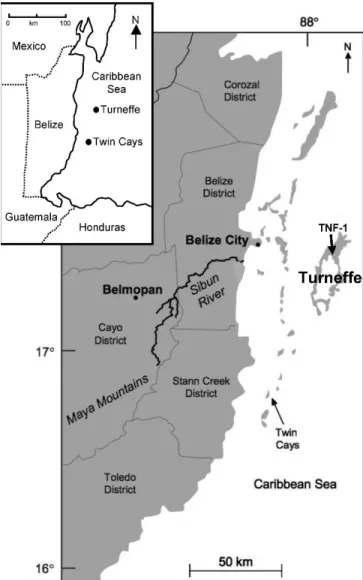
The Turneffe Islands are surrounded by deep water and have a breakwater reef encircling a main lagoon (Fig. 1). Mangrove species that encircle the central lagoon, which is ,8 m deep (Gischler, 2003), include Rhizophora mangle L. (red mangrove), Laguncularia racemosa (L.) Gaertn. f. (white mangrove), and Avicennia germinans (L.) Stearn (black mangrove). Also present on the northern end of Turneffe are other tree species, including Myrica cerifera L. along with other littoral woodland species, palms, and Conocarpus erecta L. (Murray et al., 2003). At our coring site, the vegetation consisted exclusively of dwarf R. mangle. Other plants present included epiphytic ferns and orchids. The geological setting of the Turneffe Islands has been described previously (Gischler and Hudson, 1998; Gischler and Lomando, 1999; Gischler, 2003; Gischler et al., 2003). In brief, the general facies succession begins with a basal soil overlying Pleistocene limestone, and is followed by mangrove peat and carbonate sediments (Gischler, 2003). One of the objectives of this study was to provide the longest paleoecological record from a mangrove habitat in the Turneffe Islands. We therefore used the sedimentary geological analyses of Gischler (2003) to guide selection of our coring location. We selected a location near the site of a previous core that yielded continuous mangrove peat (Gischler, 2003, core location T17) and * Corresponding author.
seemed to have sustained mangroves for the longest period at Turneffe.
METHODS
An Eijkelkamp Russian peat corer was used to obtain a 440-cm-long, continuous core (TNF-1) that was composed primarily of peat. Core sections, up to 50 cm, were wrapped in plastic, and kept in coolers at the Spanish Bay Conservation and Research Center on Spanish Lookout Cay. Sections were transported to the Water and Environ-mental Research Center (WERC) at the University of Alaska Fairbanks (UAF), where they are archived at ,4uC.
AMS radiocarbon measurements (14C) were made on wood pieces, macroscopic mangrove roots, and bulk peat at the National Ocean Sciences Accelerator Mass Spectrometry Facility (NOSAMS) at Woods Hole Oceanographic Institute (WHOI). All14C dates were calibrated using CALIB 5.0.2 and rounded to the nearest decade.
Pollen Analysis
All pollen preparation and analytical procedures were performed in the Department of Palynology and Climate Dynamics, University of Go¨ttingen. At #20 cm intervals, a 1 cm3sample was prepared using previously described methods (Wooller et al., 2004, 2007). One tablet of exotic Lycopodium spores (18,583 6 762 spores/tablet) was added prior
to processing to calculate pollen concentrations (grains/cm3). Samples were mounted in glycerin gelatin medium. At least 300 pollen grains were identified for each pollen sample, with a few exceptions that were counted to .100 due to low pollen concentrations. Pollen grains were identified using previously published procedures (Wooller et al., 2004, 2007). Pollen data are reported as percentages of the total pollen sum, which excludes aquatic taxa, fern and fungal spores, and microfor-aminifera. Pollen diagrams were created and zoned using TILIA, TILIAGRAPH, and CONISS (Grimm, 1987).
Elemental (C and N) and Stable (C, N, O) Isotope Analyses Bulk peat samples were freeze dried, ground, and acidified with 2 N HCl to remove carbonate in preparation for elemental and stable isotopic analyses of TOM. Mangrove leaf fragments were also picked from bulk peat at points throughout the core for stable isotope analyses. Stable isotope analyses were performed at the Alaska Stable Isotope Facility (ASIF) at UAF and reported in standard delta (d) notation (%o). Due to the low organic content of the basal portion of core TNF-1, larger sample masses (2–3 mg) were used to yield reliable stable isotope data. Elemental composition (%C and %N, wt. %) and stable isotope ratios (d13C and d15N, %o) were measured using a Costech Instruments Elemental Analyzer (EA) coupled with a Conflo III and a Thermo Electron Delta V Plus Isotope Ratio Mass Spectrometer (IRMS). The d13C values are reported relative to Vienna Pee Dee Belemnite (VPDB), and the d15N values are reported relative to atmospheric nitrogen. Peptone was used as a reference standard to determine analytical precision (defined here as 1 standard deviation on 15 replicate analyses of peptone throughout the analytical run): 0.9% (wt. %N), 2.8% (wt. %C), 0.5%o(d15N), and 0.3%o(d13C). The d18O of leaf fragments from core TNF-1 was analyzed using a previously published protocol and instrumentation (Wooller et al., 2007). The d18O data are expressed relative to Vienna Standard Mean Ocean Water (VSMOW). Benzoic acid (C7H6O2) was used to determine analytical precision (defined here as 1 standard deviation resulting from n 5 10 analyses of benzoic acid) associated with d18O and %O analyses for each run, which were 0.4%oand 2%, respectively.
RESULTS
All data from core TNF-1 are presented relative to four pollen zones: TNF-I (375–260 cm), TNF-II (260–210 cm), TNF-III (210–135 cm), and TNF-IV (135–0 cm). These zones were established through a Constrained Incremental Sum of Squares (CONISS) analysis per-formed in TILIA using the pollen data.
Chronology and Sediment Characteristics
Table 1 presents the AMS radiocarbon data (14C) and their corresponding calibrated dates and ranges. Ages for all depths of core TNF-1 and sedimentation rates were interpolated using four linear equations between calibrated AMS radiocarbon dates. The age at the top of the core (0–1 cm) is assumed to be modern: 255 cal yr BP. The lithology of core TNF-1 is divided into two main parts, with the bottom ,60 cm composed of grey mud with a few fine plant macrofossils and the upper portion composed of reddish-brown to brown peat. Basal rock was encountered at the bottom of the sequence. The thickness of the peat is consistent with previous data from Turneffe (Gischler, 2003). The boundaries between the pollen zones (TNF-I to TNF-IV) are at 4100, 3900, and 3300 cal yr BP, respectively (Fig. 2).
Pollen, Elemental, and Stable Isotope Analyses
Pollen Zone TNF-I (6100–4100 cal yr BP).—Poor pollen preserva-tion in the basal porpreserva-tion (440–380 cm) of the core, which was composed FIGURE 1—Site map of coring location (core TNF-1) at Turneffe, Belize.
FIGURE 2—Summary (A) and percentage (B) pollen diagrams for core TNF-1 from Turneffe (cal yr BP 5 calibrated years before present).
TABLE 1—AMS radiocarbon dates, analyzed at National Ocean Sciences Accelerator Mass Spectrometry Facility (NOSAMS) for core TNF-1 from the Turneffe Atoll, Belize. NOSAMS
accession number Material dated Depth (cm) 14C yr BP Age error
Calibrated age yr BP
Calibrated age range yr BP (2 sigma)
OS-65273 Peat 73.5 2480 30 2540 2366–2718
OS-65271 Wood 224.5 3720 30 4070 3990–4150
OS-66026 Fine roots 295.5 3750 45 4120 3994–4242
of mud with low organic carbon content (,10% C) (Fig. 3), prevented acquisition of reliable pollen data. The pollen profile in Figure 2 begins at ca. 5300 cal yr BP. The zone begins with a number of pollen types including Hippocratea, Ilex, Apocynaceae, and Poaceae, along with fern spores. The percentage composition of pollen in zone TNF-I consists primarily of Rhizophora pollen, which declined from ,35% near the start of the zone to ,10% at the end of the zone, along with ChenoAm (Chenopodiaceae-Amaranthaceae pollen, which increased from ,45% at the start of the zone to ,80% at the end of the zone. Microforaminifera were present in very low numbers, and bulk sedimentation during this pollen zone was relatively low (0.07 cm/yr). Mud at the base of the core had low total nitrogen (Fig. 3) that had a relatively high d15N value, up to 6%o(Fig. 4). The d13C composition of the TOM was relatively constant throughout the zone, with a mean of 227%o(sd 5 0.2%o) (Fig. 4). The d13C data from TOM tracked the d13C data derived from mangrove leaf fragments throughout the entire core (Fig. 5), yielding a strong positive linear relationship (R250.72). No significant relationship was evident for d15N analyses of TOM and
leaf fragments (R250.07), although the range of d15N variation in the entire core was considerably less than the range of d13C values. The d13C findings have significance for future isotope studies of mangrove peat. In the past, d13C analyses of mangrove peat have been restricted to preserved leaf fragments (Wooller et al., 2004, 2007), but it is time-consuming to remove and prepare leaf fragments. These findings show that d13C analyses of TOM in mangrove peat cores provides the same paleoecological information as data derived from fossil mangrove leaf fragments.
Pollen Zone TNF-II (4,100–3,900 cal yr BP).—Pollen zone TNF-II was marked by a slight increase in the percentage of Rhizophora pollen and a marked increase in the percentage of Melastomataceae pollen (Fig. 2). The percentage of ChenoAm pollen declined markedly at the start of the zone, at which point the percentage of Myrica type, Moraceae-Urticaceae, and Cyperaceae pollen also increased. Addition-al pollen types were evident during this zone, including Typha, Sagittaria, Poaceae, Hippocratea, Ilex, Pinus, and Fabaceae. These changes in pollen occurred during a period when the sedimentation rate increased ($0.5 cm/yr) (Fig. 3).
Pollen Zone TNF-III (3,900–3,300 cal yr BP).—The peat accumu-lation rate was slower (0.11 cm/yr) in this zone relative to the previous one. This change in sedimentation rate corresponds with marked changes in both pollen and stable isotopic composition of both TOM and mangrove leaf fragments in the core. Decreases in the percentages of Rhizophora and Melastomataceae pollen were matched by a marked increase in the percentage of ChenoAm pollen. Low percentages of mangrove pollen (Fig. 2A) indicate that these plants were not likely present at the site (Ellison, 2008). Other features in the pollen data included a peak in the percentage of Cyperaceae pollen and a rise in the number of fern spores. Myrica-type pollen was evident towards the end of the zone. Although variations in the elemental composition characteristics (i.e., C%, N%, and C:N) of the peat are minor (Fig. 3), the stable isotopic signatures of the leaf fragments (d13C and d18O) and peat (d13C) shifted to some of the highest values (d13C up to FIGURE 3—The chronology, C:N ratio,%C, %N, and lithology of core TNF-1
from Turneffe (cal yr BP 5 calibrated years before present).
FIGURE 4—Stable nitrogen, carbon, and oxygen isotope data from analyses of organic components (leaves and total organic matter) from core TNF-1 from Turneffe; TOM 5total organic matter; TON 5 total organic nitrogen.
,221.5%oand d18O up to 23%o) recorded (Fig. 4). A minor change in the d15N of peat or leaf fragments was recorded during this zone (mean 50%o).
Pollen Zone TNF-IV (3300 cal yr BP to present).—The lowest peat accumulation rate (0.03 cm/yr) was recorded in the top half of pollen zone TNF-IV. The zone began with a marked increase in Myrica-type pollen, from ,5% to ,55%. This was followed by a sharp increase in Rhizophora pollen, from ,5% to ,45%, with percentages $20% sustained through the rest of the zone. Other notable changes included an increase in Poaceae pollen approximately halfway through the zone and the presence of microforaminifera. Changes in the elemental compositions (C and N) of peat during this zone remained small (C% 6 1, sd 5 ,4%; N% 6 1, sd 5 ,0.3%). This contrasted with d13C and d18O data derived from this zone, which showed an increase from ,228%oto ,224.5%oin the d13C of peat and leaf fragments and an increase from ,17%oto ,24%oin the d18O of leaf fragments (Fig. 4).
INTERPRETATION AND DISCUSSION
The sediment sequence at core site TNF-1 on Turneffe consists of limestone bedrock overlain by ,60 cm of mud that transitions to mangrove peat. In every respect, this sequence is consistent with that previously described by Gischler (2003). Although no micromorpho-logical features were examined in the mud, high d15N values relative to the rest of the core (,6%o) imply the sediment was receiving organic nitrogen, likely marine-derived and possibly from bird guano. This chemical characteristic has previously been documented from the basal mud that transitioned to mangrove peat during the Holocene at Twin Cays, Belize (Wooller et al., 2004, 2007) as well as in a modern mangrove habitat in Belize (Man-O-War Cay) (Wooller et al., 2003a). Mangroves were established at or near the coring site by at least 5,200 cal yr BP, and the stand seems to have been essentially monospecific, composed primarily of R. mangle. The habitat was also composed of a vegetation type containing ChenoAm. There are a number of Amaranthaceae species in the extant Belize flora (Balick et al., 2000); however, there are only two species of Chenopodiaceae (Chenopodium ambrosioides L. and Salicornia bigelovii Torr.) (Balick et al., 2000). Given the lithology (mangrove peat) associated with the presence of ChenoAm pollen, it is probable that this pollen represents Salicornia, which coexists with R. mangle in some mangrove habitats. If the high percentage of this pollen type is accepted as indicating the presence of Salicornia, then this pollen would tend to indicate a particular
hydrological setting (Alexander and Dunton, 2002; Forbes and Dunton, 2006). For instance, Geographic Information System analyses of the Nuecas estuary in Texas have shown that considerable vegetation change can occur following sporadic freshwater inundation of coastal habitats, including increased cover of the annual succulent S. bigelovii (Alexander and Dunton, 2002). The duration of freshwater inundation also seems to be critical to the growth of this plant, with brief periods occurring at specific times in the year, allowing seed germination as the stress of hypersaline conditions is removed (Alexander and Dunton, 2002). The ecology of S. bigelovii suggests that the site at Turneffe may have experienced brief freshwater events (precipitation input) in the past that punctuated predominantly saline conditions. This low salinity may have come about because of decreased seawater inundation and/or sporadic input of precipitation at the site. Absence of microforamini-fera supports the scenario that the site may not have been regularly inundated with seawater until ca. 4100 cal yr BP (pollen zone boundary). Sedimentation rate also increased to the highest recorded from the core until 3,900 cal yr BP. This period of increased sedimentation rate accompanied some marked ecosystem changes. For instance, percentage of Rhizophora pollen increased slightly, and the percentage of ChenoAm pollen decreased sharply. The low d13C values of mangrove leaf fragments during the period from ca. 4100– 3900 cal yr BP indicate the site was inhabited by relatively tall mangroves (McKee et al., 2002; Wooller et al., 2003b). This period likely represents a time when the site was being inundated with seawater more frequently.
After 3,900 cal yr BP and until 3,300 cal yr BP, the vegetation composition at the site changed significantly again, with the percentage of mangrove pollen dropping to its lowest values for the entire core, most likely indicating the absence of R. mangle from the site and the general vicinity (as reviewed by Ellison, 2008). The decrease in R. mangle at the site, which plays an important role in peat dynamics (McKee et al., 2007), may account for the drop in sedimentation rate after 3,900 cal yr BP. This brief and dramatic change in the vegetation composition at this site is consistent with the view that mangroves can come and go rapidly (Alongi, 2008). The high percentage of ChenoAm pollen during this period probably indicates that Salicornia was present at the site and that the site was not inundated with seawater as frequently (Alexander and Dunton, 2002). This evidence for commu-nity change is accompanied by indications that the hydrology also changed. One indication of this is a shift towards higher d18O values (17%o to ,24%o) from leaf fragments in the core. The d18O of mangrove leaves is primarily dictated by the d18O of the source water used by mangrove trees (Wooller et al., 2007). Wooller et al. (2007) previously suggested that shifts to higher d18O in fossil mangrove leaves probably were driven by an increased proportion of seawater relative to rainwater (Sternberg and Swart, 1987; Lin and Sternberg, 1994;). In the record from core TNF-1, the d18O record may represent a similar shift, which may be overprinted by an evaporative alteration of the source water available to mangroves. Evaporation increases the d18O of water, and an evaporative influence is suspected because the d18O leaf values between ca. 3600 and 3300 cal yr BP and also from ca. 1000 cal yr BP (Fig. 4) are higher by ,4%o than fossil leaf data from Twin Cays (Wooller et al., 2007) or Spanish Lookout Cay (Monacci et al., 2009). Moreover, in contrast to the record from Twin Cays, the d18O record from core TNF-1 is accompanied by a vegetation shift, possibly towards a vegetation composed of Salicornia. As discussed above, Salicornia tends to inhabit sites that experience sporadic and brief episodes of freshwater inundation (Alexander and Dunton, 2002). Unlike the d18O record from Twin Cays, the TNF-1 core d18O data is positively correlated with a shift towards higher d13C values in mangrove leaves (Fig. 4). Higher d13C values in mangroves can result from a change in stand structure (McKee et al., 2002; Wooller et al., 2003b), indicating a shift towards a dwarf mangrove stand. These values can also indicate a shift towards greater photosynthetic water-FIGURE 5—The relationship between the d13C of leaf fragments and total organic
matter from peat samples taken from core TNF-1 from Turneffe (dotted line 5 1:1 line).
use efficiency (PWUE) in mangroves (Lin and Sternberg, 1992a, 1992b, 1992c). The lack of shift towards more negative d15N values (Fig. 4) during this time, which can relate to nutrient (P) limitation (McKee et al., 2002) and result from an increased reliance on atmospheric ammonia as a nitrogen source (Fogel et al., 2008), implicates factors other than nutrient-driven changes in the mangrove stand structure at the Turneffe site between 3900 and 3300 cal yr BP. Given the other lines of evidence (pollen and d18O data), the most likely explanation for the change in d13C values is a shift towards predominantly more saline or drier conditions, resulting from either sporadic input of precipitation, decreased frequency of seawater inundation, and/or greater evapora-tion during that time. The timing of this drying or more saline conditions at Turneffe (3900–3300 cal yr BP) correlates with a peak of climatic drying at 3500 cal yr BP in the lowlands of Guatemala (Mueller et al., 2009). Our peak in d18O from analyses of mangrove leaf fragments at ca. 3500 cal yr BP also correlates with a peak in climatic drying (Mueller et al., 2009) as well as a peak in d18O values in sediments from Haiti (Hoddell et al., 1991) and northern Venezuela (Curtis et al., 1999), which have been interpreted as documenting late Holocene climatic drying (Mueller et al., 2009). The period of climatic drying described by Mueller et al. (2009) between 4000 and 3500 cal yrs BP in the lowlands of Guatemala corresponds with a period of marked vegetation and hydrological changes in our record from Turneffe Atoll. Our record broadens the geographic range of these environmental changes in Central America to include mangrove ecosystems, which were also relied upon by Mayan populations (McKillop, 2005). Nevertheless, we must consider the additional environmental influenc-es, which could include changes in groundwater hydrology and the degree of inundation with seawater relative to freshwater (i.e., precipitation) during the late Holocene.
After 3300 cal yr BP, the site seems to shift towards a habitat composed of Myrica, which is a species typical of a more littoral forest (Russell, 1997). Wax myrtle (Myrica cerifera) is an early successional tree-shrub species and one of the first woody plants to invade secondary dunes and beach meadows, naturally reseeding in disturbed sites from adjacent forests. Wax myrtle occupies diverse habitats including fresh-to-slightly-brackish banks and shores, flats, interdune swales, pine and palmetto flatwoods and savannas, cypress-gum ponds and swamps, wet and dry prairies, pitcher-plant bogs, upland mixed woodlands, old fields, and fence and hedge rows. Such sites include tree islands, cypress heads, and wet and dry hummocks (Russell, 1997). In the sediment record this vegetation shift is accompanied by a marked shift towards lower d18O values from ca. 3300 to ca. 2000 cal yr BP, lower d13C values, and a decrease in the percentage of chenopod pollen. All of these shifts can be explained if the site was receiving an increasing proportion of precipitation relative to seawater. Changing salinity at the site could have been a consequence of increased precipitation, decreased inundation with seawater, and decreased evaporative losses, either singly or in combination. Wet conditions were recorded for the period ca. 3500 cal yr BP to ca. 1700 cal yr BP on the Yucatan Peninsula (Hodell et al., 1995; Curtis et al., 1996) and the Caribbean island of Hispaniola (Hodell et al., 1991). Rhizophora mangle seems to reestablish at the Turneffe site after ca. 2600 cal yr BP. Both the d13C and d18O increase begin at ca. 2600 cal yr BP, and Avicennia germinans pollen is evident. Since black mangrove is a low pollen producer, this relatively minor change could indicate that it was growing close to the coring site (Behling et al., 2001; Behling and Costa, 2001). All of these sediment variables indicate an increasingly saline habitat after ca. 2000 cal yr BP.
CONCLUSIONS
The record from core TNF-1 shows that the mangrove habitat that exists at the study site on Turneffe Atoll today experienced hydrologic and vegetation changes since it became established ca. 5000 cal yr BP.
In some instances, these changes occurred over short (submillennial) time scales. Hydrological changes, inferred from d18O changes, correlate with some of the marked vegetation changes. The most marked changes in vegetation composition, mangrove physiology, and site hydrology seem to have occurred in the TNF-1 record ca. 4000– 2500 cal yr BP, a period when other mangrove ecosystems also demonstrated marked ecosystem and environmental changes in Belize (Wooller et al., 2004, 2007; Monacci et al., 2009). Further paleoenvir-onmental evidence is needed to examine the factors that influenced the coastal region during the Holocene (Leyden, 2002). Our findings add to the growing suite of records demonstrating how mangrove ecosystems changed during the Holocene in Belize. These types of records will ultimately lead to a synthetic picture of how mangroves responded to Holocene environmental changes, including changes in sea level.
ACKNOWLEDGMENTS
Many thanks to Ms. Natalie Monacci, Dr. Marilyn Fogel, Dr. Jennifer Eigenbrode, Mr. Gilroy Robinson, Mr. Roger Arana, and the Hugh Parkey Foundation for assistance with fieldwork. Our research was funded by the National Science Foundation (grants #DEB 0533974 and REU-DEB 0708177), awarded to M.J. Wooller. Thanks also to Norma Haubenstock and Tim Howe for providing comments and support during this research and to Fran Pedersen for editorial assistance. We thank Dr. Mark Brenner for his detailed input and positive review of our manuscript. We also thank Dr. Alan Graham for his positive review.
REFERENCES
ALEXANDER, H.D., and DUNTON, K.H., 2002, Freshwater inundation effects on
emergent vegetation of a hypersaline salt marsh: Estuaries, v. 25, p. 1426–1435. ALONGI, D.M., 2008, Mangrove forests: Resilience, protection from tsunamis, and
responses to global climate change: Estuarine Coastal and Shelf Science, v. 76, p. 1–13.
BALICK, M., NEE, M., and ATHA, D., 2000, Checklist of the Vascular Plants of Belize with Common Names and Uses: The New York Botanical Garden Press, Bronx, New York, 246 p.
BEHLING, H., and DA COSTA, M.L., 2001, Holocene vegetational and coastal
environmental changes from the Lago Crispim record in northeastern Para State, eastern Amazonia: Review of Palaeobotany and Palynology, v. 114, p. 145–155. BEHLING, H., COHEN, M.C.L., and LARA, R.J., 2001, Studies on Holocene mangrove
ecosystem dynamics of the Braganca Peninsula in north-eastern Para, Brazil: Palaeogeography Palaeoclimatology Palaeoecology, v. 167, p. 225–242. CURTIS, J.H., HODELL, D.A., and BRENNER, M., 1996, Climate variability on the
Yucatan Peninsula (Mexico) during the past 3500 years, and implications for Maya Cultural Evolution: Quaternary Research, v. 46, p. 37–47.
CURTIS, J.H., HODELL, D.A., and BRENNER, M., 1999, Climate change in Lake
Valencia Basin, Venezuela, 12,600 yr BP to present: The Holocene, v. 9, p. 609–619. ELLISON, J.C., 2008, Long-term retrospection on mangrove development using
sediment cores and pollen analysis: A review: Aquatic Botany, v. 89, p. 93–104. FOGEL, M.L., WOOLLER, M.J., CHEESEMAN, J., SMALLWOOD, B.J., ROBERTS, Q.,
ROMERO, I., and MEYERS, M.J., 2008, Unusually negative nitrogen isotopic compositions (dN15) of mangroves and lichens in an oligotrophic,
microbially-influenced ecosystem: Biogeosciences, v. 5, p. 1693–1704.
FORBES, M.G., and DUNTON, K.H., 2006, Response of a subtropical estuarine marsh to local climatic change in the southwestern Gulf of Mexico: Estuaries and Coasts, v. 29, p. 1242–1254.
GISCHLER, E., 2003, Holocene lagoonal development in the isolated carbonate
platforms off Belize: Sedimentary Geology, v. 159, p. 113–132.
GISCHLER, E., and HUDSON, J.H., 1998, Holocene development of three isolated
carbonate platforms, Belize, central America: Marine Geology, v. 144, p. 333–347. GISCHLER, E., and LOMANDO, A.J., 1999, Recent sedimentary facies of isolated
carbonate platforms, Belize-Yucatan System, Central America: Journal of Sedimentary Research, v. 69, p. 747–763.
GISCHLER, E., HAUSER, I., HEINRICH, K., and SCHEITAL, U., 2003, Characterization of depositional environments in isolated carbonate platforms based on benthic foraminifera, Belize, Central America: PALAIOS, v. 18, p. 236–255.
GRIMM, E.C., 1987, CONISS: A Fortran 77 program for stratigraphically constrained cluster analysis by the method of the incremental sum of squares: Computer and Geosciences, v. 13, p. 13–35.
HODELL, D.A., CURTIS, J.H., JONES, G.A., HIGUERAGUNDY, A., BRENNER, M.,
BINFORD, M.W., and DORSEY, K.T., 1991, Reconstruction of Caribbean climate change over the past 10,500 years: Nature, v. 352, p. 790–793.
HODELL, D.A., CURTIS, J.H., and BRENNER, M., 1995, Possible role of climate in the
collapse of Classic Maya civilization: Nature, v. 375, p. 391–394.
LEYDEN, B.W., 2002, Pollen evidence for climatic variability and cultural disturbance
in the Maya lowlands: Ancient Mesoamerica, v. 13, p. 85–101.
LIN, G., and STERNBERG, L.D.L., 1992a, Effect of growth form, salinity, nutrient and
sulfide on photosynthesis, carbon isotope discrimination and growth of red mangrove (Rhizophora mangle L): Australian Journal of Plant Physiology, v. 19, p. 509–517.
LIN, G.H., and STERNBERG, L.D.L., 1992b, Comparative-study of water-uptake and photosynthetic gas-exchange between scrub and fringe red mangroves, Rhizophora mangle L.: Oecologia, v. 90, p. 399–403.
LIN, G.H., and STERNBERG, L.D.L., 1992c, Differences in morphology, carbon isotope
ratios, and photosynthesis between scrub and fringe mangroves in Florida, USA: Aquatic Botany, v. 42, p. 303–313.
LIN, G.H., and STERNBERG, L.D.L., 1994, Utilization of surface water by red mangrove (Rhizophora mangle L.): An isotopic study: Bulletin of Marine Science, v. 54, p. 94–102.
MCKEE, K.L., FELLER, I.C., POPP, M., and WANECK, W., 2002, Mangrove isotopic
(dN15and dC13) fractionation across a nitrogen vs. phosphorus limitation gradient:
Ecology, v. 83, p. 1065–1075.
MCKEE, K.L., CAHOON, D.R., and FELLER, I.C., 2007, Caribbean mangroves adjust to
rising sea level through biotic controls on change in soil elevation: Global Ecology and Biogeography, v. 16, p. 545–556.
MCKILLOP, H., 2005, Finds in Belize document Late Classic Maya salt making and canoe transport: Proceedings of the National Academy of Sciences, U.S.A., v. 102, p. 5630–5634.
MONACCI, N., MEIER-GRU¨ NHAGEN, U., FINNEY, B.P., BEHLING, H., and WOOLLER,
M.J., 2009, Mangrove ecosystem changes during the Holocene at Spanish Lookout
Cay, Belize: Palaeogeography, Palaeoclimatology, Palaeoecology, v. 280, no. 1–2, p. 37–46, doi: 10.1016/j.palaeo.2009.05.01.
MUELLER, A.D., ISLEBE, G.A., HILLESHEIM, M.B., GRZESIK, D.A., ANSELMETTI, F.S., ARIZTEGUI, D., BRENNER, M., CURTIS, J.H., HODELL, D.A., and VENZ, K.A., 2009,
Climate drying and associated forest decline in the lowlands of northern Guatemala during the late Holocene: Quaternary Research, v. 71, p. 133–141. MURRAY, M.R., ZISMAN, S.A., FURLEY, P.A., MUNRO, D.M., GIBSON, J., RATTER, J.,
BRIDGEWATER, S., MINTY, C.D., and PLACE, C.J., 2003, The mangroves of Belize,
Part 1: Distribution, composition and classification: Forest Ecology And Management, v. 174, p. 265–279.
RUSSELL, A.B., 1997, Trees of the Maritime Forest: Myrica cerifera fact sheet: North Carolina State University, Cooperative Extension Service, http://www.ces.ncsu. edu/depts/hort/consumer/factsheets/maritime/Myricce.htm. Checked June 19, 2009. STERNBERG, L.D.L., and SWART, P.K., 1987, Utilization of fresh-water and ocean
water by coastal plants of southern Florida: Ecology, v. 68, p. 1898–1905. WOOLLER, M., SMALLWOOD, B., JACOBSON, M., and FOGEL, M., 2003a, Carbon and
nitrogen stable isotopic variation in Laguncularia racemosa (L.) (white mangrove) from Florida and Belize: Implications for trophic level studies: Hydrobiologia, v. 499, p. 13–23.
WOOLLER, M., SMALLWOOD, B., SCHARLER, U., JACOBSON, M., and FOGEL, M., 2003b, A taphonomic study of dC13and dN15values in Rhizophora mangle leaves for a
multi-proxy approach to mangrove palaeoecology: Organic Geochemistry, v. 34, p. 1259–1275.
WOOLLER, M.J., BEHLING, H., SMALLWOOD, B.J., and FOGEL, M., 2004, Mangrove
ecosystem dynamics and elemental cycling at Twin Cays, Belize, during the Holocene: Journal of Quaternary Science, v. 19, p. 703–711.
WOOLLER, M.J., MORGAN, R., FOWELL, S., BEHLING, H., and FOGELL, M., 2007, A multiproxy peat record of Holocene mangrove palaeoecology from Twin Cays, Belize: Holocene, v. 17, p. 1129–1139.