An Analysis of International Imbalances and the Saving Glut
Hypothesis: A Payment System Perspective
THESIS
Presented to the Faculty of Economics and Social Sciences at the University of Fribourg (Switzerland)
by
Oliver BÄR
from Rothrist AGin fulfilment of the requirements for the degree of Doctor of Economics and Social Sciences
Accepted by the Faculty of Economics and Social Sciences On 28.09.2015 at the proposal of
Prof. Sergio Rossi (First Advisor) and Prof. Alvaro Cencini (Second Advisor)
The Faculty of Economics and Social Sciences of the University of Fribourg neither approves nor disapproves the opinions expressed in a doctoral thesis. They are to be considered those of the author (Decision of the Faculty Council of 23 January 1990).
Table of Contents
Illustrations ... iii
Abbreviations ... v
Introduction ... 1
1 The literature on international imbalances ... 4
1.1 From David Hume to New Open Economy Macroeconomics ... 5
1.1.1 The classical price-specie flow mechanism ... 6
1.1.2 The elasticity approach ... 10
1.1.3 The absorption approach ... 10
1.1.4 James Meade’s neoclassical synthesis ... 12
1.1.5 The approach of Robert A. Mundell and John M. Fleming ... 13
1.1.6 The monetary approach to the balance of payments ... 15
1.1.7 The intertemporal approach ... 21
1.1.8 New Open Economy Macroeconomics ... 23
1.1.9 The nature and causes of current account imbalances ... 24
1.2 Bernanke’s saving glut hypothesis ... 28
1.3 Further research and reactions to the saving glut hypothesis ... 36
2 The balance of payments revisited ... 47
2.1 The principles of the balance of payments ... 48
2.2 The major accounts of the balance of payments ... 51
2.3 Fundamental identities revisited ... 54
2.4 Identity versus equilibrium in the balance of payments ... 62
2.5 The role of the official reserves account ... 68
3 The assumptions underlying the mainstream view ... 75
3.1 Money as a net asset ... 77
3.1.1 The quantity theory of money ... 89
3.2 National monies can be used as international means of payment ... 94
3.3 Ex ante and ex post analysis ... 105
3.4 The use of calculus in monetary theory ... 112
3.5 Micro-foundations of macroeconomics ... 113
4 The macroeconomic foundations of an alternative view... 116
4.1 Money: an asset–liability ... 116
4.2 Income and production ... 126
4.3 Capital and time ... 138
4.4 Equilibrium and identity ... 140
4.5 The role of banks ... 144
4.6 The role of central banks ... 149
4.7 Exchange rate fluctuations ... 156
5 Towards a new international payments architecture ... 160
5.1 The international gold standard ... 162
5.1.1 Strengths and weaknesses of the gold standard ... 165
5.2 Bretton Woods ... 167
5.2.1 Strengths and weaknesses of Bretton Woods ... 169
5.2.2 Keynes’s International Clearing Union ... 170
5.2.3 Special Drawing Rights ... 179
5.3 The current post-Bretton Woods non-system ... 186
5.4 Principles of a new international monetary framework ... 188
6 The case of Switzerland... 204
6.2 Was the Swiss franc overvalued before September 2011? ... 208
6.3 Alternative policy: introduction of an international currency ... 211
Conclusion ... 214
43 52 61 61 78 92 103 104 107 117 126 136 153 188 190 196 202 85 100 101 120 121 150 152 174 176 183 197 199 201
Illustrations
Figures1.1 Mainstream explanations of the US trade deficit and global financial imbalances.
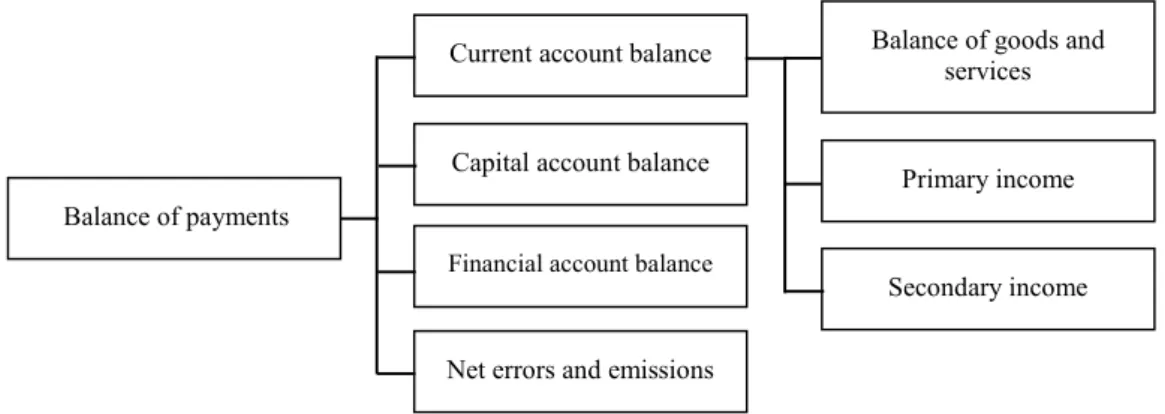
2.1 The structure of the balance of payments.
2.2 The effect of imports on income and output in country A. 2.3 The effect of exports on income and output in country B. 3.1 The sale of output on the product market.
3.2 The attempt to bridge the classical dichotomy by focusing on behaviour.
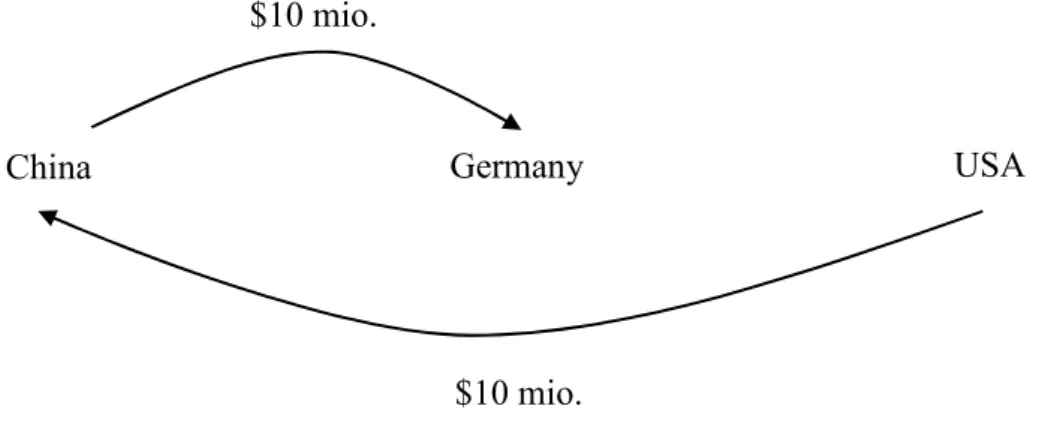
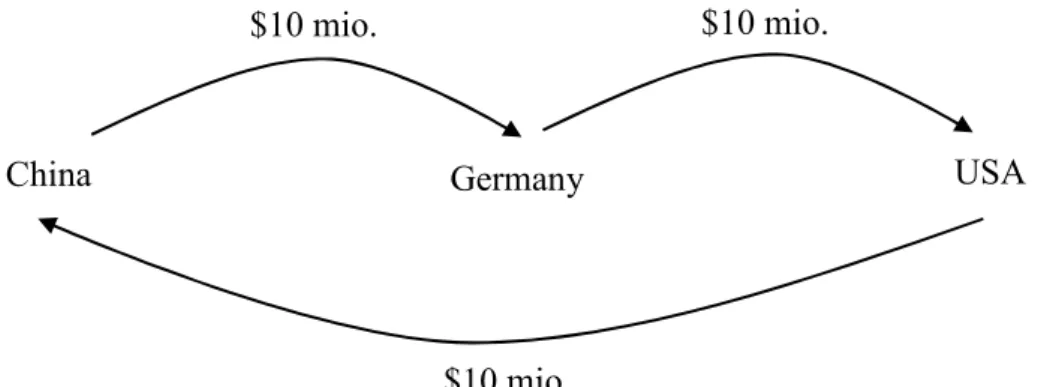
3.3 A payment with first grade debt by the United States. 3.4 The circular use of a first grade debt.
3.5 The ex post and ex ante separation of time.
4.1 The emission of money as a flow on the labour market. 4.2 The result of an absolute exchange on the labour market. 4.3 The production of a pair of shoes.
4.4 The emission of central bank money on the interbank market 5.1 The prisonner’s dilemma for reserve accumulating countries. 5.2 The macroeconomic policy trilemma.
5.3 Absolute exchange in the international monetary system. 5.4 The adapted policy trilemma.
Tables
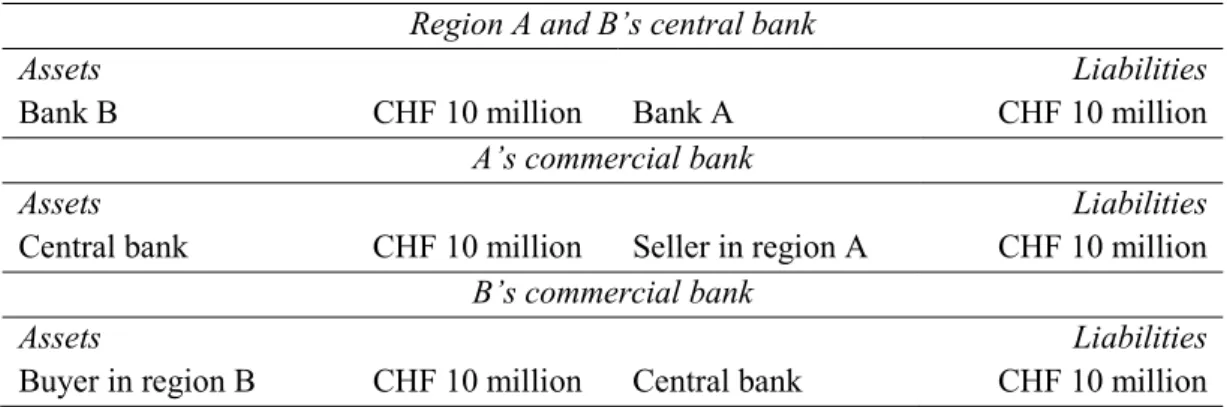
3.1 Money assets in a bank’s balance sheet. 3.2 The formation of official reserves. 3.3 The result of an inter-regional payment.
4.1 Loans and deposits resulting from the opening of a credit line. 4.2 Loans and deposits resulting from the payment of the current wage
bill.
4.3 The result of a wage payment between two clients of distinct banks without a central bank.
4.4 Central bank money as a means of final payment at the interbank level.
5.1 Allocations of bancor by the ICU.
5.2 The result of country A’s imports using bancor. 5.3 Allocations of SDRs by the IMF.
5.4 International money as the means of final payment between countries, step 1.
5.5 International money as the means of final payment between countries, step 2.
20 20 79 205 206 207 209 Graphs
1.1 The US balance of payments.
1.2 The US net international investment position.
3.1 The use of the word ‘asset’ in the English literature between 1800 and 2000.
6.1 The EUR/CHF exchange rate and SNB official reserve assets (monthly data).
6.2 The public debt crisis in the euro area and the Swiss public debt (annual data).
6.3 Sight deposits with the Swiss National Bank, 2005-2014 (monthly data).
Abbreviations
BIS Bank for International Settlements
DVP Delivery versus Payment
ECB European Central Bank
EEC European Economic Community
EFSF European Financial Stability Facility
EU European Union
FOB Free on board
GDP Gross domestic product
ICB International central bank
ICU International clearing union
IIP International investment position
IMF International Monetary Fund
IMU International money unit
NOEM New Open Economy Macroeconomics
OECD Organisation for Economic Co-operation and Development
OPEC Organization of the Petroleum Exporting Countries
RTGS Real-time gross-settlement
SDR Special Drawing Right
SNB Swiss National Bank
SSM Single supervisory mechanism
UN United Nations
Introduction
In an attempt to contribute to the current debate, the focus of this thesis lies on the theory of international imbalances in current monetary macroeconomics. The subject matter could hardly be more topical. Between April and May 2006, “the world’s three most important economic policymakers – the G7, the OECD and the IMF – issued almost simultaneously warnings about global trade imbalances” (Koo, 2009, p. 193). At the same time, there exists a broad consensus that mainstream macroeconomic modelling has failed. Stiglitz (2011c, Internet) summarises poignantly the essential insight reached at an IMF conference hosted by himself, Michael Spence, Olivier Blanchard, and David Romer:
“The most remarkable aspect of the recent conference at the IMF was the broad consensus that the macroeconomic models that had been relied upon in the past and had informed major aspects of monetary and macro-policy had failed.”
Even before this insight was reached, a joint article published by Stiglitz (2011b) and seventeen further leading economists (the ‘Beijing Group’) in the Financial Times called for an extension of the International Monetary Fund’s (IMF) Special Drawing Rights [SDRs]:
“[T]he global role of SDRs should be increased, both through new issues and a bigger role for SDRs in IMF lending. [...] Eventually SDRs could become the main, or even the only, mechanism for IMF financing. [...] All of this would make a contribution to enhancing global stability, without altering in any fundamental way existing monetary arrangements. And the dollar would continue as the main currency for private transactions, making this change more acceptable to the US.”
The problem clearly perceived by this group of economists concerns the United States’ growing external indebtedness, and, on the other side of the equation, the accumulation of dollar reserves in many developing countries. Fading confidence in the US dollar has triggered a search for alternatives to the current international monetary and financial regime that is still centred around the dollar. In fact, Iley and Lewis (2013, p. 61) are right in claiming that “Triffin’s ghost continues to haunt many economists, and the global financial system remains unstable and dangerously dependent upon the US dollar”. Soon after World War II, “the United States occupied an asymmetric position at the center of the international system, running balance-of-payments deficits, providing international reserves to other countries, and acting as export market of last resort” (Eichengreen, 2007, p. xi). This financial interdependence is ultimately made possible because emerging markets hoard claims on US dollars, instead of demanding real payment. To a
large extent, these dollar reserves serve as insurance from volatile global capital markets, as they can be deployed in order to offset the adverse effects of sudden capital outflows. Moving away from the current, asymmetrical global monetary nonsystem toward a symmetrical system based on rational principles benefitting all member countries will require a considerable degree of intellectual effort and international cooperation. The Basel III agreements and the Single Supervisory Mechanism (SSM) in Europe are a clear indication of policymakers’ awareness that financial regulation needs to become increasingly global. With respect to international monetary arrangements, a rational payment mechanism between countries is a public good that must be provided cooperatively by the international community in order for the world to enjoy its positive externalities.
In academia, it has become a widely held view that the microeconomic focus of recent decades has led economists to overlook such systemic issues. Eichengreen (ibid., pp. 2-3) warns that, “[w]hile systematic analyses were once commonplace in the literature on the international monetary and financial system, these have fallen out of fashion in recent years”. Yet, “it is impossible to understand the international economy without also understanding its monetary system” (Eichengreen, 2008, p. 1). To wit, the role of the international monetary system is “to lend order and stability to foreign exchange markets, to encourage the elimination of balance-of-payments problems, and to provide access to international credits in the event of disruptive shocks” (ibid.). Eichengreen’s remarks are to the point, and remind us to approach the problem of international imbalances in a holistic, macroeconomic manner.
The aim of the present thesis is to critically examine the axiomatic framework of current theories of international imbalances with the intention of improving economists’ model-building in this area of research. Particular attention is paid to international payment infrastructures in the present and past, topics that have moved closer to economists’ attention only recently. This will be done by critically discussing current approaches in international monetary macroeconomics, after having summarised the major developments of international balance of payments theories since David Hume’s price-specie flow mechanism. Ben Bernanke’s saving glut hypothesis (2005, Internet) will serve as a valuable example of a widely accepted application of theories of international imbalances. The most important assumptions underlying Bernanke’s hypothesis are analysed in order to then present an alternative viewpoint based on the theory of money emissions. A practical reform of the international monetary system is proposed that complies with the theoretical analysis, and that has the potential to improve the stability and efficiency of the current international monetary system. The research objective is pursued by focusing on theoretical questions. More specifically, an attempt is made to analyse structural-monetary laws in international macroeconomics, thereby largely abstracting from individual
behaviour. By focusing on theory, the author intends in no way to downplay the importance of empirical research in economics. Theoretical and empirical economics are complementary aspects that go hand in hand. But before picking up the measuring stick, it is necessary to know what needs to be measured. In addition to being falsifiable, good economic theory must fulfil at least two criteria: it should refer to reality and be logically consistent. Empirical evidence alone is not a sufficient criterion for the success of a theory. Instead, in economics as in other sciences, “it takes a theory to beat a theory” (Stigler, 1983, p. 541). Many economists empirically tested Bernanke’s (2005, Internet) saving glut hypothesis. Only few economists, however, challenged the underlying axiomatic framework. The present thesis contributes to the ongoing efforts to better understand international imbalances by applying the framework of the theory of money emissions to the saving glut hypothesis. By applying this new framework, the author takes seriously Snowdon and Vane’s (2005, p. 5) claim that “the coexistence of alternative explanations and views is a sign of strength rather than weakness”, as these views “provide a vehicle for improved understanding whereby the effort to comprehend alternative views forces economists to re-evaluate their own views”.
The thesis is organised as follows: Chapter 1 offers an overview of the literature on international imbalances, explores Ben Bernanke’s (2005, Internet) saving glut hypothesis and presents a selection of the subsequent academic response. Chapter 2 critically revisits the International Monetary Fund’s (2009) latest balance of payments framework. Chapter 3 analyses the assumptions underlying the saving glut hypothesis and theories of international imbalances in general. Chapter 4 lays down the foundations of an alternative view on international imbalances by borrowing heavily from the theory of money emissions. Chapter 5 begins by outlining the major shifts in international payment architectures since the international gold standard, focusing on the systems’ ability to guarantee final payment between countries. After discussing the role of Special Drawing Rights and Keynes’s conception of an International Clearing Union, a new settlement mechanism is suggested that has the potential to improve the stability of the international financial and monetary system. Chapter 6 summarises recent events concerning the Swiss franc’s appreciation, an event that dramatically underlines the need for reform of the international monetary framework.
1
The literature on international imbalances
The aim of this chapter is to offer a summary of the development and current state of international macroeconomics – more specifically the theory of international imbalances – in order to then critically review the underlying concepts and assumptions in the following two chapters. As a complete overview of this topic is too large for comprehensive coverage, the account offered here attempts to focus on the salient points relevant to later discussion. This chapter therefore represents a rather narrow selection of aspects in the history of open economy macroeconomics that, according to the author’s interpretation, are essential to the subsequent analysis along the lines of the theory of money emissions.
The first section sketches out the evolution of the theory of international imbalances since David Hume’s price-specie flow model. Attention is paid to the changing economic circumstances and trends that led economists to adapt their understanding of balance of payments. The second section shifts the attention to Ben Bernanke’s saving glut hypothesis. This hypothesis is of particular value and relevance, as it offers a widely accepted application of the current theory of international imbalances and thus illustrates the potency and limitations of today’s favoured approach. The third section offers an overview of economists’ reactions to Ben Bernanke’s hypothesis, followed by a summary of the common elements found in the theoretical criticism.
The term ‘international imbalances’ is used ambiguously in the literature. ‘International’, or ‘global’ imbalances often refer to trade surpluses or deficits. The terms ‘international’ or ‘global’ underline that one country’s deficit implies the other country’s surplus, thereby emphasising countries’ economic interdependence. Quite often, the definition of international imbalances is extended to include the entire current account. In part of the literature, international imbalances are identified with balance of payments deficits or surpluses. The term ‘balance of payments’ is, again, used rather ambiguously, and is therefore open to misinterpretation. Quite often, authors actually mean a current account imbalance when they write of the balance of payments surplus or deficit. Furthermore, it is often unclear if authors have an (accounting) balance or an (economic) equilibrium in mind when they write of surpluses and deficits. From a strict accounting perspective, a balance of payments surplus or deficit does not exist if one agrees with today’s conceptual standard set by the International Monetary Fund (2009). The balance of payments, understood as an accounting concept, always sums to zero because “every recorded transaction is represented by two entries with equal values” (International Monetary Fund, 1993, p. 6). However, contemporary economists have no problem to write how “the balance of payments always balances” and, in the same paragraph, explain that balance of payments surpluses and deficits can still occur (see Gandolfo, 2004, p. 63).
According to Gandolfo (ibid.), this procedure is allowed since ‘balance’ is an accounting concept, while ‘equilibrium’ is an economic concept. As we will see, the problems related to these definitions are not merely semantic. A thorough analysis of the meaning of surplus and deficit of the balance of payments will therefore be offered in Chapters 2 and 3. In general, it can be stated that, if all accounts are included, then the balance of payments always balances from an accounting (‘ex post’) perspective. Imbalances are therefore confined to the various subcategories of the balance of payments, most notably the official reserves account. The reader who would like to learn more about the differences before plunging into this chapter is referred to Chapter 2.
1.1 From David Hume to New Open Economy Macroeconomics
In accordance with Taylor (1990, p. 41), it may be agreed upon that three major shifts mark the development of economists’ understanding of international imbalances. The first shift took place in the eighteenth century, when mercantilist views gave way to the classical paradigm in international commerce. The second, methodological shift took place in the decades around 1900, when the Marginalists reformulated the price-specie flow mechanism laid out by the Classics in the language of classical physics, without changing the basic message of the theory. The third shift took place in the post-war years. Macroeconomic identities moved into the background and gave way to monetary aspects of international imbalances. We may add a fourth shift that has taken place since. Adherents of New Open Economy Macroeconomics (NOEM) integrate market imperfections and focus on forward-looking decision-making processes of rational individuals, in line with today’s Zeitgeist that requires rigid micro-foundations for macroeconomic theory. Besides pointing out the major shifts that took place, this chapter stresses the considerable continuities connecting the theories in question.
Economic theories are hard to get rid of once they have been empirically ‘verified’ for a limited period of time in a limited region of the world (think of the Phillips curve). This is so because ‘falsification’ – a much higher hurdle than ‘verification’ – does, in practice, not really challenge a theory in economics. Lack of empirical support in most time-periods and regions of the world does not greatly harm an economic theory that can be verified in a few selected cases and is deemed sufficiently attractive by the profession. Quiggin (2010, p. 1) is quite right when he notices with respect to economic theories that “even when they have proved themselves wrong and dangerous, ideas are hard to kill. Even after the evidence seems to have killed them, they keep on coming back”. Refutations on theoretical grounds are difficult, as there is virtually no agreement on the legitimacy of the most basic assumptions in economics even at the very top of the academic pyramid (see Chapter 4 for a further discussion). This has led to a
confusing co-existence of conflicting economic theories that does little to facilitate research or attract sceptical students. To the disadvantage of the prestige of our science, it has also turned economics into a hotbed for political partisans, as an economist can pick and choose the theories that most corresponds to his or her pre-set political beliefs. For these reasons, it is useful to present a variety of theories on international imbalances, as none of them in fact superseded the other one. Instead, the development of economic thought can be likened to a complex process of sedimentation, whereby each new layer is placed on top of older layers. In order to understand the landscape of current theories of international imbalances, we must therefore include into our analysis the older sediments that bequeath their structure to more recent theories.
1.1.1 The classical price-specie flow mechanism
Since the beginning of the economics profession, the concept of balance of payments has been at the core of international economics. To a large extent, Smith’s (1776/1970) Wealth of Nations was a rebuttal of the mercantilist position that the British government ought to intervene in economic affairs in order to increase Britain’s gold reserves. Hume’s (1955) price-specie flow model can be seen as an early refutation of mercantilist positions (Taylor, 1990, p. 9). Until about the 1920s or 1930s, Hume’s model provided the dominant theoretical framework to think about the tendency to equilibrium in international trade. On the dominance of Hume’s model of international trade, Schumpeter (1954/1994, p. 367) remarked:
“In fact it is not far from the truth to say that Hume’s theory, including his overemphasis on price movements as the vehicle of adjustments, remained substantially unchallenged until the twenties of this century.”
The price-specie flow mechanism is historically closely linked to the classical gold standard. Until this day, this theory “remains the dominant approach to thinking about the gold standard” (Eichengreen, 2008, p. 24). Although a lot of theoretical inquiries accompanied the gold standard, above all the works of David Ricardo, the gold standard was introduced by chance rather than design. For example, Isaac Newton, then master of the mint, set too low a gold price for silver in an attempt to uphold bimetallism in 1717. This government intervention induced the British public to hoard silver coins, which were worth more, in line with Gresham’s Law. Only gold coins and clipped silver coins were subsequently used for transactions. The gold standard was formally acknowledged in Britain in 1774, partly because of this miscalculation. The gold standard as a basis of international monetary affairs that emerged after 1870 was a late consequence of a series of such accidental developments. Britain’s role as an important trading partner in Europe and Germany’s liquidation of silver induced other countries to
adopt the British monetary arrangement. After the two most powerful industrial nations, Britain and Germany, had adopted the gold standard by 1871, other countries quickly followed suit. Eichengreen (2008, p. 24) explains the theoretical mechanism of the international gold standard as follows:
“Each time merchandise was exported, the exporter received payment in gold, which he took to the mint to have coined. Each time an importer purchased merchandise abroad, he made payment by exporting gold.” According to this mechanism, every country effectively paid for its imports by exporting gold. Every commercial deficit of a country had to be compensated with a corresponding export of gold, thereby guaranteeing perfect symmetry of international trade by using gold as an internationally accepted settlement asset. How does Hume’s (1955, pp. 60-77) model explain the equilibrating mechanism of the gold standard? Importantly, the price-specie flow model incorporates neither banks nor bank money. Instead, the model assumes that a given stock of gold coins physically circulates within an economy. Deficit countries physically lose gold to the surplus countries, triggering a decrease in the quantity of money in deficit countries and thereby falling prices (output remains constant). The inflow of gold into surplus countries, on the other hand, will provoke an increase in the quantity of money relative to output and therefore an increase in prices until international equilibrium is reached. The change of relative international prices tends to reverse trade flows, thereby equilibrating the economic systems of the trading partners involved. While domestic money supply – identified with the amount of gold coins in the economy – is supposed to be exogenously determined, the money supply can increase through exports, thereby leading to an increase in prices. This view was picked up in the monetary approach to the balance of payments two centuries later.
Needless to say, a model that assumes away bank money and capital flows fails to shed much light on the nature of balance of payments, as payments are carried out with (bank) money within as well as between countries today. Also, the model refers to an ideal gold standard, which was never put into practice in this form. In reality, gold was not used to settle all imports:
“Leaving aside flows of newly mined gold from South Africa and elsewhere to the London gold market, [international gold shipments] were but a fraction of countries trade deficits and surpluses”. (Eichengreen, 2008, p. 25)
In practice, claims on pound sterling deposits were often viewed as just as good as gold, or even better, as these claims could be used to settle international transactions. According to Brown’s (1940) interpretation, the gold standard had
actually been a sterling standard. McCloskey and Zecher (1976, p. 358) confirm that the gold standard “was a standard involving the major currencies as well as gold itself, and that few, if any, central banks followed the putative ‘rules of the game’”.
It is helpful at this point to register an important, but rarely noticed connection between Hume’s classical price-specie flow mechanism and more modern, neoclassical conceptions of international equilibrium. Both Hume and neoclassical writers, such as Léon Walras, were explicitly inspired by hydraulics when constructing their models of the economy. In his influential essay on the balance of trade, published in 1752, Hume (1955, p. 63) compares the international economic system with systems of hydraulics.
“All water, wherever it communicates, remains always at level. Ask naturalists the reason; they tell you, that, were it to be raised in any place, the superior gravity of that part not being balanced, must depress it, till it meet a counterpoise”.
This passage witnesses the early dominance of classical physics in classical economics. As is well known, Léon Walras (1874/1954, p. 71) likewise believed that “the pure theory of economics […] is a physico-mathematical science like mechanics or hydrodynamics”. It is striking, in fact, that Léon Walras (ibid., pp. 224-5) used exactly the same metaphor to explain the tendency towards equilibrium:
“Viewed this way, the market is like a lake agitated by the wind where the water is incessantly seeking its level without ever reaching it. But whereas there are days when the surface of a lake is almost smooth, there never is a day when the effective demand for products and services equals their effective supply and when the selling price of products equals the cost of the productive services used in making them.”
Alfred Marshall (1948, p. 32) believed, very similarly, that the laws of economics could be compared to the laws of the tides. This common intellectual root of classical and neoclassical economics helps to understand why the Marginalist Revolution, carried out by economists such as Menger, Jevons, Walras and Marshall, left Hume’s thesis virtually intact. “If anything”, Taylor (1990, p. 16) even points out, “the theory was strengthened”. Both classical and neoclassical economists were thinking about international trade and money flows hydraulically, in terms of dynamic equilibria brought about by laws of nature. Economists since Hume have been trying to interpret an equilibrating mechanism based on competition and arbitrage into international trade flows, mimicking the effect gravity has on water. There has therefore been no emancipation from physics, and Friedman (1953, p. 4, emphasis added) still believed that “positive
economics is, or can be, an ‘objective’ science, in precisely the same sense as any of the physical sciences”. Therefore, in 1937, it was still possible to write that “[t]he ‘classical’ theory of the mechanism of international trade from Hume to J.S. Mill, is still, in its general lines, the predominant theory” (Viner, 1937, p. 291).
But why is this relevant? We may simply point out at this stage that the ‘hydraulics analogy’ in international (monetary) economics is not self-evident, as money and payments are essentially immaterial (accounting) phenomena that rely on anthropogenic payment architectures. Payments are carried out with money, which has a distinctly numerical nature; numbers certainly are not defined physically. Payments are a cultural achievement that should not be compared to natural forces light-heartedly. This point will be taken up again and discussed in more detail in Chapters 4 and 5.
The Cunliffe Committee, a British government committee established to assess the vices and virtues of the equilibrating price-specie flow mechanism, slightly extended Hume’s model (see Eichengreen, 2008, pp. 25-6). In the Cunliffe version, an exogenously determined stock of paper money circulates in an economy, the central bank guaranteeing gold convertibility. Surplus countries convert the acquired foreign paper money into gold and then convert the gold back into domestic currency, thereby increasing the money supply. Equilibrium is achieved through a higher price level in the surplus country and a lower price level in the deficit country, analogous to Hume’s price-specie flow mechanism. As Eichengreen (ibid.) points out, “nothing essentially differed from the version of the price-specie flow model elaborated by Hume”. In fact, money is simply identified with a sort of gold certificate in the Cunliffe version of balance-of-payments imbalances. Capital flows do not play a role. The role of banks and bank money remains negligible. Instead of gold physically circulating in the economy, gold certificates are used to settle debts between economic agents. Physical gold then circulates between countries to offset net positions in international trade.
The Marginalist Revolution brought classical political economy to its knees at the end of the nineteenth century. Some classical concepts, for example Ricardo’s theory of comparative advantage, survived the Marginalist Revolution virtually unscathed despite their dependence upon the labour theory of value. However, Hume’s price-specie flow mechanism was quickly draped into the language of equilibrium as economists soon came to believe that “international monetary economic analysis never received precise mathematical formulation” (Mundell, 1976, pp. 64-5).
1.1.2 The elasticity approach
The elasticity approach (also: elasticities approach) goes back to a paper published by Charles Bickerdike (1920) and examines the effects of exchange rate variations on the balance of payments. In this view, international equilibrium depends on relative price adjustments of goods and services between trading nations. Compared to Hume’s price-specie flow model, which focuses on the influence of price levels in trading countries, the elasticity approach stresses exchange rate variations between trading nations. A relative price change of export and import goods between two countries will induce the public to shift their consumption pattern, thereby changing the flow of international trade. A devaluation of the domestic currency, ceteris paribus, increases exports and decreases imports, vice versa. However, it is not sure that the quantity effect of a devaluation of a currency will necessarily lead to a betterment of the trade balance, as the latter is expressed in terms of value, not quantity. In the short run, the devalued domestic currency will cause an import price increase, thereby worsening the trade balance in the short run (price effect). In the long run, the depreciation might lead to an improvement due to a volume effect. A depreciation of the currency will only lead to an improvement of the trade balance in the long run if the sum of export and import elasticities is greater than unity. The reason for this is that a depreciation will make imports more expensive, thereby worsening the balance of trade in the short run. In the long run, however, increased exports will tend to overcompensate this effect, producing a J-curve in net exports. The case in which increased exports overcompensate the higher price of imports is known as the Marshall-Lerner condition (Gandolfo, 2004, p. 76), a condition that is usually supposed to hold according to economics textbooks. Abel and Bernanke (1992, p. 508), however, remind their readers that “this assumption may not be valid for shorter periods – and in some cases, even for several years”. The elasticity approach is largely a barter model with relative prices between goods traded directly without the necessary intervention of money, and was deemed too simple after the Keynesian Revolution had taken place.
1.1.3 The absorption approach
The absorption approach to the balance of payments is mainly attributed to Sidney Alexander (1952, 1959) and stresses that a country’s current account balance is determined by the difference between its produced output and its ‘absorption’. Absorption means the expenditures by domestic residents on goods and services, or, in Alexander’s (1952, p. 265) terms, “the taking of goods and services off the market”. The absorption approach superseded the older elasticity approach (Johnson, 1976b, p. 150), which was considered too simple, and shaped subsequent theories of international imbalances in important ways. A new feature of this approach was that it stressed the increase or decrease of foreign assets that
result from international trade. The principal aim of the model was to answer the question if currency devaluations improve a country’s balance of trade (Vines, 2008, p. 3). While the elasticity approach attempts to answer this question by focusing on relative price changes, Alexander (1952) argues that devaluation is only successful if it widens the gap between domestic output and domestic absorption. The gap widens due to the inflation resulting from the devaluation, triggering a reduction in absorption relative to production.
The absorption approach can be best illustrated by referring to Keynesian income-expenditure accounting identities. Let the symbols Y, C, I, G, X and M stand for output, consumption, investment, government expenditure, exports and imports, respectively (Vines, 2008, p. 3). Then,
Y = C + I + G + X – M, (1)
which may be rewritten as
X – M = Y – (C + I + G). (2)
The trade surplus, X – M, is equal to total output available in the economy, Y, minus total expenditure, C + I + G. Alexander translates this formula into a simpler version, B = Y – A, where B is the balance of trade, Y total output and A total absorption. Alexander’s absorption approach can be seen as a notable shift away from traditional (microeconomic) partial equilibrium analysis of supply and demand to the study of (macroeconomic) relationships between macroeconomic magnitudes:
“[A] more fruitful line of approach can be based on a concentration on the relationships of real expenditure to real income and on the relationships of both of these to the price level, rather than on the more traditional supply and demand analysis.” (Alexander, 1952, p. 263)
The absorption approach shows that for a devaluation to improve the balance of trade, it must either lead to increasing output (Y) without increasing absorption (C + I + G), or a decrease in absorption without decreasing output, or a combination of both. Different effects work in different directions in case of a devaluation of the domestic currency. Gandolfo (2004, pp. 146-7) offers a good overview of these effects, which are not relevant to the question at hand.
The absorption approach underlined for the first time the role of desired wealth changes in generating international imbalances (Obstfeld, 2001, p. 5). Despite focusing on macroeconomic identities, it already heralded later approaches that sought a more thorough microeconomic foundation. The main points of the absorption approach were integrated into subsequent theories of international
imbalances. For Gandolfo (2001, p. 297), the pioneering idea of the absorption approach is that “it is the set of macroeconomic factors underlying absorption (i.e., saving and investment decisions) that ultimately determine the current account and hence international borrowing or lending patterns”. Indeed, it was the first model that explicitly linked the saving-investment identity with the current account balance. This idea gave a crucial impulse for further research in the area of international macroeconomics, so that the modern intertemporal approach (see section 1.1.7) can be seen as an extension of the absorption approach. The desire to integrate the capital market and individual behaviour into the theory of international imbalances also led to the approach by Robert Mundell and Marcus Fleming a decade later.
1.1.4 James Meade’s neoclassical synthesis
Before the Keynesian Revolution, international imbalances were studied in the classical context of the price-specie flow mechanism. Relative price changes of goods and services, along the lines described by the elasticity approach, were meant to equilibrate international trade. International macroeconomics after World War II focused on the path to internal (full employment) and external (balance of payments) equilibrium and optimal government policy. This also reflected the widening and deepening of democracy in the first half of the twentieth century. In the nineteenth century, the macroeconomic burden of adjustment could be laid on the working classes owing to an authoritarian state, and unemployment was not yet such a crucial issue on the government’s agenda. After the two world wars had changed the nature of the state, government policy increasingly took into consideration the demands of those classes formerly excluded from the political arena. In The Balance of Payments, volume I of the Theory of International Economic Policy – a book that set the standard for years to come – Meade (1951) integrates aspects of Keynesian thought into open economy macroeconomics in the neoclassical equilibrium tradition. In a sometimes opaque exercise of comparative statics, he analyses partial and temporary equilibrium positions, introduces exogenous shocks and then considers the new equilibrium position.
Keynes’s work can be characterised as a spirited attempt to integrate monetary and real analysis into a general, holistic framework. The difficult task for Meade was to somehow add money to the classical barter model of trade, in order to integrate classical analysis with Keynesian concepts (Mundell, 1976, p. 67). Meade does this by building the capital market into a general-equilibrium framework, thereby extending the traditional elasticities approach to the balance of payments. He stresses that governments need one policy tool for each policy objective they want to achieve. If a government wants to achieve internal and external balance (full employment and current account equilibrium, respectively),
it needs one tool for each objective. For Meade, these instruments are fiscal and monetary policy. The central thesis of Meade’s book is that if trade is sensitive to price changes, international equilibrium should be brought about by price adjustments. In general, international equilibrium will come about by itself if things are left to themselves. The view that there is a tendency to equilibrium in the balance of payments when exchange rates are left to float is mirrored in Meade’s advocacy of floating exchange rates in the European Economic Community (EEC). Only if price adjustments do not bring about international equilibrium, “reliance must be placed on direct controls” (Meade, 1951, p. viii). The possibility of sustained and harmful disequilibria – something that did not exist in the classical paradigm – reflected the Keynesian spirit in which Meade elaborated his economic model.
But Meade was only partially happy with his two-country model: “[T]his is a work not on dynamics, but on comparative statics, in economics” (ibid.). There was a desire in academia for a model that better explained a self-adjusting path to external equilibrium. Furthermore, the wide variety of heroic assumptions and the expository style of Meade’s work created a forbidding façade that greatly reduced the impact of his work.
1.1.5 The approach of Robert A. Mundell and John M. Fleming
The Mundell–Fleming model of international macroeconomics that resulted from the works of Robert Mundell (1963) and Marcus Fleming (1962) promised to introduce a missing dynamical component by integrating a self-adjusting mechanism. It extends Keynesian income-expenditure models developed by Metzler (1942) as well as Meade’s (1951) equilibrium approach. The mechanism resembles the classical price-specie flow mechanism described by Hume in important ways. Indeed, Mundell (1961, p. 154) even argues that his approach incorporates classical and Keynesian models as special cases. Mundell and Fleming managed to integrate a self-adjustment mechanism by putting international capital flows into the centre of their analysis. The theoretical developments in the 1960s reflected the increasing global integration of capital markets that was occurring at the time. While theories of international imbalances before the 1960s focused on the trade balance and the current account, new approaches increasingly integrated the capital account into formal modelling (Kenen, 1985, p. 673). In this view, perfectly informed and forward-looking arbitrageurs immediately exploit interest and exchange rate differentials between countries by trading currencies and securities in financial markets without government restrictions, a condition known today as perfect capital mobility. In Frenkel and Razin’s (1987, p. 1) opinion, “[t]he key contribution of this model has been a systematic analysis of the role played by international capital mobility
in determining the effectiveness of macroeconomic policies under alternative exchange rate regimes”.
The model quickly turned into the dominant paradigm for studying monetary and fiscal policy issues in open economies and still features prominently as the open-economy extension of the IS–LM model in economics textbooks. The model can be reduced to three equations: equilibrium on the goods market (real equilibrium), equilibrium on the money market (monetary equilibrium) and equilibrium of the balance of payments (external balance). Importantly, net capital inflows are an increasing function of the interest rate differential; the higher the domestic interest rate relative to the external interest rate, the more securities foreigners will demand, hence the greater the capital inflows. Balance of payments equilibrium is defined as the situation in which the stock of international reserves remains constant (Gandolfo, 2004, p. 86). The model enables studying the reactions of interest rates and output to fiscal and monetary policy in the case of fixed and flexible exchange rates in a neoclassical framework. A popular and rather simple version of the model that assumes perfect capital mobility is based on an article by Mundell (1963) published in the Canadian Journal of Economics and Political Science.
The Mundell–Fleming model suggests that, under fixed exchange rates and perfect capital mobility, monetary policy is completely impotent. This, of course, is perfectly in line with the policy trilemma (Obstfeld and Taylor, 1997). Interest rate differentials between countries erode because of free capital flows. A rise in the money supply lowers domestic interest rates relative to foreign interest rates. Households will then immediately start to demand foreign assets with higher yields, thereby increasing the demand for foreign currency and weakening the external value of the domestic currency. The central bank must restrict the money supply in order to stabilise the exchange rate. In a fixed exchange rate regime, the monetary authorities therefore cannot control the money supply. In this case, only fiscal policy has an effect on output and employment through an increase in aggregate demand. All that the central bank can do is alter the amount of foreign-exchange reserves in order to keep the foreign-exchange rate stable.
With flexible exchange rates, monetary policy can play a role and has an effect on output and employment: “The monetary expansion puts downward pressure on the interest rate and induces a capital outflow, further depreciating the exchange rate and creating an exports surplus, which in turn increases, through the multiplier effect, income and employment” (Mundell, 1963, p. 478). However, with flexible exchange rates, fiscal policy only has short-term effects. An increase in government spending will, ceteris paribus, increase interest rates owing to a crowding-out mechanism and therefore also increase the inflow of capital from abroad, thus strengthening the exchange rate and depressing net exports. The lower net exports offset the higher government expenditure.
While the income-specie flow mechanism was able to demonstrate self-adjustment processes of external positions, it did not explain internal self-adjustment. In order to overcome this deficiency, Mundell (1962) describes a mix of fiscal and monetary policy that would harmonise internal and external equilibrium. A country experiencing high unemployment and a negative official settlements balance could expand fiscally and contract monetarily. The fiscal expansion would increase employment; the monetary contraction would close the payments gap, as foreign residents would demand domestic financial assets.
Although the Mundell–Fleming model was the academic workhorse for many decades and was used to understand short-term developments in international economics, Obstfeld (2001, p. 7) argues that “the theory of the policy mix had little practical significance under Bretton Woods”. An early empirical study by Michaely (1971, p. 33) suggests that the Mundell–Fleming model was relevant only at universities, not for policy makers. Also, the scientific community was moving away from the analysis of stable relationships between macroeconomic aggregates and looked for models that increasingly rested on individual behaviour, as Frenkel and Razin’s (1987, p. 45) critique illustrates:
“A key characteristic of the formulation of the income-expenditure framework underlying the Mundell–Fleming model is the lack of solid microeconomic foundations underlying the behaviour of the private and public sectors, and the absence of an explicit rationale for the holdings of zero interest-bearing money in the presence of safe interest-bearing bonds.” The monetary approach to the balance of payments was supposed to overcome these deficiencies.
1.1.6 The monetary approach to the balance of payments
Mundell’s dissatisfaction with his own approach led him to pursue the so-called monetary approach to the balance of payments in the 1960s, followed by Frenkel and Johnson in the 1970s. Frenkel and Johnson (1976) clearly show that the historical origins of their theory reach back to authors such as Kindleberger, Wicksell, Mill and Gervaise. As the authors maintain – tautologically we may add – the main characteristic of the monetary approach to the balance of payments is the notion that “the balance of payments is essentially a monetary phenomenon”. According to Blejer and Frenkel (2008, p. 687), the monetary approach distinguishes itself from other analytical approaches because it enables studying “the direct connection between the money market and the balance of payments, rather than working through the implied changes in the goods or financial assets markets”. For example, older approaches in international macroeconomics
traditionally assumed that countries with a trade surplus were to expect appreciating currencies, and countries with trade deficits were to expect depreciating currencies. It was soon clear that the world did not work as simply as this, and that currency speculation could move exchange rates in directions completely unanticipated by economists (Melvin and Norrbin, 2012, p. 271). Johnson (1977, p. 251) explains that the monetary approach stresses three points. First, balance-of-payments problems are monetary problems that should be addressed with monetary models. Exchange rates are not simply viewed as the results of trade, but as the results of demand for and supply of different national monies. The money account represents the excess supply of or demand for money and is modelled in terms of behavioural relationships. Secondly, money is considered a stock, not a flow. This difference is “to some extent an empirical matter. In the stock approach, it is assumed that financial markets equilibrate very fast” (Kouri, 1976, p. 281). In the flow approach, transaction costs slow down the adjustment of portfolios. Thirdly, the money supply can be increased in two ways – through the expansion of domestic credit or the export of domestic products. Monetary authorities can control the first, though not the second source of money supply. The supply of money is the product of high-powered money and the money multiplier. High-powered money is composed of the domestic asset holdings of the monetary authorities and the domestic-currency value of the monetary authority’s foreign currency (Blejer and Frenkel, 2008, p. 687). Similarly to the absorption approach, the balance of payments may be written as follows (Johnson, 1976a, p. 49):
B = R – P, (3)
where B represents the positive or negative balance of payments, R represents aggregate receipts by residents, and P represents aggregate payments by residents. The balance of payments “refers specifically to the Official Settlements Balances, that is, the ‘money account’” (Mussa, 1976, p. 189). The demand for or supply of money drives the balance of payments in the monetary approach to the balance of payments, a clear indication of the microeconomic foundation of the theory. In case a higher demand for money is not met by an increase in supply, a stock disequilibrium is at hand. Higher levels of income, lower interest rates or rising prices will lead to an increase in the demand for nominal money balances (Mark, 2004, p. 66). If domestic money supply does not accommodate this extra demand for money, an increase in net exports will result and cause a current account surplus. The surplus will increase the foreign exchange holdings of the public, who subsequently can sell them to the foreign exchange authorities in order to satisfy their demand for domestic money holdings. In exchange for the foreign currency, the foreign exchange authority is able to create – ex nihilo – the sum of domestic money.
Looked at from the other side, a growth of the domestic money supply, induced by central bank policy, over and above what the public wishes to hold, will cause higher imports and thereby a current account deficit, leading to a decrease of the domestic money supply and the running down of international reserves. With respect to the adjustment process, Mussa (1976, p. 188) adds that “[t]he exact nature of the process of adjustment will vary from model to model. The only necessary feature is that the balance-of-payments surplus must always be equal to the excess of income over expenditure”.
Frenkel and Johnson (1976, p. 22) argue that their monetary approach improves the cruder elasticity approach because it integrates Sidney Alexander’s (1952) absorption approach and stresses the money-demand function. According to the absorption approach, the current account surplus is the result of an excess of a country’s available income over its absorption, leading to an accumulation of “claims on future income (assets) from abroad or vice versa” (Frenkel and Johnson, 1976, p. 22). Importantly, the monetary approach crucially rests on some version of the quantity theory of money and the hypothesis that the domestic flow supply of money can be controlled by the central bank via the money multiplier: “[T]he monetary authority, as the ultimate source of domestic money, controls the rate of change of the domestic component of the monetary base – the other component being international reserves – and thereby the flow supply of money” (ibid., p. 23). The stock supply, however, cannot be controlled according to the authors, as the public may “convert domestic money into goods and securities in the international markets” (ibid). There is a close relationship between the monetary approach to the balance of payments and the classical price-specie flow mechanism; the price-specie flow mechanism is seen as the intellectual origin of the monetary approach (Blejer and Frenkel, 2008, p. 687). David Hume assumed that money and gold were essentially the same, thus making the commodity money assumption typical for classical monetary theory. Frenkel and Johnson (1976) similarly assume that money is a valuable asset, created by the banking system at near zero cost, and that money can physically leave one country and enter the other, thereby inducing a money stock decrease in the importing country and a corresponding increase in the exporting country. Indeed, the following passage by David Hume (1955, pp. 62-3) is widely perceived to be in line with the monetary approach to the balance of payments:
“Suppose four-fifths of all the money in Great Britain to be annihilated in one night, and the nation reduced to the same condition, with regard to specie, as in the reigns of the HARRYS and EDWARDS, what would be the consequence? Must not the price of all labour and commodities sink in proportion, and every thing be sold as cheap as they were in those ages? What nation could then dispute with us in any foreign market, or pretend to navigate or to sell manufactures at the same price, which to us would afford sufficient profit? In how little time, therefore, must this bring back the
money which we had lost, and raise us to the level of all the neighbouring nations? Where, after we have arrived, we immediately lose the advantage of the cheapness of labour and commodities; and the farther flowing in of money is stopped by our fulness and repletion.”
This analysis assumes more or less explicitly that it is the same from a monetary point of view to import from abroad and to destroy part of a country’s money supply: “If England’s money stock suddenly was reduced by four-fifths, we know from principles of economics that the price level would fall dramatically” (Melvin and Norrbin, 2012, p. 272). Falling prices would improve England’s competitive position and induce a trade surplus that would eventually bring the system back to equilibrium.
Two main implications result from the monetary approach (see Gandolfo, 2001, pp. 176-7). First, the monetary authority cannot and should not attempt to control the money supply in a system of fixed exchange rates. Any attempt to increase (decrease) the money supply by more than the public desires will merely lead to a balance of payments deficit (surplus), thereby decreasing (increasing) the monetary base and ultimately the money supply. Secondly, monetary authorities ought not to intervene to correct international imbalances, as the path to equilibrium is automatic. Balance of payments disequilibria are self correcting in the long run:
“Balance of payments deficits or surpluses are by their very nature transient and self-correcting, requiring no deliberate policy to correct them. […] The reason is simply that deficits reduce money stocks whose excessive size underlies the deficit, and surpluses build up the money stock whose deficiency underlies the surplus.” (Johnson, 1976c, p. 16)
In a nutshell, an excess demand for money by the public causes a balance of payments surplus, while an excess supply leads to a deficit. We may now dwell a little on the equilibrating mechanism proposed by the model. Importantly, the model assumes full employment equilibrium and purchasing power parity between countries thanks to instantaneous price and wage adjustments. If, say, there is an excess supply of money, a balance of payments deficit will appear as residents will get rid of the superfluous monetary assets by increasing absorption relative to production. As soon as the desired stock of money is reached, equilibrium is reached. Problems of balance of payments disequilibria are thus reduced to finding the optimum quantity of money within a national economy. Rather than focusing on the nature of imbalances, this approach focuses on individual desires for money stocks that cause flows between countries.
With respect to the compatibility of the different approaches presented up until now, we may quote Mundell (1968, pp. 150-1), who believes that it is “not
meaningful to question the validity of the [elasticity approach, the absorption approach and the monetary approach to the balance of payments]”. According to him, “the terms can be defined so that they are all correct and assert identical propositions, even if capital movements are included”. Thus, we are made to believe by an originator of the monetary approach of the balance of payments that the string of theories explaining international imbalances are not contradictory, but rather shift the attention from relative prices (elasticity approach) to wealth disequilibria (absorption approach) to money stock disequilibria (monetary approach) as causes for international imbalances.
As we have seen, while post World War II economic literature focused on the integration of Keynesian and equilibrium models and the mechanisms of adjustment under different conditions, the turbulent 1970s changed the emphasis. The increasing rejection of Keynesian methods and the intellectual allure of the Chicago school had a significant impact on research in international macroeconomics. The sudden increase in oil prices in 1973–74 and 1979–80 triggered largely by the altered pricing policy of the Organization of the Petroleum Exporting Countries (OPEC) led to large trade surpluses in petrol exporting countries and corresponding trade deficits in petrol importing countries worldwide. This economic trauma gave rise to an extensive amount of literature focusing on the causes and the sustainability of international imbalances. After 1980, current account imbalances remained stable globally, only to increase again after 1996 (Blanchard and Milesi-Ferretti, 2009, p. 7). The Mexican Tequila-crisis of 1994–95 and the Asian financial crisis that began in 1997 again put current account deficits on the agenda of policymakers. In 2004, the US current account deficit reached over 600 billion US dollars, almost 6 percent of the country’s GDP. This deficit corresponded approximately to India’s entire GDP in 2004. In 2006, the current account deficit of the United States peaked at around 800 billion US dollars, or approximately 7 percent of its GDP, and has since then become somewhat smaller.
Fears of a disorderly unwinding of the US net debtor position triggered another wave of articles and academic papers. The European Central Bank’s (2004, p. 17) December 2004 Financial Stability Review acknowledged that “[l]arge and growing US current account deficits have generally been perceived as posing a significant risk for global financial stability, at least since 2000”. The deterioration of the US net international investment position, shown in Graph 1.2, is a direct effect of the US current account deficits. According to official statistics, the United States turned into a net debtor to the rest of the world in 1989 (Van den Berg, 2010, p. 82). In 2008, the US net debtor position was estimated at almost 3.5 trillion dollars.1
1 Despite of this substantial net debtor position, the United States continues to earn positive net
Graph 1.1 The US balance of payments.
Source: Balance of Payments Statistics Yearbook 2014, International Monetary Fund
Graph 1.2 The US net international investment position.
Source: Balance of Payments Statistics Yearbook 2014, International Monetary Fund
Current account deficits must be financed by exporting financial assets such as bonds, shares or claims to bank deposits. If the owners of US dollar-denominated financial assets lose their appetite for these assets, they could trigger fire sales around the globe, leading simultaneously to a US stock and bond market crisis, a sharp devaluation of the US dollar and an interest rate hike, thereby seriously harming the US and global economy. The warning calls are understandable, given sudden stops of capital inflows and lower economic growth that have often accompanied major reversals in current account deficits in the past (for a historical account on current account reversals see Edwards, 2004).
by Hausmann and Sturzenegger (2006) calculated the existence of an invisible but substantial positive net financial value (so-called dark matter) whose existence is evidenced by the positive net returns. -1000 -800 -600 -400 -200 0 200 400 600 800 1000 2006 2007 2008 2009 2010 2011 2012 2013 Bi lli on s o f U S do lla rs
Current account Financial account
-6 -5 -4 -3 -2 -1 0 2006 2007 2008 2009 2010 2011 2012 2013 Tr ill io ns o f U S do lla rs
1.1.7 The intertemporal approach
The intertemporal approach to explaining current account imbalances was established in the 1980s, mainly as a result of the works of Buiter (1981), Sachs (1981), and Obstfeld (1982). Similarly to the monetary approach, the intertemporal approach integrates Alexander’s (1952) absorption approach and, focusing on individual behaviour, states that current account imbalances are the result of “forward-looking dynamic saving and investment decisions” (Obstfeld and Rogoff, 1995b, p. 1732). An infinitely lived representative agent smoothens her consumption pattern by borrowing from and lending to foreign countries. If output and income are temporarily low owing to some exogenous shock, a nation may rationally increase its aggregate utility by purchasing more than it produces in this period, thereby temporarily running a current account deficit. Compliant with the tradition of methodological individualism, the nation is identified with a representative agent. If the agent absorbs (consumes plus invests) more than she produces within a specified time period, she will have to borrow from another nation the necessary purchasing power in order to acquire the foreign output. The new net borrowing equals the current account balance. Lucas’s (1976) rational expectations approach is prevalent in these models of international imbalances. Individuals do not merely take into account historical data in their decision-making, but make their best possible assessment of future developments by analysing the structure of the economy; they immediately adapt to expected future outcomes.
Since the first intertemporal models of the current account emerged, the approach has been extended. To give an example, Bussière et al. (2004) extend the standard intertemporal model with one representative agent by introducing a second agent. While the first agent is liquidity restrained and therefore consumes all of his income in each period, the second agent is able to smoothen his consumption pattern owing to a soft liquidity restraint. So, while details have been added and certain factors stressed, it is still the dominant view that macroeconomic magnitudes must be explained using micro-foundations. By borrowing and lending on international financial markets, countries – defined as the sum of their residents – smoothen their final consumption. Although empirical studies have not been able to validate the intertemporal approach (see Ghosh and Ostry, 1995; Ogaki et al., 1996; Nason and Rogers, 2002), it remains a widely accepted concept to explain changes of the current account.
Feldstein and Horioka (1980) contribute to the debate by asking if an increase in private saving is invested within the country itself or if it flows abroad. Additionally, they raise the question whether an increase in the corporate tax rate merely leads to an outflow of capital. The authors hypothesise that “[w]ith perfect world capital mobility, there should be no relation between domestic saving and domestic investment: saving in each country responds to the worldwide
opportunities for investment while investment in that country is financed by the worldwide pool of capital” (ibid., p. 317). Instead of resulting in increased investment, a one percentage point increase in national saving is supposed to feed into the current account under conditions of perfect capital mobility, not in investment. By proposing that national saving and investment ought to be uncorrelated in a world with perfect capital mobility, the authors assume the essential homogeneity of national currencies. In this view, there is no real difference between separate national currencies, and the savings of one country can just as well be spent or invested in every other country. Their hypothesis engenders an explanation of current account imbalances. Feldstein and Horioka (ibid., p. 320) point out that “the net inflow of foreign investment is equal to the current account deficit”. If their hypothesis is correct, this would mean that savings flow to wherever the highest returns to capital are to be found, and that differentials in returns to capital ultimately determine current account imbalances. The current account would have to passively adjust to the saving–investment imbalance within countries.
After testing their hypothesis empirically, the authors find that national investment and national saving tend to correlate rather closely: a point increase in the saving rate goes hand in hand with a near one-percentage-point increase in the investment rate. This is taken as evidence that capital markets are highly imperfect, namely that “portfolio preference and institutional rigidities impede the flow of long-term capital among countries” (ibid., p. 328). The close correlation of national saving and investment was subsequently coined the ‘Feldstein–Horioka puzzle’ and determined as one of six major puzzles in international macroeconomics by Obstfeld and Rogoff (2001).
As we have seen so far, neoclassical economists today regard the level of saving and investment as the result of individual behaviour, which is why contemporary theories of international imbalances are mostly extensions of microeconomic theories of saving behaviour, extrapolated into the field of international macroeconomics. The current account is modelled “as an outcome of behavior of far-sighted, intertemporally optimising households and firms” (Sachs, 1981, p. 2). The existing research on the determination of saving is itself firmly dedicated to microeconomic foundations. It particularly stresses the role of life-cycle considerations (Modigliani, 1970), precautionary savings (Kimball, 1990), habit formation (Overland et al., 2000), culture (Belton and Uwaifo Oyelere, 2008), and financial underdevelopment (Caballero et al., 2008). These microeconomic concepts feature prominently in the vast literature on current account imbalances, as we repeatedly see in this chapter.