HAL Id: insu-01355727
https://hal-insu.archives-ouvertes.fr/insu-01355727
Submitted on 24 Aug 2016HAL is a multi-disciplinary open access archive for the deposit and dissemination of sci-entific research documents, whether they are pub-lished or not. The documents may come from teaching and research institutions in France or abroad, or from public or private research centers.
L’archive ouverte pluridisciplinaire HAL, est destinée au dépôt et à la diffusion de documents scientifiques de niveau recherche, publiés ou non, émanant des établissements d’enseignement et de recherche français ou étrangers, des laboratoires publics ou privés.
feldspars and implications for OSL thermochronometry
Pierre Valla, Sally Lowick, Frédéric Herman, Jean-Daniel Champagnac,
Philippe Steer, Benny Guralnik
To cite this version:
Pierre Valla, Sally Lowick, Frédéric Herman, Jean-Daniel Champagnac, Philippe Steer, et al.. Explor-ing IRSL 50 fadExplor-ing variability in bedrock feldspars and implications for OSL thermochronometry. Qua-ternary Geochronology, Elsevier, 2016, 36, pp.55-66. �10.1016/j.quageo.2016.08.004�. �insu-01355727�
Accepted Manuscript
Exploring IRSL50 fading variability in bedrock feldspars and implications for OSL thermochronometry
Pierre G. Valla, Sally E. Lowick, Frédéric Herman, Jean-Daniel Champagnac, Philippe Steer, Benny Guralnik
PII: S1871-1014(16)30104-2 DOI: 10.1016/j.quageo.2016.08.004
Reference: QUAGEO 784
To appear in: Quaternary Geochronology Received Date: 21 December 2015
Revised Date: 22 July 2016 Accepted Date: 8 August 2016
Please cite this article as: Valla, P.G., Lowick, S.E., Herman, F., Champagnac, J.-D., Steer, P., Guralnik, B., Exploring IRSL50 fading variability in bedrock feldspars and implications for OSL thermochronometry, Quaternary Geochronology (2016), doi: 10.1016/j.quageo.2016.08.004. This is a PDF file of an unedited manuscript that has been accepted for publication. As a service to our customers we are providing this early version of the manuscript. The manuscript will undergo copyediting, typesetting, and review of the resulting proof before it is published in its final form. Please note that during the production process errors may be discovered which could affect the content, and all legal disclaimers that apply to the journal pertain.
M
AN
US
CR
IP
T
AC
CE
PT
ED
Exploring IRSL
50fading variability in bedrock feldspars and implications
1
for OSL thermochronometry
2 3
Pierre G. Valla1,2*, Sally E. Lowick3, Frédéric Herman1, Jean-Daniel Champagnac2,4, Philippe 4
Steer5 and Benny Guralnik2,6 5
1 Institute of Earth Surface Dynamics, University of Lausanne, 1015 Lausanne, Switzerland
6
2 Department of Earth Sciences, ETH Zürich, 8092 Zürich, Switzerland
7
3 Institute of Geological Sciences, University of Bern, 3012 Bern, Switzerland
8
4 Free University of Leysin, 1854 Leysin, Switzerland
9
5 Géosciences Rennes, CNRS UMR 6118, Université de Rennes 1, 35042 Rennes, France
10
6 Soil Geography and Landscape group and the Netherlands Centre for Luminescence Dating,
11
Wageningen University, 6708 Wageningen, The Netherlands
12
* Corresponding author, E-mail: [email protected]
13 14
Abstract 15
Optically Stimulated Luminescence (OSL) is a well-established Quaternary dating method, 16
which has recently been adapted to application in low-temperature thermochronometry. The 17
Infra-Red Stimulated Luminescence (IRSL) of feldspar, which so far is the most promising 18
target signal in thermochronometry, is unfortunately prone to anomalous fading. The fading of 19
feldspar IRSL is at times not only challenging to measure, but also laborious to incorporate 20
within luminescence growth models. Quantification of IRSL fading is therefore a crucial step 21
in OSL thermochronometry, raising questions regarding (i) reproducibility and reliability of 22
laboratory measurements of fading, as well as (ii) the applicability of existing fading models to 23
quantitatively predict the level of IRSL field saturation in nature. Here we investigate the 24
natural luminescence signal and anomalous fading of IRSL measured at 50 °C (IRSL50) in 32
25
bedrock samples collected from a variety of lithologies and exhumation settings (Alaska and 26
Norway). We report a large span of IRSL50 fading rates between samples (g2days ranging from
27
~0.5 to ~45 %/decade), which further demonstrates (i) a good reproducibility between two 28
common fading measurement protocols, and (ii) the ability of tunnelling models to predict the 29
level of feldspar IRSL50 field saturation in nature. We observe higher IRSL50 fading in feldspar
30
with increasing Ca content, although other factors cannot be dismissed at present. Finally, our 31
dataset confirms that the applicability of feldspar IRSL50 in OSL thermochronometry is limited
32
to rapidly-exhuming settings or warm subsurface environments. 33
M
AN
US
CR
IP
T
AC
CE
PT
ED
Keywords: luminescence, feldspar IRSL, anomalous fading, OSL thermochronometry 35 36 1. Introduction 37 1.1 OSL thermochronometry 38
Understanding the processes operating at the Earth’s surface requires quantitative methods 39
to measure erosion and sedimentation rates. In that context, low-temperature 40
thermochronometric methods (see Reiners and Brandon, 2006 for a review) have been 41
increasingly used over the past decades to quantify bedrock cooling histories within the top ~2-42
8 km of the upper crust, and subsequently to interpret them into exhumation histories (e.g. 43
Braun et al., 2006; 2012). However, linking long-term exhumation rates (105-108 year 44
timescales) to short-term erosion measurements (100-103 year timescales) remains challenging, 45
because different spatial scales and processes are involved. An ongoing debate (Herman and 46
Champagnac, 2016; Willenbring and Jerolmack, 2016), regarding the impact of Quaternary 47
climate and glacial/interglacial oscillations on global-scale erosion rates, highlights the current 48
shortage of quantitative estimates of bedrock erosion and relief evolution over Quaternary to 49
sub-Quaternary timescales (e.g. Herman et al., 2013; Champagnac et al., 2014). Recent 50
methodological developments of low-temperature thermochronometers, such as 4He/3He 51
(Shuster and Farley, 2005) and Optically Stimulated Luminescence (OSL) (Guralnik et al., 52
2015a; King et al., 2016), offer an unprecedented resolution to constrain rock cooling histories 53
within the upper ~1-3 km of the Earth’s crust, and thus to potentially reconstruct erosion 54
histories and/or topographic relief changes over sub-Quaternary timescales (e.g. Shuster et al., 55
2005; 2011; Valla et al., 2011a; King et al., 2016). 56
57
OSL dating (e.g. Aitken, 1998) has recently been adapted for low-temperature 58
thermochronometry by considering the competing effects of filling and emptying of naturally-59
occurring electron traps (linked to the OSL signal) in crystal lattices due to environmental 60
radiation and temperature, respectively (Herman et al., 2010; Li and Li, 2012; Guralnik et al., 61
2013; King et al., 2016). While other "trapped charge dating" methods (e.g. Grün, 2001) have 62
been proposed and tested, including thermoluminescence (TL; e.g. Prokein and Wagner, 1994; 63
Tang and Li, 2015) and electron-spin resonance (ESR; Koshchug and Solovyov, 1998; Grün et 64
al., 1999), the advantage of OSL techniques in thermochronometry lies in their rapid 65
methodological development and expanding use in Quaternary science (see reviews by Wintle, 66
2008 and Rhodes, 2011). One major intrinsic limitation in trapped charge dating, common to 67
M
AN
US
CR
IP
T
AC
CE
PT
ED
filled). If the target luminescence signal for dating is close to its saturation limit, only minimum 69
ages may be provided. Consequently, when luminescence is used to decipher rock cooling 70
rates, near-saturation signals can only characterise maximum (upper-bound) rates of cooling 71
and exhumation (e.g. Guralnik et al., 2013). Fortunately, the first OSL-thermochronometry 72
applications (Herman et al., 2010; Wu et al., 2012; De Sarkar et al., 2013; Wu et al., 2015) 73
addressed settings of extremely rapid exhumation (where signal saturation should not be a 74
problem), and quantified bedrock cooling histories below ~100 °C and over sub-Quaternary 75
timescales. Despite the fact that a standard mineral/signal pair was chosen (quartz “fast OSL 76
component"; Wintle and Murray, 2006), the low sensitivity (Herman et al., 2010; Jeong and 77
Choi, 2012), anomalous characteristics (Li and Li, 2006; Preusser et al., 2009), and the 78
ubiquitous lack of the “fast component” in bedrock quartz of different petrology/mineralogy 79
(Guralnik et al., 2015b), appeared to narrow the use of bedrock quartz for OSL-80
thermochronometry, and stimulated the continued search for alternative mineral/signal 81
combinations (Guralnik et al., 2015b). 82
83
Infra-Red Stimulated Luminescence (IRSL) from feldspar is advantageous over quartz in 84
several ways (e.g. Huntley and Lamothe, 2001), with (i) a higher luminescence sensitivity in 85
both sediment and bedrock samples (e.g. King et al., 2014), (ii) in general, a higher charge 86
storage capacity (i.e. later saturation) offering a wider dating range (e.g. Buylaert et al., 2012), 87
and (iii) a negligible signal contamination from quartz OSL, if present (e.g. Sohbati et al., 88
2013). Recently, OSL thermochronometry using bedrock Na-feldspar was investigated in a 89
deep continental drillhole (Guralnik et al., 2015a), where IRSL signals measured at 50 °C 90
(hereafter IRSL50) were successfully characterised in the laboratory and translated into
91
environmental palaeotemperatures in the ~40-70 °C range over a ~50 ka timescale (Guralnik et 92
al., 2015a). Moreover, the recently-introduced protocol of multiple elevated temperature post-93
IR (MET-pIRIR) measurement of feldspar (Li and Li, 2011a,b) conceptually offers access to 94
multiple thermochronometric subsystems within a single mineral, as the different subsignals 95
display higher thermal stabilities with increasing stimulation temperatures (Li and Li, 2011b; 96
King et al., 2016). 97
98
1.2. Anomalous fading in feldspar IRSL 99
Although feldspar IRSL appears in many ways preferable to quartz OSL for 100
thermochronometry, one of the drawbacks of feldspar IRSL is its anomalous fading (e.g. 101
Spooner, 1994; Huntley and Lamothe, 2001), an athermal loss of trapped electrons via quantum 102
M
AN
US
CR
IP
T
AC
CE
PT
ED
mechanical tunnelling to their nearest recombination centres (Visocekas, 2002; Huntley, 2006). 103
Since anomalous fading is ubiquitous in feldspar IRSL50 (Huntley and Lamothe, 2001; Huntley
104
and Lian, 2006), recent efforts have mainly focused on extracting a more stable feldspar signal 105
using pIRIR protocols (e.g. Thomsen et al., 2008; 2011; Li and Li, 2011a; Buylaert et al., 106
2012). Although the latter protocols exhibit a reduced, perhaps even negligible, anomalous 107
fading, it is generally at the expense of a higher thermal stability of the target electron trap (Li 108
and Li, 2011a,b; Guralnik et al., 2015c; King et al., 2016). This in turn leads to higher residual 109
doses in sediment dating (e.g. Wintle, 2008), and higher closure temperatures in 110
thermochronometry (e.g. Guralnik et al., 2015c), which may once again limit the benefit of 111
non-fading IRSL signals in low-temperature thermochronometry (e.g. Qin et al., 2015). 112
Moreover, the MET-pIRIR protocol often exhibits progressively lower IRSL sensitivity with 113
increasing stimulation temperature (Li and Li, 2011b; King et al., 2016), which can hinder 114
signal extraction for some bedrock samples with low luminescence sensitivity. Despite the 115
presence of anomalous fading in feldspar IRSL50, and in light of recent success in avoiding it
116
via pulsed stimulation at low temperature (Tsukamoto et al., 2006; Jain et al., 2015a), IRSL50
117
remains highly relevant for OSL thermochronometric investigations. 118
119
Over the years, several protocols have been proposed to quantify the anomalous fading of 120
feldspar over laboratory timescales (Huntley and Lamothe, 2001; Auclair et al., 2003) and to 121
correct for fading in the linear dose response range (e.g. Lamothe and Auclair, 1999; Huntley 122
and Lamothe, 2001; Lamothe et al., 2003). More recently, Huntley (2006) formulated a 123
physical description of electron tunnelling that further enabled the application of fading 124
corrections within the entire dose response range (Kars et al., 2008; Li and Li, 2008). In 125
particular, these models allow the prediction of luminescence intensities in “field saturation” 126
(Huntley and Lian, 2006), in which the natural intensity of feldspar IRSL50 becomes insensitive
127
to time, and is governed only by the counterbalancing effects of environmental radiation and 128
anomalous fading (Kars et al., 2008). 129
130
In the present study, we investigate anomalous fading of the IRSL50 signal in bedrock
131
feldspar, and highlight its key implications for OSL thermochronometry. As described earlier, 132
OSL thermochronometry exploits the thermal dependence of trapped electrons in minerals 133
during their exhumation towards the Earth’s surface. Given zero fading, a non-saturated natural 134
IRSL50 signal in bedrock feldspar should, in theory, reflect the sample’s cooling history.
M
AN
US
CR
IP
T
AC
CE
PT
ED
bedrock sample, preventing full saturation of the signal and influencing the determination of a 137
cooling rate (if not accounted for). While the incorporation of the effects of IRSL50 fading in
138
OSL-thermochronometric interpretation has been demonstrated as important (Guralnik et al., 139
2015a; King et al., 2016), there is a lack of consensus at present, as to whether laboratory 140
measurements of IRSL fading are reproducible and/or reliable (see Li et al., 2014 for a review), 141
and thus whether the use of fading models (and their associated age correction schemes) is 142
appropriate. Moreover, the recent notion that all luminescence processes in feldspars are 143
intrinsically related to fading (Jain et al., 2012; 2015b) raises a renewed interest in the fading 144
model of Huntley (2006) and its later derivatives. More specifically, it raises the need for 145
validation studies, where a laboratory measurement of fading rate can be related to its natural 146
fading rate in nature. To date, only a handful of studies (Huntley and Lian, 2006; Kars et al., 147
2008; Guralnik et al., 2015a) have quantitatively evaluated the effects of natural versus 148
laboratory fading rates. It is therefore necessary to assess (i) whether anomalous fading of the 149
feldspar IRSL50 signal can be accurately measured, and (ii) for a given fading rate, whether the
150
field saturation of the IRSL50 signal can be quantitatively predicted. To this aim, we extracted a
151
wide range of K- and Ca-/Na-feldspars from 32 bedrock samples in different lithologies and 152
exhumation environments, and measured their natural feldspar IRSL50 intensities alongside the
153
anomalous fading of the laboratory-regenerated signals. A large geochemical dataset, including 154
whole-rock major and trace elements as well as selected feldspar mineralogy, enables us to 155
discuss potential causes for the wide range of IRSL50 anomalous fading observed. Finally, we
156
use this dataset to test the theoretical ability of tunnelling models (Huntley 2006; Kars et al., 157
2008; Guralnik et al., 2015a,c) to predict IRSL50 field saturation levels, and to discuss the
158
implications for OSL thermochronometry. 159
160
2. Samples and methods 161
2.1. Sampling strategy and sample preparation 162
Bedrock samples from old crystalline or metamorphic basements have been collected in 163
different exhumation settings in Norway and Alaska to explore the applicability of feldspar 164
IRSL50 thermochronometry over a wide range of long-term (i.e. 105-108 years) exhumation
165
rates. All sample locations and lithological descriptions are given in Table 1. Eight samples are 166
distributed along the Sognefjord and its vicinity (SOG samples; western Norway) where 167
exhumation rates are ~0.01-0.05 km Ma-1 (e.g. Hendriks et al., 2007; Nielsen et al., 2009). The 168
SOG samples were collected at varying elevations, from sea-level towards ~1000-m a.s.l. low-169
relief surfaces (e.g. Steer et al., 2012). Fifteen samples have been collected in the Granite 170
M
AN
US
CR
IP
T
AC
CE
PT
ED
Range (GRA samples; southern Alaska) where low-temperature thermochronometric data 171
indicates long-term exhumation rates of 0.1-0.5 km Ma-1 (e.g. Spotila et al., 2004; Berger et al., 172
2008). In the Granite Range, our sampling strategy was to collect bedrock samples across 173
elevation profiles (Wagner and Reimer, 1972; Valla et al., 2011b). Finally, nine samples have 174
been collected in the Yakutat terrain (YAK samples; southern Alaska), all locations at sea-level 175
along the Disenchantment Bay - Russel Fjord. This area is tectonically active with reported 176
long-term exhumation rates of ~1-3 km Ma-1 (e.g. McAleer et al., 2009; Enkelmann et al., 177
2015). Our sampling strategy thus covers two orders of magnitude of long-term bedrock 178
exhumation rates, from 0.01 km Ma-1 (SOG) up to 1-3 km Ma-1 (YAK). Moreover, we targeted 179
different lithologies (sandstone, gneiss and granite/diorite samples), probing a large diversity in 180
bedrock geochemistry and consequently also in feldspar mineralogy. Finally, we restricted our 181
study to cold environments (mean annual surface temperatures <10 °C, Table 1) to exclude 182
potential luminescence signal loss at surface temperature conditions in tropical to sub-tropical 183
regions (Wu et al., 2015). 184
185
Bedrock samples were prepared under subdued orange light to ensure the extraction of 186
feldspar minerals from the interior of the sample, where the luminescence signal is unaffected 187
by surface bleaching. Initial sample dimensions were at least 10 cm (length/width/thickness) to 188
allow the removal of the light-exposed sample surface (at least 2-3 cm) using a water-cooled 189
diamond saw. The light-safe internal part was then gently hand crushed to 180-212 µm grain 190
size using a mortar and pestle to avoid mineral grinding and potential luminescence resetting 191
via triboluminescence (e.g. Bateman et al., 2012). All 180-212 µm grains were treated with 192
32% hydrochloric acid to remove potential surface carbonates and with 30% hydrogen 193
peroxide to remove any organic component. After chemical treatment, mineral fractions were 194
rinsed thoroughly with water to remove dust particles. Feldspar and quartz fractions were 195
isolated by density separation using LST Fastfloat (sodium heteropolytungstate). Densities of 196
2.58 g cm-3 and 2.70 g cm-3 were used in order to isolate potassium-rich feldspars (K-feldspars, 197
<2.58 g cm-3) from quartz and other feldspars (2.58-2.70 g cm-3), and from remaining heavy 198
minerals (>2.70 g cm-3). For SOG samples (except SOG-22) we selected K-feldspars for 199
analysis. 200
For GRA, YAK and SOG-22 samples, density separation at 2.58 g cm-3 yielded no light 201
fraction, suggesting the dominance of calcium/sodium-plagioclases (Ca-/Na-feldspars), which 202
were thus taken for further analysis. Further mineral purification was deemed unnecessary, as 203
M
AN
US
CR
IP
T
AC
CE
PT
ED
therein). Feldspar extracts were not etched before luminescence measurements (Duller, 1992), 205
and feldspar grains were directly mounted on stainless steel discs to produce large aliquots (4 to 206
6 mm diameter, ~500-1500 grains per disc). 207
208
2.2. Luminescence equipment and protocols 209
All IRSL50 measurements were made on automated Risø TL/OSL DA-20 readers (Institute
210
of Geological Sciences, University of Bern), each possessing a 90Sr/90Y beta source (~0.1-0.2 211
Gy s-1) and a heater plate (20-700 °C), with systematic instrumental uncertainties of ~1.5% for 212
single-aliquot measurements (Bøtter-Jensen et al., 2010). Luminescence stimulation was 213
performed with infrared (870 ±40 nm) light-emitting diodes at 90% power (delivering ∼130 214
mW cm-2 at the aliquot position); the emitted luminescence signal was detected through a 410-215
nm interference and a 2-mm Schott BG-39 filters by an EMI 9235QA photomultiplier tube. All 216
luminescence protocols described below (adapted from Guralnik, 2015a) are fully detailed in 217
Table 2. 218
219
Feldspar natural IRSL50 signals, and their subsequent laboratory dose-response curves, were
220
measured using the Single-Aliquot Regenerative-dose (SAR) protocol (Wallinga et al., 2000). 221
For each sample, at least three individual aliquots were measured using a preheat at 250 °C for 222
60 s (to empty unstable electron traps), followed by IRSL50 for 200 s (Table 2). We used
223
laboratory beta irradiation doses from 0 up to ~2800 Gy to fully characterize the dose response 224
curve, a test dose of 44 Gy to monitor sensitivity changes throughout the protocol, and a high-225
temperature optical wash (IRSL at 290 °C) between measurement cycles (Buylaert et al., 226
2009). Given the recent interest in and the research into “test dose plateaus” (Yi et al., in press), 227
we believe that a test dose of 44 Gy is readily applicable to obtain equivalent doses in the ~4.4-228
440 Gy range (cf. Yi et al., in press), and likely even beyond. While small variations in the 229
laboratory saturation level as a function of test dose have also been documented (Yi et al., in 230
press), these effects are demonstrably minor and were hence considered beyond the scope of 231
the present study. 232
All analysed aliquots fulfilled the standard performance criteria for recuperation (<5%), 233
recycling ratio (<10%) and maximum test dose error (<10%). To test the efficacy of the SAR 234
protocol parameters, a dose recovery experiment was conducted for each sample 235
(Supplementary Table S5). To this end, two to three fresh aliquots per sample were optically 236
bleached using IRSL50 for 300 s, and were subsequently given a 200-Gy laboratory dose which
M
AN
US
CR
IP
T
AC
CE
PT
ED
was then treated as an unknown and recovered using the same SAR protocol as the natural 238
doses. 239
240
To explore the fading variability of IRSL50 signals in individual bedrock samples, we
241
conducted fading experiments on two sensitised aliquots from the dose response experiments. 242
We used two different approaches to measure feldspar IRSL50 fading (Table 2), namely a
SAR-243
based long-shine method (modified from Huntley and Lamothe, 2001), and a non-SAR short-244
shine method (modified from Auclair et al., 2003), with the objective to test the agreement 245
between the two protocols. In the long-shine protocol, after a given dose of 200 Gy, the 246
luminescence signal was measured following variable delays, each lasting between 0.3 and 48 247
hours (Table 2). In the short-shine protocol, a dose of 72 Gy was given only once, and followed 248
by a series of consecutive short-shine (0.1 s) measurements, separated from each other by 249
pauses lasting between 0.1 and 55 hours. To account for signal loss due to the short optical 250
excitation, the delayed short-shine measurements were normalized to an otherwise identical 251
series of prompt (undelayed) measurements, done once before and once after the delayed 252
experiment (Table 2). 253
254
2.3. Geochemistry and environmental dose rate determination 255
We obtained the whole-rock geochemistry (major and trace elements) of all 32 samples 256
using inductively-coupled plasma mass spectrometry (Supplementary Tables S2-S3) to 257
measure the dominant radionuclide content used for the environmental dose rate estimate (U, 258
Th and K, Table 1). For a subset of 12 samples (GRA and YAK), we used the X-ray 259
fluorescence (XRF) attachment to the Risø TL/OSL reader (Kook et al., 2012; Guralnik et al., 260
2015a) to determine feldspar mineralogical composition (Supplementary Table S4) and infer 261
the internal potassium content (Kint, Tables 1 and S4). XRF data confirms that, in GRA and
262
YAK samples, the aliquot mineralogy is dominated by Ca-/Na-feldspars (with up to 50% wt. 263
quartz content), translating to an internal potassium content Kint between 0.2 and 4%
264
(Supplementary Table S4). Based on these measurements, we assumed for the other GRA and 265
YAK samples (incl. SOG-22) an averaged Kint of 1.9 ±1.4% (Table 1), in agreement with
266
previous estimates reported in the literature for Ca-/Na-feldspars (Barré and Lamothe, 2010; 267
Sohbati et al., 2013; Guralnik et al., 2015a). For SOG samples (except SOG-22), we used Kint
268
of 12.5 ±1% for K-feldspars following standard literature values (Huntley and Baril, 1997; 269
Barré and Lamothe, 2010). 270
M
AN
US
CR
IP
T
AC
CE
PT
ED
For each sample, the whole-rock radionuclide content (U, Th and K) and feldspar Kint have
272
been converted into environmental dose rates using the conversion factors of Guérin et al. 273
(2012), beta and gamma attenuation factors of Guérin et al. (2012) and Guérin and Mercier 274
(2012), and alpha attenuation factors of Bell (1980) and Brennan et al. (1991). For alpha 275
attenuation, an a-value of 0.15 ±0.05 was used after Balescu and Lamothe (1994). The average 276
water content in our bedrock samples was estimated at 2 ±2% (e.g. Aitken and Xie, 1990). 277
Cosmic dose rate was treated as negligible, being comparable in magnitude to uncertainty on 278
the total environmental dose rate (King et al., 2016). Based on thin-section observations, and 279
because the original grain size has been affected by rock crushing and sieving during feldspar 280
extraction, we used a 180-2500 µm grain size range for SOG and GRA samples and a 180-1000 281
µm grain size range for YAK samples. 282
283
To address the two entangled uncertainties regarding (i) the grain size of the target feldspar, 284
and (ii) the feldspar phase which is actually contributing to the IRSL50 signal (e.g. Sohbati et
285
al., 2013), we considered several (2 or 4, Supplementary Table S1) dose rate scenarios 286
following the approach of Guralnik et al. (2015a). Specifically, for all feldspars, we calculated 287
dose rates for two end-member grain sizes (180 and 2500 µm for GRA and SOG, and 180 and 288
1000 µm for YAK), assuming a homogeneous distribution of internal potassium (Kint, Table 1)
289
and IRSL50 signal contribution from the entire feldspar crystal. For Na-/Ca feldspars (GRA,
290
YAK and SOG-22), we calculated two additional scenarios, in which all the IRSL50 signal
291
originates only from K-feldspar inclusions (1 and 100 µm, Kint ~12.5%) within the
Na-/Ca-292
feldspar host crystal (e.g. Sohbati et al., 2013). We then averaged these end-member scenarios 293
to obtain representative environmental dose rates, which ranged across more than an order of 294
magnitude between samples, from 0.3 to 9 Gy ka-1 (Table 1). This range, and the associated 295
conservative errors, reflect the variability between K-rich and K-poor feldspar phases, and the 296
averaging across the diverse dose-rate scenarios as listed above (Supplementary Table S1). 297
298
3. Results 299
3.1. Dose response and fading measurements 300
Dose response and fading measurements are illustrated for four representative GRA, SOG 301
and YAK samples (Figure 1), and are fully documented for all samples in the Supplementary 302
Information (Supplementary Table S6). Analysed aliquots (4- to 6-mm diameter) usually 303
yielded bright signals with typical IRSL50 decay curves. Laboratory dose-response curves (left
304
panels in Figure 1) have been fitted using the General-Order Kinetics (GOK) growth function 305
M
AN
US
CR
IP
T
AC
CE
PT
ED
(Eq. (10) in Guralnik et al., 2015c). The characteristic dose (D0), the electron-trapping order
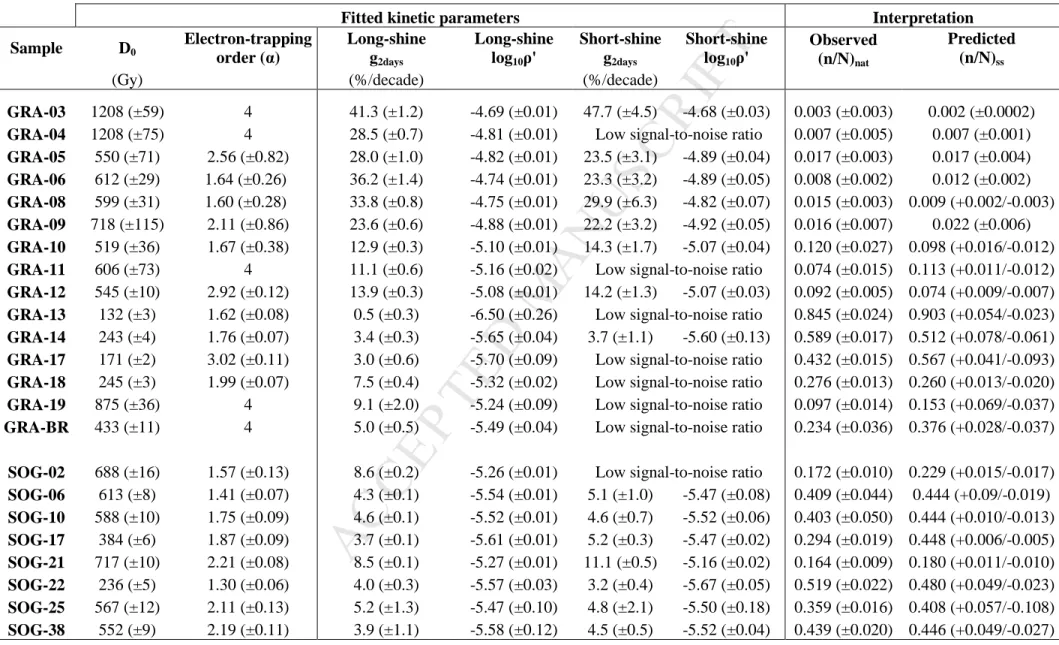
306
(α), as well as the equivalent dose (De), are reported in Tables 3 and S5. For each aliquot, we
307
also derived the natural IRSL50 signal Ln/Tn (Figure 1) and calculated the natural trap filling
308
level (n/N)nat by multiplying the apparent IRSL50 intensity relative to its laboratory maximum
309
(open stars in Figure 1) by the predicted number of occupiable traps in the laboratory (Eq. (3) 310
in Guralnik et al., 2015a). The majority of best-fit D0 and α values are well-constrained with
311
typical relative uncertainties of <10% and <4%, respectively (Table 3). Natural trap filling 312
levels (n/N)nat exhibit varying uncertainties (1-70%; clearly anticorrelated with (n/N)nat itself),
313
and cover almost three orders of magnitude (i.e. 0.003-0.85; Table 3), thus offering a robust 314
dataset for evaluating the net effects of environmental radiation, anomalous fading and possibly 315
long-term cooling on the natural IRSL50 intensity of bedrock feldspar.
316 317
Fading results obtained using both the long-shine (central panels in Figure 1) and short-318
shine (right panels in Figure 1) methods are also summarised in Table 3. Two aliquots were 319
measured individually and averaged to calculate sample-specific g-values and standard 320
deviations (g2days in %/decade; Huntley and Lamothe, 2001). Fitting the same datasets using
321
Eq. (5) in Kars et al. (2008), we obtained an alternative measure of fading - the nearest-322
neighbouring hole-centre density ρ’ as defined in Huntley (2006) - which we later used in the 323
kinetic model to predict the IRSL50 field saturation levels (Guralnik et al., 2015a). Inter-aliquot
324
variability is small, confirming the good reproducibility of the fading measurement protocols, 325
with more robust estimates for the long-shine method as explained below (Table 3). Although 326
the short-shine protocol is less time-consuming (approximately half the time), the integrated 327
IRSL50 signal at each short-shine measurement is considerably lower, and therefore associated
328
with larger uncertainties propagated into the resulting g-value (Table 3 and Figure 1). For 329
feldspars with intermediate to low luminescence sensitivity (roughly one third of our dataset), 330
the short-shine protocol yielded signals with a very low signal-to-background ratio that could 331
not be used to derive meaningful g-values (Table 3). Figure 2 shows that, on average, fading 332
rate estimates are in excellent agreement between the long- and the short-shine protocols. Thus, 333
to further reduce experimental noise, in the subsequent modelling we used averaged g-values 334
(wherever possible) from both protocols. Sample-specific IRSL50 g2days values reveal a wide
335
range from ~0.5 to ~45 %/decade (Table 3). K-feldspars from SOG samples exhibit g2days
336
values between 3 and 11 %/decade, which is typical for K-feldspars from both bedrock and 337
sediment origin (Huntley and Lamothe, 2001; Huntley and Lian, 2006). Na-/Ca-feldspars show 338
M
AN
US
CR
IP
T
AC
CE
PT
ED
a higher variability in measured g2days values between samples (Figures 2 and 3), especially for
339
GRA samples (from 0.5 to >45 %/decade). 340
341
3.2. Predictions of feldspar IRSL50 field saturation
342
To evaluate whether fading variability in our dataset is the main controlling factor for the 343
natural IRSL50 intensities, we first examined the relationship of the laboratory-derived g2days
344
values with the measured (n/N)nat values (Figure 3). Our results show a clear inverse correlation
345
between g2days and (n/N)nat values, in agreement with previous observations (Huntley and Lian,
346
2006) but over a considerably wider range of fading rates. Even prior to modelling, such an 347
inverse correlation suggests that the measured (n/N)nat in most of our samples is mainly
348
controlled by anomalous fading. Only some YAK samples appear to deviate from the overall 349
trend, with their (n/N)nat values markedly below field saturation (Figure 3). However, the
350
relation in Figure 3 is only qualitative, because this empirical relationship might be influenced 351
not only by sample-specific kinetic parameters, but also by thermal loss (which cannot be 352
accounted for in this figure). In the following section, we test our current dataset against a 353
recently proposed physical model predicting feldspar IRSL50 field saturation under anomalous
354
fading (Guralnik et al., 2015a, incorporating the tunnelling term of Huntley, 2006, and 355
extending the dose response of Kars et al., 2008 to non-first order). 356
357
Athermal IRSL signal loss in feldspars is caused by the quantum mechanical tunnelling of 358
electrons from their traps towards electron holes (Huntley and Lamothe, 2001). Here we use 359
the physical model of Huntley (2006) which is based on the assumptions that (i) the tunnelling 360
of electrons is governed by the distance to their nearest recombination centre, and (ii) 361
recombination centres within a feldspar crystal are randomly distributed with a given density. 362
This model (Huntley 2006) can be used to estimate sample-specific field saturation values (e.g. 363
Kars et al., 2008; Guralnik et al., 2015a; King et al., 2016). Following Guralnik et al. (2015a), 364
we use a Monte-Carlo approach to numerically predict, on a sample to sample basis, the IRSL50
365
trap filling saturation values in nature (n/N)ss (termed “field saturation”). In the simulation
366
(1000 runs per sample), random instances of the kinetic parameters (D0 and α, Table 3), natural
367
dose rates (Table 1), and ߩᇱ (Table 3, averaged wherever possible between the long- and short-368
shine experiments) are drawn from their normal distributions (as given by their best-fit values). 369
The modelling results, reported as median (n/N)ss and associated 68% confidence interval, are
370
given in Table 3 and visualised against measured natural trap filling (n/N)nat values in Figure 4.
371 372
M
AN
US
CR
IP
T
AC
CE
PT
ED
Figure 4 highlights the quantitative agreement between predicted (n/N)ss and measured
373
(n/N)nat values, confirming that most of our samples are either in full field saturation, or hardly
374
discernible from it (<15%; Guralnik et al., 2015b). In other words, the natural feldspar IRSL50
375
signal in the majority of our samples (n = 25) is controlled by electron tunnelling and does not 376
include a detectable thermal signature of the rock exhumation history. However, more than half 377
(66%) of YAK samples, representing the fastest-exhuming setting, exhibit (n/N)nat values that
378
are considerably (more than 15%) below their predicted (n/N)ss values, suggesting field
379
disequilibrium and thus high likelihood of a thermal signature that can be translated into a 380
cooling history. The thermal signature of two additional samples (GRA-BR and SOG-17) 381
remains in doubt, requiring further investigation that will either link them to exceptional 382
thermal histories, or dismiss them as outliers (one in each locality). 383
384
3.3. Dose recovery results 385
Calculated dose recovery ratios (Supplementary Table S5) were typically within 10% of 386
unity for all but four (GRA-13/-14/-17 and SOG-21) samples. Although imperfect, the 15-20% 387
underestimation in the dose recovery of SOG-21 is within familiar values, even when working 388
with a SOL2 solar simulator (e.g. Buylaert et al., 2012; King et al., 2016), and may relate to an 389
irreversible trapping efficiency change (Kars et al., 2014). On the other hand, it is hard to 390
blame the considerable dose recovery overestimates in GRA-13/-14/-17 (30 to 65%) on the test 391
dose/given dose ratio (here 18%), which is in the 15-80% trust zone and certainly close to the 392
recently recommended ~30% value (Yi et al., in press). To test whether the observed 393
overestimation is due to a large residual dose, we measured the latter in GRA-13 and GRA-BR 394
after an IRSL50 bleach for 300 s. Low residuals of ~5-8 Gy correspond to less than 2% of the
395
equivalent doses, and to 2-3% of the recovered dose, and therefore cannot explain the observed 396
overestimations. To test whether the problem lies in a thermal transfer (e.g. Huntley et al., 397
1993), we extended the dose recovery experiments further by conducting the IRSL bleach at 398
higher temperatures (100 and 200 °C). Bleaching at higher temperatures did not significantly 399
improve dose recovery in GRA-13/-14/-17, and had no effect on a well-behaving sample 400
(GRA-BR). Overall, unacceptable dose recovery affects only a minor subset (13%) of our 401
dataset and might not necessarily imply that the obtained (n/N)nat values are not reliable
402
(Buylaert et al., 2012). However, such dose recovery over- and underestimations do raise the 403
question of what thermal/optical bleach is most appropriate for resetting the natural IRSL50
404
intensity in feldspars that were never previously exposed to light. 405
M
AN
US
CR
IP
T
AC
CE
PT
ED
4. Discussion 4074.1. IRSL50 and anomalous fading in bedrock feldspars
408
Our results confirm that feldspar IRSL50 signals from bedrock extracts show consistent and
409
reproducible luminescence characteristics using the SAR protocol. This is a clear advantage 410
compared to OSL of bedrock quartz which, apart from a very few cases (e.g. Wu et al., 2015), 411
is generally deemed dim and unsuitable (Jeong and Choi, 2012; Guralnik et al., 2015b). 412
Moreover, the vast majority of our bedrock feldspars (87%, n = 28, Supplementary Table S5) 413
also fulfilled the dose recovery test, which is a fundamental acceptance criterion for 414
luminescence dating. Dose responses were successfully fitted with a General-Order Kinetics 415
model, with a median order of 2.4±0.8, in agreement with Na-feldspars from the KTB borehole 416
(Guralnik et al., 2015a), therefore capturing the non-linearity of the dose response curve in just 417
a single parameter. 418
419
Fading measurements exhibit a large variability in bedrock feldspars from ~0.5 to ~45 420
%/decade, beyond the previously published value range (Huntley and Lamothe, 2001; Huntley 421
and Lian, 2006). Moreover, we compared two established fading protocols in sediment dating 422
(Huntley and Lamothe, 2001; Auclair et al., 2003) and demonstrated that both are applicable 423
for bedrock feldspars, yielding comparable results between the two methods (Figure 2). Given 424
the considerable experimental differences between the protocols (SAR-based and non-SAR), 425
the agreement of the obtained results is striking. The dependence of the fading rate on the given 426
laboratory dose (Huntley and Lian, 2006; Li and Li, 2008; Kars and Wallinga, 2009) is not 427
evident from our dataset, although the administered laboratory doses (200 and 72 Gy for the 428
long-shine and short-shine protocols, respectively) may be too close to detect any systematic 429
deviation. 430
431
In our suite of bedrock feldspars, (n/N)nat values are mostly inversely correlated with
432
laboratory-measured fading rates (Figure 3), qualitatively suggesting field saturation in the 433
majority of samples. Quantitatively, we have demonstrated that field saturation can be 434
successfully predicted across almost three orders of magnitude of IRSL50 electron trap
435
occupancy (Figure 4), using a recent extension (Guralnik et al., 2015c) of familiar electron 436
tunnelling models (Huntley, 2006; Kars et al., 2008). Despite successful prediction of field 437
saturation in both sedimentary feldspars (Kars et al., 2008; Kars and Wallinga, 2009) and 438
bedrock feldspars (Guralnik et al., 2015a; King et al., 2016), the underlying model(s) and the 439
ability to accurately measure the g-value in the laboratory remains a debateable subject (Li et 440
M
AN
US
CR
IP
T
AC
CE
PT
ED
al., 2014). Here, we exploited the large variability in measured fading rates to provide a 441
quantitative validation of our predictive model over a large range of dose rates, trap 442
occupancies, and fading rates (Figure 4). 443
444
We also used the wide range of observed IRSL50 fading rates to discuss potential
445
geochemical control, starting with the whole-rock geochemistry (Supplementary Tables S2-3) 446
as a first-order proxy. However, we found no convincing relationship between the whole-rock 447
trace element content (Supplementary Table S3) and feldspar IRSL50 fading rate. Figure 5A
448
illustrates the lithological variability within our dataset as shown by representative major 449
oxides (SiO2 and Fe2O3), suggesting that, at first order, the fading rate would increase with
450
decreasing SiO2 content or increasing Fe2O3 (or CaO) content. Felsic lithologies (i.e. >63% wt.
451
SiO2 content) all show relatively low feldspar fading rates (less than 10 %/decade) regardless
452
of the feldspar type. However, for intermediate (i.e. 52-63% wt. SiO2 content) and mafic (i.e.
453
<52% wt. SiO2 content) lithologies, a large spread in fading rates is observed (Figure 5A). For
454
a representative subset of GRA and YAK feldspar separates, we also performed XRF 455
mineralogical determination (Supplementary Table S4). Figure 5B shows that the feldspar 456
fading rate increases with Ca content, in agreement with previous observations (Huntley and 457
Lian, 2006; Huntley et al., 2007). In summary, neither the whole-rock geochemistry, nor the 458
trace elements, seem to be a good proxy for feldspar anomalous fading (although we did not 459
apply multivariate analysis); however, our results show that the feldspar internal chemistry (i.e. 460
Ca content, Figure 5B) may be a first-order proxy for the IRSL50 fading rate. Further
461
investigations are required to better understand the potential causes of fading rate variability in 462
bedrock feldspars; these include both internal factors (e.g. the origin of the IRSL50 signal in
Ca-463
/Na-feldspars; e.g. Sohbati et al., 2013) as well as external drivers, such as the metamorphic 464
grade or terrain age (Huntley and Lamothe, 2001), or weathering processes (Parish, 1992; 465
Huntley, 2011). 466
467
4.2. Implications for OSL thermochronometry 468
Our extensive bedrock dataset offers an opportunity to discuss the applicability of feldspar 469
IRSL50 in OSL thermochronometry. First, the variability of the fading rates measured for both
470
K- and Ca-/Na-feldspars is significantly broader than those reported in previous OSL 471
thermochronometric studies (Guralnik et al., 2015a, King et al., 2016). This reinforces the 472
notion that anomalous fading in feldspar should be measured for each sample, as it can strongly 473
M
AN
US
CR
IP
T
AC
CE
PT
ED
thermochronometry is that a sample’s thermal history can be inverted only from the natural trap 475
filling (n/N)nat, and not from the equivalent dose alone (De) as in OSL sediment dating. This
476
prevents the application of classical fading correction schemes (e.g. Huntley and Lamothe, 477
2001) and requires the quantitative prediction of the field saturation level of the luminescence 478
signal (e.g. Kars et al., 2008; Li and Li, 2008) in order to screen for a potential "thermal 479
signature" in a given sample. For most of our samples, and within a wide range of fading rates, 480
the quantitative agreement of observed field saturation levels of the IRSL50 signal with
481
numerical results from the standard tunnelling model (Huntley, 2006), coupled with a General-482
Order Kinetics dose response (Guralnik et al., 2015c), confirms the need to include fading 483
measurements in preliminary screening of samples before any thermochronometric applications 484
using feldspar IRSL50. This first-step investigation of the feldspar athermal stability would
485
ultimately be combined with the experimental characterisation of each sample’s thermal 486
stability (Guralnik et al., 2015a; King et al., 2016), which can vary greatly between K- and Na-487
/Ca-feldspars (e.g. Tso et al., 1996; Li et al., 1997) and thus significantly influence 488
thermochronometric interpretation. 489
490
Our sampling strategy, covering a wide range of exhumation rates (from 0.01 to 3 km Ma-1), 491
provides further information regarding the range of applicability of feldspar IRSL50 to OSL
492
thermochronometry in diverse natural settings. All GRA and SOG samples appear in field 493
saturation (Figure 4), with just one outlier per locality (GRA-BR and SOG-17). SOG-17 was a 494
translucent bedrock sample, which may immediately be suspected of suffering optical resetting 495
(in nature and/or during sample preparation), that may have biased the observed luminescence 496
signal to below the predicted field saturation level. GRA-BR is a spatial outlier within the GRA 497
dataset, situated at low-elevation within a very wide and deeply-carved valley. Pending 498
additional experimental confirmation (beyond the scope of this study), its deviation from field 499
saturation could potentially reflect recent accelerated exhumation by efficient glacial processes. 500
Finally, more than half of the YAK samples exhibit a thermal signature in their measured 501
natural IRSL50 signal (Table 3 and Figure 4). Samples YAK-17/-18/-50 (all with a “thermal
502
signature”) are located along a deeply-carved fjord with very high long-term exhumation rates 503
(2-3 km Ma-1; Enkelmann et al., 2015). Interestingly, the field-saturated YAK-09/-13/-15/-19 504
also belong to this area but are located ~20 km eastwards along another smaller fjord 505
(Enkelmann et al., 2015). These spatial differences in IRSL50 intensities would suggest spatial
506
variations in the late-Quaternary exhumation history of this area that were not detected by 507
higher-temperature thermochronometers (McAleer et al., 2009; Enkelmann et al., 2015) but 508
M
AN
US
CR
IP
T
AC
CE
PT
ED
may be evidenced in our dataset. Finally, YAK-03/-07 exhibit exceptionally low natural trap 509
filling levels (Figure 4), which may have been caused by hydrothermal reheating from crustal 510
fluid circulations in a highly-fractured area (Fairweather Fault; McAleer et al., 2009), rather 511
than by extremely rapid bedrock cooling. Further work beyond the scope of the present study 512
will focus on constraining thermal kinetic parameters for these samples to derive their thermal 513
histories. 514
515
In summary, our dataset confirms that feldspar IRSL50 would be applicable only in very
516
rapidly-exhuming settings (>1 km Ma-1; e.g. King et al., 2016) or in high-temperature 517
environments such as boreholes or tunnels (>35 °C; Guralnik et al., 2015a). Feldspar 518
anomalous fading, even if correctly accounted for, ultimately reduces the trapped charge 519
capacity in a given crystal because of athermal instability, and thus initiates a faster arrival at 520
field saturation. This might preclude the applicability of feldspar IRSL50 in OSL
521
thermochronometry. MET-pIRIR protocols (Li and Li, 2011a,b) offer the advantage of multi-522
thermochronometric systems in a single mineral (Qin et al., 2015), with promising outcomes in 523
providing robust constraints on bedrock cooling rates over sub-Quaternary timescales (King et 524
al., 2016). Other feldspar protocols such as thermally-transferred IRSL (Reimann et al., 2015) 525
or pulsed IRSL50 (although the thermal stability of pulsed IRSL50 remains to be experimentally
526
constrained; Tsukamoto et al., 2006; Roskosch et al., 2015; Jain et al., 2015b) may also be 527
interesting to explore for thermochronometric application, providing that these protocols show 528
good luminescence characteristics as well as low thermal stability for bedrock feldspar extracts. 529
Alternatively, quartz protocols based on thermally-transferred OSL (Duller and Wintle, 2012), 530
Violet Stimulated Luminescence (VSL, Ankjærgaard et al., 2013; 2015) or (red-531
)thermoluminescence (TL or red TL, Schmidt et al., 2015; Tang and Li, 2015) could allow for 532
later saturation and thus a wider dating range in thermochronometry. 533
534
5. Conclusions 535
We report feldspar IRSL50 luminescence characteristics, natural signal and anomalous
536
fading for 32 bedrock samples collected from a large variety of lithologies and exhumation 537
settings. Our results show that feldspar IRSL50 signals from bedrock extracts are bright and
538
reproducible using established protocols in OSL dating. We measured a large variability in 539
IRSL50 fading rates between samples. Our results show that it is essential to measure
540
anomalous fading and account for it on a sample-to-sample basis for OSL thermochronometry, 541
M
AN
US
CR
IP
T
AC
CE
PT
ED
the wide range of observed fading rates to demonstrate the ability of electron tunnelling models 543
in quantitatively predicting the feldspar IRSL50 level in field saturation for rather diverse
544
environmental conditions. While the potential causes for feldspar IRSL50 fading still require
545
further investigation, our observations point towards a significant influence of Ca content in 546
feldspar on its anomalous fading rate. Finally, our results suggest that the applicability of 547
feldspar IRSL50 in OSL thermochronometry would be limited to rapidly-exhuming settings (i.e.
548
>1 km Ma-1) or warm subsurface environments (i.e. >35 °C). 549
550
Acknowledgments 551
We thank S. Tsukamoto and S.-H. Li for constructive and helpful reviews, A.S. Murray and M. 552
Jain (Nordic Laboratory for Luminescence dating / DTU Risø) for hosting an early pilot study 553
in 2010, M. Kook for XRF measurements, and G. King and D. Sanderson for fruitful 554
discussions and feedback. P.G.V. acknowledges funding from the SNSF (grant Ambizione 555
PZ00P2_148191) and the ETH-Zürich COFUND. S.E.L. receives funding from the National 556
Cooperative for the Disposal of Radioactive Waste (Nagra). F.H. and B.G. were funded 557
through SNSF grants PP00P2-38956 and 200021-127127. B.G. acknowledges support from the 558
NWO VENI grant 863.15.026. P.S. acknowledges the financial and scientific support from R.S. 559
Huismans, the Statoil Earth System Modelling project and the University of Bergen. 560
561
References 562
Aitken, M.J., 1985. Thermoluminescence Dating. Academic Press, London. 359 pp. 563
Aitken, M.J., Xie, J., 1990. Moisture correction for annual gamma dose. Ancient TL 8, 6-9. 564
Aitken, M.J., 1998. An Introduction to Optical Dating: The Dating of Quaternary Sediments by 565
the Use of Photon-Stimulated Luminescence. Oxford University Press. 267 pp. 566
Ankjærgaard, C., Jain, M., Wallinga, J., 2013. Towards dating quaternary sediments using the 567
quartz violet stimulated luminescence (VSL) signal. Quaternary Geochronology 18, 99-109. 568
Ankjærgaard, C., Guralnik, B., Porat, N., Heimann, A., Jain, M., Wallinga, J., 2015. Violet 569
stimulated luminescence: geo-or thermochronometer? Radiation Measurements 81, 78-84. 570
Auclair, M., Lamothe, M., Huot, S., 2003. Measurement of anomalous fading for feldspar IRSL 571
using SAR. Radiation Measurements 37, 487-492. 572
Balescu, S., Lamothe, M., 1994. Comparison of TL and IRSL age estimates of feldspar coarse 573
grains from waterlain sediments. Quaternary Science Reviews 13, 437-444. 574
Barré, M., Lamothe, M., 2010. Luminescence dating of archaeosediments: A comparison of K-575
feldspar and plagioclase IRSL ages. Quaternary Geochronology 5, 324-328. 576
M
AN
US
CR
IP
T
AC
CE
PT
ED
Bateman, M., Swift, D.A., Piotrowski, J.A., Sanderson, D.C.W., 2012. Investigating the effects 577
of glacial shearing of sediment on luminescence. Quaternary Geochronology 10, 230-236. 578
Bell, W.T., 1980. Alpha dose attenuation in quartz grains for thermoluminescence dating. 579
Ancient TL 12, 4-8. 580
Berger, A.L., Spotila, J.A., Chapman, J.B., Pavlis, T.L., Enkelmann, E., Ruppert, N.A., 581
Buscher, J.T., 2008. Architecture, kinematics, and exhumation of a convergent orogenic 582
wedge: A thermochronological investigation of tectonic-climatic interactions within the 583
central St. Elias Orogen, Alaska. Earth and Planetary Science Letters 270, 13-24. 584
Bøtter-Jensen, L., Thomsen, K.J., Jain, M., 2010. Review of optically stimulated lumi-nescence 585
(OSL) instrumental developments for retrospective dosimetry. Radiation Measurements 45, 586
253-257. 587
Braun, J., van der Beek, P., Batt, G., 2006. Quantitative thermochronology: numerical methods 588
for the interpretation of thermochronological data. Cambridge University Press. 258 pp. 589
Braun, J., van der Beek, P., Valla, P.G., Robert, X., Herman, F., 2012. Quantifying rates of 590
landscape evolution and tectonic processes by thermochronology and numerical modelling 591
of crustal heat transport using PECUBE. Tectonophysics 20, 1-28. 592
Brennan, B.J., Lyons, R.G., Phillips, S.W., 1991. Attenuation of alpha particle track dose for 593
spherical grains. International Journal of Radiation Applications and Instrumentation. Part 594
D. Nuclear Tracks and Radiation Measurements 18, 249-253. 595
Buylaert, J.P., Murray, A.S., Thomsen, K.J., Jain, M., 2009. Testing the potential of an elevated 596
temperature IRSL signal from K-feldspar. Radiation Measurements 44, 560-565. 597
Buylaert, J.P., Huot, S., Murray, A.S., van den Haute, P., 2011. Infrared stimulated 598
luminescence dating of an Eemian (MIS 5e) site in Denmark using K-feldspar. Boreas 40, 599
46-56. 600
Buylaert, J.-P., Jain, M., Murray, A.S., Thomsen, K.J., Thiel, C., Sohbati, R., 2012. A robust 601
feldspar luminescence dating method for Middle and Late Pleistocene sediments. Boreas 41, 602
435-451. 603
Buylaert, J.P., Jain, M., Murray, A.S., Thomsen, K.J., Thiel, C., Sohbati, R., 2012. A robust 604
feldspar luminescence dating method for Middle and Late Pleistocene sediments. Boreas 41, 605
435-451. 606
Champagnac, J.-D., Valla, P.G., Herman, F., 2014. Late-Cenozoic relief evolution under 607
evolving climate: A review. Tectonophysics 614, 44-65. 608
M
AN
US
CR
IP
T
AC
CE
PT
ED
De Sarkar, S., Mathew, G., Pande, K., Chauhan, N., Singhvi, A., 2013. Rapid denudation of 609
Higher Himalaya during late Pliestocence, evidence from OSL thermochronology. 610
Geochronometria 40, 304-310. 611
Duller, G.A.T., 1992. Luminescence chronology of raised marine terraces, south-west North 612
Island, New Zealand. PhD thesis, University of Wales, Aberystwyth. 236 pp. 613
Duller, G.A.T., Wintle, A.G., 2012. A review of the thermally transferred optically stimulated 614
luminescence signal from quartz for dating sediments. Quaternary Geochronology 7, 6-20. 615
Enkelmann, E., Valla, P.G., Champagnac, J.-D., 2015. Low-temperature thermochronology of 616
the Yakutat Plate corner, St. Elias Range (Alaska): bridging short-term and long-term 617
deformation. Quaternary Science Reviews 123, 23-38. 618
Grün, R., 2001. Trapped charge dating (ESR, TL, OSL). In: Brothwell, D.R., Pollard, A.M. 619
(Eds.), Handbook of Archaeological Sciences. John Wiley & Sons Inc., West Sussex, 620
England, pp. 47-62. 621
Grün, R., Tani, A., Gurbanov, A., Koshchug, D., Williams, I., Braun, J., 1999. A new method 622
for the estimation of cooling and rates using paramagnetic centers in quartz: a case study on 623
the Eldzhurtinskiy Granite, Caucasus. Journal of Geophysical Research 104, 17531-17549. 624
Guérin, G., Mercier, N., 2012. Preliminary insight into dose deposition processes in 625
sedimentary media on a grain scale : Monte Carlo modelling of the effect of water on 626
gamma dose-rates. Radiation Measurements, 47, 541-547. 627
Guérin, G., Mercier, N., Nathan, R., Adamiec, G., Lefrais, Y., 2012. On the use of the infinite 628
matrix assumption and associated concepts: a critical review. Radiation Measurements 47, 629
778-785. 630
Guralnik, B., Jain, M., Herman, F., Paris, R.B., Harrison, T.M., Murray, A.S., Valla, P.V., 631
Rhodes, E.J., 2013. Effective closure temperature in leaky and/or saturating 632
thermochronometers. Earth and Planetary Science Letters 384, 209-218. 633
Guralnik, B., Jain, M., Herman, F., Ankjærgaard, C., Murray, A.S., Valla, P.G., Preusser, F., 634
King, G.E., Chen, R., Lowick, S.E., Kook, M., Rhodes, E.J., 2015a. OSL-thermochronology 635
of feldspar from the KTB Borehole, Germany. Earth and Planetary Science Letters 423, 636
232-243. 637
Guralnik, B., Ankjærgaard, C., Jain, M., Murray, A.S., Müller, A., Wälle, M., Lowick, S.E., 638
Preusser, F., Rhodes, E.J., Wu, T.-S., Mathew, G., Herman, F., 2015b. OSL-639
thermochronometry using bedrock quartz: a note of caution. Quaternary Geochronology 25, 640
37-48. 641
M
AN
US
CR
IP
T
AC
CE
PT
ED
Guralnik, B., Li, B., Jain, M., Chen, R., Paris, R.B., Murray, A., Li, S.H., Pagonis, V., Valla, 642
P.G., Herman, F., 2015c. Radiation-induced growth and isothermal decay of infrared-643
stimulated luminescene from feldspar. Radiation Measurements 81, 224-231. 644
Hendriks, B., Andriessen, P., Huigen, Y., Leighton, C., Redfield, T., Murrell, G., Gallagher, K., 645
Nielsen, S.B., 2007. A fission track data compilation for Fennoscandia. Norwegian Journal 646
of Geology 87, 143-155. 647
Herman, F., Champagnac, J.-D., 2016. Plio-Pleistocene increase in erosion rates in mountain 648
belts in response to climate change. Terra Nova 28, 2-10. 649
Herman, F., Rhodes, E.J., Braun, J., Heiniger, L., 2010. Uniform erosion rates and re-lief 650
amplitude during glacial cycles in the Southern Alps of New Zealand, as revealed from 651
OSL-thermochronology. Earth and Planetary Science Letters 297, 183-189. 652
Herman, F., Seward, D., Valla, P.G., Carter, A., Kohn, B., Willett, S.D., Ehlers, T.A., 2013. 653
Worldwide acceleration of mountain erosion under a cooling climate. Nature 504, 423-426. 654
Hijmans, R.J., Cameron, S.E., Parra, J.L., Jones, P.G., Jarvis, A., 2005. Very high resolution 655
interpolated climate surfaces for global land areas. International Journal of Climatology 25, 656
1965-1978. 657
Huntley, D.J., Hutton, J.T., Prescott, J.R., 1993. Optical dating using inclusions within quartz 658
grains. Geology 21, 1087-1090. 659
Huntley, D.J., Baril, M.R., 1997. The K content of the K-feldspars being measured in optical 660
dating or in thermoluminescence dating. Ancient TL 15, 11-13. 661
Huntley, D.J., Lamothe, M., 2001. Ubiquity of anomalous fading in K-feldspars and the 662
measurement and correction for it in optical dating. Canadian Journal of Earth Sciences 38, 663
1093-1106. 664
Huntley, D.J., 2006. An explanation of the power-law decay of luminescence. Journal of 665
Physics: Condensed Matter 18, 1359-1365. 666
Huntley, D.J., Lian, O.B., 2006. Some observations on tunnelling of trapped electrons in 667
feldspars and their implications for optical dating. Quaternary Science Reviews 25, 2503-668
2512. 669
Huntley, D.J., Baril, M.R., Haidar, S., 2007. Tunnelling in plagioclase feldspars. Journal of 670
Physics D: Applied Physics 40, 900-906. 671
Huntley, D.J., 2011. Comment on “Isochron dating of sediments using luminescence of K-672
feldspar grains” by B. Li et al. Journal of Geophysical Research 116, F01012. 673
M
AN
US
CR
IP
T
AC
CE
PT
ED
Jain, M., Guralnik, B., Andersen, M.T., 2012. Stimulated luminescence emission arising from 674
localized recombination within randomly distributed defects. Journal of Physics Condensed 675
Matter 24, 385402. 676
Jain, M., Sohbati, R., Guralnik, B., Murray, A.S., Kook, M., Lapp, T., Prasad, A.K., Thomsen, 677
K.J., Buylaert, J.P, 2015a. Kinetics of infrared stimulated luminescence from feldspars. 678
Radiation Measurements 81, 242-250. 679
Jain, M., Buylaert, J.P., Thomsen, K.J., Murray, A.S., 2015b. Further investigations on ‘non-680
fading’ in K-Feldspar. Quaternary International 362, 3-7. 681
Kars, R.H., Wallinga, J., Cohen, K.M., 2008. A new approach towards anomalous fading 682
correction for feldspar IRSL dating - tests on samples in field saturation. Radiation 683
Measurements 43, 786-790. 684
Kars, R.H., Wallinga, J., 2009. IRSL dating of K-feldspars: Modelling natural dose response 685
curves to deal with anomalous fading and trap competition. Radiation Measurements 44, 686
594-599. 687
Kars, R.H., Reimann, T., Wallinga, J., 2014. Are feldspar SAR protocols appropriate for post-688
IR IRSL dating? Quaternary Geochronology 22, 126-136. 689
King, G.E., Herman, F., Lambert, R., Valla, P.G., Guralnik, B., 2016. Multi-OSL-690
thermochronometry of feldspar. Quaternary Geochronology 33, 76-87 691
King, G.E., Robinson, R.A.J., Finch, A.A., 2014. Towards successful OSL sampling strategies 692
in glacial environments: deciphering the residual OSL signals of quartz and K-feldspar from 693
modern glacial sediments. Quaternary Science Reviews 89, 94-107. 694
Kook, M.H., Lapp, T., Murray, A.S., Thiel, C., 2012. A Risø XRF attachment for major 695
element analysis of aliquots of quartz and feldspar separates. UK Luminescence and ESR 696
Meeting - Aberystwyth, p. 37. 697
Koshchug, D.G., Solovyov, Y.P., 1998. Accumulation of structural radiation defects in quartz 698
in cooling systems: Basis for dating. Physics and Chemistry of Minerals 25, 242-248. 699
Lamothe, M., Auclair, M., 1999. A solution to anomalous fading and age shortfalls in optical 700
dating of feldspar minerals. Earth and Planetary Science Letters 171, 319-323. 701
Lamothe, M., Auclair, M., Hamzaoui, C., Huot, S., 2003. Towards a prediction of long-term 702
anomalous fading of feldspar IRSL. Radiation Measurements 37, 493-498. 703
Li, S-H., Tso, M-Y.W., Wong, N.W.L., 1997. Parameters of OSL traps determined with 704
various linear heating rates. Radiation Measurements 27, 43-47. 705
Li, B., Li, S.-H., 2006. Comparison of De estimates using the fast component and the medium 706
component of quartz OSL. Radiation Measurements 41, 125-136. 707