
HAL Id: insu-02917170
https://hal-insu.archives-ouvertes.fr/insu-02917170
Submitted on 18 Aug 2020
HAL is a multi-disciplinary open access
archive for the deposit and dissemination of
sci-entific research documents, whether they are
pub-lished or not. The documents may come from
teaching and research institutions in France or
abroad, or from public or private research centers.
L’archive ouverte pluridisciplinaire HAL, est
destinée au dépôt et à la diffusion de documents
scientifiques de niveau recherche, publiés ou non,
émanant des établissements d’enseignement et de
recherche français ou étrangers, des laboratoires
publics ou privés.
The stable strontium isotopic composition of ocean
island basalts, mid-ocean ridge basalts, and komatiites
Elsa Amsellem, Frédéric Moynier, James M.D. Day, Manuel Moreira, Igor
Puchtel, Fang-Zhen Teng
To cite this version:
Elsa Amsellem, Frédéric Moynier, James M.D. Day, Manuel Moreira, Igor Puchtel, et al.. The
sta-ble strontium isotopic composition of ocean island basalts, mid-ocean ridge basalts, and komatiites.
Chemical Geology, Elsevier, 2018, 483, pp.595-602. �10.1016/j.chemgeo.2018.03.030�. �insu-02917170�
Contents lists available atScienceDirect
Chemical Geology
journal homepage:www.elsevier.com/locate/chemgeo
The stable strontium isotopic composition of ocean island basalts, mid-ocean
ridge basalts, and komatiites
Elsa Amsellem
a,⁎, Frédéric Moynier
a,b, James M.D. Day
a,c, Manuel Moreira
a, Igor S. Puchtel
d,
Fang-Zhen Teng
eaInstitut de Physique du Globe de Paris, Université Paris Diderot, Sorbonne Paris Cité, CNRS UMR 7154, 1 rue Jussieu, 75238 Paris, France bInstitut Universitaire de France, Paris, France
cScripps Institution of Oceanography, University of California San Diego, La Jolla, CA 92093-0244, USA dDepartment of Geology, University of Maryland, 237 Regents Drive, College Park, MD 20742, USA eDepartment of Earth and Space Sciences, University of Washington, Seattle, WA 98195-1310, USA
A R T I C L E I N F O
Keywords: Sr isotopes Ocean island basalts Mid-ocean ridge basalts Komatiites
Kilauea Iki Bulk silicate earth
A B S T R A C T
The radiogenic87Rb-87Sr system has been widely applied to the study of geological and planetary processes. In
contrast, the stable Sr isotopic composition of the bulk silicate Earth (BSE) and the effects of igneous differ-entiation on stable Sr isotopes are not well-established. Here we report the stable Sr isotope (88Sr/86Sr, reported
asδ88/86Sr, in parts per mil relative to NIST SRM 987) compositions for ocean islands basalts (OIB), mid-ocean
ridge basalts (MORB) and komatiites from a variety of locations. Stable Sr isotopes display limited fractionation in a OIB sample suite from the Kilauea Iki lava lake suggesting that igneous processes have limited effect on stable Sr isotope fractionation ( ± 0.12‰ over 20% MgO variation; 2sd). In addition, OIB (δ88/ 86Sr = 0.16–0.46‰; average 0.28 ± 0.17‰), MORB (δ88/86Sr = 0.27–0.34‰; average 0.31 ± 0.05‰) and
komatiites (δ88/86Sr = 0.20–0.97‰; average 0.41 ± 0.16‰) from global localities exhibit broadly similar Sr
stable isotopic compositions. Heavy stable Sr isotope compositions (δ88/86Sr > 0.5‰) in some Barberton
Greenstone belt komatiites may reflect Archean seawater alteration or metamorphic processes and preferential removal of the lighter isotopes of Sr. Tofirst order, the similarity among OIBs from three different ocean basins suggests homogeneity of stable Sr isotopes in the mantle. Earth's mantle stable Sr isotopic composition is es-tablished from the data on OIB, MORB and komatiites to beδ88/86Sr = 0.30 ± 0.02‰ (2sd). The BSE δ88/86Sr
value is identical, within uncertainties, to the composition of carbonaceous chondrites (δ88/ 86Sr = 0.29 ± 0.06‰; 2sd) measured in this study.
1. Introduction
Strontium is an alkaline earth metal and refractory lithophile ele-ment, with a 50% condensation temperature (Tc) of 1464 K (Lodders, 2003). It has three stable isotopes -84Sr (0.56%), 86Sr (9.86%),88Sr
(82.58%) – and a long-lived radiogenic isotope, 87Sr (7.00%), a
daughter product of 87Rb (T1/2= 49.75 × 10⁹years, Nebel et al.,
2011). Due to differences in volatility and partitioning behaviour during igneous processes of Rb and Sr, the87Rb-87Sr system has seen
wide application as a chronometer and tracer in geochemistry and cosmochemistry (e.g.,Papanastassiou and Wasserburg, 1969;Birck and Allègre, 1973). In general, for Rb-Sr isotope chronology, the88Sr/86Sr
ratio is used as a normalization ratio to correct for instrumental mass-dependent effects using either thermal-ionization (TIMS) or multi-col-lector inductively-coupled-plasma (MC-ICP-MS) mass-spectrometry.
Utilizing non-traditional stable isotopes to understand a range of geological processes (e.g.,Teng et al., 2017) has led to proliferation of high-precision stable isotopic measurements of Sr by either double-spike methods using TIMS (e.g.,Parkinson et al., 2007;Pearce et al., 2015;Stevenson et al., 2014;Charlier et al., 2017) or MC-ICP-MS (e.g.,
Shalev et al., 2013), or by sample-standard bracketing with MC-ICP-MS (e.g.,Halicz et al., 2008;Moynier et al., 2010;De Souza et al., 2010). Such studies have shown that biogenic and inorganic Ca‑carbonates tend to be enriched in the lighter isotopes of Sr, while seawater is en-riched in the heavier isotopes compared to the NIST SRM987 standard, which is a highly purified and homogenized Sr carbonate (Ohno and Hirata, 2007;Krabbenhöft et al., 2010; Raddatz et al., 2013). Stable isotopes of Sr are also used as tracers of continental weathering (e.g.,
Wei et al., 2013;Stevenson et al., 2016), and are proxies for paleo-temperature (Stevenson et al., 2014; Fietzke and Eisenhauer, 2006;
https://doi.org/10.1016/j.chemgeo.2018.03.030
Received 9 November 2017; Received in revised form 16 March 2018; Accepted 17 March 2018
⁎Corresponding author.
E-mail address:[email protected](E. Amsellem).
Chemical Geology 483 (2018) 595–602
Available online 20 March 2018
0009-2541/ © 2018 The Authors. Published by Elsevier B.V. This is an open access article under the CC BY-NC-ND license (http://creativecommons.org/licenses/BY-NC-ND/4.0/).
Vollstaedt et al., 2014).
Studies of extra-terrestrial materials have found that chondrules and calcium aluminium-rich inclusions (CAIs) of the carbonaceous chon-drite Allende are enriched in the lighter isotopes of Sr relative to the bulk rock, while terrestrial and extra-terrestrial materials have similar
88Sr/86Sr ratios within ~50 ppm (Patchett, 1980;Moynier et al., 2010;
Charlier et al., 2012). Moynier et al. (2010)proposed that the iso-topically light CAIs (down to ~− 1.7‰ for88Sr/86Sr ratios compared to bulk meteorites) resulted from electromagnetic sorting of ionized heavy Sr from neutral Sr in the early Solar System, while Patchett (1980)suggested that CAIs were isotopically fractionated during vola-tilization processes.
Given the applications described above, advancing our knowledge of Sr isotopic variability in terrestrial igneous rocks is fundamental for two principle reasons. First, the interpretation of Sr isotope applied to understand weathering processes relies on the fact that the high-tem-perature fractionation of Sr isotopes is well-understood and that iso-topic variations in weathering products do not reflect this important process. Second, the extent of Sr isotopic fractionation during igneous processes, as well as the estimation of the isotopic composition of the Earth's mantle and of the bulk silicate Earth (BSE), are central to any inter-planetary comparisons. However, the isotopic composition of the BSE has only been estimated from a limited number of terrestrial ig-neous rocks, including < 20 basalts (mostly from Hawaii, including many replicates of BHVO-2), a large set of rhyolites and several granites and andesites (Charlier et al., 2012, 2017,Moynier et al., 2010). While the Sr isotopic composition of the basalts, granites, and andesites cluster around the same value, several rhyolite glasses were reported to be enriched in the lighter Sr isotopes and it was suggested that igneous differentiation may cause Sr isotopic fractionation (Charlier et al., 2012). It is therefore possible that basalts may not be representative of their mantle source due to the effects of igneous fractionation on stable Sr isotopes.
To precisely determine the behavior of Sr isotopes during magmatic differentiation and establish the composition of BSE, it is necessary to investigate natural terrestrial samples from a common source. Kilauea Iki (KI) lava lake is well-suited to test the effects of fractional crystal-lization because these samples were formed in a closed system and have experienced extensive fractional crystallization, with MgO contents ranging from 26.9 to 2.4 wt% (Helz et al., 1994; 2012). They have therefore been used widely to study stable isotopic fractionation during igneous processes (e.g., Zn:Chen et al., 2013; Ga:Kato et al., 2017; Fe:
Teng et al., 2008; Mg:Teng et al., 2010; Sn:Badullovich et al., 2017; Li:
Tomascak et al., 1999). To evaluate the Sr isotopic composition of BSE we report data to test the effect of igneous differentiation on a series of Kilauea Iki lava lake samples, and to evaluate the spatial and temporal heterogeneity of Sr stable isotope compositions in the terrestrial mantle using basaltic rocks from different settings (ocean island basalts [OIB], mid ocean ridge basalts [MORB], continentalflood basalts [CFB], and komatiites). We also report data for a variety of chondritic meteorites for comparison with the estimated BSE Sr isotopic composition.
2. Materials and methods
2.1. Samples
A set of forty-five basalts were selected for stable Sr isotopic ana-lysis, including thirty-seven OIB, seven MORB from the Pacific, Atlantic and Indian Oceans, and one CFB (BCR-2). One of the MORB samples (EW9309-20D) comes from the Shona ridge anomaly, where there is evidence of plume-ridge interaction (Moreira et al., 1995). For the OIB, we selected samples covering a large range of compositions (Table 1). For example, St. Helena is classified as HIMU-like based on its radio-genic isotopes, and has low3He/4He (Graham et al., 1992;Hanyu and
Kaneoka, 1997). Seven samples from the Canary Islands, including the islands of La Palma, El Hierro, Gran Canaria, and Fuerteventura, are
considered to contain variable and distinct proportions of recycled oceanic crust and lithosphere as evidenced from He-O-Sr-Nd-Os-Pb isotopes (e.g.,Day et al., 2009, 2010;Day and Hilton, 2011). Three samples from volcanic complexes in the Northern Rift Zone in Iceland have depleted tholeiitic compositions. OIB samples from Iceland have attracted many studies because of the association between an oceanic ridge and a mantle plume (Rickers et al., 2013). It has been suggested, based on unradiogenic He and Ne, that the source of these samples is deep, undegassed mantle (Breddam et al., 2000;Moreira et al., 2001). The remaining samples come from several ocean island localities in the Pacific, Indian and Atlantic ocean basins and have been previously characterized for major- and trace-elements, radiogenic isotopes, and Si and Ga stable isotopic compositions (LeRoex, 1985; Albarède and Tamagnan, 1988; Breddam et al., 2000; Claude-Ivanaj et al., 2001;
Breddam, 2002;Workman et al., 2004;Geist et al., 2006;Jackson et al., 2007a, 2007b;Millet et al., 2008;Kurz et al., 2009;Day et al., 2010;
Kawabata et al., 2011;Hart and Jackson, 2014;Garapić et al., 2015,
Pringle et al., 2016,Peters & Day, 2017;Kato et al., 2017).
Samples that we analyzed from the Kilauea Iki lava lake were erupted in 1959 to form a 135 m deep lava lake. Drilling of the lava lake has afforded the opportunity to study the entire igneous sequence preserved during cooling and crystallization (Helz, 2012). The Kilauea Iki lava lake was formed from picritic lava with an average MgO con-tent of ~15.4 wt% (Wright, 1973). The chemical evolution of the lava is controlled mainly by the olivine content with a range from olivine-rich cumulates, through olivine tholeiites, ferro-diabases and andesites (Helz and Thornber, 1987). We selected eight drill core and two surface outcrop samples (Iki-22, Iki-58). The MgO contents of these samples vary from 25.8 to 2.4 wt%, and the SiO2content from 44.6 to 57.1 wt%
(Helz et al., 1994;Helz, 2012). The Li, Mg, Fe, Zn, Cu and Ga isotopic compositions for these samples have also previously been reported (see
Tomascak et al., 1999;Teng et al., 2007, 2008, 2010, 2011,Chen et al., 2013;Savage et al., 2015;Kato et al., 2017).
We analyzed 2.69 Ga komatiites from the Belingwe Greenstone Belt in Zimbabwe (TN17, TN18, TN19, ZV10). These are drill core and surface outcrop samples reported previously byPuchtel et al. (2009)for Pt-Re-Os and Sm-Nd isotopes, and for their HSE (highly siderophile elements) and REE (rare earth elements) abundance systematics. The 2.41 Ga komatiite samples 01001, 01104, 01105 from the Victoria's Lava Lake from the Vetreny Belt, Fennoscandia, are olivine cumulates studied by Greber et al. (2015) for Mo stable isotopic composition, and byPuchtel et al. (2016)for Pt-Re-Os,142Nd,182W, and HSE abundance
systematics. These komatiites are known to have assimilated ~4% of upper crustal material (Puchtel et al., 2016). Komatiites from the Bar-berton Greenstone belt in South Africa were analyzed, including 3.48 Ga Komati formation samples (BV03, BV10, BV13, BV15 from the lower to the upper part of the surface outcrop), and a single sample from the 3.27 Ga Weltevreden formation (501-1) previously studied by
Puchtel et al. (2013, 2014)andGreber et al. (2015). Since komatiites are produced by high degrees (25–40%) of partial melting (e.g.,
Herzberg, 1992), and Sr behaves as an incompatible element, komatiite melts quantitatively extract Sr from the mantle sources, which permits assessment of the temporal and spatial Sr isotopic heterogeneity of Earth's mantle and possible fractionation during partial melting be-tween komatiites, OIB and MORB.
Eight chondrite samples were studied for comparison with terres-trial samples. These included six carbonaceous chondrites - Vigarano (CV3), Felix (CO3), Isna (CO3), Cold Bokkeveld (CM2), Jbilet Winselwan (CM2) and Maralinga (CK4), one ordinary chondrite, Krymka (LL3), and one enstatite chondrite, Abee (EH4).
2.2. Sample purification
Between 7 and 100 mg of un-leached sample powder was dissolved in a 3:1 mixture of HF and HNO3in Teflon bombs. The bombs were
placed on a hot plate for 2 days at 120 °C. The samples were evaporated
E. Amsellem et al. Chemical Geology 483 (2018) 595–602
Table 1
Stable strontium isotopic composition of terrestrial basalts and komatiites relative to NIST SRM987.
Sample Location Ocean δ88/86Sr 2sea SiO
2 MgO nb Basalts BCR-2 Columbia River – 0.29 0.01 54.1 3.59 10 LP03 La Palma Atlantic 0.42 0.03 39.04d 28.7c 5 LP04 La Palma Atlantic 0.28 0.04 7.9c 3 LP15 La Palma Atlantic 0.22 0.01 43.23d 3
FE0903 Fuerteventura Atlantic 0.27 0.01 47.05d 5
FE0904 Fuerteventura Atlantic 0.23 0.03 5
GC0902 Gran Canaria Atlantic 0.46 0.02 5
GC0906 Gran Canaria Atlantic 0.27 0.03 2
EH15 El Hierro Atlantic 0.26 0.01 42.27d 17.6c 2
EH07 El Hierro Atlantic 0.18 0.02 11.7c 2
EH12 El Hierro Atlantic 0.18 0.02 42.08d 13.5c 2
EH03 El Hierro Atlantic 0.31 0.01 42.74d 12.8c 3
CVSN 98-18 Cape Verde Atlantic 0.25 0.02 44.3d 5
CVSN 98-19 Cape Verde Atlantic 0.25 0.01 5
ACO 95-3 San Miguel Azores Atlantic 0.27 0.03 47.81d 5
ACO 2000 52 Azores Atlantic 0.27 0.02 5
SH25 St Helena Atlantic 0.36 0.05 44.95d 5
SH25 (replicate) St Helena Atlantic 0.32 0.02 44.95d 5
SH25 mean St Helena Atlantic 0.34 0.04
BV2 Bouvet Atlantic 0.18 0.05 55.16d 5
BM 1962, 128 (114) Tristan da Cunha Atlantic 0.24 0.03 43.14d 5
ALR-40G Gough Atlantic 0.16 0.04 48.54d 5
KBD 408 730 Iceland Atlantic 0.30 0.03 2
151 09-9 Iceland Atlantic 0.33 0.02 44.34d 5
SK 82-28 Iceland Atlantic 0.46 0.02 5
MD50 CP112 St Paul-Amsterdam Indian 0.22 0.03 43.91d 5
ERRUPTION 1931 Reunion Indian 0.45 0.06 5
RU0713 Reunion Indian 0.43 0.04 43.3h 29.07h 5
RU0701 Reunion Indian 0.25 0.02 42.1h 23.5h 5
RU0701 (replicate) Reunion Indian 0.29 0.005 2 RU0701 mean Reunion Indian 0.27 0.04
AHANEMO2 D20-B Galapagos Pacific 0.29 0.03
Average OIB 0.29 0.03 28
RD87 DR29-101 Mid Atlantic Ridge Atlantic 0.29 0.01 5 EW9309-20D Mid Atlantic Ridge Atlantic 0.27 0.03 5 EW9309-20D (replicate) Mid Atlantic Ridge Atlantic 0.28 0.03 5 EW9309-20D mean Mid Atlantic Ridge Atlantic 0.27 0.01
DIVA 1 13-3 Mid Atlantic Ridge Atlantic 0.32 0.02 4 SWIFT DR32-1 Southwest Indian Ridge Indian 0.33 0.03 4 MD57 D2-8 Central Indian Ridge Indian 0.34 0.01 4 SEARISE 2 DR3 East Pacific Ridge Pacific 0.31 0.04 5 PAC 2 DR38 Pacific Antarctic Ridge Pacific 0.32 0.03 5
Average MORB 0.31 0.02 7
KI 19-IRI-170.9 Kilauea IKI Pacific 0.24 0.06 54.59e 3.48e 3
IKI-58 Kilauea IKI Pacific 0.28 0.04 49.91c 8.08c 3
KI-79-150.4 Kilauea IKI Pacific 0.29 0.02 48.44e 13.5e 3
KI-81-2-88.6 Kilauea IKI Pacific 0.42 0.02 57.07e 2.37e 3
KI-75-1-15.2 Kilauea IKI Pacific 0.31 0.02 50.13e 5.77e 3
IKI 22 Kilauea IKI Pacific 0.36 0.03 46.68e 19.52e 3
KI 67-3-58.0 Kilauea IKI Pacific 0.29 0.02 49.64e 8.91e 3
KI 67-2-85.7 Kilauea IKI Pacific 0.36 0.04 56.21e 2.6e 3
KI 67-3-6.8 Kilauea IKI Pacific 0.20 0.01 44.63e 25.83e 3
KI 15-1-121.5 Kilauea IKI Pacific 0.31 0.01 50e 7.77e 3
Average Kilauea Iki 0.31 0.04 10
Komatiites
TN17 Belingwe Greenstone Belt 0.44 0.04 44.7f 31.3f 4
TN18 Belingwe Greenstone Belt 0.20 0.08 45.2f 30.4f 4
TN19 Belingwe Greenstone Belt 0.35 0.08 45.3f 30.3f 4
ZV10 Belingwe Greenstone Belt 0.45 0.07 46.2f 27.5f 2
O1001 Victoria's lava lake (Vetreny Belt) 0.29 0.02 5 O1104 Victoria's lava lake (Vetreny Belt) 0.25 0.06 5 O1105 Victoria's lava lake (Vetreny Belt) 0.28 0.04 5 BV03 Komati (Barberton Greenstone Belt) 0.21 0.10 40.8g 50.6g 5
BV10 Komati (Barberton Greenstone Belt) 0.16 0.02 40.7g 50.3g 5
BV13 Komati (Barberton Greenstone Belt) 0.97 0.01 39.8g 46.8g 5
BV15 Komati (Barberton Greenstone Belt) 0.97 0.02 40.5g 48.7g 5
501-1 Weltevreden (Barberton Greenstone Belt) 0.35 0.01 45.3g 42.7g 3
Average komatiites 0.41 0.18 10
a2se = 2 × standard deviation/√n. bn = number of measurements. cDay et al. (2010).
to dryness, then re-dissolved in hydrochloric acid (6 N) and kept on the hotplate for 24 h at 120 °C. The Sr was purified using a two-step column chromatography technique in Teflon columns with 200 μL of Eichrom Sr-specific resin (20–50 μm) following the procedure described in
Valdes et al. (2014). During thefirst step, the matrix is eluted with 3 N HNO3and subsequently the Sr is eluted with Milli-Q H2O water. A
second pass through the columns was considered essential to further purify Sr from the matrix. Purified Sr samples were then dried down and re-dissolved in 0.1 N HNO3for mass spectrometric analysis.
2.3. Mass spectrometry
Measurement of the stable Sr isotopic composition of samples were performed in medium resolution mode on a Thermo Fisher Neptune Plus MC-ICP-MS housed at the Institut de Physique du Globe de Paris. Ion beam intensities of 82Kr, 83Kr, 84Sr, 85Rb, 86Sr, 87Sr, 88Sr were measured simultaneously using Faraday cups. A 100 ppb Sr solution was introduced into the mass-spectrometer using an Apex desolvating nebulizer, in conjunction with a jet sampler cone and H skimmer cone. A blank solution of 0.1 N HNO3was analyzed during each sequence and
a blank correction was applied to each analysis. This approach is con-sistent withWoodhead et al. (2005), who suggested that performing on-peak-zeros prior to each analysis was the most effective method of dealing with Kr interference during MC-ICP-MS measurements. After subtracting the machine background the signal on the82Kr and83Kr
was below 0.00001 V, and therefore there was no detectable Kr. Background measurements were below 1 mV on 88Sr, which is
insig-nificant relative to the signal of88Sr from the samples (> 5 V).
Instrumental mass bias was corrected using conventional stan-dard–sample bracketing with the NIST SRM987 standard, a purified highly homogeneous Sr carbonate. Sr isotopic variations are reported in per mil as:
= ⎡ ⎣ ⎢ ⎢ ⎢ ⎢ − ⎤ ⎦ ⎥ ⎥ ⎥ ⎥ ×
( )
( )
δ Sr (‰) sample 1 1000 SRM 88/86 Sr Sr Sr Sr 987 88 86 88 86 (1) Error is estimated from repeat measurements (~4 replicates) of the same solutions and is reported as twice the standard error (2se) where 2se = 2 × standard deviation/√n for n the number of measurements. The long-term reproducibility of the standard is ~30 ppm (2se). Three samples (SH25, RU0701 and EW9309-20D) were fully reprocessed two times (different dissolutions, chemistry and mass-spectrometer ses-sions) to test the reproducibility over time and to confirm the veracity of our chemical procedures. All duplicates have similarδ88/86Sr within40 ppm and we use this conservative error for the meteoritic sample that we could only measure once due to mass constraints (Maralinga).
3. Results
Stable Sr isotopic compositions are presented inTables 1 and 2and inFig. 1. Theδ88/86Sr of OIB ranges from +0.16‰ to +0.46‰ with, an average of +0.29 ± 0.17‰ (n = 28, 2sd) (Table 1). MORB have a more restricted range between +0.27 and + 0.34‰, with an average of +0.31 ± 0.05‰ (n = 7, 2sd) (Table 1). Thesis results are consistent with previous data for basalts (Moynier et al., 2010; δ88/ 86Sr = +0.27 ± 0.05‰ n = 3; Charlier et al., 2012; δ88/ 86Sr = +0.30 ± 0.07‰
n = 8; Charlier et al. 2017 δ88/
86Sr = +0.29 ± 0.05‰, n = 8). Kilauea Iki lava lake samples (δ88/ 86Sr = +0.31 ± 0.12‰; n = 10, 2sd), and komatiites (δ88/ 86Sr = +0.41 ± 0.18‰, n = 10, 2sd) have similar average values,
within error (Table 1). Two Komati samples, BV13 and BV15, are highly enriched in the heavier isotopes of Srδ88/86Sr = +0.97 ± 0.01‰ and δ88/86Sr = +0.97 ± 0.02 respectively), compared with the average
value for others komatiites and terrestrial igneous rocks. When these are removed from the komatiite average, theδ88/86Sr value is similar to OIB and MORB samples, within error (δ88/86Sr = 0.29 ± 0.19‰,
n = 8, 2sd).
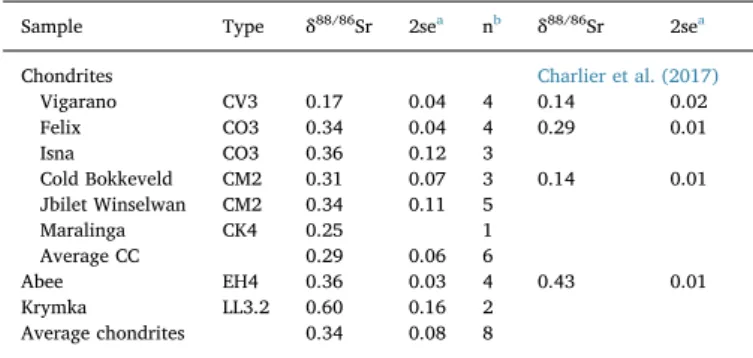
Theδ88/86Sr of chondrites vary from +0.17‰ to +0.60‰, with a mean of +0.34 ± 0.08‰. All chondrite samples that have been ana-lyzed in both our laboratory by standard bracketing MC-ICP-MS, and by
Charlier et al. (2017)at the Open University by double-spike TIMS have identicalδ88/86Sr within error (Table 2) confirming the accuracy of the
two different techniques. MC-ICPMS standard bracketing measure-ments are slightly less precise than double spike-TIMS measuremeasure-ments (~40 ppm here compared to ~20 ppm for TIMS, 2se inCharlier et al. 2017), however provide more sample throughput and the analysis of replicates. As such, this method was optimal for the current study, and eHelz et al. (1994).
fPuchtel et al. (2009). gPuchtel et al. (2013). hPeters and Day (2017).
Table 2
Stable strontium isotopic composition of chondrites relative to NIST SRM987. Sample Type δ88/86Sr 2sea nb δ88/86Sr 2sea
Chondrites Charlier et al. (2017)
Vigarano CV3 0.17 0.04 4 0.14 0.02 Felix CO3 0.34 0.04 4 0.29 0.01 Isna CO3 0.36 0.12 3 Cold Bokkeveld CM2 0.31 0.07 3 0.14 0.01 Jbilet Winselwan CM2 0.34 0.11 5 Maralinga CK4 0.25 1 Average CC 0.29 0.06 6 Abee EH4 0.36 0.03 4 0.43 0.01 Krymka LL3.2 0.60 0.16 2 Average chondrites 0.34 0.08 8
a2se = 2 × standard deviation/√n. bn = number of measurements.
Fig. 1.δ88/86Sr for terrestrials basalts (MORB and OIB) and rock basaltic standard
(BCR-2) highlighting the variation in OIB. The shaded area represents the average of basalts: δ88/86Sr = 0.29 ± 0.03‰.
E. Amsellem et al. Chemical Geology 483 (2018) 595–602
subtle variations (under 40 ppm) are not considered in this study.
4. Discussion
4.1. Chondrite meteorites
The stable Sr isotopic compositions of most of the extra-terrestrial samples studied here have been previously measured and discussed (Moynier et al., 2010,Charlier et al., 2012, 2017). New measurements are presented here to directly compare with data collected during the same analytical campaign. We obtained the same δ88/86Sr values, within error, for Vigarano and Felix compared with Charlier et al. (2017). The two exceptions are the CM Cold Bokkeveld (+0.31 ± 0.07‰) which we found to be heavier than in the study by
Charlier et al. (2017)(+0.14 ± 0.01‰), and the EH4 Abee which is
slightly lighter (+0.36 ± 0.03‰) compared to the value obtained by
Charlier et al., 2017 (+0.43 ± 0.01‰), but heavier than the value
obtained byMoynier et al. (2010)(0.25 ± 0.09‰). The origin of these
differences is not clear but could reflect localized low-temperature aqueous alteration on the CM pattern body, or simply heterogeneity in the sample. When we consider samples from the same meteoritic group, we find good agreement with the available literature data (Moynier et al., 2010, Charlier et al., 2012, 2017). As previously noted by
Moynier et al. (2010), theδ88/86Sr of most chondrites cluster around ~ +0.3‰, with the exception of the CV (here, Vigarano with δ88/ 86Sr = +0.17 ± 0.04‰), which are lighter, due to the high
abun-dance of isotopically light CAIs in CV compared to other chondrite groups.
4.2. Limited Sr isotopic fractionation during closed-system fractional crystallization
Kilauea Iki lava lake was formed during a single eruption and in-ternal magmatic differentiation has led to a range of bulk chemical compositions through fractional crystallization processes. The MgO-rich samples (MgO > 7.5 wt%) are controlled by the removal or ad-dition of olivine, while the most evolved samples (MgO < 7.5 wt%) are generated from a liquid from which experienced crystallization of au-gite, Fe-Ti oxides and plagioclase (Helz, 2012). Fractional crystal-lization and crystal settling have produced variations in the abundance of Sr, ranging from 291 to 506 ppm. In addition, Sr abundances are correlated with MgO contents of the samples, with the most evolved samples being the most Sr-rich (Fig. 2), due to the incompatibility of Sr in olivine. In contrast,δ88/86Sr shows limited variations and no corre-lation with MgO (Fig. 2; Fig. 4). Our results shows that fractional crystallization had limited effect on stable Sr isotopic compositions (< 0.1‰ for δ88/86
Sr). This limited isotopic fractionation during dif-ferentiation is confirmed by the similar isotopic composition between ultramafic samples (komatiites) and basalts (Fig. 3). It is also confirmed by recent data on rhyolites (δ88/86
Sr = +0.27 ± 0.15, 2sd, n = 33)
that are isotopically similar to basalts (Charlier et al., 2017).
4.3. Variations of stable Sr isotopic composition in MORB and OIB samples
Collectively, MORB (δ88/86Sr = +0.31 ± 0.05‰, 2sd, n = 7) and
OIB (δ88/86Sr = +0.29 ± 0.17‰, 2sd, n = 28) samples from the
Atlantic, Pacific and Indian oceans are isotopically homogeneous, within uncertainties, and define an average value for basalts of +0.29 ± 0.16‰ (2sd, n = 35). In detail, the δ88/86Sr of OIB (fromδ88/ 86Sr = +0.16 ± 0.04‰ to +0.46 ± 0.02‰) are more variable than
for MORB (fromδ88/86Sr = +0.27 ± 0.01‰ to +0.33 ± 0.03‰). Sr isotopic compositions of OIB from different localities are similar to first order. However, unlike MORB samples, some OIB exhibit small, but statistically significant, differences in isotopic composition. In parti-cular, samples from Bouvet, Gough, St. Paul Amsterdam and two samples from El Hierro display enrichment in the lighter isotopes of Sr compared to the mean value of 0.29‰, and single samples from La Palma (LP03), Gran Canaria (GC0902), and Iceland (SK82-28), and two samples from La Reunion are enriched in the heavier Sr isotopes. Below, we consider possibilities that might explain these variations, which lie outside of analytical uncertainties.
4.3.1. Post-eruptive alteration processes
Compared to the other La Palma samples, LP03 is relatively
Fig. 2. Sr isotopic composition and Sr concentration of Kilauea Iki Lava lake samples relative to their MgO content.
Fig. 3. Comparison of Sr isotopic composition of komatiites, MORB, OIB and Kilauea Iki lava lake samples.
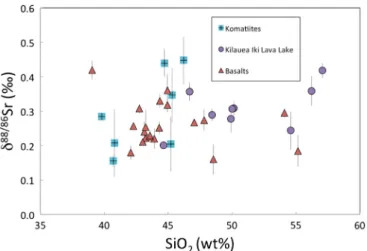
Fig. 4. Sr isotopic composition of OIB, Kilauea Iki lava lake samples and komatiites re-lative to their SiO2content (seeTable 1for published sources of SiO2data).
enriched in the heavier Sr isotopes by ~0.2‰. Sample LP03 is an al-tered pillow lava (a picrite containing epigenetic clays, serpentine and calcite) with loss on ignition of > 6% and that was shown to have a radiogenic component that was removed after leaching (Day et al., 2010). The enrichment in the heavier isotopes could be due to post eruptive alteration, since Sr is strongly affected by silicate weathering. Theδ88/86Sr value of many rivers draining volcanic terrains (including
the Azores, La Reunion) are generally higher by 0.11‰ than average basalts (around 0.30‰) (Pearce et al. 2015). Pearce et al. (2015)
showed that the heavy isotope enrichment of rivers could not be due to the weathering of isotopically heavier bedrocks as volcanic and plu-tonic rocks are known to haveδ88/86Sr ~0.30‰. Instead,Pearce et al.
(2015) proposed that weathering processes were responsible for the isotopic variations observed and suggested that the lighter Sr isotopes were concentrated into secondary phases that precipitated during al-teration. They suggest this mechanism due to the negative correlation betweenδ88/86Sr and Sr/Na that highlights the removal of isotopically
light Sr from the dissolved phase to the secondary phases that pre-cipitate during weathering. Wei et al. (2013) measured stable and radiogenic Sr isotopic compositions of samples from the Xijiang river in South China and suggested that the highδ88/86Sr value in the river represents a contribution of silicate rock weathering. This implies an enrichment of the lighter isotopes for altered silicate rock, in agreement with Pearce et al. (2015). Furthermore, preferential incorporation of lighter isotopes is observed during carbonate precipitation (Böhm et al., 2012; Stevenson et al., 2014). These observations indicate that weathering processes could fractionate Sr isotopes between the bedrock and the drainage water and could lead to lighter isotopic compositions of Sr in altered rocks. However, while we observed light Sr isotopic compositions for the Gough, Bouvet and two samples from El Hierro, these samples do not show any evidence of weathering and require alternative explanations. BV2 comes from the 1955 eruption of Bouvet (O'Nions and Pankhurst, 1974) and ALR-40G has a LOI of 0.68% im-plying that theses samples were not altered. El Hierro samples have negative LOI suggesting that they are fresh, unaltered samples, con-sistent with their petrography (Day et al., 2010).
Seafloor alteration is a different process than sub-aerial weathering and the enrichment in the heavier isotopes for LP03 might be due to this process. The replacement of serpentine could lead to an enrichment in the heavier isotopes (seeSections 4.3.2), obscuring a possibly lighter isotopic composition due to the precipitation of calcite (e.g.
Krabbenhöft et al., 2010;Böhm et al., 2012andVollstaedt et al., 2014). To summarise, stable Sr isotopes suggest that weathering processes do not account for the light Sr isotope enrichment in OIB samples; however, seafloor alteration may explain the heavier Sr isotopic com-position of samples LP03 and SK 82-28.
4.3.2. Recycled oceanic lithosphere
The variable oxygen and osmium isotopic compositions of samples from El Hierro and La Palma suggest a contribution of recycled oceanic crust and lithosphere during melting of pyroxenite-enriched peridotite lithologies (Day et al., 2009). Sedimentary materials usually have lighter Sr isotopic compositions (δ88/86Sr = 0.2‰,
Krabbenhöft et al., 2010;Widanagamage et al., 2015;Stevenson et al., 2016) than typical oceanic crust represented by MORB (~0.30‰). Therefore, recycled sediments should either have a limited effect on the Sr isotopic com-position, or slightly enrich them with the lighter isotopes, which is the opposite of what we observe for El Hierro and La Palma lavas. In contrast, altered oceanic crust should be enriched in the heavier iso-topes of Sr. This is illustrated by the most hydrothermally altered samples (LP03), which is isotopically heavier than unaltered samples (seeSection 4.3.1). Similarly, it has been found that serpentinite is itself enriched in the heavier isotopes of Sr (UB-N: δ88/86Sr = 0.54 ± 0.03‰;Ma et al., 2013). Therefore, contributions from altered oceanic crust could explain the heavier isotopic compositions measured for La Palma, Gran Canaria and La Reunion islands.
The same arguments can be made for Icelandic samples, which have been shown to have high 3He/4He ratios, negative Pb abundance anomalies and positive Nb, Ta and Sr abundance anomalies that are related to a recycled subducted lithosphere component in the plume (Breddam, 2002). To test the contribution of recycled material, we use a simple mass balance (to reach [Sr] = 100 ppm andδ88/86Sr = 0.4‰ for
the heavy OIB samples) including a fraction of sedimentary material (1%; [Sr] = 200 ppm; δ88/86Sr = 0.02‰; Plank and Langmuir, 1998;
Vollstaedt et al., 2014;Stevenson et al., 2016;Widanagamage et al., 2015), altered crust (46.5%; [Sr] = 160 ppm;δ88/86Sr = 0.43‰;Niu
and Batiza, 1997), non-altered crust (50%; [Sr] = 120 ppm; δ88/
86Sr = 0.29‰; Klein, 2003) and serpentinite (2.5%; [Sr] = 10 ppm;
δ88/86Sr = 0.54‰;Alt et al., 2013;Ma et al., 2013) for the recycled
fraction (in total: [Sr] = 140 ppm; δ88/86Sr = 0.50‰), and the con-tribution of the mantle ([Sr] = 20 ppm;δ88/86Sr = 0.29‰; this study;
Palme and O'Neill, 2003) in generating the source of OIB. Using these values, we estimate that the fraction of recycled material must be ap-proximately 53%, which is inconsistent with Pb, radiogenic Sr and trace elements constraints (Day et al., 2009). Hence, the contribution of re-cycled material is unlikely to be solely responsible for the enrichment in heavy isotopes observed for Gran Canaria, La Reunion islands and Iceland. Unfortunately, not enough Sr, Nd and Pb radiogenic isotopic composition data were available for the OIB samples studied here to assess the potential relationship with different recycled sources. More work will be needed to fully understand the origin of these outlier samples and to suggest an otherwise unidentified process that may be acting to generate these signatures.
4.4. The estimation of the stable Sr isotopic composition of the BSE
As discussed above, basaltic differentiation does not induce any measurable Sr isotopic fractionation, and with the exception of a few outliers, most basalts cluster within a very narrow range of Sr isotopic compositions, with an average of +0.28 ± 0.09‰ (2sd, n = 28). Furthermore, komatiites from three different regions ranging in age between 3.48 and 2.41 Ga have a similar average Sr isotopic composi-tion (δ88/86Sr = 0.29 ± 0.19‰, 2sd, n = 8), excluding two outliers
(BV13 and BV15), which is indistinguishable from the basalt average. The two outliers, BV13 and BV15 (from the upper part of Komati for-mation), were also found to be anomalous for Mo isotope composition (Greber et al., 2015). They are both enriched in the heavier isotopes of Mo by about 0.2‰/amu. The anomalous Sr (and Mo) isotopic com-positions of BV13 and BV15 may have been inherited from mantle source heterogeneity or may have been the result of seafloor alteration and/or metamorphism that occur in the Komati lavas (Anhaeusser and Robb, 1980; Lowe, 1999). Since Sr isotopes are homogeneously dis-tributed within a large set of basalts from around the world, as well as in the eight komatiites from four localities, we deem it as unlikely that the mantle source is isotopically heterogeneous for just these two ko-matiites. Instead, these two sample may have been affected by seafloor alteration or metamorphism.Greber et al. (2015)excluded an effect of alteration or metamorphism because of the correlation betweenδ98/ 95
Mo and the MgO content and suggest a mantle source heterogeneity or a contribution of a more depleted mantle in theses komatiites. However, the Mo isotopic composition of the Barberton komatiites does not correlate with the Sr isotopic composition neither does the Sr iso-topic composition with SiO2(Fig. 4), implying multiple processes acting
on these samples. Previous studies have shown anomalies in oxygen isotopes (Byerly et al., 2017) and REE abundances (Puchtel et al., 2013) in olivine separates in the Barberton Greenstone Belt. Byerly et al. (2017)suggested that the light isotopic composition of O in these ko-matiites reflects heterogeneity of the Archean mantle, probably due to an unhomogenized residue from the magma ocean. Puchtel et al. (2013)suggested that the enrichment of incompatible elements in the olivine separates and the presence of inclusions of secondary minerals around the olivine grains are likely related to seafloor alteration or
E. Amsellem et al. Chemical Geology 483 (2018) 595–602
metamorphism. As discussed inSection 4.3.1, seafloor alteration could
be the origin of the enrichment in heavy isotopes of Sr in these ko-matiites, while metamorphism is a process that has not been effectively studied for Sr stable isotopes. Experimental studies on bulk rocks have demonstrated that during heating the Sr isotopic composition of the bulk rocks are unaffected (e.g.Baadsgaard and Van Breemen, 1970). Metamorphism is known to homogenize Sr isotopes in a rock that re-mains in a closed system. It is therefore unlikely that metamorphism is the origin of the isotopic fractionation of the two Barbeton komatiites, and we prefer alteration as the cause for the enrichment of Sr heavy isotopes.
Since komatiites are produced by high degrees of partial melting (e.g. Herzberg, 1992), they should have quantitatively extracted Sr from their source and represent the best estimate for the composition of the mantle. The similarity of Sr isotopic compositions between koma-tiite, OIB and MORB samples as well as the limited Sr isotopic varia-bility between the Kilauea Iki samples represent strong evidence for limited isotopic fractionation during igneous processes. Their average Sr isotopic composition can be used to estimate the stable Sr isotopic composition of the mantle to be +0.29 ± 0.16‰ (n = 46, 2sd). When the average of OIB, MORB and komatiites (excluding the two outliers) are taken separately, the δ88/86Sr of the BSE can be estimated to be
+0.30 ± 0.02‰ (2sd) which is in agreement with previous work (Moynier et al., 2010:δ88/86Sr = 0.27‰ andCharlier et al., 2012:δ88/
86Sr = 0.29 ± 0.07‰). Since the continental crust contains about 10%
of the Earth's Sr (using a simple mass balance calculation), it should also be considered in the evaluation of the Sr isotopic composition of the bulk silicate Earth (BSE). However, the absence of Sr isotopic fractionation between komatiites, basalts and granites (δ88/ 86Sr = 0.31 ± 0.09‰ and δ88/86Sr = 0.28 ± 0.03‰,Moynier et al.,
2010) and the limited isotopic fractionation within the Kilauea Iki Lava lake rock series suggests that crustal material should have a similar stable Sr isotopic composition to the present-day mantle.
The high concentration of Sr in carbonates (up to 2000 ppm,Plank and Langmuir, 1998) and their enrichment in Sr lighter isotopes (~0.3‰) could alter the stable Sr isotopic composition of the BSE. However, since carbonates represent only 0.01% of the weight of the crust (Wedepohl, 1995) they should not significantly affect the stable Sr isotopic composition of the BSE. Indeed, using the estimation of the Sr concentration of the continental and oceanic crust (Wedepohl, 1995;
Hofmann, 1988) and an average of Sr concentration in carbonate (Plank and Langmuir, 1998), basalt and granite, the Sr budget of carbonates is roughly calculated to be ~6% for the continental crust and ~3% in the oceanic crust. Therefore, it can be inferred that the present estimate of the mantle composition is similar to the composition of the bulk silicate Earth. This assumption can be tested in the future by analyzing the Sr isotopic composition of shales. Furthermore, since Sr is a lithophile element, the Earth's core is nominally Sr free, and the Sr isotopic composition of the BSE can then be considered as the bulk Earth composition. Finally, the fact that the 2.4 Ga, 2.7 Ga, 3.27 Ga and 3.48 Ga old komatiites all have similar Sr isotopic compositions (δ88/ 86Sr = 0.27 ± 0.03, 0.36 ± 0.11, 0.18 ± 0.05, and 0.28 ± 0.06‰,
respectively) with modern basalts, suggests that the composition of Earth's mantle has not changed over at least the past 3.48 Ga.
5. Conclusions
In this study, we measured the Sr isotopic composition of a wide range of OIB, MORB, and komatiites from different localities and of different ages. The similarity of the δ88/86
Sr between all of the samples implies little fractionation effects during and after the formation of the basaltic and komatiitic magmas. Komatiites show a range of Sr isotopic compositions similar to that of all the basalts studied, enabling the es-timation of the Sr isotopic composition for the BSE to be +0.30 ± 0.02‰ (2sd), in agreement with previous work (Moynier et al., 2010andCharlier et al., 2012). The Sr isotopic composition of
carbonaceous chondrites is similar to terrestrial composition, except for a CV chondrite sample that is enriched in refractory inclusions and thus subsequently enriched in the light isotopes.
Acknowledgments
We thank two anonymous reviewers, and the Editor, Klaus Mezger, for their constructive comments. FM acknowledges funding from the European Research Council under the H2020 framework program/ERC grant agreement #637503 (Pristine) and financial support of the UnivEarthS Labex program at Sorbonne Paris Cité (ANR-10-LABX-0023 and ANR-11-IDEX-0005-02), and the ANR through a chaire d'excellence Sorbonne Paris Cité. We also thank the IPGP multidisciplinary program PARI, and by Paris-IdF region SESAME Grant No. 12015908. Finally, we are grateful to Brandon Mahan for proof- reading the manuscript.
References
Albarède, F., Tamagnan, V., 1988. Modelling the recent geochemical evolution of the Piton de la Fournaise Volcano, Reunion Island, 1931–1986. J. Pet. 29, 997–1030.
Alt, J.C., Schwarzenbach, E.M., Früh-Green, G.L., Shanks III, W.C., Bernasconi, S.M., Garrido, C.J., Crispini, L., Gaggero, L., Padrón-Navarta, J.A., Marchesi, C., 2013. The role of serpentinites in cycling of carbon and sulfur: seafloor serpentinization and subduction metamorphism. Lithos 178, 40–54.
Anhaeusser, C.R., Robb, L.J., 1980. Regional and detailedfield and geochemical studies of Archaean trondhjemitic gneisses, migmatites and greenstone xenoliths in the southern part of the Barberton Mountain Land, South Africa. Precambrian Res. 11 (3–4), 373–397.
Baadsgaard, H., Van Breemen, O., 1970. Thermally-induced migration of Rb and Sr in adamellite. Eclogae Geol. Helv. 63, 31–44.
Badullovich, N., Moynier, F., Creech, J., Teng, F.-Z., Sossi, P.A., 2017. Tin isotopic frac-tionation during igneous differentiation and Earth's mantle composition. Geochem. Persp. Let. 5, 24–28.
Birck, J.-L., Allègre, C.J., 1973.87Rb-87Sr systematics of Muntsche Undra Mafic Pluton (Kola Peninsula, USSR). Earth Planet. Sci. Lett. 20, 266–274.
Böhm, F., Eisenhauer, A., Tang, J., Dietzel, M., Krabbenhöft, A., Kisakürek, B., Horn, C., 2012. Strontium isotope fractionation of planktic foraminifera and inorganic calcite. Geochim. Cosmochim. Acta 93, 300–314.
Breddam, K., 2002. Kistufell: primitive melt from the Iceland mantle plume. J. Pet. 43, 345–373.
Breddam, K., Kurz, M.D., Storey, M., 2000. Mapping out the conduit of the Iceland mantle plume with helium isotopes. Earth Planet. Sci. Lett. 176, 45–55.
Byerly, B.L., Kareem, K., Bao, H., Byerly, G.R., 2017. Early earth mantle heterogeneity revealed by light oxygen isotopes of Archaean komatiites. Nature Geosc. 10, 871–875.
Charlier, B.L.A., Nowell, G.M., Parkinson, L.J., Kelley, S.P., Pearson, D.G., Burton, K.W., 2012. High temperature strontium stable isotope behaviour in the early solar system and planetary bodies. Earth Planet. Sci. Lett. 329-330, 31–40.
Charlier, B.L.A., Parkinson, I.J., Burton, K.W., Grady, M.M., Wilson, C.J.N., Smith, E.G.C., 2017. Stable strontium isotopic heterogeneity in the solar system from double-spike data. Geochim. Persp. Let. 4, 35–40.
Chen, H., Savage, P.S., Teng, F.-Z., Helz, R.T., Moynier, F., 2013. Zinc isotope fractio-nation during magmatic differentiation and the isotopic composition of the bulk earth. Earth Planet. Sci. Lett. 369-370, 34–42.
Claude-Ivanaj, C., Joron, J.L., Allègre, C.J., 2001.238U-230Th-226Ra fractionation in his-torical lavas from the Azores: long-lived source heterogeneity vs. metasomatism fingerprints. Chem. Geol. 176, 295–310.
Day, J.M.D., Hilton, D.R., 2011. Origin of3He/4He ratios in HIMU-type basalts con-strained from Canary Island lavas. Earth Planet. Sci. Lett. 305, 226–234.
Day, J.M.D., Pearson, D.G., Macpherson, C.G., Lowry, D., Carracedo, J.C., 2009. Pyroxenite-rich mantle formed by recycled oceanic lithosphere: oxygen–osmium isotope evidence from Canary Island lavas. Geology 37, 555–558.
Day, J.M.D., Pearson, D.G., Macpherson, C.G., Lowry, D., Carracedo, J.C., 2010. Evidence for distinct proportions of subducted oceanic crust and lithosphere in HIMU-type mantle beneath El Hierro and La Palma, Canary Islands. Geochim. Cosmochim. Acta 74, 6565–6589.
De Souza, G.F., Reynolds, B.C., Kiczka, M., Bourdon, B., 2010. Evidence for mass-de-pendent isotopic fractionation of strontium in a glaciated granitic watershed. Geochim. Cosmochim. Acta 75, 2596–2614.
Fietzke, J., Eisenhauer, A., 2006. Determination of temperature-dependent stable stron-tium (88Sr/86Sr) fractionation via bracketing standard MC-ICP-MS. Geochim. Geophys. Geosys. 7, 8.
Garapić, G., Jackson, M.G., Hauri, E.H., Hart, S.R., Farley, K.A., Blusztajn, J.S., Woodhead, J.D., 2015. A radiogenic isotopic (He–Sr–Nd–Pb–Os) study of lavas from the Pitcairn hotspot: implications for the origin of EM-1 (enriched mantle 1). Lithos 228–229, 1–11.
Geist, D.J., Fornari, D.J., Kurz, M.D., Harpp, K.S., Adam Soule, S., Perfit, M.R., Koleszar, A.M., 2006. Submarine Fernandina: magmatism at the leading edge of the Galapagos hot spot. Geochem. Geophys. Geosyst. 7, Q12007.
geochemistry of some volcanic rocks from Saint Helena. Earth Planet. Sci. Lett. 110, 121–131.
Greber, N.D., Puchtel, I.S., Nägler, T.F., Mezger, K., 2015. Komatiites constrain mo-lybdenum isotope composition of the Earth's mantle. Earth Planet. Sci. Lett. 421, 129–138.
Halicz, L., Segal, I., Fruchter, N., Stein, M., Lazar, B., 2008. Strontium stable isotopes fractionate in the soil environments? Earth Planet. Sci. Lett. 272, 406–411.
Hanyu, T., Kaneoka, I., 1997. The uniform and low 3He/4He ratios of HIMU basalts as evidence for their origin as recycled materials. Nature 390, 273–276.
Hart, S.R., Jackson, M.G., 2014. Ta'u and Ofu/Olosega volcanoes: the‘twin Sisters’ of Samoa, their P, T, X melting regime, and global implications. Geochem. Geophys. Geosyst. 15, 2301–2318.
Helz, R.T., 2012. Trace element analyses of core samples from the 1967-1988 drillings of Kilauea Iki Lava Lake, Hawaii. US Geological Survey Open File Report 2012–1050, 1–56.
Helz, R.T., Thornber, C.R., 1987. Geothermometry of Kilauea Iki lava lake, Hawaii. Bull. Volcanol. 49, 651–668.
Helz, R.T., Kirschenbaum, H., Marinenko, J.W., Qian, R., 1994. Whole rock analyses of core samples from the 1967, 1975, 1979 and 1981 drillings of Kilauea Iki lava lake, Hawaii. US Geological Survey Open File Report 94–684, 1–65.
Herzberg, C., 1992. Depth and degree of melting of komatiites. J. Geophys. Res. 97, 4521–4540.
Hofmann, A.W., 1988. Chemical differentiation of the earth: the relationship between mantle, continental crust and oceanic crust. Earth Planet. Sci. Lett. 90, 297–314.
Jackson, M.G., Hart, S.R., Koppers, A.A.P., Staudigel, H., Konter, J., Blusztajn, J., Kurz, M., Russell, J.A., 2007a. The return of subducted continental crust in Samoan lavas. Nature 448, 684–687.
Jackson, M.G., Kurz, M.D., Hart, S.R., Workman, R.K., 2007b. New Samoan lavas from Ofu Island reveal a hemispherically heterogeneous high 3He/4He mantle. Earth Planet. Sci. Lett. 264, 360–374.
Kato, C., Moynier, F., Foriel, J., Teng, F.-Z., Puchtel, I.S., 2017. The gallium isotopic composition of the bulk silicate earth. Chem. Geol. 448, 164–172.
Kawabata, H., Hanyu, T., Chang, Q., Kimura, J.-I., Nichols, A.R.L., Tatsumi, Y., 2011. The petrology and geochemistry of St. Helena alkali basalts: evaluation of the oceanic crust-recycling model for HIMU OIB. J. Pet. 52, 791–838.
Klein, 2003. Geochemistry of the igneous oceanic crust. Treatise on Geochemistry 3, 433–463.
Krabbenhöft, A., Eisenhauer, A., Böhm, F., Vollstaedt, H., Fietzke, J., Liebetrau, V., Augustin, N., Peucker-Ehrenbrink, B., Müller, M.N., Horn, C., Hansen, B.T., Nolte, N., Wallmann, K., 2010. Constraining the marine strontium budget with natural stron-tium isotope fractionations (87Sr/86Sr,δ88/86Sr) of carbonates, hydrothermal solu-tions and river waters. Geochim. Cosmochim. Acta 75, 4097–4109.
Kurz, M.D., Curtice, J., Fornari, D., Geist, D., Moreira, M., 2009. Primitive neon from the center of the Galapagos hotspot. Earth Planet. Sci. Lett. 286, 23–34.
LeRoex, A.P., 1985. Geochemistry, mineralogy and magmatic evolution of the basaltic and trachytic lavas from Gough Island, South Atlantic. J. Pet. 26, 149–186.
Lodders, K., 2003. Solar system abundances and condensation temperatures of the ele-ments. Astrophys. J. 591, 1220–1247.
Lowe, D.R., 1999. Geologic evolution of the Barberton Green-stone Belt and vicinity. In: Geological Evolution of the Barberton Greenstone Belt. 329. Geological Society of America, pp. 287–312.
Ma, J., Wei, G., Liu, Y., Ren, Z.Y., Xu, Y., Yang, Y., 2013. Precise measurement of stable (δ88/86Sr) and radiogenic (87Sr/86Sr) strontium isotope ratios in geological standard reference materials using MC-ICP-MS. Chin. Sci. Bull. 58, 3111–3118.
Millet, M.-A., Doucelance, R., Schiano, P., David, K., Bosq, C., 2008. Mantle plume het-erogeneity versus shallow-level interactions: a case study, the São Nicolau Island, Cape Verde archipelago. J. Volcanol. Geotherm. Res. 176, 265–276.
Moreira, M., Staudacher, T., Sarda, P., Schilling, J.-G., Allègre, C.J., 1995. A primitive plume neon component in MORB: the Shona ridge-anomaly, South Atlantic (51–52°S). Earth Planet. Sci. Lett. 133, 367–377.
Moreira, M., Breddam, K., Curtice, J., Kurz, M.D., 2001. Solar neon in the Icelandic mantle: new evidence for an undegassed lower mantle. Earth Planet. Sci. Lett. 185, 15–23.
Moynier, F., Agranier, A., Hezel, D.C., Bouvier, A., 2010. Sr stable isotope composition of earth, the moon, Mars, Vesta and meteorites. Earth Planet. Sci. Lett. 300, 359–365.
Nebel, O., Mezger, K., Westrenen, W., 2011. Rubidium isotopes in primitive chondrites: constraints on Earth's volatile element depletion and lead isotope evolution. Earth Planet. Sci. Lett. 305, 309–316.
Niu, Y., Batiza, R., 1997. Trace element evidence from seamounts for recycled oceanic crust in the Eastern Pacific mantle. Earth Planet. Sci. Lett. 148, 471–483.
Ohno, T., Hirata, T., 2007. Simultaneous determination of mass-dependent isotopic fractionation and radiogenic isotope variation of strontium in geochemical samples by multiple collector-ICP-mass spectrometry. Anal. Sci. 23, 1275–1280.
O'Nions, R.K., Pankhurst, R.J., 1974. Petrogenetic significance of isotope and trace ele-ment variations in volcanic rocks from the mid-Atlantic. J. Pet. 15, 603–634.
Palme, O'Neill, 2003. Cosmochemical estimates of mantle composition. Treatise on Geochemistry 2, 1–38.
Papanastassiou, D.A., Wasserburg, G.J., 1969. Initial strontium isotopic abundances and the resolution of small time differences in the formation of planetary objects. Earth Planet. Sci. Lett. 5, 361–376.
Parkinson, I.J., Burton, K.W., Mokadem, F., Charlier, B.L., 2007. High-precision double Sr isotope measurements: applications to geochemistry and cosmochemistry. American Geophy. Union 88, 52 Abstract.
Patchett, P.J., 1980. Sr isotopic fractionation in Ca-Al inclusions from the Allende me-teorite. Nature 283, 438–441.
Pearce, C.R., Parkinson, I., Gaillardet, J., Charlier, B.L.A., Mokadem, F., Burton, K.W., 2015. Reassessing the stable (ofδ88/86Sr) and radiogenic (87Sr/86Sr) strontium iso-topic composition of marine inputs. Geochim. Cosmochim. Acta 157, 125–146.
Peters, B.J., Day, J.M.D., 2017. A geochemical link between plume head and tail vol-canism. Geochem. Persp. Let. 5, 29–34.
Plank, T., Langmuir, C.H., 1998. The chemical composition of subducting sediment and its consequences for the crust and the mantle. Chem. Geol. 145, 325–394.
Pringle, E.A., Moynier, F., Savage, P.S., Jackson, M.G., Moreira, M., Day, J.M.D., 2016. Silicon isotopes reveal recycles altered oceanic crust in the mantle sources of Ocean Island basalts. Geochim. Cosmochim. Acta 189, 282–295.
Puchtel, I.S., Walker, R.J., Brandon, A.D., Nisbet, E.G., 2009. Pt-Re-Os and Sm-Nd isotope and HSE and REE systematics of the 2.7 Belingwe and Abiti komatiites. Geochim. Cosmochim. Acta 73, 6367–6389.
Puchtel, I.S., Blichert-Toft, J., Touboul, M., Walker, R.J., Byerly, G.R., Nisbet, E.G., Anhaeusser, C.R., 2013. Insight into early earth from Barbeton komatiites: evidence from lithophile isotope and trace element systematics. Geochim. Cosmochim. Acta 108, 63–90.
Puchtel, I.S., Walker, R.J., Touboul, M., Nisbet, E.G., Byerly, G.R., 2014. Insights into early earth from the Pt–Re–Os isotope and highly siderophile element abundance systematics of Barberton komatiites. Geochim. Cosmochim. Acta 125 (C), 394–413.
Puchtel, I.S., Touboul, M., Blichert-Toft, J., Walker, R.J., Brandon, A.D., Nicklas, R.W., Kulikov, V.S., Samsonov, A.V., 2016. Lithophile and siderophile element systematics of Earth's mantle at the Archean-Proterozoic boundary: evidence from 2.4 Ga ko-matiites. Geochim. Cosmochim. Acta 180, 227–255.
Raddatz, J., Liebetrau, V., Rüggeberg, A., Hathorne, E., Krabbenhöft, A., Eisenhauer, A., Böhm, F., Vollstaedt, H., Fietzke, J., López Correa, M., Freiwald, A., Dullo, W.-Chr, 2013. Stable Sr-isotopes, Sr/Ca, Mg/Ca and Mg/Li ratios in the scleractinian cold-water coral Lophelia pertusa. Chem. Geol. 352, 143–152.
Rickers, F., Fichtner, A., Trampert, J., 2013. The Iceland–Jan Mayen plume system and its impact on mantle dynamics in the North Atlantic region: evidence from full-wave-form inversion. Earth Planet. Sci. Lett. 367, 39–51.
Savage, P.S., Moynier, F., Chen, H., Shofner, G., Siebert, J., Badro, J., Puchtel, I.S., 2015. Copper isotope evidence for large-scale sulphide fractionation during Earth's differ-enciation. Geochem. Persp. Let. 1, 53–64.
Shalev, N., Segal, I., Lazar, B., Gavrieli, I., Fietzke, J., Eisenhauer, A., Halicz, L., 2013. Precise determination ofδ88/86Sr in natural samples by double-spike MC-ICP-MS and its TIMS verification. J. Analyt. Atomic Spectrometry(6).
Stevenson, E.I., Hermoso, M., Rickaby, R.E.M., Tyler, J.J., Minoletti, F., Parkinson, I.J., Mokadem, F., Burton, K.W., 2014. Controls on stable strontium isotope fractionation in coccolithophores with implications for the marine Sr cycle. Geochim. Cosmochim. Acta 128, 225–235.
Stevenson, E.I., Aciego, S.M., Chutcharavan, P., Parkinson, I.J., Burton, K.W., Blakowski, M.A., Arendt, C.A., 2016. Insight into combined radiogenic and stable strontium isotopes as tracers for weathering processes in subglacial environments. Chem. Geol. 429, 33–43.
Teng, F.-Z., Wadhwa, M., Helz, R.T., 2007. Investigation of magnesium isotope fractio-nation during basalt differentiation: implications for a chondritic composition of the terrestrial mantle. Earth Planet. Sci. Lett. 261, 84–92.
Teng, F.-Z., Dauphas, N., Helz, R.T., 2008. Iron isotope fractionation during magmatic differentiation in Kilauea Iki Lava Lake. Science 320, 1620–1622.
Teng, F.-Z., Li, W.-E., Ke, S., Marty, B., Dauphas, N., Huang, S., Wu, F.-Y., Pourmand, A., 2010. Magnesium isotope composition of the earth and chondrites. Geochim. Cosmochim. Acta 75, 4150–4166.
Teng, F.-Z., Dauphas, N., Helz, R.T., Gao, S., Huang, S., 2011. Diffusion-driver magnesium and iron isotope fractionation in Hawaiian olivine. Earth Planet. Sci. Lett. 308, 317–324.
Teng, F.Z., Dauphas, N., Watkins, J.M., 2017. Non-traditional Stable Isotopes: Retrospective and Prospective. In: Teng, F.Z., Dauphas, N., Watkins, J.M. (Eds.), Non-traditional Stable Isotopes. Rev. Mineral. Geochem., pp. 82.
Tomascak, P.B., Tera, F., Jelz, R.T., Walker, R.J., 1999. The absence of lithium isotope fractionation during basalt differentiation: new measurements by multicollector sector ICP-MS. Geochim. Cosmochim. Acta 63, 907–910.
Valdes, M.C., Moreira, M., Foriel, J., Moynier, F., 2014. The nature of Earth's building blocks as revealed by calcium isotopes. Earth Planet. Sci. Lett. 394, 135–145.
Vollstaedt, H., Eisanhauer, A., Wallmann, K., Böhm, F., Fietzke, J., Liebetrau, V., Krabbenhöft, Farkaš, J., Tomašovych, A., Raddatz, J., Veizer, J., 2014. The Phanerozoicδ88/86Sr record of seawater: new constraints on past changes in oceanic carbonatefluxes. Geochim. Cosmoschim. Acta 128, 249–265.
Wedepohl, K.H., 1995. The composition of the continental crust. Geochim. Cosmochim. Acta 59 (7), 1217–1232.
Wei, G., Ma, J., Liu, Y., Xie, L., Lu, W., Dend, W., Ren, Z., Zeng, T., Yang, Y., 2013. Seasonal changes in the radiogenic and stable strontium isotopic composition of Xijang River water: implications for chemical weathering. Chem. Geol. 343, 67–75.
Widanagamage, I.H., Griffith, E.M., Singer, D.M., Scher, H.D., Buckley, W.P., Senko, J.M., 2015. Controls on stable Sr-isotope fractionation in continental barite. Chem. Geol. 411, 215–227.
Woodhead, J., Swearer, S., Hergt, J., Maas, R., 2005. In situ Sr-isotope analysis of car-bonates by LA-MC-ICP-MS: interference corrections, high spatial resolution and an example from otolith studies. J. Anal. At. Spectrom. 20, 22–27.
Workman, R.K., Hart, S.R., Jackson, M., Regelous, M., Farley, K.A., Blusztajn, J., Kurz, M., Staudigel, H., 2004. Recycled metasomatized lithosphere as the origin of the enriched mantle II (EM2) end- member: evidence from the Samoan volcanic chain. Geochem. Geophys. Geosyst. 5, Q04008.
Wright, T.L., 1973. Magma mixing as illustrated by the 1959 eruption, Kilauea volcano, Hawaii. Geol. Soc. Am. Bull. 84, 849–858.
E. Amsellem et al. Chemical Geology 483 (2018) 595–602
![[PDF] Quiz programmation web pour réviser | Cours Informatique](data:image/gif;base64,R0lGODlhAQABAIAAAP///wAAACH5BAEAAAAALAAAAAABAAEAAAICRAEAOw==)