HAL Id: hal-02500974
https://hal.archives-ouvertes.fr/hal-02500974
Submitted on 11 Mar 2020
HAL is a multi-disciplinary open access
archive for the deposit and dissemination of
sci-entific research documents, whether they are
pub-lished or not. The documents may come from
teaching and research institutions in France or
abroad, or from public or private research centers.
L’archive ouverte pluridisciplinaire HAL, est
destinée au dépôt et à la diffusion de documents
scientifiques de niveau recherche, publiés ou non,
émanant des établissements d’enseignement et de
recherche français ou étrangers, des laboratoires
publics ou privés.
A knowledge server for sustainable agriculture
Vincent Soulignac, Jean-Louis Ermine, Jean-Luc Paris, Olivier Devise,
Jean-Pierre Chanet
To cite this version:
Vincent Soulignac, Jean-Louis Ermine, Jean-Luc Paris, Olivier Devise, Jean-Pierre Chanet. A
knowl-edge server for sustainable agriculture. ICICKM 2011 : 8th International Conference on Intellectual
Capital, Knowledge Management & Organisational Learning, Oct 2011, Bangkok, Thailand.
�hal-02500974�
1 / 15
ICICKM 2011
A knowledge server for sustainable agriculture
Vincent Soulignac1, Jean-Louis Ermine2, Jean-Luc Paris3, Olivier Devise3 and Jean-Pierre Chanet1
1 UR TSCF, CEMAGREF, AUBIERE, FRANCE 2 Ecole de management, EVRY, France
3 CNRS UMR 6158, LIMOS, AUBIERE, FRANCE [email protected]
[email protected] [email protected]
Keywords: Sustainable agriculture, Knowledge, Information system
Abstract: Agriculture must evolve into a more environmentally-friendly approach while remaining economically workable and socialy interesting, which is necessary so that the process can be pursued on the long term, i.e that the process is sustainable (Brundland 1987). . This type of agriculture is said to be sustainable. It has a systemic logic and therefore requires a strong knowledge base, and in this study we propose a knowledge management computing tool. In the first part of our article, we discuss the potential actors of the tool and their possible implications. The second part deals with its contents, selection and form.
1 Introduction
Agriculture is involved in a vast societal movement, imposed on it by the framework and the values associated with sustainable development. To make a success of this transformation, agriculture will have to become both integrated into its environment, and organic (INRA, 2010). This transformation depends largely on the mobilization of knowledge and know-how. But in 2011, while numerous professional software packages are accessible to farmers, no structured, interactive IT tool for knowledge management is available to them. We thus suggest developing a knowledge management tool dedicated to farmers. In the first part of our article, we study who the actors of this tool are, and their possible implications. The second part deals with the contents of the tool and the selection and formalization of the knowledge.
2 A Knowledge Management whom?
2.1 Farmers and agricultural councils
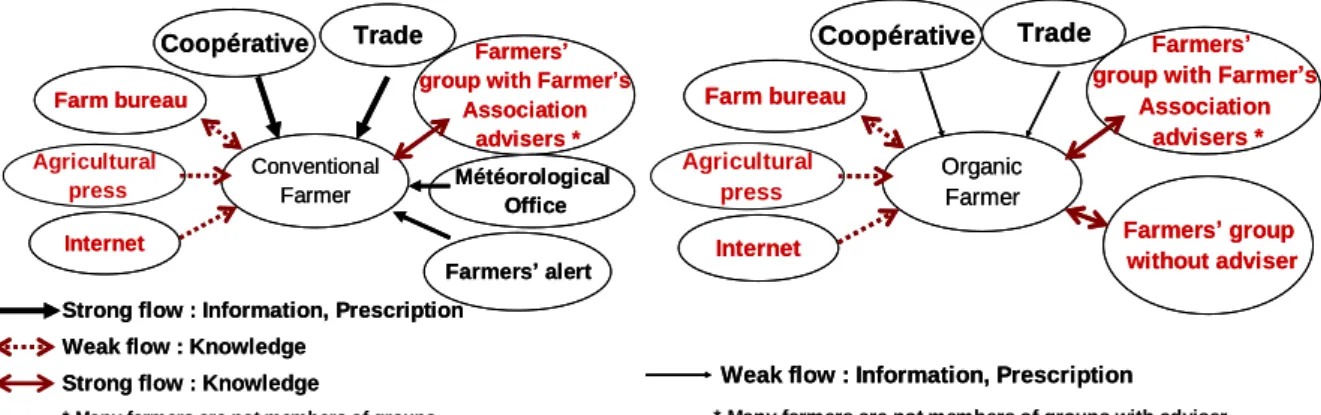
Within the framework of an investigation of both conventional and sustainable farmers, we distinguished for each type the various available information sources for the protection of vegetables. Figure 1 summarizes these main flows, their nature as well as their origin. In conventional agriculture, information exchanges are important, in particular from cooperatives and trading activities. In sustainable agriculture, in addition, the appropriation of knowledge by the farmers is fundamental, even if knowledge management is also present in conventional agriculture (Compagnone, Hellec et al. 2008). This is achieved, for the most part, by exchanges between farmers and, in the best configuration, in the presence of an expert advisor.
(Darré 1999) showed that the farmers are very often organized into Local Professional Groups (LPG). Depending on the circumstances, these are more or less structured within existing entities. The makeup of the LPG is associated with the geographical proximity of the farmers but also with similar agricultural practices. Each brings his immaterial resources, built from his experiences or stemming from his own networks (Mathieu, Lasseur et al. 2004). This shared knowledge is either then transformed or rejected.
2 / 15
Trade Conventional Farmer Coopérative Farm bureau Agricultural press Internet Farmers’ alert Météorological Office Farmers’ group with Farmer’sAssociation advisers *
Strong flow : Information, Prescription Weak flow : Knowledge
Strong flow : Knowledge
* Many farmers are not members of groups Trade Conventional Farmer Coopérative Farm bureau Agricultural press Internet Farmers’ alert Météorological Office Farmers’ group with Farmer’s
Association advisers *
Strong flow : Information, Prescription Weak flow : Knowledge
Strong flow : Knowledge
* Many farmers are not members of groups
Trade Organic Farmer Coopérative Farm bureau Agricultural press Internet Farmers’ group with Farmer’s
Association advisers *
Weak flow : Information, Prescription
* Many farmers are not members of groups with adviser Farmers’ group without adviser Trade Organic Farmer Coopérative Farm bureau Agricultural press Internet Farmers’ group with Farmer’s
Association advisers *
Weak flow : Information, Prescription
* Many farmers are not members of groups with adviser Farmers’ group
without adviser
Figure 1 : Main actors of the management of the knowledge in direct contact with farmers: sustainable vs. conventional.
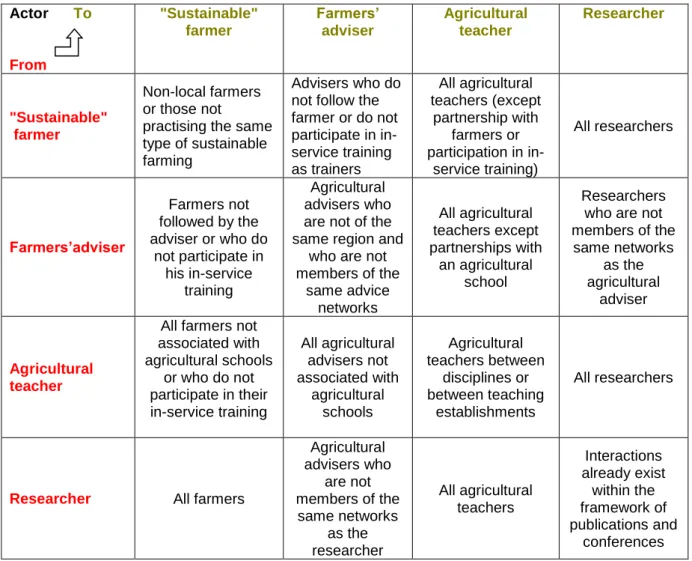
2.2 The dynamics of exchanges between the actors of the "agricultural knowledge system" The concept of "agricultural knowledge system" groups, bringing together all the institutions, councils, education and research involved in the construction of a sustainable agriculture (Cerf, Gibbon et al. 2000), underlines the interest of the production and acquisition of knowledge within the framework of a partnership between the actors of the general agricultural world. In terms of interaction, an internet-accessible tool facilitates new relations. These are presented in Table 1 below.
3 / 15
Actor To From "Sustainable" farmer Farmers’ adviser Agricultural teacher Researcher "Sustainable" farmer Non-local farmers or those notpractising the same type of sustainable farming
Advisers who do not follow the farmer or do not participate in in-service training as trainers All agricultural teachers (except partnership with farmers or participation in in-service training) All researchers Farmers’adviser Farmers not followed by the adviser or who do not participate in his in-service training Agricultural advisers who are not of the same region and
who are not members of the same advice networks All agricultural teachers except partnerships with an agricultural school Researchers who are not members of the same networks as the agricultural adviser Agricultural teacher
All farmers not associated with agricultural schools or who do not participate in their in-service training All agricultural advisers not associated with agricultural schools Agricultural teachers between disciplines or between teaching establishments All researchers
Researcher All farmers
Agricultural advisers who are not members of the same networks as the researcher All agricultural teachers Interactions already exist within the framework of publications and conferences
Table 1 : Types of interactions to be strengthened between actors in sustainable agriculture 2.3 Role of the actors in the tool
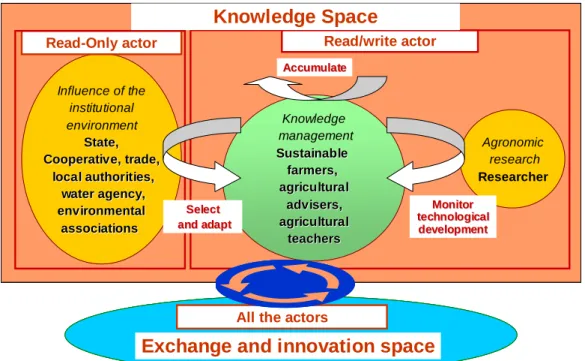
Not all the actors have the same importance. Thus, buying groups often enter into contractual relations with the farmers through cooperatives or trading. On the other hand, research organizations and the agricultural council often have no obligatory relations with the farmers. In these conditions, will all the actors in direct or indirect relation with the farmers have an equal access to this knowledge management tool? If the answer is negative, on what basis can the roles of the actors of the tool be distributed? The development of a collaborative knowledge space relies on a capacity to appropriate the experience of others. The actors also have to share the same objectives. The approach of a technical salesman to an organic cooperative is to sell his products and buy the crops produced. His participation in a knowledge management tool is thus inevitably influenced by his interests. However, it is possible to distinguish the users of the site who will potentially have read/write access (the farmers, the participants in the "agricultural knowledge system") from those who will have read-only access (cooperatives, traders, local authorities), c.f. Figure 2.
4 / 15
Read/write actor Knowledge management Sustainable Sustainable farmers, farmers, agricultural agricultural advisers, advisers, agricultural agricultural teachers teachers Agronomic research Researcher Monitor Monitor technological technological development development Influence of the institutional environment State, State, Cooperative, trade, Cooperative, trade, local authorities, local authorities, water agency, water agency, environmental environmental associations associations Read-Only actor Select Select andandadaptadapt
Knowledge Space
Accumulate
Accumulate
Exchange and innovation space
All the actorsRead/write actor Knowledge management Sustainable Sustainable farmers, farmers, agricultural agricultural advisers, advisers, agricultural agricultural teachers teachers Agronomic research Researcher Monitor Monitor technological technological development development Influence of the institutional environment State, State, Cooperative, trade, Cooperative, trade, local authorities, local authorities, water agency, water agency, environmental environmental associations associations Read-Only actor Select Select and
andadaptadapt
Knowledge Space
Accumulate Accumulate Read/write actor Knowledge management Sustainable Sustainable farmers, farmers, agricultural agricultural advisers, advisers, agricultural agricultural teachers teachers Agronomic research Researcher Monitor Monitor technological technological development development Influence of the institutional environment State, State, Cooperative, trade, Cooperative, trade, local authorities, local authorities, water agency, water agency, environmental environmental associations associations Read-Only actor Select Select andandadaptadapt
Knowledge Space
Accumulate
Accumulate
Exchange and innovation space
All the actorsExchange and innovation space
All the actorsFigure 2 : Role of the actors in the tool of knowledge management According to (Ermine 2007a) In the read/write actors' space, we separated the farmers from the researchers, considering their communication difficulties. There is however no question of restraining innovation by separating researchers from the other development actors (Le Masson, Weil et al. 2006). Agricultural advisers or agricultural teachers can monitor and transfer academic knowledge stemming from research.
3 What are the contents?
In our approach, we will privilege organic farming. Its main advantage is that it has a recognized label. The institutional environment is relatively well known (Enita de Bordeaux 2003). This choice is not limiting, because the problems are similar between integrated agriculture and organic farming (Lamine, Meynard et al. 2009). The basic idea is to manage the alive by the alive. For example: favor the housing environment of a predator of a pest whom we wish to eliminate. It is a concept where there are many interaction and which requires a lot of knowledge.
3.1 Knowledge legacy in large-scale organic farming
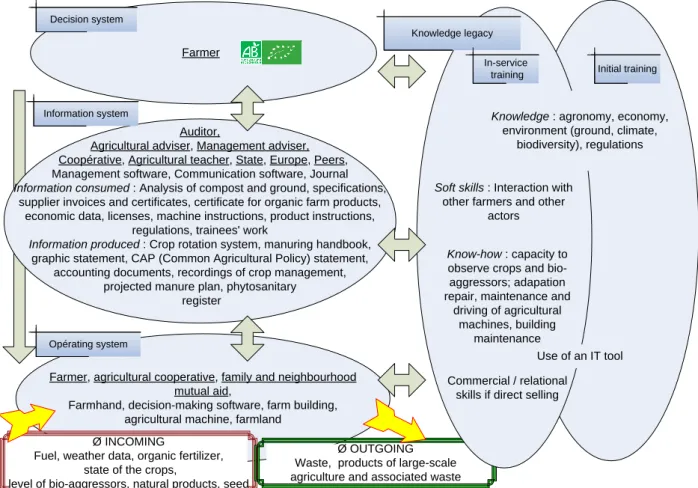
The plan " Organization, Information, Decision, Knowledge " (OIDK) comprises four sub-parts: the decision system, the information system, the operating system and the knowledge legacy (Ermine 1996, 2ièmeédition 2000). Figure 3 models a large-scale organic farm.
5 / 15
Farmer, agricultural cooperative, family and neighbourhoodmutual aid,
Farmhand, decision-making software, farm building, agricultural machine, farmland
Farmer
Decision system
Opérating system
Auditor,
Agricultural adviser, Management adviser, Coopérative, Agricultural teacher, State, Europe, Peers, Management software, Communication software, Journal
Information consumed : Analysis of compost and ground, specifications,
supplier invoices and certificates, certificate for organic farm products, economic data, licenses, machine instructions, product instructions,
regulations, trainees' work
Information produced : Crop rotation system, manuring handbook,
graphic statement, CAP (Common Agricultural Policy) statement, accounting documents, recordings of crop management,
projected manure plan, phytosanitary register
Ø INCOMING
Fuel, weather data, organic fertilizer, state of the crops,
level of bio-aggressors, natural products, seed
Information system
Ø OUTGOING Waste, products of large-scale agriculture and associated waste
continue
Soft skills : Interaction with
other farmers and other actors
Know-how : capacity to
observe crops and bio-aggressors; adapation repair, maintenance and
driving of agricultural machines, building
maintenance
Commercial / relational skills if direct selling
Knowledge : agronomy, economy,
environment (ground, climate, biodiversity), regulations Knowledge legacy In-service training Use of an IT tool Initial training
Figure 3 : The OIDK model dedicated to large-scale organic farming.
In the figure above, we have positioned all the consumed and produced information in three systems: decision, information and operating. The knowledge legacy aggregates the knowledge carried by these systems.
The decision system includes the agents who pilot the system. According to the canonical decision model proposed by Herbert Simon, quoted in (Le Moigne 1999), the decision process includes three phases: 1) An intelligence phase identifies and formulates the problems and connected risks. The problems are very often associated with a project and build up gradually. 2) If the solutions stemming from routines are ineffective, a design phase generates possible solutions and estimates them. 3) Finally, a multi-criterion selection phase retains the solution. On a farm, the farmer follows all these phases of the decision model. At the end, he retains a solution which is:
o in compliance both with his own value system and that of his social environment (Darré 2004b),
o the most relevant in terms of efficiency with regard to one or more of his general objectives, associated with a projected program and with its corpus of decision rules (Cerf and Sebillotte 1988; Sebillotte and Soler 1988).
Let us not forget that a farm is a very small firm, and the farmer is financially and legally responsible
The information system includes the agents who inform the farmer. It comprises all the strategic and tactical information supplied by these actors, which become information consumed by the farmer. The information system also lists the information produced by the farm. This information fulfils one or more purposes (ACTA 2007), i.e. the voluntary approach to organic farming, the regulations, but also the conditions concerning CAP (Common Agricultural Policy) aid. Thus, the CAP statement and the graphic declaration are a requirement relative to the CAP aid and are included in diverse regulations. In spite of its importance in sustainable agriculture, recording rotation information is not compulsory with
6 / 15
regard to the three purposes seen above. Suppliers' certificates (associated with the labels of seeds and plantations as well as with the invoices) monitor product traceablility and allow the real production conditions to be certified. They also guarantee respect for the organic network. The keeping of a phytosanitary register is associated at the same time with the community statutory constraints of the hygiene package and the CAP aid conditions. The recording of other technical operations is on the other hand a voluntary act on the part of the farmer, who will frequently keep a trace of his operations in a "plains notebook ".
The operating system connects actors and flows which generate the products. The farmer is mostly in the operation. He subcontracts some mechanical tasks to CUMA (Cooperative use of farm machines) or ETA( Contractor). Decision-making software optimizes the contributions of input products. These are less present in organic farming because there are fewer possible products and they are more complex to manipulate. Flows are constituted by the materials, the energy and the data which feed the process of nonstop production. Weather data is very important in the farmer's daily organization, in particular concerning his possibility of intervening in the fields. The level of bio aggressors and the state of the crops arise directly from observations made by the farmer or his peers, or from agricultural partners.
Legacy knowledge lists all the knowledge used and brought by all the actors and by all the artefacts listed in the operating, information and decision systems respectively. In the case of knowledge management in agriculture, it is difficult to separate the contents of the initial training from the knowledge acquired during professional life. Indeed, the agricultural high schools have constant relations with the professional environment. They are moreover under the direct supervision of the Ministry of Agriculture, contrary to all other educational establishments, which depend on the Ministry of Education. They participate in initial training as much as in vocational training. We thus suggest enriching the heritage model of knowledge legacy model proposed by (Ermine 1996, 2ièmeédition 2000) by distinguishing initial knowledge from knowledge acquired during professional life. Some knowledge acquired in initial training is regularly updated, if only by practice or life-long learning. On the contrary, some knowledge is acquired for the main part on the ground, such as a sense of observation of bio aggressors.
3.2 The essential contents of the knowledge management tool
The complexity of designing a sustainable culture system explains that knowledge cannot be proposed to the farmers in the form of complete and generalizable decision-making models (Osty 1990). However, the mere presentation of monographs associated with each farm is neither sufficient nor relevant. There is indeed a regularity of knowledge which goes beyond the farm. On the contrary, because of the variability of pedoclimatic conditions in agricultural production, numerous knowledge elements are not generalizable on a large scale. Knowledge is dependent on the context. We try to obtain cognitive representations of the critical knowledge for the action in particular to design successful and sustainable agriculture systems in their context (Soulignac, Ermine et al. 2010b). We distinguish two types of mobilizable cognitive resources:
The thematic knowledge is agronomic, economic or environmental knowledge. It has an impact generalizable to all farms. It applies only partly to any given farm. On the scale of a farm, the most successful and most generic of these agricultural systems could be modeled and stored in a library, according to the idea of (Meynard 2008). "Data, information, knowledge" modeling (Reix 2004) is effective to describe cognitive processes in industrial production. It is conceptually limited to describe the cognitive resources necessary for agricultural production. The “reference” notion introduces a cognitive concept specific to agriculture. Thus, (Bortzmeyer, Couvreur et al. 2011) suggest defining the reference as information which "is mobilizable, in order to act; clarifies (by opposition to tacit knowledge); exogenous (built by a third party); and context-dependent (the domain of validity is well-identified)". A reference thus holds at the same time some agricultural advice (thus information) and some localized knowledge (thus knowledge) enabling data to be interpreted. References which illustrate the theoretical functioning of a farm could feed the library, as a typical case or a concrete case.
o A typical case is a "fictitious farm, established by modeling, and described thanks to the concrete and coherent data of the farms studied by the same system" (Cerf and Lenoir 1987). The typical case is cognitively effective, to pass on to operational actors knowledge which is tried and tested in a given environment.
o A concrete case is "a typical case studied because of the innovative character of certain of its points, but whose representativeness is generally minor over the territory
7 / 15
of the department or the region”. It is elaborated according to the same methodology as the typical case. The major interest of this concrete case is that it can supply suggestions for orientations, strategies and adaptations of the main operating systems of the department or the region (Chambre régionale d'agriculture de Bourgogne 2009).
Other types of contextual knowledge are possible as a monograph. A monograph is the representation of a real farm, which can serve as reservoir of ideas to combine and test in different environments.
3.3 Critical knowledge
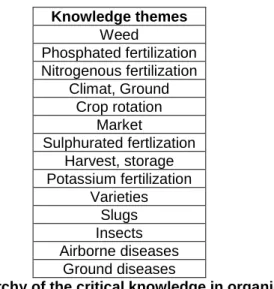
Critical knowledge (Grundstein 2002) is that knowledge without which the crucial problems of an organization have no solution. This knowledge can be explicit or tacit. The measure of this criticality is founded on both the vulnerability of the knowledge (rarity, accessibility, cost and deadlines of acquisition) and its importance in terms of collective stakes. (Aubertin 2007; Ricciardi, De Oliveira Barroso et al. 2007) are close to this mode of evaluation. (Aubertin 2007) quotes in addition the difficulty of using the knowledge. TELECOM & Management SudParis (ex INT) developed a method of mapping the critical knowledge: the M3C method. All propose a grade system established by experienced users in the domain. (Viola and Morin 2007) indicate a flaw in the construction of this criticality: respondents are tempted to overestimate the criticality of the knowledge which they manage directly. The question of divisable critical knowledge is also posed within the framework of the extended enterprise (Boughzala 2007b). In (Soulignac, Ermine et al. 2010a), we listed experts' views on the priority knowledge to be managed, and developed the methodology to establish this classification. Table 2 presents the knowledge themes to be handled, in decreasing order of priority for the farmers. Knowledge themes Weed Phosphated fertilization Nitrogenous fertilization Climat, Ground Crop rotation Market Sulphurated fertlization Harvest, storage Potassium fertilization Varieties Slugs Insects Airborne diseases Ground diseases
Table 2: Hierarchy of the critical knowledge in organic farming Which models to retain for the representation of knowledge in sustainable agriculture?
The tool to be built first is a computerized knowledge book. The proposed knowledge is dedicated to a particular business and is de facto complex. It is enriched by academic knowledge. The logical representation of the knowledge cannot be reduced to an encyclopedic-type approach. It is necessary to be able to connect different knowledge elements together, and hypertext links are not sufficient for this. We thus set up original formalisms which can describe the farmer's job. These graphic models aim to facilitate the cognitive processes. They enable access to deeper forms of knowledge such as texts, and possibly images or videos (Moity-Maïzi and Bouche 2008). The latter contain more specifically tacit knowledge, such as, for example, the regulation of the chain harrow. Thus, these models structure the knowledge.
3.4 Choice of a representation model
We studied three available types of representation: GIEA ("Gestion des Informations de l'Exploitation Agricole" (Management of Farm Information))., CEMAgriM(Abt 2010) and Mask (Ermine 1996, 2ièmeédition 2000). We take as comparison criteria the following factors:
8 / 15
The presence of a method which guarantees the rigor required in the collection of knowledge. The capacity to represent thematic knowledge, as well as the capacity to represent a farm
through a typical case, a concrete case or a monograph, according to the approach retained in paragraph 2.2.
The nature of the language to represent the models. Indeed, too heavy an investment in the appropriation of a language is in contradiction with a strong participation of the users in the tool.
Modalities of vast knowledge; if all the knowledge is not represented, the critical knowledge described above must be, in the widest possible range of modalities.
The ease of appropriation of the models by the user
We shall retain the MASK method, both to represent the thematic knowledge and to represent agricultural processes. It is immediately capable of expressing the reasons associated with the knowledge and thus enabling the users to understand it. This understanding by the final user is indispensable for the appropriation of innovative solutions on the scale of a farm. Furthermore, the exclusive choice of Mask to standardize the representation of the knowledge avoids the user's having to learn two different methods
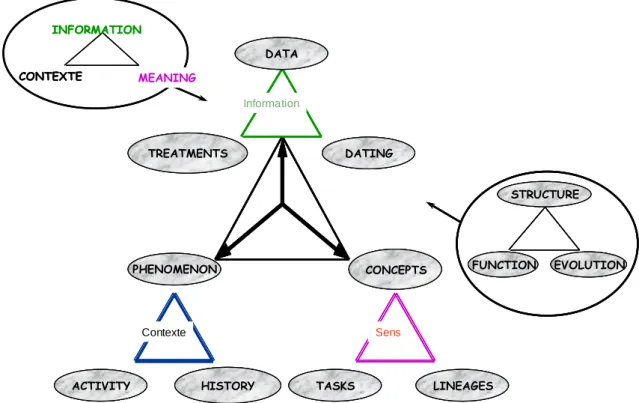
MASK comes from knowledge engineering, supplies a set of models and it based on the "macroscope of knowledge". The macroscope expresses the complexity of the knowledge. It is based on two hypotheses. The first is "semiotic": knowledge is information which has a sense according to a certain context. The sense and the context illustrate respectively a cognitive and an operational dimension of the knowledge. The second hypothesis is "systematic": knowledge is perceived according to three points of view: structure, function and evolution. This combination of both hypotheses is schematized in figure 4. It gives rise to 9 model types:
o Three models for the information: data, treatments and dating. So information is structured by the data, its function is to be treated and it is dated.
o Three models for the sense: concepts, tasks and lineages. The sense is constituted by the semantic networks of the concepts to which we apply cognitive tasks. The model of the lineage becomes attached to the evolution of objects or concepts. o Three models for the context: phenomenon, activity and history. A context is based on
phenomena which are the object of activities. The model of the history explains the evolution of the knowledge over time.
These are necessary in theory to describe the knowledge. In most cases, two to three types of models are sufficient.
9 / 15
DATA DATING TREATMENTS CONCEPTS LINEAGES TASKS PHENOMENON ACTIVITY HISTORY INFORMATION CONTEXTE STRUCTURE FUNCTION EVOLUTION Information Contexte Sens MEANING DATA DATING TREATMENTS CONCEPTS LINEAGES TASKS PHENOMENON ACTIVITY HISTORY DATA DATING TREATMENTS CONCEPTS LINEAGES TASKS PHENOMENON ACTIVITY HISTORY INFORMATION CONTEXTE STRUCTURE FUNCTION EVOLUTION STRUCTURE FUNCTION EVOLUTION Information Contexte Sens MEANINGFigure 4 : Knowledge overview (Ermine 1996, 2ièmeédition 2000)
3.5 The MASK models applied to the organic farming
3.5.1 Models for thematic knowledge management
We applied this method to the practices of large-scale organic farms in the regions of Auvergne and Burgundy. The profession recognizes the excellent skills of the chosen farmers. The rigor applied to their choice respects the MASK methodology. Indeed, it requires that the respondents have a high level of expertise in their domain. We will present two types of models applied to running large-scale agriculture.
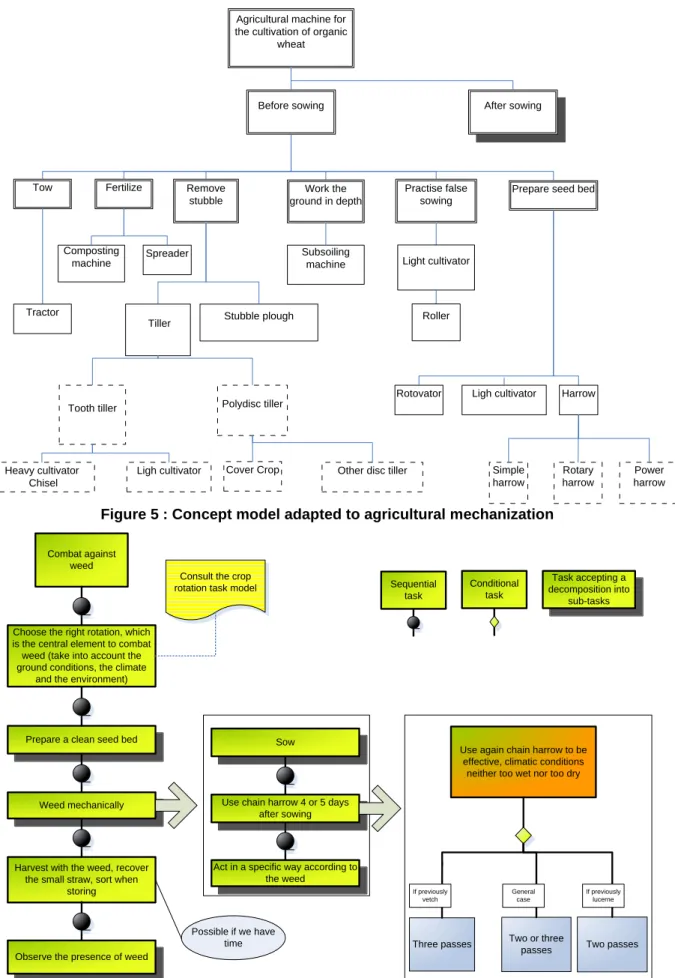
The concept model classifies knowledge according to a mode close to that of our study. In the case of the agricultural mechanization model for organic wheat production, presented on Figure 5, the farmer will classify intuitively the types of machines according to the logic of the work to be performed in the different agricultural tasks. For ergonomic reasons, we will not present the whole model. Thus, an object with shadow links back to a sub-model. In an IT tool, this connection is made by a hypertext link. Each of the identified machines is so many points of entry towards index forms which detail them and toward images which represent them. In the same way, a concept model could classify weed according to their threat level, with links to the associated methods of combating them.
The task model specifies the way a professional farmer reasons. He specifies his strategy to resolve a particular problem. To do this, he uses concepts already present in the concept model. Figure 6 shows the strategy for combating weed within the framework of growing wheat. It refers, for example, to the chain harrow, described in the agricultural machine model. An object with a shadow also links back to a sub-model.
10 / 15
Agricultural machine for the cultivation of organic
wheat
Practise false sowing Remove
stubble
Prepare seed bed Fertilize Spreader Composting machine Tiller Light cultivator Work the ground in depth Roller Polydisc tiller Tooth tiller Harrow Stubble plough Subsoiling machine Rotovator Tow Tractor Ligh cultivator Heavy cultivator Chisel
Cover Crop Other disc tiller Rotary harrow Simple
harrow
Power harrow Before sowing After sowing
Ligh cultivator
Figure 5 : Concept model adapted to agricultural mechanization
Choose the right rotation, which is the central element to combat weed (take into account the ground conditions, the climate
and the environment)
Consult the crop rotation task model Combat against
weed
Prepare a clean seed bed
Weed mechanically
Harvest with the weed, recover the small straw, sort when
storing
Possible if we have time Observe the presence of weed
Three passes Two or three
passes Two passes Use again chain harrow to be
effective, climatic conditions neither too wet nor too dry
If previously vetch General case If previously lucerne Sow
Act in a specific way according to the weed
Use chain harrow 4 or 5 days after sowing Conditional task Sequential task Task accepting a decomposition into sub-tasks
11 / 15
In spite of different climatic and environmental contexts, the bulk of knowledge is transferable from one region to another. On the other hand, depending on his own constraints, a farmer mobilizes only some knowledge. Thus, the models presented above supply farmers with knowledge that is not directly operational. However, they facilitate the organization of their agriculture systems, and associated technical processes, in the specific context of their farm. We presented about ten of these models to farmers. They quickly appropriated the associated knowledge.
3.5.2 Models to represent typical cases of innovative agriculture systems
We propose that the tool contains a library of innovative and sustainable agriculture systems in the form of typical cases or monographs. This representation requires several elements to be described: the domain of validity of the innovative agriculture system represented as well as its durability, the succession of crops and the technical processes with their decision rules. However, this pooling of information goes well beyond the representation of the results. The mode of calculation of the results and their validation must also be identified, published and even, in certain cases, homogenized. This homogenization is not simple to achieve in the divided landscape of reference tables produced by actors of diverse origins. By definition, the knowledge to be modeled is contextual. We will thus identify the models of the MASK method which are the most adapted to our objective.
The domain of validity of the innovative agriculture system specifies the context of the typical case or the monograph which we wish to describe. The evaluation of the innovative system focuses its interest on criteria of durability. To express these parameters, the phenomenon model is used. It expresses well the idea of a global transition from one system to another one. Figure 7 presents the context of farms in Burgundy.
Triggering factor adoption of organic farming
Fields of influence
Conséquence
New economic, environmental and social sustainablilty for the innovative agriculture system with calculated values and a good
image
Flow: Rotation, crop management
Clay-calcareous soil with temperate climate
Man Work Unit Example of small agricultural region:
Burgundy
Respect of the label
Yield
Organic product in large-scale agriculture
Farm
- Price of products - European policy - Regulations
Source system Target system
12 / 15
Farmer A Lucerne (3 years) Wheat Inter-cropping (vetch,oats, colza, beans)Row crop (sunflower, potato)
Cereal, einkorn after sunflowers, wheat after potatoes
Barley/peas
Inter-cropping
Potatoes or colza
Wheat
Secondary cereal, such as white oats My problem is finding outlets for lucerne; it is not
very interesting from an economic point of view
Know-how: know how to fight against weed (see corresponding task
model)
Never monoculture (wheat on wheat: no; wheat on barley: why not)
If abundance of thistles, I return faster to lucerne
Sunflowers pump the ground
I am maybe going to grow more spelt and rotate over 12 years
1/3 lucerne, 1/3 cereal, 1/3 oleaginous plants (sunflower, colza) and potatoes for two years. The lucerne wasn't a success. Note: my turnover
comes from potatoes.
I compensated the lack of lucerne with barley and peas
A green manure is a grass, a legume, a crucifer
Crop
Comments
Figure 8 : Description of a cultural succession
fertilized plot of land Stubble plough Incorporation of stubble in approximately the first ten centimeters,
raising of weed Prepare the seed-bed Clean plot of land, without weed Practise false-sowing Plot of land having
previously received leguminous plants; it fits
into a long rotation including inter-cropping
Fertilize Knowledge: calculate fertilizing needs; use the right
dose
Spreader
Stubble plough machine
Knowledge: consult the activity model for false-sowing
Knowledge: management rules, choice of seed Seed drill Know-how: adjustment of the chain harrow Sowed plot of land Weed Plot of wheat Harvest Contractor Harvest: wheat; small straw harvest, plot with
stubble Plot of land ready for sowing Sow Activity Knowledge, Know-how Resource Light cultivator Chain harrow
Figure 9 : Activity model of the crop management for wheat
Crop rotation, as well as the technical sequences, is production processes associated with a plot of land. For the rotation, we briefly formalized the succession of crops (Figure 8). Every crop can be enriched by comments. Every type of crop has a technical sequence, which is described by the activity model. Figure 9 above shows this for wheat production. Each stage of this process can be associated with one or more management rules. Every rule
13 / 15
summarizes the reasoning of the farmer, associated with threshold values for the indicators. We suggest formalizing these rules using the task model above.
These various models best represent the directories of actions and the routine procedures (Cerf and Sebillotte 1997) associated with the innovative agriculture system. They concern strategic choices (crop rotation), tactical choices (technical solutions or certain management rules) or operational choices (regulation of machines). The routine procedures, and in particular those connected to risk management, can be described through the task model.
4 Conclusion
We have proposed a computing tool based on the analysis of the actions of the people who will be the users of this tool. Its contents and its shaping will be defined using MASK methodology (Matta et al. 2001, Van Berten and Ermine, 2006). We showed that the use of MASK is satisfactory to produce a representative graphic language to pilot large-scale organic farming, for both thematic knowledge and case studies. This MASK model distinguishes procedural knowledge from declarative knowledge, as is recommended in cognitive psychology (Cerf, Papy et al. 1990). From a cognitive point of view, MASK models make the knowledge accessible. These various models best represent directories of actions and procedures for routines dedicated to sustainable agricultural systems. They concern strategic choices (crop rotation), tactical choices (technical solutions or certain management rules) or operational choices (regulation of machines). The routine procedure, and in particular those connected with risk management, can be described through the task model. Thanks to hypertext links, these models lead towards other forms of knowledge, such as text documents. The insertion of these models in an IT tool makes it possible to update them empirically (i.e stemming from farmers’ personal experiences) or from academic knowledge. The latter is introduced either by reconstructing and enriching certain documents, or by the direct insertion of engineering models.
The limitation of using the MASK method to represent knowledge is the low level of accumulated expertise on the part of the farmers. If capitalizing experiences is possible on the scale of an annual campaign, it is much more difficult to obtain over longer periods, such as those of crop rotation, which can take around ten years (at the time of the interviews, most of the farmers had experienced only one or two crop rotations) (Duru, Papy et al. 1988). However, this temporal limitation highlights the importance of cross-capitalization between farmers in similar production contexts.
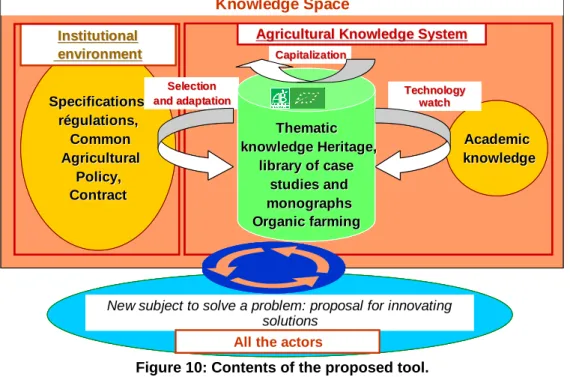
Figure 10 summarizes the place of the various contents in the knowledge tool which we propose in this article.
Knowledge Space
Agricultural Knowledge System
Agricultural Knowledge System
Academic Academic knowledge knowledge Technology Technology watch watch Specifications, Specifications, r réégulations,gulations, Common Common Agricultural Agricultural Policy, Policy, Contract Contract Institutional Institutional environment environment Selection Selection and
andadaptationadaptation
Thematic Thematic knowledge Heritage, knowledge Heritage, library of case library of case studies and studies and monographs monographs Organic farming Organic farming Capitalization Capitalization Echange Echange
New subject to solve a problem: proposal for innovating solutions
All the actors
Knowledge Space
Agricultural Knowledge System
Agricultural Knowledge System
Academic Academic knowledge knowledge Technology Technology watch watch Specifications, Specifications, r réégulations,gulations, Common Common Agricultural Agricultural Policy, Policy, Contract Contract Institutional Institutional environment environment Selection Selection and
andadaptationadaptation
Thematic Thematic knowledge Heritage, knowledge Heritage, library of case library of case studies and studies and monographs monographs Organic farming Organic farming Capitalization Capitalization Echange Echange
Agricultural Knowledge System
Agricultural Knowledge System
Academic Academic knowledge knowledge Technology Technology watch watch Specifications, Specifications, r réégulations,gulations, Common Common Agricultural Agricultural Policy, Policy, Contract Contract Institutional Institutional environment environment Selection Selection and
andadaptationadaptation
Thematic Thematic knowledge Heritage, knowledge Heritage, library of case library of case studies and studies and monographs monographs Organic farming Organic farming Capitalization Capitalization Echange Echange
New subject to solve a problem: proposal for innovating solutions
All the actors
New subject to solve a problem: proposal for innovating solutions
All the actors
Figure 10: Contents of the proposed tool.
14 / 15
Bibliography