HAL Id: hal-02331719
https://hal.archives-ouvertes.fr/hal-02331719
Submitted on 19 Apr 2020
HAL is a multi-disciplinary open access
archive for the deposit and dissemination of
sci-entific research documents, whether they are
pub-lished or not. The documents may come from
teaching and research institutions in France or
abroad, or from public or private research centers.
L’archive ouverte pluridisciplinaire HAL, est
destinée au dépôt et à la diffusion de documents
scientifiques de niveau recherche, publiés ou non,
émanant des établissements d’enseignement et de
recherche français ou étrangers, des laboratoires
publics ou privés.
Order ATHERINIFORMES ATHERINIDAE Silversides
Luis Tito de Morais, M. Sylla, W. Ivantsoff
To cite this version:
Luis Tito de Morais, M. Sylla, W. Ivantsoff. Order ATHERINIFORMES ATHERINIDAE Silversides.
Carpenter Kent E.; De Angelis Nicoletta. The living marine resources of the Eastern Central Atlantic.
Vol. 3 : Bony fishes, part 1 : Elopiformes to Scorpaeniformes, FAO, pp.2111-2118, 2016, Species
Identification Guide for Fishery Purposes - FAO, 978-92-5-109266-8. �hal-02331719�
Atheriniformes: Atherinidae
Or der ATHERINIFORMES
ATHERINIDAE
Silversides
by L. Tito de Morais, IRD/LEMAR, University of Brest, Plouzané, France; M. Sylla, Centre de Recherches Océanographiques de Dakar-Thiaroye (CRODT), Senegal and W. Ivantsoff (retired), Biology Science, Macquarie University NSW 2109, North Ryde,
Australia
D
iagnostic characters: Small, elongate fish, rarely exceeding 15 cm in length. Body elongate andsomewhat compressed. Short head, generally flattened dorsally, large eyes, sharp nose, mouth small, oblique and in terminal position, jaws subequal, reaching or slightly exceeding the anterior margin of the eye; premaxilla with ascending process of variable length, with lateral process present or absent; ramus of dentary bone elevated posteriorly or indistinct from anterior part of lower jaw; fine, small and sharp teeth on the jaws, on the roof of mouth (vomer, palatine, pterygoid) or on outside of mouth; 10 to 26 gill rakers long and slender on lower arm of first gill arch. Two well-separated dorsal fins, the first with 6 to 10 thin, flexible spines, located approximately in the middle of the body; the second dorsal and anal fins with a single small weak spine, 1 unbranched soft ray and a variable number of soft rays. Anal fin always originating slightly in advance of second dorsal fin; pectoral fins inserted high on the flanks, directly behind posterior rim of gill cover, with spine greatly reduced and first ray much thicker than those following. Abdomninal pelvic fins with 1 spine and 5 soft rays; forked caudal fin; anus away from the origin of the anal fin. Relatively large scales, cycloid (smooth). Lateral line absent. Colour: back greenish to bluish speckled with black dots, translucent with scales delineated by small chromatophores above mid-lateral band; sides of head and body, as well as abdomen silvery, flanks often iridescent; brilliant mid-lateral sideband, sometimes highlighted in black, running along the middle of the body from upper margin of pectoral fin to the base of the caudal fin.
Habitat, biology, and fisheries: Silversides inhabit the surface and coastal waters of all tropical and
temperate seas, near the surface to about 1 to 2 m, often forming large schools. They penetrate estuaries and brackish waters, while others live also in freshwater (Atherina boyeri). They feed on plankton at sea and on small benthic invertebrates in the coastal lagoons. Eggs are moderately large (up to about 1 mm) and have many filaments with which they adhere in compact mass to algae, rocks or bottom sand. Although edible, silversides are minimally consumed due to their small size, but are still caught for use as bait. They are caught in artisanal fisheries using beach seines, lift nets, gillnets and traps. Outside the area, silversides are found regularly in the markets of Italy, France, Spain and Turkey, and are also occasionally marketed pickled. Only 2 Old World species (Atherina breviceps, Atherinomorus lacunosus) are large enough to be valuable for human consumption; other species are important as forage for commercial fisheries and used as bait and in dried cat food.
Remarks: The genus
Atherina is distributed in the eastern Atlantic Ocean and the Mediterranean Sea,
extending south along the African coast into the Indian Ocean. There has been much confusion with atherinid species, possibly due to their small size, with lack of commercial importance leading to insufficient attention to this group. They are small silvery fishes which are superficially similar in size, coloration, and external morphology. Distinct differences, however, do occur in some measurements, counts, and in osteology. a recent revision recognized 5 species in the genus Atherina but strongly suggested that Atherina boyeri is a multi-species complex with 3 forms, of which the 2 new forms are restricted to the Mediterranean. Atherinamochon is cited by some authors in Morocco, but is not a valid species and is most likely A. boyeri.
midlateral stripe 1st dorsal fin with
flexible spines
2nd dorsal fin with 1
weak spine
pelvic fin with 1 spine and 5 soft rays
Similar families occurring in the area
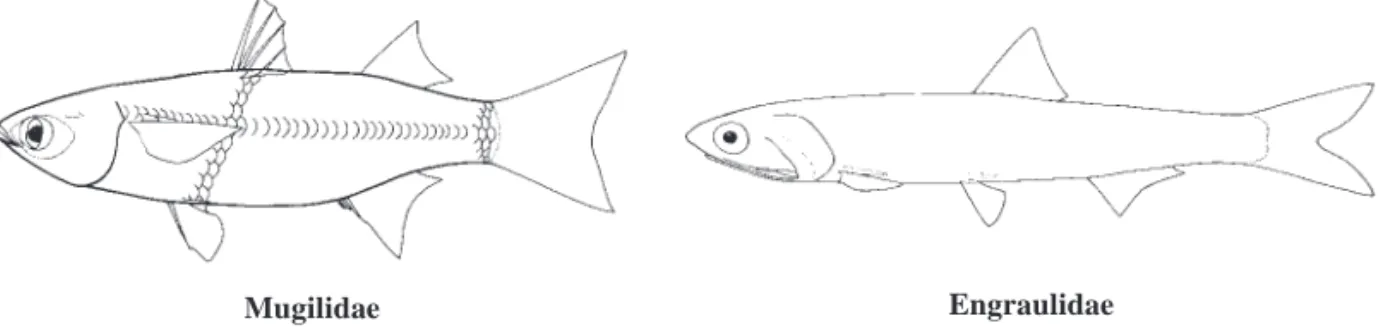
Mugilidae: broad and flat head with blunt snout; eyes surrounded and more or less covered by adipose lids; first dorsal fin with 4 slender spines, anal fins with up to 3 spines. Sometimes with rough ctenoid scales on the sides of the head; no silver stripe on the sides.
Engraulidae: a single dorsal fin, no unsegmented spines in fin; pectoral fins low on the body; very large mouth in inferior position; blunt and projecting snout; the maxillary often extending to the edge of the operculum.
Clupeidae: a single dorsal fin, no unsegmented fin rays; pectoral low on the body.
Argentinidae: 1 short dorsal fin and 1 adipose fin; mouth small; pectoral fins low on body; anal fin near caudal fin.
Key to species occurring in the area 1a. Premaxilla with ascending
p r o c e s s l o n g e r t h a n t h e h o r i z o n t a l t o o t h e d p a r t , reaching the upper edge of the eye; more than 58 mid-lateral scales (Fig. 1)
1b. Premaxilla with ascending
p r o c e s s s h o r t e r t h a n t h e horizontal toothed part, and not reaching the upper edge of t h e e y e ; l e s s t h a n 5 8 mid-lateral scales (Fig. 2)
2a. More than 50 mid-lateral scales;
ectopterygoid bone toothless
2b. L e s s t h a n 5 0 m i d - l a t e r a l
scales; ectopterygoid bone with teeth
Engraulidae
Clupeidae Mugilidae
Argentinidae
Fig. 2 Atherina presbyter
a) maxilla b) premaxilla
Fig. 1 Atherina hepsetus a) maxilla with shelf
b) premaxilla with dorsal and lateral
3a. Thirty-nine to 49 mid-lateral
scales, 40 to 47 vertebrae (haemal arches expanded), 21 to 39 gill rakers
3 b. Forty-three to 48 mid-lateral
scales, 40 to 43 vertebrae (haemal arches not expanded), 15 to 20 gill rakers
List of species occurring in the area
The symbol
0
is given when species accounts are included.0
Atherina boyeri Risso, 1810.
0
Atherina hepsetus Linnaeus, 1758.
0
Atherina lopeziana Rossignol and Blache, 1961.
0
Atherina presbyter Cuvier, 1829.
References
Azeroual, A. 2003. Monographie des Poissons de eaux continentales du Maroc: systématique,
distribution et écologie. Thèse de Doctorat, Université Mohammed V-Agdal, Rabat, Maroc,
190 pp.
Chernoff, B. 2002. Order Atheriniformes Atherinidae "Silversides." In K.E. Carpenter, ed. The living
marine resources of the Western Central Atlantic. Volume 2: Bony fishes part 1 (Acipenseridae to Grammatidae). Rome, Italy: FAO and American Society of Ichthyologists and Herpetologists, pp.
1086–1096.
Francisco, S.M., Congiu, L., von der Heyden, S. & Almada, V.C. 2011. Multilocus phylogenetic analysis
of the genus Atherina (Pisces: Atherinidae). Molecular Phylogenetics and Evolution, 61: 71–78.
Gushchin, A.V. & Fall, K.O.M. 2012. Ichthyofauna of littoral in the gulf Arguin, Mauritania. Journal of
Ichthyology, 52: 160–171.
Lloris, D. & Rucabado, J. 1998. Guide d'identification des ressources marines vivantes du maroc. Food &
Agriculture Organization, Rome, Italy 306 pp.
Maugé, L.A. 1990. Atherinidae. In J.C. Quéro, J.C. Hureau, C. Karrer, A. Post and L. Saldanha, eds.
Check-list of the fishes of the eastern tropical Atlantic, vol. 2. Paris, pp. 604–605.
Quignard, J.P. & Pras, A. 1986. Atherinidae. In PJ.P. Whitehead, ed. Fishes of the north-eastern Atlantic
and the Mediterranean. Paris, France: UNESCO. pp. 1207–1210.
Reiner, F. 1996. Catálogo dos peixes do Arquipélago de Cabo Verde. Instituto Português de Investigação
Marítima. Publicações avulsas do IPIMAR, 2: 339 p.
Rossignol, M. & Blache, J. 1961. Sur le statut spécifique de deux poissons pélagiques du Golfe de
Guinée? Anchoviella guineensis nov. sp. (Clupeiformes, Engraulidae) Atherina lopeziana nov. sp. (Mugiliformes, Atherinidae). Bulletin du Muséum National d’Histoire Naturelle, 2e
Série, 33: 285–293.
Fig. 3 haemal arches
Santos, R.S., Porteiro, F.M. & Barreiros, J.P. 1997. Marine Fishes of the Azores: annotated checklist and
bibliography: a catalogue of the Azorean marine ichthyodiversity. Universidade dos Açores.
Supplement 1: 244.
Schneider, W. 1990. Field Guide to the Commercial Marine Resources of the Gulf of Guinea. Prepared
and Published with the Support of the FAO Regional Office for Africa. FAO, Rome. FAO. 268 pp.
Vakily, J.M., Camara, S.B., Mendy, A.N., Marques, V., Samb, B., dos Santos, A.J., Sheriff, M.F., Ould Taleb Sidi, M. & Pauly, D. 2002. Poissons marins de la sous-région Nord-Ouest Africaine.
Commission Européenne, Centre Commun de Recherche, Institut de l’Environnement Durable, Ispra, Italy. 130 pp.
Atherina boyeri Risso, 1810
Frequent synonyms / misidentifications:
Atherina hepsetus Delaroche, 1809 (not Linnaeus, 1758);
A. mochon Cuvier 1829; A. presbyeter var. pontica Eichwald, 1831; A. risso Valenciennes, 1835; A. sarda
Valenciennes, 1835; A. lacustris Bonaparte, 1836; A. hyalosoma Cocco, 1885; A. riqueti Roule, 1902;A. sardinella Fowler, 1903; A. bonapartii Boulenger, 1907; Hepsetia boyeri (Risso, 1810); Atherina
caspia Eichwald, 1838 / Atherina presbyter.
FAO names: En – Big-scale sand smelt; Fr – Joël; Sp – Pejerrey mediterráneo.
Diagnostic characters: Head length 4 times or less in total length. Dorsal fin rays with 6 to 9 flexible spines
(generally 7 or 8) in the first dorsal fin and 9 to 15 (generally 10 to 13) soft rays in the second dorsal fin; anal-fin rays with 1 spine and 12 to 18 soft rays (generally 13 to 15). Scales in longitudinal series (39) 44 to 48 (49). Gill rakers 21 to 39. Vertebrae 40 to 47; haemal arches expanded. (Important variations in meristic characters according to various environmental conditions). Colour: usually yellowish translucent body. Back greenish grey with small black dots, white belly, with a silver stripe along the side. Fins clear, almost colourless. Animals living in lagoons are brownish or grey brownish on back.
Size: Up to 13 cm, usually 7 to 9 cm..
Habitat, biology, and fisheries: Found in littoral, lagoons and inshore stations; land-locked populations in
coastal lagoons, very euryhaline fish, occurring in hyperhaline water (77 psu in Corsicca) to freshwater (in Morocco). Diet is mostly planktivore. At sea, it feeds on zooplankton but in lagoons, it consumes also small benthic invertebrates. Reproduction occurs from April to June in brackish (2 psu) and hyperhaline (42 psu) waters. Sexually mature when 1 year old. Spawning occurs in the
spring, and there may be several clutches. Eggs are demersal and have filaments to adhere to the aquatic vegetation, the larvae are pelagic. Longevity of 3 years. Caught for bait with beach seines, bottom and pelagic trawls, lift nets, bottom gillnets and traps.
Distribution: Mediterranean, Black Sea, Atlantic from south of Spain
possibly to Mauritania, including the Canary Islands and Madeira (presence at Madeira appears very doubtful). Isolated populations in brackish coastal lagoons in Morocco (Sidi Bou Ghaba Lake, Oued Sebou, oxbows of Oued Beht and Dayet Erroumi) and along the coasts of United Kingdom and the Netherlands.
Remarks: There are a number of variable characteristics which
should be used with caution in any system of classification. This is true, for instance, of the number of vertebrae, the shape of the haemal arches, gill rakers, body proportions, etc. This polymorphism undoubtedly accounts for the number of synonyms assigned to the species.
Atherina hepsetus Linnaeus, 1758
Frequent synonyms / misidentifications:
Atherina (Atherina) hepsetus Linnaeus, 1758; A. athaerina
Nardom, 1827 / None.FAO names: En – Mediterranean sand smelt; Fr – Sauclet or Siauclet; Sp – Chucleto.
Diagnostic characters: Body elongate, subcylindrical or compressed. Head length more than 4 times in total
length. No teeth on pterygoid bones. Dorsal fin rays with 7 to 10 spines in the first dorsal fin and 1 spine and 10 to 12 soft rays in the second dorsal fin; anal-fin rays with 1 spine and 11 to 13 soft rays. Scales in longitudinal series 59 to 65. Gill rakers 30 to 36. Vertebrae 53 to 57. Colour: silver, greenish grey, with a lateral stripe extending from head to tail.
Size: Up to 20 cm, usually 15 cm.
Habitat, biology, and fisheries: Pelagic littoral, often near shore,
sometimes in marine lagoons and estuaries. Gregarious. Feeds on pelagic copepods and benthic crustaceans. Reproduction occurs from December to May (Mediterranean: France, Italy). Longevity from 3 to 4 years. Caught in beach seines, bottom and pelagic trawls, lift nets and bottom gillnets.
Distribution: Mediterranean, Black Sea and Caspian Sea (common,
locally abundant). Eastern Atlantic, from Spain to Morocco including the Canary Islands and Madeira (rather rare).
Atherina lopeziana Rossignol and Blache, 1961
Frequent synonyms / misidentifications:
Atherina boyeri (non Risso, 1810 in Osório, 1893, 1898);
A. hepsetus (non Linnaeus, 1758 in Fowler, 1936 and Lozano-Cabo, 1961) / Atherina presbyter
.FAO names: En – Lopez’s sand smelt.
Diagnostic characters: Elongate body, fusiform and compressed. Total length less than 1.2 times in
standard length. Body height at the origin of the ventral fin 5.3 to 5.6 times in standard length and 6.4 to 6.7 times in total length. Mouth oblique and sllightly protruding inferior jaw. Vertebrae 40 to 42; haemal arches not expanded. First dorsal fin rays with 6 to 8 spines; second dorsal fin rays with 1 spine and 11 to 13 soft rays, anal-fin rays with 1 spine and 14 to 17 soft rays. Scales in lateral line 43 to 48. Predorsal scales 18 to 23. Gill rakers 15 to 20 (lower arc 13 to 16; upper arc 2 to 4). Colour: body more or less translucent on living individuals, with a greenish back; large lateral silvery band from the operculum to the base of the tail; head silver-grey. On formalin-fixed individuals the lateral band fades and reveals a narrow black side band which ends with a grey triangular mark close to the origin of the caudal rays.
Size: Up to 8 cm.
Habitat, biology, and fisheries: This coastal species is very poorly
known.
Dis tri bu tion: Gulf of Guinea to Bay of Biafra and offshore islands,
including São Tomé Island. Also reported from littoral of Gulf of Arguin and Cape Verde.
Atherina pres by ter Cuvier, 1829
Frequent synonyms/misidentifications:
Atherina (Hepsetia) presbyter Cuvier, 1829, Hepsetia
presbyter (Cuvier, 1829) / Atherina boyeri.
FAO names: En – Sand smelt; Fr – Prêtre; Sp – Abichón.
Diagnostic characters: Head length more than 4 times in total length. Dorsal-fin rays with 7 to 9 spines in
the first dorsal, and 1 spine and 11 to 14 soft rays in the second; anal fin with 1 spine and 14 to 17 soft rays. Scales in longitudinal series 52 to 57. Gill rakers 28 to 22. Vertebrae 46 to 52 (Morocco 46 to 49, the Netherlands 49 to 52). Colour: bright stripe running the whole length of its side from head to tail, often outlined in black. No true lateral line.
Size: Up to 20 cm, usually 12 to 16 cm.
Habitat, biology, and fisheries: Pelagic fish inhabiting littoral waters, sometimes in low-salinity water,
occasionally enters estuaries and coastal lagoons. A schooling fish. Seasonal migrations along Atlantic coasts. Carnivorous (small crustaceans, fish larvae). Maximum age from 3 to 4 years. Caught in bottom gillnets and lift nets. In the Canary Islands, A. presbyter is fished both as commercial target and as bait in the seasonal live-bate tuna fishery. This species is captured near surface
in the littoral zone, mainly with beach seines and liftnets. It is caught consistently year-round without significant seasonal differences in landings.
Distribution: Atlantic coast from Kattegat Strait (rare) and Scotland
to Morocco, Canary Islands, Azores and Madeira. Also reported from littoral of Gulf of Arguin in Mauritania and Cape Verde (doubtful record). Rare in the Mediterranean (found off the Straits of Gibraltar; France: Port-Vendres, Marseilles; Tunisia: Tunis).
Remarks: Historically there has been considerable confusion
between