HAL Id: hal-02902859
https://hal.archives-ouvertes.fr/hal-02902859
Submitted on 20 Jul 2020
HAL is a multi-disciplinary open access
archive for the deposit and dissemination of
sci-entific research documents, whether they are
pub-lished or not. The documents may come from
teaching and research institutions in France or
abroad, or from public or private research centers.
L’archive ouverte pluridisciplinaire HAL, est
destinée au dépôt et à la diffusion de documents
scientifiques de niveau recherche, publiés ou non,
émanant des établissements d’enseignement et de
recherche français ou étrangers, des laboratoires
publics ou privés.
Towards photometry of Europa
Ines Belgacem, F. Schmidt, G. Jonniaux
To cite this version:
Ines Belgacem, F. Schmidt, G. Jonniaux. Towards photometry of Europa. European Planetary Science
Congress, Sep 2017, Riga, Latvia. �hal-02902859�
Towards photometry of Europa
I. Belgacem (1), F. Schmidt (1) and G.Jonniaux (2)
(1) GEOPS, Univ. Paris-Sud, CNRS, University Paris-Saclay, rue du Belvédère, Bat. 504-509 Orsay, France. (2) Airbus Defence & Space, Toulouse, France.
Contact: [email protected]
Abstract
Exploring the icy satellites of outter planets is a ma-jor step in the search for habitability in our Solar Sys-tem. This work focuses on Jupiter’s icy moon Europa and the images captured by the Long-Range Recon-naissance Imager on-board the New Horizons space-craft. It is aimed at combining images of the satellite in order to derive photometric reflectance models (i.e. angular response of a surface). It will later be extended to the other two icy Jovian satellites, Ganymede and Callisto and larger data sets.
1. Context
Europa is a prime candidate for habitability in our Solar System. The surface of the moon is the youngest of the Jovian icy satellites. It appears to be contin-iously renewing by an expanding crust [1]. This ac-tivity may be driven by a global water ocean [2] for which more and more evidence seems to be advocat-ing, the latest being the observations of possible water plumes with the Hubble Space Telescope [3].
The JUICE (JUpiter ICy moons Explorer) mission from the European Space Agency (ESA) is to be lauched in 2022 and arrive at the Jovian system in 2030 to study Jupiter and its icy moons for three and a half years. The spcacraft is being designed by Airbus De-fence & Space in Toulouse, France, with a very inno-vative navigation system. Any mission to the outter Solar System is challenging considering local radia-tive and thermal conditions as well as the distance to the Earth. This new way of navigating aims at making spacecrafts more autonomous and is based on extract-ing navigation data from on-board image processextract-ing [4]. For that algorithm to be successful, the spacecraft needs to have very realistic models of its targets -namely Jupiter’s icy moons. This work is starting with combining existing images of Europa to make them comparable as a first step towards deriving reflectance models.
2. Data set
This work is focused on the most recent mission to have encountered the Jovian moons - New Horizons. On its way to Pluto, the spacecraft spent three months observing Jupiter and its moons in 2007 with the LORRI (LOng-Range Reconnaissance Imager) cam-era [5]. Combining all the images captured during the Jupiter phase of the mission, the whole surface of Eu-ropa is accounted for.
Figure 1: Example of a LORRI observation By comparing New Horizons images of Europa to simulations based on the available geometry and atti-tude meta-data from SPICE kernels, it was found that imprecisions in meta-data [4] resulted in considerable errors when associating pixels to their coordinates on the moon. The first step is therefore to improve the meta-data as much as possible to have a coherent data set.
3. Method
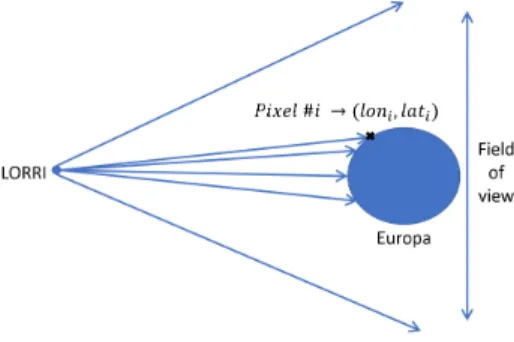
Images are compared two by two to ensure that when looking at a common part of the moon, two im-ages are matching. By considering one image as the reference, each pixel of the second image needs to be projected onto the moon to estimate its coordinates (Fig. 2).
EPSC Abstracts
Vol. 11, EPSC2017-87, 2017
European Planetary Science Congress 2017
c
Figure 2: Schematic view of projecting pixels on moon Step by step the global map of the moon will be re-constructed. Moreover, since all images are taken with different geometries (incidence, emergence and phase angles), it will be possible to determine the photomet-ric behavior of the moon.
4. Conclusion
Next steps will include extracting information from the reflectance variations at the surface and the global photometry. This will also be an opportunity to esti-mate the structure of the moon’s surface - for instance its micro-texture - as it has been done on Mars [6].
In addition, the available data set of past missions is quite rich. Galileo studied the Jovian system for seven years between 1995 and 2002. Cassini also briefly captured images of the icy moons in 2001. We plan to extend our work to these data sets. The same method-ology should also be applied to the other two Jovian icy moons: Ganymede and Callisto.
Acknowledgements
This work is supported by Airbus Defence & Space, Toulouse (France) as well as a public grant overseen by the French National research Agency (ANR) as part of the « Investissement d’Avenir » program, through the "IDI 2016" project funded by the IDEX Paris-Saclay, ANR-11-IDEX-0003-02.
References
[1] S. A. Kattenhorn and L. M. Prockter. Evidence for Subduction in the Ice shell of Europa. Nature Geoscience, 7:762–767, October 2014.
[2] R. T. Pappalardo, J. W. Head, R. Greeley, R. J. Sullivan, C. Pilcher, G. Schubert, W. B. Moore, M. H. Carr, J. M. Moore, M. J. S. Belton, and D. L. Goldsby. Geological evidence for solid-state convection in europa’s ice shell. Nature, 391(6665):365–368, January 1998.
[3] W. B. Sparks, K. P. Hand, M. A. McGrath, E. Bergeron, M. Cracraft, and S. E. Deustua. Probing for Evidence of Plumes on Europa with HST/STIS. Astrophysical Journal, 829:121, Oc-tober 2016.
[4] G. Jonniaux and D. Gherardi. Robust extraction of navigation data from images for planetary ap-proach and landing. In 9th Internation ESA Con-ference on Guidance, Navigation & Control Sys-tems, 2014.
[5] A. F. Cheng, H. A. Weaver, S. J. Conard, M. F. Morgan, O. Barnouin-Jha, J. D. Boldt, K. A. Cooper, E. H. Darlington, M. P. Grey, J. R. Hayes, K. E. Kosakowski, T. Magee, E. Rossano, D. Sam-path, C. Schlemm, and H. W. Taylor. Long-Range Reconnaissance Imager on New Horizons. Space Science Review, 140:189–215, October 2008. [6] J. Fernando, F. Schmidt, and S. Douté.
Mar-tian surface microtexture from orbital crism multi-angular observations: A new perspective for the characterization of the geological processes. Plan-etary and Space Science, 128:30 – 51, 2016.
![Figure 1: Example of a LORRI observation By comparing New Horizons images of Europa to simulations based on the available geometry and atti-tude meta-data from SPICE kernels, it was found that imprecisions in meta-data [4] resulted in considerable errors](https://thumb-eu.123doks.com/thumbv2/123doknet/14721595.570472/2.918.468.615.512.661/example-observation-comparing-horizons-simulations-available-imprecisions-considerable.webp)