Development of Novel Transition Metal-Catalyzed Cross-Coupling
Reactions and Applications Thereof
By
Georgiy Teverovskiy
B.S. Chemistry B.S. Philosophy
Long Island University - Brooklyn Campus, 2008
Submitted to the Department of Chemistry in Partial Fulfillment of the Requirement for the Degree of
DOCTOR OF PHILOSOPHY IN ORGANIC CHEMISTRY at the
Massachusetts Institute of Technology June 2013
© 2013 Massachusetts Institute of Technology
MASSArHUSET-siNS fTEt
U' BRA R IE S
All Rights Reserved
Signature of Author:
'' Department of Chemistry
May 13, 2013
Certified by:
Stephen L. Buchwald Camille Dreyfus Professor of Chemistry Thesis Supervisor Accepted by:
Robert W. Field Haslam and Dewey Professor of Chemistry Chairman, Departmental Committee on Graduate Students
This doctoral thesis has been examined by a committee of the Department of Chemistry as follows:
Professor Timothy M. Swager:
-Thesis Committee Chair
Professor Stephen L.Buchwald:
Thesis Supervisor
Professor Timothy F. Jamison:
Development of Novel Transition Metal-Catalyzed Cross-Coupling Reactions and Applications Thereof
By
Georgiy Teverovskiy
Submitted to the Department of Chemistry on May 23, 2013
in Partial Fulfillment of the Requirement for the Degree of Doctor of Philosophy at the Massachusetts Institute of Technology
ABSTRACT
Chapter 1
The first example of Pd(0)/(II) catalyzed fluorination of aryl bromides is reported herein. Based on these data, an analogous method was developed for the fluorination of aryl triflates. The reaction proceeds under mild conditions and represents the first report of reductive elimination from a Pd(II) center of a C-F bond.
Chapter 2
Herein we report the first example of a Pd-catalyzed synthesis of aryl trifluoromethyl sulfides. A wide range of aryl bromides are converted to their corresponding trifluoromethyl sulfides in good to excellent yields. Furthermore, we were successful in synthesizing an intermediate in the synthesis of Toltrazuril in two steps from commercially available starting materials.
Chapter 3
The development of a novel precatalyst for Ni-catalyzed C-N bond formation is described herein. Furthermore, the substrate scope of the reaction has been expanded to include a wide range of nucleophiles and electrophiles. Finally, we report the first use of weak base in the Ni-catalyzed arylation of anilines.
Chapter 4
The development of a novel triptycene-based hole-transport material is reported. Computational as well as preliminary photophysical and voltammetric data suggests that this class of compounds could serve as an excellent host material for blue triplet emitters.
Thesis Supervisor: Stephen L. Buchwald Title: Camille Dreyfus Professor of Chemistry
Acknowledgements
There are many people that I would like to acknowledge for helping me get to where I am today. First and foremost, I would liked to dedicate this thesis to my great grandmother, someone whom I wish could have been there for the major events of my life. To my grandfather who died shortly after I was born. To my great uncle Fima who passed only a few short weeks before my defense and only a few short months before my wedding. To my mother and grandmother for all of their support - there never has, nor ever will be, such an amazing pair of women. To my sister for always being there to kick me when I need it most. Usually, it hurt. To my dearest Stellochka, for all of her love and patience. She actually managed to (by some miracle) stay with me
throughout my entire PhD, all the while studying in NYC toward her PharmD. I am sure that if it were not for her, I would not have been able to accomplish even a fraction of what I did. Not only did she put up with the long-distance, she actually agreed to marry me!
I would also like to thank to Prof Steve Buchwald, for being a fantastic advisor. He pushed me when I needed it and gave me the freedom to explore some very strange and
interesting chemistry in my 5 years. A special thank you also goes to Prof. Tim Swager for all of his insight into hole transport materials and just generally amazing things. I do not think I will ever understand even a fraction of what he does.
Dr. David Surry, a former post-doc in the group, deserves a tremendous amount of credit for helping out when I first started. It was an honor to work with him. I doubt I will ever meet anyone quite as creative or intelligent again. Dr. Gavin Jones was a brilliant computational chemistry mentor and a dear friend. I was pretty sad to see him go - who would I have lunch with?! I guess that is where Dr. Marcel Dtfert, came in. Of course, he had the incredible honor and privilege to share a hood with me. And even after that we were still very good friends!
Amazing! I was sure he would kill me after a few months. But nope, he was just that good of a person. I very much miss our conversions. Some of the most interesting, and insane, ideas I have ever had were the result of a late night coffee break with him. Dr. Ruben Martin also deserves a special thank you. He was my first mentor, someone that got me interested in chemistry and ultimately the reason I joined the Buchwald Group. And of course there is Dr. Alexander
Spokoyny -a lone organometallic chemist in the lab that actually understands the chemistry from a fundamental inorganic chemistry perspective. Even though we overlapped for only a year, I learned quite a bit from Alex. Some things chemistry related some things not. New Orleans will always be a special place thanks to Alex.
I would also like to individually thank Dr. John Robbins Debergh for helping me out with this thesis. I very much appreciate all of the proof reading that he put up with. Especially the first drafts.
And of course, I would like to thank Dr. Derk Frantz from the Swager Group. He did a great job doing the physical measurements of my TTC compounds. Hopefully something great will come of it!
As far as the graduate students go I would like to thank Nick Bruno for being an awesome gym buddy. Not just that, but also great friend. He is one of the brightest graduate students that I have seen come through the lab. An incredibly talented chemist, he is credited with developing our awesome new precatalysts that made my life EXCEEDINGLY easy. Thanks Nick! Nathan Park deserves a special shout out as well. I liked him the moment I found out he worked for the late David Gin. This is mostly because he spent time in NYC and I REALLY miss NYC. Of course, Nathan is also a brilliant chemist. He not only helped me with the Ni chemistry, he elevated it to a whole new level. I expect great things from you Nathan! James
Colombe, you actually volunteered to be an EHS Rep. What is wrong with you?? Ah well. I will miss our safety inspections and the various grumblings (mostly on my part) about how people refuse to follow the rules.
Now, while I would love to write a whole paragraph for each and every person I ever met and liked throughout my time here, but I can't. Because I need to hand this thing in at some point. So, Phil Milner, Katya Vinogradova, Nootaree Niljianskul, Mingjuan Su and all of the members of the Buchwald group past and present with whom I had the pleasure of working with
- THANK YOU.
Finally, in accord with all prior agreements: Robert and Shelley ::nod:: -that's all you get
despite the fact that you two have been my closest friends for over 10 years.
Preface
This thesis has been adapted from the following published articles co-written by the author:
Donald Watson, Mingjuan Su, Georgiy Teverovskiy, Jorge Garcia-Fortanet, Tom Kinzel, Stephen L. Buchwald "Formation of ArF from LPdAr(F): Catalytic Conversion of Aryl Triflates to Aryl Fluorides" Science 2009, 325, 1661
Georgiy Teverovskiy, David S. Surry, Stephen L. Buchwald "Pd-Catalyzed Synthesis of ArSCF3 Compounds under Mild Conditions"Angew. Chem., Int. Ed., 2011, 50, 7312
Respective Contributions
The work described in this thesis is the result of collaboration between the author and various members of the Massachusetts Institute of Technology community. Described below are the respective contributions of these individuals to this body of work.
Chapter 1 describes the Pd-catalyzed formation of aryl fluorides from the corresponding aryl bromides and triflates. Dr. Donald Watson, Mingjuan Su and Dr. Tom Kinzel performed the work described in Scheme 4. Dr. Jorge Garcia-Fortanet and Dr. Yong Zhang did the work described in Table 3. All computational results were performed by the author with the aid of Dr. Gavin 0. Jones.
Chapter 2 describes the Pd-catalyzed formation of aryltrifluormethylsulfides. The author
conducted all of the experiments and Dr. Michael Takase solved the crystal structure depicted in Scheme 2. It is included for continuity and clarity.
Chapter 3 describes the development of a novel Ni(O) precatalyst. Dr. Peter Mueller solved the crystal structure depicted in Figure 1. Compounds in Table 4 were synthesized using conditions developed by Nathan Park.
Chapter 4 describes the synthesis of a novel trypticene derived, carbazole based hole-transport material. The synthesis was carried out by the author while the physical measurements were performed by Dr. Derik K. Frantz of the Swager Group.
Table of Contents
Introduction ... 10
Chapter 1: Pd-Catalyzed Synthesis of Aryl Fluorides ... 13
1.1: Introduction ... 14
1.2: Results and Discussion... 18
1.3: Conclusion... 26
1.4: Experim ental... 26
1.5: References ... 85
Chapter 2: Pd-Catalyzed Synthesis of Ar-SCF3 Compounds Under Mild C onditions... 87
2.1: Introduction ... 88
2.2: Results and Discussion... 89
2.3: Conclusion... 100
2.4: Experim ental... 100
2.5: References ... 191
Chapter 3: The Development of a Precatalyst for Ni-Catalyzed C-N Bond Form ation ... 193
3.1: Introduction ... 194
3.2: Results and Discussion... 196
3.3: Conclusion... 203
3.4: Experim ental... 204
3.5: References ... 239
Chapter 4: Development of a Novel Triptycene-Based Hole-Transport M aterial for Use in Triplet Emitters...240
4.1: Introduction ... 241
4.2: Results and Discussion... 245
4.3: Conclusion... 256
4.4: Experim ental... 257
4.5: References ... 297
Introduction
Transition metal-catalyzed cross-coupling reactions have become a staple of synthetic organic chemists. It is currently possible to cross-couple a wide range of aromatic electrophiles with a diverse array of nucleophiles. Advances in C-C and C-X bond forming reactions have provided facile access to a bevy of complex structures. These processes have been applied toward the synthesis of biologically active molecules and a range of novel electronic materials. Much of these advances have come from the development of the dialkylbiarylphopshine class of ligands and the use of N-heterocyclic carbene (NHC) ligands (Figure 1).
R3
P(R 1)2 R4.-N N'R4
R- |
dialkylbiarylphosphine NHC
R1 = adamantyl, tBu or Cy R4 = adamantyl, arene
R2 = OMe, OPr, Pr
R3 = OMe, Me, H
Figure 1. Dialkylbiarylphosphine and NHC-type ligand backbones
Transition metal-catalyzed cross-coupling reactions involve three elementary steps: oxidative addition, transmetallation and reductive elimination (Scheme 1). The main focus of this thesis is on transmetallation and reductive elimination of new types of nucleophiles. Oxidative addition of a d'" metal center onto an aryl halide or pseudohalide has three possible mechanistic pathways -SNAr, center 2-electron and a radical pathway. Pd(0)/(II) catalytic cycles generally involve a center 2-electron transition state for oxidative addition. In a Ni-catalyzed process either a
center 2-electron oxidative addition can occur or a radical type mechanism may be operating. Transmetallation onto a Pd(II) or a Ni(II) center depends on the nature of the nucleophile. In the case of arylation of amines, transmetallation involves amine binding and deprotonation. Transmetallation of nucleophiles such as fluoride or trifluoromethyl sulfide are presumed to proceed through an associative ai-bond metathesis process. Finally, reductive elimination occurs from a Pd(II) or Ni(II) center to generate the product and recover the Pd(O) or Ni(O) species. Ni-based systems may also proceed through a Ni(I)/(III) cycle. The fundamental steps are reversed in that transmetallation occurs first onto a Ni(I) species followed by oxidative addition and reductive elimination (Scheme 1).
X = C, Br,
X = C, Br, I, OTf
1, OTf
Y+Nu-ArNu LaM ArX ArNu LnNi(l)X
M = Pd, Ni
Y+X-L r A r n Ar
Nu X L I Nu LnNi(l)-Nu
X
Y+X- Y+Nu- ArX
Proposed Catalytic Cycle Proposed Catalytic Cycle
0/l I/1ll
Scheme 1. Typical Pd and Ni catalytic cycles
The key to the success of Pd-catalyzed cross-coupling reactions has been the development of novel classes of ligands. In our group, the focus has been on bulky, electron-rich, mono-dentate phosphine ligands. There are several factors that influence the development of this family of ligands. An electron-rich phosphine ligand facilitates oxidative addition by donating electron density into the Pd(O) center. Transmetallation is facilitated in dialkylbiarylphopshine-type
ligands by rotation around the C-P bond providing a much less sterically congested local environment for transmetallation to take place. Rotation once more around the C-P bond provides a crowded steric environment around the metal center, which facilitates reductive elimination by raising the ground state energy of the transmetallated Pd(II) complex relative to the transition state of reductive elimination. Furthermore, reductive elimination is accelerated in 3-coordinate Pd(II) complexes. Utilizing this class of ligands we have been successful in the employing phenols, primary and secondary aliphatic alcohols, amides, 5- and 6-membered heterocyclic amines, nitrites, cyantes, bromides and chlorides as viable cross-coupling partners with aryl halides and pseudohalides.
The body of work presented herein will fall into four distinct parts. The first is the development of a Pd-catalyzed cross-coupling reaction toward the synthesis of aryl fluorides. The second is the synthesis of aryl trifluoromethyl sulfides via cross-coupling. The third is synthesis, characterization and application of an air-stable Ni(O) precatalyst for C-N bond forming reactions. And finally, the fourth part will focus on applying Pd-catalyzed C-N bond forming processes toward the development of a novel structural class of hole-transport materials.
Chapter 1: Pd-Catalyzed Synthesis of Aryl Fluorides
1.1: Introduction
Due to the favorable properties of fluorine-containing organic molecules, specifically higher metabolic stability, as well as increased lipophilicity, a large percentage of the world's top grossing drugs, such as Lipitor, Risperdal and Zyvox, contain an aromatic carbon-fluorine bond (Figure 1).' In addition, the growing importance of Positron Emission Tomography (PET) in
18 2
medicine has spurred development of new ways of introducing F atoms onto aromatic rings.
F F - Me N N Me I 0 N-N/ H CO2H 0 OH OH Me Me OH
OH
Pfizer AstraZeneca Lipitor CresoCholesterol Regulation Cholesterol Regulator
Me N N N /N O N
/N
Me FPfizer O Janssen Pharmaceuticals
RisperdaI
Antibacterial Antipsychotic
Figure 1. Various fluorine containing drugs currently on the market.
Early methods for the introduction of fluorine onto aromatic rings involved SNAr reactions using a nucleophilic fluorine source3 or a modification of the Sandmeyer reaction known as the
Balz-Schiemann reaction (Scheme 1).4 More recently, electrophilic fluorine sources, such as Selectfluor, have been used in the presence of a silver salt to convert aromatic boronic acids' and stannanes' to their respective aryl fluorides. Selectfluor has also been used by Beller7 and Knochel8 in the fluorination of aromatic nucleophiles such as Grignard reagents. Nucleophilic attack on benzyne intermediates by the fluoride anion has also been explored.9 In addition, Pd-catalyzed reactions involving reductive elimination of ArF products from Pd(IV) centers have
Deoxyfluorination of Phenols iPr iPr OH N XN F F . iPr IPr G 2 BF4 0 ,CH 2CI
K%*
N F'NSelectfluor
Balz-Scheimann Reaction N2BF4 A SNAr-type reaction CI NO2 MFF Fluorination of Boronic Acids
B(OR)2
AgOTf
Selectfluor
Reductive Elimination From Pd(IV)
cat. Pd(OAc)2 Me Me N-Me e
BF
4 H )DGScheme 1. Various methods for the synthesis of aryl fluorides.
15
Grignard addition to Electrophillic Fluorine
been designed by Sanfordi and Yu." Mechanistic insights into reductive elimination from a Pd(IV) center were reported by Sanford'2 and Ritter.'3 While academically interesting, each of
these Pd-catalyzed methods requires an ortho-directing group and as such are of limited synthetic utility. In 2011, Tobias Ritter published a method for deoxyfluorination of phenols using a nucleophillic fluorine source (Scheme 1).14 The proposed mechanism involves in situ activation of the phenol followed by nucleophillic displacement by fluoride.'5
Pd(0/II)-catalyzed cross-coupling has undergone tremendous evolution over the past 30 years and has allowed for the formation of aromatic or vinylic C-C, C-N, C-O and C-S bonds.16
OMe OMe
MeO P(Cy)2 MeO P(tBu)2
Pr Pr Pr Pr X = CI, Br, I, OTf ArNu LnPd ArX Pr Pr 1 2 BrettPhos t-BuBrettPhos LnPd* Ar L Pd' Ar Nu Ln X
P(Cy)2 P(tBU)2 Y+X-
Y+Nu-Pr Pr Pr Pr
Proposed Catalytic Cycle
Pr Pr
3 4
XPhos tBuXPhos
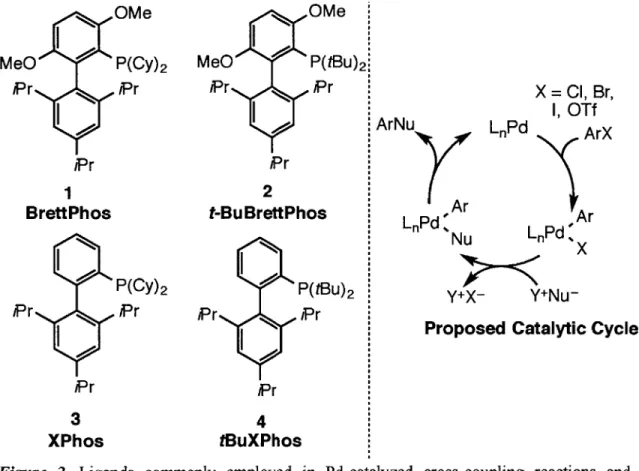
Figure 2. Ligands commonly employed in Pd-catalyzed cross-coupling reactions and the proposed catalytic cycle.
Our group has developed a set of dialkylbiarylphosphine ligands for use in Pd-catalyzed coupling processes such as (Figure 2). The proposed catalytic cycle for Pd-catalyzed cross-coupling reactions is depicted in Figure 2 as well.
Due to the importance of ArF compounds, much attention has been devoted to the advancement of fluorination reactions of aryl halides and pseudohalides using palladium catalysis. Complexes of the type LPd(Ar)F, where L = P(Ph)3 have been prepared and their
ability to reductively eliminate C-F bonds has been studied extensively. In each case, however, extensive decomposition of the complex was observed with fluorination of the ligand being the major process of the reaction (Scheme 2). 17
Phl, benzene, N2 Ph3Ps R P Ph + F-PPh4
Ph3P-Pd-F 110-120 *C, 16 h Ph' 'I PPh3
PPh3
Scheme 2. Early work on the reductive elimination of aryl-F bonds from a Pd(II) center.
Early work by Yandulov has suggested that heating (tBu)3PPd(Ar)F dimer complexes, when
in the presence of tBuXPhos (4) can effect reductive elimination to form aryl fluorides (Scheme 3).18 However, it has been suggested in later publications that the observed ArF product could
have arisen via an SNAr reaction.'9
- F R R \ F )0 0Pd 4R (tBu)3P- 0 R (u) 3P4-Pd-F. 10% if R = N0 2 2 0% if R = H, Me, OMe
Scheme 3. Demonstration of potential reductive elimination of aryl-F bonds from a Pd(II) center.
Based on this work, Dr. Donald Watson, a post-doctoral fellow in the Buchwald Group, and visiting student Mingjuan Su demonstrated unambiguously that reductive elimination of ArF from Pd(II) centers using BrettPhos (1) is feasible in stoichiometric reactions. Thus, when a (1)Pd(Ar)F complex was heated to 70 *C in the presence of an excess of aryl bromide, signals in the 19F NMR spectrum were observed corresponding to the aryl fluoride compound which is reductively eliminated from the Pd complex.
Me Me 1 AgE 1 Fd
/>
CN benzene, r.t. Fd CN Br F Me Me NC Br Me d CN toluene, 70 *C F CN 25 % (19F NMR Yield) Scheme 4. First example of reductive elimination of an aryl-F bond from a Pd(II) center.1.2: Results and Discussion
After demonstrating the viability of reductive elimination of ArF from (1)Pd(Ar)F, a catalytic version of the stoichiometric reaction was devised. Using 10 mol % of (COD)Pd(CH2TMS)2 and
10 mol % of 1 in the presence of an aryl bromide at 70 *C, 20% of the desired aryl fluoride product was obtained. Encouraged by this result, the reaction was repeated at 130 *C, which resulted in full conversion of the aryl bromide and an 86% yield of product, as judged by 19F NMR (Scheme 5).
Me NC Br Me NC Br (COD)Pd(CH 2TMS)2 (10 mol %) BrettPhos (10 mol %)
1.5 equiv. AgF, toluene, 70 *C, 18 h
(COD)Pd(CH2TMS)2 (10 mol %)
BrettPhos (10 mol %)
1.5 equiv. AgF, toluene, 130 *C, 18 h
Me NC F 20% (19F NMR Yield) Me NC F 86% (19F NMR Yield)
Scheme 5. First example of the Pd(0/1I) catalyzed cross-coupling reaction toward the synthesis of aryl fluorides.
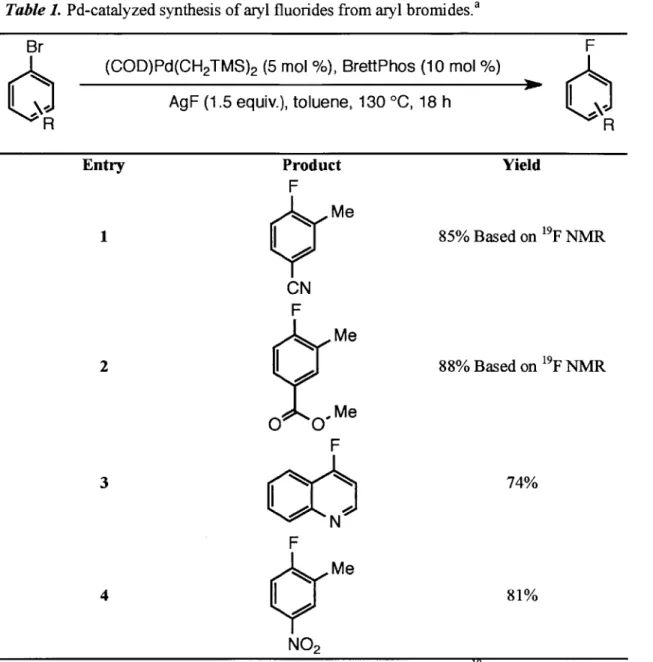
Currently, the Pd-catalyzed conversion of ArBr to ArF is only effective for the reaction of electron-deficient aryl bromides containing ortho-substituents (Table 1). Electron-neutral, electron-rich and electron-deficient aryl bromides without ortho-substitution do not afford ArF products. Control experiments have been performed for the reactions below to rule out the
possibility that the reaction proceeds through an SNAr pathway.
Table 1. Pd-catalyzed synthesis of aryl fluorides from aryl bromides.a
Br F
(COD)Pd(CH 2TMS)2 (5 mol %), BrettPhos (10 mol %)
AgF (1.5 equiv.), toluene, 130 *C, 18 h
R R Product F N Me CN F Me OOMe 00F F Yield 85% Based on 'F NMR 88% Based on 19F NMR 74% F ~Me 4 81% NO2
a) ArBr (1 mmol); isolated yields are reported on a 1 mmol scale. 'F NMR yields are reported relative to 4-fluorotoluene as standard.
An attempt was made to replace AgF with CsF as the fluoride source in order to reduce the amount of noble metal present in the reaction. The much bulkier tBuBrettPhos (2) was employed in order to facilitate the reductive elimination of ArF from the Pd(II) center. Reaction
of 4-bromobiphenyl with CsF in the presence of catalytic amounts of (COD)Pd(CH2TMS)2 and 2
resulted in a poor yield (15%) of the desired product (Scheme 6). Although this system proved to
20
Entry
1
2
be inefficient for the formation of ArF products from aryl bromides, it found later use in the conversion of aryl triflates to their corresponding aryl fluorides.
(COD)Pd(CH2TMS)2 (5 mol %)
t-BuBrettPhos (5 mol %) Ph F
Ph Br
1.5 equiv. CsF, toluene, 110 0C 15% (19F NMR Yield)
Scheme 6. First example of using CsF in the Pd(0/II)-catalyzed synthesis of aryl fluorides from aryl bromides.
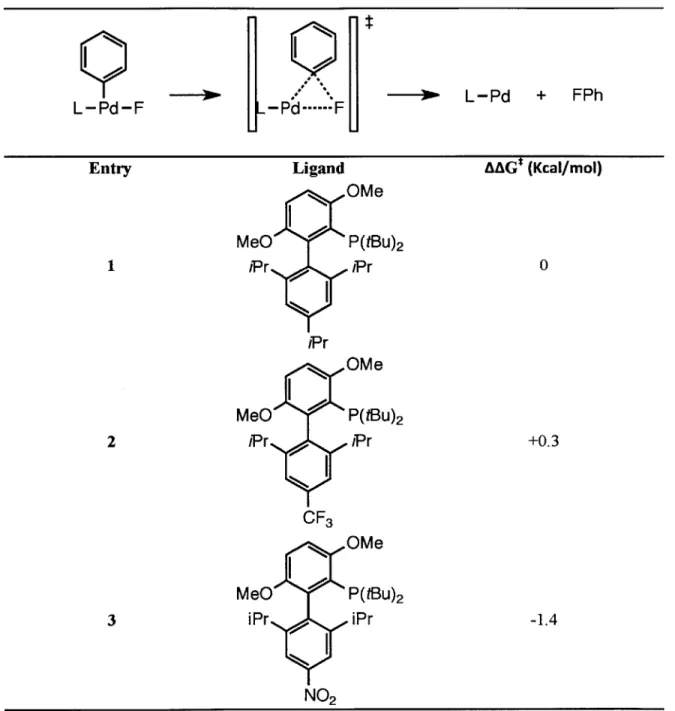
Several strategies were pursued to improve the scope and yield of the conversion of aryl bromides to their corresponding fluorides. Computational analysis of the reactive intermediates indicated that modification of the ligand backbone could provide an appropriate avenue of exploration. A series of complexes were modeled using density functional theory (DFT) with the B3LYP functional at the 6-31G(d) level of theory for C, H, 0 and P atoms, 6-311++g(d,p) for F atoms and LANL2DZ with effective core potential for Pd in order to determine which ligand backbone could have the correct electronic and steric properties in order to facilitate reductive elimination of an aryl-F bond. Complexes with 2 as the ligand were taken to be the reference point (Table 2).
Table 2. Computational structure-reactivity analysis of the reductive elimination of aryl-F bonds
from a Pd(II) center.
w - L-Pd + FPh L-Pd-F -Pd---F Ligand ,^ ,OMe AAG* (Kcal/mol) P(tBu)2 .,Pr 0 ,Pr OMe P(tBu)2 ./Pr +0.3 CF3 OMe P(tBu)2 ,iPr -1.4 NO2 22 Entry 1 MeO' ,Pr, 2 MeO' iPr., 3 MeO' iPr,.
MeO' ipr, P(tBU)2 , Pr P(OY)9 5 P(tBtJ)2 E:30 ,QMe E30. P(CY)2 O0F 3 P(tBU)2 8 OF3 23 4 -0.2 +1.7 -1.0 6 7 ±1.7 -0.3
oMe
Based on these data, we attempted to synthesize a range of ligands in order to determine their efficacy in the reaction and to validate our computational model. Despite our best efforts, however, all attempts to synthesize these ligands failed at the C-P bond-forming event (Table 2, Entries 3, 4, 5 and 6). Under all attempted reaction conditions, the ligand backbone was consumed resulting in an inseparable mixture of various phosphine-containing species in all cases. Due to the extreme difficulty in the synthesis of ligands with electron-deficient bottom rings, this approach was put on hold.
Concurrent with these efforts, Dr. Gracia-Fortanet and Dr. Yong Zhang developed an analogous system for the conversion of aryl triflates to their corresponding aryl fluorides.2 0
Although this work was performed entirely by these postdoctoral associates, the results are presented in this context for completeness.
Aryl triflates provided a mechanistic pathway by which transmetallation occurs more readily; oxidative addition of an aryl triflate to a Pd(O) intermediate generates an cationic Pd(II) center. As such, it was believed that aryl triflates could provide ready access to the requisite LPd(Ar)F intermediate.2' By utilizing 2 as the ligand, a wide range of aryl triflates were converted to their
corresponding fluorides in good to excellent yields. In this way, both electron-deficient and -neural aryl trifluoromethansulfonates were transformed to the aryl fluoride products. Heteroaryl trifluoromethansulfonates, such as quinolones, pyridines and indoles, were also readily converted to the heteroaryl florides. Finally, Dr. Fortanet and Dr. Zhang were able to utilize the triflate derived from quinine as a viable substrate in the reaction, demonstrating the direct applicability of this chemistry in a more synthetically challenging context (Table 3).
Table 3. Pd-catalyzed synthesis of aryl fluorides from aryl trifluoromethansulfones. a
OTf F
[(cinnamyl)PdCl]2 (1-5 mol %), t-BuBrettPhos (3-15 mol %)
0
CsF, toluene, 80-110 0C, 12 hR R
Entry Product Yield
F 1 Ph 82% F Me Me 2 83% O Me F 3 75% F ~Me 4 80% NO2 F 5 73% 0bOt-Bu F 6 nPp OMe 63% n-Propyl 0 25
F 7 M 83% N CF3 F AcO H2C 8 ' 70% N H
a) ArOTf (1 mmol). Isolated yields are reported as an average of two runs.
1.3: Conclusion
Currently, the transformation of aryl bromides to the corresponding aryl fluorides is limited to electron-deficient substrates with ortho-substituents. An efficient method with much greater substrate scope has been developed for the conversion of aryl triflates to aryl fluorides using catalytic amounts of palladium and ligand 2. Efforts to adapt the latter system to utilize aryl bromides are currently underway by other members of the Buchwald Group.
1.4: Experimental
[Pd(cinnamyl)Cl]22 and (COD)Pd(CH
2TMS)23 were prepared according to literature
procedure and stored at -20 *C. t-BuBrettPhos24 and BrettPhos23 were prepared according to literature procedure. CsF was purchased from Aldrich Co. and was dried at 200'C for 12h under high vacuum (< 1 torr) prior to use and was stored and weighed inside a glovebox. AgF was purchased from Aldrich Co. and used as received. Anhydrous toluene was purchased from J. T. Baker in CYCLE-TAINER(R solvent-delivery kegs and vigorously purged with argon for 2h. The solvent was further purified by passing it under argon pressure through two packed columns
of neutral alumina and copper (II) oxide. All other reagents from commercial sources were used as received. All reactions were performed in oven-dried, screw-cap test tubes with teflon seals under an atmosphere of argon. Flash chromatography was performed with silica gel from American International Chemical, Inc. (40-63 Micron).
All new compounds were characterized by 'H NMR, 13C NMR, "F NMR, IR spectroscopy,
melting point (if necessary) and in most instances, elemental analysis. The ratio between reduction product and fluorination product was determined by GC analysis. 'H, 'C NMR, and
19F spectra were recorded on a Varian XL 300 MHz or a Bruker DRX 400 MHz instrument. Infrared spectra were recorded on a Perkin-Elmer Model 2000 FT-IR using NaCl plates (thin film). All GC analyses were performed on an Agilent 6890 gas chromatograph with an FID detector using a J&W DB-200 column (30 m, 0.25 mm I.D.) or a DB-1 column (10 m, 0.1 mm I. D.). 'H NMR spectra are reported in parts per million (ppm) downfield of TMS and were measured relative to residual CHC13 (7.27 ppm). All 13C NMR spectra were reported in ppm
relative to residual CHCl3 (77 ppm) and were obtained with 1H decoupling. All coupling
constants were reported in Hz. Melting points were obtained on a Mel-Temp capillary melting point apparatus. Elemental analyses were performed by Atlantic Microlabs Inc., Norcross, GA.
Synthesis of Fluoroarenes from Bromoarenes
F
N Me
CN 4-Fluoro-3-methylbenzonitrile. 4-Bromo-3-methylbenzonitrile (23.3 mg, 0.12 mmol), BrettPhos (6.4 mg, 0.012 mmol, 10 mol%), (COD)Pd(CH2TMS)2(2.3 mg, 0.006 mmol,
5 mol%) and AgF (22.8 mg, 0.18 mmol, 1.5 equivalents) and toluene (2 mL) were added to an
oven dried resealable tube equipped with a stir bar. The tube was then sealed with a cap and taken out of the glove box, wrapped in aluminum foil and placed into a preheated 130'C oil bath with adequate stirring. After 18 h the tube was removed from the oil bath and allowed to cool to room temperature. p-Fluorotoluene (6.5 pL, 0.06 mmol, 0.5 equivalent) and dodecane (27.3 pL, 0.12 mmol, 1 equivalent) were added as standards. The reaction mixture was filtered through a glass filter and a plug of celite to remove all solids. The clear pale yellow solution was then
analyzed by 19F NMR (282 MHz) for yield and GC for conversion as well as reduction product.
The yield is determined by comparing integration of the 19F NMR resonance of p-Fluorotoluene (-118 ppm ) and that of 4-fluoro-3-methylbenzonitrile (-108 ppm, 0.103 mmol, 85% yield). The
19F-NMR chemical shift of the product corresponds to that of the authentic sample purchased
from Alfa Aesar.
F
Me
Me
O O, M Methyl 4-fluoro-3-methylbenzoate. Methyl 4-bromo-3-methylbenzoate (27.5 mg,
0.12 mmol), BrettPhos (6.4 mg, 0.012 mmol, 10 mol%), (COD)Pd(CH2TMS)2 (2.3 mg, 0.006
mmol, 5 mol%), AgF (22.8 mg, 0.18 mmol, 1.5 equivalents) and toluene (2 mL) were added to
an oven dried resealable screw top test tube equipped with a stir bar. The tube was then sealed with a cap and taken out of the glove box, wrapped in aluminum foil and placed into a preheated 130*C oil bath with adequate stirring. After 18 h the tube was removed from the oil bath and allowed to cool to room temperature. p-Fluorotoluene (6.5 VL, 0.06 mmol, 0.5 equivalent) and
dodecane (27.3 pL, 0.12 mmol, 1 equivalent) were added as standard. The reaction mixture was
filtered through a glass filter and a plug of celite to remove all solids. The clear yellow solution was then analyzed by 19F NMR (282 MHz) for yield and GC for conversion as well as reduction product. The yield is determined by comparing integration of the 19F NMR resonance of p-Fluorotoluene (-118 ppm) and that of methyl 4-fluoro-3-methylbenzoate (-110 ppm, 0.100 mmol, 88% yield). GC/MS analysis of the sample confirmed that the only compound in solution is methyl 4-fluoro-3-methylbenzoate.
F
N 4-Fluoroquinoline.2 4-Bromoquinoline (250 mg, 1.2 mmol), BrettPhos (64 mg, 0.12 mmol, 10 mol%), (COD)Pd(CH2TMS)2 (23 mg, 0.06 mmol, 5 mol%), AgF (228 mg, 1.8
mmol, 1.5 equivalents) and toluene (20 mL) were added to a flame dried 50 mL schlenk flask equipped with a stir bar. The schlenk flask was sealed with a glass stopper and removed from the glove box, wrapped in aluminum foil and placed into a preheated 130'C oil bath. After 18 h the flask was removed from the oil bath and allowed to cool to room temperature. The solution was filtered through celite to afford a clear yellow liquid. The solvent was removed and the product was purified by column chromatography (Et20:Hexanes) to afford a clear yellow oil (131 mg,
0.89 mmol, 74%). The spectroscopic data correspond to those reported in the literature. 'H NMR (300 MHz, CH2C12) 6 8.85 (dd, J = 8.5, 5.0 Hz, 1H), 8.11 (dddd, J = 9.0, 8.3, 1.7, 0.8 Hz, 2H), 7.78 (ddd, J = 8.5, 6.9, 1.5 Hz, 1H), 7.61 (ddd, J = 8.2, 6.9, 1.2 Hz, 1H), 7.11 (dd, J = 9.9, 5.0 Hz, 1H). "C NMR (75 MHz, CH2C12) 6 165.35 (d, J = 267.7 Hz), 151.67 (d, J = 7.8 Hz), 150.71 (d, J = 4.5 Hz), 130.62 (d, J = 1.0 Hz), 129.35 (d, J = 3.9 Hz), 127.04 (d, J = 1.6 Hz), 120.52 (d, J = 5.2 Hz), 119.64 (d, J = 13.1 Hz), 105.80 (d, J = 14.5 Hz). "F NMR (282 MHz, CH2Cl2) 6 -116.43 (t, J = 9.2 Hz). IR (neat) va 3065.75, 2927.95, 1910.32, 1630.93, 1605.94, 1564.88, 29
1508, 1499.66, 1467.94, 1418.78, 1394.03, 1303.44, 1261.31, 1252.29, 1216.13, 1184.18,
1157.05, 1085.59, 1054.67, 1030.7, 1010.67, 960.2, 875.58, 830.21, 809.46, 760.32, 714.69 cm'. F
* Me
NO2 1-fluoro-2-methyl-4-nitrobenzene.26 1-bromo-2-methyl-4-nitrobenzene (216
mg, 1.0 mmol), BrettPhos (58.7 mg, 0.11 mmol, 10 mol%), (COD)Pd(CH2TMS)2 (20 mg, 0.05
mmol, 5 mol%), AgF (200 mg, 1.5 mmol, 1.5 equivalents) and toluene (20 mL) were added to a
flame dried 50 mL schlenk flask equipped with a stir bar. The schlenk flask was sealed with a
glass stopper and removed from the glove box, wrapped in aluminum foil and placed into a preheated 130*C oil bath. After 18 h the flask was removed from the oil bath and allowed to cool to room temperature. The solution was filtered through silica to afford a clear yellow liquid. The
solvent was removed and the product was purified by column chromatography
(CH2Cl2:Hexanes) to afford a pale yellow solid (m.p., 36-38 0C, 128 mg, 0.83 mmol, 83%). The
spectroscopic data correspond to those reported in the literature. 'H NMR (300 MiHz, CH2C12) 6
8.44 - 7.76 (m, 2H), 7.16 (t, J = 8.8 Hz, 1H), 2.38 - 2.35 (m, 3H). "C NMR (75 MHz, CH2Cl2) 6 165.07 (d, J = 255.6 Hz), 137.22 (d, J = 1056.9 Hz), 127.28 (d, J = 7.2 Hz), 127.00 (d, J = 19.6 Hz), 115.95 (d, J = 25.0 Hz), 14.53 (d, J = 3.4 Hz). '9F NMR (282 MHz, CH2C12) 8 -105.19 (q, J = 6.3 Hz). IR (neat) vmax 3086.08, 1583.89, 1515.99, 1492.04, 1382.3, 1341.92, 1316.43, 1278.01, 1260.29, 1241.92, 1184.62, 1120.23, 1089.35, 924.7, 905.32, 827.59, 811.59, 759.52, 745.23, 697.27 cm.
Synthesis of Fluoroarenes from Trifluoromethanesulfonates (Jorge Garcia-Fortanet/Yong Zhang)
Representative procedure for the fluorination reaction of aryl triflates To an over-dried screw-cap test tube equipped with a magnetic stir bar was added
1 mmol of substrate, 2 mmol of cesium fluoride 2 mol% [Pd(cinnamyl)Cl]2 and 6 mol %
tBuBrettPhos inside a glovebox. The test tube was then sealed off with a screw-cap and taken out of the glovebox. Toluene (5 mL) was promptly added via syringe in such a manner that any reagent on the side of the test tube was washed down to the bottom of the tube. The test tube was then placed in a pre-heated oil bath at 110 *C and stirred for 12 h. After cooling to room temperature, the reaction was diluted with EtOAc (-5 mL) and the resulting mixture was filtered through a plug of Celite. An aliquot of the filtrate was taken out for GC analysis. The rest of the filtrate was concentrated under reduced pressure and purified by flash chromatography on silica gel using hexane to give the title compound.
F
&~
Ph2-fluorobiphenyl." The title compound was prepared according to the
representative procedure with 2-biphenyl trifluoromethanesulfonate (302 mg, 1 mmol, 1.0 eq), cesium fluoride (304 mg, 2 mmol, 2.0 eq), [Pd(cinnamyl)Cl]2 (10.4 mg, 0.02 mmol) and tBuBrettPhos (29.4 mg, 0.06 mmol) in toluene (5 mL) at 110 *C for 12 h. Concentration and purification via flash column chromatography gave the desired product as a white solid; m.p. 72-74 'C; yield: 137 mg (81% yield). The spectroscopic data correspond to those reported in the
literature. 'H NMR (400 MHz, CDCl3) 5: 7.55 (d, J= 8.0, 2H), 7.47-7.40 (m, 3H), 7.39-7.27 (m,
2H), 7.24-7.11 (m, 2H). '3C NMR (100 MHz, CDCl3) 8: 159.8 (d, J= 247.7), 135.8 (d, J= 1.0),
130.8 (d, J= 3.5), 129.1 (d, J= 2.9), 129.0 (d, J= 8.3), 128.4, 127.6, 124.4 (d, J= 3.7), 116.1 (d, 31
J= 22.8). 19F NMR (282 MHz, CDCl3) 5: -118.4. IR (neat) vmax 3023, 1614, 1567, 1506, 1389,
1258, 1187,1282, 1061, 925, 861, 834.
F
Me , Me
0 Me 1-(4-fluoro-3,5-dimethylphenyl)ethanone. The title compound was
prepared according to the representative procedure with 4-acetyl-2,6-dimethylphenyl trifluoromethanesulfonate (296 mg, 1 mmol, 1.0 eq), cesium fluoride (304 mg, 2 mmol,
2.0 eq), [Pd(cinnamyl)Cl]2 (10.4 mg, 0.02 mmol) and tBuBrettPhos (29.4 mg, 0.06 mmol) in toluene (5 mL) at 110 *C for 12h. Concentration and purification via flash column chromatography (10% EtOAc in hexane) gave the desired product as yellow oil. Yield: 141 mg,
85%. 'H NMR (300 MHz, CDCl3) 5: 7.58 (d, J= 7.0, 2H), 2.50 (s, 3H), 2.24 (d, J= 2.2, 6H). "C
NMR (75 MHz, CDCl3) : 196.9, 162. 8 (d, J= 252.2), 132.5 (d, J= 3.7), 129.4 (d, J= 6.4),
124.6 (d, J= 18.8), 26.3, 14.5 (d, J= 4.1). '9F NMR (282 MHz, CDCl3) 5: -113.9. IR (neat) vmax
2959, 2926, 1685, 1597, 1487, 1418, 1358, 1319, 1181, 1094, 726 cm~'.
F
N 5-Fluoroquinoline.2 The title compound was prepared according to the
representative procedure with 5-quinolinyl trifluoromethanesulfonate (277 mg, 1 mmol, 1.0 eq), cesium fluoride (304 mg, 2 mmol, 2.0 eq), [Pd(cinnamyl)Cl]2 (10.4 mg, 0.02 mmol) and tBuBrettPhos (29.4 mg, 0.06 mmol) in toluene (5 mL) at 110 *C for 12h.
Concentration and purification via flash column chromatography (dichloromethane) gave 5-fluoroquinoline as yellow oil. yield: 108 mg (73% yield). The spectroscopic data
correspond to those reported in the literature. 'H NMR (400 MHz, CDCl3) 6: 8.91 (d, J = 4.2,
1H), 8.52-8.24 (m, 1H), 7.86 (t, J= 7.2, 1H), 7.58 (dt, J= 8.5, 4.2, 1H), 7.40 (dd, J= 8.4, 4.2, 1H), 7.16 (dd, J= 9.1, 8.3, 1H). 13C NMR (100 MHz, CDCl3) 6: 157.7 (d, J= 255), 151.2, 148.9 (d, J= 3.0), 129.2 (d, J= 4.7), 128.9 (d, J= 9.1), 125.3 (d, J= 4.2), 121.1 (d, J= 2.7), 119.0 (d, J= 16.4), 110.1 (d, J= 19.3). "F NMR (282 MHz, CDCl3) 6: -123.3. IR (neat) vm 3070, 1636, 1598, 1567, 1470, 1400, 1251, 1069, 796 cm~'. F
NO2 1-fluoro-2-methyl-4-nitrobenzene.26 The title compound was prepared according
to the representative procedure with 2-methyl-4-nitrophenyl trifluoromethanesulfonate (285 mg, 1 mmol, 1.0 eq), cesium fluoride (304 mg, 2 mmol, 2.0 eq), [Pd(cinnamyl)Cl]2 (5.2 mg, 0.01 mmol) and tBuBrettPhos (14.7 mg, 0.03 mmol) in toluene (5 mL) at 110 *C for 12h. Concentration and purification via flash column chromatography (5% EtOAc in hexane) gave the desired product as colorless crystals. m.p. 39-41 *C. Yield: 128 mg, 82%. The spectroscopic data correspond to those reported in the literature. 'H NMR (300 MHz, CDCl3) 6: 8.18-8.03 (m, 2H),
7.12 (t, J= 8.7, 1H), 2.35 (d, J= 2.0, 3H). "C NMR (75 MHz, CDCl3) 6: 164.8 (d, J= 256.2),
143.9, 127.1 (d, J= 7.1), 126.6 (d, J= 19.5), 123.4 (d, J= 10.0), 115.7 (d, J= 25.0), 14.6 (d, J= 5.0). "9F NMR (282 MHz, CDCl3) 6: -106.4. IR (neat) vm: 3086, 1584, 1522, 1493, 1346, 1244,
1090, 905, 828, 746 cm'1. Anal. calcd for C7H6FNO2 C 54.20; H 3.90 found C 54.37; H 3.77.
N
Ot-Bu
0 tert-butyl 4-fluoro-1H-indole-1-carboxylate." The title compound was
prepared according to the representative procedure with 4-(N-Boc)indolyl
trifluoromethanesulfonate (350 mg, 1 mmol, 1.0 eq), cesium fluoride (304 mg, 2 mmol, 2.0 eq), [Pd(cinnamyl)Cl]2 (10.4 mg, 0.02 mmol) and tBuBrettPhos (29.4 mg, 0.06 mmol) in toluene (5 mL) at 110 "C for 12h. Concentration and purification via flash column chromatography (2% EtOAc in hexane) gave the desired product as colorless oil that solidifies upon standing. m.p. 49-51 *C; Yield: 163 mg, 69%. The spectroscopic data
correspond to those reported in the literature. 'H NMR (300 MHz, CDCl3) 6: 7.96 (d, J = 8.3,
1H), 7.58 (d, J= 3.7, 1H), 7.25 (td, J= 8.2, 5.5, 1H), 6.93 (dd, J= 9.7, 8.1, 1H),
6.69 (d, J= 3.8, 1H), 1.70 (s, 9H). 13C NMR (75 MHz, CDCl3) 8: 155.7 (d, J= 247.3),
149.5, 137.3 (d, J= 9.3), 125.8, 124.8 (d, J= 7.5), 119.3 (d, J= 22.1), 111.2 (d, J= 3.8),
107.8 (d, J= 18.2), 102.7 (d, J= 4.2), 84.1. 19F NMR (282 MHz, CDCl3) 8: -122.6 IR (neat)
vmax: 2980, 1737, 1588, 1491, 1437, 1348, 1286, 1220, 1133, 963, 749 cm1. Anal.
calcd for C13H14FN0 2 C 66.37; H 6.00 found C 66.18; H 5.97.
F
OMe
n-Propyl 1-fluoro-2-methoxy-4-propylbenzene. The title compound was
prepared according to the representative procedure with 2-methoxy-4-propylphenyl
trifluoromethanesulfonate (332 mg, 1 9mol, 1.0 eq), cesium fluoride (304 mg, 2 mmol, 2.0 eq),
[Pd(cinnamyl)Cl]2 (10.4 mg, 0.02 mmol) and tBuBrettPhos (29.4 mg, 0.06 mmol) in cyclohexane (5 mL) at 130 "C for 12h. Concentration and purification via flash column chromatography (5% EtOAc in hexanes) gave the desired product as colorless oil. Yield: 106 mg,
63%. 'H NMR (300 MHz, CDCl3) 6: 6.97 (ddd, J= 11.4, 8.2, 1.1, 1H), 6.78 (d, J= 8.3, 1H),
6.73-6.65 (m, 1H), 3.88 (s, 3H), 2.55 (t, J= 7.5, 2H), 1.63 (dt, J= 7.5, 7.3, 2H), 0.95 (t, J= 7.3,
3H). "C NMR (75 MHz, CDCl3) 6: 150.7 (d, J= 242.5), 147.1 (d, J= 10.8), 138.9 (d, J= 3.9),
120.4 (d, J= 6.5), 115.4 (d, J= 18.0), 113.5 (d, J= 1.7), 56.0, 37.7, 24.7 (d, J= 1.1), 13.7. 19F
NMR (282 MHz, CDCl3) 6: -140.6. IR (neat) vm 2961, 2934, 2872, 1609, 1518, 1465, 1417,
1269, 2826, 1153, 1282, 1035, 813, 773 cm-'. Anal. calcd for C13HuFO C 71.40; H 7.79 found C
71.18; H 8.00.
F
Me
N CF3 4-fluoro-6-methyl-2-(trifluoromethyl)quinoline. The title
compound was prepared according to the representative procedure with 4-(6-methyl-2-trimethyl)-quinolinyl trifluoromethanesulfonate (229 mg, 1 mmol, 1.0 eq), cesium fluoride (304 mg, 2 mmol, 2.0 eq), [Pd(cinnamyl)C]2 (10.4 mg, 0.02 mmol) and tBuBrettPhos (29.4 mg, 0.06 mmol) in toluene (5 mL) at 80 *C for 12h. Concentration and purification via flash column chromatography (5% EtOAc in hexane) gave the desired product as a white solid. m.p.
107-110 *C. Yield: 192 mg, 84%. 'H NMR (300 MHz, CDCl3) 6: 8.06 (dd, J= 8.7, 1.3, 1H), 7.83 (s,
1H), 7.64 (dd, J= 8.7, 1.8, 1H), 7.34 (d, J= 9.6, 1H), 2.55 (s, 3H). "C NMR (100 MHz, CDCl3)
6: 165.7 (d, J= 269.7), 148.1 (dq, J= 35.5, 8.4), 148.1 (d, J= 5.7), 139.5 (d, J= 1.7), 129.5 (d, J
= 3.5), 121.1 (dq, J= 275.0, 4.5), 119.9 (d, J= 13.0), 119.1 (d, J= 4.5), 102.3 (dq, J= 19.1, 2.2),
21.8. 19F NMR (282 MHz, CDCl3) 8: -68.0, -109.4. IR (neat) vm 1625, 1504, 1321, 1221, 1110, 831 cm. F AcO H 2C N H
6-fluoro-O-acetyl-quinine. The title compound was prepared
according to the representative procedure with O-acetyl-6-quininyl trifluoromethanesulfonate
(242 mg, 0.5 mmol, 1.0 eq), cesium fluoride (152 mg, 1 mmol, 2.0 eq), [Pd(cinnamyl)Cl]2 (13 mg, 0.05 mmol) and tBuBrettPhos (36.8 mg, 0.15 mmol) in toluene (2.5 mL) at 110 *C for 12h. Concentration and purification via flash column chromatography (5% MeOH in EtOAc) gave the
desired product as yellow foam. Yield: 132 mg, 74%. 'H NMR (300 MHz, CD3CN) 6: 8.84 (d, J
= 4.5, 1H), 8.13 (dd, J= 9.3, 5.8, 1H), 8.00 (dd, J= 10.9, 2.7, 1H), 7.57 (ddd, J= 10.6, 9.0, 3.5, 2H), 6.23 (d, J= 9.1, 1H), 5.95 (ddd, J= 17.9, 10.3, 7.7, 1H), 5.15-4.90 (m, 2H), 3.38 (dd, J= 17.3, 8.8, 1H), 3.19-2.97 (in, 1H), 2.84 (dd, J= 13.6, 10.1, 1H), 2.59-2.34 (in, 2H), 2.26 (d, J= 9.6, 1H), 2.16-1.93 (m, 7H), 1.87-1.61 (m, 3H), 1.48 (ddd, J= 21.1, 9.7, 5.3, 3H). "C NMR (75 MHz, CD3CN) 8: 169.8, 159.9 (d, J= 245.3), 149.2, 145.7 (d, J= 5.9), 145.2, 142, 132.5 (d, J= 9.6), 126.6 (d, J= 10.0), 119.7, 118.7 (d, J= 26.0), 116.9, 113.3 (d, J= 3.9), 107.1 (d, J= 23.4), 59.5, 55.5, 41.3, 39.4, 27.2, 26.9, 25.1, 19.7. 19F NMR (282 MHz, CDCl3) 6: -114.2. IR (neat) vm 2943, 1745, 1625, 1514, 1468, 1230, 1026 cm . 36
Computational Methods
All calculations were carried out with the Gaussian '03 suite.2 9 All calculations were
performed using the Becke30 31 three-parameter hybrid functional combined with
Lee-Yang-Parr32 correlation functional. C, H, 0, P, and S were computed at the 6-31G(d) level of theory, F
was computed using 6-311++G(d,p) and for the Pd center, LANL2DZ+ECP was used. Frequency calculations were undertaken to confirm the nature of the stationary points, yielding
one imaginary frequency (Nlmag = 1) for transition states (TS) with largest contributions from
internal coordinates involved in the reaction and none (Nlmag = 0) for minima. All optimizations were performed without any constraints (C1 symmetry). Geometry optimizations were carried out in the gas phase.
Cartesian Coordinates for Ground State Structures:
Minimum energy structures for LPd(Ph)F where L is: ,
0
Me
MeO' iPr, /Pr Pd 0.06087300 P -1.88093900 C -0.71678800 F 1.70579500 C 1.27892300 C 0.70665400 C 1.84375400 C -1.20020900 C 0.20093100 C 2.02313900 C -2.04633500 C 3.72834200 C 3.21252600 C -1.52426200 P(tBu)2 iPr 1.28776800 -0.07574000 3.14467900 2.37660000 -0.98426900 -3.37242600 -0.72178700 -1.83282000 -2.04316900 -0.59388500 -2.97487500 0.44203200 0.10924600 -4.26030500 0.19983600 -0.01312300 0.04475300 0.41890400 0.02637900 -0.15921800 1.31347400 -0.12931900 -0.10010800 -1.13727000 -0.19894900 0.27761700 -0.97893700 -0.29969300 3.04091400 -0.14678200 -0.74601500 -0.99639300 -1.40814200 -1.09701200 -1.34789200 3.75162000 -2.17759500 3.44289100 0.23862000 -0.48461200 -0.92081200 -1.67969000 -1.11720600 -1.56345700 1.59716300 1.23998800 -3.39457400 -4.28118700 -5.28725400 -4.13969000 -4.16231900 -0.00638700 -4.46148600 3.76825400 3.91392700 5.86948400 5.11794300 5.26282300 0.42598900 -5.12101100 0.22719900 -5.47201200 3.21472000 3.47980200 6.91809900 5.57913500 5.84069800 -0.97289300 -1.25412300 -2.75662300 -3.85121200 -3.43038700 -4.34059300 -4.59223900 37 1.40018400 -0.28133400 -1.20895800 1.17953300 -0.19653800 -1.32990500 1.05888000 -1.86655400 -0.37025900 2.38237500 -0.34433900 -2.10611900 2.17094000 -0.28884600 -2.31518400 1.95531000 -2.55523100 2.61193900 -0.12690700 -0.29155800 -0.24320700 -1.26365100 0.50936500C 4.99547600 C -3.08889000 C -2.96527600 C -4.58266300 C -2.60447000 H -1.94701400 H -3.23856500 H -3.63549100 H -4.75470300 H -5.11326400 H -5.03511300 H -3.19291900 H -2.74010100 H -1.55583800 C -2.86393400 C -3.55277100 C -1.80659800 C -3.91420200 H -4.39575700 H -2.86352800 H -3.95161300 H -1.33771500 H -2.29216900 H -1.02336500 H 4.37021800 H -3.46628100 H -4.71317000 C 6.23436500 H 6.14477300 H 7.13878600 H 6.37598300 C 4.83817700 H 4.81146300 H 3.90227500 H 5.68529500 C 0.92972100 H 1.84510500 H 0.29732100 H 0.41732500 C 2.15871100 H 3.11524300 H 1.68426400 H 2.37333500 C 1.62784000 H 2.65556500 H 1.14606900 H 1.11643000 C 2.47075800 H 2.12640800 H 3.51683900 H 2.44146000 1.26926400 -0.03302500 1.37244700 -0.29673300 -1.05684700 1.56861000 2.16891900 1.43714200 -1.27766000 -0.25624100 0.46173600 -0.92241300 -2.08744700 -0.90815900 0.29457000 1.66899500 0.39823000 -0.73311200 1.64045500 2.44913500 1.96415900 -0.56986900 0.72983000 1.11515400 -0.34845500 -1.70146800 -0.88675400 0.51633600 0.29901200 1.12054400 -0.43630200 2.64321600 2.54019000 3.11278400 3.29361100 -0.12528300 0.36901500 0.64415800 -0.52604300 -2.31190300 -1.87225900 -2.73461200 -3.12758400 0.22392400 0.52487200 -0.04539900 1.09641700 -2.11453100 -2.39921500 -1.79621600 -2.99757700 0.41619300 1.52685900 2.14760200 1.25025400 2.57139800 2.48922100 1.45090400 3.01554700 0.81336300 2.21116000 0.60817500 3.48878800 2.23648400 2.83525800 -1.64640600 -1.49549500 -2.76036300 -2.10801300 -0.80163100 -1.17115800 -2.47510900 -2.96021100 -3.68768900 -2.50902900 -3.03068300 -2.34158300 -1.38236100 -0.10586900 -1.17729700 0.03488600 0.41792800 -0.26450900 -1.35663500 0.04812600 -0.01383200 3.61419400 3.95806500 3.15888400 4.49773500 3.25869500 3.56422700 4.15301100 2.56173200 -3.52654500 -3.75944600 -4.47428900 -3.11155600 -3.11866900 -4.12073100 -3.20127100 -2.47618000 H H H 0 C H H H 0.56905500 5.14467700 0.29981800 2.06818200 2.62941600 2.41145400 3.70752100 2.27093800 MeO' /Pr, CF3 Pd -0.09469600 P 1.99347600 C 0.48800500 F -1.85205800 C -1.06133300 C -0.22224200 C -1.67690900 C 1.50097900 C 0.13229700 C -1.78925000 C 2.46766200 C -3.60974700 C -3.04512400 C 2.09632500 C -2.93982600 C 0.75111400 C 0.56350400 C 0.57912900 C 0.90806600 C 0.78141500 C 0.79760700 H -3.58997400 H 2.84262100 H -3.40025900 H 0.48219700 H 0.44259200 H 0.45814300 H 1.07465100 H 0.84152500 H 0.86780000 C -1.27772000 C -1.06599900 0 3.77323800 -1.34303300 1.44776100 -1.75799100 -3.50208000 -4.80417100 -5.32084900 -4.66262500 -5.41653900 -2.51021800 1.48975500 2.37006800 -0.08153200 -0.10843000 -1.05289100 -0.01711900 0.72974400 ,OMe 'P(tBu) 2 iPr 1.27573100 -0.12367700 0.11278700 -0.04384400 3.20071700 0.02211400 2.17081600 -0.20811600 -1.13739800 0.05608300 -3.44318400 0.23289300 -0.92363600 -1.21650400 -1.70712100 0.07411300 -2.06860700 0.13773100 -0.80766800 1.24553700 -2.75075600 0.07753100 0.03843200 -0.11647900 -0.21759600 1.12874200 -4.08444400 0.21706200 -0.32757700 -1.27262800 -4.43260400 0.29902300 3.80663100 1.28155100 4.00714300 -1.11734800 5.97794600 0.25860000 5.18468300 1.39884100 5.38377000 -0.99948800 0.06834600 2.02111100 -4.86884300 0.24099400 -0.13264200 -2.23419900 -5.47796300 0.39111100 3.21833700 2.18637400 3.57854600 -2.10667700 7.04836100 0.34877300 5.63397000 2.38786400 5.99187900 -1.89892300 -1.12268200 2.65004100 -1.40685300 -2.52988000 -2.38665400 -0.09850700 38
C 4.78558700 H 5.73233100 H 4.77337700 H 4.68776700 C -4.98825800 C 3.10266800 C 2.77915500 C 4.62998600 C 2.68370200 H 1.72025100 H 3.01829300 H 3.36552800 H 4.94179800 H 5.09958200 H 5.02539800 H 3.22103200 H 2.93359800 H 1.61687600 C 3.00929600 C 3.55113900 C 1.99578000 C 4.17434100 H 4.37315800 H 2.77839100 H 3.94593000 H 1.64024500 H 2.48329400 H 1.13114000 H 4.62750600 H 3.83445400 H 4.95379900 C -0.96062400 H -1.94893400 H -0.42684400 H -0.43098300 C -1.86430000 H -2.88481700 H -1.38080800 H -1.93381600 C -1.38633200 H -2.42840400 H -0.84145800 H -0.98293500 C -2.02217300 H -1.61476600 H -3.08898200 H -1.93605300 H -0.22223000 H -0.05640600 0 -1.56397100 C -1.97941800 -3.37567800 -2.84780300 -3.86453300 -4.13531700 0.63622000 0.32847200 1.72545000 0.23203600 -0.71640600 1.81307000 2.53085900 1.88508400 -0.74523100 0.39150300 1.00046500 -0.50380400 -1.73546300 -0.66679300 0.54224600 1.98228700 0.51127900 -0.38742800 2.05461300 2.69606600 2.29513600 -0.50509800 0.87235300 1.14609600 0.01221500 -1.40271100 -0.43569600 -0.27982300 0.06603500 0.58755500 -0.63620800 -2.59897200 -2.29992900 -2.98335300 -3.41244200 0.08657200 0.28946500 -0.11462300 0.99674300 -2.32817500 -2.56024200 -2.10502800 -3.21699500 -1.39749600 -1.77093300 -3.71862900 -5.07327000 0.00259600 -0.12523200 0.98508800 -0.78338500 -0.19884600 -1.63969900 -2.20327000 -1.44982500 -2.69183900 -2.45372600 -1.50414000 -3.11818200 -1.08670300 -2.42985900 -0.78288900 -3.62562800 -2.38855400 -2.91611800 1.55447800 1.41785200 2.71314100 1.94027700 0.70249300 1.13130900 2.39353600 2.90720200 3.62828500 2.51203500 2.85784100 2.15661100 1.17969000 -3.57547700 -3.89757700 -3.17300600 -4.46735400 -3.09927900 -3.36536600 -4.00564500 -2.37102200 3.60090200 3.87288400 4.53083000 3.14946300 3.26341300 4.25504900 3.38374200 2.63443500 2.56917000 -2.32225500 0.24062600 0.32285000 H -1.64561800 H -3.06997800 H -1.61137000 F -5.94190000 F -5.20253800 F -5.22238600 iPr. -5.54209200 -5.04902300 -5.66061300 -0.32894700 1.27096700 1.51349400 1.25806100 0.30128100 -0.52869800 -0.09810800 -1.36898300 0.79752500 OMe P(tBu)2 , Pr NO2 Pd 0.12897300 1.31527200 -0.12349500 P 1.80335100 -0.38695100 -0.03314600 C 1.22842000 F -1.32034500 C -1.48879500 C -1.33050900 C -1.99101300 C 0.81390600 C -0.60214100 C -2.11285900 C 1.44602900 C -3.58193100 C -3.15048700 C 0.71326200 C -3.03257100 C -0.67546300 C 1.45347700 C 1.55559700 C 2.40297200 C 2.04596400 C 2.14770900 H -3.63145000 H 1.20862600 H -3.42425900 H -1.22856900 H 1.16203200 H 1.33317900 H 2.85969900 H 2.21620200 H 2.39629500 C -1.73109600 C -1.51435200 0 2.80123400 C 3.49163200 2.99804400 2.65292800 -0.73080800 -3.17411700 -0.35599400 -1.99310400 -1.95659200 -0.20588600 -3.26727400 1.09431000 0.71320800 -4.44164400 0.57172600 -4.39710900 3.57273500 3.73010500 5.54843700 4.83659600 4.99293300 1.14809900 -5.40403000 0.89302300 -5.32353300 3.05183500 3.33912100 6.53124400 5.26401500 5.54594100 -0.64030300 -0.99527500 -3.28774200 -4.52444200 0.01940300 -0.18183000 0.03888700 0.24057000 -1.24726600 0.08364200 0.14014100 1.21790300 0.09595300 -0.17621600 1.08446700 0.24073700 -1.33102100 0.31789300 1.27528600 -1.12613100 0.23835100 1.38358300 -1.01618100 1.95045100 0.27324000 -2.28702100 0.41437400 2.18258600 -2.11332600 0.32193700 2.36937300 -1.91945700 2.63116400 -2.54937400 -0.07676400 0.01232300 39
H 4.54786000 H 3.35165600 H 3.17337600 C 2.95645100 C 3.04973500 C 4.39131100 C 2.28503600 H 2.06864500 H 3.46510000 H 3.69994700 H 4.40940800 H 4.90379800 H 4.97291000 H 2.87784200 H 2.23781800 H 1.27802800 C 2.87460600 C 3.78671100 C 1.87624800 C 3.74501300 H 4.58330500 H 3.23285700 H 4.27181800 H 1.27207500 H 2.43134800 H 1.20322600 H 4.26360200 H 3.14655700 H 4.50609200 C -1.08509600 H -1.93499400 H -0.34302500 H -0.65520700 C -2.60105200 H -3.49251200 H -2.22514500 H -2.90804900 C -1.49692600 H -2.43994300 H -1.03961200 H -0.84748700 C -2.79974900 H -2.49050400 H -3.75918300 H -2.96232900 H -0.80009600 H -0.64723200 0 -2.69540500 C -3.47703100 H -3.30231600 H -4.51616700 -4.28689900 -4.99319000 -5.22111000 -0.50577200 0.91940600 -1.02017500 -1.40487800 1.28793800 1.63869500 0.90170200 -2.03311300 -1.02824500 -0.37208900 -1.35891900 -2.44936800 -1.06451500 -0.26084700 0.98065700 -0.03176000 -1.47181300 0.85287200 1.88704900 1.14037800 -0.92453300 0.19274800 0.80216500 -1.21748700 -2.36532900 -1.71277800 0.05630300 0.65733200 0.74597200 -0.43425800 -1.92248700 -1.35331600 -2.43138700 -2.68035400 0.56306300 1.05837300 0.22764600 1.31400900 -1.56974000 -1.88906300 -1.04800900 -2.45866000 -1.21023400 -1.62068900 -3.06007300 -4.24380800 -4.79546000 -3.91308200 -0.12597800 0.99462700 -0.77348000 -1.60955300 -2.18790900 -1.38038000 -2.66500700 -2.49403900 -1.47767800 -3.07276600 -0.98430700 -2.35173900 -0.72207900 -3.58811800 -2.35040800 -2.91188700 1.58270200 1.46887600 2.73203300 1.97222300 0.73203300 1.22426200 2.44094400 2.92057700 3.65210200 2.52654600 2.90674000 2.16242700 1.22934200 -3.59013400 -3.93132900 -3.17462100 -4.47167200 -3.13332800 -3.42131600 -4.02904600 -2.40647200 3.56704200 3.82382700 4.50529200 3.10955800 3.24550900 4.24815100 3.34220300 2.63189900 2.56649500 -2.32244800 0.24171700 0.30341300 1.23650500 0.27012400 H -3.27659800 N -4.68339000 0 -5.17517000 0 -5.05852000 MeO iPr CN Pd -1.03976000 P -0.84836800 C -3.03159200 F -1.09495700 C 1.54870800 C 3.30624500 C 1.60279600 C 1.01578000 C 1.90566400 C 1.56793000 C 1.57639600 C 1.58994200 C 1.57850000 C 2.94698500 C 1.60703600 C 3.81395800 C -3.61350600 C -3.80307800 C -5.73345800 C -4.95866500 C -5.14718000 H 1.57817600 H 3.35921200 H 1.63075500 H 4.87883600 H -3.02699100 H -3.36295300 H -6.77718000 H -5.39247600 H -5.73083300 C 1.63275300 C 1.75952000 0 0.71228500 C 1.20592200 H 0.33744700 H 1.66819000 -4.90280300 -0.55142000 2.06564600 -0.28874200 2.49547900 0.75377500 2.37683600 -1.41834800 ,OMe P(tBu)2 - iPr -0.90002300 -0.14143000 1.48346300 -0.02679300 -1.17170700 0.00147700 -2.87151800 -0.23545000 -0.79824300 0.01880100 0.90586900 0.21268500 -1.42729400 -1.26520500 1.77482000 0.08602000 0.67196600 0.12173000 -1.61433400 1.19695600 3.08231300 0.11250000 -3.60670800 -0.19424300 -2.99930500 1.06478900 3.28342000 0.24572800 -2.82110700 -1.34473200 2.19608600 0.30005500 -1.37386000 1.25798500 -1.40036200 -1.14256500 -1.93803700 0.22549500 -1.74608000 1.36929700 -1.77173100 -1.03014500 -3.62883400 1.94724100 4.28387500 0.28644000 -3.30926200 -2.31242400 2.37425700 0.38874700 -1.25540500 2.16433200 -1.31532600 -2.13062600 -2.22948700 0.31067900 -1.89377300 2.35596400 -1.94295900 -1.93216900 -1.03435300 2.60799400 -0.64654200 -2.56797700 4.13114000 -0.03343800 5.45592500 0.09145900 6.10872500 -0.01249700 5.62159500 1.07282800 40