
Signal definition and resource management techniques for upcoming communication and broadcasting systems
257
0
0
Texte intégral
(2) 1. Université de Bretagne-Sud Ecole Doctorale – MathSTIC. Signal definition and resource management techniques for upcoming communication and broadcasting systems. Habilitation à Diriger des Recherches HDR Presented by. Charbel Abdel Nour Prepared at. IMT Atlantique Department : Electronics Laboratory : Lab-STICC / IAS team. Defended online 30/11/2020. Defense committee : Gianluigi Liva Christophe Jego Carlos Bader Charly Poulliat Emmanuel Boutillon Catherine Douillard. Head of transmission group, DLR, Germany Professor at INP/ENSEIRB-MATMECA, Bordeaux Professor at ISEP, Paris Professor at INP/ENSEEIHT Toulouse Professor at UBS, Lorient Professor at IMT Atlantique, Brest. Reviewer Reviewer Reviewer President Examiner Examiner.
(3)
(4) Contents Contents. i. List of Figures. v. Acronyms. vii. Short introduction. xv. Curriculum Vitæ 1 Strong points/Summary . . . . . . . . . . . . . . . . . . 2 Education and career . . . . . . . . . . . . . . . . . . . . 2.1 Education . . . . . . . . . . . . . . . . . . . . . . 2.2 Career . . . . . . . . . . . . . . . . . . . . . . . . 3 Research activities . . . . . . . . . . . . . . . . . . . . . 4 Advisorship/Tutorship . . . . . . . . . . . . . . . . . . . 5 Contribution to research projects . . . . . . . . . . . . . 6 Collaborations . . . . . . . . . . . . . . . . . . . . . . . 7 Remarkable results . . . . . . . . . . . . . . . . . . . . . 8 Teaching activities . . . . . . . . . . . . . . . . . . . . . 8.1 Topics and courses . . . . . . . . . . . . . . . . . 8.2 Teaching and administrative responsabilities . . 8.3 Other responsabilities, activities and distinctions 9 Publications . . . . . . . . . . . . . . . . . . . . . . . . .. 1 1 2 2 2 2 4 5 6 8 9 9 10 10 11. . . . . . . . . . . . . . .. . . . . . . . . . . . . . .. . . . . . . . . . . . . . .. . . . . . . . . . . . . . .. . . . . . . . . . . . . . .. . . . . . . . . . . . . . .. . . . . . . . . . . . . . .. . . . . . . . . . . . . . .. . . . . . . . . . . . . . .. . . . . . . . . . . . . . .. . . . . . . . . . . . . . .. . . . . . . . . . . . . . .. List of publications. 12. Introduction to my research activities. 23. 1 Algorithms for coded modulations with(out) MIMO 1.1 Introduction and motivation . . . . . . . . . . . . . . . . . . . . . . . . . . 1.2 Diversity, constellation and mapping for broadcasting standards . . . . . . 1.2.1 Context and prior art . . . . . . . . . . . . . . . . . . . . . . . . . 1.2.1.1 Coded modulation and diversity techniques . . . . . . . . 1.2.1.2 Signal space diversity and receiver implementation . . . . 1.2.1.3 Channel emulation/simulation . . . . . . . . . . . . . . . 1.2.1.4 Non-uniform constellations and corresponding demappers 1.2.1.5 Advanced interleaving for improved system performance .. 25 25 26 26 26 27 27 28 29. i. . . . . . . . .. . . . . . . . ..
(5) ii. Contents. 1.2.2. 1.3 1.4. 1.5. 1.6. Performed work and contributions . . . . . . . . . . . . . . . . . . . . 29 1.2.2.1 Signal space diversity design and action in DVB standardization 29 1.2.2.2 Signal space diversity and receiver implementation . . . . . . 37 1.2.2.3 Channel emulation/simulation . . . . . . . . . . . . . . . . . 38 1.2.2.4 Non-uniform constellations and corresponding demappers . . 39 1.2.2.5 Advanced interleaving for improved system performance . . . 39 MIMO related studies . . . . . . . . . . . . . . . . . . . . . . . . . . . . . . . 51 1.3.1 Context and prior art . . . . . . . . . . . . . . . . . . . . . . . . . . . 51 1.3.2 Performed work and contributions . . . . . . . . . . . . . . . . . . . . 51 Improving binary Turbo codes . . . . . . . . . . . . . . . . . . . . . . . . . . 57 1.4.1 Context and prior art . . . . . . . . . . . . . . . . . . . . . . . . . . . 57 1.4.2 TC design: Performed work and contributions . . . . . . . . . . . . . 58 1.4.3 Actions in the 3GPP consortium . . . . . . . . . . . . . . . . . . . . . 72 1.4.4 3GPP standardization discussions and conclusions . . . . . . . . . . . 73 1.4.5 Performed work and contributions in designing beyond 5G high throughput Turbo codes/decoders . . . . . . . . . . . . . . . . . . . . . . . . . 75 Study of non-binary codes and non-binary coded modulations . . . . . . . . . 91 1.5.1 Context and prior art . . . . . . . . . . . . . . . . . . . . . . . . . . . 91 1.5.1.1 Non-binary LDPC codes and coded modulation . . . . . . . 91 1.5.1.2 Non-binary LDPC codes and MIMO . . . . . . . . . . . . . . 92 1.5.1.3 Non-binary convolutional and Turbo codes . . . . . . . . . . 92 1.5.2 Performed work and contributions . . . . . . . . . . . . . . . . . . . . 93 1.5.2.1 Design of non-binary LDPC codes . . . . . . . . . . . . . . . 93 1.5.2.2 SSD and non-binary LDPC codes: Study of an association . 93 1.5.2.3 Non-binary LDPC codes and MIMO: Proposal of a joint framework . . . . . . . . . . . . . . . . . . . . . . . . . . . . . . . . 93 1.5.2.4 Design and proposal of non-binary convolutional and Turbo codes . . . . . . . . . . . . . . . . . . . . . . . . . . . . . . . 100 Summary . . . . . . . . . . . . . . . . . . . . . . . . . . . . . . . . . . . . . . 102. 2 Algorithms for filtered waveforms 105 2.1 Introduction and motivation . . . . . . . . . . . . . . . . . . . . . . . . . . . . 105 2.1.1 Post-OFDM waveforms: Improvement by filtering . . . . . . . . . . . 105 2.1.2 Post-OFDM waveforms: Faster than Nyquist signalling . . . . . . . . 107 2.2 Performed work and contributions . . . . . . . . . . . . . . . . . . . . . . . . 108 2.2.1 Design of filtered waveforms . . . . . . . . . . . . . . . . . . . . . . . . 108 2.2.1.1 Design and algorithmic contributions . . . . . . . . . . . . . 108 2.2.1.2 Architecture, implementation and system aspects . . . . . . 109 2.2.1.3 Implementation of FBMC-OQAM and OFDM transmitters . 126 2.2.1.4 Novel UF-OFDM transmitter . . . . . . . . . . . . . . . . . . 128 2.2.1.5 Complete demonstrator platform . . . . . . . . . . . . . . . . 143 2.2.2 Performed work and contributions on FTN signalling for FBMC/OQAM144 2.3 Summary . . . . . . . . . . . . . . . . . . . . . . . . . . . . . . . . . . . . . . 153 3 Algorithms for NOMA systems 3.1 Introduction and motivation . . . . . . . . . . . 3.1.1 Resource allocation . . . . . . . . . . . . 3.1.1.1 Resource allocation for OMA . 3.1.1.2 Resource allocation for NOMA 3.2 Performed work and contributions for NOMA . 3.2.1 Cognitive radio-like scenario . . . . . . .. . . . . . .. . . . . . .. . . . . . .. . . . . . .. . . . . . .. . . . . . .. . . . . . .. . . . . . .. . . . . . .. . . . . . .. . . . . . .. . . . . . .. . . . . . .. . . . . . .. . . . . . .. . . . . . .. . . . . . .. 155 155 156 156 157 158 158.
(6) Contents. iii. 3.2.2 3.2.3 3.2.4 3.2.5 3.2.6. 3.3. Classical communications system scenario . . . . . . . . . . . . . . . . 159 Extension to single-user MIMO . . . . . . . . . . . . . . . . . . . . . . 164 Allocation dedicated to the reduction of BS power consumption . . . . 164 Joint broadcast-broadband operation . . . . . . . . . . . . . . . . . . . 165 NOMA for distributed antenna systems . . . . . . . . . . . . . . . . . 165 3.2.6.1 New power minimization techniques for OMA and NOMA with power-constrained DAS . . . . . . . . . . . . . . . . . . 181 3.2.6.2 Resource allocation for mixed traffic types in DAS using NOMA182 3.2.6.3 Mutual SIC strategies in NOMA to enhance the spectral efficiency of coordinated multi-point systems . . . . . . . . . . . 199 Summary . . . . . . . . . . . . . . . . . . . . . . . . . . . . . . . . . . . . . . 200. 4 Future works 201 4.1 Ongoing work . . . . . . . . . . . . . . . . . . . . . . . . . . . . . . . . . . . . 201 4.1.1 Coding and modulation-related: Towards Tb/s turbo decoders . . . . 201 4.1.1.1 Motivation and introduction . . . . . . . . . . . . . . . . . . 201 4.1.1.2 Way forward and study items . . . . . . . . . . . . . . . . . . 202 4.1.2 FBMC-related: Towards a complete solution for waveform design beyond 5G . . . . . . . . . . . . . . . . . . . . . . . . . . . . . . . . . . . 203 4.1.2.1 PAPR reduction for FBMC with short ProFs . . . . . . . . . 204 4.1.2.2 Enrichment of the proof-of-concept waveform platform . . . 204 4.1.3 NOMA-related: Drone-assisted communications . . . . . . . . . . . . . 205 4.1.3.1 In-band full-duplex and backhaul-constrained drone-enabled networks using NOMA . . . . . . . . . . . . . . . . . . . . . 205 4.1.3.2 Drone placement for mutual SIC optimization in two-cell NOMA CoMP systems . . . . . . . . . . . . . . . . . . . . . . . . . . 206 4.2 Long term future work . . . . . . . . . . . . . . . . . . . . . . . . . . . . . . . 207 4.2.1 Towards efficient Tb/s turbo decoders . . . . . . . . . . . . . . . . . . 207 4.2.2 FEC code construction using genetic and AI-based algorithms . . . . 209 4.2.3 Massive MIMO FBMC-OQAM . . . . . . . . . . . . . . . . . . . . . . 209 4.2.4 D2D communications underlaying cellular networks . . . . . . . . . . . 210 4.2.5 Support of grant-free or uncoordinated multiple access through learning algorithms and/or NOMA . . . . . . . . . . . . . . . . . . . . . . . . . 211 4.3 Conclusions . . . . . . . . . . . . . . . . . . . . . . . . . . . . . . . . . . . . . 212 References. 215.
(7)
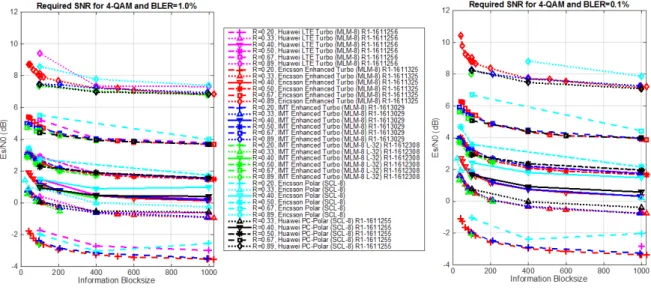
(8) List of Figures 1 3 4 5 6. Education and career at a glance . . . . . . . . . Summary of advisorship/tutorship activity . . . Collaboration map . . . . . . . . . . . . . . . . . Google scholar citations and h-index . . . . . . . Map of the research activities since the beginning. 1.1. . . . . . . . . . . . . . . . . . . . . . . . . . . . . of my PhD. . . . . .. . . . . .. . . . . .. . . . . .. . . . . .. . . . . .. . . . . .. . . . . .. . . . . .. . . . . .. . . . . .. 2 4 7 11 24. DVB Scene magazine cover from 28/02/2011 with emphasis on rotated constellations. . . . . . . . . . . . . . . . . . . . . . . . . . . . . . . . . . . . . . . . . . . 30 1.2 DVB-T2 transmitter, channel emulator and receiver of Teamcast integrating proposed BICM receiver demonstrated at IBC 2010. . . . . . . . . . . . . . . . . . . 38 1.3 The developed GUI for the demonstrator. . . . . . . . . . . . . . . . . . . . . . . 38 1.4 Performance comparison of the enhanced TC with the Multi-Edge LDPC code in AWGN channel for coding rates ranging from 1/5 to 8/9 in terms of BLock Error Rate vs Es/N0. QPSK modulation, block size K around 100 bits. . . . . . . . . 72 1.5 Performance comparison for the first transmission of the enhanced TC with the polar code in AWGN channel for coding rates ranging from 1/5 to 8/9 in terms of required Es/N0 to achieve 1% and 0.1% of BLER. QPSK modulation, block size K ranging from 32 to 1024 bits. . . . . . . . . . . . . . . . . . . . . . . . . . . . . 73 1.6 Performance comparison for up to four retransmissions of the enhanced TC with the polar code in AWGN channel for coding rates ranging from 1/12 to 2/3 in terms of required Es/N0 to achieve 1% and 0.1% of BLER. QPSK modulation, block size K ranging from 32 to 1024 bits. . . . . . . . . . . . . . . . . . . . . . . 74 1.7 The joint Factor Graph representation of the detector and the decoder (example given for N T = N R = 4, D = 1, Hadamard STBC). . . . . . . . . . . . . . . . . 94 1.8 Comparison between the two template structures of a classical accumulator and the proposed one. The corresponding trellises are represented for q=4. . . . . . . 100 1.9 Performance comparison between the best state-of-the-art codeover Z(64), the best code over GF(64) and the proposed code – named C3 – over GF(64) from the application of the new design procedure. 64-QAM constellation, R = 1/2 over an AWGN channel. . . . . . . . . . . . . . . . . . . . . . . . . . . . . . . . . . . . . 101 1.10 Frame error rate performance comparison with ARP interleaver over an AWGN channel with 64-QAM modulation, Ks = 160 GF(64) symbols and R = 1/3 for two convolutional codes, C1 and C3, in GF(64) with and without symbol transformation.102 1.11 Frame error rate performance comparison of NB-TC defined over GF(64), Ks = 164 GF(64) symbols, and 5G-polar code, Kb = 984 bits with different coding rates, AWGN channel and 4-QAM constellation. . . . . . . . . . . . . . . . . . . 102 v.
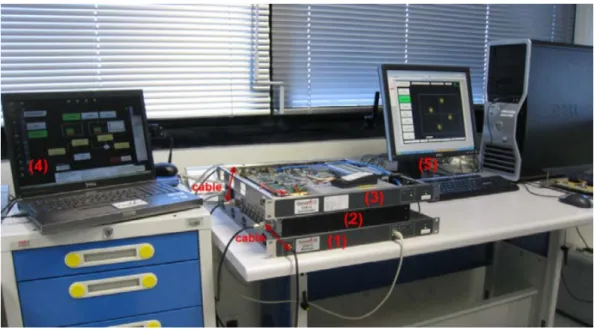
(9) vi. 2.1. List of Figures. 2.6 2.7 2.8. PSD comparison of OFDM and FBMC/OQAM using a short and a long prototype filter. . . . . . . . . . . . . . . . . . . . . . . . . . . . . . . . . . . . . . . . . . . . 106 OFDM transmitter and PPN implementation of the FBMC/OQAM transmitter. 106 Timing offset evaluation in terms of measured SIR for OFDM and FBMC with the considered short ProFs. The effect of different implementations is also evaluated.109 Evaluation of the impact of NG (number of non-zero filter coefficients) on the SIR for different ProFs. . . . . . . . . . . . . . . . . . . . . . . . . . . . . . . . . . . . 110 BER evaluation of OFDM and FBMC with different ProFs and implementations in presence of AWGN, for ETU static channel. . . . . . . . . . . . . . . . . . . . 110 Optimized FBMC/OQAM hardware architecture using pruned IFFT algorithm . 126 3-way Decomposition of the UF-OFDM symbol . . . . . . . . . . . . . . . . . . . 128 Demonstration setup with front-end interface. . . . . . . . . . . . . . . . . . . . . 143. 3.1 3.2 3.3 3.4. The principle of PD NOMA [230, 231, 232]. . . . . . . . . . . . The problem of resource allocation for of PD NOMA. . . . . . The different scenarios for resource allocation of of PD NOMA. DAS cell with two power-limited RRHs (RRH 1 and RRH 4). .. 4.1 4.2. System model for IBFD backhaul-constrained UAV assisted networks. . . . . . . Illustration of the two-cell JT system with the functional base station a1 , the saturated BS in cell 2, the UAV working as MBS a2 , and the three colored user regions. . . . . . . . . . . . . . . . . . . . . . . . . . . . . . . . . . . . . . . . . . UXMAP architecture framework, prime parameters and their effects. . . . . . . . FD inband underlay communication sharing the uplink resource of a cellular user.. 2.2 2.3 2.4 2.5. 4.3 4.4. . . . .. . . . .. . . . .. . . . .. . . . .. . . . .. . . . .. . . . .. . . . .. . . . .. 156 157 159 181 206 207 208 211.
(10) Acronyms 2G 2nd Generation mobile networks 3GPP 3rd Generation Partnership Project 4G/LTE 4th Generation mobile networks / Long Term Evolution 5G 5th Generation mobile networks ACLR adjacent channel leakage ratio ACS Add-Compare-Select ADC Analog-to-Digital Converter AFB Analysis Filter Bank AI Artificial Intelligence API Application Programming Interface ARP Almost Regular Permutation AS Antenna Selection ASIC Application-Specific Integrated Circuit AWGN Additive White Gaussian Noise BBU BaseBand Unit BCH Bose Ray-Chaudhuri Hocquenghem BCJR Bahl Cocke Jelinek Raviv BE Best Effort BER Bit-Error Rate BF-OFDM Block-Filtered-Orthogonal Frequency-Division Multiplexing BICM Bit-Interleaved Coded Modulation BICM-ID Bit-Interleaved Coded Modulation with Iterative Demodulation vii.
(11) viii. BLER BLock-Error Rate BMI Bitwise Mutual Information BPSK Binary Phase Shift Keying BS Base Station C-RAN Cloud Radio Access Network CAS Centralized Antenna Systems CC Convolutional Codes CCDF Complementary Cumulative Distribution Function CFO Carrier Frequency Offset CFR Channel Frequency Response CIR Channel Impulse Response CM Complex Multiplier CoMP Coordinated MultiPoint CP Cyclic Prefix CPE Common Phase Error CSD Canonical Signed Digit CSI Channel State Information D2D Device-to-Device DA Deferred Acceptance DAC Digital-to-Analog Converter DAS Distributed Antenna Systems DCT Discrete Cosine Transform DDR Double Data Rate DFE Decision Feedback Equalizer DIF Decimation In Frequency DMA Direct Memory Access DMSIC Double Mutual Successive Interference Cancellation DMT Diversity-Multiplexing Tradeoff DSP Digital Signal Processor DRP Dithered Relative Prime DRS Demodulation Reference Signal. Acronyms.
(12) Acronyms. DVB Digital Video Broadcasting DVB-NGH Digital Video Broadcasting New Generation Handheld DVB-RCS2 Digital Video Broadcasting Return Channel Satellite 2nd generation DVB-T2 Digital Video Broadcasting Terrestrial 2nd generation EIC Equalization with Interference Cancellation eMBB enhanced Mobile BroadBand EMCM Even Multiplierless Constant Multiplication EPA Extended Pedestrian A ETU Extended Typical Urban EVA Extended Vehicular A EVM Error Vector Magnitude EXIT EXtrinsic Information Transfer F-OFDM Filtered-Orthogonal Frequency-Division Multiplexing FB Filter-Bank FC-OFDM Flexible-Configuration Orthogonal Frequency-Division Multiplexing FBMC Filter Bank Multi-Carrier FD Full-Duplex FDA Frequency Domain Approximation FDC Frequency Domain Compensation FEC Forward Error Correction FFT Fast Fourier Transform FIFO First-In First-Out FIR Finite Impulse Response FPA Fixed Power Allocation FPGA Field-Programmable Gate Array FS Frequency Spread FSPA Full Search Power Allocation FTN FasterThan-Nyquist FTPA Fractional Transmit Power Allocation GUI Graphical User interface. ix.
(13) x. GFDM Generalized Frequency Division Multiplexing HARQ Hybrid Automatic Repeat reQuest HFS Half Frequency Shift HPA High Power Amplifier IAI Inter-Antenna-Interference IAM Interference Approximation Method IBC International Broadcasting Convention IBFD In-band Backhaul Full-Duplex ICeI Inter-Cell Interference ICI Inter-Carrier Interference IFFT Inverse Fast Fourier Transform IIR Infinite Impulse Response IMT2020 International Mobile Telecommunications-2020 IoT Internet-of-Things IOTA4 Isotropic Orthogonal Transform Algorithm 4 IR Incremental Redundancy ISI Inter-Symbol Interference IUI Inter-User Interference JFG Joint Factor Graph JT Joint Transmission LDM Layer Division Multiplexing LDPC Low density Parity Check LO Local Oscillator LoS Line-of-Sight LPR Linear Phase Rotation LTE Long Term Evolution LUT Look-Up Table M2M Machine-to-Machine MAB Multi-Armed Bandits MAP Maximum A Posteriori. Acronyms.
(14) Acronyms. Max-Log-MAP Maximum A Posteriori with Max-Log approximation MBB Mobile BroadBand MBS Master Base Station MCC Mission Critical Communication MCM Multiplier-less Constant Multiplication MI Mutual Information MIMO Multiple-Input Multiple-Ouput MISO Multiple-Input Single-Ouput ML Maximum Likelihood MMB4 Martin–Mirabassi–Bellanger 4 MMC Massive Machine Communication mMIMO massive Multiple-Input Multiple-Output MMSE Minimum Mean Square Error MRC Maximum Ratio Combining MTC Machine Type Communications MTD Machine-Type-Devices MUST MultiUser Superposition Transmission NB Non-Binary NB-CC Non-Binary Convolutional Codes NLOS Non-Line-of-Sight NMSE Normalized Mean Square Error NN Neural Network NOMA Non Orthogonal Multiple Access NPR1 Near Perfect Reconstruction 1 NR New Radio NUC Non-Uniform Constellation OFDM Orthogonal Frequency-Division Multiplexing OMA Orthogonal Multiple Access OMCM Odd Multiplierless Constant Multiplication OOBPL Out-Of-Band Power Leakage OS Overlap-Save. xi.
(15) xii. Acronyms. OSB Overlap-Save-Block OQAM Offset Quadrature Amplitude Modulation P-OFDM Pulse-shaped Orthogonal Frequency-Division Multiplexing PAM Pulse-Amplitude Modulation PAPR Peak-to-Average Power Ratio PAS Probabilistic Amplitude Shaping PD PPower Domain PER Packet Error Rate PF Proportional Fairness PHYDYAS Physical Layer For Dynamic Spectrum Access And Cognitive Radio PPN PolyPhase Network ProF Prototype Filter PSD Power Spectral Density PTC Precoded Turbo Code PU Primary User QAM Quadrature Amplitude Modulation QMF1 Quadrature Mirror Filter 1 QoS Quality of Service QPP Quadratic Permutation Polynomial QPSK Quadrature phase-shift keying RA Real Addition RAM Random Access Memory RB Resource Block RF Radio Frequency RI Roll-off Interval RL Reinforcement Learning RM Real Multiplication RRH Remote Radio Head RT Real Time SBF Subband Prototype Filter.
(16) Acronyms. SCMA Sparse Code Multiple Access SC Successive Cancellation SC-OFDM Single-Carrier Orthogonal Frequency-Division Multiplexing SeI Self Interference SFN Single Frequency Network SI Side Information SIC Successive Interference Cancellation SINR Signal-to-interference-plus-noise ratio SISO Soft-Input Soft-Output SIR Signal-to-Interference Ratio SLM Selective Mapping SMT Staggered Modulated Multitone SNR Signal-to-Noise Ratio SP-RAM Single-Port Random-Access Memory SoC System on Chip SOVA Soft Output Viterbi Algorithm SQNR Signal-to-Quantization-Noise Ratio SSD Signal Space Diversity SU Secondary User STBC Space-Time Block-Coding TA Timing Advance TC Turbo Code TDD Time-Division Duplexing TDW Time Domain Windowing TFL1 Time Frequency Localization 1 TMSIC Triple Mutual Successive Interference Cancellation TTI Time Transmission Interval TUKL Technical University of Kaiserslautern UAV Unmanned Aerial Vehicle UE User Equipment UF-OFDM Universal-Filtered Orthogonal Frequency-Division Multiplexing. xiii.
(17) xiv. Acronyms. UFMC Universal Filtered Multi-Carrier UMTS Universal Mobile Telecommunications System URLLC Ultra-Reliable Low Latency Communications UXMAP Unrolled X Maximum A Posteriori V2I Vehicular-to-Infrastructure V2X Vehicular-to-Anything V2V Vehicular-to-Vehicular VHDL VHSIC (Very High Speed Integrated Circuit) Hardware Description Language ZF Zero-Forcing ZT-OFDM Zero-Tail Orthogonal Frequency-Division Multiplexing.
(18) Short introduction This document represents my Habilitation thesis manuscript. It summarizes my academic and professional career including recent and future research activities. It is organized as follows: - A first part includes my Curriculum Vitae; - A second short part gives a high level view on my research activities and articulates the rest of the document into addressed topics; - Chapter 1 presents the first topic related to the study and proposal of algorithms for coded modulations with(out) MIMO; - Chapter 2 presents the second topic related to the study and proposal of algorithms for filtered waveforms; - Chapter 3 presents the third topic related to the study and proposal of algorithms for non-orthogonal multiple access systems; - The final Chapter 4 provides a brief review of planned short and long-term future works.. xv.
(19)
(20) Curriculum Vitæ Current professional address: IMT Atlantique — Electronics department Lab-STICC UMR CNRS 6285 Technopôle Brest-Iroise — CS 83818 29238 Brest Cedex 3 France Phone : +33 2 29 00 15 94 Fax : +33 2 29 00 11 84 Email : [email protected] Web :. 1. Strong points/Summary. •. 15+ years in R&D in the fields of digital communications and broadcasting.. •. Active participation (35+ technical contributions) to the technical groups of 3GPP and three different DVB standards.. •. Contribution to 18+ different R&D projects.. •. Participation to 5 different teaching modules in undergraduate engineering degree. The creation of new teaching courses including advanced ones for last year students.. •. In charge of the teaching module related to Electronics for the second year engineering students from 2014 till 2019. Since 2019, in charge of the digital and analog integrated circuits course.. •. Large experience in managing a R&D team and tutorship: 7 post-doctoral researchers, 14 PhD students (including 9 defended), 4 R&D engineers and several Master and undergraduate students.. •. 18 patent filings including 8 extended to multiple countries and 1 patent adopted and recognized as essential in 3 different DVB standards.. •. 24 journal publications, 2 book chapters, 5 invited talks and 65 publications in conferences including 2 articles attributed best paper awards. 1.
(21) 2. Curriculum Vitæ. •. 2. 5+ demonstrations in forums including the international Broadcasting Convention (IBC) in 2010 (250+ visitors) and at the Mobile World Congress (MWC) in 2015 (1000+ visitors including the EU commissioner in charge of the digital technology).. Education and career. Figure 1: Education and career at a glance. 2.1. Education. Oct. 1997Oct. 2002. Engineering diploma in electronics, computer and communications. Lebanese university, faculty of engineering branch II, Roumieh, Lebanon.. Oct. 2002Oct. 2003. Master Degree in electronics and image processing. Université de Valenciennes et du Haînaut Cambrésis (UVHC), Valenciennes, France.. Oct. 2003Jan. 2008. PhD in electronics and communications: “Iterative methods for improving error correcting performance of spectrally efficient coded transmissions”, Telecom Bretagne, Brest, France.. 2.2. Career. Jun. 2007Nov. 2011. Post-doctoral researcher in telecommunications. Telecom Bretagne, Brest, France.. Nov. 2011Present. Associate Professor in electronics and telecommunications. Telecom Bretagne/IMT Atlantique, Brest, France.. 3. Research activities. My research activities take place in the “Laboratoire des Sciences et Techniques de l’Information, Communication et Connaissance” (Lab-STICC) within the team specialized in the Interaction between Algorithm and Silicon (IAS) where algorithms are designed while taking into account their future implementation. They target the elaboration of new algorithms in the field of digital communications and broadcasting. In particular, the study of: •. Binary and non-binary error correcting codes (turbo, LDPC, polar codes etc.) and their associated decoding..
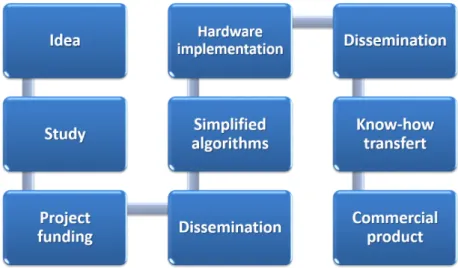
(22) 3. Research activities. 3. •. Digital modulations and Continuous Phase Modulation (CPM), etc.. •. Multi-antennas or Multiple Input Multiple Output (MIMO) systems.. •. Waveform design and multi-carrier modulations such as Filter-Bank MultiCarrier with Orthogonal Quadrature Amplitude Modulation (FBMC/OQAM), etc.. •. Diversity techniques (signal space, interleaving, space-time codes, etc.).. •. Resource and power allocation for (Non)-Orthogonal Multiple Access techniques ((N)OMA).. •. Joint design of several physical layer components; system optimization for standards (LTE, DVB-T2, etc.); simulation methods of correlated fading.. Figure 2: Guiding steps of research activity These algorithmic studies have the particularity of following partially or totally, depending on the study at hand, an IAS approach summarized by the steps depicted in Fig. 2. At the start of every study, there is an original idea that is often the fruit of an out-of-themainstream thinking. Deeper studies are needed hereafter to validate the originality of this idea and its positive impact on the obtained measurable results for the targeted application. If possible, implementation constraints would be already taken into consideration when elaborating corresponding algorithms following the IAS approach. In other words, choices would be made favouring hardware friendly functions. The work can be performed in the context of a collaborative/industrial project depending on the application. This allows providing the necessary funding to finance a Master degree student, a PhD student or a Post-doc fellow. Once validated via simulation results showing the superiority of the idea when compared to existing solutions in state of the art, the study can be the subject of a dissemination via one or more publications and potentially via patent filing. A second phase can be initiated in collaboration with IAS team members specialized in hardware implementation where at first, fully hardware compliant algorithms are devised. Then architectural templates are explored depending on the translated application requirements into hardware constraints such as latency, complexity, throughput, etc. Once a suitable architecture is selected, implementation is performed leading to a prototype that can be demonstrated showing the benefits of the developed idea. The hardware architectures and the demonstrator can be the subject of a second dissemination step..
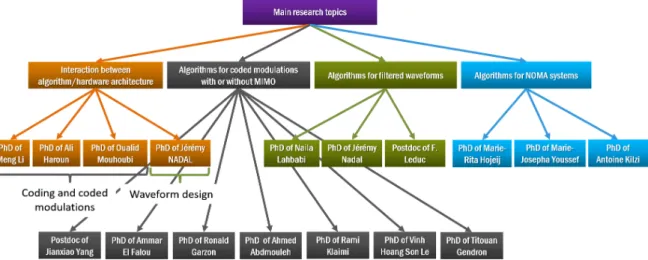
(23) 4. Curriculum Vitæ. A third phase can take place where the know-how is transfered to an industrial partner to go one step further towards a commercial product. This widens the reach of these benefits to the general public.. 4. Advisorship/Tutorship. Figure 3: Summary of advisorship/tutorship activity Since my PhD defense early 2008, I have been involved in the tutorship of 9 defended PhDs, 4 Master thesis students and 8 undergraduate student projects. I am currently the advisor of 5 PhDs with a scheduled defense date ranging between the end of 2020 and the end of 2022. In parallel, I have also collaborated closely with 7 post-doctoral fellows and 4 R&D engineers. The tutorship activity is summarized in Fig. 3 and falls within the 4 main research topics shown in the legend, namely:.
(24) 5. 5. Contribution to research projects. •. Interaction between algorithm/hardware architecture.. •. Algorithms for coded modulations with or without MIMO.. •. Algorithms for filtered waveforms.. •. Algorithms for Non-Orthogonal Multiple Access (NOMA) systems.. 5. Contribution to research projects. Since 2006, I have actively participated to numerous R&D projects as summarized in Table 1. Several projects received distinction and/or awards thanks to their impact on standardization and/or thanks to their innovative aspect. Table 1: List of research projects. Type of project French national ANR Industrial with Newtec EU H2020 beyond 5G Industrial with Newtec Industrial with Orange Labs and TCL PHC CEDRE Campus France Patent factory with France brevets Patent factory with France brevets Industrial with Orange Labs EU H2020 5G-PPP. EU FP7 FUI GREENCoMM. Title Quasi-Cyclic Small Packet (QCSP) Design of improved turbo decoders Enabling Practical Wireless Tb/s Communications with Next Generation Channel Coding (EPIC) Design of improved turbo codes Implementation of a VLIW hardware accelerated 5G LDPC decoder Green and robust digital communications Patent factory for non orthogonal multiple access schemes Patent factory for filter bank multi-carrier modulation and demodulation Improving turbo codes for future standards Flexible air interface for scalable service delivery within wireless communication networks of the 5th Generation (FANTASTIC-5G) Mobile and wireless communications Enablers for Twenty-twenty (2020) Information Society (METIS) GREEN Computing and CoMMunications. Role within IMT Atlantique. Budget Period. Technical manager. 75ke. 2019-2022. Technical and admin. manager. 30ke. 2019. Setting up, WP leader and technical contribution. 416ke. 2017-2020. 30ke. 2018. 80ke. 2017-2018. 18ke. 2017-2018. Technical admin.. 300ke. 2016-2019. Technical admin.. 150ke. 2015-2018. Technical and admin. manager. 180ke. 2015-2018. Setup, technical contribution to several WPs. 486ke. 2015-2017. Setup, technical contribution to several WPs. 578ke. 2012-2015. Technical contribution. 280ke. 2012-2015. Technical and admin. manager Admin. manager and technical contribution Setup, technical contribution.
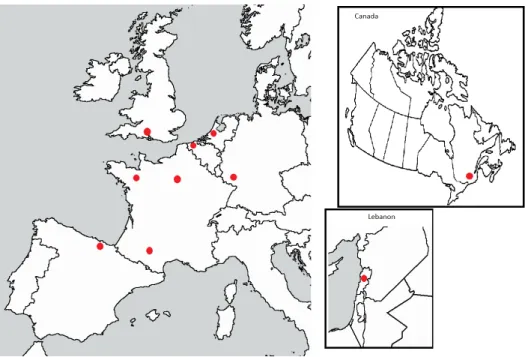
(25) 6. Curriculum Vitæ. Industrial with Orange Labs Bilateral with French space agency CNES Bilateral with French space agency CNES Industrial with SIMPULSE (SME). Improved end-to-end 3G/4G simulator. Technical manager. 25ke. 2014. Rotated constellations for satellite to mobile communications. Technical and admin. manager. 84ke. 2012-2013. Development of a EMBMS simulation chain. Technical and admin. manager. 32ke. 2011. Hardware implementation of a DVB-T2 receiver. Technical contribution. 30ke. 2011-2012. EU Eurostars. Enhanced wireless Technologies for News and Security Applications (ETNA). 131ke. 2011- 2013. French national ANR. Mobile MultiMedia (M3). Setup, technical contribution to several WPs Setup, technical contribution to several WPs. 289ke. 2011- 2013. 325ke. 2010- 2012. 174ke. 2008- 2011. 286ke. 2007- 2009. 80ke. 2007- 2008. 30ke. 2006- 2007. Celtic Plus EU. EU Eurostars Celtic EU EU space agency ESA Internal IMT. 6. Enabling Next GeneratIon NEtworks for broadcast Services (ENGINES). Received Celtic bronze award of excellence in 2014. Small and Medium Enterprise for T2 (SME42). Ranked #1 among 113 accepted projects. Broadcast for the 21st Century (B21C). Received Celtic silver award of excellence in 2009. Broadband Satellite Digital Transmissions Ultra Wide Band for Domotics (UWB-DOMO). Setup, technical contribution to several WPs Setup, technical contribution to several WPs Setup, technical contribution to several WPs Technical contribution Technical contribution. Collaborations. During my professional career, I have been able to build 3 types of collaborations: •. Strategic agreements/partnerships: recurrent collaborations within bilateral and collaborative projects that can lead to joint patent filing(s) and/or joint contributions to standards.. •. Industrial collaborations: collaborations with industrial partners in the context of research projects or a joint vision regarding a particular technique in the context of standardization.. •. Academic collaborations: repeated collaborations with academic partners leading to a strengthened relationship with common publications.. These collaborations span several countries as shown in Fig. 4. The corresponding details are as follows:.
(26) 7. 6. Collaborations. Figure 4: Collaboration map •. Strategic agreements/partnerships: • Orange Labs: Agreement on the design of enhanced turbo codes for next generation standards. • France Brevets: Agreement on financing research activity related to waveform and NOMA.. •. Industrial collaborations: • Orange Labs: collaborations within more than 8 EU and bilateral projects. • TEAMCAST (Now ENENSYS group): collaboration within 3 EU and 1 French national projects. • Newtec: collaboration within 1 European Space Agency (ESA) project EU, 2 bilateral projects and one Cifre PhD. • Panasonic Germany: collaboration during DVB-T2 and DVB-NGH standardization. • European Space Agency (ESA): collaboration during DVB-RCS2 standardization and one bilateral project.. •. Academic collaborations: • Lebanese university: Collaboration with Prof. Joumana Farah (associate researcher with IMT Atlantique): 4 common PhD students (2 defended). Execution of a joint CEDRE project (Campus France) and 11 common publications. • Holy Spirit University of Kaslik (USEK) Lebanon: collaboration with Associate professors Marie-Rita Hojeij and Charles Yaacoub: 1 PhD student and 2 Master students in common. • Basque Country University in Spain UPV/EHU: collaboration with Professor Pablo Angueira Buceta: 3 months visit of PhD student Jon Barrueco to Brest. 2 common publications..
(27) 8. Curriculum Vitæ. • Technical University of Kaiserslautern (TUK) in Germany: collaboration with professor Norbert Wehn: 1 month visit of my PhD student Ahmed Abdmouleh to TUK. Two visits of two weeks each of postdoc Stefan Weithoffer to IMT Atlantique. Stefan participated to IMT teachings. 1 common publication with 2 planned submissions. Stefan was lately hired as an associate professor at IMT Atlantique. • ENSTA Paristech: collaboration with Professor Benoît Geller and postdoc Jianxiao Yang: visit of 2 weeks of Jianxiao to IMT Atlantique. 3 common publications. • Ecole Technique Supérieure and Polytech. Montréal: collaborations with Professor Georges Kaddoum and associate professor François Leduc-Primeau (associate researcher at IMT Atlantique) and visit of François for 2 weeks to IMT Atlantique. 2 common publications. • University of Southampton: collaboration with Professor Rob Maunder: Multiple joint contributions to 3GPP technical group regarding coding for 5G. • Concordia University: collaboration with Professor Walaa Hamouda: Visit of my PhD student Ammar el Falou to Québec for 3 months. 3 common publications. • University of Illinois at Urbana-Champaign: Collaboration with Professor Venugopal V. Veeravalli: Visit of my PhD student Marie-Josepha Youssef to UrbanaChampaign for 6 months. 1 common publication and several under preparation.. 7. Remarkable results. •. In 2007, proposal of a coded Continuous Phase Modulation (CPM) scheme particularly suited for satellite transmissions. The proposal was implemented in Sat3Play modems of the company Newtec. This series of modems was successfully commercialized by the satellite operator SES Astra since 2009 using the service ASTRA2Connect.. •. Adoption of 16-state double-binary turbo codes in 2009 (for the return channel), in 2012 (for the download channel) and of a variant of the coded CPM in the DVB-RCS2 standard.. •. Delivered patent on rotated constellations technique in February 2009. Extension to Europe and Asia in 2010.. •. Adoption of rotated constellations technique and acknowledgment of the essentiality of the patent to the DVB-T2 standard in June 2008 and to its mobile version in February 2011. This adoption was extended to include the hybrid terrestrial-satellite standard for mobile broadcasting DVB-NGH in September 2011.. •. Implementation of the first published hardware prototype for a DVB-T2 receiver including rotated constellations. It was demonstrated at the International Broadcasting Convention (IBC) in 2010.. •. The publication detailing an improved DVB-T2 receiver received the best PhD paper award at the IEEE International Workshop on Signal Processing Systems (SIPS) conference in 2011.. •. Implementation of the first hardware prototype for a filtered multi-carrier waveform. The corresponding demonstrator was selected by the METIS project as one of its two contributions to the Mobile World Congress (MWC) in 2015. The corresponding booth received more than 1000 visitors including the European commissioner in charge of.
(28) 9. 8. Teaching activities. the digital technologies and the director of research and strategy at Orange Labs. A following demonstration took place at the research forum of Orange Labs. •. In 2015-2016, agreement over 3 patent factories (2 with France brevets and 1 with Orange Labs) spanning 3 different technical topics: Filtered waveforms, NOMA and coding. These topics were considered of high importance for 5G and future communications standards.. •. The publication addressing the association of NOMA techniques with single-user MIMO received the best paper award at the ISCC conference in 2017.. •. The 2019 URSI Radioscience PhD Thesis Prize was awarded to Jérémy Nadal for his work entitled: “Filtered multicarrier waveforms in the context of 5G: novel algorithms and architecture optimizations”. The PhD thesis was carried out within the IAS team under the direction of Amer Baghdadi and my supervision. The “Radioscience PhD Thesis Prize” is intended to reward annually excellent doctoral work in one or more of the URSI’s scientific fields.. 8. Teaching activities. 8.1. Topics and courses. My teaching activities took place solely at Telecom Bretagne/IMT Atlantique premises with a total average volume of around 145 hours of equivalent tutorial classes. They are related to the following topics: •. Digital electronics.. •. Components and architecture of transmission systems.. •. System on chip.. •. X86 processor architecture.. •. Error correcting codes and coded modulations.. The following table details the type of courses, their level and the volume in number of hours annually:. Table 2: Detailed teaching activities. Course. Level. Volume (eq. tut). Basic Electronics ELP203, ELP314, ELP213. 1st and 2nd year. 55 h/y. Architecture of transmission systems F14B201. 3rd year, Master. 27 h/y. ... continued in the next page.
(29) 10. Curriculum Vitæ. Table 2 – Follow-up of the previous page. Course. Level. Volume (eq. tut). Systems on chip. 3rd year. 18 h/y. Embedded systems. 3rd year, Master. 15 h/y. Introduction to engineering systems. 1st and 2nd year. 12 h/y. Discovering electronics project. 1st year. 18 h/y. 8.2. Teaching and administrative responsabilities. a) I was attributed the following responsabilities at Telecom Bretagne/IMT Atlantique: • Head of the digital and analog integrated circuit course since 2019 (40 face-to-face hours): Modification of the exercices and adaptation of the contents to the new cursus. This module takes place twice a year. • Head of the basic Electronics course ELP203 from 2014 till 2019 (21 face-toface hours): Modification of the exercices and the creation of a new course on memories. This module took place twice a year. • Main contact for continuous courses at the Electronics department since 2012. • In charge of the coding and modulation courses and exercices for 3rd year and Master degree students since 2015. b) I have also managed student research projects of 1st and 3rd year/Master degree (≈2 projects/year in average).. 8.3. Other responsabilities, activities and distinctions. a) Active participation to the code selection group in 3GPP for 5G. More than 5 technical contributions in 5 different meetings. b) Senior IEEE member since August 2019. c) Member of the technical program committee of: • The International Symposium on Turbo Codes (ISTC) initially planned in 2020 then postponed to 2021 due to Covid-19. • The IEEE Symposium on Computers and Communications (ISCC) in 2020. • ISTC in 2018..
(30) 11. 9. Publications. • ISCC in 2017. • Colloque francophone de traitement du signal et des images (GRETSI) 2017. • ISTC in 2016. d) Co-organiser of special sessions at: • ISTC in 2018 on ultra-high throughput decoding. • International Conference on Telecommunications (ICT) in 2018 on NOMA techniques. e) Chairman of the following sessions: • On the construction of LDPC codes at ISTC in 2018. • On receiver design and sensor networks at the Workshop on Signal Processing Systems (SiPS) in 2011. f) Regular reviewer for IEEE transactions on wireless communications, IEEE transactions on communications, IEEE transactions on vehicular technology, IEEE access, IEEE transactions on broadcasting, IEEE communications letters. Int. Conference on Telecommunications ICT, IEEE GLObal TeleCOMmunications conference GLOBECOM, Workshop on Signal Processing Systems SiPS, IEEE International Conference on Communications ICC. g) Promoter of scientific progress and development through the participation to the researcher’s night in Brest for several years.. 9. Publications. Figure 5: Google scholar citations and h-index The results of my research activities generated 18 patent filings and were published in 24 journal publications, 2 book chapters, 65 conferences, 2 invited talks and 15 demonstration/exhibition/talk events. The performed work received 1172 citations with a h-index of 17 (ref. Google scholar, 08/09/2020) as shown in Fig. 5. In addition, I am also a co-author of 3 standardization documents: •. The ETSI specification document EN 302 755 of the DVB-T2 standard.. •. The ETSI implementation guidelines document TS 102 831 for the DVB-T2 standard.. •. The ETSI specification document EN 303 105 for the DVB-NGH standard..
(31) 12. List of publications. List of publications Patents [P1] Rami Klaimi, Charbel Abdel Nour, and Catherine Douillard. Procédé de codage d’un signal numérique d’entrée, 2020. Patent number FR2003223. [P2] Marie Rita Hojeij, Charbel Abdel Nour, Joumana Farah, and Catherine Douillard. User distribution to sub-bands in multiple access communications systems, March 2018. Patent number EP18305353. [P3] Marie Rita Hojeij, Charbel Abdel Nour, Joumana Farah, and Catherine Douillard. Method and apparatus for user distribution to sub-bands in multiple access communications systems, March 2018. Patent number EP18305352. [P4] Marie Rita Hojeij, Charbel Abdel Nour, Joumana Farah, and Catherine Douillard. Method and apparatus for power distribution to sub-bands in multiple access communications systems, March 2018. Patent number EP18305355. [P5] Marie Rita Hojeij, Charbel Abdel Nour, Joumana Farah, and Catherine Douillard. Method and apparatus for user distribution to sub-bands in multiple access communications systems, March 2018. Patent number EP18305354. [P6] Rami Klaimi, Charbel Abdel Nour, and Catherine Douillard. Procédé de génération d’un signal mettant en oeuvre un turbo-codeur, dispositif et programme d’ordinateur correspondant, December 2018. Patent number FR1873615. [P7] Jérémy Nadal, Charbel Abdel Nour, and Amer Baghdadi. Pseudo-guard intervals insertion in an FBMC transmitter, March 2018. Patent number EP18305251. [P8] Ronald Garzón Bohórquez, Charbel Abdel Nour, and Catherine Douillard. Procédés et dispositifs de codage à rendement compatible, March 2017. Patent number FR1752273. [P9] Jérémy Nadal, Charbel Abdel Nour, and Amer Baghdadi. Overlap-Save FBMC receiver, October 2017. Patent number EP17306395. [P10] Marie Rita Hojeij, Charbel Abdel Nour, Joumana Farah, and Catherine Douillard. Method and apparatus for power and user distribution to sub-bands in NOMA systems, July 2016. Patent number EP16305929. [P11] Ronald Garzon Bohorquez, Charbel Abdel Nour, and Catherine Douillard. Procédé de codage d’un message numérique d’entrée mettant en oeuvre un turbo-encodeur, programme d’ordinateur et turbo-encodeur correspondants, December 2016. Patent number WO2016203039. [P12] Naila Lahbabi, Hao Lin, Charbel Abdel Nour, and Catherine Douillard. Procédé de génération d’un signal multiporteuse, dispositif et programme d’ordinateur correspondant, October 2016. Patent number FR1659988. [P13] Jérémy Nadal, Charbel Abdel Nour, and Amer Baghdadi. Receiver architecture for linear modulation based communication systems, June 2016. Patent number EP16305752. [P14] Jérémy Nadal, Charbel Abdel Nour, and Amer Baghdadi. Digital encoder and method of encoding, August 2016. Patent number EP16306056..
(32) 13. [P15] Jérémy Nadal, Charbel Abdel Nour, and Amer Baghdadi. Filter for linear modulation based communication systems, April 2016. Patent number EP16305462. [P16] Marie Rita Hojeij, Charbel Abdel Nour, Joumana Farah, and Catherine Douillard. Method and apparatus for user distribution to sub-bands in NOMA systems, December 2016. Patent number EP16306722. [P17] Charbel Abdel Nour and Catherine Douillard. Method and device for Space-Time encoding, September 2011. Patent number WO2011104377. [P18] Charbel Abdel Nour and Catherine Douillard. Modulation codée avec entrelacement des voies I et Q et rotation optimisée, February 2008. Patent number WO2009103746. Book chapters [B1] Frank Schaich, Catherine Douillard, Charbel Abdel Nour, Malte Schellmann, Tommy Svensson, Hao Lin, Honglei Miao, Hua Wang, Jian Luo, Milos Tesanovic, Nuno Pratas, Sandra Roger, and Thorsten Wild. Antenna, PHY and MAC Design. In 5G System Design: Architectural and Functional Considerations and Long Term Research. April 2018. [B2] Catherine Douillard and Charbel Abdel Nour. Chapter 11. Bit interleaved coding and modulation in next generation DVB-NGH. In Next Generation Mobile Broadcasting, pages 321 – 354. CRC Press, 2013. Journal publications [J1] Jeremy Nadal, Francois Leduc-Primeau, Charbel Abdel Nour, and Amer Baghdadi. Overlap-save FBMC receivers. IEEE Transactions on Wireless Communications, 2020. [J2] Rami Klaimi, Charbel Abdel Nour, Catherine Douillard, and Joumana Farah. Union bound evaluation for non-binary turbo coded modulations. IEEE Communications Letters, 24(6):1178–1182, jun 2020. [J3] Vinh Hoang Son Le, Charbel Abdel Nour, Emmanuel Boutillon, and Catherine Douillard. Revisiting the Max-Log-Map algorithm with SOVA updates rules: new simplifications for high-radix SISO decoders. IEEE Transactions on Communications, 68(4):1991– 2004, 2020. [J4] Marie-Josépha Youssef, Joumana Farah, Charbel Abdel Nour, and Catherine Douillard. Resource Allocation in NOMA Systems for Centralized and Distributed Antennas with Mixed Traffic using Matching Theory. IEEE Transactions on Communications, 68(1):414–428, January 2020. [J5] Antoine Kilzi, Joumana Farah, Charbel Abdel Nour, and Catherine Douillard. Mutual Successive Interference Cancellation Strategies in NOMA for Enhancing the Spectral Efficiency of CoMP Systems. IEEE Transactions on Communications, 68(2):1213–1226, October 2019. [J6] Jon Barrueco Gutierrez, Jon Montalban, Pablo Angueira, Charbel Abdel Nour, and Catherine Douillard. Low Complexity Adaptive Demapper for 2-D Non-Uniform Constellations. IEEE Transactions on Broadcasting, 65(1):10–19, March 2019..
(33) 14. List of publications. [J7] Antoine Kilzi, Joumana Farah, Charbel Abdel Nour, and Catherine Douillard. New Power Minimization Techniques in Hybrid Distributed Antenna Systems with Orthogonal and Non Orthogonal Multiple Access. IEEE Transactions on Green Communications and Networking, 3(3):679–690, May 2019. [J8] Jérémy Nadal, Charbel Abdel Nour, and Amer Baghdadi. Design and Evaluation of a Novel Short Prototype Filter for FBMC/OQAM Modulation. IEEE access, 6:19610– 19625, March 2018. [J9] Tarak Arbi, Benoit Geller, Jianxiao Yang, Charbel Abdel Nour, and Olivier Rioul. Uniformly Projected RCQD QAM: A Low-Complexity Signal Space Diversity Solution over Fading Channels With or Without Erasures. IEEE Transactions on Broadcasting, 64(4):803–815, 2018. [J10] Marie Rita Hojeij, Charbel Abdel Nour, Joumana Farah, and Catherine Douillard. Weighted Proportional Fair Scheduling for Downlink Non-Orthogonal Multiple Access. Wireless Communications and Mobile Computing, 2018. [J11] Jérémy Nadal, Charbel Abdel Nour, and Amer Baghdadi. Flexible and efficient hardware platform and architectures for waveform design and proof-of-concept in the context of 5G. AEÜ - International Journal of Electronics and Communications / Archiv für Elektronik und Übertragungstechnik, September 2018. [J12] Joumana Farah, Antoine Kilzi, Charbel Abdel Nour, and Catherine Douillard. Power Minimization in Distributed Antenna Systems using Non-Orthogonal Multiple Access and Mutual Successive Interference Cancellation. IEEE Transactions on Vehicular Technology, 67(12):11873 – 11885, 2018. [J13] Ronald Garzon Bohorquez, Charbel Abdel Nour, and Catherine Douillard. Protographbased interleavers for punctured turbo codes. IEEE Transactions on Communications, 66(5):1833–1844, 5 2018. [J14] Marie Rita Hojeij, Charbel Abdel Nour, Joumana Farah, and Catherine Douillard. Waterfilling-based Proportional Fairness Scheduler for Downlink Non-Orthogonal Multiple Access. IEEE Wireless Communications Letters, 6(2):230 – 233, April 2017. [J15] Jérémy Nadal, Charbel Abdel Nour, and Amer Baghdadi. Novel UF-OFDM transmitter: significant complexity reduction without signal approximation. IEEE Transactions on Vehicular Technology, 67(3):2141–2154, October 2017. [J16] Marie Rita Hojeij, Joumana Farah, Charbel Abdel Nour, and Catherine Douillard. New Optimal and Suboptimal Resource Allocation Techniques for Downlink Non-orthogonal Multiple Access (NOMA). Wireless Personal Communications, 87(3):837 – 867, April 2016. [J17] Jérémy Nadal, Charbel Abdel Nour, and Amer Baghdadi. Low-complexity pipelined architecture for FBMC/OQAM transmitter. IEEE Transactions on Circuits and Systems II: Express Briefs, 63(1):19 – 23, January 2016. [J18] Ali Haroun, Charbel Abdel Nour, Matthieu Arzel, and Christophe Jego. LowComplexity Soft Detection of QAM demapper for a MIMO System. IEEE Communications Letters, 20(4):732 – 735, April 2016. [J19] Ronald Garzon Bohorquez, Charbel Abdel Nour, and Catherine Douillard. On the Equivalence of Interleavers for Turbo Codes. IEEE Wireless Communications Letters, 4(1):58 – 61, February 2015..
(34) 15. [J20] Ronald Garzon Bohorquez, Charbel Abdel Nour, and Catherine Douillard. Channel Interleavers for Terrestrial Broadcast: Analysis and Design. IEEE Transactions on Broadcasting, 60(4):679 – 692, December 2014. [J21] Hartmut Brandt, Charbel Abdel Nour, Nader ALAGHA, and Hans Peter LEXOW. Digital video broadcasting-return channel via satellite linear modulation with turbo coding. International Journal of Satellite Communications and Networking, Special Issue, March 2013. [J22] Jianxiao Yang, Charbel Abdel Nour, and Charlotte Langlais. Correlated fading channel simulator based on the overlap-save method. IEEE Transactions on Wireless Communications, 12(6):3060 – 3071, June 2013. [J23] Ammar El Falou, Walaa Hamouda, Charlotte Langlais, Charbel Abdel Nour, and Catherine Douillard. Finite-SNR diversity-multiplexing tradeoff for Rayleigh MIMO channels. IEEE Communications Letters, 17(4):753 – 756, April 2013. [J24] A. Graell i Amat, Charbel Abdel Nour, and Catherine Douillard. Serially concatenated continuous phase modulation for satellite communications. IEEE Transactions on Wireless Communications, 8(6):3260 – 3269, June 2009. Invited talks [I1] Charbel Abdel Nour and Catherine Douillard. Channel coding for Tb/s wireless communications: insights into code design and implementation. In The International Symposium on Ubiquitous Networking UNet, Limoges, France, Nov. 2019. [I2] Rami Klaimi, Charbel Abdel Nour, and Catherine Douillard. Non-binary turbo codes: design, simplified decoding and comparison with SoA codes. In GdR ISIS day: Coding Theory and Its Applications to Data Storage, Communications and Security, Paris, France, November 2019. [I3] Charbel Abdel Nour and Catherine Douillard. Channel coding for Tb/s wireless communications: insights into code design and implementation. In GdR ISIS workshop on Enabling Technologies for sub-TeraHertz and TeraHertz communications, MaisonsAlfort, France, Sept. 2019. [I4] Charbel Abdel Nour, Catherine Douillard, and Stefan Weithoffer. Turbo codes for Tb/s communications: code design and hardware architecture. In Oberpfaffenhofen Workshop on High Throughput Coding (OWHTC), Munich, Germany, Feb. 2019. [I5] Charbel Abdel Nour and Catherine Douillard. Designing practical diversity schemes for next generation broadcasting applications. In 6th International Symposium on Turbo Codes & Iterative Information Processing, Brest, France, September 2010. Conferences [C1] Stefan Weithoffer, Rami Klaimi, Charbel Abdel Nour, Norbert Wehn, and Catherine Douillard. Fully Pipelined Iteration Unrolled Decoders -The Road to Tb/s Turbo Decoding. In ICASSP 2020 : 45th International Conference on Acoustics, Speech, and Signal Processing, Barcelona, Spain, May 2020..
(35) 16. List of publications. [C2] Stefan Weithoffer, Oliver Griebel, Rami Klaimi, Charbel Abdel Nour, and Norbert Wehn. Advanced Hardware Architectures for Turbo Code Decoding Beyond 100 Gb/s. In WCNC 2020 : IEEE Wireless Communications and Networking Conference, Seoul, South Korea, April 2020. [C3] Vinh Hoang Son Le, Charbel Abdel Nour, Catherine Douillard, and Emmanuel Boutillon. A low-complexity dual trellis decoding algorithm for high-rate convolutional codes. In WCNC 2020 : IEEE Wireless Communications and Networking Conference, Seoul, South Korea, April 2020. [C4] Vinh Hoang Son Le, Charbel Abdel Nour, Emmanuel Boutillon, and Catherine Douillard. Dual Trellis Construction for High-Rate Punctured Convolutional Codes. In 2019 IEEE 30th Annual International Symposium on Personal, Indoor and Mobile Radio Communications (PIMRC) Workshops - W3: First Int. Workshop on Enabling Technologies for TeraHertz Communications, Istanbul, Turkey, September 2019. [C5] Marie-Josépha Youssef, Joumana Farah, Catherine Douillard, and Charbel Abdel Nour. Backhaul-Constrained Resource Allocation and 3D Placement for UAV-Enabled Networks. In IEEE 90th Vehicular Technology Conference, VTC2019-Fall,, Honolulu, Hawaii, United States, September 2019. [C6] Marie-Josépha Youssef, Joumana Farah, Charbel Abdel Nour, and Catherine Douillard. Resource Allocation for Mixed Traffic Types in Distributed Antenna Systems Using NOMA. In IEEE 88th Vehicular Technology Conference, VTC2018-Fall, Chicago, United States, August 2018. [C7] Stefan Weithoffer, Charbel Abdel Nour, Norbert Wehn, Catherine Douillard, and Claude Berrou. 25 Years of Turbo Codes: From Mb/s to beyond 100 Gb/s. In 10th International Symposium on Turbo Codes & Iterative Information Processing (ISTC 2018), Hong Kong, Hong Kong SAR China, December 2018. [C8] Rami Klaimi, Charbel Abdel Nour, Catherine Douillard, and Joumana Farah. Lowcomplexity decoders for non-binary turbo codes. In 10th International Symposium on Turbo Codes & Iterative Information Processing (ISTC 2018), Hong Kong, Hong Kong SAR China, December 2018. [C9] Marie-Rita Hojeij, Charbel Abdel Nour, Joumana Farah, and Catherine Douillard. Advanced Resource Allocation Technique for a Fair Downlink Non-Orthogonal Multiple Access System. In 25th International Conference on Telecommunications, ICT 2018, Saint Malo, France, June 2018. [C10] Ronald Garzón-Bohórquez, Rami Klaimi, Charbel Abdel Nour, and Catherine Douillard. Mitigating Correlation Problems in Turbo Decoders. In 10th International Symposium on Turbo Codes & Iterative Information Processing (ISTC 2018), Hong Kong, Hong Kong SAR China, December 2018. [C11] Rami Klaimi, Charbel Abdel Nour, Catherine Douillard, and Joumana Farah. Design of Low-Complexity Convolutional Codes over GF(q). In IEEE Global Communications Conference (GLOBECOM 2018), Abu Dhabi, United Arab Emirates, December 2018. [C12] Jon Barrueco Gutierrez, Jon Montalban, Pablo Angueira, Charbel Abdel Nour, and Catherine Douillard. Low-Complexity Lattice Reduction Demapper for Massive Order One-Dimensional Non-Uniform Constellations. In BMSB2018: IEEE International Symposium on Broadband Multimedia Systems and Broadcasting, Valencia, Spain, June 2018..
(36) 17. [C13] Marie-Rita Hojeij, Charbel Abdel Nour, Joumana Farah, and Catherine Douillard. Joint Resource and Power Allocation Technique for Downlink Power-Domain NonOrthogonal Multiple Access. In 2018 IEEE CAMA - International Conference on Antenna Measurement and Application, Västerås, Sweden, September 2018. [C14] Jérémy Nadal, François Leduc-Primeau, Charbel Abdel Nour, and Amer Baghdadi. A Block FBMC Receiver Designed For Short Filters. In ICC 2018 : IEEE International Conference on Communications, Kansas City, United States, May 2018. [C15] Marie-Josépha Youssef, Joumana Farah, Charbel Abdel Nour, and Catherine Douillard. Waterfilling-based Resource Allocation Techniques in Downlink Non-Orthogonal Multiple Access (NOMA) with Single-User MIMO. In ISCC 2017 : The 22nd IEEE Symposium on Computers and Communications, pages 499 – 506, Crete, Greece, July 2017. [C16] Naila Lahbabi, Lin Hao, Charbel Abdel Nour, Catherine Douillard, and Pierre Siohan. An Enhanced Coding Strategy for FTN-OFDM/OQAM Transceiver Design. In ICC 2017 : IEEE International Conference on Communications, Paris, France, May 2017. [C17] Ronald Garzon Bohorquez, Charbel Abdel Nour, and Catherine Douillard. Amélioration des turbocodes pour la 5G. In GRETSI 2017 : 26ème colloque du Groupement de Recherche en Traitement du Signal et des Images, Juan Les Pins, France, September 2017. [C18] Joumana Farah, Elie Sfeir, Charbel Abdel Nour, and Catherine Douillard. New Resource Allocation Techniques for Base Station Power Reduction in Orthogonal and NonOrthogonal Multiplexing Systems. In ICC Workshops 2017: WT02 - 3rd International Workshop on 5G RAN Design, pages 618 – 624, Paris, France, May 2017. [C19] Joumana Farah, Elie Sfeir, Charbel Abdel Nour, and Catherine Douillard. New Efficient Energy-Saving Techniques for Resource Allocation in Downlink OFDMA Transmission Systems. In ISCC 2017 : The 22nd IEEE Symposium on Computers and Communications, pages 1056 – 1062, Crete, Greece, July 2017. [C20] Saïd Medjkouh, Jérémy Nadal, Charbel Abdel Nour, and Amer Baghdadi. Reduced Complexity FPGA Implementation for UF-OFDM Frequency Domain Transmitter. In SIPS 2017: IEEE Workshop on Signal Processing Systems, pages 1 – 6, Lorient, France, October 2017. [C21] Jérémy Nadal, Charbel Abdel Nour, and Amer Baghdadi. Proof-of-concept for postOFDM waveforms as candidates for 5G. In SIPS 2017: IEEE International Workshop on Signal Processing Systems, page ., Lorient, France, October 2017. [C22] Jérémy Nadal, Charbel Abdel Nour, and Amer Baghdadi. Flexible hardware platform for demonstrating new 5G waveform candidates. In ICM 2017 : 29th IEEE International Conference on Microelectronics, Beirut, Lebanon, December 2017. [C23] Jérémy Nadal, Charbel Abdel Nour, and Amer Baghdadi. Hardware demonstration of post-OFDM waveforms. In EuCNC 2017: European Conference on Networks and Communications, Oulu, Finland, June 2017. [C24] Ali Haroun, Charbel Abdel Nour, Matthieu Arzel, and Christophe Jego. Architecture de détecteur MIMO-BP itératif associé à un décodeur LDPC non binaire. In GRETSI 2017 : 26ème colloque du Groupement de Recherche en Traitement du Signal et des Images, Juan Les Pins, France, September 2017..
(37) 18. List of publications. [C25] Tarak Arbi, Jianxiao Yang, Charbel Abdel Nour, Olivier Rioul, and Benoit Geller. Performance et simplicité d’implantation des constellations tournées: une approche pragmatique. In 26ème colloque du Groupement de Recherche en Traitement du Signal et des Images (GRETSI 2017), Juan Les Pins, France, September 2017. [C26] Zeina Eddo, Marie Rita Hojeij, Charbel Abdel Nour, Joumana Farah, and Catherine Douillard. Evaluation of Intra-Subband Power Allocation for a Downlink NonOrthogonal Multiple Access (NOMA) System. In GLOBECOM 2016 : IEEE Global Communications Conference: 2nd International Workshop on 5G RAN Design, page ., Washington, United States, December 2016. [C27] Ahmed Abdmouleh, Emmanuel Boutillon, Laura Conde-Canencia, Charbel Abdel Nour, and Catherine Douillard. On Signal Space Diversity for non binary coded modulation schemes. In 23rd International Conference on Telecommunications, Telecommunications (ICT), 2016 23rd International Conference on, pages 1 – 5, Thessaloniki, Greece, May 2016. [C28] Ahmed Abdmouleh, Emmanuel Boutillon, Laura Conde-Canencia, Charbel Abdel Nour, and Catherine Douillard. A new approach to optimise Non-Binary LDPC codes for Coded Modulations. In ISTC 2016 : 9th International Symposium on Turbo Codes & Iterative Information Processing, pages 295–299, Brest, France, September 2016. [C29] Naila Lahbabi, Hao Lin, Charbel Abdel Nour, Catherine Douillard, and Pierre Siohan. Sparse Interference Pre-Cancellation for FTN-OQAM Systems. In EW 2016 : 22nd European Wireless Conference, pages 1 – 6, Oulu, Finland, May 2016. [C30] Ronald Garzon Bohorquez, Charbel Abdel Nour, and Catherine Douillard. Improving Turbo Codes for 5G with Parity Puncture-Constrained Interleavers. In ISTC 2016 : 9th International Symposium on Turbo Codes & Iterative Information Processing, pages 151 – 155, Brest, France, September 2016. [C31] Ali Haroun, Charbel Abdel Nour, Matthieu Arzel, and Christophe Jego. Soft detector architecture based on Belief Propagation for MIMO systems. In DASIP 2016 : Conference on Design and Architectures for Signal and Image Processing, pages 1 – 4, Rennes, France, October 2016. [C32] Ronald Garzon Bohorquez, Charbel Abdel Nour, and Catherine Douillard. Precoding Techniques for Turbo Codes. In EW 2015 : 21nd European Wireless 2015 : 5G and Beyond, pages 1 – 6, Budapest, Hungary, May 2015. [C33] Ronald Garzon Bohorquez, Charbel Abdel Nour, and Catherine Douillard. Etude de techniques de précodage pour les turbocodes. In GRETSI 2015 : 25ème colloque du Groupement de Recherche en Traitement du Signal et des Images, Lyon, France, September 2015. [C34] Ali Haroun, Charbel Abdel Nour, Matthieu Arzel, and Christophe Jego. Algorithme de détection à très faible complexité pour des systèmes MIMO basés sur la propagation de croyance. In GRETSI 2015 : 25ème colloque du Groupement de Recherche en Traitement du Signal et des Images, Lyon, France, September 2015. [C35] Jianxiao Yang, Wan Kai, Benoit Geller, Charbel Abdel Nour, Olivier Rioul, and Catherine Douillard. A low-complexity 2D signal space diversity solution for future broadcasting systems. In IEEE International Conference on Communications (ICC 2015), volume 63, pages 2762–2767, Londre, France, June 2015..
(38) 19. [C36] Jianxiao Yang, Meng Li, Min Li, Charbel Abdel Nour, Catherine Douillard, and Benoit Geller. Max-log demapper architecture design for DVB-T2 rotated QAM constellations. In 2015 IEEE Workshop on Signal Processing Systems (SiPS) , Hangzhou, China, 2015. [C37] Marie Rita Hojeij, Joumana Farah, Charbel Abdel Nour, and Catherine Douillard. Resource Allocation in Downlink Non-orthogonal Multiple Access (NOMA) for Future Radio Access. In VTC 2015 spring : IEEE 81st Vehicular Technology Conference, pages 1 – 6, Glasgow, United Kingdom, May 2015. [C38] Ammar El Falou, Charlotte Langlais, Walaa Hamouda, Charbel Abdel Nour, and Catherine Douillard. Transmit Antenna Selection for Coded Multiple-Input DualOutput Systems. In ISTC 2014 : 8th International Symposium on Turbo Codes and Iterative Information Processing, pages 269 – 273, Bremen, Germany, August 2014. [C39] Ammar El Falou, Charlotte Langlais, Walaa Hamouda, Charbel Abdel Nour, and Catherine Douillard. Finite-SNR Diversity-Multiplexing Tradeoff for Spatially Correlated Rayleigh MIMO Channels. In ICC 2014 : IEEE International Conference on Communications, pages 5604–5609, Sidney, Australia, June 2014. [C40] Benjamin Ros, Frédéric Lacoste, Kévin Burgi, and Charbel Abdel Nour. Rotated Constellations for a Satellite Communication Link in a DVB-T2 context. In VEHICULAR 2014 : the Third International Conference on Advances in Vehicular Systems, Technologies and Applications, pages 1 – 5, Seville, Spain, June 2014. [C41] Jérémy Nadal, Charbel Abdel Nour, Amer Baghdadi, and Hao Lin. Hardware prototyping of FBMC/OQAM baseband for 5G mobile communication systems. In RSP 2014 : IEEE International Symposium on Rapid System Prototyping, pages 135 – 141, New Delhi, India, October 2014. [C42] Jérémy Nadal, Charbel Abdel Nour, Amer Baghdadi, and Hao Lin. FBMC/OQAMrelated new waveform. In EuCNC 2015 : 24th European Conference on Networks and Communications, Bologna, Italy, June 2014. [C43] Ali Haroun, Charbel Abdel Nour, Matthieu Arzel, and Christophe Jégo. Symbol-based BP Detection for MIMO Systems associated with Non-Binary LDPC Codes. In WCNC 2014 : IEEE Wireless Communications and Networking Conference, pages 212 – 217, Istanbul, Turkey, April 2014. [C44] Ali Haroun, Charbel Abdel Nour, Matthieu Arzel, and Christophe Jego. LowComplexity LDPC-coded Iterative MIMO Receiver Based on Belief Propagation algorithm for Detection. In ISTC 2014 : 8th International Symposium on Turbo Codes and Iterative Information Processing, pages 213 – 217, Bremen, Germany, August 2014. [C45] Ali Haroun, Charbel Abdel Nour, Matthieu Arzel, and Christophe Jégo. LowComplexity layered BP-based Detection and Decoding for a NB-LDPC Coded MIMO System. In ICC 2014 : IEEE International Conference on Communications, pages 5107 – 5112, Sydney, Australia, June 2014. [C46] Ronald Garzon Bohorquez, Charbel Abdel Nour, and Catherine Douillard. Etude de structures d’entrelacement canal adaptées à la diffusion vidéo par voie terrestre. In GRETSI 2013 : 24ème colloque du Groupement de Recherche en Traitement du Signal et des Images, Brest, France, September 2013..
(39) 20. List of publications. [C47] Ammar El Falou, Charlotte Langlais, Charbel Abdel Nour, and Catherine Douillard. Codage spatio-temporel adaptatif pour les systèmes MIMO utilisant un codage de canal à fort pouvoir de correction. In GRETSI 2013 : 24ème colloque du Groupement de Recherche en Traitement du Signal et des Images, Brest, France, September 2013. [C48] Ali Haroun, Charbel Abdel Nour, Matthieu Arzel, and Christophe Jego. Réception itérative MIMO basée sur la propagation de croyance et des codes LDPC non-binaires. In GRETSI 2013 : 24ème colloque du Groupement de Recherche en Traitement du Signal et des Images, Brest, France, September 2013. [C49] Catherine Douillard and Charbel Abdel Nour. The bit interleaved coded modulation module for DVB-NGH: enhanced features for mobile reception. In ICT 2012: 19th International Conference on Telecommunications, pages 1 – 6, Jounieh, Lebanon, April 2012. [C50] Ammar El Falou, Charlotte Langlais, Charbel Abdel Nour, and Catherine Douillard. Adaptive trace-orthonormal STBC for MIMO system with capacity approaching FEC codes. In VTC2012-Fall 2012: 76th IEEE Vehicular Technology Conference, Québec, Canada, September 2012. [C51] Charbel Abdel Nour and Catherine Douillard. High diversity multi-block space-time code for broadcasting applications. In ICT 2012 : 19th International Conference on Telecommunications, Jounieh, Lebanon, April 2012. [C52] Ammar El Falou, Charlotte Langlais, Charbel Abdel Nour, and Catherine Douillard. Low ML-detection complexity, adaptive 2x2 STBC, with powerful FEC codes. In 7th International Symposium on Turbo Codes & Iterative Information Processing, Gothenburg, Sweden, August 2012. [C53] Meng Li, Charbel Abdel Nour, Christophe Jego, Jianxiao Yang, and Catherine Douillard. Etude d’un récepteur itératif dédié à un système de modulation codée à bits entrelacés pour le standard DVB-T2. In 23ème colloque GRETSI, Bordeaux, France, September 2011. [C54] Ammar El Falou, Charbel Abdel Nour, Charlotte Langlais, and Catherine Douillard. Low decoding complexity STBC design for turbo coded broadcast transmission. In IEEE International Symposium on Broadband Multimedia Systems and Broadcasting, Erlangen, Germany, June 2011. [C55] Meng Li, Charbel Abdel Nour, Christophe Jego, Jianxiao Yang, and Catherine Douillard. Efficient iterative receiver for Bit-Interleaved Coded Modulation according to the DVB-T2 standard. In ICASSP 2011 IEEE 36th international Conference on Acoustics, Speech and Signal Processing, pages 3168 – 3171, Prague, Czech Republic, May 2011. [C56] Meng Li, Charbel Abdel Nour, Christophe Jego, Jianxiao Yang, and Catherine Douillard. A shuffled iterative bit-interleaved coded modulation receiver for the DVB-T2 standard: Design, implementation and FPGA prototyping. In Signal Processing Systems (SiPS), 2011 IEEE Workshop on, pages 55 –60, Beirut, Lebanon, October 2011. [C57] Meng Li, Charbel Abdel Nour, Christophe Jego, and Catherine Douillard. Design and FPGA prototyping of a bit-interleaved coded modulation receiver for the DVB-T2 standard. In Signal Processing Systems (SIPS), 2010 IEEE Workshop on, pages 162 –167, San Francisco, United States, October 2010..
(40) 21. [C58] Jianxiao Yang, Charlotte Langlais, and Charbel Abdel Nour. Joint factor graph detector for LDPC and STBC coded MIMO systems: a new framework. In 6th International Symposium on Turbo Codes & Iterative Information Processing, Brest, France, September 2010. [C59] Meng Li, Charbel Abdel Nour, Christophe Jego, and Catherine Douillard. Design of rotated QAM mapper/demapper for the DVB-T2 standard. In SiPS 2009 : IEEE workshop on Signal Processing Systems, pages 18 – 23, Tampere, Finland, October 2009. [C60] Charbel Abdel Nour and Catherine Douillard. Rotated QAM Constellations to Improve BICM Performance for DVB-T2. In 2008 IEEE 10th International Symposium on Spread Spectrum Techniques and Applications (ISSSTA), pages 354–359, Bologna, France, August 2008. [C61] Charbel Abdel Nour and Catherine Douillard. Improving BICM performance of QAM constellations for broadcasting applications. In 2008 5th International Symposium on Turbo Codes and Related Topics, pages 55–60, Lausanne, France, September 2008. [C62] Alexandre Graell i Amat, Charbel Abdel Nour, and Catherine Douillard. Serially Concatenated Continuous Phase Modulation with Extended BCH Codes. In 2007 IEEE Information Theory Workshop on Information Theory for Wireless Networks, pages 1–5, Bergen, Norway, July 2007. [C63] Charbel Abdel Nour and Catherine Douillard. On Lowering the Error Floor of High Order Turbo BICM Schemes Over Fading Channels. In IEEE Global Communications Conference, pages 1–5, San Francisco, United States, November 2006. [C64] Sylvain S. Chaillou, Joseph J. Boutros, and Charbel Abdel Nour. Efficient iterative decoding of impulse radio based on energy detection. In International Workshop on UWB Technologies, Yokosuka, Japan, December 2005. [C65] Charbel Abdel Nour and Catherine Douillard. Performance improvement using turbo coded BICM-ID with 16 QAM over Gaussian and flat fading Rayleih channels. In 14th IST Mobile & Wireless Communications Summit, Dresden, Germany, June 2005. Demonstrations/Exhibitions/Talks/Other publications [D1] Jérémy Nadal, Charbel Abdel Nour, and Amer Baghdadi. Flexible PoC for PostOFDM waveforms. In G5-PPP 2016 : 2nd Global 5G Infrastructure public private partnership event, Rome, Italy, November 2016. [D2] Jérémy Nadal, Charbel Abdel Nour, and Amer Baghdadi. Enabling 5G new services – Post-OFDM waveforms, September 2016. Exhibition of a hardware prototype for post-OFDM waveforms at the European researchers night in Brest. [D3] Ali Haroun, Charbel Abdel Nour, Matthieu Arzel, and Christophe Jego. Architecture d’un détecteur MIMO souple basé sur l’algorithme de propagation de croyance. In GDR SoC-SiP 2016 : colloque National du Groupe de Recherche System on Chip -System in Package, Nantes, France, June 2016. [D4] Jérémy Nadal, Charbel Abdel Nour, Amer Baghdadi, Hao Lin, Bruno Jahan, and Pierre Siohan. New candidate waveform for 5G, November 2015. Proof of concept demonstration at Orange Labs Research Fair..
Figure

+7

Documents relatifs
