XVIII. COMMUNICATIONS BIOPHYSICS
A. Biomedical Engineering
Academic and Research Staff
Prof. Stephen K. Burns Martin E. Fraeman Marvin S. Keshner
Prof. Roger G. Mark Joseph B. Walters, Jr.
Graduate Students
Jerrold Bonn Dennis V. Marsicano David L. Sulman Chester H. Conrad Theodore L. Rhyne Leslie Tung Peter Kurnik J. Sianez- Gutierrez Allen W. Wiegner
1. SUCTION ELECTRODE ARRAY FOR RECORDING ACTION POTENTIALS FROM THE INTACT BEATING HEART Chester H. Conrad
[Chester H. Conrad is a member of the Harvard-M. I. T. Program in Health Sciences and Technology. The work was performed at Boston City Hospital.]
Introduction
This report describes the design and performance of a bipolar suction electrode array that has been designed and built for use in the study of cardiac arrhythmias, in particular, the ventricular arrhythmias (extrasystoles, tachycardia, and flutter) that may precede ventricular fibrillation and death, especially in the ischemic or infarcted heart. For these purposes, it is necessary to determine the spatiotemporal pattern of ventricular depolarization and repolarization. Since the arrhythmias are in general tran-sient, and occur unpredictably, a single movable electrode is not adequate to define pat-terns of activity. A matrix of electrodes is required to define the patpat-terns of electrical activity on a beat-to-beat basis.
While intracellular microelectrodes are the most direct means of measuring cardiac electrical activity, they are very difficult to use in the beating heart, especially in larger mammals, because of their mechanical fragility. As a result, suction electrodes of various types have been used since the 1930s to record cardiac electrical activity. These have the advantage of being simple to use, and are relatively stable, even on a beating heart. They record a signal (usually referred to as a "monophasic action tial," or "MAP"), which is very similar in morphology to the intracellular action poten-tial.
Design
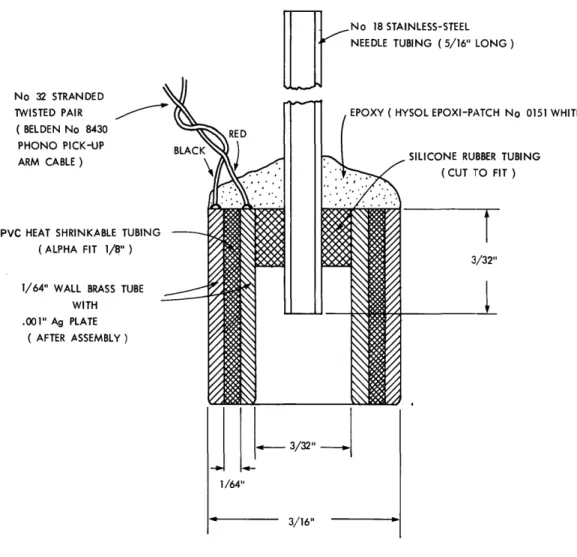
The design of the suction electrode is shown in Fig. XVIII-1. It has two concentric silver-plated electrodes separated by an insulator, with a stainless-steel tube for con-nection to a small flexible silicone rubber suction line, and a twisted pair of fine stranded
No 18 STAINLESS-STEEL NEEDLE TUBING ( 5/16" LONG )
No 32 STRANDED
TWISTED PAIR EPOXY ( HYSOL EPOXI-PATCH No 0151 WHITE )
( BELDEN No 8430 RED
PHONO PICK-UP BLACK
ARM CABLE) \ SILICONE RUBBER TUBING
ARM CABLE)
S(CUT 1O FIT )
PVC HEAT SHRINKABLE TUBING
T
( ALPHA FIT 1/8" )
3/32" 1/64" WALL BRASS TUBE
WITH .001" Ag PLATE ( AFTER ASSEMBLY) S 3/32" 1/64" 3/16" ASSEMBLY:
1. SHRINK HEAT SHRINKABLE TUBING OVER LENGTH OF 3/32 ID X 1/8 OD TUBING
(AS LONG AS NECESSARY FOR NUMBER OF ELECTRODES TO BE MADE, PLUS WASTAGE. )
2. COAT WITH EPOXY, SLIDE OUTER TUBING (5/321DX 3/16 OD) OVER, LET EPOXY SET.
3. CUT IN 3/16" + LENGTHS, SMOOTH ENDS DOWN TO 3/16" .
4. ROUND EDGES AS SHOWN, POLISH BOTTOM END
(CROCUS CLOTH FOLLOWED BY CLOTH BUFFING WHEEL). 5. SOLDER WIRES ON INNER AND OUTER ELECTRODES.
6. CUT SILICONE RUBBER TO HOLD STAINLESS-STEEL TUBING IN PLACE. 7. APPLY EPOXY, ALLOW TO SET.
8. PLATE EXPOSED BRASS SURFACES WITH Ag .001" THICK.
Fig. XVIII-1. Cross section of bipolar suction electrode.
(XVIII. COMMUNICATIONS BIOPHYSICS)
wire for connection to an amplifier.
The size of the suction electrode is determined by mechanical factors. Since the force holding the electrode to the heart is equal to the negative pressure applied multi-plied by the surface area open to the suction, there is a minimum size that will reliably stick to the heart. Furthermore, the electrodes adhere less well to ischemic areas than to normal areas. Electrodes of the size used in this design stick reliably to both normal and ischemic areas with a vacuum of approximately 600 mm Hg.
Results
All recordings were made on a dog under pentobarbital anesthesia, with the heart
exposed by means of a left thoracotomy (4t h interspace). The heart was suspended in a cradle formed by the opened pericardium sewn to the chest wall.
Figure XVIII-2 shows typical recordings over 30 minutes from a bipolar suction
- "-200oms
0 5 10 15 20 25 30 TIME AFTER APPLICATION (min)
Fig. XVIII-2.
Bipolar suction electrode recordings (0-30 min after application).
Fig. XVIII-3.
Mean MAP amplitude (bipolar recording) and range over a 1-hour period.
10 20 30 40 50 60
(XVIII. COMMUNICATIONS BIOPHYSICS)
electrode of the design that we have described. The rise time of the depolarization phase (phase 0) is approximately 4 ms. The initial amplitude of the MAP is typically 40-60 mV, and decreases to approximately 15-30 mV in 30 min (Fig. XVIII-3). The morphology of the MAP is essentially preserved (see Fig. XVIII-2). It is important to keep the surface
of the heart moist, or the signal will deteriorate more quickly. The injury caused by these electrodes becomes irreversible after a few minutes, with hemorrhage in the area where suction is applied, and a wick electrode placed over the same area will show evi-dence of injury (a MAP component in addition to the electrogram).
Mechanism
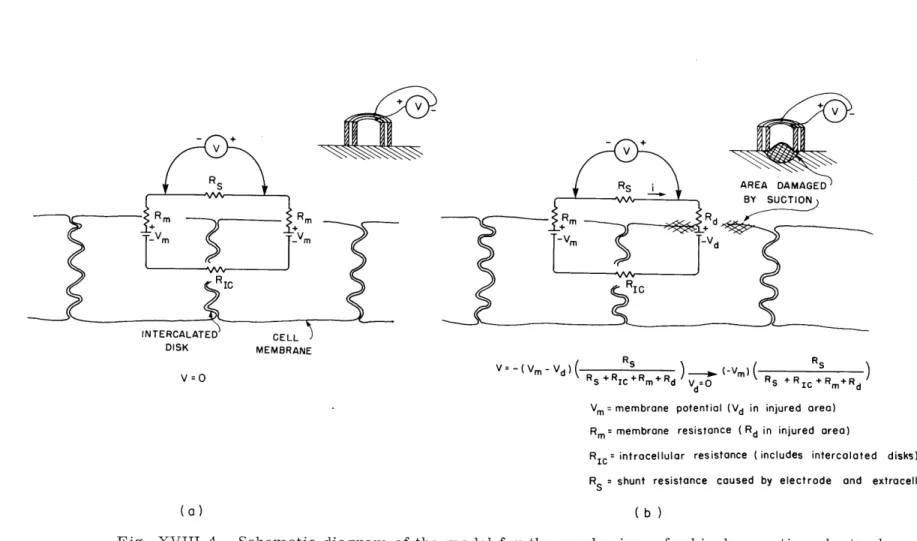
Cardiac muscle is a network of cells joined by membrane specializations known as intercalated disks. Although each cell has a distinct cell membrane, the intercalated disks are believed to have low electrical resistance, so that cardiac muscle can be con-sidered as an electrical syncytium, although not an anatomical one. Therefore the model in Fig. XVIII-4 considers the entire area under a suction electrode to be analogous to a single cell. One extracellular electrode (outer electrode) is placed over a normal area, and one (inner electrode) over the area to which suction will be applied.
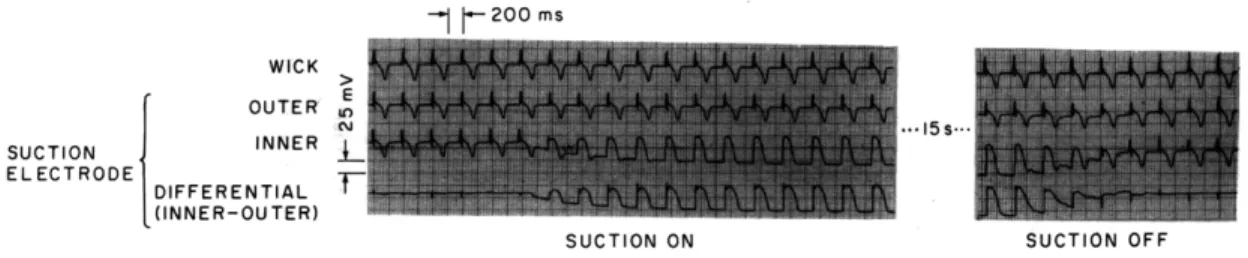
Under normal conditions (without suction), both areas have the same membrane potential, and no local current flows between them, so that the meter sees only an electrogram which is due to transient differences in potential in the heart as a whole (Fig. XVIII-4a). Both the reference (outer) and inner electrodes record an electrogram, identical to that recorded by a nearby wick electrode (see Fig. XVIII-5). According to the proposed model, suction causes local injury, with depolarization of the membrane in the injured area (KC1, or ischemia, has a similar effect). Therefore a current flows between the two areas (called the "current of injury"), and the meter now records a potential that is a fraction of the membrane potential of the cells near the depolarized zone, determined by the resistive voltage-divider effect (Fig. XVIII-4b). In essence, the inner electrode has become partially coupled to the intracellular space of nearby cells by the depolarization of the membrane underneath it. Thus the inner electrode (on damaged tissue) records the intracellular potential, attenuated by the voltage-divider effect, plus the surface electrogram. The outer electrode (on normal tissue) still records the electrogram alone, so that the differential signal (inner-outer) represents the attenuated intracellular potential (the "MAP"). (See Fig. XVIII-5.) Note that the injury is reversible if the suction is removed within a short time; after a few minutes the injury persists without suction, and a wick electrode over the area will show evi-dence of injury (a MAP component in addition to the electrogram).
As the suction is turned on, a negative dc shift can be observed over the damaged area, which results from the coupling to the negative resting intracellular potential. This same effect can be seen with a wick electrode over an ischemic area of myocardium,
.0
S+
V
S RS i AREA DAMAGED BY SUCTION Rd R I C RIC INTERCALATED CELL DISK MEMBRANE V-(vm-vd)( RS (-Vm) R5 V=0 VRS+Rrc+Rm+Rd VVd=O Vm Rs +RIc+Rm+RdVm= membrane potential (Vd in injured area)
Rm= membrane resistance (Rd in injured area)
Rc = intracellular resistance (includes intercalated disks)
RS = shunt resistance caused by electrode and extracellular medium
(a) (b)
Fig. XVIII-4. Schematic diagram of the model for the mechanism of a bipolar suction electrode.
(XVIII. COMMUNICATIONS BIOPHYSICS) 200 ms WICK OUTER
o
N ... 15sOUTER SUCTION INNER DIFFERENTIAL (INNER-OUTER)SUCTION ON SUCTION OFF
Fig. VIII-5. Wick electrode and suction electrode (outer to ground, inner to ground), differential (inner-outer) suction turned on and off.
and, in fact, it will record a MAP, exactly analogous to the recording from a suction elec-trode; this is responsible for the S-T segment elevation seen at a distance on the EKG.
Since a suction electrode actually records from a large number of cells, the rise time of the observed depolarization will be longer than with a true intracellular trode. Furthermore, our model does not apply if activation of the cells under the elec-trode is asynchronous (as, for example, in ventricular fibrillation).
Summary
We have described a bipolar suction electrode that can be used to study the electrical activity of a beating heart, under both normal conditions and conditions of ischemia and infarction. An array of these electrodes (9, at present) is easily placed and maintained on a beating heart. The electrode can be used to define the timing of depolarization and repolarization, at least under conditions where the activity under the electrode is syn-chronous. The MAP amplitude does not reflect the true amplitude of the action potential as recorded by an intracellular microelectrode, nor the dc value of the membrane poten-tial.
These electrodes have several disadvantages: (i) recording from a large number of cells, so that the rise time of depolarization (phase 0) is longer than it would be with microelectrodes, (ii) decreasing MAP amplitude with time, and (iii) damage to the myo-cardium where the electrodes are applied.