Connected Factory: Real Time Data Analysis for Manufacturing Efficiency
ByCaitlin Mary Butala
Bachelor of Science in Mechanical Engineering, Villanova University, 2014
Submitted to the Department of Mechanical Engineering and the Sloan School of Management in partial fulfillment of the requirements for the degree of
Master of Science in Mechanical Engineering And
Master of Business Administration
In conjunction with the Leaders for Global Operations Program and the Massachusetts Institute of Technology
May 2020
© 2020 Caitlin Mary Butala. All Rights Reserved.
The author hereby grants to MIT permission to reproduce and to distribute publicly paper and electronic copies of this thesis document in whole or in part in any medium now known or hereafter created.
Signature of Author……… Department of Mechanical Engineering Sloan School of Management May 8,2020 Certified by ………
Brian Anthony, Thesis Supervisor Director, Master of Engineering in Manufacturing Program Certified by ………
Steve Spear, Thesis Senior Lecturer Accepted by ………
Nicolas Hadjiconstantinou Chair, Mechanical Engineering Committee On Graduate Students Accepted by ………
Maura Herson Assistant Dean, MBA Program
Connected Factory: Real Time Data Analysis for Manufacturing Efficiency
By Caitlin Mary Butala
Submitted to the department of Mechanical Engineering and the Sloan School of Management on May 08, 2020, in partial fulfillment of the requirements for the degree of Master of Science in
Mechanical Engineering and Master of Business Administration
Abstract
Pratt and Whitney is expecting an increase in demand for new engines and for parts supportive of aftermarket service, maintenance, and repair. To avoid expensive capital
investments in additional production capacity, Pratt is taking several approaches to better utilize existing capacity. In a business where historically margins have been high, demand was flat, and in some years decreasing, and staffing had relatively low turnover, conditions were not forcing leaders to focus on identifying ways to eliminate waste or adapt cutting edge manufacturing analytics. With the introduction of new and innovative products, Pratt & Whitney is quickly approaching conditions where demand will outpace capacity. Additionally, demographics of the employee base has started to hit a point where many key and tenured employees have started to and will continue to retire leaving a knowledge gap behind.
To attack this growing problem, Pratt is taking several approaches to win more efficiency and effectiveness out of existing capacity. These include lean initiatives supported by connected and real time manufacturing technologies. Sensors and monitors are primarily used to gather data about machine condition and performance which is fed back to calculate Overall Equipment Effectiveness (OEE), a lean metric used to identify waste in the manufacturing process. The production team in Columbus has done a lot over the past few years to increase production, but as utilization rates increase, they are looking for new ways to expand capacity. The problem faced by management is identifying and reacting to losses as they occur, rather than
retroactively, which is caused, in part, by inadequate access to the data. This problem of reacting timely to losses is exacerbated by attrition of experienced workers who had tribal knowledge of the processes and how to react, whereas newer employees have not developed those reactionary instincts yet.
Pratt & Whitney in Columbus has been collecting and storing data from their forge presses for years; accessing and analyzing that data in real time and integrating decision making based off that data has not been a part of their process. Using machine state tags, that is logic based off Programable Logic Controllers (PLCs) to tell users if the machine is in a run state, going through a changeover, or sitting idle, management can view the state of machines
anywhere they can access the Pratt network. This data has also been used to calculate production efficiencies by part number by asset by calculating actual cycle times and comparing them to the engineering design time per part. This is fed as an input to the new scheduling tool developed over the past few months which is meant to capture the intricacies of how different materials perform on different presses and optimize total production time by maximizing tool life among the presses.
I have identified key inputs and business analytics processes to evaluate suboptimal efficiencies in the production process. This has affected the manner in which Pratt & Whitney in Columbus conducts business and permeated throughout the management structure to be included in events from daily production meetings all the way up to weekly executive report outs. Initial results show scheduling efficiency would improve output up to 8%, and the data has been utilized to uncover other areas for efficiency gains amounting to a 25% go get by the end of the year. This research has shown that a data rich environment can present you with a vast array of
opportunities if the data can be aggregated and interpreted timely enough to feed the decision-making process of production and if the organization has a culture to embrace it.
Thesis Supervisor: Brian Anthony
Title: Director, Master of Engineering in Manufacturing Program Department of Mechanical Engineering
Thesis Advisor: Steve Spear Title: Senior Lecturer
Acknowledgements
This thesis is the result of a six-month immersive experience in the process to integrate more real time data and optimization into the production environment of the Pratt and Whitney forge disk plant in Columbus GA. The dedication and openness of all team members within the facility has made this experience truly memorable. I’ve had the opportunity to test and develop many of the skills taught through the Leaders for Global Operations program at MIT and learned more than I could have ever imagined.
I would like to thank my project sponsor and VP of Operational Excellence, Dave Parry, for pushing me to take on a project in Columbus GA. To Gary Griesheim for taking me under his wing as I gained my footing in the organization and for being my biggest advocate. To the industrial engineering team, Chris Palmer and Allen Dugger for always helping me find the data I needed. To the production leadership in Columbus, Kevin Carillon, Elvin Dumas, Jeff Gomes, and Grant Stanczuk, thank you for being open to testing new ways we utilize data especially during a time of so much ramp up in production. To the supervisors, working leads and ladies and gentlemen of the forging cell for being a pleasure to work with and willing to implement each of the data tools we developed. To the planning team, especially Shaun Lewis for his patience as we developed production optimization tools though each iteration and testing. To Rob Tomastik for his guidance as learned to implement liner optimization in a production environment. To the connected factory team in Connecticut, Chris Smith, my supervisor, and Nick Rothaar and Kate Wight. To Travis Gracewski for his help navigate the internship process within Pratt & Whitney.
To my thesis advisors, Brian Anthony and Steve Spear for their advice and
recommendations. To the Massachusetts Institute of Technology and the Staff of the LGO program for the experiences I have had over the past two years. I came to this program to learn about analytics or manufacturing and operations, MIT and LGO gave me the foundation to be successful and Pratt & Whitney gave me the opportunity to implement and develop those skills. To my fellow classmates in the LGO class of 2020 for their support. This experience has been a dream come true and I will be forever grateful. Finally, I would like to thank my family for their unyielding support and encouragement.
Table of Contents
Chapter 1 Introduction ... 15
1.1 Problem Statement and Motivation ... 15
1.2 Hypothesis... 17
1.3 Research Methodology ... 17
1.4 Scope and Limitation ... 17
1.5 Thesis outline ... 18
Chapter 2 Company Overview... 20
2.1 Company Background ... 20
2.2 Three Lens Analysis of Columbus Forge Disk Plant ... 22
2.2.1 Strategic Design Lens ... 22
2.2.2 Cultural Lens ... 23
2.2.3 Political Lens ... 24
Chapter 3 Literature Review ... 26
3.1 Lean Manufacturing ... 26
3.2 Overall Equipment Effectiveness ... 28
3.2.1 Defining Losses ... 29
3.2.2 Calculating OEE ... 30
3.2.3 Management’s Role in OEE and Successful Applications of the Tool ... 31
3.2.3 Use of OEE ... 32
3.3 Real Time Data ... 33
3.4 Tying It All Together ... 34
Chapter 4 Project Context ... 35
4.1 Timeline of Connected Factory Implementation ... 35
4.2 Machine State... 36
4.3 Implementation of Machine State at Pratt and Whitney ... 37
4.3.1 Evolution of the Process to Compile Data ... 37
4.3.2 OEE Command Center ... 38
4.3.3 How Machine State is perceived at the shop floor level ... 39
4.3.4 Automating Machine State ... 40
4.4 What Does This Mean ... 40
Chapter 5 Data Analysis: Transforming How We Look at Data ... 41
5.1 Current State Model ... 41
5.3 Phase 2: Real Time Monitoring ... 45
5.4 Phase 3: Proactive Planning ... 48
Chapter 6 Results and Analysis ... 53
6.1 Demonstrated Results ... 53
6.1.1 Isothermal Forging OEE ... 53
6.1.1.1 C1 Trends ... 56
6.1.1.2 C2 Trends ... 59
6.1.1.3 C4 Trends ... 62
6.1.1.4 C5 Trends ... 65
6.1.2 Isothermal Forging Scheduling Capacity ... 68
6.2. Future State Plant Simulation ... 69
6.3 Analysis: Effects of Mix on Throughput ... 71
6.4 Operational Impact... 74
Chapter 7 Conclusion and Recommendations ... 75
7.1 Conclusions ... 75
7.2 Recommendations ... 75
7.2.1 Continue to Drive a Culture of Analytics ... 75
List of Figures
Figure 1.1 Columbus Forge Disk Retirement Horizon ... 16
Figure 2.1 Cross Section of Pratt & Whitney Gear Turbofan Engine[4]... 21
Figure 3.2 Relationship Between Input and Output in Production Activities ... 29
Figure 3.3 OEE Computation and Procedure ... 31
Figure 4.1 OEE Command Center ... 39
Figure 5.1 Current State CellSim Model Output ... 42
Figure 5.2 Waterfall Chart of OEE Losses Over Longer Time Horizon ... 43
Figure 5.3 Pareto Charts of Losses in Each OEE Category ... 43
Figure 5.4 Trend in OEE For Each Press ... 44
Figure 5.5 Trends Within Loss Categories for One of The Presses... 44
Figure 5.6 Daily Shift Report High Level View ... 46
Figure 5.7 Daily Shift Report Breakdown of One Part on One Shift (1)... 47
Figure 5.8 Daily Shift Report Breakdown of One Part on One Shift (2)... 47
Figure 5.9 Deployment of Forge Shift Report to the Production Floor ... 48
Figure 5.10 Decision Variables as a Function of Time Horizon ... 52
Figure 6.1 C1 OEE Actuals November 2018-August 2019 ... 54
Figure 6.2 C2 OEE Actuals November 2018-August 2019 ... 55
Figure 6.3 C4 OEE Actuals November 2018-August 2019 ... 55
Figure 6.4 C5 OEE Actuals March 2019-August 2019 ... 56
Figure 6.5 C1 Breakdown Trend ... 57
Figure 6.7 C1 Planned Maintenance Trend ... 58
Figure 6.9 C1 Waiting to Load/Unload Trend ... 59
Figure 6.11 C2 Breakdown Trend ... 60
Figure 6.13 C2 Planned Maintenance Trend ... 61
Figure 6.15 C2 Waiting to Load/Unload Trend ... 62
Figure 6.17 C4 Breakdown Trend ... 63
Figure 6.19 C4 Planned Maintenance Trend ... 64
Figure 6.21 C4 Waiting to Load/Unload Trend ... 65
Figure 6.23 C5 Breakdown Trend ... 66
Figure 6.25 C5 Planned Maintenance Trend ... 67
Figure 6.27 C5 Waiting to Load/Unload Trend ... 68
Figure 6.30 Future State CellSim Model Output ... 70 Figure 6.31 Graph of Simulated Output as a Function of Performance Efficiency ... 71
List of Tables
Table 3.1 Support for Relationships between Fit Manufacturing OEE and Business
Performance[9] ... 33
Table 6.1 Comparison of Actual Production To Schedule Optimization tool Recommendation . 69 Table 6.2 Sensitivity Analysis of Performance Efficiency ... 71
Table 6.2 C1 Average Load to Load Cycle Times ... 73
Table 6.3 C2 Average Load to Load Cycle Times ... 73
Table 6.4 C4 Average Load to Load Cycle Times ... 73
List of Equations
Equation 3-1 ... 30
Equation 3-2 ... 30
Equation 3-3 ... 30
Chapter 1 Introduction
This thesis seeks to help develop the next generation manufacturing operating system by capturing production data in real time and delivering it to the point of use to inform the decision-making process to identify opportunities and improve efficiencies. By evaluating the inputs and outcomes of the manufacturing process, the right indicators and metrics can be identified and delivered to the production and leadership teams to inform the decision-making process. This chapter focuses on outlining the problem statement and project motivation. I introduce the hypothesis tested, my research methodology, and provide a structure to introduce the content of the rest of this document.
1.1 Problem Statement and Motivation
Pratt & Whitney is expecting an increase in demand for new engines and for parts supportive of aftermarket service, maintenance, and repair. In a business where margins are historically high, demand was contracting, and staffing had relatively low turnover, conditions were not conducive to adopting manufacturing analytics. With the introduction of new and innovative products, Pratt & Whitney is quickly approaching conditions where demand will outpace capacity. An additional point of context that heightened the need for new processes are the shifting demographics of the employee base. The average age of shop floor employees has hit a point where many key and tenured
employees have started to and will continue to retire leaving a knowledge gap as demonstrated in figure 1.1.
Figure 1.1 Columbus Forge Disk Retirement Horizon
At the Columbus GA site, home to the isothermal forging center, this means an increased demand of 2X for isothermal forged disks over 3 years. In a process that is capital intensive, Pratt & Whitney is investing in connected factory opportunities to supplement capacity expansion. In Georgia, a new iso-thermal press was installed this past year to increase capacity, but this expansion of capacity does not double throughput, therefore tools and processes must be put in place to enable additional production throughput. These connected factory opportunities include sensors monitoring live production data, Programable Logic Controller (PLC) on production equipment feed machine states to factory visualization software, and a combination of internal and third-party solutions to plan capacity and production through the value stream.
For Pratt & Whitney’s site in Columbus GA, this is critical. Columbus Forge Disk (referred to as Columbus Forge or Columbus Forge Disks (CFD)) is commonly recognized as a bottleneck of the engine production process and management at the plant is relatively new, almost all coming within the past 2 years. Additionally, attrition in staffing on the production floor has been picking up in the past 2 years. As a result, true causes of loss in the production process is not always fully understood. Currently, the focus of management and of this analysis has been on the efficiencies of the machines themselves. The human element of production comes in if operators have not completed their tasks on schedule, but because machines and not operator time is the bottleneck in the process, focus has been on the machines.
1.2 Hypothesis
The hypothesis tested within this thesis is that by gathering and analyzing production data in real time, the management and production teams will understand and be able to react to losses at a faster pace, improve efficiencies, and therefore the throughput of the cell. This project is focused not only on sharing data with management but driving a culture of analytics throughout the plant and specifically to the hands of the operators so that data is part of the processes driving decision making and not a supplement to production.
1.3 Research Methodology
Research was primarily conducted through informational interviews with plant management, analysis of historical production data, and interactions with the shop floor. To visualize the hypothesis, a capacity simulation of the shop has been developed using the Overall Equipment Efficiency (OEE) data manually gathered in a current state analysis. Projected improvements from this hypothesis were modeled in to estimate gains and projects to test this hypothesis were implemented. An optimization model for production planning has been developed, supplemented by tools providing directional data of real time performance for the forge cell to utilize and to maximize throughput. The remainder of this thesis will evaluate the process of implementing these changes and highlight the results.
1.4 Scope and Limitation
This thesis is limited to the scope of the production process within Columbus Forge Disks (CFD), Pratt & Whitney’s plant in Columbus GA. The research is further narrowed down to implementations within the isothermal forging cell in order to test the hypothesis described above. Provided that the hypothesis proves to be true, Pratt & Whitney intends to deploy similar analytics and processes throughout the rest of the value chain. The phases of data analysis and
implementation can be broken down into three distinct categories: retrospective analysis, real time monitoring, and proactive planning. Each of these phases can be described as follows:
• Retrospective Analysis – the foundational steps that allowed the team to identify trends within the production process and route out systemic and part specific loss drivers.
• Real Time Monitoring – the implementation of tools and dashboards that delivered data to the production floor and notified management of abnormal conditions within the production environment.
• Proactive Planning – the utilization of data collected throughout this process to identify sub-optimal efficiencies and optimize the production schedule.
1.5 Thesis outline
Chapter 2 provides an overview of Pratt & Whitney. More specifically the Columbus Forge site from a political, cultural, and strategic design perspective.
Chapter 3 provides a summary of literature around the implementation of real time data analytics across a variety of industries and the use of overall equipment effectiveness to improve production throughput.
Chapter 4 dives into the project context and provides background on how Columbus Forge Disks prepared to make this transition to implementing real time data analysis
Chapter 5 outlines how we went about implementing change within the facility and how we transformed the way Columbus Forge Disks looks at data.
Chapter 6 provides an analysis of results of this thesis and the drivers behind these results as well as source of error that could obscure these results.
Chapter 7 outlines future recommendations for continued work and highlights and lessons learned throughout this implementation.
Chapter 2 Company Overview
This chapter provides an overview of Pratt & Whitney’s background relevant to the motivation for this thesis, namely the increase in production due to the introduction of the Gear Turbofan Engine Family. This chapter also narrows down and provides a three-lens analysis of Pratt & Whitney in the context of the Pratt & Whitney plant in Columbus, Georgia as it is related to the connected factory implementation. The three lens analysis is a management tool studied by John Carroll of the MIT Sloan School of Management to understand the cultural, political, and organizational structural dynamics of an organization.[1] This will be pertinent background to better understand the following chapters on project context and the discussion of results.
2.1 Company Background
Pratt & Whitney, a Connecticut based manufacturer, has been a major player, both in terms of size of the business and longevity in the aviation industry since the 1920’s. Pratt & Whitney has had a long history of serving both the military and commercial aviation sectors. With new technologies coming into service over the past two years, their production forecasts are increasing significantly over the traditional year over year marginal growth.
Since the mid 1990’s Pratt has invested $10 Billion in the development of the new Gear Turbofan Technology (GTF) This engine represents a fundamental shift in design as it allows the fan to spin at a different speed than the turbine. This shift is the result of adding a gear ratio that allows the fan to spin slower than the turbine so that speeds can be optimized. Previously the fan and turbine spun on the same shaft, requiring each component to compromise performance in order to work together. While gear ratios to proportionally alter the speed between the fan and turbine is a fundamental engineering concept, implementing this technology in the high temperature environment of a jet engine requires a high level of thermodynamic and materials
expertise.[3] Providing this technology to their customers sets Pratt & Whitney apart from their competitors who have not developed a product with this capability to date. Figure 2.1 shows a cross section of a Pratt & Whitney Gear Turbofan engine highlighting the added gearbox.
Figure 2.1 Cross Section of Pratt & Whitney Gear Turbofan Engine[4]
With an engine where the fan can spin slower than the turbine, Pratt & Whitney has been able to offer an engine with improved performance.[5] This new technology entered into service in 2016 and has demonstrated its ability to, “reduce fuel burn by 16 percent, reduce NOx
emissions by 50 percent to the regulatory standard, and lower the noise footprint by 75 percent.”[6]
Starting in 2016, Pratt & Whitney was faced with a ramp to double production output over five years. At that time, they had 7000 orders in hand totaling $18 Billion for the Gear Turbofan engine family alone.[7] To meet this demand Pratt & Whitney is working with its suppliers to prepare for the launch and is investing $1.3 Billion in internal facilities to meet this
demand. They committed to investing over $400 million to expand their Connecticut facilities, open a new facility in Lansing, MI and invest $451 million in the expansion of the facility in Columbus GA.[5] The facility in Columbus GA, which among other components, supplies the turbine disks and compressor rotors. These components are made on isothermal vacuum forge presses, a process whose capacity is critical to supporting the company’s increase in
production.[8] This thesis focuses on the potential value of real time data analysis on the improvement of performance metrics of the isothermal forging process in Columbus, GA.
2.2 Three Lens Analysis of Columbus Forge Disk Plant
As a team member of the corporate connected factory team, which operates out of Connecticut, I was based at a plant in Columbus Georgia. The connected factory initiative was critical for Columbus because it was believed implementing connected factory tools there would expand the capacity of the overall value stream. This put me in a unique position to observe and participate in this transformation. In order to successfully complete this transformation, an environment where information and expectations are flowing freely in a collaborative way is required between executive and support groups in Connecticut and the production team in Georgia.
2.2.1 Strategic Design Lens
Pratt & Whitney operates using a matrix structure. As an intern, I was part of the corporate connected factory team, which is based out of Connecticut, but I sat in a plant in Columbus Georgia. I was the only member of the team not located in Connecticut, and my role was to act as a bridge between the connected factory team and the plant. Connected factory reports up through the organization through Operational Excellence to the VP of Operations. Operations in the plant reports up through a separate chain of command to the VP of Operations,
as a result, the priorities of the two groups are not always aligned. The effect of this structure is that the top priorities of the connected factory team become secondary to the operations team behind meeting the production commits of the current month.
Connected Factory is intended to be a support group helping to enable connected factory tools across all production facilities within Pratt. Two Georgia employees were identified to be connected factory leads from the plant’s perspective, and my role was intended to represent connected factory from corporate’s perspective. As discussed in the results section, having a person on-site with the bandwidth and capabilities to focus on connected factory initiative was critical to success.
2.2.2 Cultural Lens
Pratt & Whitney is a large organization that has been operating since the first half of the 20th century, as a result, they have a very strong and pervasive culture. Many of the company’s employees throughout all levels of the organization, from the shop floor to C-Suite level
management, are retired US military personnel and veterans, which has manifested in the culture. Examples of this manifestation are both visual artifacts, such as the wall of veterans showing images of employees who have been deployed overseas, as well as in the operations, where a strict adherence to procedure is required. As a company that operates in the aerospace industry and works on many military contracts, the culture is understandably conservative and, like many large organizations, slower to change. As a profitable company, Pratt & Whitney knows how to produce engines and knows how to do it well. Over the course of this thesis, I experienced what happens when one tries to “break” from the cultural norms. To the credit of the organization, I never heard a hard NO, but many reviews and approvals were required to implement change within the system. This was especially true for bringing new technology enabled solutions to the
manufacturing process. All hardware had to be acquired through regimented and tightly controlled process for the safety of company protected data. As with any system that is
regimented and tightly controlled, adding and changing processes required approvals that took weeks or months to acquire.
Pratt & Whitney has a strong history routed in lean production under the UTC program ACE, which stands for Achieving Competitive Excellence. With the goal of the connected factory team being to gather more data, using digital solutions inform business decisions and support continuous improvement, this goal is conducive to the norms and values of ACE. In fact, many times we were review digital dashboards, employees would comment, “we used to do this under ACE.” Leveraging that experience helped gained acceptance of the connected factory tools.
2.2.3 Political Lens
The individual with the most political influence in this transformation was the VP of Operational Excellence. He came to Pratt & Whitney a little more than a year prior to this thesis from the automotive industry, which is well known for being one of the leaders in the Lean Manufacturing space. His mandate was to revamp operations at Pratt & Whitney to get the organization ready to handle influx of demand that has been forecasted. His goal, to expand capacity as cost effectively as possible, is supported by the other executives across the organization.
The effort required to implement his initiatives falls heavily on the plant level employees who are already stretched thin. While there is a dedicated connected factory team to support this initiative, much of the implementation requires the expertise of those most familiar with the production process, the employees at the plant. Though the end state of having a “connected
factory” should remove some burden from the plants, the implementation process adds more requirements on the plant in the short term. It is the role of the VP of Operational Excellence to challenge the organization to incorporate these tools but he creates friction in the short term. If it were not for his influence, Pratt & Whitney would be much farther behind in the connected factory space.
Chapter 3 Literature Review
A substantial amount of study and literature of Lean Manufacturing and the use of Overall Equipment Effectiveness (OEE) as a tool to achieve greater operational output has been written over the past 20-40 years. Over the past 10 more work has been done to study the contributions and effects of organizational structure and management support on the successful implementation and use of these tools. Additionally, more focus on real time data and the use of digitalization and analytics in the manufacturing systems has emerged and been published in recent years, but little empirical research has been published studying the effects of real time data on the driving factors of OEE. This chapter aims to provide an overview of relevant research in the application of Overall Equipment Effectiveness and real time data analysis in manufacturing environments. The remainder of the thesis focuses on the application and effects of real time data analysis on the underlying components of OEE and specifically performance.
3.1 Lean Manufacturing
With ever growing applications of technology and globalization in the manufacturing space, companies feel the pressure to improve throughput and reduce costs[9]. This pressure has led to the implementation of Lean Manufacturing strategies. Lean is commonly defined as a manufacturing strategy the focus on continuous improvement and the elimination of waste. Many researchers have studied lean, and the Toyota Production System (TPS), which is the genesis of the lean manufacturing movement.
While many companies aim to implement lean principles within their process, many also fail to achieve the same success that Toyota enjoys.[10] In their study of “Decoding the DNA of the Toyota Production System” Spear and Bowen highlight that many observers confuse the tools and practices they see as the system itself, rather than the approach managers and operators
take to manage complex operations so feedback is pervasive, fast and frequent.[10] Spear and Bowen conclude that many lean initiatives focus on manufacturing flow and process controls and the lack of attention to the cultural aspects of implementing a mindset focused on continuous improvement. This prevents the business from making a lasting change within the organization.
It is ironic to go back and examine the original source material on TPS, Taiichi Ohno’s book Toyota Production System: Beyond Large Scale Production. Ohno, an industrial engineer from Toyota considered to be the father of TPS, starts out by stating, “We kept reminding ourselves, however, that careless imitation of the American system could be dangerous.” [11] This statement indicates that he realized that replicating the actions of the American system would not make them successful, that there was something beyond what could be documented and that Toyota had to develop their own process in order to succeed. The irony lays in the fact that 40 years later, American companies spend money and time every year implementing TPS tools and practices.
These identified implementation shortcomings, both the operational and cultural may be impacted by the utilization of real time data in the manufacturing process. This thesis not only tested the effects of real time data within the manufacturing system but studied the effects of implementing a culture of analytics within a manufacturing environment and how that aligns with the principles of Lean and TPS.
With the implementation of these strategies often comes the question of how one quantifies and measure these initiatives within a factory. Both researchers highlight the importance of measurement within a lean manufacturing strategy. As Spear and Bowen point out, one foundation of the Toyota Production System is the use of the scientific method within production, where the ability to quantify and measure is critical to the process. Use of the
scientific method allow practitioners to both make a strong declaration of what is expected to happen, testing that prediction, and generate data to confirm or refute that declaration.[13] “Seeing what happens” is discouraged in change events such as kaizens because knowledge and information is gathered from examining the process.
Operations teams within manufacturers have turned to many metrics to evaluate their processes. Some of the most common metrics include on-time delivery, process lead time, total cost, quality yield, inventory turns, utilization, travel distance, and productivity. Applications of six sigma have also been employed to control processes and measure performance. Another common metric used to evaluate performance is Overall Equipment Effectiveness (OEE) which I will explore further in this review.
3.2 Overall Equipment Effectiveness
Overall Equipment Effectiveness is a way to measure how well organizations are using equipment in the time it is scheduled to run. OEE ties together a machine’s performance, availability and quality to calculate total effectiveness. As a tool, OEE ”indicates a single piece of equipment's actual contribution as a percentage of its potential to add value to the value stream”.[9] Using this tool, organizations aim to minimize inputs and maximize their output.[14] Figure 3.2 below provides a summary published by Sciichi Nakajima, the inventor or the term OEE, illustrating how these inputs and outputs intersect. OEE focuses on the center column to capture the effectiveness of the machines. The following sections explain how the metric is calculated and quantified as well as explores data gathered from a variety of manufacturers utilizing OEE and summarizes lessons learned and best practices for using the tool. In this way, OEE is both a policy, a multi-dimensional measurement tool, and a result, the calculated
Figure 3.2 Relationship Between Input and Output in Production Activities[14, p. 13]
3.2.1 Defining Losses
OEE aims to eliminate the six big losses contributing to lost efficiency in production equipment. Nakajima defines them as:
Downtime:
1. Equipment failure from breakdowns 2. Setup and adjustment from changeover Speed losses:
3. Idling and minor stoppages where there is waiting to load or unload a machine 4. Reduced speed where the actual speed is longer than the designed speed Defect:
5. Process defects due to scrap and quality
3.2.2 Calculating OEE
OEE is calculate using the following formula:
OEE = Availabity ∗ Performance Efficiency ∗ Rate of Quality Production Availability:
(Net available time per period−planned downtime)− downtime
Net available time per period−planned downtime ∗ 100%
Equation 3-1 Availability is calculated from the planned time of the machine, less lost time due to breakdowns and changeover activity.
Performance Efficiency:
amount processed ∗ ideal cycle time
operation time ∗ 100%
Equation 3-2 Performance efficiency is calculated taking the ratio of how long it should have taken for a given run to the actual time of that run.
Rate of Quality Production:
Processed amount − defect amount
Processed amount ∗ 100%
Equation 3-3 Rate of quality production is a straightforward percentage calculation of defect free parts to total parts. Figure 3.3 below shows the figure outlined by Nakajima.
Figure 3.3 OEE Computation and Procedure[12, p. 25]
3.2.3 Management’s Role in OEE and Successful Applications of the
Tool
In a review of management’s role in successful implementation and use of OEE in the manufacturing space, a study published in the International Journal of Production Research, across 139 different respondent across a range of companies in size, geographic location, and industry provides some of the first empirical research of the managerial implications of implementing and utilizing OEE in a manufacturing organization.[15]
A few of key findings important to this thesis are:
• The use of OEE is linked to the use of other lean manufacturing techniques
• Awareness training and operator attitude rank higher in importance than management support within an organization, meaning engagement with the workforce is critical to success
• Understanding loss drivers is more important to success than understanding the calculations
• OEE data is used for a variety of purposes across the organization. For example: real time analysis, capacity planning, and financial decision making
The findings of this study are consistent with the research on lean manufacturing done by Spear, Bowen, and Feld which makes sense given the first point that OEE is typically
implemented in organizations that are also utilizing other lean manufacturing techniques. The study concludes that operator attitude and awareness training are bigger factors to successful implementation than the management support, additionally they found an operator’s
understanding of equipment stoppages and loss categories to be more important than a deep understanding of the calculation of OEE. Both these findings provide further evidence that the culture and environment are critical to successful implementation of this tool and would bring an appreciation of the importance of OEE to the organization.[15]
3.2.3 Use of OEE
OEE data is used in a variety of ways across organizations, but all for the common goal of improved business performance. The study of managerial factors affecting the
implementation of OEE found that while companies use the data to identify improvement projects, it is also used for benchmarking and a way to track equipment status.[15] This data is used for performance optimization to defer capital expenses, reduce changeover time, overtime expenses, and process variation all in the pursuit of cost reduction.[9] As shown in the study of business performance from the perspective of manufacturing strategies,
summarized in the table 3.1, correlation can be found between the use of Fit manufacturing, which encompasses lean manufacturing, OEE, and improved business performance.[9]
Table 3.1 Support for Relationships between Fit Manufacturing OEE and Business Performance[9]
3.3 Real Time Data
A range of literature has been written about the digitalization of industries and the emerging Industrial Internet of Things (IIoT), also commonly referred to as Industry 4.0. In an article written in 2018 focused on integrating real time data analysis in industry 4.0 applications researcher propose a framework for the implementation of a true IIoT called Intelligent Data Analysis with Real Time Supervision (IDARTS) with data processing, analysis, and automated decision making iterations happening within the manufacturing environment.[16] While this paper proposes as system more advanced than tested in this thesis, their research has the same fundamental building blocks that motivate this thesis. They conclude that “there is still a clear need to further combine real-time streams of data from the shop-floor with historical data at both the resource and system levels”[16] across the manufacturing environment. In another article focused on the effects of digitalization on different aspects of an organization researchers discuss the benefits to internal efficiencies and conclude that “digitalization enables better real time review of operations and results, by integrating structured and unstructured data.”[17]
Both these studies highlight the importance of real time data. Combining this with lean principles results in Lean Automation. In a research paper from the German Research Center for Artificial Intelligence, the authors emphasize that combining automation technology with Lean
Production enables faster response and more direct flow of information.[18] Developments of these frameworks are still ongoing, and with the ever changing landscape of digital technology in the manufacturing space these frameworks will change over time.
3.4 Tying It All Together
From this background research, it is clear that an extensive amount of research has been done in the areas of Lean Manufacturing and the tools that support it. More specifically, much research has been done on Overall Equipment Effectiveness, its use, and effects of management structure and support on effective use of this tool. Furthermore, as the world of manufacturing becomes more data rich and more importantly that data is accessed and utilized by organizations, this will become a more important differentiator in who wins in competitive industries. The remainder of this thesis will outline the case study of applying real time data analysis on production data to influence the performance efficiency component of overall equipment effectiveness in pursuit of better business performance.
Chapter 4 Project Context
This chapter aims to outline the steps CFD went through to enable this thesis. The effort that went into starting this connected factory journey is not trivial, and in fact set the groundwork to introduce the tools outlined in the remaining chapters.
4.1 Timeline of Connected Factory Implementation
In the summer of 2018 action was put in place to build the infrastructure needed to test the hypothesis of this thesis, that by automating data aggregation and analysis, and by providing visual insights into the process data, the production team will be able to respond more quickly, driving up performance, and therefore the throughput of the cell. An industrial automation software system was put in place to pull data and signals from the shop floor and convert them to event tags, which is fed into a visualization software. The visualization software uses these event tags to provide a front-end display of the state of machines across the plant.
The CFD team began using the data off these events to evaluate production and use a Lean Tool called Overall Equipment Effectiveness (OEE) to highlight losses in the system in August of 2018. The scope of tracking OEE started with 17 production towers across the whole plant, but the area with the most attention and visibility of executive management is the
isothermal forge cell, whose presses made up 3 of those production towers. As with any new process, CFD went through waves of growing pains trying to decipher how this tool would work best for their business and processes. Each tower faced their own challenges when it came to data collection, but by November, the forging towers, C1, C2, and C4, commonly recognized as the pacing step in the plant’s operations had a robust process with high fidelity data on loss drivers being collected.
The cadence developed by the team was to collect data in weekly buckets with a
combination of event data pulled off the presses, supplemented by turn back sheets that operators would fill out on pen and paper describing what types of breakdowns were occurring, or why parts were running slower than normal. The results were combined manually and reviewed in a cross functional meeting between production, engineering, and operations. Projects were
identified for issues causing the top losses each week, and projects were tracked by the industrial engineering manager. This process continued for six months. When reflecting on this experience, the business unit manager described it saying, “our discussions were data based, but all
reactionary and led to a whack-a-mole approach.” It was about four months into this process that I joined the team. The process we went through to utilize, understand, and integrate the data is outlined in chapter 5.
4.2 Machine State
The goal of creating a connected and visual factory is to better utilize the rich volumes of data streaming off the machines throughout the production process. The focus of this project is primarily around the isothermal forging cell, which, as stated before, is the pacing component of the Columbus Forge Disk (CFD) plant. Collecting data off the forges in nothing new for CFD. For years the presses have been wired with thermocouples and switches which relay events off the presses to a PLC on the machine. That data is relayed to a database either directly or through a pass through system that converts the data to the acceptable format for the database.
Historically, this is where the flow of data stopped.
The database was accessed frequently, and data would be pulled for specific projects by industrial and mechanical engineers. Production would use the database to confirm part
was accessed to flag parts that needed quality inspection, referred to as METCHEMs, but a robust systematic approach for operations to breakdown how parts were running and where losses were occurring based off of data did not exist.
While machine state is just the first stage of the connected factory vision, it is the focus of the CFD initiative right now. Beyond just identifying whether a machine is running or not, machine state aims to capture the machine in each of the six loss categories of OEE with detailed descriptions causing those losses.
4.3 Implementation of Machine State at Pratt and Whitney
Implementing the monitoring of machine state at CFD was not as simple as the flip of a switch. As described by the business unit manager, “One of our biggest struggles was data collection. The machine events were the easy part, changing the culture to identify and collect turnbacks was the most difficult piece.” Driving a culture integrated with data has been the most interesting aspect of this project and is a journey CFD is still very much in the middle of.
4.3.1 Evolution of the Process to Compile Data
When this process started in the summer and fall of 2018, details of the loss buckets were being captured, complied, and analyzed by teams of manufacturing engineers, industrial
engineers, and production supervisors. As described by the industrial manager, “so much of our focus in the beginning was on collecting and compiling data into our templates and creating projects.” In an operations environment that runs 24/7 the team ended up investing a camera system that helped record data on the process, so that they could capture cycle times on external processes, such as manual inspections of parts outside the presses, as well as go back and understand loss drivers from evening shifts and weekends as a stop gap while the process for operators to capture and submit data on each of the loss categories was rolled out. These cameras
continue to be valuable to the process as time studies continue to be captured with them as well as EH&S issues that need to be addressed.
At the same time I joined the team, a group of contract employees were brought on board as data techs to aid the process until the reporting could be automated. Now that a process to collect and compile the data had been developed, the goal was to transition the responsibility of creating those OEE reports away from the engineers and supervisors so that they could focus on the value added tasks of working projects to address losses and prevent future losses. Within that transition, one manager noted, “the challenge the data techs faced was coming up to speed on what we do here at CFD, while at the same time learning what OEE was and how to identify, quantify, and qualify losses.” Several months later, an employee enrichment program was established to get operators exposure to how OEE is calculated and used by the management team. High potential employees from the operator level were identified an invited to work as data techs for 6 months to learn the process and understand what was driving it. These individuals would gain exposure to how data being captured by operators directly affected the decisions and projects management focused on. The idea was that their experience would be relayed
throughout the organization and a new group of operators would join the team as the first returned to the operations team.
4.3.2 OEE Command Center
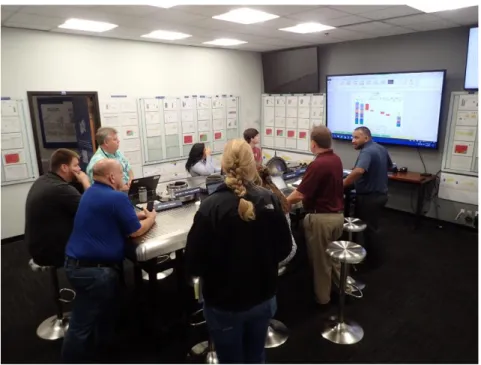
At a testament to the importance Columbus has placed on the learnings and opportunities around machine state, they have dedicated an entire 20 ft X 30 ft room, a valuable commodity in a manufacturing environment, to be the central hub of data in the facility. Each of the now 23 towers that are tracked for Machine State have a dedicated spot around the room where losses and projects are documented. Leadership teams of each area meet in the room once a week to
review their data and projects. The room is also frequently used for brainstorming sessions and after action reviews of implementations, SMED and Kaizen events, and monthly production reviews. Figure 4.1 shows an example of this room in use.
Unfortunately, the proximity of the command center to the shop floor is not ideal. The room sits in the main admin building, so operator do not pass it and see the work that is being done each day. Opportunities exist to get the shop floor more involved in the command center and are discussed in the chapter on recommendations and future work.
Figure 4.1 OEE Command Center
4.3.3 How Machine State is perceived at the shop floor level
Data collected from informational interviews with working leads and operators
throughout the shop shows that the workforce attitude towards the implementation of machine state and tracking of OEE has been generally positive. OEE was introduced to the floor as a tool that would be utilized to justify investment in additional capital. As one working lead described
it, “most operators like OEE because they can tell their side of the story of what is really going on at the press.”
While the attitude is mostly positive and accepting, each interview noted some frustration with the communication loop within the plant. One operator noted, “There is a disconnect
between supervisors and shop employees. Management is all focused on that room and operators feel smaller problems get swept under the rug.” But he went on to continue that most employees view it as a ”platform to point out problems that supervisors would normally be too busy to pick up on.”
4.3.4 Automating Machine State
Concurrent to all the processes described above to qualify this quantitative data with root causes, the core connected factory team, based out of Connecticut, was traveling down to
Columbus week after week to help validate machine event tags as they were translated over to the plant visualization platform. The process to capture this was several months of effort, but would enable the capability to communicate machine state throughout the organization and generate OEE reports that were, and are still are, being created manually. The step required to close out the process and transition to automated reporting of machine state and OEE loss drivers is collecting that qualitative data on what breakdowns were occurring and why parts are running over cycle times etc.
4.4 What Does This Mean
This chapter is meant to illustrate the effort that went into introducing the plant
management and operators to OEE as a tool and set this project up to focus on how do we use and integrate this data, rather than having to socialize what is the tool among the operations team. The following chapters describe how we implemented the data and preliminary results.
Chapter 5 Data Analysis: Transforming How
We Look at Data
This chapter outlines the current state of the CFD plant manufacturing when this analysis was started, the three phases of data integration into the management of the plant to test the hypothesis of this thesis.
5.1 Current State Model
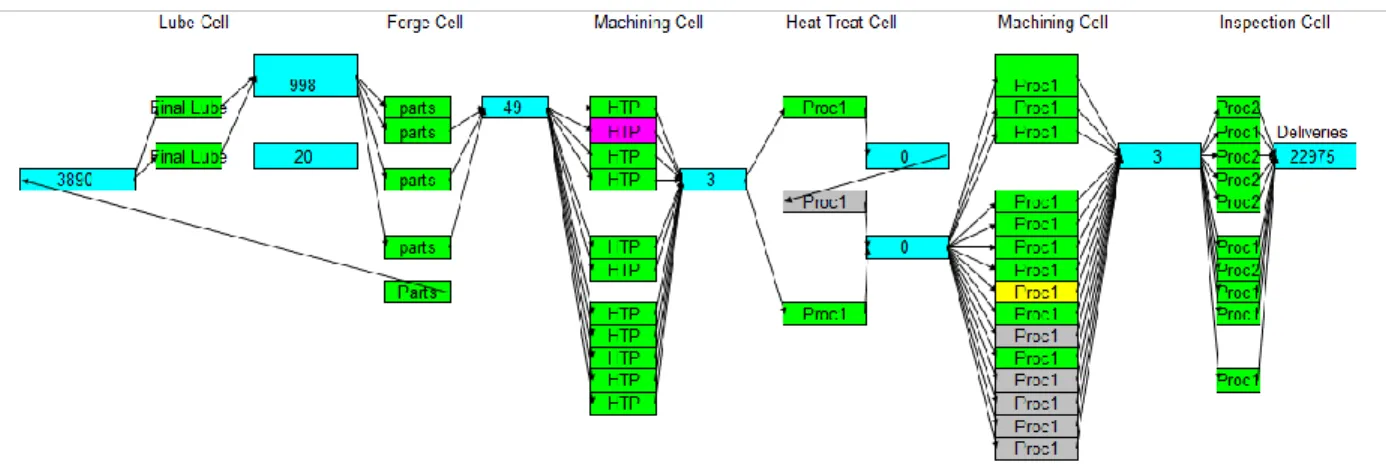
Using the data collected from the Fall of 2018-Spring of 2019, a simulation of the current state production model was constructed using CellSim. CellSim is a software built by John McClain at Cornell University which is a discrete event simulation tool. The tool runs in Excel and models machines and buffers with processing time, mean time to fail (MTTF), and mean time to repair (MTTR) distributions modeled in.[19] Maintenance log data was used to calculate MTTF and MTTR for each production cell. This data along with information on changeover times, design cycle times, and trends of performance collected from OEE tracking were used to inform adjustments to cycle times. This data was used to build a one-year simulation and produced an output for deliveries that within 0.5% of actuals for the CFD plant production in 2018. This model shows that the process bottleneck occurs at the Forge Cell, which is reinforced by the buildup of inventory prior to this step and the fact that there is no outsourcing option for this process. A snipping of the simulation output can be found in figure 5.1.
Figure 5.1 Current State CellSim Model Output
5.2 Phase 1: Retrospective Analysis
The use of OEE and analysis of machine state was a process to provide business leaders with a concrete set of data to better inform business decisions and highlight waste in the process. With several months of data to analyze and trend, CFD took an introspective look at the drivers behind OEE. The data was analyzed and interpreted in two ways, big buckets of data where losses were aggregated over many months, as well as a trend analysis that looked at week over week trends in each of the loss categories.
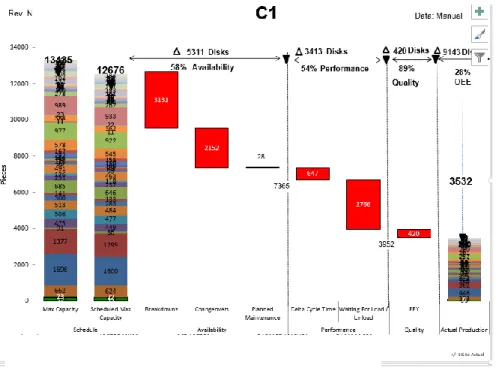
One of the team’s concerns with creating problem statements for top loss drivers each week was that smaller but persistent losses were getting overlooked. Data was aggregate together for each press, figure 5.2 and figure 5.3 are examples of the analysis for one of the presses. This analysis allowed the team to align the weekly projects to the top drivers over a longer period of time and refocus efforts on persistent problems.
Figure 5.2 Waterfall Chart of OEE Losses Over Longer Time Horizon
Figure 5.3 Pareto Charts of Losses in Each OEE Category
The second way the data was analyzed was by plotting the data on a week over week basis. This presented a startling realization that the effectiveness of the forge cell was not improving, and in fact, it was declining. A decline of 12%-30% was seen across each of the presses and displayed in figure 5.4. Further analysis showed how each of the categories used to
calculate OEE were trending. While some categories were improving others were not. As this was the first time the data had been trended since tracking of OEE and losses had begun, management was concerned.
Figure 5.4 Trend in OEE For Each Press
The team decided to take a strategic pause to evaluate what was diving this consistent decline in efficiency especially considering so much attention was being put on projects to improve efficiency. Comprehensively, it was found that many of the losses that had the biggest effects were part specific and resulted from inefficiencies from running specific parts on specific presses. An example of one of these breakdowns is displayed in Figure 5.5. This led to the need for a schedule and allocation optimization tool that is discussed in chapter 5.4.
5.3 Phase 2: Real Time Monitoring
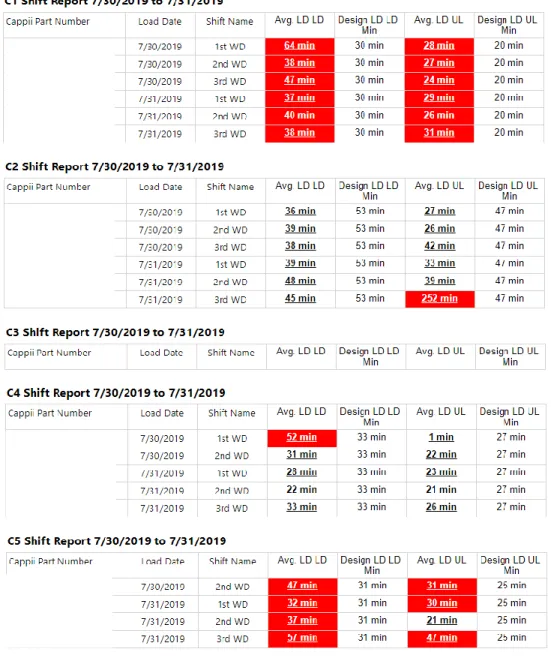
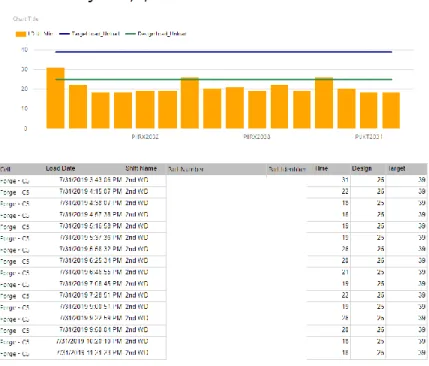
The limitation to the retrospective analysis, was that by the time losses had been identified, part runs had concluded and the operations team was focused on running new parts, while the losses that were being discussed were for parts that may not run again for several months or even a year. It is the hypothesis of this thesis that by incorporating the data that is being collected into the production process, through daily Gemba walks and production meetings, an improvement in efficiency will occur. As with the process to pull data for OEE reporting, the process started out manually. Because the data was already being collected in the database and maintained for reporting of machine state, the team was able to transition to an automated report, accessible by all operations working leads and supervisors and added to the Gemba board on the shop floor for operator to access. This report breaks down the machine time to show average load to load and load to unload cycle times by press by shift and by part number allowing each operator and each shift to be accountable for his or her performance. Figure 5.6, Figure 5.7, and Figure 5.8 show examples of these reports. Figure 5.9 shows the deployment of these reports to the floor so operators can monitor stats in real time.
Figure 5.7 Daily Shift Report Breakdown of One Part on One Shift (1)
Figure 5.9 Deployment of Forge Shift Report to the Production Floor
5.4 Phase 3: Proactive Planning
Pratt & Whitney had recently built a team dedicated to scheduling the value stream called the Integrated Business Planning team (IBP). An observer to this process may ask, why the Company is not using MRP to plan their production. Historically, Pratt & Whitney had been in a environment where orders were relatively flat year over year, or in some cases declining and they were going through capacity and footprint reduction. During this period, time to deliver an engine or spare was modeled as the time to take to produce that product. In essence, infinite capacity is modeled in the MRP system. Because the business cycle is now going through a period of expansion, the demand out of MRP is too high for the plants to meet. Projects are in place to update the ERP system and bring the inputs for the MRP system up to date. In the short to medium time horizon, the IBP team was established to prioritize and balance demand.
The team published the first schedule in September of 2018 using mixed integer linear programing to build a plan in order to optimize the entire values stream from raw materials to engine delivery, giving each node in the chain their required deliveries for the month. Because the plan gets so much visibility among executive leadership within the company, capacity that is modeled in is meant to be realistic, but conservative. Additionally, the plan developed by the IBP group did not originally give a press by press plan, just a total expected production level from the forge cell.
This gives the internal team an opportunity to build a detailed schedule by press that is a stretch goal while feeling confident that they can at least meet the plan. In order to maximize total pieces out of production in the forge cell, an optimization tool was built as part of this thesis project. More importantly, this tool allowed the CFD team to run forecasts of production given different inputs that helped better understand the effect of mix on production output. Relaying on the data gathered from the enhanced monitoring of the production processes, a tool was built using the following constraints and optimization function using mixed integer linear programing in OpenSolver:
Constants
.i=part number .j=month
.p=press
. 𝑡𝑖𝑗𝑝= Time to produce each part in each month on each press . 𝑐𝑖𝑗𝑝= changeover time for each part each month on each press . 𝑘𝑖𝑗𝑝= parts that can be made per changeover each month on each press
Decision variables
.𝑥𝑖𝑗= quantity of each part number to make each month on each press
. 𝑦𝑖𝑗= number of changeovers for each part in each month on each press
Objective Function:
Min T = ∑𝑥𝑖𝑗𝑝𝑡𝑖𝑗𝑝+ 𝑐𝑖𝑗𝑝𝑦𝑖𝑗𝑝
Constraints
For each month j, for each part i : 𝑥𝑝
𝑘𝑝, ≤ 𝑦𝑝
. 𝑦𝑖𝑗𝑝 𝑚𝑢𝑠𝑡 𝑏𝑒 𝑎𝑛 𝑖𝑛𝑡𝑒𝑔𝑒𝑟
For each month j on each press p: ∑𝑥𝑖𝑡𝑖+𝑦𝑖𝑐𝑖 ≤ 𝑡𝑖𝑚𝑒 𝑖𝑛 𝑡ℎ𝑎𝑡 𝑚𝑜𝑛𝑡ℎ
For each month j, For each part i: ∑𝑗1𝑥𝑗 ≥ 𝑝𝑎𝑟𝑡𝑠 𝑟𝑒𝑞𝑢𝑖𝑟𝑒𝑑 𝑖𝑛 𝑡ℎ𝑎𝑡 𝑚𝑜𝑛𝑡ℎ
Developing the tool and iterating though to include the caveats and nuances known by the schedulers was relatively quick and straight forward. The process to get the tool integrated in the decision making of the team was slow to adoption. The scheduler encompassed the sentiment of the plant best when describing the process. He said, “Honestly I didn’t think it could capture all the inputs for it to work and we would constantly have to double check it”
What this tool provided was better planning to reduce the number of changeovers required to meet demand. In a process where changeovers take 12-36 hours to complete and production runs last 1-5 days, reducing the number of changeovers and maxing out the life to tools can improve the efficiency of the system. The initial project was outlined by management at the end of February with a mandate to reduce changeovers by optimizing the scheduling process. The tool was built throughout March, with the first run scheduling for the month of April. While the results were looked at, it was considered as an afterthought, and the scheduler did not run the tool himself. It was during the month of May that the tool was utilized by the GM and Business Unit Manager to develop a forecast to communicate to executive management for output of the plant for the remainder of the year. As the GM described it, “The optimizer was a prioritization of demand for a final output, but the forge schedule tool optimized the forge output, and this is what helps us maximize our final output. Presenting to management, we
needed a data drive tool to make commitments rather than strictly going off gut feel. Having this tool gives us a chance to see how inputs affect the overall output at the Pratt level.”
After management’s experience with the tool successfully helped develop a forecast for the year, the business unit manager started pushing his scheduler to utilize the tool to build the month’s schedule. His encouragement helped galvanize the team to familiarize themselves with the tool and its functionality. It was my perception that the ultimate success for utilization of the tool came from top down pressure in the organization. The plant general manager and business unit manager were the first people to vocally support the tool in the operations team and my hypothesis was that their direction to the staff and operators motivated the others to get on board. To test this hypothesis, I asked the scheduler when, if ever, did he start to see value in the tool, his response was, “When we ran it and had a 95% match to my manual schedule but it brought in more volume.” While the hypothesis for why the tool had been accepted was wrong, it is
evidence that a culture open to and embracing analytics was forming.
As a testament to the tool’s success, other production cells within the plant asked for help building allocation tools for their area. For example, the last major production cell before
delivery in the plant is sonic inspection. Their schedule is typically a flow down from the previous stage in production, but they were looking for a tool to automate the decision-making process of sending parts out to vendors or running them internally and then the further
determination of which parts to running in each inspection tank. This marks a major success for the intent of this thesis project. Here the production team was asking for a tool to automate and quantify the planning process, transferring the work of developing a schedule each day across 11 different assets, from tribal knowledge in the minds of the supervisors and working leads to institutional knowledge documented in a tool and standard work. One of the most impactful
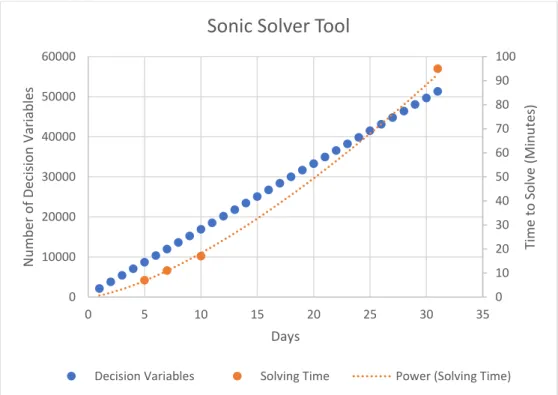
ways to illustrate the power of the tool was to show the working leads and supervisors the proliferation of the tool as we look at longer and longer time horizons. Figure 5.10 illustrates how the number of decision variables expand as the tool looks farther into the future.
Highlighting that the tool would help them gain back the time and mental effort of building a schedule each day resonated with the team. Chapter 6 analyzes the preliminary results of implementing real time data on the production floor and using optimization to plan the production schedule.
Figure 5.10 Decision Variables as a Function of Time Horizon
0 10 20 30 40 50 60 70 80 90 100 0 10000 20000 30000 40000 50000 60000 0 5 10 15 20 25 30 35 Tim e to Solv e (Minu tes ) N u m b er o f Deci sion Varia b le s Days
Sonic Solver Tool
Chapter 6 Results and Analysis
This chapter outlines the findings which demonstrate the improved efficiencies in the overall equipment effectiveness and scheduling process within the Columbus Forged Disk plant. First, we quantify the improvement gains observed within the isothermal forging cell and
compare the scheduling optimization model performance to historical data. We will then perform an analysis on the drivers of OEE demonstrating the expected gains of a shop operating at 85% efficiency in the performance metrics of OEE and complete a sensitivity analysis. Next, we will discuss the impact of mix on our findings. Finally, we discuss the impact on the operations team of the process changes within the facility.
6.1 Demonstrated Results
This section demonstrates the high-level trends we observed in OEE of each of the isothermal presses and dives into the trends of the six factors driving OEE for each of the presses. This section also highlights the improved throughput achievable if parts are scheduled on their optimal presses based on demand quantity and overall part mix.
6.1.1 Isothermal Forging OEE
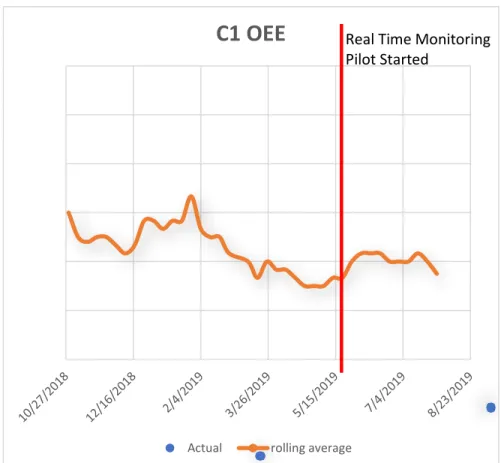
Figure 6.1-Figure 6.4 demonstrate the weekly measured performance of OEE from the time data started to be collected in November of 2018 through the end of this study in August of 2019. Positive trends in these graphs signal improvement to the OEE of the presses. The major changes to the operation’s process outlined in chapter 5, namely the review of live data in the morning production meeting, were implemented at the end of May 2019. OEE of each of the 4 presses achieves a noticeable uptick. The C1 press saw a 1% average increase in OEE comparing the weekly average OEE from April -May to that of June-July. The C2 press saw a 12% average increase in OEE comparing the weekly average OEE from April -May to that of June-July. The
C4 press saw a 2% average increase in OEE comparing the weekly average OEE from April -May to that of the end of July (C4 was down for a major maintenance event for 4 weeks between June and July). The C5 press saw a 9% average increase in OEE comparing the weekly average OEE from April -May to that of June-July.
Figure 6.1 C1 OEE Actuals November 2018-August 2019
C1 OEE
Actual rolling average
Real Time Monitoring Pilot Started
Figure 6.2 C2 OEE Actuals November 2018-August 2019
Figure 6.3 C4 OEE Actuals November 2018-August 2019
C2 OEE
Actual rolling average
C4 OEE
rolling average Actual
Real Time Monitoring Pilot Started
Real Time Monitoring Pilot Started
Figure 6.4 C5 OEE Actuals March 2019-August 2019
6.1.1.1 C1 Trends
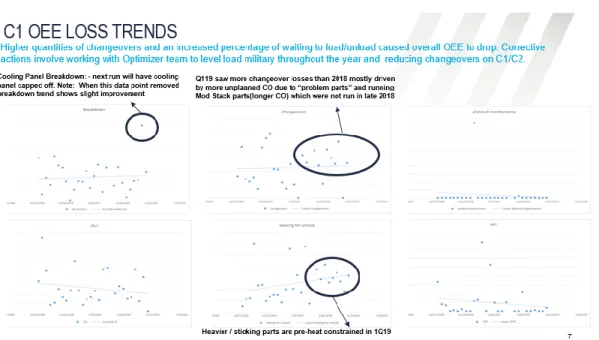
Figures 6.5-6.10 demonstrate the trend in each of the six drivers of OEE. Unlike the graphs above, negative trends denote a positive signal and highlight improvement within that category. We see a decline in the amount of time attributed to changeovers, first pass yield and delta cycle time, while the other three categories, breakdowns, waiting to load/unload, and preventive maintenance see flat to increasing percentages of time attributed to each category. The overall OEE of C1 saw slight improvement in section 6.1.1, the deeper analysis below shows the biggest difference being the amount of time spent on changeovers and delta cycle time before and after the changes were implemented. Changeovers can be influenced by the
scheduling of the presses, and more immediate intervention of the process to reduce delta cycle
C5 OEE
Actual Rolling Average
time can result from real time monitoring. These results may indicate improvement from the changes implemented and are analyzed further in sections 6.1.2 and section 6.3.
Figure 6.5 C1 Breakdown Trend Figure 6.6 C1 Changeover Trend
Figure 6.5 shows the trend in percent of time spent in breakdown week over week for C1. What is most interesting is that in the time period after the implementation of real time data analysis (end of May onward) the percent of time spent in breakdown is increasing, which suggests that improvements in other categories are being offset by more breakdowns. Figure 6.6 shows the trend in percent of time spent in changeover week over week for C1. What is most interesting is that during the months of June and July, the percent of time spent in changeover is decreasing, which suggests that results from the schedule optimization tool could be generating a positive effect. This is explored in more detail in section 6.1.2.
C1 Breakdown
Breakdown Poly. (Breakdown)
C1 Changeovers
![Figure 2.1 Cross Section of Pratt & Whitney Gear Turbofan Engine[4]](https://thumb-eu.123doks.com/thumbv2/123doknet/14455205.519464/21.918.127.797.235.647/figure-cross-section-pratt-whitney-gear-turbofan-engine.webp)
![Figure 3.3 OEE Computation and Procedure[12, p. 25]](https://thumb-eu.123doks.com/thumbv2/123doknet/14455205.519464/31.918.131.788.119.435/figure-oee-computation-procedure-p.webp)