HAL Id: hal-00973027
https://hal-sciencespo.archives-ouvertes.fr/hal-00973027
Preprint submitted on 3 Apr 2014
HAL is a multi-disciplinary open access archive for the deposit and dissemination of sci-entific research documents, whether they are pub-lished or not. The documents may come from
L’archive ouverte pluridisciplinaire HAL, est destinée au dépôt et à la diffusion de documents scientifiques de niveau recherche, publiés ou non, émanant des établissements d’enseignement et de
How do different exporters react to exchange rate
changes? Theory, empirics and aggregate implications
Nicolas Berman, Philippe Martin, Thierry Mayer
To cite this version:
Nicolas Berman, Philippe Martin, Thierry Mayer. How do different exporters react to exchange rate changes? Theory, empirics and aggregate implications. 2009. �hal-00973027�
DISCUSSION PAPER SERIES
ABCD
www.cepr.org
Available online at:
www.cepr.org/pubs/dps/DP7493.asp
No. 7493
HOW DO DIFFERENT EXPORTERS
REACT TO EXCHANGE RATE
CHANGES? THEORY, EMPIRICS AND
AGGREGATE IMPLICATIONS
Nicolas Berman, Philippe Martin
and Thierry Mayer
INTERNATIONAL MACROECONOMICS
and INTERNATIONAL TRADE AND
ISSN 0265-8003
HOW DO DIFFERENT EXPORTERS
REACT TO EXCHANGE RATE
CHANGES? THEORY, EMPIRICS AND
AGGREGATE IMPLICATIONS
Nicolas Berman, Graduate Institute of International and Development Studies
Philippe Martin, Sciences Po, Paris and CEPR
Thierry Mayer, Sciences Po, Paris, CEPII and CEPR
Discussion Paper No. 7493
October 2009
Centre for Economic Policy Research
53–56 Gt Sutton St, London EC1V 0DG, UK
Tel: (44 20) 7183 8801, Fax: (44 20) 7183 8820
Email: [email protected], Website: www.cepr.org
This Discussion Paper is issued under the auspices of the Centre’s research
programme in INTERNATIONAL MACROECONOMICS and
INTERNATIONAL TRADE AND REGIONAL ECONOMICS. Any opinions
expressed here are those of the author(s) and not those of the Centre for
Economic Policy Research. Research disseminated by CEPR may include
views on policy, but the Centre itself takes no institutional policy positions.
The Centre for Economic Policy Research was established in 1983 as an
educational charity, to promote independent analysis and public discussion
of open economies and the relations among them. It is pluralist and
non-partisan, bringing economic research to bear on the analysis of medium- and
long-run policy questions.
These Discussion Papers often represent preliminary or incomplete work,
circulated to encourage discussion and comment. Citation and use of such a
paper should take account of its provisional character.
CEPR Discussion Paper No. 7493
October 2009
ABSTRACT
How do different exporters react to exchange rate changes?
Theory, empirics and aggregate implications
This paper analyzes the reaction of exporters to exchange rate changes. We
present a model where, in the presence of distribution costs in the export
market, high and low productivity firms react differently to a depreciation .
Whereas high productivity firms optimally raise their markup rather than the
volume they export, low productivity firms choose the opposite strategy.
Hence, pricing to market is both endogenous and heterogenous. This
heterogeneity has important consequences for the aggregate impact of
exchange rate movements. The presence of fixed costs to export means that
only high productivity firms can export, firms which precisely react to an
exchange rate depreciation by increasing their export price rather than their
sales. We show that this selection effect can explain the weak impact of
exchange rate movements on aggregate export volumes. We then test the
main predictions of the model on a very rich French firm level data set with
destination-specific export values and volumes on the period 1995-2005. Our
results confirm that high performance firms react to a depreciation by
increasing their export price rather than their export volume. The reverse is
true for low productivity exporters. Pricing to market by exporters is also more
pervasive in sectors and destination countries with higher distribution costs.
Consistent with our theoretical framework, we show that the probability of
firms to enter the export market following a depreciation increases. The
extensive margin response to exchange rate changes is modest at the
aggregate level because firms that enter, following a depreciation, are smaller
relative to existing firms.
JEL Classification: F12 and F41
Keywords: distribution costs, exchange rates, exports, heterogeneity, pricing
to market and productivity
Nicolas Berman
Graduate Institute of International
and Development Studies
Case Postale 136
CH - 1211 Genève
SWITZERLAND
Email:
[email protected]
For further Discussion Papers by this author see:
www.cepr.org/pubs/new-dps/dplist.asp?authorid=166315
Philippe Martin
Sciences Po
27, Rue Saint-Guillaume
75007 Paris
FRANCE
Email: [email protected]
For further Discussion Papers by this author see:
www.cepr.org/pubs/new-dps/dplist.asp?authorid=116056
Thierry Mayer
Sciences Po
27, Rue Saint-Guillaume
75007 Paris
FRANCE
Email: [email protected]
For further Discussion Papers by this author see:
www.cepr.org/pubs/new-dps/dplist.asp?authorid=152707
*This paper is produced as part of the project European Firms in a Global
Economy: Internal policies for external competitiveness (EFIGE), a
Collaborative Project funded by the European Commission's Seventh
Research Framework Programme, Contract number 225551.
We thank Anders Akerman, Andrew Atkeson, Ariel Burstein, Giancarlo
Corsetti, Mario Crucini, Linda Goldberg, Samuel Kortum, Francis Kramarz,
Steve Redding David Weinstein and participants at the Federal Reserve Bank
of New York, Sciences-Po, CREST-LMA, Oslo university, Cesifo Summer
Institute, Banco de Portugal, Bank of Hungary, Berkeley, UCLA, Federal
Reserve Bank of San Francisco, University Nova of Lisbon and AEA, NBER
Summer Institute and ERWIT Meetings for helpful comments. We are very
grateful to Linda Goldberg who provided us the data on distribution costs.
Philippe Martin and Thierry Mayer thank the Institut Universitaire de France for
financial help.
Abstract
This paper analyzes the reaction of exporters to exchange rate changes. We present a model where, in the presence of distribution costs in the export market, high and low produc-tivity firms react differently to a depreciation . Whereas high producproduc-tivity firms optimally raise their markup rather than the volume they export, low productivity firms choose the opposite strategy. Hence, pricing to market is both endogenous and heteroegenous. This heterogeneity has important consequences for the aggregate impact of exchange rate move-ments. The presence of fixed costs to export means that only high productivity firms can export, firms which precisely react to an exchange rate depreciation by increasing their ex-port price rather than their sales. We show that this selection effect can explain the weak impact of exchange rate movements on aggregate export volumes. We then test the main predictions of the model on a very rich French firm level data set with destination-specific export values and volumes on the period 1995-2005. Our results confirm that high perfor-mance firms react to a depreciation by increasing their export price rather than their export volume. The reverse is true for low productivity exporters. Pricing to market by exporters is also more pervasive in sectors and destination countries with higher distribution costs. Consistent with our theoretical framework, we show that the probability of firms to enter the export market following a depreciation increases. The extensive margin response to ex-change rate ex-changes is modest at the aggregate level because firms that enter, following a depreciation, are smaller relative to existing firms.
1
Introduction
Movements of nominal and real exchange rates are large. They however seem to have little effect on aggregate variables such as import prices, consumer prices, and the volumes of imports and exports. The sensitivity, or rather lack of, of prices to exchange rate movements has been well documented by Goldberg and Knetter (1997) and Campa and Goldberg (2005 and 2008) who provide estimates of the pass-through of exchange rates into import prices. There is also evidence indicating a decline in exchange rate pass-through to import prices in the U.S. On the quantity side, the elasticity of aggregate exports to real exchange rate movements is typically found to be low in industrialized countries, a bit below unity for example in Hooper, Johnson, and Marquez (2000) and above unity but rarely above 2 in others studies. In international real business cycle models, the elasticity used for simulations is typically between 0.5 and 2.
One possible explanation is that prices are rigid in the currency of the export market. However, Campa and Goldberg, (2005) show that the incomplete pass-through of exchange rate changes into import prices is far from being a short-term phenomenon as it remains after one year. This suggests that price rigidities cannot fully explain this phenomenon. Moreover, Gopinath and Rigobon (2008) have recently shown on good-level data, that even conditioning on a price change, trade weighted exchange rate pass-through into U.S. import prices is low, at 22%. Another explanation is the presence of local distribution costs. These can directly explain why consumer prices do not respond fully to exchange rate movements. Corsetti and Dedola (2007) show that with imperfect competition, distribution costs may also explain why import prices themselves do not respond much to exchange rate movements. In this paper, we show that the heterogeneity of the optimal response of exporters to exchange rate movements can help explain the lack of response of aggregate variables (prices and quantities) to these movements. We show theoretically and empirically that high and low performance firms react very differently to exchange rate movements. We interpret performance in terms of productivity or, in an alternative version of the model, in terms of quality. Whereas, following a depreciation, high performance firms optimally raise their markup rather than the volume they export, low performance firms choose the opposite strategy. Another way to state this result is that high performance firms absorb exchange rate movements in their markups but low performance firms do not. The reason is that, due to local distribution costs, the demand elasticity perceived by high performance firms is lower than the elasticity perceived by low performance ones. This heterogeneity is a novel finding and is also interesting because of its implications for aggregate effects of exchange
rate movements. In our model, following the spirit of Melitz (2003), fixed export costs generate a selection mechanism through which only the best performers are able to export. Also, heterogeneity in productivity implies that a very large share of aggregate exports is made by a small portion of high performance firms. Hence, exporters, and even more so big exporters, are, by this selection effect, firms which optimally choose to absorb exchange rate movements in their markups. A depreciation also leads new firms to enter the export market but these are less productive and smaller than existing ones. We show that our model, with sufficient heterogeneity in productivity, can indeed reproduce the observed low level of the elasticity of the intensive and extensive margins of trade to exchange rate movements.
The model produces testable implications on the heterogeneity of the sensitivity of firm level export prices and volumes to exchange rates. We test these predictions on a very rich firm-level dataset. We collected information on firm-level, destination-specific export values and volumes from the French Customs and other information on firm performance at annual frequency. This is the same source as the one used by Eaton, Kortum, and Kramarz (2008) for the year 1986. We use this data set for a longer and more recent period (1995-2005) so that we can exploit variation across both years and destinations1. To our knowledge,
our paper is the first to exploit such detailed data to document the reaction of firms to exchange rate movements in terms of prices, quantities, entry and exit and to analyze how different firms react differently to exchange rate movements. A big advantage of our dataset is that we have information that can proxy for the FOB price at the producer/destination level. We can infer the impact of a depreciation on the pricing strategy of the exporter. Our paper is therefore complementary to existing studies on pricing to market and pass-through which use information that proxies pricing strategies of exporters pass-through import prices2 (which contain transport costs) or consumer prices3 (which also contain distribution
costs). We first show that firms with performance (measured by TFP, labor productivity, export size, number of destinations) above the median react to a 10% depreciation by increasing their (destination specific) export price in euro by around 2%. In contrast, those firms below median performance do not change export prices in reaction to a change in exchange rate. Hence, only high performance partially price to market and partially absorb exchange rate movements in their mark-ups. On export volumes (again destination specific), the reverse is true: for the best performers export volumes do not react to exchange rate
1Berthou and Fontagné (2008a, and b) use this same data set to analyze the effect of the creation of the euro on the exports of French firms.
2See for example Gopinath and Itskhoki (2008), Gopinath, Itskhoki and Rigobon (2009), Halpern and Koren (2008).
movements but poor performers react by increasing their export volumes by around 6%. We also find that, following a depreciation, French exporters selling in sectors and countries with high distribution costs, choose to increase their mark-up rather than their export volumes. Distribution costs in the destination market therefore change the pricing strategy of exporters towards more pricing to market. Again, this is consistent with our theoretical framework and with the model of Corsetti and Dedola (2007).
To our knowledge, our paper is also the first to document the impact of exchange rate changes on entry and exit in different destinations. The model predicts entry of firms follow-ing a depreciation4 We find that this is indeed the case for French firms and, surprisingly,
that this entry takes place relatively quickly, within a year. The extensive margin represents around 20% of the total increase in exports. However, because the new entrants are on average smaller than existing exporters, the extensive margin of exchange rate movements on exports has a limited effect at the aggregate level.
Consistently with the existing literature, we find that the aggregate elasticity of exports to exchange rate is low, a little bit above unity. We show that with sufficient heterogeneity and plausible distribution costs margins, our model, in the absence of nominal rigidities, can reproduce the observed low aggregate elasticities at both the intensive and extensive margins. Empirically, and consistent with the key role of heterogeneity in our model, we also find that sectors with more heterogenous firms are those for which aggregate export volumes are the least sensitive to exchange rate movements.
At the origin of our results is the interaction between two key elements recently em-phasized by the international trade and macroeconomics literatures. The first element is productivity heterogeneity across firms which has been theoretically analyzed by Melitz (2003) and Chaney (2008) in the trade context. Several papers have documented the fact that firms that export have higher productivity and perform better than other firms more generally (see for the French case, Eaton, Kortum, and Kramarz (2004 and 2008)). This is due to the existence of fixed costs of exports that allows only high performers to export. Moreover, a very large share of exports is concentrated on a small number of firms, the best performers among the exporters (see Bernard, Jensen, Redding and Schott 2007 and Mayer and Ottaviano, 2007). The second element is local distributions costs that have to be paid by firms to reach consumers. Evidence of the significance of these costs have been found by Goldberg and Campa (2008) and previously emphasized by Anderson and Van Wincoop (2004) among others; they are generally found to constitute a 40 to 60 percent
4Bernard, Eaton, Jensen and Kortum (2003), in a theoretical model with firm heterogeneity, entry and exit find that an appreciation leads some of the firms to stop exporting.
share of consumer prices. Burstein, Neves, and Rebelo (2003) report that distribution costs represent more than 40 percent of the retail price in the US and 60 percent of the retail price in Argentina. We show in this paper that the interaction of firms’ heterogeneity and local distribution costs generate heterogenous optimal response to exchange rate changes in terms of prices (heterogenous pricing to market) and quantities.
Our paper is related to the literature on incomplete exchange rate pass-through and pricing to market. A recent paper by Auer and Chaney (2008) shows that the pass-through can be incomplete and heterogeneous across goods of different quality in a model with heterogenous consumers. Our paper is also related to the papers (Corsetti and Dedola, 2007 and Atkeson and Burstein, 2008) which have analyzed the impact of distribution costs on the extent of the pass-through. Indeed, in our model, local distribution costs directly lower the pass-through to consumer prices but also generate variable producer mark-ups as in Corsetti and Dedola (2007) that further reduce the pass-through.
Burstein, Neves, and Rebelo (2003) analyze the role of nontradable distribution costs in accounting for the behavior of international relative prices. and show that because distribu-tion services require local labor, they drive a natural wedge between retail prices in different countries. Burstein, Eichenbaum, and Rebelo (2005) show that distribution costs are also key to understand the large drop in real exchange rates that occurs after large devaluations. In the theoretical contribution of Atkeson and Burstein (2008), distribution costs also play an important role to explain deviations from relative purchasing power parity in a model with imperfect competition and variable markups. The model they present is the closest to ours because they show that in the presence of trade costs and imperfect competition large firms have an incentive to price to market. Hence, heterogeneity across firms features prominently in their analysis of pricing to market and deviations from PPP. Different from Atkeson and Burstein (2008), we focus on both prices and quantities and the mechanism we analyze in our theoretical contribution depends on the interaction between heterogeneity in productivity and local distribution costs. In addition, we test our predictions on a very detailed firm-level dataset for both prices and quantities. Our empirical results on prices are consistent with several aspects of their theoretical model, in particular the fact that firms differ in the degree to which they price to market and that this heterogeneity may have important aggregate consequences. Two other related papers are Dekle, Jeong and Ryoo (2007) and Imbs and Mejean (2009) who show that the aggregation of heterogenous firms or sectors can result into an aggregation bias in the estimation of the elasticity of exports to exchange rate changes. Their firm and sector level analysis concludes that estimates of the elasticity parameter at the firm or sector and at the (consistently) aggregated levels are
similar.
There are few empirical contributions on pricing to market, exchange rate and export flows using exporter-level data5. Martin and Rodriguez (2004) find that Spanish firms do react to a depreciation by raising their mark up. Hellerstein (2008) uses a detailed dataset with retail and wholesale prices for beer and finds that markup adjustments by manufac-turers and retailers explain roughly half of the incomplete pass-through whereas local costs components account for the other half. Gaulier, Lahrèche-Révil and Méjean (2006) show, using product-level data, that pricing to market is more pervasive when the goods are traded on referenced markets and for final consumption goods. Their study stresses strong hetero-geneity in pricing to market across products. Bernard, Jensen an Schott (2006) show that multinationals differentially adjust their prices inside and outside the firm in response to exchange rate movements. Fitzgerald and Haller (2008) use an Irish firm level data set and show that, conditioning on goods being invoiced in destination currency and observing a price change, mark-ups move one-for-one with movements of the exchange rate. However, these studies do not analyze how and why different firms react differently to an exchange rate movement and how their sales and entry/exit decision are affected which is the focus of our paper. Using British data, Greenaway, Kneller and Zhang (2007) analyze the exporter status choice following exchange rate variations but they do not have information on export destination, nor on the pricing strategy of firms.
The paper is organized as follows. We derive the main theoretical results and predictions in the next section. Section 3 presents the data set, the empirical methodology and the main findings. Section 4 concludes.
2
Theoretical framework
2.1
Preferences and technology
We analyze a simple model in which heterogenous firms of a country (called Home) export to countries. The aim is to derive testable implications concerning the impact of ex-change rate movements on exporters behavior. In the empirical section, where we test those
5Other papers analyze different aspects of firms reactions to exchange rate shocks. Gourinchas (1999), evaluates the impact of exchange rate fluctuations on inter- and intra-sectoral job reallocation. The pa-per investigates empirically the pattern of job creation and destruction in response to real exchange rate movements in France between 1984 and 1992, using disaggregated firm-level data and finds that traded-sector industries are very responsive to real exchange rate movements. Ekholm, Moxnes and Ullveit-Moe (2008) study firms’ response to the appreciation of the Norwegian Krone in the early 2000s with respect to employment, productivity, and offshoring.
implications, the exporter country will be France. For notational simplicity, given that we concentrate on one exporter country (Home), we drop subscripts that describe this country. There is only one sector which operates under monopolistic competition.
The origin of the movements in the bilateral real exchange rates with each countries will be left exogenous but could be made endogenous either by introducing monetary shocks that move the nominal exchange rate under the assumption of rigid nominal wages or pro-ductivity shocks in a non tradeable sector. Corsetti and Dedola (2007) analyze both in a general equilibrium model. Ghironi and Melitz (2005) and Atkeson and Burstein (2008) focus on productivity shocks. We prefer to remain agnostic on the origin of real exchange rate movements in short-medium term horizon (around one year) on which we will focus in the empirical section. One reason is the failure of the empirical literature to find an im-portant role for fundamentals (monetary or real) to real exchange rate movements on this horizon. Another is that one aim of our model is to derive testable implications of the effect of exchange rate movements at the firm level, a level at which we can take these movements as exogenous.
Utility for a representative agent in country is derived from consumption of a continuum of differentiated varieties in the standard Dixit-Stiglitz framework:
() = ⎡ ⎣Z ()1−1 ⎤ ⎦ 1 1−1 (1) where () is the consumption of variety . Firms are indexed by which represents their productivity (1 is the number of units of labor necessary for producing the good). As will be seen below, also affects the fixed cost of production in the country where the firm is located. The set of traded varieties is . The elasticity of substitution between two varieties is 1
We assume that several trade costs impede transactions at the international level: an iceberg trade cost, a fixed cost of exporting and a distribution cost.
First, we assume an iceberg trade cost 1 between Home and country , the
desti-nation country. units of the good are produced and shipped but only one unit arrives at
destination.
Second, in order to export in country , a firm producing in the Home country must pay a fixed cost, specific to each destination (). We will characterize the specific form of this
fixed cost when we analyze the effect of exchange rates on the extensive margin of trade as this specific form does not affect the intensive margin of trade.
destination country on the amount that reaches the destination. Distribution takes units of labor in country per unit consumed in that country. Hence, we follow Tirole (1995), (p. 175) characterization of distribution: "production and retailing are complements". This is the same assumption as in Burstein, Neves and Rebelo (2003) and Corsetti and Dedola (2007). The wage paid in distribution is the same as in the production sector. We assume that the cost of distribution does not depend on the idiosyncratic productivity of the firm. Again, this means that the distribution costs are outsourced. Those costs are paid to an outside firm that provides distribution services. If a French firm exports to the US, we therefore assume that what it pays in distribution services (to wholesalers and retailers) does not depend on its productivity. Any additive cost (transport, marketing, advertising, insurance...) -not substitutable to production - paid in local currency and which does -not depend on the productivity of the exporter would have the same impact as the distribution costs we assume here. Qualitatively, our results would remain if these distribution costs depended on the firm’s productivity, as long as they react less to productivity than production costs.
In our model, the costs that depend directly on productivity are at the core of what defines a firm and a product: these are the production costs and the share of the fixed cost of exporting that is borne in the country where the firm is located.
In units of currency of country , the consumer price
() of a variety exported from
Home to country is:
()≡()
+ (2)
where () is the producer price of the good exported to expressed in Home currency.
is the wage rate in country and is the nominal exchange rate between the Home
country and country expressed as Home currency in units of currency. An increase in
is a depreciation in the Home currency vis a vis currency . The quantity demanded in of this variety is:
() = −1[()]− (3)
where is the income of country and is the price index in country . The cost
(in units of currency of the Home country) of producing () units of good (inclusive of
transaction costs) and selling them in country for a domestic firm with productivity is: () = () + () (4)
where is the wage rate in the Home country. will be more generally interpreted as a measure of the performance of the firm that can affect its sales and its presence on markets.
The profits (in units of currency of the Home country) of exporting this variety to country are therefore given by:
() = [()− ]()− () (5)
2.2
Prices and the intensive margin
With monopolistic competition on the production side, the producer price () expressed
in Home currency of firm/variety exporting to country is higher than
−1, the standard
mark-up in the monopolistic competition model:
() = − 1 µ 1 + ¶ = () (6)
where we call ≡ the real exchange rate of the Home country with country .
The mark-up () over the marginal cost increases with the productivity of the firm and
the exchange rate6. Due to high productivity and low producer prices, a large share of the
final consumer price does not depend on the producer price so that the elasticity of demand perceived by the producer is lower. The producer price can be rewritten as a function of this perceived elasticity () :
() = () ()− 1 where () = + + 1 (7)
() is lower than , the elasticity in the standard monopolistic competition model. High
productivity firms (high ) have a lower elasticity which explains their higher mark-up. A depreciation (higher ) also reduces the perceived demand elasticity which allows all firms
to increase their markup. High productivity firms, because they have a lower elasticity to start with, can increase their markup more than others.
Note that the law of one price does not hold: the producer price of the same variety sold in different countries depends on the bilateral exchange rate, trade and distribution costs and the wage rate of this country. The impact of a depreciation on the producer price is given by the following elasticity, specific to each firm:
() = () () = + (8)
6Bergin and Feenstra. (2000, 2001, 2009) show that producer mark-ups also increase with a depreciation in a model with translog preferences. Atkeson and Burstein (2008) show the same result in a model with quantity competition à la Cournot. In a model with decreasing returns to labor rather than the linear production function we assume, firms would also react to a depreciation by increasing producer prices. This is because their marginal costs increase with production. However, in the absence of distribution costs, the elasticity of the producer price to exchange rate would not depend on productivity.
Testable Prediction 1. The elasticity of the producer price, () to a real depreciation
(an increase in ) is positive and
i) increases with the productivity of the firm , the size of its exports and more generally its performance on exports markets.
ii) increases with the importance of local distribution costs iii) increases with the level of the real exchange rate
The mark-up increases with a depreciation because distribution costs involve some en-dogenous pricing to market as explained by Corsetti and Dedola (2007). Firms partially absorb some of the exchange rate change in the mark-up. (), which can be thought as a
measure of pricing to market, which here is heterogenous and increases with the productiv-ity of the exporter. The productivproductiv-ity of a firm affects positively the size of its exports and the number of markets it exports to (see below). Hence, the elasticity of the producer price to a real depreciation should increase with these measures of export performance. These predictions also hold in a version of the model presented in appendix in which firms differ in the quality of the goods they export. In this case, firms that export higher quality goods (and have higher value added per worker) react to a depreciation by a larger increase of their producer price.
Firms that export in countries and sectors with higher distribution costs should react to a real depreciation by increasing more their producer prices. This is because the elasticity of demand perceived by the producer is lower on those markets.
Finally, the reason for prediction (iii) is that the share of the price affected by the exchange rate decreases with the exchange rate itself. In fact, a depreciation acts as a productivity gain for all firms and — exactly as a productivity gain — it increases the share of the distribution costs in consumer prices and reduces the elasticity of demand perceived by the producer. The effect of a real depreciation is therefore non linear.
The import price and the consumer price (expressed in the currency of country ) are:
() = () = − 1 µ + ¶ ; () = − 1 µ + ¶ (9) so that there is incomplete pass-through of a depreciation at the level of both import and consumer prices. Part of the lack of response of the consumer price to exchange rate comes directly from the presence of local distribution costs and part comes from the change in the mark-up of the producer as a response to the exchange rate change7. The optimal
degree of pass-through on prices at the import and consumer levels are respectively:
7Hellerstein (2008) work on the beer market estimates that half of the lack of complete pass-through in this market is due to changes in mark-up and half to local distribution costs.
() () =− + ; () () =− + (10) and decreases with both the importance of the distribution cost and the productivity of the firm. Note that in our model, we do not consider the choice of currency of invoicing but the optimal choice of the degree of pass-through is implicitly similar to such a choice. If the elasticity in (10) for both the import and consumer price approaches -1, this is similar to producer currency pricing. At the other extreme, if it approaches zero (for example, for very high productivity firms and or distribution costs), this is similar to local currency pricing.
For an active exporter, the volume of exports increases with productivity:
() = −1 ∙ + ¸− − µ − 1 ¶ (11) where is the ideal price index in country :
= Ã X =1 Z ∞ ∗ h − 1 ³ + ´i1− () !−1(−1) (12) where is the bilateral real exchange rate of country and and the bilateral
trade cost. Note that as in Chaney (2008), we assume that the number of entrepreneurs who get a productivity draw is proportional to the population size in country Only
firms with productivity above ∗ in country can export in country . Note that the
price index for country depends on the bilateral exchange rates of country with all its trade partners. In this perfect price index, a measure of the effective real exchange rate of the country appears in the second part of the bracket (in a very non linear way). More precisely, it is the weighted sum of real bilateral exchange rates of country with all its trading partners. The weights depend in particular on the number of exporters which is proportional to the number of workers. Hence an effective exchange rate appreciation of country that decreases leads to a fall of the volume of exports from an exporter of the
Home country. We will assume that the Home country is too small for its bilateral exchange rate to affect the price index of country .
We can now analyze the impact of a change in the bilateral real exchange rate on the volume of exports between the Home country and country , characterized by the following elasticity, specific to each firm:
() = () () = + (13)
Testable Prediction 2. The elasticity of the firm exports, () to a real depreciation
(an increase in ) is positive and
i) decreases with the productivity of the firm , the size of its exports and more generally its performance on exports markets
ii) decreases with the importance of local distribution costs iii) decreases with the level of the real exchange rate
The intuition of these predictions on export volumes comes directly from the intuition on producer prices. Heterogenous absorption of real exchange rate movements into mark-ups generates an heterogenous reaction of export volumes. Again, these results hold in a version of the model presented in appendix in which firms differ in the quality of the goods they export.
The elasticity of the value of exports (in Home currency) to exchange rate change of a firm with productivity is the sum of the elasticities given in (8) and (13). It can be checked that the elasticity of the value of exports to decreases with the productivity of the firm
as long as 1 i.e. the relevant case in our model.
2.3
Profits and the extensive margin
The equilibrium profits for an active Home country exporter to country can be shown to be:
() = ()() − () (14) = − −1 ∙ + ¸1− − ()
where ≡ −(− 1)−1 is a constant. We now specify the fixed export cost
(). We
assume that workers in both countries are employed to pay this fixed cost which might be interpreted as research and development, innovation, adaptation to the market or marketing expenses. We assume that firms with higher productivity in production activities are also more productive in activities (R&D, innovation, marketing expenses...) necessary to provide the fixed cost. The production function for the fixed cost to export is more general than in the existing literature because we allow for it to be partly incurred in the destination country, for example in the case of marketing costs. It is expressed as a Cobb-Douglas in labor of the Home country and labor in country , with shares and 1− respectively:
() = µ ¶ ()1−= −1− (15)
where 0 This specification implies that the productivity parameter that characterizes
the firm affects its fixed cost only in the country where production is located. Implicitly, this means that the share of fixed costs paid in the foreign country is outsourced.
One can show that profits increase with a real depreciation. Partly this is because sales increase in country and partly this is because the mark-up of exporting to country increases with the depreciation.
The threshold such that profits of a firm ∗
exporting in are zero is (implicitly) defined
by the following cutoff condition: −−1 ∙ ∗ + ¸1− = (∗)− (16)
Below the threshold productivity ∗, firms are not able to export on market . Exporters are higher productivity firms as in Melitz (2003). Given that we showed in the previous section that higher productivity firms choose to absorb more of the exchange rate movements into their mark-up, this implies that exporters are firms which, by selection, are less sensitive (in terms of their export volumes) to exchange rate movements than other firms.
Note also that if we rank markets by their size or fixed cost, higher productivity firms will export to more markets.
Using equation (16), the elasticity of the threshold productivity to exchange rate move-ments is: ∗ = ∗ ∗ =−1 (17)
The threshold decreases with a depreciation because it allows firms that were not productive enough to sell enough and be profitable to enter the market. Given that a depreciation reduces the productivity threshold, we should also observe that a depreciation reduces the average productivity of firms exporting to this destination.
2.4
Aggregate exports
We denote () the cumulative distribution function of productivity (symmetric in all countries). Hence, in quantity terms, aggregate exports from the Home country to country are given by the sum of all individual exports of firms with productivity above the threshold ∗ : = ∞ Z ∗ ()() = ∞ Z ∗ −1 µ − 1 ¶−∙ + ¸− () (18)
The elasticity of aggregate exports to exchange rate shocks can be decomposed into the intensive and extensive elasticities as follows:
= ∞ Z ∗ () () | {z } − (∗)0(∗) × ∗ | {z } (19)
The first term represents the increase in exports that comes from existing exporters. The second term is the increase in exports due to entry of new exporters and is also positive (as
∗
0).
We now want to check whether our model can broadly reproduce the low elasticity of aggregate export to exchange rate movements. What are we attempting to replicate? In the literature on the effect of exchange rate on aggregate exports, a typical elasticity is around unity or a bit above unity. As explained in the empirical section below, we find a similar elasticity, more precisely 111 (see column 1, table 7, section 3.4), for the French yearly data we use. With firm level data and information on exports for each destination and for each year, we can disentangle the change of aggregate exports that comes from existing exporters for a specific destination and the change that comes from the entry or exit of exporters on this destination8. We can therefore compute the intensive and the extensive
margin elasticities. In column 1 of table 8 (section 3.4), we estimate the intensive elasticity to be 088 for French exporters The extensive margin is therefore 023. These are the three elasticities that we attempt to replicate in our model. Note that the extensive margin - even though small in absolute value- is non negligible as it represents around 20% of the total change in aggregate exports in the year following an exchange rate movement.
We assume a Pareto distribution for productivity of the form () = 1− −, () =
−−1where is an inverse measure of productivity heterogeneity. We calibrate the model
around a symmetric equilibrium where = , = = = 1.
Hence, = ∞ Z ∗ [+ ]−−1−−1 ∞ Z ∗ [+ ]−−−1 | {z } + [+ ∗]−∗− ∞ Z ∗ [+ ]−−−1 | {z } (20)
It can be shown that9:
= (21)
8In these estimations, we control for the GDP, GDP per capita as well as the effective real exchange rate of the destination country, a destination sector fixed effect as well as a year fixed effect.
9To see this, note that:
[+ ∗]−∗−= ∞ ∗ [+ ]−−1− + (− ) ∞ ∗ [+ ]−−−1
the same aggregate elasticity that Chaney (2008) obtains for the effect of a fall in trade costs . However, the decomposition is different from Chaney (2008). In his model, the intensive
elasticity is and the extensive elasticity is − . It can be shown that in our model, the intensive elasticity is smaller than and that the extensive elasticity is larger than − .
We take a value of 12 for so that iceberg trade costs are 20% Distribution costs are
assumed to be a constant share of the average consumer price in country . Burstein,
Neves, and Rebelo (2003) provide evidence on the size of distribution margins using data for two countries, the United States and Argentina, concluding that local distribution services (expenditures on transport, wholesale and retail services, marketing, etc.) account for at least half of the retail prices of consumer goods, and an even higher share of tradable agricultural products. Goldberg and Verboven (2001) concluded that local costs account for up to 35 percent of the price of a car. Goldberg and Campa (2008) report distribution expenditure shares, which average 32 to 50 percent of the total cost of goods. We choose a share = 05 when we interpret local distribution costs as including all local costs. Note
that if we assume that part of the transport costs are additive and do not depend on the exchange rate, this is similar to an increase in distribution costs in the model. We also report the results for a stricter definition of distribution costs for which we choose a share of 03
The elasticity is evaluated around an equilibrium where ∗ is such that ( ∗) = (∗) = 08 so that 20% of firms in the Home country export to country , approximately what is observed in France. Fixing the proportion of firms that export determines ∗ so that
the parameter does not affect the intensive or extensive elasticities as it does not affect the elasticity of the threshold productivity to the exchange rate (see equation (17)). Finally, we assume that home country exporters have a negligible impact on the foreign country’s price index10.
The Pareto distribution parameter has been estimated on French firms by Mayer and Ottaviano (2007) using the methodology proposed by Norman, Kotz and Balakrishnan (1994), and the results always range between 1.5 and 3. These estimations are for firms that are either exporters and non exporters but with more than 20 employees. This last restriction means that the relevant heterogeneity in our model is underestimated as our model does not restrict firm size. When we use our own data - which also includes firms with less than 20 employees - to evaluate the Pareto distribution parameter, we get a number around one. We thus choose = 15 as a benchmark and report results for a lower value = 1 and higher value = 2 For , the elasticity of substitution, we take as our benchmark a high value of 7. In Romalis (2007) as well as in Imbs and Mejean (2008), and more generally
in studies using industry-level rather than macro data, elasticities of substitution between domestic and foreign varieties are estimated to be between 4 and 13 in the case of Romalis. In a standard monopolistic trade model, the elasticity of aggregate exports to exchange rate movements is . A high value of means that the predicted aggregate elasticity is much too high. We want to see if our model is able to generate a low aggregate elasticity even though we choose a high elasticity of substitution. We also report the results for = 4 Note that contrary to the literature on firm heterogeneity (see Chaney (2008) for example), our model does not restrict parameters such that − 1. We can have low values of (high degrees of firm heterogeneity) because the size distribution of exports has finite mean even with low values of relative to due the presence of local distribution costs which do not depend on the productivity of the firm.
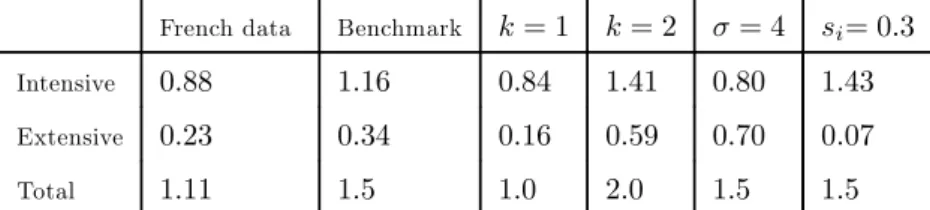
In table 1, we report the results of our calibration. In our benchmark calibration ( = 7; = 15; = 05), we find that both the intensive margin and the extensive margins are
low even though a bit higher than in the data. The exporter with the lowest productivity ∗
and the lowest export volume has the highest intensive elasticity (at around 1.5). The
other more productive and larger exporters have a lower elasticity. The aggregate elasticity is = 15 versus 1.11 in the data. Remember that in standard macro models without distribution costs, heterogeneity, entry/exit, this elasticity would be equal to the elasticity of substitution between domestic and foreign goods, in this specific case 7, hence much too high with respect to the observed 111 In a model such as Melitz (2003) or Chaney (2008) with heterogeneity, entry and exit but without distribution costs, it is easy to check that the intensive elasticity is , much too high also with respect to the observed 088. Hence, in our model, distribution costs are key to produce a low intensive elasticity.
Increasing heterogeneity (with a lower ) means that both the intensive and extensive margins fall. A Pareto parameter around 1 generates results very close to the data11.
Re-member that in our data the Pareto parameter is actually estimated to be around 1. With more heterogeneity, the intensive margin falls because a larger share of exports is made by a few very productive and very large firms which prefer to increase their markup rather than their export volumes following a depreciation. The extensive margin also falls because firms that enter the export market following the depreciation are much less productive and smaller than those already on the market so that their impact on the aggregate elasticity is small. With a low level of heterogeneity (high value of ), the aggregate elasticity be-comes very large and very different from the data: heterogeneity of firms performance is a
1 1To replicate exactly the French data, we obviouly need to choose = 111 With = 7, a share of distribution costs equal to 47% of the final price enables us to exactly match the two elasticities.
key ingredient to explain the low aggregate elasticity of export volumes to exchange rate changes.
A lower elasticity of substitution reduces the intensive elasticity. There are two opposite effects. On the one hand, firms have more incentive to price to market as their export volumes respond less to a change in relative price (see equation (13)). On the other hand, with a lower elasticity, more productive firms have a smaller export share and these are the firms that react to a depreciation by increasing their mark-ups rather than their sales. The extensive margin increases with a lower The reason is that firms that enter following a depreciation are less productive. With a low , this low productivity is not such a severe disadvantage. Finally, when the share of distribution costs in consumer prices is lowered to 03, the intensive margin increases but the extensive margin decreases. The first result comes from the fact that with lower distribution costs, pricing to market becomes less profitable. The second result comes from the fact that with lower distribution costs (which do not depend on productivity), the productivity disadvantage of the new entrants is more pronounced.
Table 1: Calibration of aggregate export elasticities to exchange rate
French data Benchmark = 1 = 2 = 4 = 03
Intensive 088 116 084 141 080 143
Extensive 023 034 016 059 070 007
Total 111 15 10 20 15 15
Hence, overall these simulation results are consistent with the data. In particular, they are much closer to the low observed intensive and extensive elasticities than what models without heterogeneity or distribution costs would produce. The interaction of both ingre-dients is key for our story. If exporters are selected and concentrated among the most productive firms because of the presence of a fixed cost to export, and there is sufficient heterogeneity among firms, then exporters are firms for which export volumes are optimally insensitive to exchange rate movements due to the presence of distribution costs. We claim that this may explain why, at the aggregate level, the intensive elasticity of exports to ex-change rate is small. Furthermore, with sufficient heterogeneity, firms that enter following a depreciation are small so that their effect in the aggregate is also small. Our model is therefore able to rationalize the weak observed reaction of aggregate exports to exchange rate movements. A key ingredient for this result to hold is the heterogeneity of firms in their reaction to exchange rate movements. We test the empirical validity of this mechanism in the next section.
3
Empirics
3.1
Data
We test the predictions of the model using a large database on French firms. The data comes from two different sources:
1) the French customs for firm-level trade data, which reports exports for each firm, by destination and year. This database reports the volume (in tones) and value of exports by 8-digit product (combined nomenclature) and destination, for each firm located on the French metropolitan territory. It does not report all export shipments. Inside the European Union (EU), firms are required to report their shipments by product and destination country only if their annual trade value exceeds the threshold of 150,000 euro. For exports outside the EU all flows are recorded, unless their value is smaller than 1000 euros or one ton. Even though the database is not comprehensive, in practice, those thresholds only eliminate a very small proportion of total exports.
2) A balance sheet dataset called BRN which contains other relevant firm-level infor-mation, including firms’ total turnover, size, sector, and other balance-sheet variables. The period for which we have the data is from 1995 to 2005. The BRN database is constructed from mandatory reports of French firms to the tax administration, which are in turn trans-mitted to INSEE (the French Statistical Institute). The customs database is virtually exhaustive, while the BRN contains between 650,000 and 750,000 firms per year over the period - around 60% of the total number of French firms. A more detailed description of the database is provided by Biscourp and Kramarz (2002) and Eaton, Kortum and Kramarz (2004). After merging the two sources, more than 90% of French exporters are still present in the database. Finally, macroeconomic variables come from the Penn World tables and the IMF’s International Financial Statistics.
We restrict the sample in several ways. Given that we proxy the export price by the export unit value (the ratio of the export value to volume to a specific destination), we need to be sure that an increase in this export unit value does not come from an increase in the number of products exported to a destination. We therefore choose to restrict our analysis to single-product exporters for which this problem does not exist. However, as our database also contains firm-level export information at the product-level (Combined Nomenclature 8 Digits, 10,000 products), we also run robustness checks using product-specific information on the entire sample. Second, the results presented here contain only non Eurozone destinations, to focus on destinations characterized by a sufficient level of
variance of the real exchange rate. We have checked that our results are robust to the inclusion of Eurozone destinations.
Table 2 contains some descriptive statistics. We only report information on positive export flows, i.e. only firms which export at least one time during the period appear here. The total number of exporters is equal to 175,496, which corresponds to a number of ex-porters per year comprised between 90,000 and 100,000. This lowest number demonstrates the important turnover in the export market already emphasized, among others, by Das, Robert and Tybout (2007). Restricting the sample to single product observations reduces the number of observations but most of the exporters remain in the database (164,479) since most of the exporters are single-product toward at least one destination/year. In the same way, restricting the database to non Eurozone countries results in a moderated loss in the number of exporting firms (148,356 in that case). Note also that firms in the restricted sample are comparable to those of the entire sample in terms of value added per worker.
Nb. Obs. Nb firms Mean Median 1st quartile 3rd quartile
ALL OBSERVATIONS
Nb Employees 4010101 165993 260 36 11 120 VA / L 3931378 162154 81.65 51.99 37.87 111.05 Number of destinations 4248713 175496 14.8 12 5 22 Number of products by dest. 4248713 175496 4.03 2 1 4
SINGLE-PRODUCT OBS.
Nb Employees 1852521 154216 164 27 9 78 VA / L 1812482 150548 73.45 50.15 36.6 72.04 Number of destinations 1986168 164479 6.4 2 5 9
SINGLE-PRODUCT, NON EURO
Nb Employees 1183693 138416 187.7 30 9 91 VA / L 1156355 135084 76.77 50.86 37.1 73.15 Number of destinations 1275684 148356 4.76 3 2 7
TABLE 2: DESCRIPTIVES STATISTICS
3.2
Firm-level Methodology
Our first testable prediction is that firms of the Home country (France) react to a currency depreciation by increasing their production price, and the more so the higher the perfor-mance of the firm. Recall the expression of producer prices in Home currency (euro), (6) for goods exported to country :
() = − 1 µ 1 + ¶ (22)
This expression depends on the elasticity of substitution , distribution costs in the destination country, the bilateral real exchange rate = , the performance of the firm
, the wage rate in France , and bilateral variable trade costs . We will estimate the
elasticity of prices with respect to variations in the real exchange rate, for which equation (8) in our model gives
() () = +
Our first testable prediction is that this elasticity is increasing in , the level of the firms’ productivity.
We estimate the following reduced-form for producer prices (equation 22) proxied by the firm-level destination specific export unit values ( ):
ln( ) = 0ln(−1) + 1ln() + + + (23)
Firms are indexed by , and time by . −1is firm ’s productivity in year − 1, is
the average real exchange rate between France and country during year . The inclusion of firm-destination fixed effects (labeled ) enables to estimate a “pure” within effect of
the exchange rate variation over time on prices charged by a firm on a specific market. All unobservable time invariant characteristics of a firm on a specific market (such as time invariant trade or distribution costs) are captured by these firm-destination fixed effects. Year dummies () capture the overall evolution of French variables like the wage rate . Robustness checks have been made, controlling for country-specific variables such as GDP and GDP per capita as well as past values of the real exchange rate. The results are similar. Equation (23) is estimated for two sets of firms: those under and those above the median (computed by destination-year) performance variable, and we evaluate whether 1 is larger
for firms above the median , following testable prediction 112. Firm-level export volumes in equation (11) are given by:
() = −1− ∙ + ¸−µ − 1 ¶ (24)
with the associated elasticity (13) () () = +
now a decreasing function of firm’s performance. We follow the same reduced form strategy, as for unit values, estimating firm exports to destination in year as:
ln = 0ln(−1) + 1ln() + + + + (25)
1 2This estimation could be done with interaction terms, but we prefer to let more flexibility in the estimation of other determinants of firms’ unit value.
where is a set of destination-year specific variables containing the following variables:
GDP, GDP per capita and effective exchange rate. Indeed, export volumes (see 24) depend on , and , i.e. on country ’s GDP, wage and its price index. The second is proxied
by GDP per capita, and the third by the country ’s effective real exchange rate13. As
for the price equation, we include firm-destination fixed effects and year dummies. Again, equation (25) is estimated for high and low performance firms separately, and we expect 1
to be smaller for high performance firms following testable prediction 2.
To assess the relevance of our price and volume elasticity predictions, we therefore es-timate equations (23), and (25), on different subsamples, defined according to the level of performance of the firm. More precisely, we run separate estimations for firms above (respectively below) the median of , computed for each destination-year. Firms’ perfor-mance is proxied in different ways: In addition to its contemporaneous TFP14 and labor
productivity (value added per worker), we use its TFP in − 2, the number of destinations it exports to, and its total export volume. Each indicator is a proxy for the performance of the firms as an exporter. In the model, it is easy to check that a firm with a higher will export to more destinations and will have a larger volume of exports to each of these destinations.
Our theoretical framework also predicts that the exporting probability — ( ∗ ) —
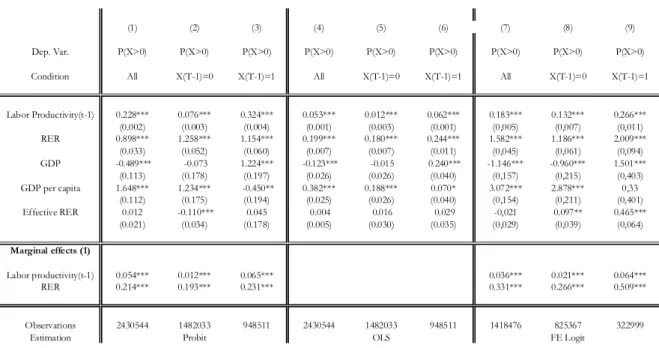
increases with an exchange rate depreciation. We thus estimate the exporting probability by replacing the dependent variable of equation (25) a dependent variable which equals 1 when the firm exports to country during year . We further estimate this equation under the conditions −1= 0 (firm did not export in destination in year − 1) and −1 0
to assess separately the effect of exchange rate movements on entry decisions and on the decision to stay on the export market.
3.3
Firm-Level Results
3.3.1 Intensive Margin
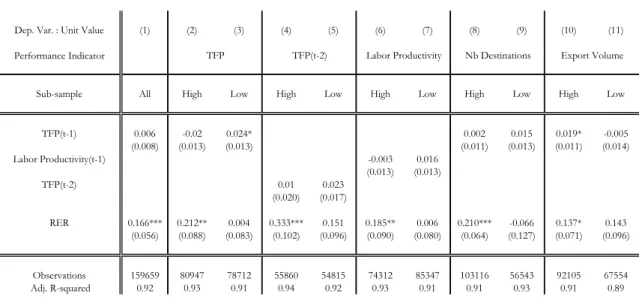
Tables 3 and 4 report the results of the estimations of unit values and export volumes. In each table, we present in the first column the results on the whole sample, before splitting the sample according to the firm’s performance in the other estimations. The results are clear-cut. Regarding unit values (Table 3), exchange rate changes have a positive effect on prices for the whole sample, as the model predicts (column (1)). Firms do react to an exchange
1 3The effective exchange rate is computed from CEPII and IFS data as an average of the real exchange rates of destination countries toward all its trade partners - including itself - weighted by the share of each trade partner in the country’s total imports.
rate depreciation (appreciation) by increasing (decreasing) their producer prices. However, the sub-sample analysis shows that only high performers absorb part of the exchange rate depreciation by increasing their producer prices. Firms which are above the median in terms of performance react to a 1% depreciation by increasing their producer price between 0.14% and 0.33% depending on the performance indicator. Low performers do not change their unit values when exchange rates vary whatever the definition of performance.
The implications of this result on export volumes (Table 4) are also in line with our theoretical predictions. On the whole sample (column (1)), the exchange rate has a positive and significant impact on individual export volumes. The effect however varies importantly across firms: it is significantly positive for export volumes of low performers, whereas the impact is not significantly positive for high performance firms. Note that even among low performers, the elasticity of export volumes to exchange movements is rather small, between 0.36 and 0.69. Consistently with our theoretical framework, high and low productivity exporters clearly have a different price and quantity strategies when faced with an exchange rate change. As mentioned before, this effect has interesting aggregate implications, since exports are very concentrated toward high performers. In the next section we will indeed show that the distribution of performance among exporters modifies to a large extent the response of aggregate export volumes to exchange rate movements.
Dep. Var. : Unit Value (1) (2) (3) (4) (5) (6) (7) (8) (9) (10) (11) Performance Indicator
Sub-sample All High Low High Low High Low High Low High Low TFP(t-1) 0.006 -0.02 0.024* 0.002 0.015 0.019* -0.005 (0.008) (0.013) (0.013) (0.011) (0.013) (0.011) (0.014) Labor Productivity(t-1) -0.003 0.016 (0.013) (0.013) TFP(t-2) 0.01 0.023 (0.020) (0.017) RER 0.166*** 0.212** 0.004 0.333*** 0.151 0.185** 0.006 0.210*** -0.066 0.137* 0.143 (0.056) (0.088) (0.083) (0.102) (0.096) (0.090) (0.080) (0.064) (0.127) (0.071) (0.096) Observations 159659 80947 78712 55860 54815 74312 85347 103116 56543 92105 67554 Adj. R-squared 0.92 0.93 0.91 0.94 0.92 0.93 0.91 0.91 0.93 0.91 0.89
Dep. Var. : Export Volume (1) (2) (3) (4) (5) (6) (7) (8) (9) (10) (11) Performance Indicator
Sub-sample All High Low High Low High Low High Low High Low TFP(t-1) 0.070*** 0.076** 0.044 0.039 0.080*** 0.094*** 0.033 (0.020) (0.031) (0.033) (0.030) (0.028) (0.028) (0.030) Labor Productivity(t-1) 0.067** 0.063* (0.032) (0.032) TFP(t-2) 0.01 -0.033 (0.048) (0.047) RER 0.333** 0.127 0.630*** -0.093 0.450** 0.341* 0.566*** -0.183 0.405*** 0.330* 0.531** (0.130) (0.204) (0.207) (0.258) (0.229) (0.206) (0.204) (0.269) (0.155) (0.176) (0.209) Effective RER -0.227*** -0.196 -0.279** -0.276* -0.329** -0.023 -0.363*** -0.097 -0.193* -0.218** -0.14 (0.081) (0.124) (0.136) (0.151) (0.149) (0.126) (0.131) (0.154) (0.101) (0.110) (0.131) GDP 0.810* 0.768 0.816 0.905 2.585*** 1.084 0.548 1.889* 0.308 0.381 2.132*** (0.442) (0.666) (0.748) (0.918) (0.910) (0.666) (0.722) (1.042) (0.531) (0.589) (0.748) GDP per capita 0.145 0.335 0.142 -0.125 -1.956** 0.005 0.391 -1.925* 0.814 0.594 -1.204 (0.450) (0.677) (0.768) (0.984) (0.955) (0.676) (0.742) (1.132) (0.524) (0.599) (0.763) Observations 134958 68434 66524 45985 45154 62968 71990 52413 82545 77851 57107 Adj. R-squared 0.86 0.87 0.85 0.88 0.86 0.88 0.85 0.87 0.86 0.84 0.76 All variables in logarithms. Robust standard errors in parentheses. Panel, within estimations (firm-destination fixed effects) with year dummies. Sub-samples computed by destination-year, except for columns (8) and (9), computed by year. * significant at 10%; ** significant at 5%; *** significant at 1%
All variables in logarithms. Robust standard errors in parentheses. Panel, within estimations (firm-destination fixed effects) with year dummies. Sub-samples computed by destination-year, except for columns (8) and (9), computed by year. * significant at 10%; ** significant at 5%; *** significant at 1%
TABLE 4 : EXCHANGE RATE AND EXPORT VOLUMES TABLE 3 : EXCHANGE RATE AND UNIT VALUES
Export Volume TFP TFP(t-2) Labor Productivity
TFP(t-2) Labor Productivity
Nb Destinations Export Volume
TFP Nb Destinations
We have also estimated (25) using individual export values instead of export volumes as a dependent variable. As mentioned in the theoretical section, the elasticity of individual export values to exchange rate is the sum of the elasticities on unit values and export volumes, which approximately holds in the data. Moreover, the first elasticity increases
with productivity, while the second decreases with productivity. The total effect is thus less clear than on export volumes, but the model predicts that the total elasticity should decrease with productivity as long as the elasticity of substitution between goods is larger than unity. This is what Table 10 (in appendix) confirms: the elasticity of the value of exports to exchange rates is always lower for high than for low performers. As expected from our theoretical framework, the difference is less striking than in Table 4, but generally significant.
We proceed to a set of robustness checks. First, we have so far only considered single-product firms, since the analysis of unit values and export volumes for multi-single-product firms is more difficult to interpret. To control the robustness of our results to the use of the entire sample of firms, we have estimated (23) and (25) at the product level. Results are presented in Table 11, columns (1) to (6) (in the appendix)15. The results are consistent with our two
main theoretical predictions on the difference of reaction of high and low performance firms to exchange rate movements. Even though more precisely estimated, the difference between the high and low subsamples is lower than with single product firms. This may be due to the fact that our performance indicators - and therefore the sub-sample separation - are not at the product-level. It may also be due to the fact that both low and high performance firms react to an exchange rate depreciation by increasing the number of products they export to a destination.
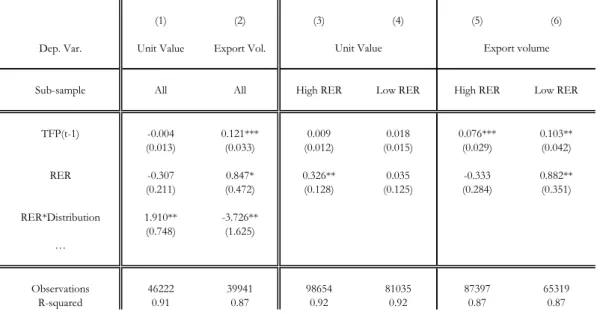
Finally, those results are not modified when considering a different decomposition of firms’ performance, based on the first and last deciles rather than the median. Tables 11, columns (7) to (10) (in the appendix) show on the contrary that, as expected, the use of deciles instead of median reinforces the difference of behavior between high and low performers. We also checked that introducing lags of the exchange rate in the regressions does not alter the firm-level results. In most regressions the lagged exchange rate is not significant which suggests that the effects we document materialize during the year. This is not true when we aggregate the results at the sector level (see Table 14 in appendix). Lagged exchange rates are in some regressions significant. These regressions at the sector level also serve as a robustness check. When we split the sample between high and low performance sectors (rather than high and low performance firms), we find again that only the low performance sectors react to an exchange rate depreciation by increasing their export volumes16.
1 5We only report in Table 11 results obtained using TFP as a perfomance indicator. Results using other indicators are similar, and available upon request.
1 6This is consistent with Alexandre et al., (2009) who show that employment in high-technology sectors are less affected by changes in real exchange rates than low-technology sectors.