MINISTRY OF HIGHER EDUCATION AND SCIENTIFIC RESEARCH UNIVERSITY OF ABDELHAMID IBN BADIS-MOSTAGANEM-
Faculty of Foreign Languages
Department of English
Title
A dissertation submitted as a partial fulfilment for the obtaining of a Master in
English Language and Linguistics
By:
Keltoum Bettaher
Boards of Examiners:
- Dr. S. Hamerlain MC-A President University of Mostaganem - Dr. B. A. Neddar MC-A Supervisor University of Mostaganem - Ms. R. Benyoucef MA-A Examiner University of Mostaganem
Academic Year: 2016/2017
Pragmatic Analysis in Terms of Gricean Maxims
Master Two: English Language and L
inguistics “Facebookian’s” Community
As a case study
I
Dedication
II
Acknowledgement
Unbelievable, I have finally finished my work, it was just a miracle.
Taking into account my situation, I am really astonished and I do not know how I did manage between work, studies, training and writing this dissertation. I find myself clueless when it comes to express gratitude to Allah. This research would never been completed without the help of ALLAH and the prayers of my Mother, I am highly indebted to her…
First and foremost, I would really like to thank my teacher and supervisor Dr. B. Neddar for his tolerance and his great forbearance. His door office was always open whenever I run into a trouble spot about my research, though I sometimes annoy him; he consistently provides a positive and constructive feedback.
No words can ever express my deepest and sincere gratitude to Dr. Hamerlain who gave me the opportunity to carry on my Master degree despite the very limited attendance of her lectures. I really wish I was at the level required....I owe it all to her.
I would really like to thank Mr. Y. Benamour for providing me the necessary information and enlightening me at first glance of my project, with a special mention to Mr. H. Cherifi for his guidance regarding the methodology chapters.
I am also grateful to the support of my lovely friends Hadjer Taibi, Shahrazed Chenine, Houda Bouacha, Fatima Rebai, Imene, Lynda and Lyla. I owe them a lot too.
Finally, my thanks and appreciations also go to my family, my colleagues, my friends, my pupils and all people who provide a helping hand during the whole year.
III Abstract
Today, social networks are part of the lives of our students. Facebook is probably the main site of encounter, communication, interaction, sharing of ideas and matters of common interest among university students. Correspondingly, the present paper aims to shed light on the notion of pragmatics in general and the conversational Gricean maxims in particular. Hence, it shows how these conversational maxims are flouted and/or respected in the FB context. The method used in this research is the qualitative analysis method. The data for this research were taken from the ELL posts in their Facebook group; fifteen posts were randomly collected, classified and pragmatically analyzed. Findings of this paper indicate that ELL FB users tend to flout mostly two kinds of the maxims which are the maxims of quantity (say no more, no less) and/or maxims of manner (be perspicuous, avoid obscurity of expression, avoid ambiguity, be brief and be orderly).
Keywords: Pragmatics, the Conversational Gricean Maxims, Flouting the Maxims and Facebookian Posts.
IV
List of Abbreviations
CMC: Computer Mediated Communication CP: Cooperative Principle
ELL: English Language and Linguistics FB: Facebook
SNS: Social Networking Sites TV: Television
UK: United Kingdom US: United States
IV
List of Abbreviations
CMC: Computer Mediated Communication CP: Cooperative Principles
ELL: English Language and Linguistics FB: Facebook
V
List of Tables
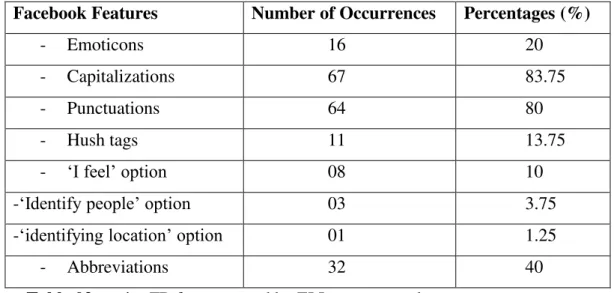
Table 01: the ethnography of SPEAKING (Hymes, 1972)………..05 Table 02: major FB features used by ELL group members……….38
VI List of Graphs
VII List of Figures
VIII Table of Content: Dedications.……….………...I Acknowledgment………...II Abstract………..…..III
List of abbreviations……….………...………..……...IV
List of Tables ………..……….……….………V
List of Graphs………..………VI List of Figures……….………….………..……….VII Table of Content……….………..………...VIII
General Introduction……….……..………..1
PART ONE: Theoretical Considerations Chapter One: Theoretical Overview 1- Introduction ……….….………..………...…..03
2- The Scope of Pragmatics...03
3- Context of Pragmatics ………...………..………..….….04
3-1- Physical Context…….…………...………...………..……06
3-2- Linguistic Context…….…..…..……….……..06
3-3- Social Context………...…………..………...………..06
3-4- Epistemic Context……..………...…...………06
4- The Pragmatics’ theories………..07
4-1- Speech Act theory…………..………...07
4-1-1- Speech Acts………..……….….08
4-1-2- Direct and Indirect Speech Acts………..………..10
4-2- Politeness Theory………..………..…..11
4-3- Deixis………...…..………..……….13
4-3-1- Personal Deixis………..……...………..……...14
4-3-2- Spatial Deixis…………..……...………...14
IX
5- The Cooperative Principle………..……….15
5-1- Definition…..………..………...…..15
5-2- The Conversational Grecian Maxims………...16
5-2-1- Maxims of Quality………...……….…….16
5-2-2- Maxims of Quantity…….………..16
5-2-3- Maxims of Relation………...………….………...16
5-2-4- Maxims of Manner………...…………..16
5-3- The Non-observance of the Maxims…..………...17
5-4- Flouting the Maxims………....17
5-4-1- Flouting quantity………17
5-4-2- Flouting Quality……….17
5-4-3- Flouting Relevance.………...18
5-4-4- Flouting Manner………18
6- Conclusion…..……….18
Chapter Two: Social Networking Sites 1- Introduction ……….….………..………...…...19
2- The Social Network Sites...19
2-1- Definition………..…………..………..………..……..19
2-2- The History of Social Networking Sites...………...………..…...21
2-3- Features of SNS’s……….24
3- The Social Network Site : Facebook ………..………….25
3-1- An overview of Facebook………25
3-2- The History of Facebook……….……….25
3-3- The Features of Facebook………27
4- Computer Mediated Communication………....28
5- The Difference between Face-to-face Interaction and Facebook Communication...30
6- Conclusion………31 PART TWO: Practical Considerations
X 1- Introduction……….32 2- Data Collection………32 3- Data Analysis………...32 4- Discussion ………...45 5- Conclusion………...48 General Conclusion………..49 References………51
Strictly speaking, we, people communicate with one another in our day-today life and simply understand each other without thinking or having the faintest idea about the how we do understand each other. In daily interaction, various styles and/or channels of conversation occur, both linguistic and paralinguistic, verbal and non-verbal and either authentic or mediated. In face to face interactions people used wide range of strategies to exchange meanings. The linguistic behavior results not only linguistic information but also non-linguistic one, which are carried by the voice, body gestures and facial expressions of the participants. Such non-linguistic features give hints about what speakers aim to transmit as a message or idea. With reference to both Austin’s ideas and Grice’s ideas, we usually ‘if not sometimes’ always say something and mean either directly or indirectly something else, that is the surface linguistic or structural form of words and sentences of the utterance says something, whereas the implicit (deepest) intended meaning is something else. Correspondingly, as a linguist, to successfully understand the messages or ideas conveyed in daily interaction, it is needed that we learn and study about one of the ideas in the field of pragmatics which called ‘cooperative principle’. In producing a good conversation, participants intend to understand each others’ meaning of the utterance when engaging in a talk. That is why they tend to follow this cooperative principle and the so called conversational rules or what Grice called: maxims, by giving enough, true, germane, and arranged utterance which is assumed as explicit information. Grice (1975) categorized the cooperative principle and elaborates it in four sub-principles: (1) maxim of quantity, (2) maxim of quality, (3) maxim of relation, and (4) maxim of manner. Yule (1996) says that it is important to recognize these maxims as unstated assumptions we have in conversations. In this sense, the paper in hand tends to explore the types of conversational maxims that are followed and/or flouted not in face to face interactions but rather in social networks context. Particularly, we will be analyzing the linguistic behavior of the Algerian English Language and Linguistics (ELL) Master Two Students of Mostaganem in the particular social website Facebook.
With this as a backdrop, the present study therefore seeks to answer following question: What types of conversational maxims are frequently flouted and/or followed by the ELL students in Facebook communication, thus, conveying the pragmatic meaning?
The hypothesis related to this study suggests that ELL FB users flout the manner and the quantity maxims. We hypothesize that the fact that they share the same field of study, they tend to be brief and concise when adding a post in their FB group. Besides that, the typographic affordances and features available to them, including (emoticons, the ‘I feel’ option, hush tags and the so like) are used as indicators and create the same effect as in face to face interactions; ergo, they help them shape their context where they may say less, yet, the meaning can be successfully transmitted.
Furthermore, the main purpose for this research is to explore the nature of language and the discursive utterances via the social network website: Facebook. The study aims further at investigating the fact that the conversational maxims proposed by Austin and later on extended by Grice can be universal, i.e. can be applied by all people around the world, and to all types or modes of communication; particularly the Facebookian communication in this case.
Moreover, this study is basically segmented up into two parts; the theoretical considerations and the practical one, in which the two parts include three main chapters. Part one introduces the two first chapters; it includes the theoretical overview, previous done-work and the definitions of the key concepts. While part two represents the chapter three, which is merely practical. It includes the research methodology, data collection and analysis. Again, chapter one entitled “theoretical overview: pragmatics” aims at highlighting the scope of pragmatics, context in pragmatics, theories that pragmatics is concerned with as well as the notion of conversational principles which would be our focus. Similarly, the second chapter entitled “social networking sites”, aims at introducing the field of research: social networking sites in general, their definition, their history and their features as well. Along with a detailed description about the particular famous social network site: Facebook, in addition to the different features prevalent in CMC contexts and finally illuminate the distinction between in person face to face interaction and Facebook communication. The third and the last chapter introduces our participants, explains the methodology implemented in the research process and details the procedure being used in collecting and analyzing the data, accompanied with an in depth discussion about the results obtained.
Chapter One:
1- Introduction
This research provides an accessible introduction to pragmatics, which deals with how speakers and listeners use language to communicate meaning in different real-life situations. This paper represents the first chapter that draws our attention to the fact that in many regular linguistic exchanges, many things are meant without being explicitly said, and accordingly tries to explain how this is possible. To do so, we need to tackle two broad points in pragmatics: (a) how meaning can depend on the context of use, (i.e. how context can affect the meaning of certain utterances), and (b) the contrast between what is said and what is communicated. In addressing (a) and (b), we will basically discuss the notion of pragmatics, and the theories that pragmatics is concerned with; starting first with the speech act theory, then the politeness theory, after that the deixis, ending up to the cooperative principle.
2- The Scope of Pragmatics
As stated by Nordquist (2016) the term pragmatics was coined in the 1930s by the philosopher Morris. Pragmatics has developed as a subfield of linguistics in the late 1970s. Its applications cover aspects of meaning other than literal and/or linguistic meaning. The linguist Yule in his book Pragmatics (1996) affords many definitions to this term among which: ‘Pragmatics is concerned with the speaker meaning’ (Yule, 1996, p. 3). That is, it concerned with what a speaker (or writer) means by his/her utterance, and what the listener (or reader) interprets in a particular context; it has not to do with the literally meaning of words and phrases per se, but also it takes into account how speakers organize their intended messages in accordance with whom they are talking to, when, where and in which circumstances. As he states: ‘Pragmatics is the study of contextual meaning’ (Ibid).
Another sparkling definition can be added here. Generally listeners are able to make an inference and/or can deduce what speakers want to transmit as an idea in order to reach an adequate interpretation; even if the idea has not been literally said, certainly in a circumstantial situation. Pragmatics then, explores a great deal of what is unsaid being recognized as part of what is communicated. He sums it up in ‘Pragmatics is the study of
how more gets communicated then is said’ (Ibid). This shows that speakers rely on
Another view to pragmatics is based on the assumption of how close and distant the listener is (e.g. a friend, a father, or a teacher); speakers can define how much needs to be said during the interaction. In Yule’s words ‘Pragmatics is the study of the expression of
relative distance’ (Ibid).
The study of pragmatics has to do with the relationships between ‘the linguistic forms
and users of those forms’ (Ibid, p. 4). That is the meaning potential may a speaker has in
his/her disposal; which structure to be chosen among other alternatives when communicating with others.
In Stalnaker’s words, pragmatics is ‘the study of linguistic acts and the contexts in
which they are performed’ (1972, p. 383).
To wrap it up, the benefit of studying language via pragmatics is that, one can talk about people’s intended meanings, their assumptions, their goals and purposes, the choice of a particular linguistic form among other choices, the non-said yet communicated, the role of distance between people, the kinds of actions they perform when speaking (a command, for instance), the impact of context in the interpretation of the discursive utterances and so on. And pragmatically speaking, it includes lot of aspects such as speech acts, conventional structure, conversational implicature, discourse organization, sociolinguistic aspects of language use and so on.
Correspondingly, one may notice that a single demanding and commanding word we may hear most often in the study and practice of pragmatics is context, meaning context of
utterances. Context is a stepping-stone concept for the above disciplines, because without it they simply would not exist. For more elaboration, one may raise the following question: How much context (or rather which contextual elements) language users must either be informed or ‘retrieve from the universe of contextual factors that is located in their
physical, mental, social and interactive environment’ (Kopytko, n.d., p. 45)
3- The Context of Pragmatics
The linguistic pragmatics has often been defined as the study of meaning in context. To answer the above question one needs to review the previous done-works on the notion of context from different researchers’ perspective. As Malinowski (1962) notes that ‘a
statement, spoken in real life, is never detached from the situation in which it has been uttered… the utterance has no meaning except in the context of situation’. (Ibid)
Grice (1975) views context primarily as knowledge; this is because the language user’s
knowledge of the ‘world’ (including its mental, social and cultural aspects) guides and
helps the use and interpretation of language. (p. 46)
Poznan besides that states that the role of knowledge in language use includes: ‘the
knowledge of role and status, location, formality level, the medium (spoken or written), subject matter, province (or domain determining the register of a language’. (Poznan, n.d,
p. 48-49)
Additionally, Leech (1983) characterizes context as ‘any background knowledge assumed to be shared by speakers (S) and hearers (H) which contributes to the H’s
interpretation of what S’s means by a given utterance’. (Ibid, p. 49)
In addition to that, the linguist Widdowson states in his book ‘Discourse Analysis’ (1972) the genuine concept of ‘ethnography of communication’ done by Hymes; which constitutes the acronym of SPEAKING under which the components of a linguistic interaction are grouped. For Hymes, our ability to communicate does incorporate our encoded knowledge (what a sentence means), as well as the knowledge of how these encodings are appropriately used in a given context. Hymes gave each letter an appropriate label, which is demonstrated in the table below:
S Setting or scene (time, place and environment of situation) P Participants (who talks to whom)
E Ends= purposes, goals, and outcome of speech A Act sequence: form and order of events
K Key: tone and manner of speech
I Instrumentalities: forms and styles of speech N Norms: what is socially acceptable
G Genre, type or kind or event
Table 01: the ethnography of SPEAKING (Hymes, 1972)
Another view concerning context can be added by Panevoa and Hana (2011). They claimed that the major role of pragmatics is to understand how context affects the meaning of certain utterances; in which they came up with several types of context that should be taken into account when communicating:
3-1- Physical context
Things and objects that are physically surrounding the interaction; time and place references of the communication, what going on is around, for example:
a. I take this novel; (accompanying by pointing). Here, one needs to know what “this” refers to in the utterance.
b. Be there at 10.00 o’clock tonight, here one needs to be informed about the “there’s” reference.
3-2- Linguistic Context
Let’s take the example below:
a. Sofia broke the vase yesterday. She thought nobody would notice. If we utter the second sentence solely, one needs first to know the “she” refers to whom in the utterance, and what does “what does nobody would notice !” express; that is what has been already said before in the conversation.
b. If my dad heard you talk like that…, in (b), no one can grasp what is the intended message unless s/he is well-informed about “the talk that the father could have heard”. 3-3- Social Context
It refers to the status of participants and their social relationship involved in a particular interaction. For instance the sentence: #Hey, call me when you get home. (You can never talk in this way to a teacher, for instance). We must take into account the social relationship between speakers such as: the degree of formality, politeness, “inferiority vs. superiority”, social status, power and so on.
Note: # commonly used to mark a sentence that is inappropriate for a given context. 3-4- Epistemic Context
The epistemic context represents the schematic knowledge, the common values, the society’s norms and the beliefs shared by speakers and hearers of a particular society.
4- Pragmatics’ Theories
As it is mentioned above, pragmatic information is the combination of linguistic and extra linguistic information; that is what is beyond the structural units that the hearer relies on to figure out what the speaker is communicating. For more elaboration, taking into account pragmatic considerations; in everyday speech not just what a sentence literally means but the fact that someone utters it plays a crucial role in determining what its utterance conveys. Scholars of the field explain how the things we mean can go beyond the things we say and still be understood. This way of characterizing pragmatic information generalizes Grice’s point that what a speaker implies in saying what he says ‘is carried not
by what he says but by his saying it and perhaps by his saying it in a certain way’ (Grice,
1989). Hence, it is arguable that what a sentence means generally does not identify what a speaker means by uttering it (the utterance). Subsequently, the linguistic (structural) meaning of an utterance may fail to interpret ambiguity, indexicality, speech act, implicature, illocutionary force and many others. In what follows, we will see how can we rely on pragmatics to interpret the intended speech act; starting with a brief explanation of speech act theory narrowing down its components.
4-1- Speech Act Theory
People do not simply produce utterances containing grammatical structures and words, but also performing actions via those utterances. The Oxford philosopher Austin called such social actions “speech acts”, and so gave birth to the branch of linguistics and philosophy of language that ever since has been called speech-act theory.
As introduced by Austin (1962) and further developed by the American philosopher Searle, speech-act theory is a subfield of pragmatics that is concerned with the ways in which words can be used not only to give information but also to carry out actions. In other words, Austin observed that ‘there are many uses of language which have the linguistic
appearance of fact-stating but are really quite different’ (Bach, n.d., p, 147). That is to say,
in some cases, sentences cannot be just said to have a truth value like commands or questions, even declaratives are used often not to make a mere statements but also to perform something: to make a commitment, to give directions, to adjourn a meeting, to name something, among others. That is any usage of language that may accomplish something.
According to Merriam Webster Dictionary the so-called performatives have been defined as ‘expressions that constitute the performance of a specified act by virtue of their
utterance’. The explicit performative like (you are fired, for instance), addressed by a
leader of a company to one of his employee is not used to make a mere statement, but rather to perform an action; the act of ceasing his post. Actions can be less unpleasant as the previous example. Pleasing actions can be performed via utterances too, as the praise in: ‘Thank you man’, a compliment as in: ‘You are so solicitous’ and an acknowledgement of thanks as in: ‘You are most welcome’. As a result, performatives in Austin’s words are ‘verbs in the first-person singular, present indicative active’ (Austin, 1962, p. 56); they are simply utterances which carry out the act they name. So whenever we use language to accomplish something, we are performing a speech act. Generally speech acts in English are commonly known that they have more specific labels such as: promise, compliment, complaint, command, request, question, threat, apology, invitation and the so-like.
As cited in Bach’s words, one can promise by saying “I promise to change”, order someone by saying “I order you to go to your room”. ‘These are examples of explicit
performatives; statements in form but not in fact’ (Bach, n.d, p. 148). The performative
verbs ‘promise and order’ which are present in the above examples to name the speech acts promise and order respectively; are explicitly introduced. In other cases, we may find the same speech act (promising, for instance) without being explicitly stated. According to Searle (1969), language per se is performative (that is, it does things); language doesn't merely describe or report.
Another good depiction of speech act can be seen in a description offered by a dictionary, which states that a speech act:
Can be any of the acts that may be performed by a speaker in making an utterance, as stating, asking, requesting, advising, warning, or persuading, considered in terms of the content of the message, the intention of the speaker, and the effect on the listener (Dictionary.com Unabridged).
4-1-1- Speech Acts
According to Yule (1996), speech-act theory considers the levels of actions being performed through a particular utterance; hence they will always have three related acts:
Locutionary, Illocutionary and Perlocutionary acts. (p. 47). Thereupon, a brief explanation would be mentioned as follow:
a- Locutionary Act
As cited in Yule’s Book, locutionary act ‘is the basic act of an utterance’ (Ibid). It means the ability to produce meaningful grammatical sentences or words; that is purely the fact of using words or saying something. If a person has a difficulty or fails to produce a correct sentence (for example because it is foreign or he is tongue-tied) (Ibid), then he is failing to produce a locutionary act. Producing “Allume la television” in English will not normally count as locutionary act, whereas [1] will:
[1]- Switch on the TV. b- Illocutionary Act
This is the second dimension. For Yule, utterances are never well-performed purposelessly, but rather for a particular function in mind. Yule states that the illocutionary act ‘is performed via communicative force of an utterance’ (Ibid). We might utter [1] to make a statement, an order, a request or any other communicative purpose. Thus, it is what one does by saying something such as answering or apologizing. This is generally known as the illocutionary force of an utterance. For example, the utterance (I will see you later) can have different illocutionary forces such as:
- Prediction (I predict/ guess to see you). - Promise (I promise to see you later) or - Warning (I warn you that).
Additionally, he states that people do not simply create utterances with a particular function, but instead they do intend those functions to have an effect. Consequently, this is the third dimension, what he calls the perlocutionary act.
c- The Perlocutionary Act
This refers to the assumption that hearers will recognize the effect of speakers’ utterances, of course vis-a-vis the contextual situation being involved. A particular act may succeed or not depending on certain conditions. The utterance [1] (for example, will account as an invitation to watch an interesting broadcast or series). Another example, as in
[2] Do you have any money on you? (Would be recognized as a question or request for money in a situation where the asker knows that the other person does in fact have money). An illocutionary act succeeds only if the listener recognizes the attitude being expressed, such as a desire in this case of request. This is generally known as the perlocutionary
effect. (Ibid, p. 49) In addition, the perlocutionary act can only be successful if the listener accepts it and actually does it (in this case; lends him some money).
4-1-2- Direct and Indirect Speech Acts
Concerning the types of speech acts, a good distinction can be made on the basis of structure. Yule provides us with a simple structural distinction of three general types of speech acts; he stresses that in English we have basically three sentence types (or what he calls structural forms) as well as three communicative functions. He refers the former to (declarative, interrogative and imperative), whereas the latter to (statement, question, request/command) (Ibid). As shown in the coming example, we can easily distinguish between the three sentence types and the communicative function as well.
a. You go out. (Declarative) b. Do you go out? (Interrogative) c. Go out! (Imperative)
Whenever there is a direct relationship between the sentence type and the function; we say that we have a direct speech act. In the other hand, whenever there is an indirect relationship between the structure and the function, we say that we have an indirect speech act. To make it simple, a declarative that is used to make a mere statement is a direct speech act, whereas a declarative used to make a command for instance is an indirect speech act. Let’s consider the example below as an illustration.
- Goodness me, it’s hot in here.
It is obvious that this sentence structurally represents a declarative. When this sentence is being uttered for the sake of telling about the weather, it is functioning as a direct speech act. In the contrary, if the same sentence is being uttered for the sake of making a request or a command (to get the hearer open the window, for example), it is clearly an indirect speech act.
Yet, not only declaratives are meant to function as an indirect speech act, but also the other types. For example, the sentence: Do you have to turn off the TV? is an interrogative in form (a question), but it is an indirect request (request/command of turning it on). So, it is an indirect speech act.
Yule claims that the most common type of indirect speech act in English has the form of interrogatives. They are not meant to ask questions or requests; that is we do not expect just an answer from a question, but also we expect an action. A simple example can be added in here:
- Could you pass me that pent, please?
Asking this question by saying (could you/can you/would you) with the assumption that the hearer is able to do it (something), will count as a request to do that thing. The fact that we use those different formal expressions demonstrates that indirect speech acts are associated with greater politeness. This latter, as we shall see right away, is another theory that pragmatics is concerned with.
4-2- Politeness Theory
Supposing that a layman might be questioned about the nature of politeness, they would probably say it is the fact of ‘showing or having good manners or respect for other
people’ (Merriam Webster Dictionary) in the sense that speakers should be selective in
their words; using socially correct and proper terms when interacting with others. Generally, politeness might reflect the fact of using a particular linguistic behavior in a particular situation such as apology, gratefulness, expressing acknowledgment, and compliment. Politeness has become essential in our daily interaction; people tend to be polite as much possible as they can in order to gain respect from others. Withal, social studies, anthropologists and linguists have been always interested in the human intercourse, behavior and communication. As a result, many interpretations of politeness emerged.
The term polite is etymologically derived from the word politus which is a past participle of the Latin verb polire. Politus means ‘polished or smoothed’ (Hameedaddeen, 2012, p. 2). Consequently, the term politeness came to refer to ‘correct social behavior,
courtly manners, the right etiquettes and consideration for others during the social interaction’ (Ibid). In linguistics, many linguists have been interested in the study of
politeness; where they have developed a theoretical framework that studies this phenomenon among which: Lakoff, Leech, Brown and Levinson. These linguists relied on the work of Grice Conversational Maxims, Austen’s and Searle’s Speech Act Theory, and Goffman’s notion of “Face”.
Politeness in pragmatics according to Hameedaddeen refers to ‘the linguistic
expression of courtesy and social position’. (p. 2). It is the fact of using language
appropriately in a way that embarrassment or offense is avoided. Generally, we are informal and relaxed (at ease) with our family and friends when speaking. We can ask a brother for clarification simply by saying ‘what does that mean?’ Whereas, when we socialize and mix with other people and we get in formal situations we will undoubtedly change our language; we use formal, courteous and mannerly sort of language that shows our respect for the others. With otherness, we may rather say ‘would you like to explain that for me please, because I did not get it!’ that’s why sociologists and linguists concluded that the specific way (being generous, kind, sympathetic, and tactful) speakers perform speech acts like commands, requests or offers reflect their social relationship with the others (Ibid, p. 3). In this respect, Yule (1996) asserts that ‘there is more narrowly
specified type of politeness, and in order to describe it we need to talk about the concept of ‘face’ (p. 60).
Face for him means the public-self image of a person. It is the individual’s emotional and social sense of self that anyone has and expects the others to recognize (Ibid). In accordance to that, we can say that politeness is meant to be employed to show awareness to the other person’s face (Ibid).
Showing awareness for the others’ face is equated with the amount of social distance or closeness. That is, showing respect or deference (awareness) denotes the fact of being socially distant, however; showing friendliness, camaraderie or solidarity (equivalent awareness) is a sign of social closeness. As a result, politeness strategies were developed in order to minimize the threat to the hearer’s face during the interaction, and it consists of two main aspects, positive face and negative face.
A person’s positive face refers to the speaker’s need to be accepted and even being liked by others. While a negative face is the act of being free, independent and not being imposed by others to do something. In Yule’s words, ‘a positive face is the need to be
strategies described by Brown and Levinson, which explain the speaker’s linguistic behavior, and they are bold on-record, off-record, positive and negative politeness:
a- Bold On-record Strategy
Usually speakers in this strategy do not try to reduce or minimize the threat to the hearer’s face; they are direct and even chocking (Brown and Levinson, p. 95). For example: using an imperative such as: Say that again! (The speaker here is too direct). (Leech, p. 11)
b- Off–record (Indirect) Strategy
Speakers in here are less direct; they attempt to avoid imposition on hearers by using indirect language. For example: Hmm I forgot my pen. (It is an indirect request; they might be referred to as giving hints).
c- Positive Politeness Strategy
This strategy is supposed to assign some positive value to the addressee (making him feel good about himself) (Ibid, p.12). It seeks to minimize and soften the threat to the hearer’s positive face. They are commonly used among people who know each other fairly well (Moore, 2001, n.p.).
d- Negative Politeness Strategy
Its function as cited by Leech is mitigation; it lessens the possible cause of offense. For example:
a- By being indirect: (e.g. pity me, I have no credit to call...). The speaker in here is asking indirectly the hearer to afford him/her a cell phone to call, thus being polite.
b- Using hedges (or questions): Something that provides defense or protection (e.g. could you please stop smoking!)
c- By being pessimistic: (e.g. It’s a pity; there is no chance to help me!)
d- Impersonalize: It is an impersonal order or request (e.g. It is forbidden to smoke). In here, the speaker is impersonally asking the hearer to stop smoking. e- Apologizing: (e.g. I’m sorry or sorry for wasting your time, would you like to
f- Using plural pronouns: for example: we regret to inform you. (as cited in Brown & Levinson, 1987)
Brown, Levinson and Leech have developed Politeness Theory in order to differentiate between different forms of utterances and make a separation between them vis-a-vis the context or the situation in which the communication process takes place.
4-3 Deixis
Another important topic in the study of pragmatics is deixis. One of the most frequent things we do with utterances is deixis. This latter is a Greek word (deiknyai) i.e. to display or to show. Yule refers it to the act of ‘pointing’ via language. Any linguistic form used to indicate this pointing is meant to be a deictic expression. (Yule, 1996, p. 9)
Using a deictic expression is the fact of indicating or pointing something in face-to face spoken interaction in the immediate shared context (by a speaker and a hearer). For example: while hearing a loud sound, one may utter: what’s this? “This” in here is a deictic expression.
Studies show that deixis can be further divided into six types: person deixis, empathetic deixis, place deixis, time deixis, discourse deixis and social deixis. Whereas for Yule we can distinguish basically three main types: (the person deixis, spatial deixis and temporal deixis) (Ibid) which will be briefly explained as follow.
4-3-1- Person Deixis
Generally we use person deixis to indicate people or persons. It is about referring to a participant role (a speaker or an addressee). This operation can be carried out via personal pronouns (the first pronoun “I, we”, the second person “you”, and the third one “she, he, it, they”). For example: she is busy right now. ‘She’ in here stands as a person deixis.
We can also distinguish between two kinds of the first person plural “pronoun we”. The
exclusive we (speaker plus the other(s) except the addressee), and the inclusive we (both speaker and addressee(s) are included). This distinction is valuable in pragmatics.
4-3-2- Spatial Deixis
It refers to the relative location of the speaker as well as things that are surrounding. For Levinson we can realize place deixis through grammatical units such as:
a- Adverbs of place: like: here, there, near, far. etc.
b- Demonstrative pronouns: such as: this, that and there with their plurals that represent proximity and non-proximity. This stands for something near, whereas that and there stands for something far from the speaker.
c- Spatial prepositions: for example: to the right/left of, behind, in front of, away from, next to...etc.
d- Absolute places: (e.g. east, west, north, south, upstream, downstream, across river
.etc) and also motion verbs. 4-3-3- Temporal Deixis
It refers to a relative temporal frozen point in time, typically in the moment of utterance. Time deixis is encoded in adverbs of time (e.g. now, then, today, yesterday, tomorrow, Sunday, May, this afternoon, this year, next month. etc), tenses (e.g. future, present continuous, past.etc) and other deictic expressions (e.g. greetings: good morning, good evening. etc).
It is noticeable that the deictic expressions mentioned above are meant to be under the pragmatic scope. Their interpretation depends predominantly on the common contextual circumstances, the speaker’s intention as well as the relative distance between the speaker and the hearer. In addition, for references to be successful in a conversation, collaboration or cooperation by participants (the speaker and the hearer) is necessary. It is helpful making sense of what is said. Consequently, since our interest is the idea of cooperation in Gricean pragmatics, our focus will be on the Grice’s conversational principles. In what follows, we will dig deeper in another concept which pragmatics is concerned with; which is the so-called cooperative principle.
5- The Cooperative Principle 5-1 Definition
The basis of Gricean pragmatics is the cooperative principle (henceforth, CP). All linguistic exchanges are successfully taking place in a situation where people are co-operative with each other. In this sense, the coco-operative principle describes how effective communication is carried out and achieved in shared social context. In other words, it is about how participants (speakers and listeners) must act cooperatively to be well understood; so that they have the mutual assumption that each one is cooperative with the
other. As phrased by Grice (1989) who states that ‘Make your conversational contribution
such as is required, at the stage at which it occurs, by the accepted purpose or direction of the talk exchange’ (p. 26). Besides that, Yule (1996) said that CP is ‘a basic assumption in conversation that each participant will attempt to contribute appropriately, at the required time, to the current exchange of talk’ (p. 37).
To put it simple, the CP for Grice is simply a description of how people suppose to behave when engaging in a linguistic talk. Basically, they need to understand each other’s meaning of the utterance. Grice further discusses that in producing a good conversation, people implicitly obey some principles when communicating. That is, they are expected to follow the cooperative principle and/or the conversational rules by giving enough, true, related, and arranged utterance which is assumed as explicit information. Subsequently, when these rules are observed and appropriately followed; then it is easy for interactants to understand each other’s intended meaning. These rules have been labeled conversational rules or what he calls maxims, Gricean maxims. Applying these maxims (as we shall explain in what follow) is a way to explain the link between utterances and what is understood from them.
5-2 The Conversational ‘Gricean’ Maxims
The framework of Grice’s cooperative principles of conversation (1975) was primarily elaborated into four basic sub-principles: (1) maxim of quantity, (2) maxim of quality, (3)
maxim of relation, and (4) maxim of manner. Each maxim can be defined as follows (Grice, 1975, p. 26):
5-2-1- Maxim of Quality
This maxim refers to the fact of being truthful (saying the truth). That is, do not say what you lack evidence or what you believe to be wrong. Do not provide wrong information. (Ibid, p. 27)
5-2-2- Maxims of Quantity
The category of quantity as stated by Grice represents ‘the quantity of information to
be provided’ (Grice, 2001, p. 26). In other words, do not provide much more information
contribution as informative as required no more than is required’ (1996, p.37) also, make
your contribution purposeful and targeted to the immediate talk. 5-2-3- Maxim of Relation
Grice calls it maxim of relation or relevance. This category has to do with being relevant to what has been already said. As Grice argues ‘I place in this category one single
maxim: be relevant’ (Grice, 2001, p. 27). We all (as users of language) assume that what
people say to us has a degree of relevance in the immediate context. 5-2-4- Maxim of Manner
In Grice’s words under the category of manner, he includes the supermaxim ‘be
perspicuous’. Its maxims involve: being clear, brief and orderly; especially avoid obscurity
of expression and ambiguous expressions or adding unnecessary prolixity when talking (Ibid).
These maxims are considered as rules or laws that are mutually employed by interactants in order to engage in a cooperative, relevant, clear and successful conversation. Although Grice prescribes these conversational maxims for participants to successfully continue the interaction. He adds that there are other sorts of maxims ‘(social, aesthetic, or
moral in character) such as the maxim of ‘be polite’ that are normally observed by participants in a talk’. (Ibid. p.28) He acknowledges the fact that these rules may be
respected and followed by speakers in some cases, as well as they may not be followed and/or observed in other cases.By observing whether the speaker obeys the maxims or not, the hearer finds out how to interpret what the speaker says. This idea of observance and non-observance can be further explained in what follows.
5-3- The Non-Observance of The Maxims
Generally, people communicate by observing the maxims (consciously or unconsciously), but sometimes they communicate by not observing them. A cooperative speaker can intentionally disobey (not observe) one of the maxims, as long as s/he or the context provides enough indicators for the hearer to notice it. This is called flouting. Flouting the principle of cooperation as Levinson (1983) argues ‘is not an indicator of a
breakdown of interaction’ (p. 109). In the contrary, even by flouting, speakers tend to
getting conversational implicature. For Inayati (2014) conversational implicature ‘is a
nonconventional implicature based on an addressee’s assumption that the speaker is following the conversational maxims or at least the cooperative principle’ (p. 54)
Yet, for Grice the Conversational Implicature refers to what is more being communicated than is said. i.e., a meaning or message that is implicated in a conversation; whenever people oversay (say more of) or undersay (say less of) something, they produce certain extra meaning which is beyond the literal linguistic spoken meaning of words and sentences); they can mean exactly what they say or entirely something else (such as: sarcasm, irony, fun. etc. This extra meaning is conversationally called implicature. Usually, it is carried out by means of indirect and contradictory utterances, or using figures of speech such as irony, metaphor, overstatement, exaggeration, understatement, tautology, and the so like. For example, one may utter 'I like the sound of your voice' in order to tell someone non-literally and indirectly that s/he could not stand the sound of his/her voice and ask him/her to stop singing. Consequently, the importance in here was in what was not said, thus, what maxims were flouted as we shall see it in detail right away.
5-4 Flouting the Maxims
As it was mentioned above, flouting for Grice means that speakers imply different functions from the literal meaning of the words being used. In this respect, we will explain the notion of maxim flouting simply by providing each an example with a concise description. Consider the first following example:
5-4-1- Flouting Quantity:
It involves giving either too much or too little information. Generally, speakers when disobeying the maxims of quantity find themselves inevitably disobeying the maxims of manner as the example shows: (A) asks: Well, how do I look? (B) replies: Your shoes are nice…
We can notice in here, that B’s utterance was not the answer required. The fact that (B)’s answer was [your shoes are nice] indirectly tells (A) that s/he is looking good, yet, flouting the maxims of quantity as well as manner.
5-4-2- Flouting Quality:
This can be done in a variety of ways; some of the most common are:
a- Exaggeration: like in (I’m starving, I could eat a horse). Hearers in here would be expected to infer that speaker is so hungry.
b- Metaphor: for example: the utterance (My house is a refrigerator in winter). Hearers infer that the speaker’s house is exceedingly cold in winter.
c- Irony: by saying the opposite of what we mean, i.e. the words are contradicted of opposite to the intended meaning. One may say for instance (you are so smart), ironizing the hearer that he/she is too stupid.
5-4-3- Flouting Relevance:
This arises when a speaker deviates from the particular topic being asked and discussed about, and replies by something out of the topic. For example: X says: are you going home tomorrow. Y replies: does it suit me this Jacket? In here, Y’s cooperation was irrelevant and out of the topic or the question being asked by X.
5-4-4- Flouting Manner:
For Inayati (2014) the maxim of manner is ‘be perspicuous, avoid obscurity of
expression, avoid ambiguity, be brief, and be orderly’ (p. 58) generally, it is related to the
form (structure) of speech being used. Participants shouldn't use words they know listeners won't understand, also, they should state events briefly and following the natural order of events. Usually, it takes the form of obscurity or ambiguity (quite often it can be used to
exclude another interactant). 6- Conclusion
Linguists and philosophers bring sharper focus to the scope of pragmatics in the late 1970s. It focuses attention on users of language and the context of language use. To conclude, pragmatics deals with the extra linguistic information. It covers all those aspects of meaning that semantics-the study of utterances’ linguistic meaning- fails to take into account. In other words, pragmatics has to do with the factors that participants rely on for the interpretation of what is being said such as: the speech acts, the illocutionary effect, social relationship, the non-said, reference, the paralanguage, and many others. In this respect, the scope of this study is beyond a detailed treatment on the notion of Gricean
cooperative maxims. People are assumed to be cooperative and follow the conversational (cooperative) maxims of quality, quantity, relevance and manner, these maxims serve a purpose in both cases; when they are followed as well as when they are flouted.
Chapter Two:
1- Introduction
The growth of internet and the popularity of social network sites have emerged a new world of communication. They have attracted millions of users across the world to connect, communicate and interact with each other; many of whom have integrated these sites into their daily-life practices. Initially, this paper represents the second chapter in which: first, the social network sites are briefly introduced and defined with the consideration of their historical background. Then, providing a general overview of the Facebook network site in particular; narrowing down its history as well as its features. In addition to that, we will include the channel that maintains this sort of online communication; particularly by exploring the notion of computer-mediated-communication and briefly highlighting the distinction between Facebook computer-mediated-communication and face-to-face interaction.
2- The Social Network Sites
Nowadays, the social networks have attracted the attention of million of people around the world; whether young, old, male or female such as: students, teachers, marketers, clients, professionals, scholars.etc. Recently, with the tremendous evolution of internet, the popularity and application of Web 2.0 technologies have been significantly increased such as blogs, online discussion boards, CyWorld, Bebo, YouTube and many others. These new applications have created a new space for communication and information; they allow users to connect, interact and collaborate with one another in a virtual community via the so-called social network site (Atef, n.d., p. 60)
2-1- Definition
The social networking sites SNSs (also known as social networks, social networking
services, online social networks or even social websites) are an online platform which is used by people providing them an easy and accessible way to connect and interact with others; whether they know them or they do not, generally, those who share with them similar interests, opinions, ideas, activities, backgrounds or simply real-life context. (Ibid, p. 62)
Studies and many scholars referred social network sites to the definition stated by Boyd and Ellison; in which they discussed that SNSs are:
Web-based services that allow individuals to (1) construct a public or semi-public profile within a bounded system, (2) articulate a list of other users with whom they share a connection, and (3) view and traverse their list of connections and those made by others within the system (As cited in Ellison & Boyd, 2013, para. 2). To put it simple, people engaging in a social network site are able to create or set up a digital representation about themselves (what they call: a profile), this is in one hand. In the other hand, they are able to select people who share the same site or connection, add them as friends, communicate and interact with them. Yet, there are hundreds of social network services, each with its distinct technological features and specificities, and each with a particular kind of users. In Ellison’s and Boyd’s words, some sites are meant to diverse audiences; while others are disposed to people with a common language, or shared the same identity based on sex, culture, religion, race, or nationality. (Ibid, para. 1)
In addition, social platforms also vary in the way people use them, the way they embody new information, the way they give access to users to share and publish a particular content, likewise the communication and availability tools such as mobile connectivity/devices (such as tablet computers or smart phones), blogging, messaging (email or chat), digital photo/video-sharing and the so-like. Some sites require that their members must personally know each other in the real life before being in touch online, like LinkedIn; which necessitate the real-life pre-existing contact between participants before engaging in the online talk.
Another definition to SNS provided by an English dictionary can be added here. SNS ‘is seen as a website that is designed to help people communicate and share
information, photographs, etc. With a group politicians seek to reach young voters through social networking sites such as Facebook or MySpace. (Cambridge Business-English Dictionary)
To wrap it up, social networking services/sites/websites are virtual internet based communities which allow people to connect and interact with each other (friends, family members, classmates, customers, clients, students, colleagues, etc) on a particular subject or simply to hang out together online, through a particular website such as: Facebook, Twitter, Messenger, Classmates.com, LinkedIn, Gmail, etc. It is called social because the main focus of an online social network is building up online communities where people can connect, interact and share activities and/or interests; as Cheung, Chiu and Lee (2010)
claimed ‘it is more appropriate to consider the use of online social networks as collective
social action’ (p. 1337). It is arguable that these social sites can be specified historically
from other kinds of web-based genres; that is they did not come into being from scratch and/or overnight, certainly they would have had a history. In what follows we will discuss the historical background of the most basic social networking sites.
2-2- The History of Social Networking Sites
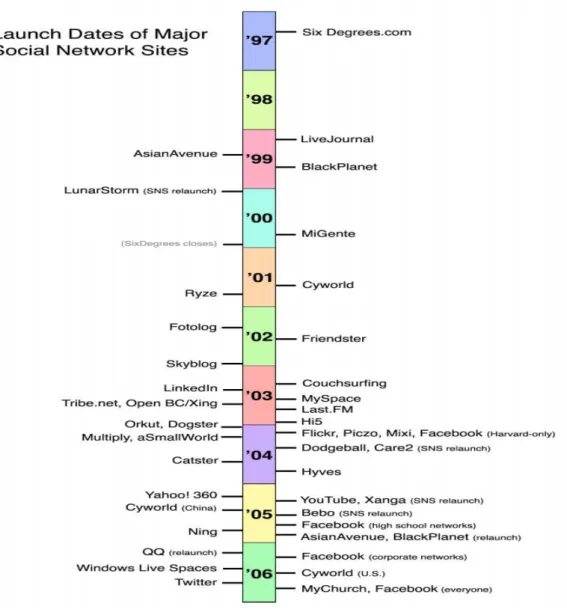
It has been argued that the history of social networks can be traced back to begin in the late years of 1990s, simultaneously with the evolution and development of the new technologies. The following timeline of selected social platforms, adopted from Ellison and Boyd classifies the chronology of major SNSs in recent years.
The timetable above demonstrates and lists the chronological dates of the major social networking sites. In this respect, we will discuss and highlight the main ones. According to Ellison and Boyd, the most recognizable (or the first) social network site is ‘SixDegrees’, it was launched in 1997. ‘SixDegrees.com’ enables its users to create profiles, add friends and list them. It gives access to users to send messages to others. In 2000, the service/ the website closed. Two years after the first SNS’ appearance (in 1999), a virtual community was launched known as ‘LiveJournal’ where blogs, users’ journals and diaries are maintained; that is,people were able to register others as friends in order to follow their journals and manage their privacy setting. Looking back from 1997 to 2001, a number of internet-based communities have delivered such as ‘AsianAvenue’, ‘BlackPlanet’, and ‘MiGente’. They allowed users to create personal, professional, and
dating profiles—‘users could identify and add friends on their personal profiles with no need to be approved’. Additionally, in 2001 the Korean virtual web-site was started under
the name ‘Cyworld’ likewise, the Swedish web community ‘LunarStorm’ refashioned itself as SNS; where it contained ‘friends’ lists, guestbook and diary pages’. (Ellison, n.d., para. 14)
The next wave of SNSs was (still in 2001) a network platform launched by Scott namely ‘Ryze’. ‘Ryze.com’ was primarily for members of business and technology community. Following after, in 2002 Friendster was founded. Ellison claims that people behind the inception of ‘Ryze’, ‘Friendster’, ‘Tribe.net’ and ‘LinkedIn’ were too close to each other ‘personally and professionally’. They believed that they could support each other without being rivals. As a result, ‘Ryze’ did not acquire mass popularity, ‘Friendster’ became the most significant, if only as ‘one of the biggest disappointments in Internet
history’, ‘Tribe.net’ ‘grew to attract a passionate niche user base’, and ‘LinkedIn’ became
a powerful business service. Later on, ‘MySpace’ also reached a popular status in the world; it has been appeared in 2003, enabling its users to post messages, videos and music. In parallel to ‘MySpace’, ‘Hi5’ also was a popular social media site, mainly spread in places of Asia, Latin America and parts of Africa. (Ibid, para. 16)
A year after, in 2004, Anderson states that Dale Dougherty, a vice-president of O’Reilly media was officially the first who coined ‘Web 2.0’, a term that came to be tremendously used in the twenty first century, marking a distinction from the old web 1.0 (Anderson, 2007, p. 5). Web 2.0 technologies are internet tools that enable users to go beyond just receiving the information but also interacting, communicating and creating
contents with others (O’Reilly, 2005, p. 4). Within the same year, as the figure above demonstrates, a number of social network platforms came into being. The first and the famous one is Facebook, created by Mark Zuckerberg in 2004 as a Harvard-dorm social network; as it is mentioned in the figure ‘only in Harvard’ University, then it enlarged upon two years later to general public, to become a supersized social platform ever in which we will see later. Another famous website to be added is ‘Flickr’ which is photo and video sharing application; it enables its users to add images, videos and friends as well.
Later on, in 2005, ‘Yahoo!’ appeared as an online social network that enables users to send and receive messages. At the same time ‘YouTube’, the major video sharing site came out, initiating a new way of receiving information; by watching and even downloading videos for free. Following after, in 2006 a blogging network site came to be known as ‘Twitter’. It is originally intended for people to comment and post answers on the question ‘what am I doing’ in no more than 140 characters, these comments are labeled as tweets. (Bob, n.d, p. 4)
Adding to all these, in 2009 a new technology was launched which is mobile applications, where people can upload any social network they want such as Facebook, Email, Twitter, Tumblr, YouTube and the so-like. By 2010, a new giant photo and video sharing application came into being, known as ‘Instagram’. This later has initially developed by Fcaebook; it became briskly popular and reached a high status all over the world. The reason behind its modishness is that it is mainly used by popular and well-known people across the world such as stars, models, actors, singers and all celebrities, adding to them their fans or their lovers. A year after, in 2011, Google launched an interest internet-based platform named GooglePlus, where individuals can share their interests, post and add new content. Within the same year, three genius students have created a social mobile application gives access to people to share photos and videos, and they called it ‘SnapChat’. And still the evolution to be continued.
Some websites have been flourished since their inceptions and still they are; others have been perished. Among all websites, the magnetic and the most appealing ones are Facebook, Twitter and Instagram. Subsequently, reasons behind the modishness, popularity and the tremendous use of these social websites refer mainly to the affordances and technological features available at the users’ disposals, in which we will discuss them in details in the coming phase.
2-3- Features of SNS’s
Studies show that social network sites share a variety of technical features that allow people to create a public or semi-public profile and construct a list of users who share with them the same web-service. That is, the most basic feature is the creation of a profile with a list of friends who are a commonly users of the site. According to Boyd and Ellison (2007) profiles can be described as ‘unique pages where one can type oneself into being’ (para. 7). After subscribing in a particular social website, individuals are required to fill out or complete series of questions and/or information considered as identification of the user such as: the user’s pseudo name, age, location, sex, birthday, address email or the phone number, interests, sometimes even the relationship status, the diplomat or the job you have and the ‘about me’ section (which is a self-description; where people can add a specific information about themselves). Hence, the profile is the mixture of these information and the answers to these questions. Most web-sites require users to upload a profile picture. Yet, some sites provide their users with a range of tools and applications to enrich their profiles by adding multimedia content (such as photos or videos), adding comments or links, sending messages, allowing integration with other sites, modifying their profile's look and feel, giving them the opportunity to play online games, also, giving access to coonect in mobile devices.
Users who are part of the same network service are able to view each other's profiles; simply by typing their friends’ name or pseudo name in the search option in the same service. In this respect, the visibility of profiles may vary from one site to the other. It depends on the website itself; sometimes there are some social platforms which prevent individuals to view the others’ profile. Whereas, other sites depend on the profile owner per se; that is the user is the decision maker of giving access or not to other users to view his/her profile. Yet, since the objective of SNS is constructing relationships between people, the label of such a connection also vary from one SNS to another; popular terms can be noticed such as ‘friends, contacts, followers, fans’ and the so-like. Most SNSs require a mutual confirmation from both participants. Generally, the terms ‘fans or followers’ are meant to be confirmed by one user; in Ellison’s words ‘one-directional ties’ (n.d, para. 8). Whereas, the term ‘friends or contacts’ are a reciprocal ties. Withal, the term friends doesn’t necessarily equate friendship in real-life situations, even strangers can be friends via those online networks, because reasons people connect are varied, and the
preferred social network being used also varied from one individual to another. In our study we prefer to dig into the well-known social platform ‘Facebook’.
3- The Social Network Site: Facebook 3-1- An Overview of Facebook
The one social website that is considered as uppermost, leading and most demanding is Facebook (www.facebook.com). Facebook (henceforth, FB) is an online internet-based website founded by Mark Zuckerberg in 2004 at Harvard University. It was primarily limited for Harvard students; where they can keep in touch and contact with their classmates. In other words, FB is a free social networking service connecting people across the street, city, country or the world. Its focus is building up an online intercourse and maintains the social relationship between people who share something in common. Baron (2008) stated that Facebook was created ‘as a tool for meeting new people and a platform
for networking with people you already know’ (as cited in Perez, 2012, p. 82). Studies
show that this social networking site is nowadays used by more than 800 million active users in every country on the planet, so far in seventy languages. (Collier & Magid, 2012, p. 2)
Furthermore, the site’s minimum age is 13, yet the teenagers represent a minority population on Facebook, it is typically used by adults, and sometimes including their parents too. They can be students, educators, sports fans, film amateurs, cooks, travelers, gamers, music lovers, etc. Again, FB users could be even non-individuals; that is like organizations, businesses, political institutions and/or government all over the world. Besides that, it can be used by people from the same place (country, town or region) and also by people from different geographical locations or boundaries. Other thing to be considered, is that some social platforms are devoted for use on computers solely, others just for mobile/smart phones. Facebook is favorable accessed by both. (Ibid)
3-2- The History of Facebook
As it is mentioned above, one among the fascinating social networking sites is Facebook. It is known that, this website has been created by a keen computer programmer, a student of psychology at Harvard University; Mark Zuckerberg. This person has already been a pioneer of a number of social-networking websites for students, such as Coursematch; which allowed users to view people taking their degree, and Facemash;