RESEARCH OUTPUTS / RÉSULTATS DE RECHERCHE
Author(s) - Auteur(s) :
Publication date - Date de publication :
Permanent link - Permalien :
Rights / License - Licence de droit d’auteur :
Bibliothèque Universitaire Moretus Plantin
Institutional Repository - Research Portal
Dépôt Institutionnel - Portail de la Recherche
researchportal.unamur.be
University of Namur
Is Thrombin Time Useful To Guide Peri-Procedural Management For Patients On
Dabigatran Etexilate?: An In Vitro Validation Study
Mullier, François; Douxfils, Jonathan; Baes, Hélène; Baudar, Justine; Lessire, Sarah;
Gourdin, Maximilien; Classen, Jean-François; Chatelain, Christian; Chatelain, Bernard;
Dogne, Jean-Michel
Published in:
Blood 2013 122:2388; published ahead of print December 6, 2013
Publication date:
2013
Document Version
Early version, also known as pre-print
Link to publication
Citation for pulished version (HARVARD):
Mullier, F, Douxfils, J, Baes, H, Baudar, J, Lessire, S, Gourdin, M, Classen, J-F, Chatelain, C, Chatelain, B &
Dogne, J-M 2013, Is Thrombin Time Useful To Guide Peri-Procedural Management For Patients On Dabigatran
Etexilate?: An In Vitro Validation Study. in Blood 2013 122:2388; published ahead of print December 6, 2013.
55th ASH Annual Meeting and Exposition, New Orleans, United States, 7/12/13.
<http://bloodjournal.hematologylibrary.org/content/122/21/2388.abstract?sid=0dfe429c-dd16-4b92-a9d7-2e37a0f200f7>
General rights
Copyright and moral rights for the publications made accessible in the public portal are retained by the authors and/or other copyright owners and it is a condition of accessing publications that users recognise and abide by the legal requirements associated with these rights. • Users may download and print one copy of any publication from the public portal for the purpose of private study or research. • You may not further distribute the material or use it for any profit-making activity or commercial gain
• You may freely distribute the URL identifying the publication in the public portal ?
Take down policy
If you believe that this document breaches copyright please contact us providing details, and we will remove access to the work immediately and investigate your claim.
Is thrombin time useful to guide Peri-procedural Management for patients on dabigatran?:
An in vitro validation study
Conclusions
Disclosure
Contacts
J.Douxfils: [email protected], JM. Dogné: [email protected], F. Mullier: [email protected] The authors have no relevant conflicts
of interest to disclose.
François Mullier1, Jonathan Douxfils2, Hélène Baes1, Justine Baudar1, Sarah Lessire3, Maximilien Gourdin3, Jean-François Classen1, Bernard Chatelain1, Jean-Michel Dogné2 1Hematology laboratory Namur Thrombosis and Hemostasis Center (NTHC), Namur Research Institute for LIfe Sciences (NARILIS), CHU Dinant-Godinne UCL Namur, Belgium; 2Department of Pharmacy, Namur Thrombosis and Hemostasis Center (NTHC), Namur Research Institute
for LIfe Sciences (NARILIS) University of Namur, Namur, Belgium; 3Department of Anesthesiology, Namur Thrombosis and Hemostasis Center (NTHC), Namur Research Institute for LIfe Sciences (NARILIS), CHU Dinant-Godinne UCL Namur, Belgium
Background
References
1 Douxfils J, Mullier F, Robert S, et al. Thromb Haemost 2012 May;107(5):985-97.
2Douxfils J, Dogné J-M, Mullier F, Chatelain B, Rönquist-Nii Y, Malmström R.E. Hjemdahl P. Thromb Haemost. 2013; 110(3): 543-9
TT may be more informative than aPTT and HTI to provide with guidance to carry out an urgent procedure or surgery for patients receiving DE. However, TT is affected by a lot of analytic variables that should be understood by laboratories. Each laboratory should optimize its TT procedure according to its combination coagulometer-reagent.
Results and Discussion
Objectives
Methods
Possibilities to monitor the intensity of dabigatran etexilate
(DE) treatment may be valuable before urgent
intervention. The Working Group on Perioperative
Haemostasis proposed that the drug plasma concentration ([]) should be less or equal to 30ng/mL. However, plasma levels where it is safe to carry out an invasive procedure or
surgery have not been confirmed prospectively. In
addition, no biological test has been correlated with bleeding risk. Literature showed heterogeneous data regarding the arrest of DE depending on the renal function and the haemorrhagic risk. In addition, physicians request guidance for patients excluded from the clinical trials. Consequently, there is still a need for a rapid and widely available biological test.
Some authors make proposals based on activated Partial
Thromboplastin Time (aPTT), Hemoclot Thrombin
Inhibitor® (HTI) or Thrombin Time (TT).1,2 TT displayed
several advantages over aPTT. However, TT is affected by
numerous analytic variables.1
1. To determine the optimal [thrombin] with a variety of instruments and reagents 2. To assess the repeatability of TT at optimized conditions
3. To compare the sensitivity and linearity of TT at residual [dabigatran] (DA) with those of aPTT and HTI
4. To validate the fibrinogen reagent (with heparin inhibitor) for TT experiments
Dabigatran was spiked at increasing [ ] in pooled citrated normal human platelet-poor plasma (NPP). The following [DA] were prepared: 0, 5, 10, 20, 30, 40 and 50ng/ml.
Optimal [thrombin] determination.
- The optimal [thrombin] was defined with 2 reagents: bovine thrombin (HemosIL®TT) and human thrombin (STA®-Thrombin) on 4 instruments: STA-R
Evolution®, ACL-TOP®, CS2000i®and KC10®.
- TT higher than Tmax is not informative for the physician. Thus, the optimized [thrombin] was defined as the maximum [thrombin] giving, in a reproducible way, a TT at 50ng/ml lower than Tmax and a TT at 0ng/ml higher than the minimum TT. The Tmax was set arbitrarily at 120 sec. - The repeatability of optimized TT was assessed by running aliquots of NPP spiked with all [DA] on 10 consecutive days
- TT (1.5 NIH/ml, STA®-Thrombin), aPTT with SynthasIL®and STA®-C.K.Prest, and HTI were also determined within 1 hour on STA-R®on replicates of
all NPP solutions.
- STA®- Fibrinogen-5 was diluted to the optimized [thrombin] (1.5 NIH/ml) on STA-R®and used as a thrombin reagent.
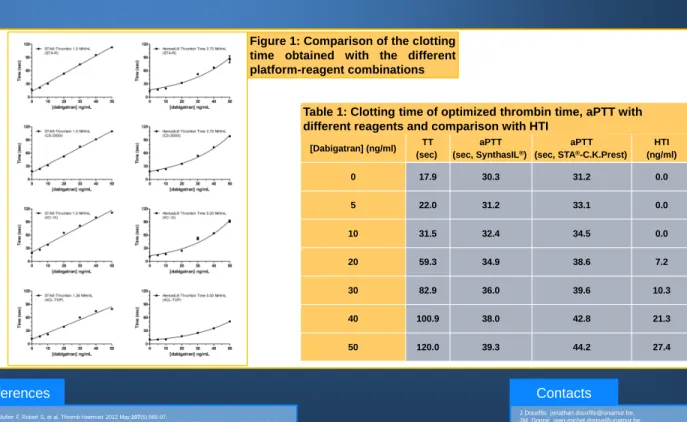
The thrombin origin is a more important variable in comparison to the type of coagulometer. At [DA] of 30ng/ml and [thrombin] of 1.5 NIH/ml, the STA®-TT ranges from 56 sec to 74 sec according to the instrument, whereas on a same instrument, the TT varied of minimum 43 sec, depending on the thrombin origin.
The optimized [thrombin] are the following : a) STA-R®, STA®-Thrombin : 1.5 NIH/ml,
b) STA-R®, HemosIL®TT : 3.8 NIH/ml,
c) ACLTOP®, STA®-Thrombin 3.8 NIH/ml, d) ACLTOP®, HemosIL® TT 5.0 NIH/ml, e) KC10®, STA®-Thrombin 1.5 NIH/ml, f) KC10®, HemosIL®TT 5.0 NIH/ml, g) CS2000i®, STA®-Thrombin 1.4 NIH/ml, h) CS2000i®, HemosIL®TT 3.8 NIH/ml.
Except for STA®-Thrombin on STA-R®, the [optimized] is not the one recommended by the
manufacturer. Figure 1 shows the results of optimized TT according to thrombin origin and coagulometer.
Repeatability experiments showed that variability increased with the [DA] (i.e. STA®-Thrombin
(STA-R®): coefficient of variation: 8.0% and 28.9% for 0ng/ml and 50ng/ml, respectively) and that the variability depends on the coagulometer and the reagent.
Comparison of sensitivity and linearity of TT, aPTT and HTI are presented in Table 1. APTT is not sensitive enough in low [DA], whatever the reagent, whereas HTI is not suitable in [DA] lower than 50ng/ml.
TT performed with fibrinogen reagent shows longer times in comparison to thrombin reagent (>120 sec vs 109 sec at 30ng/ml DA).
[Dabigatran] (ng/ml) TT (sec)
aPTT (sec, SynthasIL®)
aPTT (sec, STA®-C.K.Prest)
HTI (ng/ml) 0 17.9 30.3 31.2 0.0 5 22.0 31.2 33.1 0.0 10 31.5 32.4 34.5 0.0 20 59.3 34.9 38.6 7.2 30 82.9 36.0 39.6 10.3 40 100.9 38.0 42.8 21.3 50 120.0 39.3 44.2 27.4
Table 1: Clotting time of optimized thrombin time, aPTT with different reagents and comparison with HTI
Figure 1: Comparison of the clotting time obtained with the different platform-reagent combinations