RESEARCH OUTPUTS / RÉSULTATS DE RECHERCHE
Author(s) - Auteur(s) :
Publication date - Date de publication :
Permanent link - Permalien :
Rights / License - Licence de droit d’auteur :
Institutional Repository - Research Portal
Dépôt Institutionnel - Portail de la Recherche
researchportal.unamur.be
University of Namur
Light extraction enhancement for light-emitting diodes: a firefly-inspired structure
refined by the genetic algorithm
Bay, Annick; Mayer, Alexandre
Published in:
Proceedings of SPIE - The International Society for Optical Engineering DOI:
10.1117/12.2060797 Publication date: 2014
Document Version
Publisher's PDF, also known as Version of record Link to publication
Citation for pulished version (HARVARD):
Bay, A & Mayer, A 2014, Light extraction enhancement for light-emitting diodes: a firefly-inspired structure refined by the genetic algorithm: A firefly-inspired structure refined by the genetic algorithm. in Proceedings of SPIE - The International Society for Optical Engineering. vol. 9187, 918706, SPIE, The Nature of Light: Light in Nature V, San Diego, United States, 18/08/14. https://doi.org/10.1117/12.2060797
General rights
Copyright and moral rights for the publications made accessible in the public portal are retained by the authors and/or other copyright owners and it is a condition of accessing publications that users recognise and abide by the legal requirements associated with these rights. • Users may download and print one copy of any publication from the public portal for the purpose of private study or research. • You may not further distribute the material or use it for any profit-making activity or commercial gain
• You may freely distribute the URL identifying the publication in the public portal ? Take down policy
If you believe that this document breaches copyright please contact us providing details, and we will remove access to the work immediately and investigate your claim.
Light-extraction enhancement for light-emitting diodes: a
firefly-inspired structure refined by the genetic algorithm
Annick Bay
a,band Alexandre Mayer
ba
Scripps Institution of Oceanography, University of California, San Diego, 9500 Gilman Drive,
La Jolla, 92093 CA USA
b
Research Center in Physics of Matter and Radiation, University of Namur, Rue de Bruxelles
61, 5000 Namur, Belgium
ABSTRACT
The efficiency of light-emitting diodes (LED) has increased significantly over the past few years, but the overall efficiency is still limited by total internal reflections due to the high dielectric-constant contrast between the incident and emergent media. The bioluminescent organ of fireflies gave incentive for light-extraction enhance-ment studies. A specific factory-roof shaped structure was shown, by means of light-propagation simulations and measurements, to enhance light extraction significantly. In order to achieve a similar effect for light-emitting diodes, the structure needs to be adapted to the specific set-up of LEDs. In this context simulations were carried out to determine the best geometrical parameters.
In the present work, the search for a geometry that maximizes the extraction of light has been conducted by using a genetic algorithm. The idealized structure considered previously was generalized to a broader variety of shapes. The genetic algorithm makes it possible to search simultaneously over a wider range of parameters. It is also significantly less time-consuming than the previous approach that was based on a systematic scan on parameters. The results of the genetic algorithm show that (1) the calculations can be performed in a smaller amount of time and (2) the light extraction can be enhanced even more significantly by using optimal parameters determined by the genetic algorithm for the generalized structure. The combination of the genetic algorithm with the Rigorous Coupled Waves Analysis method constitutes a strong simulation tool, which provides us with adapted designs for enhancing light extraction from light-emitting diodes.
Keywords: light-emitting diode (LED), firefly, light extraction, optimization, genetic algorithm
1. INTRODUCTION
The light-extraction efficiency (LEE) of light-emitting devices is fundamentally limited by the high dielectric-constant contrast between the incident material and the emergent material. Various approaches are considered in order to increase the extraction of light from high dielectric-constant materials, including plasmonics, interface
structuring and alteration of the light-emitting material by encapsulation.1–4 In the present paper, we will
describe a theoretical approach that enables the determination of optimal parameters in order to achieve high extraction efficiencies.
A previous study5on the morphology of the bioluminescent organ of fireflies showed that the cuticle surface
presents a specific jagged scales pattern, which turns out to increase significantly the LEE in comparison to a planar surface. This specific structure is used as a starting point to enhance the light-extraction efficiency of a blue light-emitting diode. Several parameters of the structure are varied using the genetic algorithm and the effect on the light-extraction efficiency is analyzed.
Further author information: (Send correspondence to A.B.) A.B.: E-mail: [email protected], Telephone: 1 858 822 5303
Our objective is to maximize the light-extraction efficiency η, which is defined as the ratio between the
intensity Itrans of the light extracted into free space and the intensity Iinc of the light emitted in the active
material (Eq. 1).
η(%) = Itrans
Iinc
× 100 (1)
To quantify the increase in LEE, we define the light-extraction efficiency enhancement ∆η as the relative
increase of the LEE of the structured device ηstruct, when comparing with the LEE of the reference model ηref
(Eq. 2). The reference model consists in a light-emitting material with the same dielectric constant as the structured device, but terminated by a planar interface.
∆η = ηstruct− ηref ηref
× 100 (2)
2. FORMER RESULTS
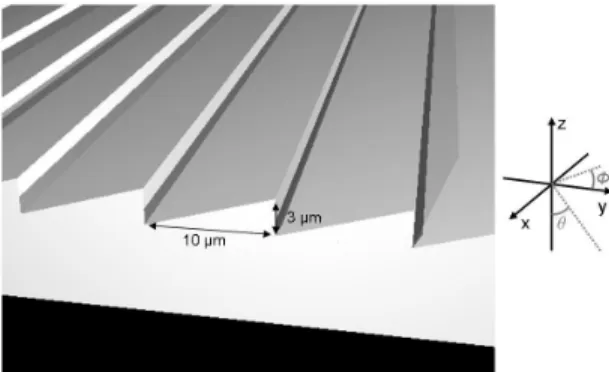
The surface of the cuticle of fireflies is characterized by jagged scale structures, which influence the LEE.5 The
mean period of these structures is about 10 µm and the height is about 3 µm (see Fig 1). Simulations were carried out by using a Rigorous Coupled Waves Analysis method. They show that the LEE enhancement reaches the value of ∆η = 45%, when comparing with a planar surface. The question then arises whether similar, but slightly different, structures could be even more efficient.
Figure 1. Schematic representation of the jagged scales found on the firefly cuticle.
A closer study of the jagged scale structure was carried out by varying the geometrical parameters of this structure, i.e. the period p and the height h. We also investigated related structures, i.e. a triangle, a pyramid and a cone, by a similar variation of p and h. The four structures considered in this study are represented in Fig. 2.
Figure 2. Different shapes considered in the case of the firefly. Two-dimensional shapes: (a) jagged scales and (b) triangles and three-dimensional shapes: (c) pyramids and (d) cones.
Parameter optimization in this previous study was actually carried out by a systematic scan on p and h. The
8 -(a) 6 _ 1 5 -- i 4 3 _ 2 -0 0 2 3 4 5 6 7 8 9 10 11 Period (µm) 0 1 2 3 4 5 6 7 Period (µm) 8 9 10 11
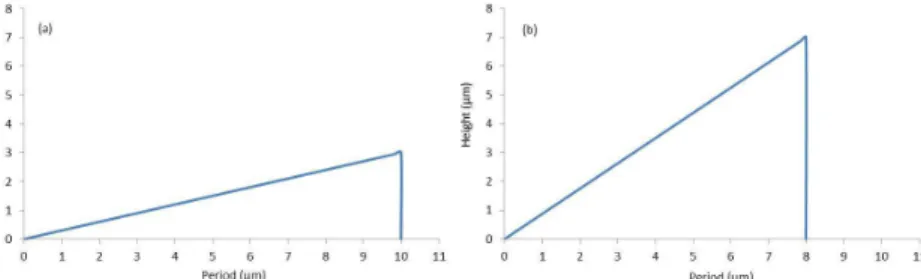
to the conclusion that the jagged scale structure is the most efficient, as it provides a LEE enhancement as high as ∆η = 58% when considering a period p=8µm and a height h=7µm. Fig. 3(b) shows the profile associated with these optimal parameters.
Figure 3. Profiles of the simulated structures in the firefly case. (a) Period p=10µm and height h=3µm found on the firefly (see Fig. 1). (b) Period p=8µm and height h=7µm after search for the highest LEE.
This approach was very time-consuming. The simulations have been done for structures varying in period p and height h from 1 µm to 15 µm, by steps of 1 µm. The number of structures that were evaluated was large: 15 × 15 = 225 for each configuration (jagged scales, triangles, pyramids and cones), giving a total of 900 evaluations. Considering that one evaluation took typically four hours, the total computing time was 3600 hours or 150 days. Another disadvantage of this approach is that the variation step was quite coarse. The probability to miss a more efficient structure is high.
This significant increase in the LEE of a high dielectric-constant light-emitting material led to a closer investigation of the jagged scale structure for fabrication on a gallium-nitride (GaN)-based light-emitting diode. The emission wavelength is 425 nm. In the case of a light-emitting diode, the dielectric constant of the emitting material is even higher than in the case of organic bioluminescent organs and the light extraction for a planar interface is therefore very limited. A Ni/Au current spreading layer is added on top of the light-emitting material for functioning purposes of the LED. The light-extraction efficiency for such a GaN-based LED terminated by a
planar surface has been estimated to be ηref= 3.7% only.
Former simulations, in which the period p and the height h of the jagged scales structure were varied by
steps of 1µm, show that the LEE can be enhanced up to ηstruct= 5.7%. The optimal parameters were found to
be p=5µm and h=6µm. When comparing with a system terminated by a planar surface, the LEE enhancement
is ∆η = 54%.7 In this case, 15 × 15 = 225 different structures were evaluated when exploring the jagged scale
shape.
3. GENETIC ALGORITHM
Let us consider a different approach for the parameter optimization. The function to be optimized is the light-extraction efficiency η of a light-emitting diode, as defined in the Introduction. This function has a number n
of variable physical parameters xi, where xi∈ [xmini , xmaxi ] with a specific granularity of ∆xi. We approach this
optimization problem by using this time a genetic algorithm. This approach will provide a globally maximized
function f , defined by a specific set of parameters xi.
Each of the structural parameters xi is represented by a gene, which consists of a string of ni bits (0 or 1).
The corresponding value of xi is given by
xi= xmini + hgeneii
xmax
i − xmini
2ni− 1 , (3)
where hgeneii is the value coded by the ithgene in Gray binary coding.8 The length ni of each gene is chosen
so that (xmax
i − xmini )/(2ni− 1) ≤ ∆xi. The juxtaposition of the n genes used for the representation of each
parameter is called DNA. The optimal solution is searched for by working on the DNA representation of the structural parameters.
We work with a population of npop=100 individuals. Each individual has its own DNA and is therefore
The first step is to evaluate the fitness, i.e. the light-extraction efficiency, of these 100 individuals. Out of
these 100 individuals, npop/2 individuals (the parents) are chosen by a random selection procedure that takes
into account the actual fitness of each individual. Individuals with a higher fitness have a higher chance to be selected. Each individual can be selected several times. This enables the best individuals to progressively
dominate the population. We define the mean value of the fitness fmeanas the average fitness value of the whole
population. The best fitness fbest corresponds to the highest LEE achieved in the population.
The parents are transferred to the next generation. For each pair of parents, two children are created either by (a) a one-point crossover of the parent’s DNA, or by (b) a simple replication of the parent’s DNA. These events occur with a probability of 90% and 10%, respectively. The one-point crossover of the parent’s DNA is intended to explore new solutions, whereas the transmission of unchanged individuals to the next generation contributes to the conservation of good solutions.
We finally introduce random mutations in the children’s DNA. At a high rate of mutations (> 5% for each bit) the exploration is very random and convergence is unreasonably slow. For a low rate of mutations (< 0.1%) the convergence of the genetic algorithm tends to be too fast and a local maximum may be found instead of the global maximum.
The three steps - selection, crossover/replication and mutation - are repeated for each new generation. Elitism is implemented in order to ensure that the best solution is not lost when going from one generation to the next. The 10% least efficient individuals in terms of fitness are replaced by random individuals. This is done again to ensure a good exploration of the entire parameter space.
The genetic similarity s represents the fraction of bits in the population whose value is the same as for the best individual. The genetic similarity provides a useful monitoring of the population dynamics. It is defined by
s = 1 nbits(npop− 1) npop X k=1 k6=kbest nbits X i=1 δbi[k],bi[kbest], (4)
where nbits = Pni=1ni. bi[k] refers to the ith bit in the DNA of the kth individual. kbest refers to the best
individual in the current population. At the beginning, the genetic similarity s typically takes a value of 0.5, indicating a random population. If s = 1, the population is completely dominated by the best individual.
Three different criteria are used to terminate the genetic algorithm: (a) the improvement of the best fitness
fbest was less than 0.5% over a determined number of generations, (b) the genetic similarity s reached a value
over 90% over a determined number of generations or, (c) s ≥ 1 − m, m being the mutation rate, and fmean≥
0.85 × fbest.
4. APPLICATION OF THE GENETIC ALGORITHM TO THE FIREFLY INSPIRED
STRUCTURE
In this section we describe the results provided by the genetic algorithm when applied to two sets of parameters.
In a first approach, the period p, the height h and the dielectric constant εform of the structure used for the
surface texturation of the LED were varied. The dielectric constant of the emitting material was kept constant. In a second approach, three parameters were varied in addition to the period p and the height h: the position of
the apex c, the concavity of the left edge αleft and the concavity of the right edge αright.
The geometry of the structure is defined by
h(x) = h ×h1 −(c.p−x)(c.p)αleftαleft i when 0 ≤ x ≤ c.p h ×h1 −(x−c.p)(p−c.p)αrightαright i when c.p ≤ x ≤ p (5)
This formula enables the exploration of a wide range of possible shapes. The symmetric triangular structure
(c=0.5, αleft=αright=1) and the asymmetric jagged scale structure (c=1, αleft=αright=1) are only particular cases
100 90 80 70 E ta 50 tj 50 40 30 20 10 O 10 15 20 25 30 35 40 45 50 Number of Generations 10% 9% 8% 7% , 6% " 5% 4% i% 0% - Best fitness - - Mean fitness
---
-10 15 20 25 30 Number of Generations 35 40 45 504.1 Variation of p, h and ε
formIn the first optimization using the genetic algorithm, only three parameters of the structure were varied. The
period p=x1 ranged from xmin1 =1µm up to xmax1 =15µm by steps of ∆x1=0.1 µm. The height h=x2 was varied
from xmin
2 =1µm to xmax2 =10µm by steps of ∆x2=0.1µm. In this case, the height was cut off at xmax2 =10µm
based on former results. The dielectric constant εform=x3 of the material that constitutes the structure in itself
was also varied from xmin
3 =1.2 to xmax3 =6.35 by steps of ∆x3=0.01. xmax3 =6.35 has been chosen as the highest
considered value for the dielectric constant, as it is equal to the dielectric constant of the emitting material
(GaN). The other parameters were fixed at c=1, αleft=1 and αright=1.
Figure 4. Genetic similarity for each generation when varying the period p=x1, the height h=x2and the dielectric constant
εform=x3 of the structure.
Fig. 4 shows the evolution of the genetic similarity as a function of the number of generations. Generation after generation the genetic similarity increases. This increase is not steadily positive, as we introduce random seeds and mutation to explore a wider number of individuals in the parameter space. Therefore we encounter decreases in the genetic similarity.
Figure 5. Fitness for each generation when varying the period p=x1, the height h=x2 and the dielectric constant εform=x3
of the structure.
Fig. 5 shows the evolution of the fitness as a function of the number of generations. The genetic algorithm adjusts only three parameters in this case and the fitness converges very quickly to a high value. The mean fitness (dotted red line on Fig. 5) corresponds to the average fitness of all individuals of a given generation. For the first generation, one can see that the average fitness is close to the best value achieved by former, more gross, calculations. The best individual of the first generation is already significantly higher than the rest of the population. In this specific case, a solution providing a high fitness, i.e. a high LEE, is already achieved in the early stages of the optimization. The evolution of the genetic similarity shows however that the genetic algorithm
5
m 4
0 2
4 Period bµm) 8 10 12
has still been exploring parameters and was therefore not stuck to a single high-fitness solution, thereby ruling out a local optimum.
In this simulation, the fitness reaches η=7.5% after 49 generations, which gives a relative increase in the LEE of
∆η =102%. This result corresponds to a period p=x1=2.98µm, a height h=x2=2.20µm and a dielectric constant
εform=x3=6.32. It is interesting to note that a dielectric constant close to the value of the emitting material
is more favorable for a high light-extraction efficiency. The structure determined by the genetic algorithm is represented in Fig. 6. This specific structure doubles the amount of light that is extracted in comparison to a plane surfacee.
Figure 6. Profile of the structure associated with the highest LEE, as obtained for a period p=x1=2.98µm, a height
h=x2=2.20µm and a dielectric constant εform=x3=6.32. The relative enhancement of the LEE reaches ∆η=102%.
The number of fitness evaluations in the present optimization reaches 1425, i.e. the light-extraction efficiency was calculated 1425 times. For the former results, 225 evaluations of the LEE were needed in order to determine an optimal shape for the jagged scale structure (see Sec. 2). Only two parameters were however considered (the
period p and the height h) in this previous work, instead of three (p, h and the dielectric constant εform) in this
optimization using the genetic algorithm. Moreover, the step width used with the genetic algorithm is way more precise than formerly. To achieve the same result by calculating all possible parameter combinations without using the genetic algorithm, over six millions evaluations would have been needed.
4.2 Variation of p, h, c, α
leftand α
rightFor this second optimization using the genetic algorithm, we considered the whole set of structural parameters
(p, h, c, αleft and αright). The dielectric constant of the material used for the surface texturation was fixed to a
known, previously determined value (εstruct = 2.763). Only the shape of the structure was thus changed. The
period p=x1 was varied between xmin1 =1µm and xmax1 =15µm by steps of ∆x1=0.1µm. The height h=x2 was
varied between xmin2 =1µm and xmax2 =10µm by steps of ∆x2=0.1µm. The height was cut off at xmax2 =10µm
just as in the previous case, based on former results. The apex position c=x3 of the structure could take
values between xmin
3 =0.5 and xmax3 =1 by steps of ∆x3=0.01. This parameter controls the position of the apex.
It allows the consideration of all intermediate structures between the symmetric triangle and the jagged scale structure (see Section 2). The concavity of the two edges can be changed independently, allowing the structure
to have either convex or concave edges on any side. The concavity of the left edge is parameterized by αleft=x4,
while the concavity of the right edge is parameterized by αright=x5. These two parameters can take values
between xmin
4,5 =0.2 and xmax4,5 =5 by steps of ∆x4,5=0.01. x4,5∈ [0.2, 1] corresponds to a convex edge. x4,5∈ [1, 5]
corresponds to a concave edge.
Fig 7 shows the evolution of the genetic similarity as a function of the number of generations. Fig 8 shows the evolution of the best and the mean fitness values as a function of the number of generations. Just as in the previous case (Sec. 4.1), the mean fitness value is comparable to the best LEE achieved when considering a systematic scan on parameters with larger discretization steps (see Sec. 2). However, already in the first generation, the best fitness indicates a significantly higher value for the LEE. This best fitness is increased further as more generations are considered. The genetic similarity is again an important indicator to verify a good exploration of parameters and that new individuals, very different from their parents, are taken into account to avoid local optima.
The highest LEE found by the genetic algorithm reaches η=7.1%. This value is achieved for a period
100 90 80 70 E 60 Xj 50 40 30 20 10 0 5 10 15 20 25 Number of Generations 30 35 40 10% 9% 8% 7% 6% LL 5% 4% 3% 1% 0%
---10 15 20 25 Number of Generations 30 35 40 - Best Fitness - - Mean Fitness 0 2 4 6 8 10 Period (µm) 12 14Figure 7. Genetic similarity for each generation when varying the period p=x1, the height h=x2, the apex position c=x3
and the concavity of the edges αleft=x4 and αright=x5.
Figure 8. Fitness for each generation when varying the period p=x1, the height h=x2, the apex position c=x3 and the
concavity of the edges αleft=x4 and αright=x5.
and a concavity of the right edge αright=x5=1.06. The relative enhancement of the LEE reaches ∆η=89%. Fig.
9 represents the structure determined by the genetic algorithm.
The fitness function was calculated 1478 times to achieve the present result. In comparison to the results achieved in our previous work (15 × 15 × 2=450 evaluations for the jagged scale and the triangular shape, see Sec. 2) this might appear as a large number. However, we have to consider that in this case five parameters were varied instead of two, a wider variety of shapes was taken into account and the search was carried out with a higher precision than before. Only 1478 combinations out of 78 trillions were calculated.
Figure 9. Profile of the structure associated with the highest LEE, as obtained for a period p=x1=6.87µm, a height
h=x2=4.97µm, an apex position c=x3=0.51, a concavity of the left edge αleft=x4=1.07 and a concavity of the right edge
5. CONCLUSION
We presented a method to increase the light-extraction efficiency of light-emitting diodes by using Nature as an inspiration. The first inspiration for the structures considered in this work came by studying thoroughly the morphology of a firefly. This structure was then studied in a wider approach by taking into consideration the specific needs of an artificial system, such as the light-emitting diode. The second inspiration from Nature that is used in this work is the genetic algorithm in itself, which mimics natural selection.
The results achieved with the genetic algorithm are more precise in the determination of structural parameters and also more accurate in the evaluation of the LEE than those achieved in our previous work, where every combination of parameters had to be considered. Here only a thorough selection is considered, which allows to take (a) more parameters into consideration and (b) a finer step width into consideration. The results found with the genetic algorithm are significantly higher than those achieved formerly.
When comparing the two optimizations presented in this paper, it is interesting to note that similar results could be achieved when working either on three or five parameters (η ∼ 7%). The first simulation introduced
a variation of the dielectric constant εform, whereas the second simulation introduced a broader variation of
the shape, taking into account the apex position c and the concavity of the two edges αleft and αright. The
optimization that included the dielectric constant could however provide higher light-extraction efficiencies. It seems that the dielectric constant of the add-on material has a very high impact on the final LEE.
The advantages of the genetic algorithm approach are obvious: we could explore a wider range of parameters, in a reasonable amount of time and achieve higher LEE. These simulations are still ongoing and even better results can be expected in the near future. A next step is to vary all six parameters to find an optimal structure for high light-extraction efficiency of LED’s.
ACKNOWLEDGMENTS
A.B. is funded as a Postdoctoral Researcher by the Fund for Scientific Research (F.R.S.-FNRS) of Belgium and by the Fulbright Commission Belgium. A.M. is funded as a Research Associate by the Fund for Scientific Research (F.R.S.-FNRS) of Belgium. He is member of NaXys, Namur Center for Complex Systems, University of Namur, Belgium. This research used resources of the ”Plateforme Technologique de Calcul Intensif (PTCI)” (http://www.ptci.unamur.be) located at the University of Namur, Belgium, which is supported by the F.R.S.-FNRS under the convention No. 2.4520.11. The PTCI is member of the ”Consortium des Equipements de Calcul
Intensif (CECI)” (http://www.ceci-hpc.be). Fr´ed´eric Wautelet is acknowledged for the script that enabled the
development of multi-agent versions of the genetic algorithm. The authors also acknowledge Prof. Jean Pol Vigneron (deceased), colleague, and friend.
REFERENCES
[1] Horng, R.-H., Chuang, S.-H., Tsung, C.-S., Chen, C.-H., Lin, C.-Y., Chang, F.-Y., and Wuu, D.-S., “Study of surface plasmons at the metal/semiconductor interface,” Proc. of SPIE 9126(91261L) (2014).
[2] A.Haldar, Bera, S., Jana, S., Bhattacharya, K., and Chakraborty, R., “Development of a cost effective surface-patterned transparent conductive coating as top-contact of light emitting diodes,” J. Appl. Phys 115(1931098) (2014).
[3] Seo, J., Kim, S., Kim, Y., Iqbal, F., and Kim, H., “Effecto pf glass refractive index on light extraction efficiency of light-emitting diodes,” J. Am. Ceram. Soc. , 1–5 (2014).
[4] Kim, J. B., Kim, S.-M., Kim, Y. W., Kang, S.-K., Jeon, S.-R., Hwang, N., Choi, Y.-J., and Chung, C. S., “Light extraction enhancement of gan-based light-emitting diodes using volcano-shaped patterned sapphire substrates,” Jpn. J. Appl. Phys. 49 (2010).
[5] Bay, A., Cloetens, P., Suhonen, H., and Vigneron, J. P., “Improved light extraction in the bioluminescent lantern of a Photuris firefly (Lampyridae),” Opt. Express 21(1), 764–780 (2013).
[6] Bay, A., Sarrazin, M., and Vigneron, J. P., “Search for an optimal light-extracting surface derived from the morphology of a firefly lantern,” Opt. Eng. 52(2), 1–7 (2013).
[7] Bay, A., Andr´e, N., Sarrazin, M., Belarouci, A., Aimez, V., Francis, L. A., and Vigneron, J. P., “Optimal
overlayer inspired by Photuris firefly improves light-extraction efficiency of existing light-emitting diodes,” Opt. Express 21(S1), A179–A189 (2013).