The Peoples Democratic Republic of Algeria Ministry of Higher Education and Scientific Research
Mentouri University Constantine Faculty of Letters and Languages Department of Foreign Languages
A Dissertation Submitted in Partial Fulfilment of the Requirements for a Master Degree in Applied Language Studies.
Candidate: Supervised by:
Miss Souaad ALLILI Dr. Youcef BEGHOUL
2009 – 2010
Difficulties with the Collocational Behaviour
of the Near – synonymous Verbs
‘Earn’, ‘Gain’, and ‘Win’
Dedication I dedicate this work to:
- My Father and mother for their patience and sacrifice. - My sisters and brothers for their love and support.
Acknowledgments
I wish, above all, to thank my teacher and supervisor Dr Youcef Beghoul whose unfailing guidance and encouragement have supported this project from beginning to end.
Special thanks must go to My Teachers: Dr El Khiar Atamna, Dr Nacif Labed, Miss Achwak Bader. I really appreciate their kindness as they have given me generously of their time and knowledge.
I must also thank all the students who have taken part in this study. Their contribution has been great in the fulfillment of this project. I am very grateful to them.
Last but not least, I would like to thank my friends Samira, Samia,radia, Hassiba, Hassnaa, Zahra and all my classmates for their help.
Abstract
The present study aims at investigating the students‟ ability to collocate the near-synonymous verbs „gain‟, „win‟ and „earn‟ appropriately. For this purpose, 25 third year LMD students of English reading for a BA degree in applied language studies, during the academic year 2009-2010 at Mentouri University in Constantine, have taken part in this study. The findings have shown that the students are not competent in their production of the collocations that contain the near-synonymous verbs „gain‟, „win‟, and „earn‟. Some pedagogical implications are drawn from the overall findings and some suggestions are provided in order to improve the learners‟ knowledge of collocations and their use for more fluent English.
List of Tables
Table 1: Correct and Incorrect Collocational Use of „Gain‟ 20 Table 2: Top Seven Correct Collocations Containing „Gain‟ 22 Table 3: Top Seven Incorrect Collocational Uses of „Gain‟ 24 Table 4: Acceptable and Unacceptable Collocational Uses of „Win‟ 26 Table 5: Top Four Correct Collocations Containing „Win‟ 27 Table 6: Top Six Combinations of Incorrect Collocational Use of „Win‟ 30 Table 7: Acceptable and Unacceptable Collocational Uses of „Earn‟ 31 Table 8: Top Three Correct Collocations Containing „Earn‟ 32 Table 9: Top Three Incorrect Collocational Use of „Earn‟ 33 Table 10: Box Formats to Record New Collocations in a Notebook 37 Table 11: Nouns that Collocate with „Rob‟ and „Steal‟ 38
List of Abbreviations EFL: English as a Foreign Language
G: Grammatical Collocation
L: Lexical Collocation
LMD: License, Master, Doctorate
N: Noun
Contents
Introduction 1
Chapter I: Theoretical Issues and Problems of Collocation and Synonymy 4
Introduction 4
I.1. Collocations 4
I.1.1. Definitions of Collocation 4
I.1.2. Types of Collocation 6
I.1.2.1. Grammatical Collocations 7
I.1.2.1. Lexical Collocations 7
I.2. Synonymy 8
I.2.1. Definition of Synonymy 8
I.2.2. Types of Synonymy 9
I.2.2.1. Absolute Synonyms 9
I.1.2.2. Propositional Synonyms 10
I.1.2.3. Near- Synonyms 10
I.1.2.3. Synonymy as a Source of Learners‟ Collocation Problems 11
Conclusion 12
Chapter II: ‘Earn’ ‘Gain’, ‘Win’ and their Collocations 13
Introduction 13
I.1. „Earn‟ and its Collocations 13
I.2. „Gain‟ and its Collocations 14
I.3. „Win‟ and its Collocations 16
Chapter III: Data Collection and Analysis 19
Introduction 19
III.1. Participants 19
III.2. Tools and Procedures 19
III.3. Data Analysis 20
III.3.1. Correct and Incorrect Collocational Use of „Gain‟ 20 III.3.2. Correct and Incorrect Collocational Use of „Win‟ 26 III.3.3. Correct and Incorrect Collocational Use of „Earn‟ 31
III.4. Summary 34
Conclusion 34
Chapter IV: Pedagogical Implications 36
Introduction 36
IV.1. Collocations 36
IV.2. V + N Collocations Containing Synonymous Verbs 38
Conclusion 39
General Conclusion 40-41
Bibliography 42-43
Appendix 44-45
Introduction
1. Statement of the Problem
English includes more synonyms than some languages for the historical reason that it has grown over the centuries by constantly incorporating words from other languages. These words with identical or very similar meanings, however, pose a lot of problems to students learning English as a foreign language; they find it difficult to decide which of the synonymous words fit better in a specific sentence. They are also not always sure about their correct collocates. Students, for example, believe that because the verbs „shout‟ and „bawl‟ have nearly similar meanings and share many semantic proprieties they can be used in exactly the same contexts. Consequently, they produce both „I shouted for help‟ and „I bawled for help‟. The former is correct and native-like since „help‟ collocates perfectly well with „shout‟, and the latter is strange and non-native since „help‟ cannot possibly collocate with „bawl‟. The near synonymous verbs „shout‟ and „bawl‟ are not collocationally interchangeable; they cannot be freely substituted in a sentence. Students, thus, have to be careful using a word out of a number of synonyms or near-synonyms.
2. Aims of the Study
The present study aims at investigating the ability of 3rd year LMD students of English to collocate the seemingly synonymous verbs „earn‟, „gain‟ and „win‟ appropriately through:
* Identifying, classifying and analysing the students‟ V+N unacceptable collocations;
* Pointing out the differences in the collocational patterns of the near-synonymous verbs „earn‟, „gain‟ and „win‟;
* Providing solutions to the problem.
3. Research Questions
The present research addresses the following questions:
* What are the typical V+N unacceptable collocations found in the written production of 3rd year LMD students of English?
* Do these students use the near-synonymous verbs „earn‟, „gain‟ and „win‟ interchangeably? If yes, to what extent?
* How does ignorance of the restrictions that govern the use of these synonymous words contribute to the students‟ V+N unacceptable collocations?
4. Hypothesis
The students‟ lack of knowledge about the collocational behaviour of the near-synonymous verbs „earn‟, „gain‟ and „win‟ results in V+N unacceptable collocations.
5. Participants
The sample of the study consists of 25 third year LMD students of English reading for a BA degree in applied language studies at Mentouri University. The choice of this sample population has been motivated by the fact that they are supposed to have acquired the necessary basic knowledge about the collocational use of English verbs.
6. Research Tools
A discourse completion task will be administered to 25 third year LMD learners of English. It consists of 28 sentences with blanks to be filled by students using the
appropriate verb. This task aims to uncover the students‟ knowledge of the collocational behaviour of the near-synonymous verbs „earn‟, „gain‟ and „win‟.
Collocation mistakes will be analysed from a qualitative perspective while their frequency and accuracy will be calculated quantitatively
7. Structure of the Study
The present research is basically divided into two main parts: a descriptive part which includes two chapters about the review of the related literature, and an empirical part which includes two chapters.
Chapter one, first, provides a brief review of collocations, their definitions and types. Then, it deals with the notion of synonymy in English, its definitions and its categories. Finally, it reviews some studies on the learner‟s collocational problems that are due to the use of synonyms.
Chapter two provides a detailed discussion of the different definitions and collocational patterns of the near-synonymous verbs „earn‟, „gain‟ and „win‟. This is to show how the seemingly related meanings of such words can be distinguished by the nouns or noun phrases with which they collocate.
Chapter three provides an in-depth analysis of the students‟ performance in the discourse completion task. This is to answer the basic question of the study, which is to what extent does lack of knowledge of the collocational behaviour of the near-synonymous verbs „earn‟, „gain‟ and „win‟ contribute to the students V+N unusual collocations?
Chapter four presents some pedagogical implications of the findings on the collocations containing synonymous verbs.
Chapter I
Theoretical Issues and Problems of Collocation and Synonymy
Introduction
Native speakers of English generally express themselves fluently because they possess a large stock of recurrent word combinations called collocations. Learners of English lacking these readymade chunks make non-native errors when producing utterances. According to McCarthy (1990: 13), “Even very advanced learners often make inappropriate or unacceptable collocations.” Acquisition and correct production of such word combinations is a mark of an advanced level of proficiency in a language, as Lewis (1997:15) puts it “fluency is based on the acquisition of a large store of fixed or semi-fixed prefabricated items”. James (1998:152) also agrees that correct usage of collocations “contributes greatly to one‟s idiomaticity and native-likeness”. Thus, in order to achieve native-like fluency, learners of English need to be able to comprehend and produce collocations appropriately.
In this chapter, we first review the literature on collocations in an attempt to provide answers to the questions: what are collocations? And what are their different types? Second, we deal with the notion of synonymy in English as to how it is defined and categorized. Finally, we review the related literature on learners‟ collocation problems that are due to the use of synonymy.
I. 1 Collocations
I.1.1 Definitions of Collocation
Originally, the term „collocation‟ was introduced by Firth (1951: 195-196) as one of the “levels” of meaning. He distinguished “meaning by collocation” from both the
“conceptual or idea approach to the meaning of the word” and „contextual meaning‟. In Firth‟s view (1957: 181), Collocation is „the company the words keep together‟ or “the statements of the habitual or customary places of that word”.
Collocations are not easily defined, they are often discussed in contrast with free word combinations at one extreme and idiomatic expressions at the other, collocations occurring somewhere in the middle of this continuum. Free word combinations are combinations of two or more words co-occurring together, without any specific relation between these words. Idiomatic expressions are rigid phrases whose meanings cannot be determined from the meanings of their parts.
Collocations fall between these extremes; they are combinations of words which are used together with greater than usual frequency. Generally, the factors that determine whether a lexical combination is an idiom, a collocation or a free word combination are: the degree of probability that the items will co-occur, the degree of fixity of the combination, and the degree to which the meaning of the combination can be derived from the meaning of its constituent parts. These factors, however, are not all taken into account by all analysts. As a result, exact definitions of collocations, idioms and free words combinations vary from one analyst to another.
Mitchell (1971: 53-57) suggests the following continuum: idioms – collocations- colligations – free combinations. Idioms are defined both from their semantic characteristics and the fixity of their constituents. They function semantically as a single unit, and are more or less “non-productive”, that is, they tend not to allow for neither substitution of their elements, nor for grammatical or syntactic alterations. Free combinations, however, are “really compositional and productive”. Collocations are presented as “roughly predictable ….yet restricted to certain specified items”. Colligations are “generalisable classes of collocations, from which at least one construct is specified by category rather than as a distinct lexical item”. Cruse (1986: 37-41) uses semantic criteria
to distinguish between idioms which are “lexically complex” units, constituting a “single minimal semantic constituent”, and collocations which are “sequences of lexical items which habitually co-occur”, each lexical item being a “semantic constituent”. He also introduces “bound collocations” which are “expressions whose constituents do not like to be separated” as a “transitional area bordering on idiom”.
Kjellmer (1994: xiv – xxxiii) defines collocations as “such recurring sequences of items that are grammatically well formed. He defines an idiom as a “subcategory of the class of collocations”; it is “a collocation whose meaning cannot be deduced from the combined meaning of its constituents”.
Benson, Benson and Ilson (1986: 252-254) identify five groups of “lexical combinations”: “Free combinations” whose “components are the freest in regard to combining with other lexical items”, “idioms” which are “relatively frozen expressions whose meanings do not reflect the meanings of their component parts”, „collocations” or “fixed/recurrent combinations” which are “loosely fixed combinations”. Between free combinations and idioms, “transitional collocations” are “between idioms and collocations ….more frozen than ordinary collocations …..[They] seem to have a meaning close to that suggested by their component parts”, and “compounds” which are “lexical elements of more than one word”.
I.1.2 Types of Collocation
In an effort to characterize collocations, Benson et al. (1986) divide collocations into grammatical collocations and lexical collocations.
I.1.2.1 Grammatical Collocations
Grammatical collocations are those which consist of a dominant word such as a verb, a noun, or an adjective followed by a preposition or a grammatical structure such as an infinitive or a clause. They come in eight groups:
G1 = noun + preposition e.g. Blockade against, apathy towards.
G2 = noun + to infinitive e.g. He was a fool to do it .e.g. They felt a need to do it.
G3 = noun + that clause e.g. We reached an agreement that she would represent us in court.
G4 = preposition + noun e.g. By accident.
G5 = adjective + preposition e.g. Fond of children, hungry for news.
G6 = predicate adjective + to. Infinitive e.g. It was necessary to work.
G7 = adjective + that clause e.g. She was afraid that she would fail.
G8 = verb patterns e.g. They begin to speak.
I.1.2.2 Lexical Collocations
Lexical collocations are those which consist of two lexical components in combinations like adjectives + noun, noun + verb, and verb +noun. Such lexical collocations do not contain prepositions, infinitives or clauses lexical collocations.
L1 = verb (meaning creation, activation) + noun / pronoun / prepositional phrase, e.g. Come to an agreement, launch a missile.
L2 = verb (meaning eradication, nullification) + noun, e.g. Reject an appeal, crush resistance
L3 = (adjective + noun) or (noun used in an attributive way + noun) e.g. Strong tea, house arrest.
L4 = noun + verb naming the activity which is performed by a designate of this noun e.g. Bombs explode, bees sting.
L5 = Quantifier + noun e.g. A Swarm of bees, a piece of advice.
L6 = adverb + adjective e.g. Hopelessly addicted, sound asleep.
L7 = verb + adverb e.g.: Argue heatedly, apologize humbly.
I.2 Synonymy
I.2.1 Definition of Synonymy
In English, as in many other languages, there are words that have identical or very similar meanings. They are called synonyms. Examples of some English synonyms are: „car‟ and „automobile‟, „funny‟ and „humorous‟, „peace‟ and „tranquillity‟.Ghazala (1995: 91) states that synonymy is “the similarity of meaning between two or more words”. For instance, the words “big”, “ large“, and“ huge“ are synonyms. This definition might sound easy and quite logical, but it is not really accepted by all semanticists. “It can, however, be maintained that there are no real synonyms, that no two words have exactly the same meaning” (Palmer 1976: 60).That is, there is no such thing as a form that is identical in every aspect of meaning with another.
I.2.2 Types of Synonymy
In general, synonymy is the semantic relation that holds between lexical units, phrases, sentences, and propositions. It can be classified into three types: absolute synonymy, propositional synonymy, and near-synonymy.
I.2.2.1 Absolute Synonyms
Two words are defined as being absolutely synonymous “if and only if they have the same distribution and are completely synonymous in all their meanings and in all their contexts of occurrence” (Lyons 1981:148). Lyons claims that if absolute synonymy exists at all, it is in very special contexts such as scientific terms (e.g. „almonds‟ and „tonsils‟). Cruse (2000: 157) agrees to Lyons‟ definition of absolute synonymy. He claims that two or more lexemes are described as absolute synonyms if their meanings are completely identical in all contexts. He also claims that absolute synonyms are „non-existent‟ for many reasons. First, if one of these synonyms is used, the function of the other becomes unnecessary. Second, the interchangeability of these synonyms in all contexts cannot be proved since the number of contexts is infinite. Palmer (1976:60) states that “it can, however, be maintained that there are no real synonyms, that no two words have exactly the same meaning”. He states five different ways in which many apparent synonyms may differ. First, some synonyms belong to different varieties of the same language. For instance, the word “autumn” is used in Britain and “fall” is used in the United States. Second, some apparent synonyms are used in different styles according to the degree of formality. For instance, “gentleman”, “man”, and “chap”. Thirdly, some synonyms may differ only in their emotive or evaluative meanings but their cognitive meanings are the same. For instance, “hide” and “canceal”.Fourthly, many other apparent synonyms differ with respect to the items with which they collocate. Not every synonym of a particular
word can take the place of that word. The words “rancid” and “addled” would be considered as synonyms, but only “rancid” collocates with “butter” and only “addled” collocates with “eggs”.Fifthly,some synonyms are only close in meaning or their meaning overlap such as „mature‟ and „adult‟ ,and „ripe‟.
I.2.2.2 Propositional Synonyms
Propositional synonymy has to do with clauses, sentences and propositions. Propositions are synonyms when their contents are identical.
Mary fed the cat.
The cat was fed by Mary.
It was the cat that Mary fed. (Cann et al 2009: 9)
Propositional synonymy is also known as cognitive synonymy (Cruse 2000:158). Cognitive synonymy presents the relationships that hold between sentences or propositions that contain pairs of cognitive synonyms. These cognitive synonyms are words with the same sense but not necessarily the same denotation. He also states that cognitive synonymy can be described through entailment. A proposition containing one synonym is “mutually entailed” by the same proposition containing the other. The propositions „john brought a fiddle‟ and „john brought a violin‟ are mutually entailing i.e., the first proposition is entailed by the second.
I .2.2.3 Near- Synonyms
Synonymous words that are neither of the two above are near-synonyms. They are associated with overlapping of meaning. Murphy (2003:155) claims that the “senses of near-synonyms overlap to a great degree, but not completely”. Near-synonyms are not
collocationally interchangeable in all their contexts, both „friendly‟ and „amicable‟ would be considered as near-synonyms but only „amicable‟ collocates well with „divorce‟; „friendly‟ cannot.
I.2.2.4. Synonymy as a Source of Learners’ Collocation Problems
Hussein (1998) conducted a study that aimed at investigating the ability of the third-year and fourth-year students of English in Jordan to collocate English words correctly. It also aimed at finding out the strategies students tend to use when they try to convey meaning that involve collocations. For this purpose, a multiple choice type collocation test was used and students were asked to choose one correct answer out of four distracters. Subjects were asked to select one of the following words (a) final (b) ending, (c) closing or (d) finish. Findings show that only 39 % of the collocations were rendered correctly. About 22% of the unusual collocations were found to be due to the use of synonymy; students believed that when two words are synonymous or near-synonymous, they combine freely with the same set of nouns. In the above example, students used „final‟ instead of „finish‟ because they believed that they can freely substitute for one another.
Another study conducted by kuo (2009) investigates the use of collocation by intermediate EFL college students in Taiwan. It aimed at giving suggestions to teachers to help students work on certain errors. For this purpose, 49 students majoring in English were asked to produce essays in four or five paragraphs (between 200 and 300 words). They were free to choose their writing topic. Findings show that the use of synonymy as a strategy Contributed to the students‟ collocation problems. 31℅ of students unusual collocations were due to the use of synonymy. For example, students knew that „vision‟ and „eyesight‟ are synonymous but failed to know their collocates. They produced the incorrect collocation „broaden your eyesight.
Conclusion
Collocation is the way one word frequently or always comes together with another word or words for no specific reasons. Collocations are mainly classified as lexical and grammatical. The power of v + n lexical collocations is considerable as a verb and a noun are enough to make a sentence. Students use the combination v + n for self –expression, and the result is they are more communicative and their language has a better chance of developing naturally.
Chapter II
‘Earn’ ‘Gain’, ‘Win’ and their Collocations
Introduction
The English verbs earn, gain and win have approximately similar meanings related to getting or achieving something. These verbs, however, differ with respect to the nouns with which they collocate. This chapter provides an in depth discussion of the different definitions of the verbs „earn‟, „gain‟ and „win‟. It also presents the different collocational patterns of these verbs. The collocational patterns are taken from Oxford Advanced Learner‟s Dictionary (2000:396; 526;1482).
II.1‘Earn’ and its Collocations(Oxford Advanced Learner s Dictionary2000:396). Earn
1. Money for work.
2. Profit.
3. Something deserved.
1. To get money for work that you do. [Vn] He earns about E 20,000 a year.
[Vnn] His victory in the tournament earned him $ 50000. [v]All the children are earning now.
2. [Vn] to get money as profit or interest on money you lend, have in bank, etc.
3. To get something that you deserve, usually because of something good you have done or because of the good qualities you have.
[Vn] He earned a reputation as an expert on tax law.
[Vnn] His outstanding ability earned him a place on the team.
II.2 ‘Gain’ and its Collocations(Oxford Advanced Learner s Dictionary2000:526)
Gain
1. Obtain / win.
2. Get benefit / advantage. 3. Get more. 4. Of watch / clock. 5. Of currencies/ shares. 6. Reach place. Phrases Phrasal verbs
1. Obtain or win something, especially something that you want or need. [vn]The country gained its independence ten years ago.
Collocations of Earn
Money, a living(earn enough money for the things you need to live),a fortune (earn an extremely large amount of money),a place, a salary, a rest.
[Vnn] Her unusual talent gained her world wide recognition.
2.To obtain an advantage or benefit from something or from doing something.
[vn] There is nothing to be gained from delaying the decision.
[v]Who stands to gain from this decision.
3. [Vn] to gradually get one of something.
I’ve gained weight recently.
4.To go too fast.
[vn] My watch gains two minutes every 2 hours. (It may also be v)
5. To increase in value.
[vn] The shares gained 14p to 262p.
[v] The pound gained against the dollar again today.
6. [Vn] to reach a place, usually after a lot of effort.
At last she gained the shelter of the forest.
15 Collocations of Gain
Acceptance, entrance, access, recognition, confidence, strength, experience, ideas, information, insight, popularity, recognition weight.
Phrases
Gain ground: to become more powerful or successful: The sterling continues to gain ground against the dollar.
Gain time: to delay something so that you can have more time to make a decision, deal with a problem.
Phrasal Verbs
Gain in something: to get more of a particular quality. Wine bars have gained in popularity in recent years.
Gain on somebody/something: to get closer to somebody/something that you are chasing.
II.3 ‘Win’ and its Collocations (Oxford Advanced Learner’s Dictionary 2000: 1482)
Win
1. be the most successful. 2. get something.
3. achieve something you want. Phrases
Phrasal Verbs
1. To be the most successful in a competition, race, battle etc. [v] France won by six goals to two against Denmark.
2. To get something as the result of a competition, race, election, etc. (vn) Britain won five gold medals.
[Vnn] You’ve won a trip to New York.
3. [Vn] to achieve or get something that you want, especially by your awn efforts: e.g. They are trying to win support for their proposal.
Phrases
You can’t win them all: (spoken) used to express sympathy for somebody who has been disappointed about something
You win: (spoken) used to agree to what somebody wants after you have failed to persuade them to do or let you do something else e.g. Ok, you win; I’ll admit I was wrong.
Win hand dawn: to win something very easily.
Win or lose: whether you succeed or fail: e.g. Win or lose, we’ll know we’ve done our best.
Phrasal verbs
Win somebody around/ over/ round to (something): to get somebody‟s support or approval by persuading them that you are right: She’s against the idea but I am sure I can win her over.
Collocations of Win
Match, race, game, lottery, war, battle, election, respect, a contract, the right(to do something) ,support, approval, argument
Contract, the right (to do something), support Approval, argument, administration
Win something/somebody back: to get or have again something/ somebody that you had before: e.g. The party is struggling to win back voters who have been alienated by recent scandals.
Win out/ through: to be successful in spite of difficulties .e.g. It’s not going to be easy but we’ll win through in the end.
Conclusion
The near- synonymous verbs „earn‟, „gain‟, and „win‟ really differ with respect to the nouns with which they collocate . However, there is, at least, one noun that collocates with all the three verbs: one can earn „respect‟, „win respect‟ and „gain respect‟.
Chapter III
Data Collection and Analysis
Introduction
The main concern of this chapter is the analysis of the data collected by means of a discourse completion task. The analysis focuses on the appropriate and inappropriate collocational use of the near-synonymous verbs „gain‟, „win‟ and „earn‟.
III.1 Participants
The participants in this study have been 25 third year LMD students of English reading for a BA degree in applied language studies during the academic year 2009-2010 at Mentouri University in Constantine. The choice of this sample population has been motivated by the fact that they are supposed to have acquired the necessary basic knowledge about the collocational use of English verbs.
III.2 Tools and Procedures
In order to obtain data on the students‟ performance in collocating the rear-synonymous verbs „gain‟, „win‟ and „earn‟ a discourse completion task has been administered to 25 third year LMD learners of English. It consists of twenty eight sentences each of which contains a blank which the informants are required to fill in using the appropriate verb. We have to note that the informants have been given three options. The criterion for choosing the collocations found in this study has been that each of the verbs cannot be replaced by other possible choices. Data has been collected in a real written expression class.
In this study, both qualitative and quantitative methods have been used. Collocation mistakes have been analyzed from a qualitative perspective while their frequency and accuracy have been calculated quantitatively. The obtained results have been given in tabular formats.
The Oxford Advanced learner‟s dictionary(2000:526,1482,396) has been used as the basis against which the informants responses have been evaluated.
III.3 Data Analysis
III.3.1 Correct and Incorrect Collocational Use of ‘Gain’
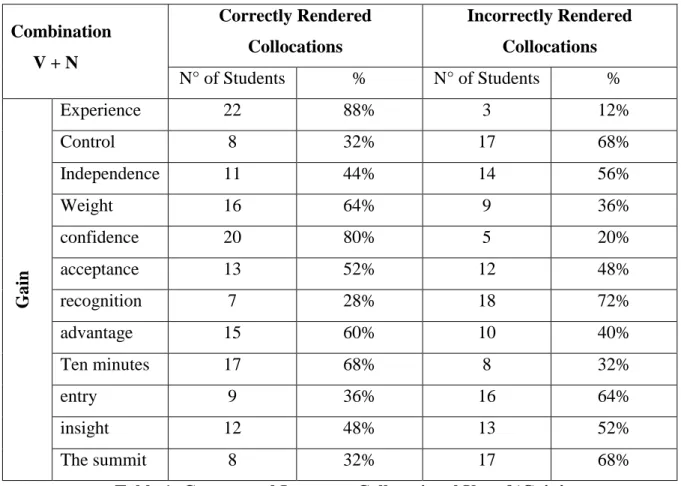
The table below presents the frequency of correct and incorrect collocational use of the verb „gain‟.
Combination V + N Correctly Rendered Collocations Incorrectly Rendered Collocations N° of Students % N° of Students % G ain Experience 22 88% 3 12% Control 8 32% 17 68% Independence 11 44% 14 56% Weight 16 64% 9 36% confidence 20 80% 5 20% acceptance 13 52% 12 48% recognition 7 28% 18 72% advantage 15 60% 10 40% Ten minutes 17 68% 8 32% entry 9 36% 16 64% insight 12 48% 13 52% The summit 8 32% 17 68%
From the table above, the combinations that have received the highest percentages of correct responses are:
Gain Experience
Twenty two participants (88%) have rendered this combination correctly.
Gain Weight
Sixteen informants (64%) have rendered this combination correctly.
Gain Confidence
Twenty informants (80%) have produced this combination correctly.
Gain Acceptance
Thirteen informants (52%) have produced this combination appropriately.
Gain Advantage.
Fifteen participants (60%) have rendered this combination correctly.
Gain Ten minutes
Seventeen informants (68%) have rendered this combination appropriately.
Gain Insight
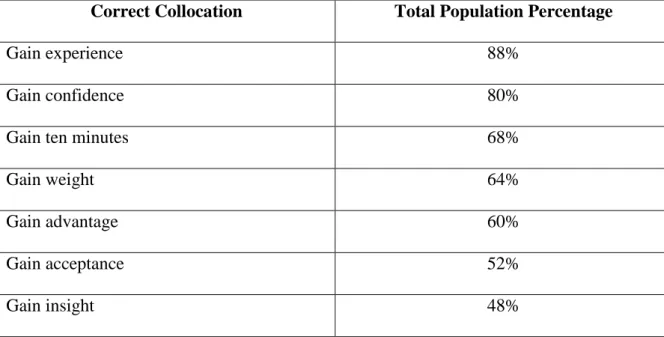
The highest seven correct collocations produced by participants are as follows:
Correct Collocation Total Population Percentage
Gain experience 88%
Gain confidence 80%
Gain ten minutes 68%
Gain weight 64%
Gain advantage 60%
Gain acceptance 52%
Gain insight 48%
Table 2: Top Seven Correct Collocations Containing ‘Gain’
The relatively high percentage of the correct rendering of the above can be attributed to a) the high frequency of using them in news papers and TV programs as concepts of public concern such as „gain weight‟, „gain experience‟, and „gain advantage‟, b) the students belief that these collocations constitute entities and are, thus, learned as linked pairs such as „gain confidence‟, „gain time‟, „gain acceptance‟ and „gain insight‟.
From table 1, the combinations that have received the highest percentages of incorrect responses are:
Gain Control
Seventeen participants (68%) have rendered this combination incorrectly. 12 participants (48%) have been responsible for the unacceptable collocation *„win control‟, whereas 5 participants (20%) have made the collocational mistake *„earn control‟.
Gain Independence
Fourteen participants (56%) rendered this combination incorrectly. 10 participants (40%) have been responsible for the unacceptable collocation *„win independence‟ whereas 4 participants (16%) have made the collocation mistake *„earn independence‟.
Gain Acceptance.
Twelve participants (48%) have rendered this combination incorrectly.8 participants (32%) have been responsible for the incorrect collocation *„earn acceptance‟ whereas 4 participants (16%) have made the collocational deviation *„win acceptance‟.
Gain Recognition
Eighteen participants (72%) have rendered this combination incorrectly. 10 informants (40%) have been responsible for the unacceptable combination *„earn recognition‟ whereas 8 informants (32%) have made the collocational mistake *„win recognition‟.
Gain Entry
Sixteen participants (64%) have rendered this combination incorrectly.12 participants (48%) have produced the incorrect collocation *„win entry‟ whereas 4 informants (16%) have made the collocational deviation *„earn entry‟.
Gain Insight
Thirteen participants (52%) have rendered this combination incorrectly.10 participants (40%) have been responsible for the unacceptable collocation *„earn insight‟, whereas 3 informants (12%) have made the collocational mistake *„win insight‟.
Gain the Summit
Seventeen participants (68%) have rendered this combination incorrectly. 12 informants (48%) have been responsible for the incorrect collocation *„win the summit‟, whereas 5 participants (20%) have made the collocational mistake *„earn the summit
The highest seven incorrect collocations produced by participants are:
Combination V + N Total Population Percentage Overall Percentage *win Recognition 32% 72% *earn 40% *win Control 48% 68% *earn 20% *win The summit 48% 68% *earn 20% *win Entry 48% 64% *earn 16% *win Independence 40% 56% *earn 16% *win insight 12% 52% *earn 40% *win Acceptance 16% 48% *earn 32%
Table 3: Top Seven Incorrect Collocational Uses of ‘Gain’
The relatively high percentage of the instances of incorrect collocational use of the verb „gain‟ is attributed a strategy learners resort to when faced with unfamiliar combinations. Students who are not confident in the use of „gain‟, and being under the
illusion that there is no restriction to the way synonyms or near-synonyms of „gain‟ can be used, learners combine them freely with all sets of nouns. Synonymous or
near-synonymous verbs, however, take varied meanings when they combine with other words. This is why these verbs are more likely to be misused by students. One meaning of „gain‟ is „to gradually get more of something‟. In this sense, „gain‟ combines with nouns such as „strength‟ and „insight‟. Learners, who are not sure about the use of „gain‟ with the noun „insight‟, use the other near-synonymous verbs „win‟ and „earn‟. Learners, who do not know that with nouns such as „shelter‟, „summit‟, „gain‟ means „to reach a place‟, have used the near synonymous verbs „win‟ and „earn‟ instead. Surprisingly, students made collocational mistakes combining the nouns „entry‟, „independence‟, „control‟,
„recognition‟ with the verbs „win‟ and „earn‟. With these nouns, „gain‟ takes the meaning of „obtaining something that one needs‟ which is supposedly known to students. This is because, with this sense of „gain‟, students have produced the acceptable collocation „gain acceptance‟ and „gain advantage‟.
The reason behind this might be that students, unaware of the fact that „gains‟ is used with these nouns to mean „obtain something‟, they use the other near-synonymous that share the same meaning of „gain‟. They have used „gain‟ correctly when it takes this meaning because they hear them in TV shows and programs to express topics of public concern. Examples are „gain weight‟, and „gain confidence‟.
One other interpretation might be the reliance of dictionaries on synonymy to illustrate the meanings of words. According to abussaydeh (1995), students‟ inability to produce correct collocations can be attributed to the frequent and, inherently, dangerous reliance on synonymy and near-synonymy in dictionaries to illustrate the meanings of head words; this reliance on synonyms creates the erroneous impression amongst learners that conceptual equivalence entails distributional equivalence. The Oxford Advanced Learners
Dictionary (2000: 526) defines „gain‟ as „to win something‟, especially something that you need. Students think that because the verbs are synonymous, this means that they combine with the same set of nouns; consequently, they have used the nouns that go with „gain‟ and „win‟. They have produced *„win entry‟, „win recognition‟, *„win control‟, *„win
independence‟ and *„win the summit‟.
III.3.2 Correct and Incorrect Collocational Use of ‘Win’
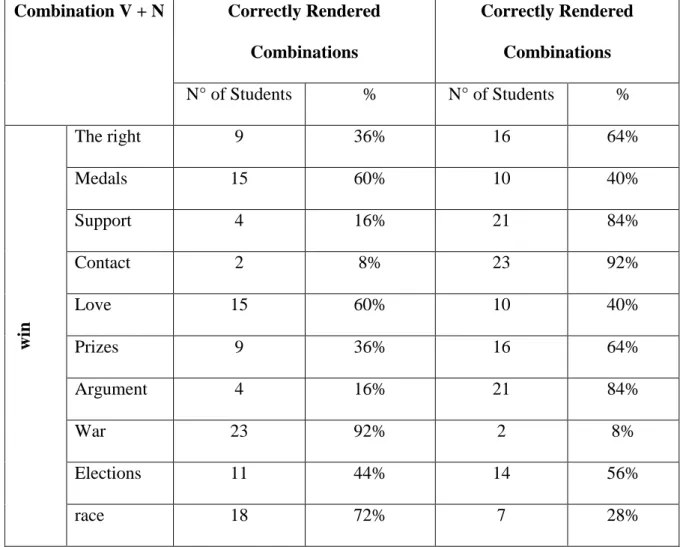
The table below presents the frequency of correct and incorrect collocational use of the verb „win‟.
Combination V + N Correctly Rendered Combinations Correctly Rendered Combinations N° of Students % N° of Students % win The right 9 36% 16 64% Medals 15 60% 10 40% Support 4 16% 21 84% Contact 2 8% 23 92% Love 15 60% 10 40% Prizes 9 36% 16 64% Argument 4 16% 21 84% War 23 92% 2 8% Elections 11 44% 14 56% race 18 72% 7 28%
From the table above, the combinations that have received the highest percentages of correct responses are:
Win Medals
Fifteen participants (60%) have rendered this combination correctly. Win Love
Fifteen participants (60% have rendered this combination appropriately. Win War
Twenty three participants (92%) have rendered this combination correctly.
Win Race
Eighteen participants (72%) have rendered this combination correctly.
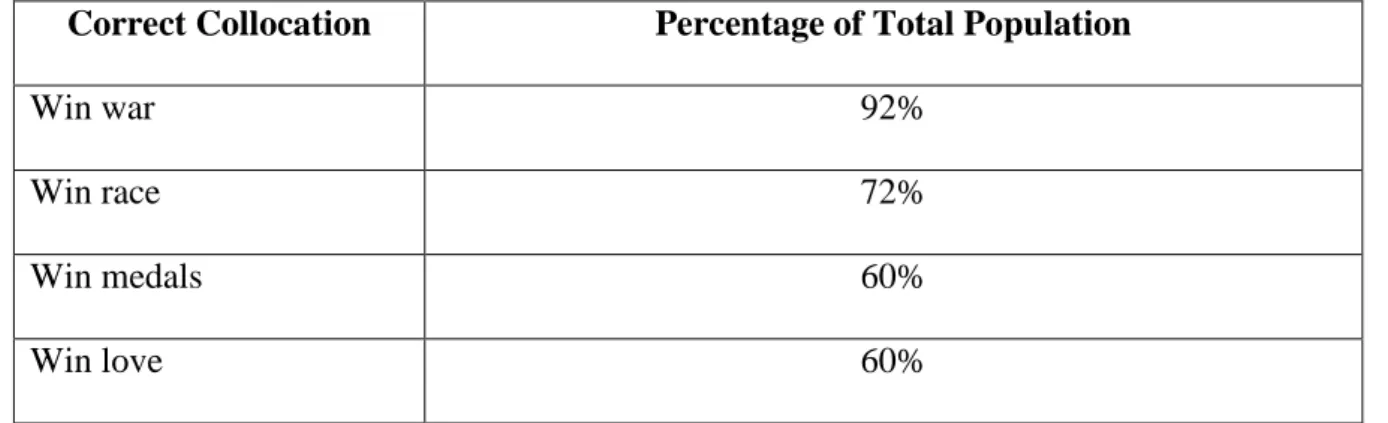
The correct collocations produced by participants are as follows:
Correct Collocation Percentage of Total Population
Win war 92%
Win race 72%
Win medals 60%
Win love 60%
Table 5: Top Four Correct Collocations Containing ‘Win’
The high frequency of these correct collocations is due to a) the fact that students have no difficulty using the verb „win‟ correctly with nouns such as „race‟, „war‟ with these nouns, „win‟ takes the meaning most familiar to students which is „being successful in a competition‟. When combined with nouns such as medals, „win‟ means „to get
something as the result of a competition‟, with this sense, students, seem to face no problems since they combine it correctly with the noun medals. b) The fact that collocations such as „win the war‟, „win the race‟. Are used in media, students hear them more frequently and thus find no problems using them.
Table 5 also show: that the combinations that received the highest percentages of incorrect responses are:
Win the Right
Sixteen participants (64%) have rendered this combination incorrectly; 9 participants (36%) have been responsible for the incorrect combination * „gain the right‟ while 7 participants (28%) have made the collocational mistake *„ earn the right‟.
Win Support
Twenty one participants (84%) have rendered this combination incorrectly.15participants (60%) have been responsible for the unacceptable collocation * „gain support‟ while 6 informants (24%) have made the collocation mistake *„ earn support‟.
Win Contract
Twenty three participants (92%) have rendered this combination incorrectly. 12informants (48%) have been responsible for the unacceptable collocation * „earn a contract‟ while 11 informants (44%) made the collocational mistake * „gain a contract‟.
Win Prizes
Sixteen informants (64%) have rendered this combination incorrectly. 14 informants (56%) have been responsible for the unacceptable collocation *„ earn prizes‟ while 2 informants (8%) have made the collocation al mistake * „gain prizes‟
Win Argument
Twenty one participants (84%) have rendered this combination incorrectly. 13 participants (52%) have been responsible for the incorrect collocation * „gain an argument‟. While 8 participants (32%) participants made the collocational mistake * „earn an argument‟.
Win Elections
Fourteen participants (56%) have rendered this combination incorrectly. 8 participants (32%) have been responsible for the unacceptable collocation *„earn elections‟ while 6 participants (24%) made the collocational mistake *„gain elections‟.
The highest six incorrect collocations produced by participants are:
Combination V + N Percentage of Total Population Overall Percentage * gain Contract 44% 92% * earn 48% * gain Support 60% 84% * earn 24% * gain Argument 52% 84% * earn 32% * gain The right 36% 64% * earn 28% * gain Prizes 8% 64% * earn 56% * gain elections 24% 56% * earn 32%
Table 6: Top Six Combinations of Incorrect Collocational Use of ‘Win’
The incorrect collocations may be due to the fact that learners know the general meaning of „win‟; it is „to be successful in a competition. This is why they have rendered the collocations „win the war‟ and „win the race‟ correctly. In contexts where „win‟ does not take this sense, they use the other near-synonymous verbs „gain‟ and „earn‟. One other meaning of „win‟ is to get something one wants especially by his/her efforts. In this sense, it can go with nouns such as „support‟ and „contract‟. When unfamiliar with this meaning of „win‟, students tend to use the near-synonymous verbs „gain‟ and „earn‟ more often while they use „win‟ less frequently.
Nouns such as „argument‟ combine with the verb „win‟ when it takes the meaning of „being successful in a competition‟. Surprisingly, students have used these nouns with
„gain‟ and „earn‟. This may be interpreted in a way that „win an argument‟ is not familiar to students. They are not sure whether win takes this sense when it combines with the noun „argument‟. Consequently they avoid it and use the other near –synonyms „gain‟ and „earn‟.
III.3.3. Correct and Incorrect Collocational Use of ‘Earn’
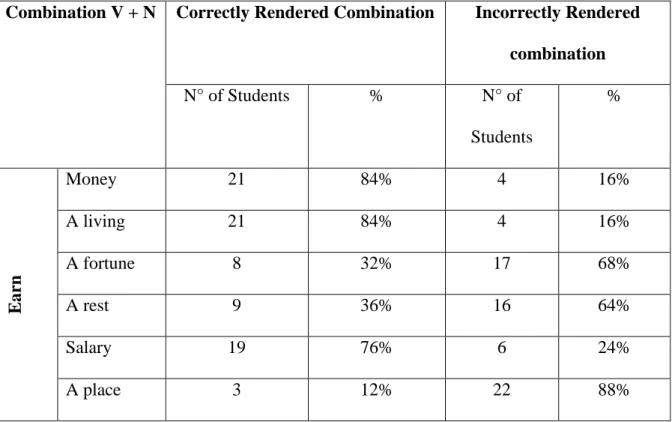
The table below presents the frequency of correct and incorrect collocational use of the verb „earn‟
Combination V + N Correctly Rendered Combination Incorrectly Rendered combination N° of Students % N° of Students % E ar n Money 21 84% 4 16% A living 21 84% 4 16% A fortune 8 32% 17 68% A rest 9 36% 16 64% Salary 19 76% 6 24% A place 3 12% 22 88%
Table 7: Acceptable and Unacceptable Collocational Use of ‘Earn’
From the table above, the combination that has received the highest percentages of correct responses are:
Earn Money
Earn a Living
Twenty one participants (84%) have rendered this combination appropriately.
Earn a Salary
Nineteen participants (76%) have rendered this combination correctly.
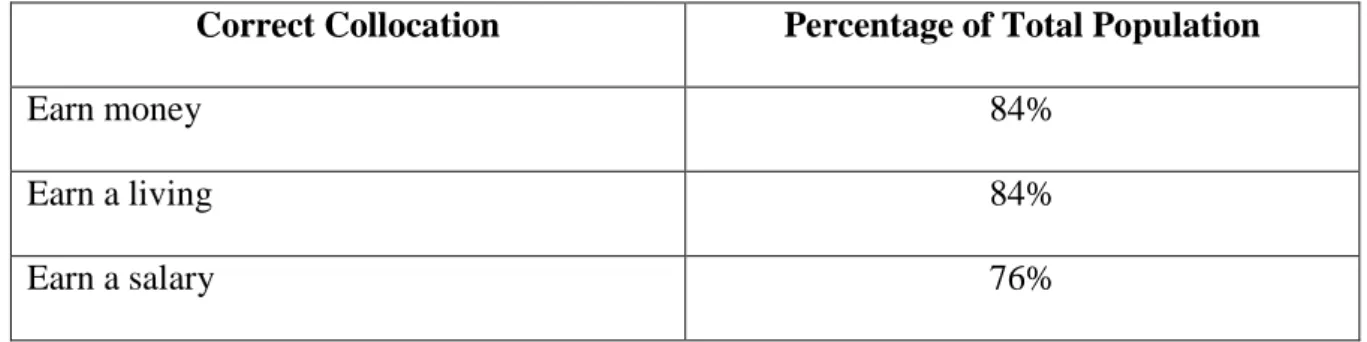
The highest three correct collocations produced by participants are:
Correct Collocation Percentage of Total Population
Earn money 84%
Earn a living 84%
Earn a salary 76%
Table 8: Top Three Correct Collocations Containing ‘Earn’
One way to explain the relatively high percentage of the correct rendering of collocations in Table 8 can be attributed to the student‟s awareness that when „earn‟ takes the meaning of „getting money for work one does‟, it can go with nouns such as „a salary‟, and „a living‟. These collocations, „earn money‟, „earn a salary‟, and „earn a living‟, are also used more frequently in newspapers and TV shows.
The combinations that have received the highest percentages of incorrect responses are:
Earn a Fortune
Seventeen participants (68%) have rendered this combination correctly. 13 participants (52%) have been responsible for the unacceptable combination *‟gain a fortune‟. While 4 participants (16%) have made the less commonly used collocation *‟win a fortune‟.
Earn a Rest
Sixteen participants (64%) have rendered this combination incorrectly. 12 participants (48%) have been responsible for the unacceptable collocation * „gain a rest‟, while 4 participants (16%) made the collocational mistake *„win a rest‟.
Earn a Place
Twenty two participants (88%) have rendered this combination incorrectly. 18 participants (72%) have been responsible for the incorrect combination *„gain a place‟ while 4 participants (16%) have made the collocational mistakes *„win a place‟.
The highest three incorrect collocations produced by participants are: Combination
V + N
Percentage of Total Population Overall Percentage *gain A place 72% 88% *win 16% *gain A fortune 52% 68% *win 16% *gain A rest 48% 64% *win 16%
Table 9: Top Three Incorrect Collocational Use of ‘Earn’
The relatively high percentage of the instances of incorrect collocational use of the verb „earn‟ is due to students lack of knowledge about the varied meanings the verb „earn‟ takes with other words. One meaning of „earn‟ is to get something you deserve because of the good qualities you have. In this sense, „earn‟ combines with nouns such as „a rest‟ and „a place‟. Unaware of these restrictions on the use of „earn‟, students use the other verbs
„gain‟ and „win‟. One other reason might be that these collocations are non-predictable. Although one meaning of „earn‟ is' to get something you want after a lot of efforts‟, one can say „earn a place‟, „earn a rest‟ but one cannot say „win a place‟, „win a rest‟ although „win‟ has the meaning of „getting something that one deserves‟. Such unpredictability of collocations poses a lot of problems to students.
III.4. Summary
The results obtained in this study show that the majority of participants have not found it difficult to combine the verb „gain‟ with the nouns „experience„, „confidence‟, „ten minutes‟, „weight‟ and „advantage‟. Participants, however, have faced serious problems collocating the same verb with the nouns „recognition‟, „control‟, „ the summit',' entry', „independence‟ and „insight‟.
The results also indicate that most of the participants have produced the combinations „win the war‟, „win the race‟, „win medals‟ and „win love‟ correctly. Participants, however, have had difficulty collocating the verb „win‟ with the nouns: „contact‟, „support‟, „argument‟, „the right‟, „prizes‟ and „elections‟.
Results also indicate that the correct collocations that contain „earn‟ produced by most participants have been „earn money‟, „earn a living‟ and „earn a salary. The incorrect collocational use of „earn‟ is found with nouns such as „a place‟, a fortune‟ and „a rest‟.
Conclusion
The results obtained in this study indicate that the participants are not competent in their production of the collocations containing the near-synonymous verbs „gain‟, „win‟ and „earn‟. Participants have rendered the combinations „gain experience‟, „gain confidence‟, „gain ten minutes‟, „gain weight‟ and „gain advantage‟, „win the war‟, „win
the race‟, „win medals‟, „win love‟ „earn money‟, „earn a living‟, „earn a salary‟ correctly. Students, however, have not used the verb „gain‟ with the nouns „recognition‟, „control‟, „the summit‟, „entry‟, „independence‟ and „insight‟. In addition, students have not combined the verb „win‟ correctly with the nouns contract, „support‟, „argument‟, „ the right‟, „prizes‟ and „elections‟. Participants have failed also to collocate the verb „earn‟ with the nouns „a place‟, „a fortune‟ and „a rest‟.
Chapter IV
Pedagogical Implications
Introduction
The main concern of this chapter is to review some pedagogical implications about the teaching of collocation. It first views some suggestions on the teaching of collocations in general, and then it focuses on the teaching of lexical collocations that contain synonymous or near-synonymous verbs.
IV.1. Collocations
First of all, students at every level need to be aware of the importance of collocation, “in all kinds of texts collocations are essential, indispensable elements …. With which our utterances are very largely made” (Kjellmer, 1987; 140).This means that collocational relations are an important part of the language to be mastered. Collocations are also important to communicate ideas more fluently, “fluency is based on the acquisition of a large store of fixed or semi-fixed prefabricated items” (Lewis, 1997:15). There fore, EFL learners should have a number of collocations in stock to communicate fluently.
Some collocations are arbitrary and unpredictable. It is correct to say „have a coffee „but not *„drink a coffee‟, „make the bed‟ but not *„do the bed‟. Obviously, it is hard for EFL learners to produce these collocations effectively when the choice of words is completely arbitrary. If students are encouraged to notice and record language patterns and collocations whenever they occur, they will have a record of which combinations are possible and which are not. Learners may use box formats to record new collocation in their vocabulary notebooks.
(Verb) (Adjective)
(Verb) (Adverb)
(Adjective) (Adverb)
Table 10: Box Formats to Record New Collocations in a Notebook
Such collocation boxes might be organised by topic (in the same order as their course books), key words – work, holiday etc or grammatical structures – verb + noun + verb, Adjective + Adverb etc.
Teachers should be selective about what collocations to teach since a great number of collocations generally appear in each class. Passive and unclear collocations are not necessary for the EFL learners‟ daily life. Thus, they should not be focused on in classroom teaching.
Teachers should introduce a variety of activities that reinforce already learnt collocation. In the same course, the teacher may ask students to observe the collocations they find in the text, make a list of collocations that are similar etc the ask learners to use the same collocations in writing. The teacher here gives a topic in which those collocations can be used. In this way. Already learnt collocations can be reinforced.
Teachers may repeat and recycle the collocations already learnt every now and then in class activities to help learners register those collocations in memory. “The same thing twice activates collocations” (Hill, Lewis and Lewis, 2000:90)
Several activities can be produced to help students become familiar with the collocations:
- Board Race Activity: The teacher here calls out one half of the already learnt collocation and asks the students to write the other half on the board. This activity can be extended by asking students to suggest other possible collocates.
- Surveys, reports and stories with different levels of learners to practise previously-learnt collocations in context. In case collocations are organized by topic, students can conduct a survey and follow it up with a written or oral report in the topic of household chores, who:
Does the dishes?
Makes the beds?
Takes the rubbish out?
Teachers should encourage group work since it helps fostering learning interdependence. Learners can exchange knowledge and ask others to explain unknown items.
IV.2. V + N Collocations Containing Synonymous Verbs
Synonymous or near-synonymous words do not always combine with the same set of items. They exhibit different collocation patterns. Collocational grids are informative tables that can be useful in helping learners differentiating the collocates of near-synonymous word. The following table illustrates how the near-near-synonymous verbs „rob‟ and „steal‟ collocate differently.
Person Bank Money Car Shop Wallet
Rob +
Steal - +
Table 11: Nouns that Collocate with ‘Rob’ and ‘Steal’
If there is a + for a word printed in bold, this means that the word collocates with the word or expression at the top of this grid. In this case „rob a bank‟ is a good collocation, whereas *„steal a bank‟ is not
Theses grids can be made from text books by students as an activity. Such an activity helps students differentiating the collocational behaviour of synonymous or near synonymous words. These grids can also be produced by teachers from the students own written work as a correction exercise. In such a way, students realize their collocation mistakes and learn from them.
Conclusion
EFI teachers can possibly help students overcome their collocation problems. This can be achieved by encouraging learners to notice and record language patterns and collocations whenever they occur, Select active and clear collocations to teach, reinforcing students‟ knowledge of already learnt collocations by having a number of activities. Teachers might also repeat and recycle already learnt collocations so that students register them in their memories and encourage group work to foster students learning interdependence.
General Conclusion
The aim of the present study has been to investigate the ability of 3rd year LMD students of English to collocate the near-synonymous verbs „gain‟, „win‟ and „earn‟ appropriately
We have hypothesised that the students‟ lack of knowledge about the collocational behaviour of the near-synonymous Verbs „gain‟, „win‟ and „earn‟ results in V+N unacceptable collocations.
The analysis of the participants‟ collocation usage of the near-synonymous verbs „gain‟, „win‟, and „earn‟ has shown that they are not competent in their production of the collocations that contain these verbs.
The majority of participants have failed to use the verb „gain‟ with the nouns „recognition‟, „ control‟, „summit‟, „ entry‟, „ independence‟, „ insight‟, and „acceptance‟.
Most of the participants have also failed to combine the verb „win‟ with nouns such as „contract‟, „support‟, „argument‟, „right‟ , „prizes‟, and „elections‟.
More than half the participants have found it difficult to collocate the verb „earn‟ appropriately with nouns such as „place‟, „fortune‟, and „rest‟.
The present study, however, has many limitations the most important of which are:
The subjects have been limited to a small number of students (25 students) which is not really representative of all the teaching and learning situations. It would have been better to include more students from different Universities. The subjects of this study have been also limited to one language level. If the study includes students at different language levels, more comprehensive observations on students‟ usage of collocations will be done.
The two dictionaries used have been „Oxford Advanced learner‟s Dictionary‟ and „English Collocations in Use'. They have been used as the basis of which the informants‟ responses are evaluated. Reference to more specialized dictionaries that might provide more details on the collocational behaviour of the near-synonymous verbs „gain‟ „win‟ and „earn‟ would have been of a greater help.
The items that collocate with the near-synonymous verbs „earn‟, „gain‟ and „win‟ have been limited to a small number of nouns. More nouns such as„ ground‟, „respect‟, „reputation ‟and even expressions could have been used.
Further research in the field of collocations can extend to cover other types of collocations than V+N such as Adjective + Noun (e.g. daily life). Verb + Adjective (e.g. appreciate sincerely) and Adverb + Adjective (e.g. closely acquainted) etc. Furthermore, this study has concentrated on student‟s ability with V+N lexical collocations. Further studies might consider the students‟ ability with grammatical collocation. Thus, it becomes possible to have a complete picture of EFI students collocational know ledge.
The study focused on combinations containing near synonymous verbs. It has shown that these verbs combine with different sets of nouns. Other studies might focus on collocations containing polysemous words. Such studies may show whether or not polysemous words collocate with the same set of items or not.
Other studies might investigate the relationship between collocational knowledge and academic success. It might show whether or not collocational knowledge helps students increase their academic achievement or not.
Bibliography
Benson, M., Benson. & IIson, R. (1986 a). Lexicographic Description of English. Amsterdam: John Benjamin‟s publishing Company.
(1986 b). The BBI Combinatory Dictionary of English. Amsterdam: John Benjamin‟s publishing Company.
Cann, R., Kempson, R. & Gregoromichelaki, E. (2009). Semantics: An Introduction to Meaning in Language. Cambridge: Cambridge University Press.
Cruse, D.A. (1986). Lexical Semantics. Cambridge: Cambridge University Press.
Cruse, (2000). Meaning in Language: An Introduction to Semantics and Pragmatics. Oxford: Oxford University Press.
Firth, J.R. (1951). Modes of Meaning. Oxford: Oxford University Press.
Firth, J.R. (1957). Papers in Linguistics. Oxford: Oxford University Press.
Jackson. (1988).Words and their Meaning.London: Longman.
James. (1998). Errors in Language Learning and Use. London: Longman.
Hill, J., Lewis, M. (2000). Classroom Strategies, activities and Exercises. Oxford: Oxford University Press.
Hussein, R.F. (1998). Collocations revisited. Language and Translation.Vol.10, 39-47.
Ghazala, H. (1995). Translation as Problems and Solutions. ELGA Publications. Kjellmer, G. (1987). Aspects of English Collocations. W.Meijs, (Ed.).Rodopi.
Kjellmer, G. (1994). A Dictionary of English Collocations, Clarendon Press.
Kuo, C. (2009). An Analysis of the use of collocations by intermediate EFL colleague students in Taiwan. Arecls.Vol.6, 141-155.
Lewis. (1997). Implementing the Lexical Approach: Putting Theory into Practice. Hove: Language Teaching Publications.
Lyons. (1981). Language and Linguistics. Cambridge: Cambridge University Press.
Mitchell, T.F. (1971). Linguistic „Goings on‟: collocations and other lexical matters arising on the syntagmatic record. Archivuum Linguisticum. Vol. 3, 53-57.
Murphy, M.C. (2003). Semantic Relations and the Lexicon. Cambridge: Cambridge University Press.
O‟Dell. & McCarthy, (2008). Collocations in Use. Cambridge: Cambridge University Press.
Appendix
This test serves as a data collection tool for a research project to obtain a Masters degree in applied language studies. Your answers will be of much help for this research project.
Complete each of the following sentences using earn, gain or win. Make sure to use correct grammar.
1. He ……….yearly £ 20,000 a year. 2. I have ………..a lot of useful experience. 3. The city has…….. the right to host the games.
4. The socialist party……… control of the national assembly.
5. Jack has already ……….. a very good reputation as a talented lawyer. 6. The country ………….its in independence ten year ago.
7. As a teacher, she had………..the respect and admiration of her students. 8. Britain……. Five gold medals.
9. I‟ve ………..weight recently.
10. They are trying to……… support for their proposals. 11. She did all sorts of jobs to ………a living.
12. They have……. a £ 5 millions contract to build the new bridge. 13. He……… confidence when he got a new job.
14. Her theories have only recently……….. Acceptance. 15. He was never able to …………. Her love.
16. Her printings…………..recognition thanks to a major exhibition in London. 17. Kim has ……. Several prizes for her singing.
18. In the cycle race Henrick…..an advantage when several of his opponents had punctures.
19. Chris will pay- he‟s ………. A fortune.
20. My watch…………..two minutes every 24 hours. 21. I need a rest, think I‟ve……… it, don‟t you? 22. She loves to …………..an argument.
23. He………..entry to the building by showing a fake pass. 24. Now a days, john……… a very good salary.
25. No matter who………….the war. There will be heavy casualties on both sides.
26. He hopes to ………. A place in the team.
27. I hope you have………some insight into the difficulties we face.
28. The conservative party...the 1994 general elections.
29.Who...the race
Résumé
Cette recherche a pour objectif d‟étudier la capacité des étudiants à utiliser de manière adéquate les collocations des verbes anglais presque synonymes „gain‟, „win‟ et „earn‟. A cette fin, 25 étudiants de licence LMD en anglais, langues appliquée, à l‟université de Constantine, ont pris part dans un test. Les résultats obtenus ont prouvé que les étudiants manquent de beaucoup de compétence quant à la production de collocations contenant les verbes anglais presque synonymes „gain‟, „win‟ et „earn‟. Les implications d‟une telle étude consistent en des suggestions émises pour améliorer la connaissance des étudiants en matière de collocations et l‟utilisation de cet aspect lexico sémantique pour an anglais beaucoup plus courant.
صخلم تيزيهجولإا لاعفلأا ثادراىتم لامعتسا ىهع تبهطنا ةردق تسارد ىنإ ثحبنا اذه فدهي „gain‟, „win‟ و „earn‟ يتنا امئلام لاامعتسا تفدازم نىكت داكت . فدهنا اذه غىهب مجأ هم تساردنا يذه يف كراش 25 يف سواسينا تبهط هم ابناط تيزيهجولإا تغهنا . لاعفلأا يذه ثادراىتم لامعتسا نىىسحي لا تبهطنا نأ ثحبنا جئاتو زهظتو . ضعبب ثحبنا يهتىي ثادراىتمناب تبهطنا تفزعم هسحت نأ اهوأش هم يتنا ثاحازتقلاا ضعب اهيهع ىىبت يتنا تيجىغاديبنا ثاجاتىتسلاا تحاصفو تسلاس زثكأ تيزيهجوأ تغن مهعت مجأ هم اهنامعتساو .