HAL Id: tel-02268575
https://tel.archives-ouvertes.fr/tel-02268575
Submitted on 21 Aug 2019HAL is a multi-disciplinary open access
archive for the deposit and dissemination of sci-entific research documents, whether they are pub-lished or not. The documents may come from teaching and research institutions in France or abroad, or from public or private research centers.
L’archive ouverte pluridisciplinaire HAL, est destinée au dépôt et à la diffusion de documents scientifiques de niveau recherche, publiés ou non, émanant des établissements d’enseignement et de recherche français ou étrangers, des laboratoires publics ou privés.
Phylogeny, biogeography, and breeding system evolution
in Moraceae
Qian Zhang
To cite this version:
Qian Zhang. Phylogeny, biogeography, and breeding system evolution in Moraceae. Plant breeding. Université Paris Saclay (COmUE), 2019. English. �NNT : 2019SACLS205�. �tel-02268575�
Phylogeny, biogeography, and
breeding system evolution in
Moraceae
Thèse de doctorat de l'Université Paris-Saclay préparée à l’Université Paris-Sud ED n°567 Sciences du végétal : du gène à l’écosystème
Spécialité de doctorat : Biologie
Thèse présentée et soutenue à Orsay, le 16/07/2019, par
Qian Zhang
Composition du Jury : Tatiana GiraudDirectrice de Recherche, CNRS (ESE) Présidente Mathilde Dufaÿ
Professeur, Université de Montpellier (CEFE) Rapporteur Jean-Yves Rasplus
Directeur de Recherche, INRA (CBGP) Rapporteur Florian Jabbour
Maître de Conférences, Muséum national d’Histoire naturelle (ISYEB)
Examinateur
Jos Käfer
Chargé de Recherche, Université Lyon I (ESE) Examinateur Hervé Sauquet
Maître de Conférences, Université Paris-Sud (ESE) Directeur de thèse
NNT : 2 0 1 9 S A CL S 2 0 5
I
ACKNOWLEDGEMENTS
I would like to express my deepest gratitude to my supervisors Dr. Hervé Sauquet and Dr. Renske Onstein, for their patience and help throughout my PhD journey. Their advice on both research as well as my career have been invaluable. I still remember when I introduced my idea, which finally became chapter III of my thesis, to Hervé at the very beginning. This idea has been elaborated and finally become a PhD thesis with help from many people I will mention below.
I would also like to extend my deepest appreciation to my thesis committee, without whose help I will not improve so much in my studies. They are Dr. Thomas Couvreur, Dr. Elliot Gardner, Dr. Damien Hinsinger, Prof. Sophie Nadot, Prof. Jacqui Shykoff and Prof. Nina Rønsted.
I am extremely grateful to my jury of defense: Prof. Mathilde Dufaÿ, Dr. Jean-Yves Rasplus, Prof. Tatiana Giraud, Dr. Florian Jabbour, Dr. Jos Käfer and Dr. Hervé Sauquet. Thank them for their participation in my defense, helpful comments to my thesis and future studies.
I deeply indebted to my coauthors as well. I am grateful to Dr. Stefan Little for his profound knowledge in fossils. I would also like to extend my sincere thanks to Dr. Elliot Gardner and Prof. Nyree Zerega, for their insightful guides on experiments and analyses in Chapter II. I must thank them again for sharing their collections of Neotropical species of Dorstenieae with me.
I also wish to thank Véronique Normand and Alodie Snirc for their great help in my experiments.
Thanks should also go to all the members in team EVA (Evolution of Angiosperms), especially Prof. Sophie Nadot, who took care of me when Hervé was not in Orsay. I wish to thank Xavier Aubriot for sharing much knowledge in taxonomy and biogeography with me. Thanks also to Xiaolei Pang, who introduced the knowledge of ITCZ to me.
I gratefully acknowledge Martine Fournier and Prof. Jacqui Shykoff’s great help in the daily paper works. I would like to acknowledge Emmanuelle Jestin’s excellent work in arranging the travel and accomodation for my Jury of thesis defense as well.
I had great pleasure of working with my three kind office mates Fantin Carpentier, Fanny Hartmann, Marine Duhamel and other members in team GEE (Evolutionary genetics and ecology), who brought much social life to me.
Finally, I cannot begin to express my thanks to my parents, without whose support I will never leave home so far away and have a chance to chase my dream. Thanks to Prof. Xiaoyong Chen, who helped me to apply the CSC fellowship. Thanks to my three best friends: Xiaokun Zhang, Sen Lin, Dazheng Dong, for their company, no matter how physically far away we are. Thanks also to all those who helped and accompanied with me in these years. It is a pity that the space is too limmited to list all of you, but I remember you and all your help.
III
ABSTRACT
Angiosperms are the most diversified clade of extant plants and are exceptionally species-rich in tropical regions. Flowers are the breeding organs of angiosperms. Flowers exhibit remarkable levels of both structural and functional diversity and for this reason have long thought to have a direct influence on the diversity and evolution of angiosperms. In this thesis, I investigated breeding system evolution and biogeographic history in the family Moraceae (40 genera, ca. 1100 species, including its largest genus, Ficus, ca. 750 species), which I used as a model clade to understand the origin and evolution of diversity of angiosperms.
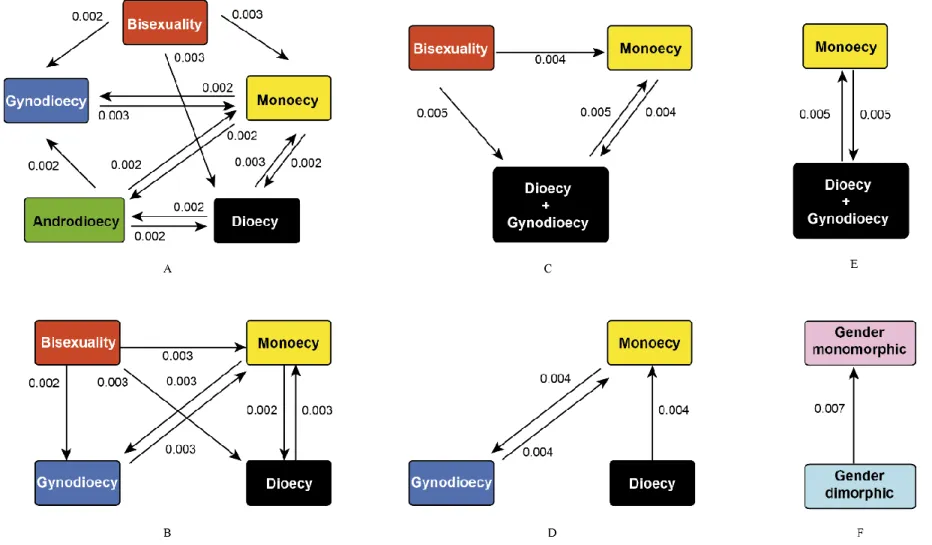
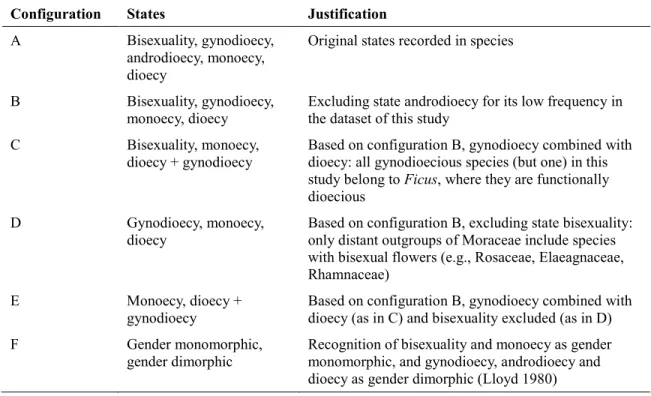
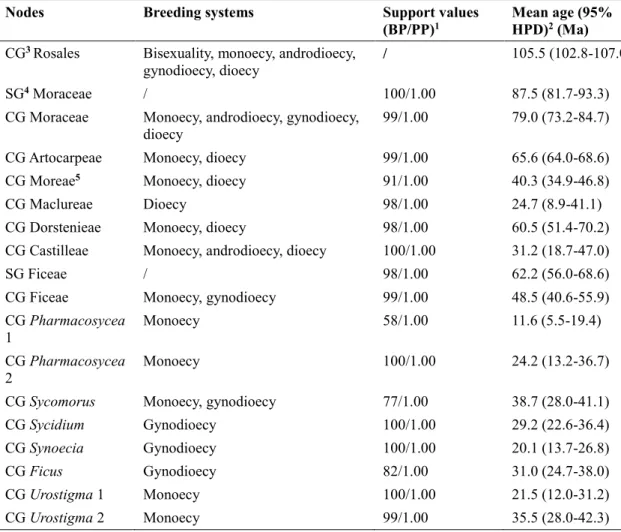
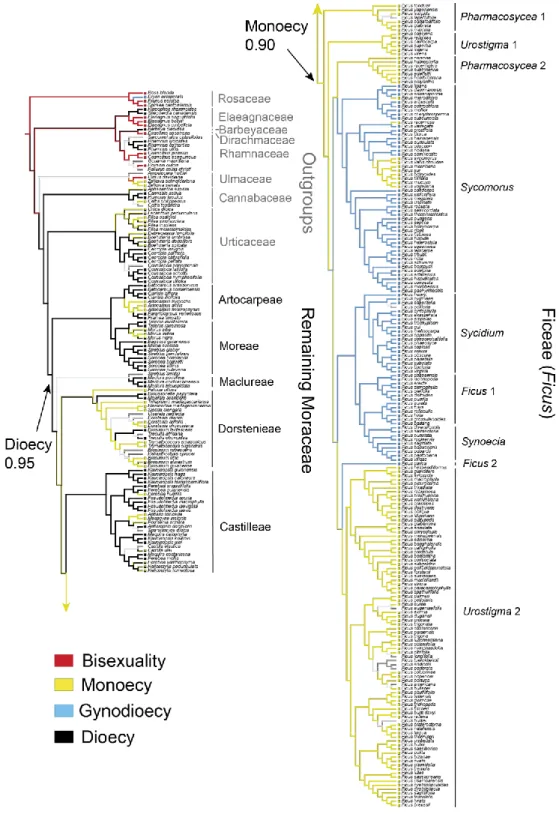
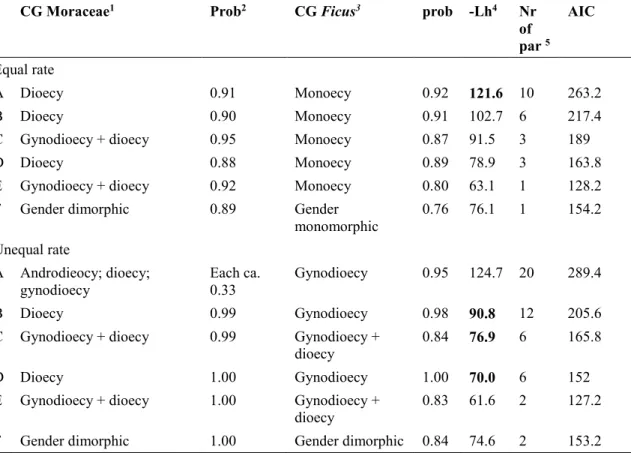
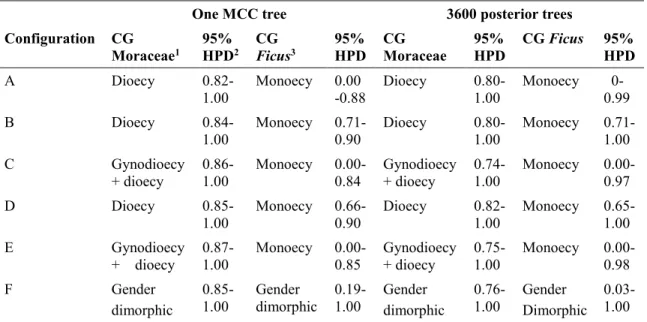
In Chapter I, I reconstructed and calibrated a new dated phylogenetic tree for Moraceae as a whole, based on a dataset of 320 species (including 272 species sampled from 36 genera in Moraceae, and 48 species representing 8 outgroup families in Rosales), eight molecular markers (three chloroplastic, five nuclear), and twelve fossil age constraints. I then used this phylogenetic tree to reconstruct ancestral states of breeding systems in Moraceae and Ficus using parsimony and model-based approaches, using and comparing six configurations of breeding system data in Moraceae, differing in the number of states recognized. The crown group ages of Moraceae and Ficus were estimated in the Cretaceous (73.2-84.7 Ma) and in the Eocene (40.6-55.9 Ma), respectively. Dioecy was inferred as the ancestral breeding systems of Moraceae with high support by all the approaches, models and configurations, followed by several subsequent transitions to monoecy, including in Ficus. This result suggests that dioecy is not necessarily an evolutionary dead end. While monoecy emerged as the most likely ancestral state of Ficus, this result remained uncertain and sensitive to model selection.
In Chapter II, I reconstructed a dated phylogenetic tree for tribe Dorstenieae (15 genera, ca. 156 species, including Dorstenia, ca. 113 species), mainly distributed in tropical regions. To do so, I produced a new dataset of nuclear genomic data (102 genes) generated with a target enrichment approach (Hyb-Seq), sampling all genera (15) and 83 (53%) species in the tribe and five outgroups. This phylogenomic tree allowed me to reconstruct the biogeographic history of this group using dispersal-extinction-cladogenesis models, including models with a founder-event speciation process. The crown group ages of Dorstenieae and Dorstenia were estimated in the Cretaceous (65.8-79.8 Ma) and in the Cretaceous/Paleocene to Eocene period (50.8-67.3 Ma), respectively. Two long-distance dispersal events from continental Africa to South America occurred in the Cenozoic, one in Dorstenia and one in Brosimum s.l. Species of Dorstenia further colonized Central America during the Oligocene to Miocene (12.0-34.7 Ma).
In Chapter III, I tested the climatic niche difference (temperature and precipitation) between the two breeding systems (monoecy and gynodioecy) in Ficus using a new dataset of cleaned spatial occurrence records and breeding systems for 183 species. To do so, I used two comparative approaches, differing in whether phylogeny is taken into account (generalized estimating equations, GEE) or not (generalized linear models, GLM). A positive relationship between precipitation and gynodioecy was supported by GLM, but not by GEE analyses, and no relationship between temperature and breeding systems was supported by either method. Higher dispersal ability and the potential for self-fertilization may explain why monoecious species of Ficus have been able to colonize and survive in drier environments.
V phylogenomic data to address questions of breeding system evolution and biogeography in Moraceae. More densely sampled phylogenies of Ficus and Moraceae as a whole will be required to confirm some of the results emerging from this thesis, such as ancestral monoecy in Ficus. Nevertheless, this thesis opens up several important new perspectives worth investigating in other plant clades, such as a relationship between breeding system and climatic niche.
RESUME
Les Angiospermes sont le clade le plus diversifié des plantes actuelles et sont exceptionnellement riches en espèces dans les régions tropicales. La fleur est l’organe reproducteur des Angiospermes. Il existe une diversité remarquable de fleurs tant sur le plan structurel que fonctionnel et pour cette raison, l’on pense depuis longtemps que les fleurs ont une influence directe sur la diversité et l’évolution des Angiospermes. Dans cette thèse, j’ai étudié l’évolution des systèmes sexuels et l’histoire biogéographique de la famille des Moraceae (40 genres, env. 1100 espèces, dont le genre le plus diversifié, Ficus, env. 750 espèces), clade modèle utilisé pour comprendre l’origine et l’évolution de la diversité chez les Angiospermes.
Dans le Chapitre I, j’ai reconstruit et calibré un nouvel arbre phylogénétique daté pour les Moraceae à partir d’un jeu de données de 320 espèces (dont 272 issues de 36 genres chez les Moraceae, et 48 espèces représentant 8 familles de groupes externes chez les Rosales), 8 marqueurs moléculaires (3 chloroplastiques, 5 nucléaires) et 12 contraintes d’âge fondées sur le registre fossile. J’ai ensuite utilisé cet arbre phylogénétique pour reconstruire les états ancestraux des systèmes sexuels chez les Moraceae et Ficus avec les méthodes de parcimonie et de maximum de vraisemblance, en utilisant et comparant six configurations de données de systèmes sexuels chez les Moraceae différant par le nombre d’états distingués. Les âges des groupes-couronne des Moraceae et du genre Ficus sont estimés au Crétacé (73.2-84.7 Ma) et à l’Eocène (40.6-55.9 Ma), respectivement. La dioécie est inférée comme l’état ancestral des systèmes sexuels chez les Moraceae, un résultat très bien soutenu par toutes les approches, modèles et configurations. Plusieurs transitions ultérieures vers la monoécie se sont ensuite produites, y compris chez Ficus. Ce
VII résultat suggère que la dioécie ne représente pas nécessairement un cul-de-sac évolutif. La monoécie semble être l’état ancestral le plus vraisemblable chez Ficus, mais ce résultat est peu robuste et sensible au choix du modèle.
Dans le Chapitre II, j’ai reconstruit un arbre phylogénétique daté pour la tribu des Dorstenieae (15 genres, env. 156 espèces, dont Dorstenia, env. 113 espèces), distribuée principalement dans les régions tropicales. Pour ce faire, j’ai produit un nouveau jeu de données génomiques nucléaires (102 gènes) à partir d’une approche d’enrichissement ciblé (Hyb-Seq) échantillonnant tous les genres (15) et 83 espèces (53%), ainsi que 5 groupes externes. Cet arbre phylogénomique m’a permis de reconstruire l’histoire biogéographique du groupe en utilisant les modèles de dispersion-extinction-cladogenèse, dont des modèles avec un processus d’événement-fondateur de dispersion. Les âges des groupes-couronne des Dorstenieae et du genre Dorstenia sont estimés au Crétacé (65.8-79.8 Ma) et dans la période du Crétacé/Paléocène à l’Eocène (50.8-67.3 Ma), respectivement. Deux évènements de dispersion à longue distance depuis l’Afrique continentale vers l’Amérique du Sud ont eu lieu au Cénozoïque, l’un chez Dorstenia et l’autre chez Brosimum s.l. Le genre Dorstenia a ensuite colonisé l’Amérique Centrale entre l’Oligocène et le Miocène (12.0-34.7 Ma).
Dans le Chapitre III, j’ai testé les différences de niche climatique (température et précipitation) entre les deux systèmes sexuels (monoécie et gynodioécie) chez Ficus avec un nouveau jeu de données fiables d’occurrences spatiales et de systèmes sexuels chez 183 espèces. À cette fin, j’ai utilisé deux approches comparatives, différant dans la prise en compte de la phylogénie (équations d’estimation généralisées, GEE) ou non (modèles linéaires généralisés, GLM). Une relation positive entre précipitation et gynodioécie est
soutenue par les analyses GLM, et aucune méthode ne soutient une relation entre température et système sexuel. Une meilleure capacité à se disperser et le potentiel d’autopollinisation sont deux explications possibles pour la colonisation et la survie des espèces monoïques dans des environnements plus secs.
Cette thèse démontre le potentiel des méthodes phylogénétiques comparatives et des données phylogénomiques pour répondre aux questions d’évolution des systèmes sexuels et de biogéographie chez les Moraceae. Des phylogénies plus densément échantillonnées pour Ficus et les Moraceae sont requises pour confirmer certains des résultats émergeant de cette thèse, tels que le caractère ancestral de la monoécie chez Ficus. Cependant, cette thèse ouvre plusieurs nouvelles perspectives importantes méritant d’être approfondies chez d’autres clades de plantes, telles que la relation entre système sexuel et niche climatique.
i
TABLE OF CONTENTS
ACKNOWLEDGEMENTS ...I ABSTRACT ... III RESUME ... VI GENERAL INTRODUCTION ... 1BREEDING SYSTEM EVOLUTION AND DIVERSITY IN ANGIOSPERMS ...1
BIOGEOGRAPHIC HISTORY OF ANGIOSPERMS IN THE TROPICS ...3
MORACEAE: AN IDEAL MODEL CLADE ...5
General presentation of family Moraceae ...5
Genus Ficus ...9
Tribe Dorstenieae ... 12
METHODOLOGICAL APPROACHES USED IN THIS THESIS ... 13
Hyb-seq approaches ... 13
Molecular dating ... 14
Parametric models for ancestral state reconstruction ... 15
Parametric models for historical biogeography ... 16
OBJECTIVES OF THIS THESIS ... 17
LITERATURECITED ... 18
CHAPTER I. ESTIMATING DIVERGENCE TIMES AND ANCESTRAL BREEDING SYSTEMS IN FICUS AND MORACEAE ... 26
ABSTRACT ... 26
INTRODUCTION ... 28
MATERIALSANDMETHODS ... 31
Taxonomic sampling and molecular dataset assembly ... 31
Phylogenetic reconstruction ... 32
Fossil calibration ... 33
Molecular dating analyses ... 34
Ancestral state reconstruction... 37
RESULTS ... 41
Phylogenetic reconstruction ... 41
Molecular dating ... 44
Ancestral state reconstruction... 44
DISCUSSION ... 50
Phylogenetic relationships in Moraceae ... 50
A new time scale for Moraceae diversification ... 52
Breeding system transitions in Moraceae and Ficus ... 54
Dioecy not an evolutionary dead end in Moraceae ... 57
Conclusion ... 59
ACKNOWLEDGEMENTS ... 60
LITERATURECITED ... 61
CHAPTER II. LONG-DISTANCE DISPERSAL SHAPED THE DIVERSITY OF TRIBE
DORSTENIEAE (MORACEAE) ... 68
ABSTRACT ... 68
INTRODUCTION ... 70
MATERIALSANDMETHODS ... 74
Specimen and sample collection ... 74
DNA extraction and sequencing ... 75
Sequence cleaning, assembly, and filtering ... 76
Phylogenomic reconstruction and molecular dating ... 78
Reconstruction of biogeographic history ... 81
RESULTS ... 84
Sequencing ... 84
Phylogenetic relationships ... 84
Divergence times of Dorstenieae and Dorstenia ... 87
Biogeographic history of Dorstenieae ... 88
DISCUSSION ... 91
Success of the targeted enrichment strategy with herbarium specimens ... 91
Phylogenetic relationships in Dorstenieae and Dorstenia ... 93
Divergence times of Dorstenieae and its genera ... 94
Biogeographic history of Dorstenieae ... 94
Taxonomic implications ... 98
Conclusion ... 101
ACKNOWLEDGEMENTS ... 102
LITERATURECITED ... 102
SUPPLEMENTARYINFORMATION ... 107
CHAPTER III. BREEDING SYSTEM EVOLUTION AND CLIMATE IN FICUS ... 109
ABSTRACT ... 109
INTRODUCTION ... 111
MATERIALSANDMETHODS ... 115
Occurrence records download and cleaning ... 115
Principal component analysis and regression ... 116
Ancestral state reconstruction of climatic variables ... 118
Additional analyses ... 118
RESULTS ... 119
Global distribution pattern of Ficus according to breeding systems... 119
Principal component analysis and regressions ... 120
Ancestral state reconstruction for precipitation ... 122
DISCUSSION ... 122
Different results in GLM and GEE ... 122
Temperature may not relate with the distribution of dioecious Ficus ... 124
Monoecious Ficus occur in drier environments more often than dioecious Ficus ... 124
Conclusion ... 126
ACKNOWLEDGEMENTS ... 127
LITERATURECITED ... 128
iii
CONCLUSION AND PERSPECTIVES ... 132
LITERATURECITED ... 137
SUPPLEMENTARY DATA ... 140
SUMMARY OF MY CONTRIBUTION TO THE BROSIMUM PHYLOGENY... 140
SUPPLEMENTARY DATA FOR CHAPTER I. ... 146
Figure S3. Ancestral state reconstruction with 320-species dataset by parsimony approach with tip names with all six configurations ... 146
Figure S4. Ancestral state reconstruction with 320-species dataset by equal-rate maximum likelihood with configurations A to F ... 152
Figure S5. Ancestral state reconstruction with only Ficus species in the dataset with tip names by different approaches ... 157
Table S1. GenBank accession numbers for the sequences used in this study, the hyphen symbol denotes missing data. ... 159
Table S2. Detailed information for the fossil calibrations used in this study. ... 169
Table S4. Divergence time estimates for tribes of Moraceae. ... 171
Table S5. Summary results of ancestral state reconstruction for the complete (320 species) dataset by Bayesian approach with fixed model ... 171
SUPPLEMENTARY DATA FOR CHAPTER II ... 173
Table S1. List of specimens collected in this study. ... 173
Table S2. AIC of biogeographic reconstruction ... 178
Table S3. List of ancestral distribution area estimated for several nodes by BioGeoBEARS ... 179
SUPPLEMENTARY DATA FOR CHAPTER III ... 180
Table S2. Estimates for interaction effects of climatic variables and breeding systems in Ficus from the regressions ... 180
GENERAL INTRODUCTION
Angiosperms are the dominant plant lineage in most terrestrial ecosystems, especially in tropical regions. Breeding system evolution and biogeography are two of the keys to understand the extreme diversity of angiosperms. My PhD thesis uses the mulberry family, Moraceae, as a model clade to address these topics by answering three key questions: how did breeding systems evolve in Moraceae (Chapter I)? What is the biogeographic history of Dorstenieae, the second most diversified tribe in Moraceae (Chapter II)? Do the two breeding systems in Ficus occupy different climatic niches (Chapter III)? This introduction will present the background of three important aspects of my thesis: 1) broader biological background, introducing current knowledge of relationship of breeding system evolution and diversity in angiosperms, and the biogeographic history of the angiosperms in three main tropical regions; 2) the plant family Moraceae and the two large subclades studied in more detail in this thesis, genus Ficus and tribe Dorstenieae; 3) specific methods used in my thesis, including the target enrichment approach for genomic sequencing (Chapter II); fossil-calibrated molecular dating (Chapters I and II); parametric models for reconstruction of ancestral states (Chapter I) and biogeographic history (Chapter II).
Breeding system evolution and diversity in angiosperms
The term “breeding system” has not been used consistently throughout the literature and is sometimes treated as a synonym of “reproductive system” or “mating system” (Neal and Anderson 2005; Cardoso et al. 2018). In this thesis, to remain consistent with previous work on Ficus and Moraceae, I chose the term “breeding system” to describe the arrangement of flowers of different sex at different levels, including both individual and population levels.
2 Angiosperms are the most diversified lineage of extant plants, accounting for approximately 96% of vascular plants (Christenhusz and Byng 2016). The diversity of their species and morphological attributes, including their flowers, have fascinated biologists for hundreds of years. Because breeding systems directly impact genetic variation and reproductive success at both intra- and interspecific levels, they are critical to understanding floral evolution and diversification. Bisexual flowers are likely ancestral in angiosperms and subsequently evolved many times independently to unisexual flowers associated with a diversity of breeding systems (Sauquet et al. 2017). Dioecy is rare (ca. 6% species of angiosperms) but evolved independently thousands of times during the history of angiosperms (Renner 2014). This observation has prompted multiple lines of research on dioecy evolution, including resource allocation strategies, sexual selection, genetic determination of separate sexes in angiosperms (Case and Barrett 2004; Dufay et al. 2014; Charlesworth 2015; Käfer et al. 2017; Zemp et al. 2018). Dioecy was once suggested to be an evolutionary dead end, following the assumption that loss of bisexuality appears to be easier than its gain and the observation that lower species richness was found in dioecious clades (Bull and Charnov 1985; Heilbuth 2000). However, this hypothesis may have been an artificial result from the sister-group comparison approach and has been challenged by two recent studies with new comparative approaches (Käfer et al. 2014; Sabath et al. 2016). Although bisexuality is predominant in angiosperms, no significant direction of breeding system transition was found in an angiosperm-wide metaanalysis, suggesting that different selective pressures and constraints have been at play in different clades for breeding system evolution in angiosperms (Goldberg et al. 2017).
Biogeographic history of angiosperms in the tropics
Tropical regions hold the highest terrestrial diversity on earth (Mutke and Barthlott 2005). Species richness typically decreases from tropics to poles, a pattern commonly referred to as the latitudinal gradient and observed in most clades (Wiens and Donoghue 2004), with a few exceptions (e.g., ray-finned fishes or Actinopterygii; Rabosky et al. 2018). Before the Middle Miocene Climatic Transition (MMCT, ca. 14 Ma), tropical climates covered a much larger area than they do now (Morley 2003). Thus, investigations on the origin, evolution and maintenance of diversity in tropical areas is critical not only to help us understand present patterns of diversity distribution, but also to predict their evolution in a changing environment. The origin of diversity of angiosperms in tropical regions, especially in the Neotropics and Africa, is one of the main questions in this thesis. Hence, I will briefly summarize below current knowledge of diversity of angiosperms in the Neotropics and Africa.
Biodiversity is not evenly distributed across tropical regions. Here, we consider the Neotropics as the area extending from central Mexico to Southern Brazil (including the Caribbean islands) (Antonelli and Sanmartín 2011). The Neotropics have been estimated to harbor the most number of vascular plant species, followed by the Indo-Pacific region (Kreft and Jetz 2007; Ulloa Ulloa et al. 2017). Both dispersal followed by in situ diversification and Andean uplift have been proposed as the main causes for extreme diversification in the Neotropical region (Hoorn et al. 2010). In addition, approximately ten biomes have been identified in the Neotropics (Antonelli and Sanmartín 2011; Hughes et al. 2013; Antonelli et al. 2018), suggesting high habitat diversity. On the one hand, biota exchange occurred between North and South America through the Central American land bridge during the Late Cretaceous to Eocene, and through the Panama Isthmus during the Oligocene-Miocene transition (Morley 2003; Jaramillo et al. 2006; Bacon et al. 2015).
4 Long-distance dispersal from continental Africa (e.g., Ficus section Americanae [Moraceae], Begonia [Begoniaceae], Lobeliaceae), Asia-Oceania (e.g. Bocconia and Macleaya [Papaveraceae], Osmorhiza [Apiaceae]) and Australia (e.g., Liliales) also contributed to the diversity of the Neotropics (Moonlight et al. 2015; Yi et al. 2015; Givnish et al. 2016; Knox and Li 2017; Pederneiras et al. 2018; Li et al. 2018). On the other hand, analyses of biota interchange (including invertebrates, vertebrates, ferns, and angiosperms) among different Neotropical regions suggested Amazonia as the source of Neotropical diversity (Antonelli et al. 2018). However, the drivers of Neotropical diversification still remain unclear at present.
Asia-Oceania consists of a heterogenous assemblage of part of Laurasia and several fragments of Gondwana, and these fragments have reached their current positions in different times from the Cretaceous to the Miocene (Hall 2009). This region has been proposed as the place of origin of angiosperms (Buerki et al. 2014; Coiro et al. 2019). However, more evidence are needed to be found for this hypothesis. Borneo and continental South-East Asia have been suggested to be the major evolutionary hotspots for Southeast Asian Biodiversity during the latest 65.5 Ma in a study examining the assembly of local biota (including invertebrates, vertebrates, and plants) (De Bruyn et al. 2014). Floristic exchange between Sunda and Sahul has been estimated to start approximately 33 Ma ago and proceed mainly eastwards (from Sunda including Malay Peninsula, Sumatra, Borneo to Sahul including New Guinea and other Pacific islands) (Crayn et al. 2015), suggesting the relationship of floras of South-East Asia and Pacific islands.
It remains obscure why continental Africa holds comparatively lower diversity than in the Neotropics and in South-East Asia. Couvreur (2015) reviewed several hypotheses for the low diversity of tropical Africa (e.g., time-to-speciation effect, area-for-speciation effect), and suggested that lower speciation rates might be one potential explanation. Although continental
Africa has been geographically isolated from the Late Cretaceous, when land bridges between continental Africa and Europe, South America, and the Indian Plate occurred, to the Middle Miocene (Morley 2003), evidence suggests that biota exchange has been continuing through long-distance dispersal. Six floristic regions have been defined in sub-Saharan Africa by geographical analyses, and these floristic regions show relationships with counterparts of other continents (Linder 2014), suggesting flora exchanges in the assembly of the African flora. Although the diversity in Africa as a whole is comparatively lower, clades such as Detarioideae (Fabaceae) harbor higher diversity in continental Africa than other tropical areas, suggesting clades of angiosperms have responded differently to historical climatic change in Africa (de la Estrella et al. 2017). Investigation of the biogeographic history of additional clades of angiosperms in Africa, based on solid dated phylogenies, is critical to further understand the causes of low diversity in continental Africa (Couvreur 2015).
Moraceae: an ideal model clade
General presentation of family Moraceae
The angiosperm family Moraceae is an ideal model for investigating in breeding system evolution and the origin of diversity in tropical regions. Moraceae are now classified in order Rosales, together with eight other families (APG IV 2016). Urticaceae are well supported as the sister group of Moraceae (Soltis et al. 2011; Zhang et al. 2011). Moraceae consist of seven tribes, 40 genera and around 1100 species (Clement and Weiblen 2009; Zerega and Gardner 2019). Moraceae have a pantropical geographic distribution with some species extending into temperate areas (Fig. 1). The family is characterized by milky latex, small, unisexual flowers (pistillode
6 Figure 1. Geographic distribution and species richness of Moraceae. This map was compiled using a dataset of cleaned occurrence records from the
Global Biodiversity Information Facility (GBIF), following the same protocol as described in Chapter III. To decrease the impact from cultivated individuals, records of widely cultivated species in Moraceae (Artocarpus heterophyllus, A. altilis, Broussonetia papyrifera, Castilla elastica, Ficus
benjamina, F. benghalensis, F. carica, F. elastica, F. lyrata, F. microcarpa, F. pumila, F. religiosa, Morus alba, M. nigra) were excluded from this
present or not), a uniseriate perianth, and compact but variable inflorescences (Berg et al. 2006; Simpson 2010). The family exhibits high diversity in several key traits, including habit (tree, shrub, herb, woody liana), inflorescence architecture (from the open inflorescences of Morus to the closed ones of Ficus), pollination (by wind, e.g. Morus; or by insects e.g. Ficus) (Rohwer and Berg 1993) and breeding systems (monoecy, androdioecy, gynodioecy, dioecy) (Fig. 2) (Clement and Weiblen 2009). The seeds of Moraceae are mostly dispersed by vertebrates (Rohwer and Berg 1993; Shanahan et al. 2001). Dioecy has been proposed to be the ancestral breeding system of Moraceae (Datwyler and Weiblen 2004). The crown-group age of Moraceae has been estimated in the Cretaceous (72.6-110.0 Ma) (Zerega et al. 2005), while biogeographic analyses for Moraceae as a whole using model-based approaches have not been conducted so far. The ancestral area of Moraceae remains an enigma and may have been either in Gondwana or in Laurasia (Zerega et al. 2005). Except for Ficus (see below), biogeography analyses have been conducted so far in three genera (Artocarpus, Maclura and Dorstenia) in Moraceae to date. Artocarpus (ca. 70 spp.) has been estimated to originate in Borneo in the Eocene to Oligocene (29.8-50.8 Ma) and subsequently disperse to other Asia-Oceania areas ( Williams et al. 2017). Maclura (ca. 12 spp.) has been estimated to originate in South America in the Cretaceous to Eocene (49.1-73.4 Ma), followed by dispersal to Africa and the northern hemisphere (Gardner et al. 2017). The particular case of Dorstenia is developed further below.
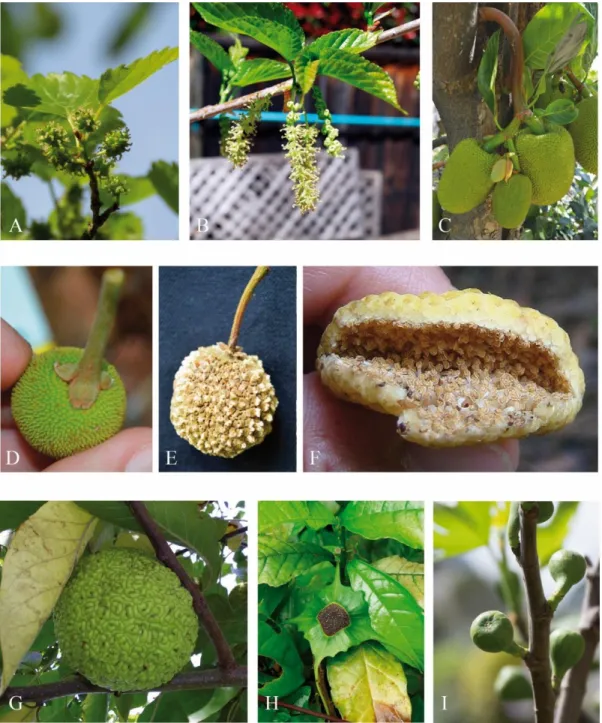
Moraceae harbors several species of economic value and some of them are widely cultivated. Leaves of mulberry (Morus) provide food for silk worms (Fig. 2 A, B, He et al. 2013). Artocarpus heterophyllus (Fig. 2 C) and Ficus carica (Fig. 2 I) are cultivated for their edible infructescences known as breadfruit and fig, respectively (Ghada et al. 2010; E W Williams et al. 2017). Some species of Dorstenia have been used in folk medicine for the treatment of infection, snake bites,
8 Figure 2. Representative species of the seven tribes of Moraceae. A-B. Morus alba female and male
inflorescence (Moreae); C. Artocarpus heterophyllus (Artocarpeae); D-E. Parartocarpus venenosus female and male inflorescence (Parartocarpeae); F.Castilla elastica (Castilleae); G. Maclura pomiera syncarp
(Moreae); H. Dorstenia barteri (Dorstenieae); I. Ficus carica female inflorescence (Ficeae). Photo: A,I by Qian Zhang; H by Hervé Sauquet; C from Williams et al. (2017); D, E from Zerega and Gardner (2019); G from (Gardner et al. 2017), reproduced with authors’ permission; B, F from Wikimedia commons by Fastily and Dick Culbert, respectively.
and as anti-inflammatory in Africa and South America (Zapata-Sudo et al. 2010). Lastly, the fibrous bark of Broussonetia papyrifera, known as paper mulberry, was used to make paper in ancient China (Chung et al. 2017).
Genus Ficus
The most diversified genus in Moraceae is Ficus (ca. 750 spp.), which is known for its coevolution with its symbiotic pollinating wasps (Hymenoptera, Chalcidoidea, Agaonidae) (Cruaud et al. 2012). Ficus is characterized by very small unisexual flowers enclosed in urn-shape inflorescences called syconia (Fig. 2 I). There are three kinds of flowers in Ficus inflorescences: male flowers (producing pollen), female flowers (producing seeds) and gall flowers (develop wasps). Two breeding systems occur in Ficus, monoecy and gynodioecy, differing in the distribution of these three kinds of flowers among syconia (Fig. 3), each representing about half of the species of Ficus (Cook and Rasplus 2003). In monoecious Ficus, all three kinds of flowers co-occur in every syconium (Fig. 3). Pollinating wasps lay eggs and pollinate the host plants after entering the syconium, depending on the lengths of styles of female flowers in monoecious Ficus. Conversely, gynodioecious species of Ficus are characterized by two kinds of syconia: male and female (Fig. 3). On the one hand, functional female syconia contain only female flowers. On the other hand, functional male syconia contain both male and gall flowers, and as a result will not deliver seeds. The male pollinating wasps are wingless, and usually never leave the syconium in which they developed. When the mature winged female wasps leave the male syconium in which they developed, they have to pass the cluster of male flowers near the exit of the syconium. These pollinating wasps then look for a new syconium and struggle into it (carrying pollen from another
10 Figure 3. Diagram of syconia (enclosed, urn-shaped inflorescences) in the two breeding systems
of Ficus, monoecy and gynodioecy.
syconium). They may lose their wings and some legs during the process. Following entry into a male syconium, they lay eggs; if they enter into a female syconium, they pollinate the female flowers (Cook and Rasplus 2003). Thus, structural gynodioecy in Ficus (plants are structurally either bisexual, with monoecious inflorescences, or female only) is functionally equivalent to dioecy (plants are functionally either male or female only). Ficus has a broad, mostly pantropical geographic distribution across all the three major tropical regions, but gynodioecious Ficus are remarkably absent in the Neotropics (Cruaud et al. 2012). Monoecy has been proposed to be the ancestral state of breeding system of Ficus
(Datwyler and Weiblen 2004).
Six subgenera were proposed for Ficus (Berg 2003). Three of them have so far been confirmed to be monophyletic, whereas subgenera Ficus, Pharmacosycea, and Urostigma appear to be polyphyletic in the phylogeny of Cruaud et al. (2012) based on five nuclear markers and 200 species. Pederneiras et al. reconstructed the most densely sampled phylogenetic analysis for Ficus to date (249 species) with nine nuclear molecular markers (Pederneiras et al. 2018). The topology of Pederneiras et al. (2018) was similar to the one of Cruaud et al. (2012), but with higher support for the deeper nodes. With the development of high-throughput sequencing, initial phylogenomic studies of Ficus have also recently been conducted based on much larger gene datasets but more limited taxon sampling (Bruun-Lund et al. 2017; Rasplus et al. 2018). Phylogenetic relationships based on complete chloroplast genomes (Bruun-Lund et al. 2017) differ markedly from phylogenies based on a few nuclear markers (Cruaud et al. 2012; Pederneiras et al. 2018), suggesting hybridization in the early history of Ficus. However, phylogenetic relationships based on nuclear RAD-seq genomic data (Rasplus et al. 2018) also differ from previous nuclear phylogenies (Cruaud et al. 2012; Pederneiras et al. 2018), specifically in relationships at the base of Ficus.
The crown-group age of Ficus has been estimated in the Cretaceous to the Paleocene (60.0-101.9 Ma) or in the Eocene (34.9-50.6 Ma), depending on different calibration strategies (Cruaud et al. 2012; Pederneiras et al. 2018). The ancestral area of Ficus has been inferred to be Eurasia (Cruaud et al. 2012; Pederneiras et al. 2018), from which Ficus then dispersed from the Old World to the New World twice, leading to the two Neotropical lineages (sections Pharmacosycea and Americanae) (Pederneiras et al. 2018). Ficus
12 subsect. Urostigma may have originated in the Paleocene to Eocene (40.3-60.6 Ma) in Madagascar (Chantarasuwan et al. 2016).
Tribe Dorstenieae
Tribe Dorstenieae includes fifteen genera and 156 species, distributed on both sides of the Atlantic (Figure 1, Chapter II). Dorstenia, with ca. 113 species, is the most diversified genus in Dorstenieae and the second in Moraceae (Berg and Hijman 1999; Berg 2001). New species have been discovered continuously in Africa and South America during the last decade (Mccoy and Massara 2008; dos Santos and Neto 2012; Machado and Marcelo Filho 2012; Chase et al. 2013; dos Santos et al. 2013; Leal 2014; Machado et al. 2014; Rzepecky 2016). Dorstenia has very small unisexual flowers organized and partly embedded in disk-like monoecious inflorescences, except D. lavrani which is dioecious (Mccoy and Massara 2008). Dorstenia is further characterized by the marginal appendages around the inflorescence (i.e., extensions of the flattened inflorescence receptacle), and the length of these appendages varies among species (Fig. 2 H). Inflorescence shape in Dorstenia ranges from square to round. Species of Dorstenia are diverse in habit, ranging from treelets to shrubs to herbs and the genus contains almost exclusively all of the herbaceous species known in Moraceae (Berg and Hijman 1999; Berg 2001).
Most species of Dorstenia are distributed in either South America or Africa (incl. Madagascar and Arabian Peninsula). Dorstenia has been estimated to originate in Africa in the Cretaceous (84.8-132.0 Ma) (Misiewicz and Zerega 2012). However, this estimate is older than the estimate of Moraceae as a whole (Zerega et al. 2005) and likely needs to be revised. Misiewicz and Zerega (2012) reconstructed the first phylogeny of Dorstenia using
ITS sequences, but some of the deep nodes remained weakly supported. Interestingly, their results suggested a single dispersal into the Neotropics with a subsequent re-colonization of Africa. However, sampling of both ingroup (32 out of 113 species) and outgroups (seven species represented seven genera, including two in the same tribe) was limited and the phylogeny of tribe Dorstenieae as a whole remains incompletely understood.
Methodological approaches used in this thesis
During my PhD program, I took advantage of recent methodological improvements in phylogenetics and macroevolution, including both technical advances (high-throughput sequencing) and conceptual developments in phylogenetic tree reconstruction and dating, model-based biogeographic history reconstruction, and phylogenetic comparative methods.
Hyb-seq approaches
The rapid development of high-throughput sequencing (HTS) has revolutionized phylogenetic analysis in the last decade (Drew et al. 2014; Matasci et al. 2014; Couvreur et al. 2019; Villaverde et al. 2018). The five widely used HTS approaches at present are: 1) microfluidic PCR, based on PCR amplification of targeted regions; 2) restriction enzyme-based methods, using restriction enzymes to separate genomic DNA and sequence, for instance, RAD-seq; 3) genome skimming, consisting of total genomic DNA sequencing at low depth without enrichment (typically aimed at recovering organellar genomes); 4) target enrichment approach (incl. the strategy commonly referred to as “exon capture”), enriching shotgun sequencing libraries for target genes; 5) transcriptome sequencing
14 (McKain et al. 2018). The Hyb-seq approach differs from other target enrichment strategies by not only targeting thousands of low-copy nuclear exons, but also their flanking regions, high-copy repeats, and organellar genomes simultaneously (Weitemier et al. 2014). One of the advantages of the target enrichment and Hyb-seq approaches is their suitability to work with degraded herbarium specimens (McKain et al. 2018). Herbarium collections are a treasure for biodiversity studies, when we consider the information about diversity and distribution from them, and the fact that some species are very difficult to be collected in the field (Hart et al. 2016).
Molecular dating
Molecular dating, which transforms the relative time from molecular branch lengths of phylogenetic trees to absolute time, using calibrations typically derived from the fossil record. Molecular dating is essential to connect the evolutionary history of a studied group of organisms with extrinsic geographic and climatic events (Sauquet 2013). Originally developed under the assumption of a strict clock (constant molecular rate) model, current molecular dating methods now allow heterogenous rates (relaxed clock models). Fossil calibrations have traditionally been applied as minimum age constraints. More recently, following the development of Bayesian approaches to molecular dating, various prior distributions (e.g., lognormal, exponential) have been implemented to describe the expected time between the fossil and calibrated node age (Ho and Phillips 2009). Further, to mitigate the impact of potential errors in calibration and the conflicts among calibration nodes, soft boundaries (allowing non-zero probability beyond both minimum and maximum age constraints) were introduced in prior distributions for calibrations (Yang and
Rannala 2005). However, even more recent molecular dating approaches (not used in this thesis), including the fossilized birth-death process and the so-called total-evidence (or tip-dating) methods treat fossils more explicitly as tips (and/or ancestors) of the phylogenetic tree, thereby avoiding the arbitrariness of prior distribution parameterization (Pyron 2011; Ronquist et al. 2012; Heath et al. 2014).
The development of molecular dating methods in the genomic era has mainly focused on handling the much larger datasets than in the Sanger sequencing era, including the challenge of adequately partitioning such datasets (Foster et al. 2016; Foster and Ho 2017). Although widely used software such as BEAST 2 (Bouckaert et al. 2014) may still be used in theory to analyze genomic data, computational times are in practice a limiting factor. New software such as MCMCTree in package PAML (Yang 2007) use approximate likelihood to solve this problem. Contrary to some early expectations, phylogenomic data so far appear to have a limited impact on divergence times, whereas fossil calibrations remain the most important factor (Dos Reis et al. 2016; Foster and Ho 2017). Thus, robust and well justified fossil calibration remains as critical with phylogenomic datasets as in the Sanger sequencing era (Sauquet et al. 2012; Ksepka et al. 2015).
Parametric models for ancestral state reconstruction
Ancestral state reconstruction (ASR) helps evolutionary biologists to understand the transition of traits in the evolutionary history of a clade. Parsimony approaches, which find the states that minimize the number of transition events given the states on tips of the phylogeny, were first used in ASR (Maddison et al. 1984). However, model-based
16 according to the branch lengths and allow to measure the relative confidence of each state at internal nodes of the phylogeny, expressed as proportional marginal likelihoods (Pagel 1999). Asymmetrical (directional) transition can also be estimated with ML approaches, allowing biologists to test more hypotheses in studies of trait evolution. Originally developed under a maximum likelihood (ML) framework, model-based approaches to ASR are also now available in a Bayesian framework. Bayesian approaches to ASR take into account uncertainty of both phylogenies (topologies and branch lengths) and model parameters (Pagel et al. 2004; Ronquist 2004). The reversible-jump Markov Chain Monte Carlo approach takes further advantage of the Bayesian framework to explore and visit multiple models of morphological evolution in proportion to their posterior probabilities (Pagel and Meade 2006).
Parametric models for historical biogeography
The reconstruction of ancestral distribution areas is similar to ancestral state reconstruction, and both fields have similar histories of methodological improvement. Historical biogeographic reconstruction started with parsimony-based method, for instance event-based approaches (Ronquist 2003). Inspired by the methods of ancestral state reconstruction and phylogenetic model selection, parametric models were introduced to historical biogeographic reconstruction about ten years ago, for instance the now widely used dispersal-extinction-cladogenesis (DEC) model (Ree and Smith 2008; Ree and Sanmartín 2009). Parametric biogeographic methods not only consider the topology but also the relative or absolute time, which parsimony methods do not. As in ASR models, the amount of biogeographic change (range expansion or local expansion) is proportional to
branch lengths (relative time). Absolute time links the historical biogeographic reconstruction with extrinsic geographic events (e.g., land bridges, fluctuation of sea level, climate in certain area). When multiple parametric models are considered, model selection metrics such as Akaike Information Criterion (AIC) and Bayes Factor (BF) may be used to determine the most appropriate model to explain the data.
Objectives of this thesis
This thesis focuses on breeding system evolution and the origin of diversity of angiosperm in tropical regions by using Moraceae as a model clade. My thesis is composed of three chapters, each written as a standalone manuscript for publication. Chapter I mainly focuses on breeding system evolution in Moraceae as a whole. To tackle this question, a new dated phylogenetic tree and ancestral states of breeding systems were reconstructed in Moraceae and Ficus. This chapter was recently published in Annals of Botany (Zhang et al. 2019a). In Chapter II, I investigated the biogeographic history of Dorstenieae, the second most species-rich tribe of Moraceae. To do so, a new dated phylogenomic tree of tribe Dorstenieae, sampled from herbarium specimens, was reconstructed and used to address the biogeographic history of the group. This chapter was recently made available as a preprint in bioRxiv and is currently being considered for recommendation by Peer Community in Evolutionary Biology (Zhang et al. 2019b). In addition, this work led to a collaboration on a smaller phylogenomic study focused on the genus Brosimum. While this has not yet reached the stage of a draft manuscript, I have outlined my contribution in Supplementary Data part of this thesis. Chapter III focused on characterizing niche
18 dataset for the genus and tested the relationship between breeding systems and climate (incl. precipitation and temperature), taking the phylogeny into account. This last chapter has not yet been submitted to any journal.
LITERATURE CITED
Antonelli A, Sanmartín I. 2011. Why are there so many plant species in the Neotropics? Taxon 60: 403–414.
Antonelli A, Zizka A, Carvalho FA, et al. 2018. Amazonia is the primary source of Neotropical
biodiversity. Proceedings of the National Academy of Sciences 115: 6034–6039.
APG IV. 2016. An update of the Angiosperm Phylogeny Group classification for the orders and
families of flowering plants: APG IV. Botanical Journal of the Linnean Society 181: 1–20.
Bacon CD, Silvestro D, Jaramillo C, Smith BT, Chakrabarty P, Antonelli A. 2015. Biological
evidence supports an early and complex emergence of the Isthmus of Panama. Proceedings of
the National Academy of Sciences 112: 6110–6115.
Berg CC. 2001. Moreae, Artocarpeae, and Dorstenia (Moraceae): with introductions to the family
and Ficus and with additions and corrections to Flora Neotropica Monograph 7. Flora
Neotropica 83: 1-346.
Berg CC. 2003. Flora Malesiana precursor for the treatment of Moraceae 1: the main subdivision
of Ficus: the subgenera. Blumea 48: 166–177.
Berg CC, Corner EJH, Jarrett FM. 2006. Moraceae-genera other than Ficus. Flora Malesiana. Series I, Seed plants 17:1-152.
Berg CC, Hijman MEE. 1999. The genus Dorstenia (Moraceae). Ilicifolia 2: 1–211.
Bouckaert R, Heled J, Kühnert D, et al. 2014. BEAST 2: A Software Platform for Bayesian
Evolutionary Analysis. PLOS Computational Biology 10: e1003537.
Bruun-Lund S, Clement WL, Kjellberg F, Rønsted N. 2017. First plastid phylogenomic study
reveals potential cyto-nuclear discordance in the evolutionary history of Ficus L. (Moraceae).
Molecular Phylogenetics and Evolution 109: 93–104.
De Bruyn M, Stelbrink B, Morley RJ, et al. 2014. Borneo and Indochina are major evolutionary
hotspots for Southeast Asian biodiversity. Systematic Biology 63: 879–901.
diversification. Botanical Journal of the Linnean Society 174: 326–333.
Bull JJ, Charnov EL. 1985. On Irreversible Evolution. Evolution 39: 1149–1155.
Cardoso JCF, Viana ML, Matias R, et al. 2018. Towards a unified terminology for angiosperm
reproductive systems. Acta Botanica Brasilica 32: 329–348.
Case AL, Barrett SCH. 2004. Environmental stress and the evolution of dioecy: Wurmbea dioica
(Colchicaceae) in Western Australia. Evolutionary Ecology 18: 145–164.
Chantarasuwan B, Rønsted N, Kjellberg F, Sungkaew S, van Welzen PC. 2016. Palaeotropical
intercontinental disjunctions revisited using a dated phylogenetic hypothesis with nearly complete species level sampling of Ficus subsect. Urostigma (Moraceae). Journal of
biogeography 43: 384–397.
Charlesworth D. 2015. Plant contributions to our understanding of sex chromosome evolution. New Phytologist 208: 52–65.
Chase MW, Thijs KW, Kamau P, Fay MF. 2013. Dorstenia christenhuszii (Moraceae), a new
species from the Taita Hills, Kenya. Phytotaxa 81: 45–48.
Christenhusz MJM, Byng JW. 2016. The number of known plants species in the world and its
annual increase. Phytotaxa 261: 201–217.
Chung K-F, Kuo W-H, Hsu Y-H, Li Y-H, Rubite RR, Xu W-B. 2017. Molecular
recircumscription of Broussonetia (Moraceae) and the identity and taxonomic status of B.
kaempferi var. australis. Botanical Studies 58: 11.
Clement WL, Weiblen GD. 2009. Morphological evolution in the mulberry family (Moraceae). Systematic Botany 34: 530–552.
Coiro M, Doyle JA, Hilton J. 2019. How deep is the conflict between molecular and fossil
evidence on the age of angiosperms? New Phytologist: In press. https://doi.org/10.1111/nph.15708 .
Cook JM, Rasplus J-Y. 2003. Mutualists with attitude: coevolving fig wasps and figs. Trends in Ecology & Evolution 18: 241–248.
Couvreur TLP. 2015. Odd man out: why are there fewer plant species in African rain forests? Plant systematics and evolution 301: 1299–1313.
Couvreur TLP, Helmstetter AJ, Koenen EJM, et al. 2019. Phylogenomics of the Major Tropical
Plant Family Annonaceae Using Targeted Enrichment of Nuclear Genes. Frontiers in Plant
Science 9: 1941.
Crayn DM, Costion C, Harrington MG. 2015. The Sahul–Sunda floristic exchange: dated
molecular phylogenies document Cenozoic intercontinental dispersal dynamics. Journal of
20 Cruaud A, Ronsted N, Chantarasuwan B, et al. 2012. An extreme case of plant-insect
codiversification: figs and fig-pollinating wasps. Systematic Biology 61: 1029–1047.
Datwyler SL, Weiblen GD. 2004. On the origin of the fig: phylogenetic relationships of Moraceae
from ndhF sequences. American Journal of Botany 91: 767–777.
Drew BT, Ruhfel BR, Smith SA, et al. 2014. Another look at the root of the angiosperms reveals
a familiar tale. Systematic Biology 63: 368–382.
Dufaÿ M, Champelovier P, Käfer J, Henry JP, Mousset S, Marais GAB. 2014. An
angiosperm-wide analysis of the gynodioecy–dioecy pathway. Annals of Botany 114: 539–548.
Foster CSP, Ho SYW. 2017. Strategies for partitioning clock models in phylogenomic dating:
application to the angiosperm evolutionary timescale. Genome biology and evolution 9: 2752– 2763.
Foster CSP, Ho SYW, Duchêne S. 2016. Estimating the number and assignment of clock models
in analyses of multigene datasets. Bioinformatics 32: 1281–1285.
Gardner EM, Sarraf P, Williams EW, Zerega NJC. 2017. Phylogeny and biogeography of Maclura (Moraceae) and the origin of an anachronistic fruit. Molecular phylogenetics and evolution 117: 49–59.
Ghada B, Ahmed BA, Khaled C, et al. 2010. Molecular evolution of chloroplast DNA in fig
(Ficus carica L.): Footprints of sweep selection and recent expansion. Biochemical
Systematics and Ecology 38: 563–575.
Givnish TJ, Zuluaga A, Marques I, et al. 2016. Phylogenomics and historical biogeography of
the monocot order Liliales: out of Australia and through Antarctica. Cladistics 32: 581–605.
Goldberg EE, Otto SP, Vamosi JC, et al. 2017. Macroevolutionary synthesis of flowering plant
sexual systems. Evolution 71: 898–912.
Hall R. 2009. Southeast Asia’s changing palaeogeography. Blumea 54: 148–161.
Hart ML, Forrest LL, Nicholls JA, Kidner CA. 2016. Retrieval of hundreds of nuclear loci from
herbarium specimens. Taxon 65: 1081–1092.
He N, Zhang C, Qi X, et al. 2013. Draft genome sequence of the mulberry tree Morus notabilis. Nature communications 4: 2445.
Heath TA, Huelsenbeck JP, Stadler T. 2014. The fossilized birth–death process for coherent
calibration of divergence-time estimates. Proceedings of the National Academy of Sciences
111: E2957–E2966.
Heilbuth JC. 2000. Lower species richness in dioecious clades. American Naturalist 156: 221–
241.
evolutionary divergence times. Systematic Biology 58: 367–380.
Hoorn C, Wesselingh FP, Ter Steege H, et al. 2010. Amazonia through time: Andean uplift,
climate change, landscape evolution, and biodiversity. Science 330: 927–931.
Hughes KA, Houde AE, Price AC, Rodd FH. 2013. Mating advantage for rare males in wild
guppy populations. Nature 503: 108–110.
Jaramillo C, Rueda MJ, Mora G. 2006. Cenozoic plant diversity in the Neotropics. Science 311:
1893–1896.
Käfer J, de Boer HJ, Mousset S, Kool A, Dufay M, Marais GAB. 2014. Dioecy is associated
with higher diversification rates in flowering plants. Journal of evolutionary biology 27: 1478– 1490.
Käfer J, Marais GAB, Pannell JR. 2017. On the rarity of dioecy in flowering plants. Molecular Ecology 26: 1225–1241.
Knox EB, Li C. 2017. The East Asian origin of the giant lobelias. American Journal of Botany 104:
924–938.
Kreft H, Jetz W. 2007. Global patterns and determinants of vascular plant diversity. Proceedings of the National Academy of Sciences 104: 5925–5930.
Ksepka DT, Parham JF, Allman JF, et al. 2015. The Fossil Calibration Database—A new
resource for divergence dating. Systematic Biology 64: 853–859.
de la Estrella M, Forest F, Wieringa JJ, Fougère‐Danezan M, Bruneau A. 2017. Insights on
the evolutionary origin of Detarioideae, a clade of ecologically dominant tropical African trees.
New Phytologist 214: 1722–1735.
Leal ME. 2014. Dorstenia luamensis (Moraceae), a new species from eastern Democratic Republic
of Congo. PhytoKeys: 49–55.
Li J, Murray KG, Li P, Brown K. 2018. Differential diversifications of South American and
Eastern Asian disjunct genera Bocconia and Macleaya (Papaveraceae). Journal of Systematics
and Evolution 56: 25–34.
Linder HP. 2014. The evolution of African plant diversity. Frontiers in Ecology and Evolution 2:
38.
Machado AFP, Marcelo Filho DMV. 2012. Dorstenia romaniucii (Moraceae), a new species from
the Brazilian Atlantic Rain Forest. Systematic Botany 37: 451–455.
Machado AFP, Pereira JF, Carauta JPP. 2014. Dorstenia triseriata (Moraceae) a new and
endangered species from Brazil. PhytoKeys: 31–35.
Maddison WP, Donoghue MJ, Maddison DR. 1984. Outgroup analysis and parsimony. Systematic Biology 33: 83–103.
22 Matasci N, Hung L-H, Yan Z, et al. 2014. Data access for the 1,000 Plants (1KP) project.
Gigascience 3: 17.
Mccoy T, Massara M. 2008. Dorstenia lavrani: a dioecious new species from northern Somaliland. Cactus and Succulent Journal 80: 78–82.
McKain MR, Johnson MG, Uribe‐Convers S, Eaton D, Yang Y. 2018. Practical considerations
for plant phylogenomics. Applications in plant sciences 6: e1038.
Misiewicz TM, Zerega NC. 2012. Phylogeny, biogeography and character evolution of Dorstenia
(Moraceae). Edinburgh Journal of Botany 69: 413–440.
Moonlight PW, Richardson JE, Tebbitt MC, et al. 2015. Continental‐scale diversification
patterns in a megadiverse genus: the biogeography of Neotropical Begonia. Journal of
Biogeography 42: 1137–1149.
Morley RJ. 2003. Interplate dispersal paths for megathermal angiosperms. Perspectives in Plant Ecology, Evolution and Systematics 6: 5–20.
Mutke J, Barthlott W. 2005. Patterns of vascular plant diversity at continental to global scales. Biologiske skrifter 55: 521–531.
Neal PR, Anderson GJ. 2005. Are ‘mating systems’‘breeding systems’ of inconsistent and
confusing terminology in plant reproductive biology? or is it the other way around? Plant
Systematics and Evolution 250: 173–185.
Pagel M. 1999. The maximum likelihood approach to reconstructing ancestral character states of
discrete characters on phylogenies. Systematic Biology 48: 612–622.
Pagel M, Meade A. 2006. Bayesian analysis of correlated evolution of discrete characters by
reversible‐jump Markov Chain Monte Carlo. The American Naturalist 167: 808–825.
Pagel M, Meade A, Barker D. 2004. Bayesian estimation of ancestral character states on
phylogenies. Systematic Biology 53: 673–684.
Pederneiras LC, Gaglioti AL, Romaniuc-Neto S, Mansano V de F. 2018. The role of
biogeographical barriers and bridges in determining divergent lineages in Ficus (Moraceae).
Botanical Journal of the Linnean Society 187: 594–613.
Pyron RA. 2011. Divergence time estimation using fossils as terminal taxa and the origins of
Lissamphibia. Systematic Biology 60: 466–481.
Rabosky DL, Chang J, Title PO, et al. 2018. An inverse latitudinal gradient in speciation rate for
marine fishes. Nature 559: 392–395.
Rasplus J-Y, Rodriguez LJ, Tollon-Cordet C, Cruaud A. 2018. Revisiting the phylogeny of Ficus (Moraceae): when next generation sequencing corroborates past generation botanists. bioRxiv: 340463.
Ree RH, Sanmartín I. 2009. Prospects and challenges for parametric models in historical
biogeographical inference. Journal of Biogeography 36: 1211–1220.
Ree RH, Smith SA. 2008. Maximum likelihood inference of geographic range evolution by
dispersal, local extinction, and cladogenesis. Systematic Biology 57: 4–14.
dos Reis M, Donoghue PCJ, Yang Z. 2016. Bayesian molecular clock dating of species
divergences in the genomics era. Nature Reviews Genetics 17: 71–80.
Renner SS. 2014. The relative and absolute frequencies of angiosperm sexual systems: dioecy,
monoecy, gynodioecy, and an updated online database. American Journal of Botany 101: 1588–1596.
Rohwer JG, Berg CC. 1993. Moraceae In: Flowering Plants Dicotyledons. Berlin Heidelberg: Springer.
Ronquist F. 2003. Parsimony analysis of coevolving species associations In: Tangled trees: phylogeny, cospeciation and coevolution. The University of Chicago Press Chicago, 22–64. Ronquist F. 2004. Bayesian inference of character evolution. Trends in Ecology & Evolution 19:
475–481.
Ronquist F, Klopfstein S, Vilhelmsen L, Schulmeister S, Murray DL, Rasnitsyn AP. 2012. A
total-evidence approach to dating with fossils, applied to the early radiation of the Hymenoptera. Systematic Biology 61: 973–999.
Rzepecky A. 2016. Dorstenia horwoodii Rzepecky sp. nov. from Nudum to Novum, a Fortyish
Year Hiatus. Cactus and Succulent Journal 88: 66–74.
Sabath N, Goldberg EE, Glick L, et al. 2016. Dioecy does not consistently accelerate or slow
lineage diversification across multiple genera of angiosperms. New Phytologist 209: 1290– 1300.
dos Santos A, Machado AFP, Mansano VDEF, Neto SR. 2013. Dorstenia acangatara
(Moraceae), a new and threatened species from Southeastern Brazil. Phytotaxa 118: 29–34.
dos Santos A, Neto SR. 2012. A new species of Dorstenia (Moraceae) from southeastern Brazil. PhytoKeys: 47–51.
Sauquet H. 2013. A practical guide to molecular dating. Comptes Rendus Palevol 12: 355–367. Sauquet H, von Balthazar M, Magallón S, et al. 2017. The ancestral flower of angiosperms and
its early diversification. Nature Communications 8: 16047.
Sauquet H, Ho SYW, Gandolfo MA, et al. 2012. Testing the impact of calibration on molecular
divergence times using a fossil-rich group: the case of Nothofagus (Fagales). Systematic
Biology 61: 289–313.
24 review. Biological Reviews 76: 529–572.
Simpson MG. 2010. Plant systematics. Cambridge: Academic press.
Soltis DE, Smith SA, Cellinese N, et al. 2011. Angiosperm phylogeny: 17 genes, 640 taxa. American Journal of Botany 98: 704–730.
Ulloa Ulloa C, Acevedo-Rodríguez P, Beck S, et al. 2017. An integrated assessment of the
vascular plant species of the Americas. Science 358: 1614–1617.
Villaverde T, Pokorny L, Olsson S, et al. 2018. Bridging the micro‐and macroevolutionary levels
in phylogenomics: Hyb‐Seq solves relationships from populations to species and above. New
Phytologist 220: 636–650.
Weitemier K, Straub SCK, Cronn RC, et al. 2014. Hyb‐Seq: combining target enrichment and
genome skimming for plant phylogenomics. Applications in Plant Sciences 2: 1400042.
Wiens JJ, Donoghue MJ. 2004. Historical biogeography, ecology and species richness. Trends in Ecology Evolution 19: 639–644.
Williams E W, Gardner EM, Harris R, Chaveerach A, Pereira JT, Zerega NJC. 2017. Out of
Borneo: biogeography, phylogeny and divergence date estimates of Artocarpus (Moraceae).
Annals of Botany 119: 611–627.
Williams Evelyn W, Gardner EM, Harris III R, Chaveerach A, Pereira JT, Zerega NJC. 2017.
Out of Borneo: biogeography, phylogeny and divergence date estimates of Artocarpus (Moraceae). Annals of Botany 119: 611–627.
Yang Z. 2007. PAML 4: phylogenetic analysis by maximum likelihood. Molecular biology and evolution 24: 1586–1591.
Yang Z, Rannala B. 2005. Bayesian estimation of species divergence times under a molecular
clock using multiple fossil calibrations with soft bounds. Molecular Biology and Evolution 23: 212–226.
Yi T-S, Jin G-H, Wen J. 2015. Chloroplast capture and intra- and inter-continental biogeographic
diversification in the Asian – New World disjunct plant genus Osmorhiza (Apiaceae).
Molecular Phylogenetics and Evolution 85: 10–21.
Zapata-Sudo G, Mendes TCF, Kartnaller MA, et al. 2010. Sedative and anticonvulsant activities
of methanol extract of Dorstenia arifolia in mice. Journal of ethnopharmacology 130: 9–12.
Zemp N, Widmer A, Charlesworth D. 2018. Has adaptation occurred in males and females since
separate sexes evolved in the plant Silene latifolia? Proceedings of the Royal Society B:
Biological Sciences 285: 20172824.
Zerega NJC, Clement WL, Datwyler SL, Weiblen GD. 2005. Biogeography and divergence
416.
Zerega NC, Gardner EM. 2019. Delimitation of the new tribe Parartocarpeae (Moraceae) is
supported by a 333-gene phylogeny and resolves tribal level Moraceae taxonomy. Phytotaxa
338: 253–265.
Zhang Q, Onstein RE, Little SA, Sauquet H. 2019a. Estimating divergence times and ancestral
breeding systems in Ficus and Moraceae. Annals of Botany 123: 191–204.
Zhang Q, Gardner E, Zerega N, Sauquet H. 2019b. Long-distance dispersal shaped the diversity
of tribe Dorstenieae (Moraceae). bioRxiv: 531855.
Zhang S-D, Soltis DE, Yang Y, Li D-Z, Yi T-S. 2011. Multi-gene analysis provides a
26
CHAPTER I. ESTIMATING DIVERGENCE TIMES AND
ANCESTRAL BREEDING SYSTEMS IN FICUS AND
MORACEAE
This chapter was recently published in Annals of Botany in January 2019 (https://academic.oup.com/aob/article/123/1/191/5092035), in collaboration with Stefan Little, Renske Onstein and Hervé Sauquet.
ABSTRACT
Background and Aims Although dioecy, which characterizes only 6% of angiosperm species, has been considered an evolutionary dead end, recent studies have demonstrated that this is not necessarily the case. Moraceae (40 genera, 1100 spp., incl. Ficus, 750 spp.) are particularly diverse in breeding systems (incl. monoecy, gynodioecy, androdioecy, and dioecy) and thus represent a model clade to study macroevolution of dioecy.
Methods Ancestral breeding systems of Ficus and Moraceae were inferred. To do so, a new dated phylogenetic trees of Ficus and Moraceae was first reconstructed by combining a revised twelve-fossil calibration set and a densely sampled molecular dataset of eight markers and 320 species. Breeding system evolution was then reconstructed using both parsimony and model-based (maximum likelihood and Bayesian) approaches with this new timescale.
Key Results The crown-group ages of Ficus and Moraceae were estimated in the Eocene (40.6-55.9 Ma) and Late Cretaceous (73.2-84.7 Ma), respectively. Strong support was found for ancestral dioecy in Moraceae. Although the ancestral state of Ficus remained particularly sensitive to model selection, the results show that monoecy and gynodioecy evolved from dioecy in Moraceae, and suggest that gynodioecy probably evolved from monoecy in Ficus.
Conclusions Dioecy was found not to be an evolutionary dead end in Moraceae. This study provides a new time scale for the phylogeny and a new framework of breeding system evolution in Ficus and Moraceae.
Key words: breeding system evolution, dioecy, evolutionary dead end, molecular dating, ancestral state reconstruction, fossil calibration, Ficus, Moraceae