HAL Id: hal-02060771
https://hal-amu.archives-ouvertes.fr/hal-02060771
Submitted on 7 Mar 2019
HAL is a multi-disciplinary open access
archive for the deposit and dissemination of sci-entific research documents, whether they are pub-lished or not. The documents may come from teaching and research institutions in France or abroad, or from public or private research centers.
L’archive ouverte pluridisciplinaire HAL, est destinée au dépôt et à la diffusion de documents scientifiques de niveau recherche, publiés ou non, émanant des établissements d’enseignement et de recherche français ou étrangers, des laboratoires publics ou privés.
Distributed under a Creative Commons Attribution| 4.0 International License
UV-enhanced Ozone Sensing Response of Al-doped Zinc
Oxide Nanocrystals at Room Temperature
Sandrine Bernardini, Tomas Fiorido, Khalifa Aguir, O. Margeat, J.
Ackermann, C. Videlot-Ackermann
To cite this version:
Sandrine Bernardini, Tomas Fiorido, Khalifa Aguir, O. Margeat, J. Ackermann, et al.. UV-enhanced Ozone Sensing Response of Al-doped Zinc Oxide Nanocrystals at Room Temperature. Materials Today: Proceedings, Elsevier, 2019, 6, pp.310-313. �hal-02060771�
ScienceDirect
Materials Today: Proceedings 6 (2019) 310–313 www.materialstoday.com/proceedings
2214-7853 © 2018 Elsevier Ltd. All rights reserved.
Selection and/or Peer-review under responsibility of SURFOCAP 2017.
SURFOCAP 2017
UV-enhanced Ozone Sensing Response of Al-doped Zinc Oxide
Nanocrystals at Room Temperature
S. Bernardini
a,*, T. Fiorido
a, K. Aguir
a, O. Margeat
b, J. Ackermann
b,
C. Videlot-Ackermann
baAix Marseille Univ, Univ Toulon, CNRS, IM2NP, Marseille, France bAix Marseille Univ, CNRS, CINaM, Marseille, France
Abstract
In this work, we focus on ozone (O3) detection at room temperature in the main objective to be well suited for most of flexible substrates. Aluminum doped zinc oxide (AZO) nanoparticles were deposited in thin films to be used as ozone gas sensors. It was demonstrated that the nanoparticles had good sensitivity to O3 at low temperature ( 125°C) when the sensor was exposed to UV illumination. This study provides an easy and efficient way to obtain O3 gas sensors at temperature from 25°C up to 125°C by a simple and versatile solution-process. Electrical resistance measurements at 25°C under UV irradiation showed that AZO thin films were sensitive even at a low ozone concentration (35 ppb).
© 2018 Elsevier Ltd. All rights reserved.
Selection and/or Peer-review under responsibility of SURFOCAP 2017.
Keywords: Gaz Sensors; Ozone; Al-dpoed ZnO (AZO) nanoparticles; Thin films.
1. Introduction
In this work, we focus on ozone (O3) detection at room temperature to be well suited for most of flexible
substrates. O3 is naturally present in the atmosphere due to the interaction of sunlight with chemicals emitted into
the environment [1]. At ground level ozone is harmful even at low concentrations and leads to health problems such
as inflammation and congestion of the respiratory tract [2]. O3 detection can be acquired by monitoring the
* Corresponding author. Tel.: +33 04 91 28 89 71; fax: +33 04 91 28 89 70.
Bernardini et al. / Materials Today: Proceedings 6 (2019) 310–313 311
conductance changes in oxide semiconductor thin-films as Zinc Oxide (ZnO). For gas sensor devices, a large surface-area-to-volume ratio favors the adsorption of the gases on its surface [3]. We have shown previously that
ZnO nanoparticles (NPs) can be used as sensitive layer to detect O3 at 200°C on flexible substrate [4]. When ZnO is
doped with group III elements such as Aluminum, it is expected that the dopants act as singly charged donors and supply the excess carriers to conductance band, which will increase the conductivity [5]. Furthermore, illuminating sensitive layers with ultra-violet (UV) light improves sensing performances [6].
We propose herein O3 detection at temperature ranging from 25°C to 125°C by Aluminum doped zinc oxide
(AZO) NPs deposited on rigid substrate to form porous thin films composed of tightly packed grains. Electrical resistance measurements at 25°C under UV irradiation showed that AZO thin films were sensitive even at low ozone concentrations (35 ppb).
2. Experimental section 2.1. Materials and methods
AZO NPs were prepared following procedures described previously [7,8]. In a typical experiment, AZO NPs were produced by adding zinc acetate, aluminum isopropylate and distilled water into a flask containing anhydrous ethanol. After heating at 80°C, potassium hydroxide dispersed in ethanol was added dropwise to the flask, and heating was kept at 80°C during 16 h. The as-synthesized AZO NPs were washed by centrifugation. By controlling the initial ratio of the aluminum to zinc precursor during synthesis while keeping constant all the other parameters, a precise control of Al doping content (atomic percentage, at.%) can be obtained. In the present study, AZO NPs with 0.8 at.% Al doping level have been synthesized. The solution-processable dispersions were prepared by transferring
the synthesized AZO NPs from medium reaction to isopropanol at concentrations of 30 mg.mL-1. Additionally,
cluster-free dispersions of AZO NPs were obtained in isopropanol by using 0.2 vol.% of ethanolamine (EA) as surfactant [7]. EA is a small organic molecule giving high dispersions without aggregate in alcohols and avoiding the need of bulky or long surfactants.
2.2. Sensor assembly
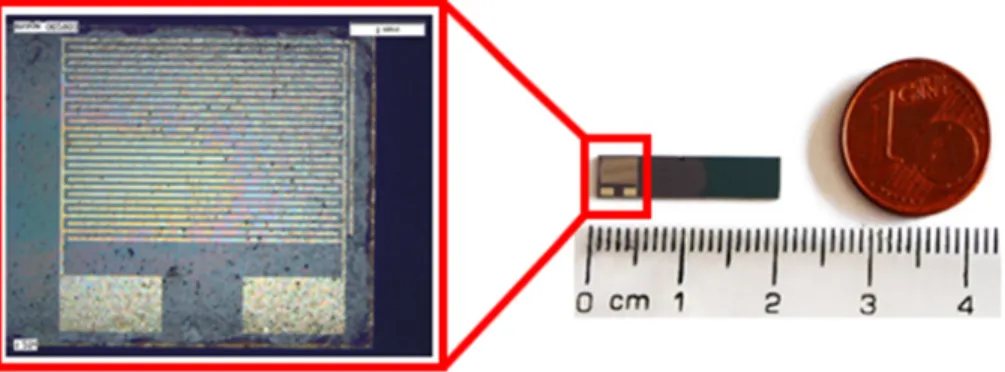
Our sensors consist of two interdigitated platinum electrodes, obtained by standard pulverization method on silicon dioxide in a resistor configuration (Fig. 1). Then, AZO NPs disperse in isopropanol, using 0.2 vol.% of EA, were dropped on the electrodes in order to reach a sensitive film thickness around 200±10nm as for our previous studies on ZnO NP [4]. Finally, the deposited drop was dried at 150°C for 30 min.
2.3. Gas sensing measurements
The gas sensing properties of AZO films were investigated in a sealed stainless test cell to control the substrate
temperature and O3 concentrations. Dry air was used as gas vector at 500 sccm. The sensor was exposed to dry air
(i.e. 0% relative humidity) with different concentrations of O3 (35, 65, 125, 165 ppb) during 30 s and exposed to a
clean dry airflow for recovery. O3 gas was formed from oxidizing oxygen molecules of dry air by a calibrated
pen-ray UV lamp (UVP, model). The dry air, containing O3, was blown directly onto the sample placed on a heated
holder. The applied dc voltage was 0.1 V. The electrical resistance was measured using a Keithley (model 2450) source-meter connected to a computer. The detection response is defined as the normalized electric resistance
response, by S = RO3/Rdry air, where RO3 and Rdry air are the electric resistances of the sensor exposed to O3 gas and to
dry air, respectively. Gas sensing measurements under UV-light irradiation were performed using a UV-LED (UV5TZ-390-30, peak wavelength of 390 nm) kept at 10 mm from the sensing material. Initially, the samples were irradiated for 60 min with a UV-LED to stabilize the electrical resistance.
3. Results and discussion 3.1. Thin film Characterization
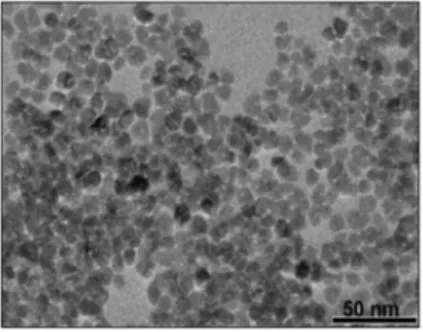
Fig. 2 shows a typical Transmission Electron Microscopy (TEM) image of the AZO NPs with homogeneous sizes (diameters about 10 nm) and shape dispersions. Previous analyses have shown that the AZO nanocrystals are monocrystalline with a classical wurtzite structure [7].
Fig. 2. TEM image of AZO nanocrystals drop-casted on a TEM grid.
By drop casting of AZO NPs-based dispersion, thin films with tightly packed grains are obtained. The free-spaces between NPs offer a high surface-area-to-volume-ratio to the thin film where gas molecules can diffuse in the volume structure.
3.2. AZO Sensor response
The sample studied here was initially exposed to O3 at room temperature (around 25°C) without any
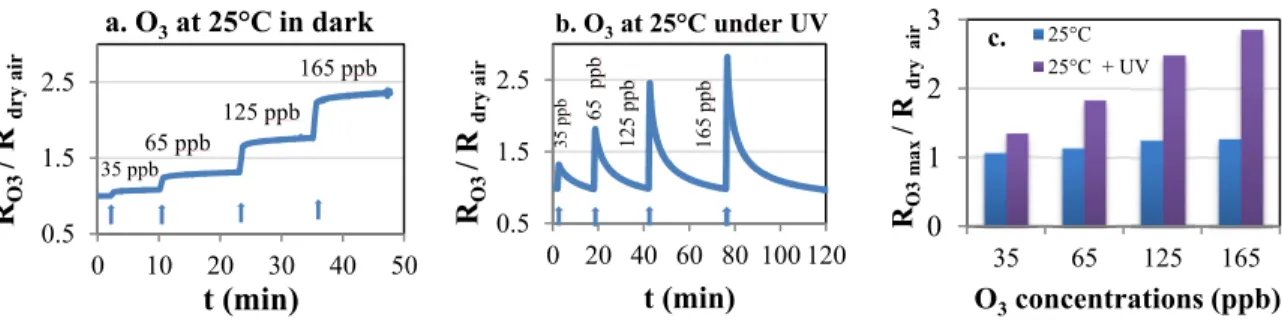
illumination. As can be seen in Fig. 3a, a slight O3 response was observed without recovery time. When the sample
was exposed to O3 at 25°C under UV illumination, Fig. 3b, the sensitivity to O3 gas was enhanced over that without
UV light with long recovery time. It presented total reversibility and had good stability of the base line. Figure 3c presents the comparison of sensor responses at room temperature in dark and under UV light. In ozone gas
detection, the O3 gas molecules adsorb on the AZO surface, implying the formation of an electron-depletion layer
Bernardini et al. / Materials Today: Proceedings 6 (2019) 310–313 313
Fig. 3. Sensor responses as function of O3 concentrations at 25°C (a) in dark, (b) under UV and (c) comparison of both.
To decrease the recovery time under UV light irradiation, temperature is required. Fig. 4 presents the best response in terms of amplitude and recovery time acquired at 125°C under UV irradiation. The results obtained show fast responses at low level ozone concentration and good reversibility.
Fig. 4. Ozone exposure during 30s increasing from 35 to 165 ppb and decreasing from 165 to 35 ppb at 125°C under UV.
4. Conclusion
This work reported a low-temperature way to detect O3 molecules by thin-film based sensors. Synthesized
Aluminum doped ZnO nanoparticles with a controlled doping level (0.8 at. % Al) have been dropped casted to form a gas sensing layer. Gas sensing measurements showed the great potential of AZO nanoparticles, which display a fast response, short recovery time, at optimal temperature of 125°C under UV-light irradiation. This versatile methodology provides an alternative way to manufacture gas sensor devices, operating at low temperatures, which is compatible with flexible substrates. Electrical resistance measurements at 25°C under UV irradiation have shown that AZO thin films were sensitive even at low ozone concentrations.
Acknowledgements
The authors would like to express many thanks toA. Combes for his technical support in this work.
References
[1] S. Wakamatsu, T. Ohara, and I. Uno, Atmos. Environ vol. 30 (1995) pp. 715–721.
[2] Air Quality Guideline for Europe, EURO, World Health Organization, Regional, Copenhagen, European Series (1998). [3] G. J. Cadena, J. Riu and F. X. Rius, Analyst, 132, (2007) pp. 1083–1099.
[4] M. Acuautla, S. Bernardini, and M. Bendahan, Key Engineering Materials 605 (2014) pp. 163–166. [5] D.Y. Kim, J.Y. Son. Solid-State Lett. 12 (2009) pp. J109–J111.
[6] L. F. da Silva, J.-C. M’Pekob, A. C. Catto, et al. Sensors and Actuators B Chemical (2016) pp. 240:573–579. [7] M. Gaceur, S. Ben Dkhil, D. Duché, et al. Adv. Funct. Mat. 26 (2016) pp. 243-253.
[8] A.K. Diallo, M. Gaceur, S. Fall, et al. Materials Science and Engineering: B, 214 (2016) pp.11–18.
0.5 1.5 2.5 0 10 20 30 40 50 RO3 / R dry air t (min) a. O3at 25°C in dark 35 ppb 65 ppb 125 ppb 165 ppb 0.5 1.5 2.5 0 20 40 60 80 100 120 RO3 / R dry air t (min) 35 ppb b. O3at 25°C under UV 65 ppb 125 ppb 165 ppb 0 1 2 3 35 65 125 165 RO 3 m ax / R dry air O3concentrations (ppb) 25°C 25°C + UV c.