UNIVERSITÉ DU QUÉBEC
MÉMOIRE PRÉSENTÉ À
L'UNIVERSITÉ DU QUÉBEC À TROIS-RIVIÈRES
COMME EXIGENCE PARTIELLE DE LA MAÎTRISE EN MATHÉMATIQUES
ET INFORMATIQUE APPLIQUÉES
PAR YANFENSHEN
A FORMAL ONTOLOGY FOR DATA MINING: PRINCIPLES, DESIGN, AND EVOLUTION
(UNE ONTOLOGIE FORMELLE POUR LE FORAGE DE DONNÉES: PRINCIPES, CONCEPTION ET ÉVOLUTION)
Université du Québec à Trois-Rivières
Service de la bibliothèque
Avertissement
L’auteur de ce mémoire ou de cette thèse a autorisé l’Université du Québec
à Trois-Rivières à diffuser, à des fins non lucratives, une copie de son
mémoire ou de sa thèse.
Cette diffusion n’entraîne pas une renonciation de la part de l’auteur à ses
droits de propriété intellectuelle, incluant le droit d’auteur, sur ce mémoire
ou cette thèse. Notamment, la reproduction ou la publication de la totalité
ou d’une partie importante de ce mémoire ou de cette thèse requiert son
autorisation.
A FORMAL ONTOLOGY FOR DATA MINING:
PRINCIPLES, DESIGN, AND EVOLUTION
Yanfen Shen
ABSTRACT
Data mining (DM) and decision support system (DS) are two relatively independent domains broadly applied to scientific research and business practice. Successful integration of technologies associated with both domains could an intelligent data mining assistant system, which is able to provide intelligent assistance beyond the numbers of DM methods and tools, is an essential step toward a better integration of DM and DS. However, the development of su ch a system is currently facing two major challenges: the support of non-expert data miner and the definition of DM knowledge. Formalized and computerized ontologies, as a new research area for knowledge conceptualization, possess a great potential to help resolve the above problems. Due to its powerful knowledge representation formalism and associated maintenance mechanism, integrating an ontology into a data mining assistant system will be an effective way of making the system more intelligent and helpful for decision makers. The objective of the research is to develop an ontology-based approach for data mining. It incIudes a data mining ontology, which creates a complete data mining domain knowledge base, and an ontology evolution tool, which provides a mechanism to support the ontology development and updating. This research provides a fundamental part of a larger project which aims to develop an intelligent data mining assistant system.
Based on protégé (Stanford University) and the OWL language, a finely designed DM ontology is successfully established. The role of the DM ontology is to represent the data mining knowledge required in the system. Two types ofknowledge are represented: data mining domain knowledge that consists of both the methodology and the detailed
applicable knowledge of the entire data mining process, and system generated knowledge that consists of data annotation and CBR case representation. To provide more intelligent support for data mining activities, our DM ontology is further integrated with the other two system components: a data warehouse and a case-based reasoning system.
Furthermore, a new ontology evolution methodology is proposed and implemented as a Protégé plug-in. This methodology is based on the evolution tasks and the consequence of the change operations. The different change operations and evolution tasks are finely defined in the methodology. The plug-in groups and arranges the necessary steps of most commonly used evolution tasks. It can be used as a step-by-step wizard to guide decision makers to execute ontology-updating tasks.
The results of this research have led to the construction of a fundamental framework for our data mining assistant system and pave the way for a better integration of data mining and decision support system. Furthermore our versatile DM ontology evolution methodology will greatly improve the accuracy, consistency, and efficiency of the evolution tasks. More importantly, this evolution methodology possesses a great potential for further development.
UNE ONTOLOGIE FORMELLE POUR LE FORAGE DE
DONNÉES: PRINCIPES, CONCEPTION ET ÉVOLUTION
Yanfen Shen
SOMMAIRE
Le forage de données (DM) et les systèmes d'aide à la décision (OS) sont deux domaines relativement indépendants qui sont largement appliquées dans la recherche scientifique et la gestion. L'intégration réussie des technologies associées à ces deux domaines pourra mener à la réalisation d'un système intelligent puissant pour soutenir la prise de décision. L'application d'un système intelligent d'aide au forage de données, qui peut fournir une aide intelligente au delà de nombre de méthodes et d'outils de DM, est une étape essentielle vers une meilleure intégration de DM et de OS. Cependant, le développement du système doit relever actuellement deux défis principaux : le support de foreur de données non expert et la définition de la connaissance de DM. Les ontologies formelles et informatisées, en tant que nouveau secteur de recherche pour la conceptualisation de la connaissance, possèdent un grand potentiel pour aider à résoudre les problèmes ci-dessus. En raison de son puissant formalisme de représentation de la connaissance et du mécanisme d'entretien associé, intégrer une ontologie dans le système d'aide au forage de données sera une manière efficace de rendre le système plus intelligent et utile pour des décideurs.
L'objectif de cette recherche est de développer une approche basée sur l'utilisation d'une ontologie dans le domaine du forage de données. Cette dernière constitue une base de connaissance du domaine de forage de données ; ainsi qu'une méthode d'évolution d'ontologie, laquelle fournit un mécanisme et un outil pour soutenir le développement et la mise àjour de l'ontologie. Cette recherche est une partie fondamentale d'un plus grand projet de développement d'un système intelligent d'aide au forage de données.
Basé sur Protégé (Université de Stanford) et le langage OWL, nous avons établi avec succès une fine ontologie de DM. Le rôle de l'ontologie de DM est de représenter la connaissance de forage de données nécessaire au système. Deux types de connaissance sont représentés : la connaissance du domaine de forage de données et la connaissance produite par le système. La connaissance du domaine de forage de données se compose de la méthodologie et de la connaissance détaillée applicable au processus de forage de données, alors que la connaissance produite par le système se compose de la représentation d'annotations de données et des cas du système à base de cas. Pour fournir un support plus intelligent pour des activités de forage de données, notre ontologie de DM reste intégrée avec les deux autres composants du système: l'entrepôt de données et le système de raisonnement basé sur les cas.
Nous avons aussi proposé une nouvelle méthodologie d'évolution d'ontologie, cette méthodologie est mise en application comme un plug-in de Protégé. Cette approche est basée sur les tâches de l'évolution de l'ontologie et la conséquence des opérations de changement. Cette approche définie avec grande précision les différentes opérations de changement et les tâches de l'évolution. Le plug-in groupe et arrange les étapes nécessaires des tâches de l'évolution les plus généralement utilisées. Il peut être employé comme un wizard, étape par étape, pour guider des décideurs pour exécuter les tâches de mise à jour de l'ontologie.
Les travaux accomplis dans cette recherche ont permIs de construire la structure fondamentale pour notre système d'aide au forage de données et ont préparé le terrain pour une meilleure intégration du forage de données et des systèmes d'aide à la décision. En outre notre méthodologie d'évolution d'ontologie améliorera considérablement l'exactitude, l'uniformité et l'efficacité des tâches de l'évolution. À notre avis, cette approche évolutive possède un grand potentiel pour un développement ultérieur.
ACKNOWLEDGEMENTS
1 would like to express my sincere thanks to Dr. Sylvain Delisle, my supervisor, for his constant encouragement and support throughout my study at UQTR. Without his ambition, creative ideas, clear expression and concem of the detail, this thesis would not have been possible.
1 want to thank Dr. Ofelia Cervantes, Michel Charest, Marie-Chantal Denis, Francis Gasse, Remy Auclair, Michel D. Pepin and Dr. Mhamed Mesfioui for their great assistance and collaboration during my master's study.
Finally, 1 would like to thank my husband Changbin Mao, my little daughter Jenny Mao, my parents and my brother for their profound love and unwavering supports during my studies.
TABLE OF CONTENTS ABSTRACT ...
i
SOMMAIRE ... iii ACKNOWLEDGEMENTS ... v LIST OF FIGURES ... ix LIST OF TABLES ... xi Chapter 1 : INTRODUCTION ... 1 1.1 Background ... 11.2 Challenges of intelligent data rnining assistance ... 3
1.3 Onto logy ... 5
1.4 Research objectives ... 6
Chapter 2 : DATA MINING FUNDAMENTALS ... 9
2.1 Basic concepts ... 9
2.1.1 Data rnining definition ... 9
2.1.2 Data rnining and KDD process ... 9
2.1.3 Data rnining and data warehouse ... Il 2.2 CRISP-DM ... 12
Chapter 3 : A BRIEF STATE OF THE ART IN ONTOLOGY RESEARCH ... 16
3.1 Fundarnentals of ontology ... 16
3.1.2 Ontology cornponents and types ... 18
3.1.3 Ontology and sernantic web ... 20
3.2 OWL web ontology language ... 23
3.2.1 OWL language overview ... 23
3.2.2 OWL classes ... 25
3.2.3 OWL properties ... 28
3.2.4 OWL individuals ... 29
3.3 Existing ontology evolution rnethodologies ... 30
3.3.1 An ontology evolution process ... 30
3.3.2 OWL ontology change management ... 33
3.3.3 Other methodologies ... 35
3.4 Ontology-based applications for data rnining ... 36
3.4.1 Ontologies for knowledge representation ... 37
3.4.2 Ontologies for a better selection ... 38
Chapter 4 : DEVELOPMENT OF A NEW DATA MINING
ONTOLOGY ... 40
4.1 DM ontology in an intelligent data mining assistant system ... 40
4.1.1 Overview of the new system ... 40
4.1.2 Roles of the DM ontology ... .42
4.2 The design of the data rnining knowledge representation ... 43
4.2.1 CRISP-DM ... 44
4.2.2 Data source ... 46
4.2.3 CBR cases ... 47
4.2.4 DM techniques ... 48
4.2.4.1 Sorne differences in definition of data rnining knowledge ... 48
4.2.4.2 Data rnining knowledge representation ... 49
4.3 Design and implernentation of the DM ontology ... 54
4.3.1 Class definition and hierarchies ... 56
4.3.3 Added instances ... 70
4.3.4 Reasoning ... 72
4.4 Discussion ... 73
Chapter 5 :
A
NEW TOOL TO MANAGE THE EVOLUTION OF A PROTÉGÉ OWL ONTOLOGY ... 755.1 Challenges of ontology evolution ... 75
5.1.1 The importance of ontology evolution ... 76
5.1.2 The problems of ontology evolution ... 77
5.2 Conceptual solutions for OWL ontology evolution ... 78
5.2.1 OWL change operations ... 78
5.2.2 A task-based evolution methodology ... 83
5.3 The ontology evolution tab: a new Protégé plug-in ... 88
5.3.1 Overview of the new ontology evolution tab ... 88
5.3.2 Implementation of the ontology evolution tab ... 88
5.4 Discussion ... 100
Chapter 6 : FUTURE WORK ... 104
Chapter 7 : CONCLUSION ... 107
References ... 110
Appendix ... 116
LIST OF FIGURES
Figure 1.1 Decision support and knowledge management activities ... 3
Figure 2.1 The KDD process ... 10
Figure 2.2 The CRISP-DM process ... 13
Figure 2.3 The phases, tasks and outputs of the CRISP-DM process ... 13
Figure 3.1 The reusability-usability trade-off.. ... 20
Figure 3.2 The architecture of the Semantic Web ... 22
Figure 3.3 language synopsis ofOWL sub languages ... 25
Figure 3.4 The ontology evolution process ... 31
Figure 3.5 A schematic representation of the framework ... 34
Figure 4.1 Intelligent DM assistant system architecture ... 41
Figure 4.2 The hierarchy ofCRISP-DM ... 44
Figure 4.3 The knowledge representation of CRISP-DM ... 45
Figure 4.4 The knowledge representation of Data Source ... 47
Figure 4.5 The knowledge representation of the DM Techniques ... 51
Figure 4.6 The concept hierarchy of DM Task ... 52
Figure 4.7 The concept hierarchy of Algorithm ... 53
Figure 4.8 The concept hierarchy of Program ... 53
Figure 4.9 The concept hierarchy of Model ... 54
Figure 4.10 The DM ontology environment ... 55
Figure 4.11 The highest level of class hierarchy in DM ontology ... 56
Figure 4.12 The CRISP-DM classes ... 57
Figure 4.13 The class hierarchy of DataSource ... 58
Figure 4.14 Relationships between CRISP-DM and DM ontology ... 59
Figure 4.15 The class Modeling and its subclasses ... 60
Figure 4.16 The class Algorithm and its subclasses ... 61
Figure 4.17 The class Model and its subclasses ... 61
Figure 4.18 The class Program and its subclasses ... 62
Figure 4.20 The constraints of the class ClassificationAlgorithm ... 68
Figure 4.21 Inherited and created properties of the class DecisionTreeAlgorithm ... 70
Figure 4.22 The boundary of classes and instances ... 71
Figure 4.23 Instances of the class DecisionTreeAlgorithm ... 72
Figure 5.1 The strategy of ontology evolution ... 85
Figure 5.2 The property related task ... 86
Figure 5.3 The class related task ... 87
Figure 5.4 Create and edit a class Restaurant ... 90
Figure 5.5 Check the created class restaurant ... 91
Figure 5.6 Create and edit instances in the class Restaurant.. ... 92
Figure 5.7 Try to delete the class Restaurant.. ... 93
Figure 5.8 Create a property makesPizza ... ... 95
Figure 5.9 The changed class Restaurant ... 96
Figure 5.10 The property makesPizza is added to the instances of Restaurant ... 97
Figure 5.11 Delete the property sellsPizza ... 98
LIST OF TABLES
Table 3.1 Types of ontology ... 19
Table 3.2 Comparison ofthree OWL sub languages ... 24
Table 3.3 OWL class description type and its language constructs ... 26
Table 4.1 Properties of CRISP-DM ... 63
Table 4.2 Properties of CBRCases ... 63
Table 4.3 Properties of DataSource ... 64
Table 4.4 Properties of Techniques ... 64
Table 4.5 The properties associated to the class Algorithm ... 66
Table 4.6 Domain and range of the properties associated with Algorithm ... 67
Table 5.1 Sorne basic change operations of an OWL ontology ... 79
Table 5.2 Change operations applied to the composite changes ... 81
Chapter 1 . INTRODUCTION
1.1 Background
Data mining (DM), the extraction of hidden predictive information from large databases, is a powerful new technology with great potential for applications in almost every area to support decision-making. Nowadays, with the tremendous growing competition, many organizations are facing serious challenges in data and information analysis when making decisions. One of the challenges is the increasing availability of large volumes of high-dimensional data occupying databases. Another is the competitive demand for the rapid construction and deployment of data-driven analysis. The third is the need to give end users analysis results in a form readily understandable, helping them gain the insights they need to make critical decisions. This trend requires intelligent support to de al with a very large volume of data and find new, interesting and useful patterns from data for effective decision-making. Data mining, as proposed by many researchers, is regarded as the best choice to assist decision makers to solve the "data rich but knowledge poor" problems.
Decision makers can make decisions based on the information and knowledge obtained through data mining processes, or in other cases, through decision support systems (DSS) for certain types of decisions. The decision support system is "an interactive, flexible and adaptable computer-based information system especially developed for supporting the solution of a non-structured management problem for improved decision making" [ 1 ]. It aims to increase the productivity of decision makers through implementing their abilities to manipulate knowledge, by facilitating problem solving, and by providing the assistance for non-structured problems. This requires a complex processing of data and information. The results depend largely on the quality of the applied data processes. Thus data mining and decision support systems are not two independent components to support decision-making. They interact with each other to
combine useful data and information for decision-making process, improve the understanding of making process, and generate new knowledge from decision-making process. ActuaIly, they are interdependent; they can bene fit from each other if they can be successfully integrated.
Proper integration of DM and DS will not only support required interaction between them but also present new opportunities for enhancing the quality of support provided by each system[2, 3, 4]. Mladenic et al. [2] proposed an equation, "data mining + decision tool
=
better business", which illustrates that integration can lead to more success in business. While integrated in DS, data mining will provide a strategie advantage in defining, developing, and deploying competitive business strategies. Data mining tools will predict future trends and behaviors, allowing business to make proactive, knowledge-driven decisions. They will also answer quickly and accurately business questions that were traditionally time consuming to resolve.However, data mining and Decision Support System are currently not weIl integrated [5]. The problem ofthe poor integration has recently been clearly acknowledged in the scientific literature and so far little work has been done. The DSS mainly focuses on improving decision makers' ability in dealing with data, information and knowledge; while data mining methods and tools are supposed to be able to facilitate decision makers by finding interesting information from a sea of data and compacting it into a form easily amenable to decision making. However, currently tools provided by data mining cannot completely fui fi Il its task due to its lack of cooperation with DSS. As shown in Figure 1.1 [3], "DM and DSS are two distinct components that do not usually interact through a computerized tool. Thus, DM and DSS are not integrated at ail". [5] Therefore, the integration of DM and DSS remains one of the biggest challenges in the artificial intelligence field.
Data from internai and
External SOUrœs
N Balloju et al, 1 DecisÎoo SUPPI)r/ Sy.!lems 33 (}(}(}]) J63-J 76
DecIsiOn
makers
•
L..
DIIlI_O.:...~_~_'
EIS,WIII ...~ItH
Quertes
n
Knowledge Ii'om JntemaIancl
Extemal Sources
Figure 1.1 Decision support and knowledge management activities 1.2 Challenges of intelligent data mining assistance
Data mining is not an easy, simple process; it is a discipline which brings together database systems, data warehouse, statistics, artificial intelligence, machine learning, parallel and distributed processing, and visualization. An intelligent data-mining assistant can make DM more accessible and effective for decision makers to support the application-oriented decision-support tasks. The application of the intelligent assistant systems is an essential step toward a better integration of DM and DSS, but it is currently facing the following challenges [6, 7, 8].
How to support the non-expert data miner
Data mining is a complicated process that ranges from specifying DM objects, data preprocessing, selecting algorithms, and models to evaluating DM results. For each step, sorne important decisions must be made. For example, how to con vert business objectives into DM objectives; how to perform the data preparation phase; how to
choose the most appropriate DM algorithm and its parameters; how to evaluate and interpret DM results, and so on. These decisions require a deep understanding of data mining concepts, and only expert data miners can handle this detailed knowledge. Unfortunately, most commercial products either do not offer any intelligent assistance or tend to offer only "wizard-like" interfaces that tend to assume a high level of background knowledge to use the system. In order to make DM tools more applicable and practical for the potential users of aIl levels, including ordinary decision makers, special consideration must be taken in how to effectively support the non-expert users when designing a data mining assistant.
How to define the DM knowledge
Over the past several decades, the field of statistics and machine learning has evolved at a tremendous pace. This results in a myriad of algorithms and associated knowledge available to data miners. The effective use of sorne algorithms requires a data miner to possess a great de al of basic knowledge to carry out a given step. This basic knowledge consists of domain knowledge describing DM concepts and tacit knowledge explaining the experience from the weil-accompli shed DM tasks.
Data mining domain knowledge is a basic requirement of DM intelligent systems. Often the amount of encapsulated knowledge determines the "level" of intelligence the system can provide. With the increasing growth of DM technologies, the corresponding DM knowledge becomes multidisciplinary covering more and more relative fields. The contents of the do main knowledge also bec orne increasingly ri cher and deeper, and the accuracy and the versatility of knowledge interpretation become more and more important and difficult. Nevertheless, many DM methodologies are not capable of providing enough necessary, detailed knowledge for the novice miners. In most cases, they only specify the phases, tasks and activities that need to be carried out during a DM project. Thus, how to formalize the domain knowledge that can be further shared and reused by different applications is still a challenge.
Another source of knowledge is the tacit knowledge from the data mmers. Tacit knowledge often deals with the practice experience and the personal knowledge of various DM tasks; it could be used to assist in answering important questions during the DM process. Most enterprises do not directly manage tacit knowledge in a form that can be stored, refined and reused. Therefore, how to extemalize tacit knowledge to make it explicit remains another challenge.
1.3 Ontology
Ontology is currently a hot research area under development that is catching increasing interest in many industrial and academic fields, especially in artificial intelligence. Ontology is a knowledge representation mechanism for better structuring domain knowledge. Existing knowledge sources are mapped into the domain ontology and semantically enriched. This semantically enriched information enables better knowledge sharing and automatic processing and, implicitly, a better management of knowledge. Based on this characteristic, ontology-based systems seem to be the best choice for knowledge management systems.
In computer science, ontology is defined as a formaI specification of a particular view on the important concepts within a respective domain. Typically, an ontology consists of a hierarchy of concepts with a specification of their characteristics and relationships. The idea of applying ontologies to knowledge management is due to the fact that computers can exploit the knowledge contained in an ontology to handle information in a way similar to humans (who share the same knowledge). The usage of ontology has several advantages [9]. Ontologies can facilitate interoperability between applications by capturing a shared understanding of a specific domain, they can provide a formalization of the shared understanding that makes them machine-processable, the explicit representation of the semantics of data through ontologies enables applications to provide a new level of services such as verification, justification etc.
Due to the powerful knowledge representation formalism and associated inference mechanism, adopting an ontology into the data mining intelligent assistant system will be an effecting way of making the system more powerful and helpful for decision makers. An ontology can be used to solve the knowledge definition problems as discussed in section 1.2 in the assistant system. As the data mining knowledge is a necessary background to data mining activities, the ontology can play an essential role as the backbone of the data mining assistant system. The ontology can structure and model DM domain knowledge and the relationships between different concepts. The knowledge represented in an ontology will not only give the intelligent system more accessible information, but also provide a corn mon semantic agreement between different components to share and reuse. Therefore, the assistant system will be ontology based. On the other hand, from the point of view of users, the ontology can contribute more intelligence to the system. The contextual knowledge defined in the ontology may help data miners select the appropriate information, features or techniques, prune the space of hypothesis, represent the output in a most comprehensible way and improve the process. Ontology can also allow semantic search and combination of DM knowledge; this will enable users to incorporate necessary knowledge into the DM process. In a few words, formaI and computerized ontologies offer a promising technology that has great potential for the data mining field, and an ontology-based data mining system could become a truly intelligent data mining assistant system
1.4 Research objectives
In order to provide better support for decision makers who will conduct data mining activities, our project aims to create an intelligent data mining assistant system. The whole project will be accomplished by our data mining research team at UQTR. The assistant system can empower data miners with the understanding of basic concepts and assist them to make right choices throughout various phases of the DM process for a particular data-mining task, and eventually, help them make better decisions. The
architecture of our system will mainly consist of a DM ontology, a case-based reasoning system and a data warehouse.
The main objective of this work is to develop an ontological approach to data mining for decision makers. Our research work mainly includes the following three parts:
Part 1: To design and build a data mining ontology. This DM ontology will model and
represent the various concepts of data mining process and data mining do main knowledge. It will also specify the relationships among the concepts. This ontology will facilitate the knowledge sharing and reuse among decision makers. Our DM ontology will be developed using the OWL language and based on the Protégé ontology editor [10] (Stanford University).
Part 2: To integrate a DM ontology into the intelligent data mining assistant system.
Particularly, the ontology will interact with a case-based reasoning system and the metadata of a data warehouse. This integration will assist decision makers in specifying the data, the cases, and the necessary data mining technique more efficiently for a given DMtask.
Part 3: To develop an ontology evolution too1. This new tool will support the users in
dealing with the activities of ontology updating and maintenance. It will provide a step-by-step guide to help users, especially non-expert users, capture ail the necessary works for the most commonly used evolution tasks. This tool will be integrated into Protégé as a new plug-in that can be used for any Protégé OWL ontologies.
Structurally, the thesis consists of seven chapters. Chapter 2 reviews briefly the concepts of data mining. Chapter 3 reviews the CUITent state of ontology research relevant to this work, including the fundamental concepts, the OWL language, the ontology evolution strategies, and the ontology based application in data mining domain. Chapter 4 describes the procedures of the development of the new data mining ontology. This inc1udes the definition of the functions, the design and the implementation of the DM
ontology in the intelligent assistant system. Chapter 5 presents the conceptual solutions of Protégé Owl ontology evolution, and the details on development of the ontology evolution plug-in. The possible future works and general conclusions are given in chapter 6 and chapter 7 respectively.
Chapter 2 : DATA MINING FUNDAMENTALS
2.1 Basic concepts
2.1.1 Data mining definition
Data mining is the nontrivial extraction of implicit, previously unknown, interesting, and potentially useful information from data. The extracted knowiedge is used to describe the hidden regularity of data, to make prediction, or to aid human users in other ways. It is usually in a form of knowledge patterns or models. From a business perspective, data mining is defined as a decision support process in which we search for patterns of information in data.
Data mining is usually classified into two categories: prediction and description. Prediction focuses on using sorne variables or fields in the database to predict unknown or future values of other variables of interest, while description or discovery focuses on finding hidden knowledge patterns or regularities without a predetermined idea or hypothesis about what the pattern may be.
Data mining is primarily used today in companies with a strong customer focus - retail, financial, communication, and marketing organizations. It enables the se companies to determine relationships among internaI factors such as priee, product positioning, or staff skills, and external factors such as economic indicators, competition, and customer demographics. It also enables them to determine the impact on sales, customer satisfaction, and corporate profits. Finally, it enables them to "drill down" into summary information to view detail transactional data.
2.1.2 Data mining and KDD process
Knowledge Discovery in Databases (KDD) [11] is the overall process of discovering useful knowiedge from data, which is widely adopted in the field of knowledge
management and data mining. Fayyad et al [12] define the KDD as "the nontrivial process of identifying valid, nove l, potentially useful, and ultimately understandable patterns in data. Figure 2.1. It includes numerous steps, summarized as:
Raw
Data Target Data Preprocessed Data Transformed Data Patterns Knowledge
..
1
\,\\1/1."T"T1T'
1 1 ________ j' _______ t:. _______T
.:1 __________IIITY
J 1 +- Data Preprocessing _ Data Fusion Sampling Multi-resolution analvsis De-noising Object-identification Feature-extraction Normalization Dimension-reductionPattern Recognition Interpretlng Results
Classifi cati on Clustering Regression
Visualization Validation
Figure 2.1 The KDD process
1. Learning the application domain: includes relevant prior knowledge and the goals of the application.
2. Creating a target dataset: includes selecting a dataset or focusing on a subset or data samples on which discovery is to be performed.
3. Data cleaning and preprocessing: includes basic operations such as removing noise or outliers, handling missing values, etc.
4. Data reduction and projection: includes finding useful features to represent the data, reduce the number of variables or find invariant representations for the data. 5. Choosing the function of data mining: includes deciding the purpose of the
6. Choosing the data mining algorithms: includes selecting methods to be used for searching for patterns in the data and matching a particular data mining method with the overall criteria of the KDD process.
7. Data mining: includes searching for patterns of interest in a particular representational form or a set of representations, such as classification, regression, clustering etc.
8. Interpretation: includes interpreting and visualizing the discovered patterns and translating the useful ones into terms understandable by users.
9. Using discovered knowledge: includes documenting and reporting the discovered knowledge, incorporating the knowledge into the performance system, and taking actions based on the knowledge.
Sometimes the two terms KDD and data mining are used interchangeably. However, from a research-oriented perspective in computer science, knowledge discovery in databases, or KDD, is aimed to set up an infrastructure for data mining at the organizational level. KDD is used to refer to the broad process of finding knowledge in data, while data mining refers to the actual algorithms used in the discovery process. Nevertheless, in business community the term data mining is used in a broader sense, because it refers to both the infrastructure and the algorithms. In addition, KDD implies the data reside in databases, while data mining could be conducted at data sets stored in any format. Since this work intends to concentrate on data mining aspects from a broad perspective and model data mining techniques for ail the phases from data understanding to model evaluation, we will use the term data mining to refer to both infrastructure and algorithms.
2.1.3 Data mining and data warehouse
Data mining may involve data from multiple data sources, which may be located in a distributed database system. The complexity of distributed database systems makes data
mining more difficult when dealing with data preparation. Data warehouses provide an excellent environment for database-centric data mining.
Data warehouse is an integrated environment, containing integrated data, detailed and summarized data, historical data, and metadata. An important advantage of performing data mining in such an environment is that the data miner can concentrate on mining data, rather than cleaning the integrating data. Data warehousing provides an effective approach to de al with complex decision support queries over data from multiple sites. A key advantage of the data warehousing approach is to create a copy of aIl the data at one location, and to use the copy rather than going to the individual sources. Data warehouses contain consolidated data from many sources, spanning long time periods, and augmented with summary information. Data warehouses are much larger than other kinds of databases, sizes are larger, typical workloads involve ad hoc, fairly complex queries, and fast response times are important. Data warehouses are usually integrated with OLAP (OnLine Analytical Processing) to bene fit the data preparation phase of data mining.
2.2 CRISP-DM
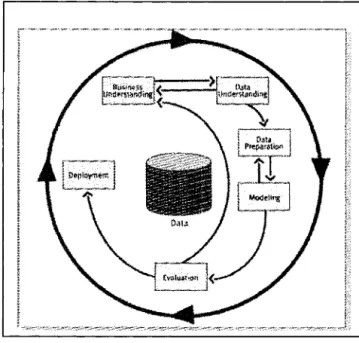
CRISP-DM [13] is a comprehensive data mining methodology and process mode!. It provides not only guidance to aIl data miners from beginners to experts but also a generic process model that can be specialized according to the needs of any particular industry or company. CRISP-DM organizes the data mining process into six phases: business understanding, data understanding, data preparation, modeling, evaluation, and deployment. These phases help organizations understand the data mining process and provide a road map to follow while planning and carrying out a data mining project. The whole data mining process is shown in Figure 2.2 [13]. The arrows indicate the most important and frequent dependencies between the phases, while the outer circle symbolizes the cyclical nature of data mining itself and illustrates that data mining
process is an iterative process. Figure 2.3 [13]outlines each phase of the data mining process.
Figure 2.2 The CRISP-DM process
il Business li 1 Data Id, . . . D.a.t.a.ÎiII.I
I!
l ..
M.o.d.e.l.in.9 • •I,
1~valuation
il Understandin!l li Understandln!l ln Preoaration 1. .i ! 1
; !
i Determine 1 Collect Initiai Data
i Business Objectives i Initial Data Collection
i Background i Report
!
~~!~~:!! ~tb:~~es IDeSCribe Data. Criteria j Data Description Report
! i
! Situation Assessment ! Explore Data
!/nventory of Resources ! Data Exploration Report ; ReqU/rements, ;
! Assumptlons, and ! Verify Data Quallty
! ~onstraints. .! Data Quality Report
i Rlsks and Contmgencles!
! Termin%gy !
i Costs and Benefits
, loetermlne
1 Data Mlnlng Goal
1 g:~: ~~~~~g ~~~:!ss
1 Criteria
i Produce Project Plan i Project Plan
! Initial Asessment of
i Tools and Techniques ~
. 1
IOata Set select Modellng 1 Evaluate Results
i Data Set Description Technique ! Assessment of Data
1
Select Data ~::Z~g ~:~~~~~ns! ~~~~~:se~~~~~.t.! Rationa/e for Inclusion / j Criteria
i Exclusion Generale Test Design 1 Approved Mode/s
IClean Data Test Design j Revlew Process
!Data Cleaning Report ~~~~':n~t~~ett;ngs 1 Revlew of Procass
!construct Data Mode/s 1 Determine Next Steps
i Derived Attributss Model Description ! Ust of Possible Actions
i
Generaled Records Assess Model j Decisionllntegrate Data Model Assessment IMerged Data R;:~~~:arameter
!Format Data i Refonnafted Data ,
III
Deployment1
i
Plan Oeployment 1 ! Depfoyment Plan !!
Plan Monitoring and ,i! Maintenance
1 Monitoring and !
1 Maintenance Plan 1 Produce Final Report 1
Final Report i
Final Presentation 1
Revlew Project
l
Experience Documentation
Phase one: Business understanding. The initial business understanding phase focuses on understanding the project objectives from a business perspective, converting the project objectives into a data mining problem definition, and then developing a preliminary plan to achieve the objectives. This phase involves several steps, including determining business objectives, assessing the situation, determining the data mining goals, and producing the project plan.
Phase two: Data understanding. This phase starts with an initial data collection. The analyst then proceeds to increase familiarity with the data, to identify data quality problems, to discover initial insights into the data, or to delete interesting subsets to form hypotheses about hidden information. This phase involves four steps: the collection of initial data, the description of data, the exploration of data, and the verification of data quality.
Phase three: Data preparation. This phase covers aIl the activities to construct the final data set or the data that will be fed into the modeling tools from the initial raw data. The five steps in this phase are the selection of data, the cleaning of data, the construction of data, the integration of data, and the formatting of data.
Phase four: Modeling. In this phase, various modeling techniques are selected and applied and their parameters are calibrated to optimal values. Typically, several techniques exist for one data mining problem type, and sorne techniques have specific requirements on the form of data. Therefore, stepping back to the data preparation phase may be necessary. The modeling phase includes the selection of the modeling technique, the generation of test design, the creation of models, and the assessment of models. Phase five: Evaluation. Before proceeding to final deployment of the model, it is important to thoroughly evaluate the model and review the model's construction to be certain it properly achieves the business objectives. Here it is critical to determine if sorne important business issue has not been sufficiently considered. The key steps for
the evaluation phase are the evaluation of the results, the process review, and the determination of next steps.
Phase six: Deployment. Model creation is generally not the end of the project. The data mining results and the knowledge gained must be organized and presented in a way such that the decision makers can use it, which often involves applying "live" models within an organization's decision-making processes.
Chapter 3 : A BRIEF STATE OF THE ART IN
ONTOLOGYRESEARCH
3.1 Fundarnentals of ontology
3.1.1 Sorne definitions
Ontology is a term that cornes from Philosophy, where it means a systematic explanation of being. In the last decade, this word has become relevant for the knowledge engineering community. Ontology is used to facilitate knowledge representation, sharing and reuse. Ontology can take different meanings in different domains. One of the first definitions was given by Neches and colleagues [14], who defined an ontology as follows:
An ontology defines the basic terms and relations comprising the vocabulary of a topic area as weil as the rules for combining terms and relations ta define extensions ta the vocabulary.
This definition de scribes how to build an ontology, identifies the basic terms and relations between terms, and also the rules to combine the terms.
The most widely quoted ontology definition is given by Gruber [15]: An ontology is an explicit specification of a conceptualization.
Ontologies are used as a specification mechanism to represent knowledge based on a conceptualization. A conceptualization of the domain starts with the identification of the abstract or concrete objects and the relationships between them. A domain can be conceptualized differently from different viewpoints. In general there is no unique conceptualization of a domain. An ontology expresses a viewpoint on the knowledge of a domain. A specification of a conceptualization provides the foundations for building
conceptual vocabularies for knowledge sharing. These shared vocabularies can become computable models ifthey are implemented in an ontology specification language. Based on Gruber's definition, many definitions of what an ontology is were proposed. Borst modified slightly Gruber's definition as follows [14]:
Ontologies are defined as a formaI specification of a shared conceptualization.
Gruber's and Borst's definitions have been merged and explained by Studer and colleagues as follows [14]
Ontology is a formaI, explicit specification of a shared conceptualization. Conceptualization refers to an abstract model of some phenomenon in the world by having identified the relevant concepts of that phenomenon. Explicit means that the type of concepts used, and the constraints on their use are explicitly defined. FormaI refers to the fact that the ontology should be machine-readable. Shared reflects the notion that an ontology captures consensual knowledge, that is, it is not private of some individual, but accepted by a group.
In 1995, Guarino and Giaretta [14] collected and defined an ontology as (1) a philosophical discipline, (2) an informaI conceptual system, (3) a formaI semantic account, (4) a specification of a conceptualization, (5) a representation of a conceptual system via a logical the ory, (6) the vocabulary used by logical theory, and (7) a (meta-level) specification of a logical the ory.
Although the different definitions of ontology discussed above provide different and complementary points of view, they share some common features: ontologies aim to capture and model knowledge in a generic way, and they may be reused and shared across software applications and by groups ofpeople.
3.1.2 Ontology components and types
Ontology components vary in different ontology languages, but they also share sorne common elements. According to the logic formalism of modeling techniques, ontology components can be classified into two groups. One is based on frames and first order logic. This group identifies five kinds of components: classes, relations, functions, formaI axioms and instances. Another group is based on Description Logic (DL). DL systems allow the representation of ontologies with three kinds of components: concepts, roi es, and individuals. Concepts represent classes of objects, roles describe binary relations between concepts that allow the description of properties of concepts, and individuals represent instances of classes. An example language in this group is OWL, which will be discussed further.
It is important to know that there are sorne connections and implications among the knowledge modeling components, the knowledge representation paradigms and the languages used to implement the ontologies under a given knowledge representation paradigm. That is, an ontology built with frames or description logics can be implemented in several frames or description logics languages.
There are various categories of ontologies. Ontologies can be classified with different criteria. The categorization can be made based on the subject of the conceptualization, the information that the ontology needs to express and the richness of their internaI structure, and the level of dependence on a particular task or point ofview.
Table 3.1 gives a detailed classification and description of ontologies based on the conceptualization subject.
Table 3.1 Types of ontology
Ontology type Description Examples
Knowledge Capture the representation - Frame Ontology (Gruber, Representation (KR) primitives used to formalize 1993)
ontologies knowledge under a given KR
- OKBC Ontology paradigm
- OWL KR Ontology General or common Used to represent common sense Mereology Ontology (Borst,
ontologies knowledge reusable across 1997)
domains.
Standard-Units Ontology Top-level or Upper-level Describe very general concepts IEEE Standard Upper ontologies and pro vide general notions under Ontology (SUO)
which aIl root terms in existing
Cyc's Upper Ontology ontologies should be linked.
Domain ontologies Are reusable in a given specific UNSPSC (the United Nations domain. Provide vocabularies Standard Products and
about concepts within a domain Services Codes) (for computer and the relationships, about the equipment)
activities taking place in that
NAICS (North American domain, and about the theories and
Industry Classification elementary princip les goveming
System) that domain.
Task ontologies Describe the vocabulary related to Scheduling Task Ontology a generic task or activity by
specializing the terms in the top-level ontologies.
Domain-task ontologies Are task ontologies reusable in a Plan-surgery ontology given domain, but not across
domains. Are application-independent.
Method ontologies Give definitions of the relevant Scheduling by means of task concepts and relations applied to decomposition
specify a reasoning process so as to achieve a particular task.
Application ontologies Contain aIl the definitions needed Application ontology for to model the knowledge required travel agencies
for a particular application
The reusability-usability trade-off problem applied to the ontology filed states that the more reusable an ontology is, the less usable it becomes, and vice versa. Figure 3.1 [14] presents the reusability-usability trade-off of ontologies. Upper-Ievel, general, and
do main ontologies capture knowledge in a problem-solving independent way, whereas method, task, and domain-task ontologies are concemed with problem solving knowledge.
Reusability
+ Usability
+
Figure 3.1 The reusability-usability trade-off
3.1.3 Ontology and semantic web
The Semantic Web [16, 17, 18] based on a vision of Tim Bemers-Lee, is the next generation of the WWW. "It is an extension of the CUITent web in which information is given well-defined meaning, better enabling computers and people to work in cooperation." [16]. The great success of the current WWW leads to a new challenge: a huge amount of data is so unstructured that they can only be understood by humans, but the amount of data is sa huge that they can only be processed efficiently by machines. The Semantic Web aims to build a WWW architecture that enhances the web contents with formaI semantics, thus making data, information and knowledge machine-processable.
Ontologies are the backbone of the Semantic Web. They enable machine understandable information representation and information exchange. This means ontologies can establish common vocabularies; define shared and common domain concepts, their relationships and their semantics. They can help both human and machines to communicate concisely by supporting the exchange of semantics of data, information and knowledge rather than only the syntax. "The success of the deployment of the Semantic Web will largely depend on whether useful ontologies will emerge, allowing shared agreements about vocabularies for knowledge representation." [19]. It is therefore important that any semantics of the web resources should be explicitly specified on ontologies. Only in this way can aIl the users reach a shared understanding by exploiting the contents of ontologies.
Berner-Lee believes that the application of ontologies on the web scale will greatly accelerate the development of the Semantic Web. In his vision, the Semantic Web will have severallayers in its structure, as presented in Figure 3.2 [17].
The first two layers provide a common syntax. Uniform resource identifiers (urus) provide a standard way to refer to entities, while Unicode is a standard for exchanging symbols. The XML layer formalizes the structure of the documents and XML Schema defines the grammars for valid XML documents. The RDF can be seen as the first layer where information becomes machine understandable. It is the foundation for processing metadata. RDF Schema defines a modeling language on top ofRDF.
Figure 3.2 The architecture of the Semantic Web
The next layer is the ontology vocabulary, which is the main research area of the Semantic Web. Technologies such as XML, RDF and RDFS represent the basis of the ontology language, while the ontology vocabulary layer adds the semantic annotations to the web documents and represents the formaI corn mon agreement about the meaning of the data. The Semantic Web needs ontologies with a significant degree of structures. Most ontologies consist of a set of concepts, a hierarchy on them, and relations between concepts. Ontologies are also integrated with the logic layer because most ontologies allow for logic axioms. By applying logical deduction, one can infer new knowledge from the information that is stated implicitly in ontologies.
Proof and trust are the remaining layers. They check the validity of the statements made in the Semantic Web.
As the research on the Semantic Web keeps on growing, ontological engineering has become an essential part of ontology studies. Ontologies are facing sorne real challenges [20]: they must be developed, managed and endorsed by committed practice
communities, and they must carefully define the data and allow interactions he Id in different formats.
3.2 OWL web ontology language
3.2.1 OWL language overview
The OWL Web Ontology Language [21, 22, 23] is a language for defining and instantiating web ontologies. It is the recommended standard language of W3C for describing the semantic web. An OWL ontology may include descriptions of classes, properties, instances and their relationships.
OWL is outstanding from other ontology languages in several aspects. OWL is designed for the Semantic Web, in which information is given explicit meaning, making it easier for machines to automatically process and integrate. OWL can formally de scribe the meaning of the terminology used in a Web application and the relationships between those terms; it has more facilities for expressing semantics than XML, RDF, and RDF-S. Thus OWL goes beyond these languages in its ability to represent machine interpretable content on the Web. OWL also supports more powerful reasoning techniques. There are a lot of available tools that can not only do sorne general works but also perform reasoning tasks about OWL ontologies.
The OWL language provides three increasingly expressive sub languages: OWL Lite, OWL DL and OWL Full. OWL Lite supports those users primarily needing a classification hierarchy and simple constraint features. OWL DL supports those users who want the maximum expressiveness without losing computational completeness and decidability of reasoning systems. OWL DL is so named due to its correspondence with description logic; it includes aIl OWL language constructs with restrictions. OWL Full is meant for users who want maximum expressiveness and the syntactic freedom of RDF with no computational guarantees. It is not actually a sub language since it contains all
the OWL language constructs and provides free, unconstrained use of RDF constructs. Table 3.2 gives a brief comparison ofthese three sub languages.
Table 3.2 Comparison of three OWL sub languages
OWLLite OWLDL OWLFull
Usage - Classification - Maximum expressiveness - Maximum expressiveness hierarchy, simple
- High reasoning ability - Free syntax
constraints
- Unwarranted reasoning
Representation - Fundamental part -AlI, but used under certain -AlI, used freely without
language - Subset of OWL DL constraints constraints
-Based on description logic -Extension ofRDF
Reasoning High efficiency High efficiency No warrantee
OWL is a powerful language with many language features. Figure 3.3 presents sorne main synopsis of its sub languages. This figure indicates that OWL Lite is the fundamental part of the OWL language, it also has more limitations on the use of the features than OWL DL or OWL Full. OWL DL and OWL Full expand OWL Lite in many important aspects.
The most important concepts In OWL ontology are classes, properties, instances of classes, and relationships between these instances. These concepts are discussed respectively in the next three sections.
OWLDLand OWLFull
, ' f '
OWLLite
RDF Schema features Property Characteristics • Class (Thing, Nothing) • ObjectProperty
• rdfs: subClassOf • DatatypeProperty • rdf: Property • inverseOf • rdfs: subPropertyOf • TransitiveProperty • rdfs: domain • SymmetricProperty • rdfs: range • FunctionalProperty • Individnal • InverseFunctionalProperty Equality and Inequality Property Restrictions • equivalentClass • allValuesFrom • equivalentProperty • someValuesFrom • sameAs
• differentFrom
• AllDifferent Restricted Cardinality
• minCardinality Class IntersectIon • maxCardinality • intersectionOf • cardinality .. . Class
Axioms
·oneOr ~ disjointWith..
~ . Boolean combinations of dass expressIons • unionOf '. complementOfFigure 3.3 language synopsis of OWL sub languages
3.2.2 OWL classes
OWL classes provide an abstraction mechanism for grouping resources with similar characteristics. They can be used to represent the different concepts and their hierarchies in ontology. Every OWL class is associated with a set of individuals, called the class extension or instances. OWL classes are described through class descriptions and class aXlOms.
1. Class description
A class description describes an OWL class either by a class name or by specifying the class extension of an unnamed anonymous class.
OWL distinguish six types of class descriptions: (1) A class identifier
(2) An exhaustive enumeration of individuals that together form the instances of a class
(3) A property restriction
(4) The intersection oftwo or more class description (5) The union oftwo or more class description (6) The complement of a class description.
Table 3.3 categorizes the language constructs with different class descriptions. Sorne language constructs are further described in detail right after the table.
Table 3.3 OWL class description type and its language constructs Description type Language constructs
Class identifier - owl: Class - rdfs: subClassOf
Enumeration - owl: oneOf
Property Value constraints - owl: allValuesFrom, restrictions
- owl: someValuesFrom - owl: hasValue
Cardinality - owl: maxCardinality constraints
- owl: minCardinality - owl: cardinality Intersection, union, complement - owl: intersectionOf
- owl: unionOf - owl: complementOf
rdfs:subClassOf: Class hierarchies may be created by making one or more statements that a class is a subclass of another class.
owl:aIlValueFrom: It requires that for every instance of the class that has instances of the specified property, the value of the property are aIl members of the class indicated by the owl:allValuesFrom clause.
SomeValuesFrom: It is stated on a property with respect to a class. A particular class may have a restriction on a property such that at least one value for that property is the member of the class indicated by owl:some ValuesFrom clause.
Owl:hasValue: It links a restriction class to a particular property value. A restriction containing a owl:hasValue constraint de scribes a class of aIl individuals for which the property concerned has at least one value semantically equal to the particular property value.
MinCardinality: If a minCardinality of 1 is stated on a property with respect to a class, then any instance of that class will be related to at least one individual by that property. This restriction is another way of saying that the property is required to have value for aIl instances of the class.
MaxCardinality: If a maxCardinality of 1 is stated on a property with respect to a class, then any instance of that class will be related to at most one individual by that property. A maxCardinality 1 restriction is sometimes called a functional property.
Cardinality: Cardinality is provided as a convenience when it is useful to state that a property on a class has both minCardinality 0 and maxCardinality 0 or both minCardinality 1 and maxCardinality 1.
2. Class axioms
Class descriptions form the building blocks for defining classes through class axioms. Class axioms typically contain additional components that state necessary and/or
sufficient characteristics of a class. OWL contains three language constructs for combining class description into class axioms:
(1) rdfs: subClassOf: allows one to say that the class extension of a class description is a subset of the class description of another class description (2) owl: equivalentClass: allows one to say that a c1ass description has exactly
the same class extension as another c1ass description
(3) owl: disjointWith: allows one to say that the c1ass extension of a c1ass description has no members in common with the class extension of another c1ass description
3.2.3
OWL propertiesA property is a binary relation. OWL distinguishes two categories of properties: object properties that define the relations between instances of two classes and datatype properties that define the relations between instances of classes and data types. In other words, object properties link individuals to individuals while datatype properties link individuals to data values.
A property axiom de fines the characteristics of a property. OWL supports the following constructs for property axioms:
(l) RDF Schema constructs: rdfs: subPropertyOf, rdfs:domain and rdfs:range (2) Relations to other properties: owl:equivalentProperty and owl:inverseOf (3) Global cardinality constraints: owl:FunctionalProperty and
owl:InverseFunctionalProperty
(4) Logical property characteristics: owl:SymmetricProperty and owl: TransitiveProperty
rdfs:domain: A do main of a property limits the individuals to which the property can be applied. If a property relates an individual to another individual, and the property has a class as one of its do main s, then the individual must belong to the class. For example, the property hasChild may be stated to have the domain of Mammal. From this a reasoner can deduce that if Frank hasChild Anna, then Frank must be a Mammal.
rdfs:range: The range of a property limits the individuals that the property may have as its value. If a property relates an individual to another individual, and the property has a class as its range, then the other individual must belong to the range class. For example, the property hasChild may be stated to have the range of Mammal. From this a reasoner can deduce that if Louise is related to Deborah by the hasChild property, (i.e., Deborah is the child of Louise), then Deborah is a Mammal.
owl:inverseOf: One property may be stated to be the inverse of another property. If the property Plis stated to be the inverse of the property P2, then if X is related to Y by the P2 property, then Y is related to X by the Pl property.
owl:FunctionaIProperty: Properties may be stated to have a unique value. If a property is a FunctionalProperty, then it has no more than one value for each individual (it may have no values for an individual).
owl:lnverseFunctionaIProperty: If a property is inverse functional then the inverse of the property is functional.
3.2.4 OWL individuals
Individuals are instances of classes, and properties may be used to relate one individual to another. Individuals are defined with individual axioms. There are two types of individual axioms:
(1) Axioms about class membership and property values of individuals (2) Axioms about individual identity.
3.3 Existing ontology evolution methodologies
Due to the increasing number of ontologies in use and the increasing requirements associated with ontology updating and maintenance, ontology evolution becomes an oncoming hot topic nowadays. Stojavonic et al. [24] defines ontology evolution as "Ontology evolution is the timely adaptation of an ontology to the arisen changes and the consistent propagation of these changes to dependent artifacts." Ontology evolution is a quiet new question in the ontology research field; its importance has just been realized recently due to the tremendous growing speed of ontology applications. Even though many institutes and research groups are interested in how to maintain and evolve ontologies, there are not many fruitful results available now. Many areas of ontology updating remain to be explored and much more research is needed.
This section reviews sorne existing ontology evolution methodologies. Two well-developed evolution strategies are discussed in detail and concluded with their advantages and drawbacks. Sorne other strategies are also presented.
3.3.1 An ontology evolution process
Ontology consistency is an essential issue to be considered in the ontology evolution domain. As ontologies grow in size, the complexity of change management increases the difficulty of keeping ontologies consistent. Focusing on this problem, Stojanovic et al. [24, 25, 26] propose an ontology evolution process that enables resolving the given ontology changes and ensures the consistency of the underlying ontology and ail its dependent applications.
The ontology evolution process contains six phases, occurring in a cyclic loop. Figure 3.4 [25] presents the entire evolution process. The process of ontology evolution starts with capturing changes either from explicit requirements or from the result of change discovery methods, which induce changes from existing data. In the change representation phase, a set of ontology changes is derived. Three levels of fine-grained
changes are specified in this set: elementary changes, composite changes and complex changes. The semantics of change is the most important phase to deal with the effects of the change on the ontology consistency. It distinguishes syntax and semantic inconsistency. The possible problems that might be caused in the ontology by the identified changes are determined and resolved in this phase. For example, if a concept is removed, we should decide what to do with its instances. It enables the resolution of ontology changes in a systematic manner by ensuring the consistency of the ontology. The role of the implementation phase is to implement the changes identified in the previous two phases, to present the changes to the ontology engineer for final verification and to keep a log of the implementation changes. The change propagation phase ensures that all changes will be propagated to the interested parties and the consistency of dependent artifacts after an ontology update has been performed. Finally, the change validation phase allows the ontology engineer to review the changes and possibly undo them if desired.
5. Propagation 4. Implementation 6. Validation 3 . Semantics of change Business requirements 2 . Representation