HAL Id: hal-01795904
https://hal-amu.archives-ouvertes.fr/hal-01795904
Submitted on 23 May 2018HAL is a multi-disciplinary open access archive for the deposit and dissemination of sci-entific research documents, whether they are pub-lished or not. The documents may come from teaching and research institutions in France or abroad, or from public or private research centers.
L’archive ouverte pluridisciplinaire HAL, est destinée au dépôt et à la diffusion de documents scientifiques de niveau recherche, publiés ou non, émanant des établissements d’enseignement et de recherche français ou étrangers, des laboratoires publics ou privés.
Discovering Light Verb Constructions and their
Translations from Parallel Corpora without Word
Alignment
Natalie Vargas, Carlos Ramisch, Helena Caseli
To cite this version:
Natalie Vargas, Carlos Ramisch, Helena Caseli. Discovering Light Verb Constructions and their Translations from Parallel Corpora without Word Alignment. Proceedings of the 13th Workshop on Multiword Expressions (MWE 2017), 2017, Valencia, Spain. pp.91 - 96. �hal-01795904�
Discovering Light Verb Constructions and their Translations
from Parallel Corpora without Word Alignment
Natalie Vargas1, Carlos Ramisch2 and Helena de M. Caseli1 1Federal University of S˜ao Carlos, S˜ao Carlos, Brazil
{helenacaseli, natalie.vargas}@dc.ufscar.br
2Aix Marseille Univ, CNRS, LIF, Marseille, France
[email protected] Abstract
We propose a method for joint unsu-pervised discovery of multiword expres-sions (MWEs) and their translations from parallel corpora. First, we apply inde-pendent monolingual MWE extraction in source and target languages simultane-ously. Then, we calculate translation prob-ability, association score and distributional similarity of co-occurring pairs. Finally, we rank all translations of a given MWE using a linear combination of these fea-tures. Preliminary experiments on light verb constructions show promising results.
1 Introduction
The automatic discovery of multiword expres-sions (MWEs) has been a topic of interest in the computational linguistics community for a while (Choueka, 1988; Church and Hanks, 1990). In the last 20 years, multilingual discovery of MWEs has gained some popularity thanks to the widespread use of statistical machine translation (MT), auto-matic word alignment tools and freely available parallel corpora (Zarrieß and Kuhn, 2009; Attia et al., 2010; Caseli et al., 2010). MWEs tend to be non compositional or show some kind of lexico-syntactic inflexibility, which is often reflected in translation asymmetries (Manning and Sch¨utze, 1999). Therefore, parallel corpora are rich re-sources to mine for MWEs. Techniques adapted from machine translation can help to exploit trans-lation information for the specific needs of MWE discovery.
Parallel corpora can be useful for MWE discov-ery in many ways. First, a second (target) lan-guage can be used to model features, which in turn help in the discovery of new MWEs in a single (source) language (Salehi and Cook, 2013; Caseli
et al., 2010; Tsvetkov and Wintner, 2014). Sec-ond, one can also use parallel data to discover the translations of known multiword lexical units (Morin and Daille, 2010). Finally, it is possible to perform both simultaneously, generating a bilin-gual lexicon of MWEs and their potential transla-tions from the parallel corpus, as proposed in this paper.
The goal of our paper is to propose a new method for unsupervised joint discovery of MWEs and their translations. It consists in discovering potential MWEs on source and target texts inde-pendently, and then trying to match them with-out using automatic word alignment. It is impor-tant to emphasize that we are not against the use of word alignment for this task, but we are in-terested in seeing how the automatic discovery of MWEs can be performed without relying on this information. Moreover, our experiments focus on light verb constructions such as to make a presen-tation and to take a walk, which generally contain non-adjacent tokens and thus would probably not be captured by standard word alignment methods. We study several features to rank automatically extracted candidates that could be translations of each other. We show preliminary results that indi-cate this approach is promising and point towards future improvements.
2 Related Work
Multilingual resources in general can be used for MWE discovery. Attia et al. (2010), for instance, do not rely on parallel texts but on short Wikipedia page titles, cross-linked across multiple languages. They consider that, if a page whose title contains a cross-lingual link to a page whose title is a single word (in any available language), then the original page title is probably a MWE. Similarly, transla-tion links in Wiktransla-tionary can be exploited, among 91
other features, for predicting the compositionality of MWEs (Salehi et al., 2014a).
Another possibility to model non-translatability without recurring to parallel corpora consists in building up artificial word-for-word MWE translations using bilingual single-word dictionar-ies. Afterwards, the existence of these automat-ically generated potential translations can be as-sessed in large monolingual corpora (Morin and Daille, 2010). This can be used as a feature, among other sources of information, in super-vised or semi-supersuper-vised monolingual MWE dis-covery (Tsvetkov and Wintner, 2011; Rondon et al., 2015). Bilingual dictionaries can also be used to predict the compositionality of MWEs by es-timating the string similarity (Salehi and Cook, 2013) or distributional similarity (Salehi et al., 2014b) between translations of an MWE and of the single words it contains.
Melamed (1997) describes one of the earliest attempts to extract MWEs from parallel corpora. The method is based on lexical alignment and mu-tual information. Statistical lexical alignment can provide straightforward MWE candidates, which can be further filtered using POS patterns and association scores. If two or more words in a source language are aligned to the same word on the target side, the source is likely an MWE (Caseli et al., 2010). Conversely, one can as-sume that some types of MWEs such as verb-noun combinations tend to be translated as MWEs with the same syntactic structure, using aligned dependency-parsed corpora for discovery (Zarrieß and Kuhn, 2009). Instead of focusing on 1-to-many alignments, Tsvetkov and Wintner (2010) propose a method which incrementally removes from parallel sentences word pairs that are surely not MWEs. Therefore, they use bilingual dictio-naries and alignment reliability scores. The re-maining units are considered candidate MWEs.
Bilingual lexicons containing MWEs are impor-tant resources for MT systems. It has been shown that the presence of MWEs can harm the quality of both statistical (Ramisch et al., 2013) and rule-based (Barreiro et al., 2014) MT systems. Simple techniques for taking MWEs into account such as binary features (Carpuat and Diab, 2010) and spe-cial token markers (Cap et al., 2015) can help im-proving translation quality. However, this may not suffice if the expressions are not correctly identi-fied with the help of bilingual MWE lexicons.
3 Bilingual MWE Lexicon Creation
Most existing methods exploit parallel corpora to discover MWEs in a single language. They use translation information, among other sources, to confirm the idiosyncratic behaviour of the MWE in the source language, but do not output possi-ble translations as a result of the discovery algo-rithm. In this section, we propose a method to cre-ate probabilistic bilingual MWE dictionaries using minimal supervision.
First, we extract MWE candidates from pre-processed (POS-tagged and lemmatized) source and target texts separately. In our experiments, the texts were pre-processed by TreeTagger (Schmid, 1994). We explicitly configured it not to segment sentences, since we need to preserve the alignment between source and target sentences in our input parallel corpus.
To allow the extraction of these monolingual MWE candidates, it is necessary to manually de-fine POS patterns in both languages. This step re-quires some knowledge about the languages and about the syntactic patterns of the MWEs that we want to extract. These patterns were defined using the mwetoolkit corpus query language and can-didate extraction tools (Ramisch, 2015).1 In this
first moment, we focused on MWEs translated into MWEs, but we believe that the technique could be adapted to MWEs translated into single words. For instance, one could extract verbal MWEs from the source corpus and try to match them with single-word verbs in the target language. In the-ory, any monolingual MWE discovery approach could be used to obtain candidates on each side of the parallel corpus independently.
The process described above outputs two sets of candidates. The first set S = {s1, s2, . . . , s|S|}
contains MWE candidates si extracted from
the source corpus. The second set T = {t1, t2, . . . , t|T |} contains MWE candidates tj
ex-tracted from the target corpus. Then, we try to map source MWEs si to their target correspondences
tj. To do so, we calculate the conditional
proba-bility of each potential translation (tj) in T given
a source (si):
P (tj|si) = c(sc(si, tj) i)
Here, c(si, tj) is the number of times a source
can-didate si was found in a sentence whose
transla-1http://mwetoolkit.sf.net/
tion contained tj and c(si) is simply the number
of occurrences of the candidate in the source cor-pus. Since candidates si and tj can be
discontin-uous, their numbers of occurrences are not neces-sarily n-gram counts, but must be obtained during monolingual candidate discovery as output by the mwetoolkit.
Another measure that we use to rank transla-tions is the t-score. This association score es-timates to what extent the co-occurrence of a group of words is outstanding compared to ran-dom chance co-occurrence. For each target can-didate tj = wt1jw2tj. . . wntj, formed by n words
wtj
k, we compute the expected number of
occur-rences by multiplying all individual word proba-bilities c(wktj)
N and then scaling this joint
probabil-ity by the total number of tokens in the target cor-pus N:
E(tj) = c(w tj
1) × c(wt2j) × . . . × c(wtnj)
Nn−1
The t-score, also obtained using the mwetoolkit, is the difference between observed and expected counts normalized by an estimate of the standard deviation of the distribution:
tscore(tj) = c(tjq) − E(tj)
c(tj)
Finally, we calculate the multilingual distribu-tional similarity between pairs si and tj. This
score is based on a pre-trained vector space model which uses sentence alignment information to en-sure that words that are translations of each other end up being close in the resulting semantic space. Since each unit si and tj is composed of m and
n words, respectively, we use the average cosine similarity between all possible m×n source-target pairs present in the semantic space:2
Sim(si, tj) = m × n1 X k = 1..m l = 1..n cos(wsi k, wtlj)
The bilingual semantic space is obtained using MultiVec (B´erard et al., 2016).3 Distributional
similarity between source and target candidate words is obtained using the bag of words mode.
2The normalization factor may be less than m × n when
some pairs wsi
k, wltj do not occur in the semantic space. 3https://github.com/eske/multivec
The three scores are normalized so that their values fall between 0 and 1. The final score F is simply a log-linear combination of these scores: F (tj|si) =
X
f∈{P,tscore,Sim}
− log norm(f(tj, si))
The lower its value, the more likely a given pair of source and target MWEs is.
4 Experimental Setup
For this work, the pre-processed texts (POS-tagged source and target texts) were obtained from the FAPESP parallel corpus containing 166,719 aligned sentences of Brazilian Portuguese texts translated into English (Aziz and Specia, 2011). The source corpus contains 4,191,942 tokens and the target corpus contains 4,499,064 tokens.4
Our experiments employ manually defined pat-terns for the monolingual step. These patpat-terns target light-verb constructions in Portuguese and some possible translations into English:
GET+ADJ The first pattern consists of the
Por-tuguese verb ficar (to become) immediately fol-lowed by an adjective. This frequent construc-tion often indicates a change of state (inchoative). On the target language (English), we build a simi-lar pattern consisting of verbs to be/become/get + an adjective, which we assume as being frequent translations for the source construction.
MAKE+N This pattern is formed by the verb
re-alizar (to make) followed by a noun. Between the verb and the noun there can be any number of adjectives, adverbs or determinants, which are ignored in the extracted candidate. For the trans-lation, we build an equivalent pattern with verbs to make/carry due to the high occurrence of carry out in the target corpus.
TAKE+N This pattern is formed by verbs
fazer/tomar/dar (to make/take/give) followed by a noun. We allow intervening elements as for MAKE+N. In English, we use verbs to
make/do/take. Notice that verb to give was con-sidered as an unlikely translation and disregarded.
5 Preliminary Results
As mentioned in Section 3, we used the mwe-toolkit to apply the patterns and calculate t-scores
4http://www.nilc.icmc.usp.br/nilc/
MWE source MWE target # T ts T Sim F 1 ficar doente get sick 2 0.51 0.53 1.44 2 ficar doente become ill 2 0.50 0.46 1.51 3 ficar doente be normal 1 0.52 0.41 1.84 4 ficar doente become sick 1 0.49 0.41 1.86 5 ficar doente be tolerant 1 0.50 0.33 1.95 1 ficar pronto be ready 46 0.72 0.67 0.41 2 ficar pronto become ready 5 0.50 0.60 1.58 3 ficar pronto get ready 1 0.58 0.69 2.15 4 ficar pronto be capable 2 0.74 0.25 2.18 5 ficar pronto be necessary 1 0.87 0.40 2.22 6 ficar pronto be fundamental 1 0.74 0.26 2.47
Table 1: Pattern GET+ADJ: ficar doente/pronto
(get sick/ready). Correct pairs are in bold.
and MultiVec for bilingual similarity. Unfortu-nately, quantitative evaluation was not yet per-formed. Nonetheless, in this section, we present some examples of discovered MWEs along with their translations. We point out positive and neg-ative results in this small sample that give us an idea of our approach’s potential.
Table 1 shows ranked examples extracted from the source and target corpus for the first pattern. The entries are ranked by final score, more likely translations appear on the top of the table and the correct ones are in bold. According to these exam-ples, the MWE pairs with lowest scores are cor-rectly aligned to a valid translation. In addition to the final score (F), target t-score (ts T) and similar-ity (Sim), the table also shows how many times the source MWE co-occurred with the target MWE (# T). This information allows us to calculate the conditional probability.
It is important to point out that our approach does not work for all cases, as some spurious pairs also occur. For example, in the first half of table 1, become sick is indeed a possible translation for ficar doente but it appears in a worst position com-pared to be normal, which is not a possible transla-tion. Beyond the conditional probability, distribu-tional similarity and t-score seem to help in some cases. For instance, get ready appears only once as a translation of ficar pronto, but still it gets a better score than be capable, a wrong translation with higher conditional probability. In general, we have observed that the patternGET+ADJ is quite
“easy” to translate as these constructions show a high degree of regularity.
Table 2 shows the results of the extraction for MAKE+N. The results for realizar teste show that the best ranked MWEs are the corrected transla-tions. The last row of this table shows a drawback
MWE source MWE target # T ts T Sim F 1 realizar teste carry test 20 0.50 0.73 0.71 2 realizar teste carry trial 3 0.29 0.63 1.85 3 realizar teste carry field 4 0.26 0.47 1.89 4 realizar teste make assessment 4 0.22 0.28 2.18 5 realizar teste make use 1 1.00 0.24 2.19 6 realizar teste make test 1 0.23 0.62 2.43 7 realizar teste make comparison 1 0.38 0.30 2.51 8 realizar teste carry test 1 0.17 0.65 2.54 9 realizar teste carry safety 1 0.17 0.53 2.64 10 realizar teste make prototype 1 0.23 0.37 2.64 11 realizar teste make search 1 0.15 0.24 3.02 1 realizarsubstituic¸˜ao carryidentification 1 0.19 0.45 1.67
Table 2: Pattern MAKE+N: realizar
teste/substituic¸˜ao (make test/replacement). Cor-rect pairs are in bold.
of our approach: that it is not possible to obtain re-liable probability scores when the pattern just ap-pears once.
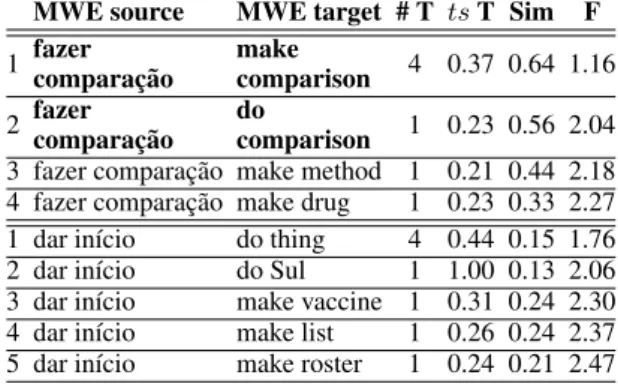
The results in table 3 show the extraction for the last pattern, TAKE+N. Despite the first half of
this table presenting good results for do compari-son and make comparicompari-son, the second half shows that some patterns do not work for the target side. The verb dar in Portuguese is a productive light verb, specially when combined with participles (dar uma caminhada/corrida/passeada lit. to give a walk/run/stroll). On the other hand, the transla-tions usually involve a single verb and not a light-verb construction. This indicates that further er-ror analysis is required, studying the three verbs in this pattern separately.
MWE source MWE target # T ts T Sim F 1 fazercomparac¸˜ao makecomparison 4 0.37 0.64 1.16 2 fazercomparac¸˜ao docomparison 1 0.23 0.56 2.04 3 fazer comparac¸˜ao make method 1 0.21 0.44 2.18 4 fazer comparac¸˜ao make drug 1 0.23 0.33 2.27 1 dar in´ıcio do thing 4 0.44 0.15 1.76 2 dar in´ıcio do Sul 1 1.00 0.13 2.06 3 dar in´ıcio make vaccine 1 0.31 0.24 2.30 4 dar in´ıcio make list 1 0.26 0.24 2.37 5 dar in´ıcio make roster 1 0.24 0.21 2.47
Table 3: Pattern TAKE+N: fazer comparac¸˜ao
(make comparison) and dar in´ıcio (lit. give be-ginning ’to start’). Correct pairs are in bold.
6 Conclusions and Future Work
This paper constitutes our first proposal towards automatic discovery of bilingual MWE lexicons. While preliminary results are promising, the obvi-94
ous next step is to design an evaluation protocol and apply it. Having this goal set, the idea is test-ing the approach first with other patterns and, then, making a robust evaluation.
We would also like to extrapolate this method to other language pairs and MWE categories, spe-cially those MWE translated as single words. In this case, we are still investigating solutions but one of them consists in using monolingual word embeddings and similarity measures in order to define if the translation should be an MWE or a single word.
We believe that the method itself can be im-proved in many ways. For instance, we would like to design a distributional similarity measure able to focus on valid alignments. We would also like to experiment with different weights for the scores (e.g. similarity seems more important than t-score). Optimizing, that is, learning these weights from small amounts of supervised data, sounds appealing as well.
At the moment, the extraction patterns represent a bottleneck and bias the obtained results towards more plausible translations. We would like to find a way to get rid of them, specially when it comes to the target side. Another point that must be un-derlined is the fact that, as we are not discarding the use of word alignment in the future, we would like to perform a systematic quantitative compari-son with related work and methods based on word alignment.
Acknowledgments
We would like to thank the S˜ao Paulo Re-search Foundation (FAPESP) for the grants #2013/50757-0 (AIM-WEST project) and #2016/13002-0 (MMeaning project). This work has been partly funded by projects PARSEME (Cost Action IC1207), PARSEME-FR (ANR-14-CERA-0001), and AIM-WEST (FAPERGS-INRIA 1706-2551/13-7).
References
Mohammed Attia, Antonio Toral, Lamia Tounsi, Pavel Pecina, and Josef van Genabith. 2010. Automatic extraction of Arabic multiword expressions. In ´Eric Laporte, Preslav Nakov, Carlos Ramisch, and Aline Villavicencio, editors, Proc. of the COLING Work-shop on MWEs: from Theory to Applications (MWE 2010), pages 18–26, Beijing, China, Aug. ACL. Wilker Aziz and Lucia Specia. 2011. Fully automatic
compilation of a Portuguese-English parallel corpus for statistical machine translation. In STIL 2011, Cuiab´a, MT, Obtober.
Anabela Barreiro, Johanna Monti, Brigitte Orliac, Su-sanne Preuß, Kutz Arrieta, Wang Ling, Fernando Batista, and Isabel Trancoso. 2014. Linguistic eval-uation of support verb constructions by openlogos and google translate. In Proc. of the Ninth LREC (LREC 2014), Reykjavik, Iceland, May. ELRA. Alexandre B´erard, Christophe Servan, Olivier Pietquin,
and Laurent Besacier. 2016. MultiVec: a Multilin-gual and Multilevel Representation Learning Toolkit for NLP. In The 10th edition of the Language Re-sources and Evaluation Conference (LREC 2016), May.
Fabienne Cap, Manju Nirmal, Marion Weller, and Sabine Schulte im Walde. 2015. How to account for idiomatic German support verb constructions in statistical machine translation. In Proc. of the 11th Workshop on MWEs (MWE 2015) (con, 2015), pages 19–28.
Marine Carpuat and Mona Diab. 2010. Task-based evaluation of multiword expressions: a pilot study in statistical machine translation. In Proc. of HLT: The 2010 Annual Conf. of the NAACL (NAACL 2003), pages 242–245, Los Angeles, California, Jun. ACL. Helena de Medeiros Caseli, Carlos Ramisch, Maria das Grac¸as Volpe Nunes, and Aline Villavicencio. 2010. Alignment-based extraction of multiword ex-pressions. In Lang. Res. & Eval. Special Issue on Multiword expression: hard going or plain sailing (jou, 2010), pages 59–77.
Yaacov Choueka. 1988. Looking for
nee-dles in a haystack or locating interesting col-locational expressions in large textual databases. In Christian Fluhr and Donald E. Walker, edi-tors, Proceedings of the 2nd International Confer-ence on Computer-Assisted Information Retrieval (Recherche d’Information et ses Applications - RIA 1988), pages 609–624, Cambridge, MA, USA, Mar. CID.
Kenneth Church and Patrick Hanks. 1990. Word asso-ciation norms mutual information, and lexicography. Comp. Ling., 16(1):22–29.
2015. Proc. of the 11th Workshop on MWEs (MWE 2015), Denver, Colorado, USA. ACL.
2010. Lang. Res. & Eval. Special Issue on Multiword expression: hard going or plain sailing, 44(1-2), Apr.
Christopher D. Manning and Hinrich Sch¨utze. 1999. Foundations of statistical natural language process-ing. MIT Press, Cambridge, USA. 620 p.
I. Dan Melamed. 1997. Automatic discovery of non-compositional compounds in parallel data. In Proc. of the 2nd EMNLP (EMNLP-2), pages 97– 108, Brown University, RI, USA, Aug. ACL.
Emmanuel Morin and B´eatrice Daille. 2010. Com-positionality and lexical alignment of multi-word terms. In Lang. Res. & Eval. Special Issue on Mul-tiword expression: hard going or plain sailing (jou, 2010), pages 79–95.
Carlos Ramisch, Laurent Besacier, and Oleksandr Kobzar. 2013. How hard is it to automatically trans-late phrasal verbs from English to French? In Rus-lan Mitkov, Johanna Monti, Gloria Corpas Pastor, and Violeta Seretan, editors, Proc. of the MT Summit 2013 MUMTTT workshop (MUMTTT 2013), pages 53–61, Nice, France, Sep.
Carlos Ramisch. 2015. Multiword Expressions Ac-quisition: A Generic and Open Framework, volume XIV of Theory and Applications of Natural Lan-guage Processing. Springer.
Alexandre Rondon, Helena de Medeiros Caseli, and Carlos Ramisch. 2015. Never-ending multiword ex-pressions learning. In Proc. of the 11th Workshop on MWEs (MWE 2015) (con, 2015), pages 45–53.
Bahar Salehi and Paul Cook. 2013. Predicting
the compositionality of multiword expressions us-ing translations in multiple languages. In Second Joint Conference on Lexical and Computational Se-mantics (*SEM), Volume 1: Proceedings of the Main Conference and the Shared Task: Semantic Textual Similarity, pages 266–275, Atlanta, Georgia, USA, June. Association for Computational Linguistics. Bahar Salehi, Paul Cook, and Timothy Baldwin.
2014a. Detecting non-compositional mwe com-ponents using wiktionary. In Proceedings of the 2014 Conference on Empirical Methods in Natu-ral Language Processing (EMNLP), pages 1792– 1797, Doha, Qatar, October. Association for Com-putational Linguistics.
Bahar Salehi, Paul Cook, and Timothy Baldwin. 2014b. Using distributional similarity of multi-way translations to predict multiword expression compo-sitionality. In Proceedings of the 14th Conference of the European Chapter of the Association for Com-putational Linguistics, pages 472–481, Gothenburg, Sweden, April. Association for Computational Lin-guistics.
Helmut Schmid. 1994. Probabilistic part-of-speech tagging using decision trees. In Proceedings of the International Conference on New Methods in Lan-guage Processing, pages 44–49.
Yulia Tsvetkov and Shuly Wintner. 2010. Extraction of multi-word expressions from small parallel cor-pora. In Chu-Ren Huang and Dan Jurafsky, edi-tors, Proc. of the 23rd COLING (COLING 2010) — Posters, pages 1256–1264, Beijing, China, Aug. The Coling 2010 Organizing Committee.
Yulia Tsvetkov and Shuly Wintner. 2011. Iden-tification of multi-word expressions by combining multiple linguistic information sources. In Regina
Barzilay and Mark Johnson, editors, Proc. of the 2011 EMNLP (EMNLP 2011), pages 836–845, Ed-inburgh, Scotland, UK, Jul. ACL.
Yulia Tsvetkov and Shuly Wintner. 2014. Identifica-tion of multiword expressions by combining mul-tiple linguistic information sources. Comp. Ling., 40(2):449–468.
Sina Zarrieß and Jonas Kuhn. 2009. Exploiting trans-lational correspondences for pattern-independent
MWE identification. In Dimitra Anastasiou,
Chikara Hashimoto, Preslav Nakov, and Su Nam Kim, editors, Proc. of the ACL Workshop on MWEs: Identification, Interpretation, Disambiguation, Ap-plications (MWE 2009), pages 23–30, Suntec, Sin-gapore, Aug. ACL.