RESEARCH OUTPUTS / RÉSULTATS DE RECHERCHE
Author(s) - Auteur(s) :
Publication date - Date de publication :
Permanent link - Permalien :
Rights / License - Licence de droit d’auteur :
Bibliothèque Universitaire Moretus Plantin
Institutional Repository - Research Portal
Dépôt Institutionnel - Portail de la Recherche
researchportal.unamur.be
University of Namur
Theoretical study of the vibrational edge modes in graphene nanoribbons
Vandescuren, Matthieu; Hermet, Patrick; Meunier, Vincent; Lambin, Philippe; Henrard, Luc
Published in:Physical Review B
Publication date: 2008
Document Version
Early version, also known as pre-print
Link to publication
Citation for pulished version (HARVARD):
Vandescuren, M, Hermet, P, Meunier, V, Lambin, P & Henrard, L 2008, 'Theoretical study of the vibrational edge modes in graphene nanoribbons', Physical Review B, vol. 78, pp. 233407-1-4.
General rights
Copyright and moral rights for the publications made accessible in the public portal are retained by the authors and/or other copyright owners and it is a condition of accessing publications that users recognise and abide by the legal requirements associated with these rights. • Users may download and print one copy of any publication from the public portal for the purpose of private study or research. • You may not further distribute the material or use it for any profit-making activity or commercial gain
• You may freely distribute the URL identifying the publication in the public portal ? Take down policy
If you believe that this document breaches copyright please contact us providing details, and we will remove access to the work immediately and investigate your claim.
Theoretical study of the vibrational edge modes in graphene nanoribbons
M. Vandescuren,1,
*
P. Hermet,1V. Meunier,2L. Henrard,1and Ph. Lambin11Laboratoire de Physique du Solide, Facultés Universitaires Notre-Dame de la Paix, 5000 Namur, Belgium 2Computer Science and Mathematics Division, Oak Ridge National Laboratory, Oak Ridge, Tennessee 37831, USA
共Received 25 June 2008; revised manuscript received 2 September 2008; published 4 November 2008兲 We investigate the phonon normal modes in hydrogen-terminated graphene nanoribbons共GNRs兲 using the second-generation reactive empirical bond order共REBOII兲 potential and density-functional theory calculations. We show that specific modes, absent in pristine graphene and localized at the GNR edges, are intrinsic signatures of the vibrational density of states of the GNRs. Three particular modes are described in details: a transverse phonon mode related to armchair GNRs, a hydrogen out-of-plane mode present in both armchair and zigzag GNRs, and the Raman radial-breathing-like mode. The good agreement between the frequencies of selected edge modes obtained using REBOII and first-principles methods shows the reliability of this empirical potential for the calculation and the assignment of phonon modes in carbon nanostructures where carbon atoms present a sp2hybridization.
DOI:10.1103/PhysRevB.78.195401 PACS number共s兲: 61.46.⫺w, 63.20.Pw
I. INTRODUCTION
Graphite nanocrystallites are the most recently discovered carbon-based nanomaterials.1These nanoflakes are a few at-oms thick, are stable under ambient conditions, and have a lot of promises as nanoscale transistors.2 Their remarkable properties make their study one of the hottest subjects in present-day nanoscience.3
Graphene nanoribbons 共GNRs兲 are similar to carbon nanotubes as they are prototypical one-dimensional 共1D兲 nanostructures. It has been recently shown that a GNR can be peeled off from the topmost layer of highly oriented py-rolytic graphite by scanning tunneling microscope共STM兲 li-thography operated in air, allowing the design of arbitrary geometry.4Because of the presence of edges on both sides, GNRs possess a set of particular properties, depending on width and helicity. Many investigations so far have focused their attention on the electronic and magnetic properties of GNRs, revealing spectacular effects arising from the confine-ment of electron and hole gases.5–8One of the most remark-able findings is that electrons and holes can be specularly reflected, such as billiard particles, at the edges of a graphene ribbon.9
Electronic states localized at zigzag edges of a graphene sheet10by increasing the local electronic density of states at the Fermi level can induce superconductivity confined along the edges.11An important issue for modeling this behavior is related to the availability of an appropriate vibrational model for the description of the phonon-mediated Cooper pairing mechanism. Like electrons, phonons can be localized at the edges of a ribbon, which could enhance the electron-phonon interactions and further contribute to edge superconductivity. Despite this specific interest, only a few works have been devoted to the study of the vibrational structure of GNRs. A transverse-optical edge mode typical to armchair GNRs 共na-noribbon with armchair edges兲 has been predicted theoretically12 and detected experimentally a few years later.13 This type of mode has further been investigated in GNRs with various widths14 using the first-generation reac-tive empirical bond order potential 共REBO兲.15 In a recent
work on Raman-active mode in GNRs, Zhou et al.16studied vibrational properties within the density-function theory 共DFT兲 framework, providing ab initio prediction of special GNRs modes. At last, a systematic study of phonon disper-sions of GNRs was carried out by Yamada et al.17by using a transferable force field model and the zone folding method.
The main objective of this work is to study and charac-terize the intrinsic phonon modes of GNRs 关i.e., modes which are not present in two-dimensional 共2D兲 graphene兴. For this purpose, we used the second-generation reactive em-pirical bond order共REBOII兲 potential18to calculate the pho-non modes of different GNRs. By construction, this force field reproduces with a good accuracy the static and dynami-cal properties of pure graphene, pure diamond, and usual forms of hydrocarbon molecules.19 However, there is not much information available about the reliability of REBOII potential for dynamical properties of carboneous materials. Thus, first-principles calculations of phonon mode frequen-cies of different GNRs have been also performed to state the reliability of the potential by direct comparison between the REBOII frequencies and the DFT ones. This potential con-stitutes an interesting alternative to first-principles methods to compute, at low computational efforts, the phonons modes in GNRs. Studying phonons within REBOII force field is therefore a step forward for its validation as a reliable poten-tial in hydrocarbon structure with sp2conformation.
II. METHODOLOGY AND COMPUTATIONAL DETAILS
The local vibrational density of state 共lVDOS兲 on an atomic site i is given for a frequency by
i共兲 = 2
兺
兺
␣ 兩ui,共␣兲兩2␦共2−
2兲, 共1兲
where the sums run over all the modes and the space di-rections ␣. and ui,共␣兲 are the frequency and the 共i,␣兲
component of theth phonon eigenvector, respectively. They are calculated by means of the lattice-dynamics equations
兺
j,Dij共␣,兲uj,共兲 =2ui,共␣兲, 共2兲
wheredenote the Cartesian directions and D˜ is the dynami-cal matrix defined by
Dij共␣,兲 =
ij共␣,兲
冑
MiMj. 共3兲
M are the masses of atoms andijis the second-rank
force-constant tensor containing the complete information about the interactions between the ith and the jth atoms. The total VDOS is therefore calculated from the lVDOS by summing i共兲 in Eq. 共1兲 over all the atomic sites of the structure.
From Eq.共3兲, it is obvious that the force-constant tensors are the central quantities to be determined in order to compute the lVDOS. These tensors are calculated using both first-principles approach and the empirical REBOII potential for comparison purposes.
A. First-principles calculations
DFT calculations were performed with the SIESTA package20 on three different armchair and zigzag GNR widths 关N=4, 10 and 15, where N labels the number of at-oms across the GNR width共see Fig.2 in the case of N = 10 armchair GNR, for instance兲兴. These GNRs have been cho-sen to provide a reliable comparison basis with REBOII re-sults. Exchange-correlation effects were handled within the local-density approximation 共LDA兲 as proposed by Perdew and Zunger.21Core electrons are replaced by nonlocal norm-conserving pseudopotentials.22 The valence electrons were described by localized pseudoatomic orbitals with a double- singly polarized共DZP兲 basis set.23The cut-off radii for the s and p orbitals were, respectively, 5.12 and 6.25 a.u. for the carbon atoms and 6.05 a.u. for the hydrogen atoms. The first Brillouin zone was sampled according to the Monkhorst-Pack scheme24 by using a 30⫻1⫻1 k-points grid for the insulator GNRs, whereas a 60⫻1⫻1 k-points grid was used for the metallic ones. The atomic positions in the unit cell of each GNRs were relaxed at fixed lattice parameters using a conjugate gradient until the maximum residual force on the atoms was smaller than 1⫻10−3 eV/Å. Real-space integra-tion was performed on a regular grid corresponding to a plane-wave cutoff around 300 Ry, for which the structural relaxations and phonons are fully converged. Dynamical ma-trix was calculated at the ⌫-point in the harmonic approxi-mation via the knowledge of the Hellmann-Feynman 共HF兲 forces by using the direct method25and an atomic displace-ment of 0.03 Å as detailed in Ref.26. Positive and negative displacements were used to minimize numerical errors in the HF calculations related to anharmonic effects. Finally, zone-center phonon modes were calculated by a direct diagonal-ization of the dynamical matrix.27
B. Force-field calculations
The empirical REBOII potential is the second generation of pairwise-like potential for 共hydro兲carbon materials based on the classical model initially proposed by Tersoff for
silicon28and further adapted to carbon materials.15,29Briefly stated, the total energy for solid carbon materials and hydro-carbon molecules is expressed by
E =
兺
i
兺
j⬎ifc共rij兲关VR共rij兲 − bijVA共rij兲兴, 共4兲
where fc共r兲 is a cut-off-distance function. VR and VA are,
respectively, the repulsive and attractive parts of the poten-tial. The coefficient bij depends on the angles between the
bond ij and all the bonds issued from the sites i and j. The parameters of the potential depend on the local coordination 共3 for graphite and 4 for diamond兲. Numerous calculations have already demonstrated the validity of this potential when addressing structural properties of graphitic systems, includ-ing fullerenes and nanotubes, and nanodiamonds.19 The ad-vantage of this model over ab initio approaches is its ease of implementation, its low computational cost, and therefore its ability to tackle large and complex structures. Also, the first version of the REBO potential15 has already been used for both phonon studies and thermal properties of carbon nano-structures, yielding good agreement with first-principles results.14 Even if much less is known on the reliability of REBOII for dynamical properties of carboneous materials, we can rely on the significant improvements of REBO in terms of bond energy, bond-lengths, and force-constants calculations18 to yield an accurate prediction of phonon modes in hydrocarbon materials.
This empirical force field has been used to optimize the atomic positions of different GNRs and to compute their in-teratomic force-constant tensors. A conjugate gradient algo-rithm was used to perform the optimization of the atomic positions until the energy of the system reached its minimum with a precision of 1⫻10−5 eV. The optimized C-H bonds
were slightly longer than the 1.09 Å, and the C-C bond lengths were about 1.42 Å, except for the edges carbons where the bond lengths were closer to 1.41 Å. These opti-mized bond lengths are in good agreement with the ones reported for hydrocarbon structures in sp2configuration. The
interatomic force-constant tensors were calculated for each C-C or C-H interaction within the harmonic approximation. We used the finite difference method on the total energy with an atomic displacement of 1⫻10−3 Å. The force constants
are calculated up to the fourth neighbors which is the lowest-order interaction required to have a reliable representation of the dynamics of hydrocarbon structures.30
The usual method to calculate the lVDOS 共and therefore the VDOS兲 spectrum consists of injecting in Eq. 共1兲 the val-ues of and ui,共␣兲 obtained by direct diagonalization of
the dynamical matrix of the system关Eq. 共2兲兴. By contrast, the spectral moments method based on a recursive technique similar to the ones initially developed by Lanczos31to deter-mine the eigenvalues of large matrices allows the lVDOS computation of very large harmonic systems to be directly computed without any diagonalization of the dynamical ma-trix. The mode frequencies in the lVDOS spectra are then directly obtained from the position of the peaks in the calcu-lated lVDOS spectra.32,33 The mathematical details of the spectral moments method can be found in Refs.34–36.
VANDESCUREN et al. PHYSICAL REVIEW B 78, 195401共2008兲
We have used the spectral moments method on a 50⫻1 ⫻1 supercell to compute the VDOS spectra of the different GNRs displayed in this paper. A direct diagonalization of the dynamical matrix calculated using the REBOII force field was also used to compare very accurately the REBOII pho-non frequencies of the different GNRs calculated with the DFT ones at the ⌫-point.
III. RESULTS AND DISCUSSION
Two main complementary methods exist to assign the edge-localized phonon modes involved in a GNR. The first method is the most standard and has already been used by the authors of Refs.12and14. It consists in the comparison of the phonon band structure of GNRs and that of the graphene sheet. The phonon branches which are not involved in the 1D projected dispersion relation of the 2D graphene sheet are therefore assigned to GNRs. The second method compares the VDOS spectra of GNRs and that of the graphene sheet. Because edge-localized phonon modes are absent in graphene, characteristic modes of GNRs are ex-pected to be detected in the differences between the VDOS spectra of GNRs and perfect graphene. To the best of our knowledge, this method has never been used for the investi-gation of the edge-localized phonon modes. Its main limita-tion is that peaks only appear in the VDOS spectra when their dispersion curves are flat in the first Brillouin zone. These two methods are therefore complementary because if a specific mode turns out to be located in the continuum region of the graphene band structure, it will remain undetectable within the first method. In this work, we have used the VDOS method to investigate the edge-localized phonon modes involved in a GNR to complete the information ob-tained by the authors of Refs. 12 and 14 using the band-structure method.
A. Edge-localized phonon modes in GNRs
1. Transverse phonon modes in armchair GNRs
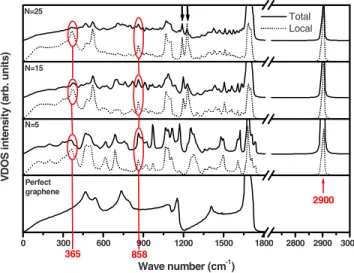
Figure1compares the VDOS calculated with the empiri-cal REBOII potential between a graphene sheet and three armchair GNRs of different widths共N=5, 15, and 25兲.37We observe two phonon modes located around 365 and 858 cm−1 present in all GNRs and absent in the VDOS of
graphene. To ensure that real edge phonon modes are se-lected, much attention has been paid to avoid Van Hove sin-gularities. These singular peaks are often tall in small GNR widths, whereas they nearly disappeared in larger ones. In addition, edge-localized phonon modes have peaks of ap-proximately constant height in the lVDOS of atoms localized at the edges in all GNRs. Keeping that in mind helps us in the detection of edge-localized phonon modes and convinces us that the 365 and 858 cm−1 modes are characteristic to
armchair GNRs. The real-space representation of the phonon eigendisplacement vectors of these two modes allows us to assign the mode calculated at 365 cm−1 to an out-of-plane edge-localized motion of the carbon atoms共see Fig.2兲. The mode localized at 858 cm−1has been assigned to an
out-of-plane edge-localized motion of the hydrogens 共see Fig. 3兲.
This latter mode will be further discussed in this paper. In literature, Yamamoto et al.14 calculated the phonon band structures of graphene and armchair GNRs without hy-drogens at the edges using the empirical REBO potential. They observed only one edge mode centered at 430 cm−1 共similar to ours at 365 cm−1兲 which is upshifted due to the
lower effective mass resulting from the absence of hydrogen at the edges. A rigorous analysis based on the diagonalization of the dynamical matrix38 for the three armchair GNRs shows that the peak located around 365 cm−1 is actually a doublet with its two components centered at 356 共A兲 and 362 cm−1 共S兲 for N=4. Here, S and A, respectively, denote
the symmetric and antisymmetric modes involved in the dou-blet. We observe that the splitting between these two fre-quencies decreases 关358 共A兲 and 367 cm−1 共S兲兴 when the armchair GNR width increases 共N=10兲 and the symmetric 0 300 600 900 1200 1500 1800 2800 2900 3000 2900 Wave number (cm-1) VD OS in te ns ity (a rb. uni ts ) Perfect graphene N=5 N=15 N=25 Total Local 858 365
FIG. 1. 共Color online兲 Calculated 共using the empirical REBOII potential兲 vibrational densities of states of a perfect graphene sheet and three different armchair GNRs of widths N = 5, 15, and 25, respectively. The solid curves are the total VDOS. The dotted curves are lVDOS calculated on a carbon site close to a hydrogen of the edge. The C-H stretching mode is located at 2900 cm−1and two
edge-localized phonon modes characteristic to the armchair GNRs are centered around 365 and 858 cm−1. The arrows mark the
posi-tion of two shear modes of the ribbon.
1 2
3 4
FIG. 2. 共Color online兲 Four snapshots displaying the 365 cm−1
edge-localized phonon mode at the ⌫-point of a N=10 armchair GNR saturated with hydrogens. The sequence order is indicated on the upper left corner of each picture. N = 10 represents the number of carbon atoms across the width.
and antisymmetric modes are degenerated at 368 cm−1 for
N = 15. The same behavior is reproduced by our DFT calcu-lations with phonon modes centered at 370 共A兲 and 405 cm−1共S兲 for N=4, 376 cm−1共A and S兲 for N=10, and
376 cm−1共A and S兲 for N=15. Although the frequencies of
the tranverse phonon mode calculated with the REBOII po-tential in armchair GNRs are always underestimated with respect to the DFT ones, they are in good agreement and the largest discrepancy between the two models is less than 6%.
2. Hydrogen edge-localized phonon modes in zigzag GNRs
Figure4compares the VDOS calculated with the empiri-cal REBOII potential between a graphene sheet and three different zigzag GNRs widths 共N=5, 10, and 20兲. By con-trast to the armchair GNRs, the transverse phonon edge-localized mode has no equivalent in zigzag GNRs in the same frequency range. At higher frequencies, however, we observe a characteristic zigzag GNR mode centered around
610 cm−1. This phonon mode共displayed in Fig.5兲 has been
assigned to an out-of-plane edge-localized mode of the hy-drogens. Additional calculations performed on hydrogen-free edges indicate that this mode does not appear in the VDOS spectra.
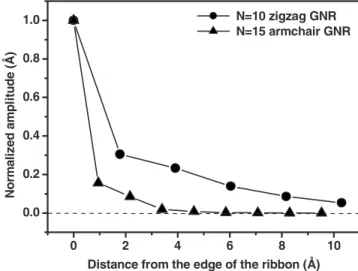
Figure6 shows the oscillation amplitude of the hydrogen edge phonon mode for N = 10 zigzag GNR 共curves with circles兲 with respect to the distance from the edge of the ribbon. The oscillation amplitudes of the carbons are normal-ized by the amplitude of the hydrogen of the edge. Same curves are obtained for GNRs with larger widths, which in-dicate that the central part of the ribbons does not participate to the mode for width exceeding about 30 Å. Thus, for an infinite GNR共the perfect graphene sheet兲, the carbon atoms no longer oscillate. This mode located at 610 cm−1is
there-fore intrinsic to zigzag GNRs.
In addition, this hydrogen edge mode splits into two peaks centered at 585 and 635 cm−1 in the total VDOS displayed in Fig. 4 for N = 5. These two peaks are, respectively,
as-1 2
3 4
FIG. 3. 共Color online兲 Four snapshots displaying the 858 cm−1
edge-localized phonon mode at the ⌫-point of a N=10 armchair GNR saturated with hydrogens. The sequence order is indicated on the upper left corner of each picture.
0 300 600 900 1200 1500 1800 2800 2900 3000 2900 Wave number (cm-1) Perfect graphene N=5 N=10 N=20 Total Local 610 V D OS in te ns it y (a rb. u n it s)
FIG. 4. 共Color online兲 Comparison between the calculated VDOS of a perfect graphene sheet and three different zigzag GNR widths 共N=5, 10, and 20兲 using the empirical REBOII potential. The solid curves are the total VDOS and the dotted curves are lVDOS on a carbon near to a hydrogen of the edge. The C-H stretching mode is located at 2900 cm−1 and the only
edge-localized phonon mode characteristic to the zigzag GNRs lies around 610 cm−1. The arrow marks the position of an in-plane
hydrogen edge phonon.
1 2
3 4
FIG. 5. 共Color online兲 Four snapshots displaying the 610 cm−1
edge-localized phonon mode at the⌫-point of a N=10 zigzag GNR saturated with hydrogens. The sequence order is indicated on the upper left corner of each picture.
0 2 4 6 8 10 0.0 0.2 0.4 0.6 0.8 1.0 N=10 zigzag GNR N=15 armchair GNR Nor m al iz ed am pl it u de (Å )
Distance from the edge of the ribbon (Å) FIG. 6. Normalized amplitudes of atomic oscillations of the two hydrogen edge modes. The N = 10 zigzag GNR mode centered at 610 cm−1is represented with circles and the N = 15 armchair GNR mode centered at 858 cm−1with triangles. Both ribbons are
ap-proximately 20 Å wide. The x axis represents the distance from the edge of the ribbon共i.e., the amplitude at the middle of the ribbon is represented on the last point of the curve兲. Only the largest ampli-tudes of the carbon atoms are represented. The lines are guides for the reader’s eyes.
VANDESCUREN et al. PHYSICAL REVIEW B 78, 195401共2008兲
signed to antisymmetric共both edges oscillate with opposite phases兲 and symmetric 共both edges oscillate in phase兲 modes. A systematic study has been carried out for different zigzag GNR widths varying from 4 to 15 to characterize these two particular modes. The results are reported in Fig.7 and can be separated into two groups: those obtained for odd N and those obtained for even N. We observe that the fre-quency of the symmetric 共antisymmetric兲 mode increases 共decreases兲 when N increases while being even 共odd兲. For a given GNR, the frequency splitting between symmetric and antisymmetric modes is due to vibrational interferences be-tween both edges. Indeed, for a fixed width and depending on the selected mode 共symmetric or antisymmetric兲, the in-terferences are either constructive or destructive making the frequency slightly higher or lower than the asymptotic value. In Fig.6, the nonzero amplitude in the middle of the ribbon indicates that some interactions between both edges are still active, leading to an estimate of the localization length of the edge phonon共around 10 Å兲. Now, supposing that the width of the GNR becomes larger and larger, no more interferences would take place at the center of the ribbon and the frequen-cies of the symmetric and antisymmetric modes therefore converge to the limiting value共see Fig.7兲. Thus, the modes converge either to 613 cm−1for N odd or to 611 cm−1for N
even when N goes to infinity. The difference 共2 cm−1兲
be-tween these asymptotic values is not significant.
The frequency of the symmetric and antisymmetric hy-drogen edge phonon has also been calculated by using DFT
for three different zigzag GNRs widths 共N=4, 10, and 15兲 and are reported in TableI共the first three lines兲 together with the REBOII ones. The frequencies calculated by both models are found to be in close agreement; the largest discrepancy being less than 4%. Thus, the REBOII potential is reliable for the prediction of this type of edge mode in zigzag GNRs.
3. Hydrogen edge-localized phonon modes in armchair GNRs
The same systematic study has been performed for the armchair GNRs with edges saturated with hydrogens. As pre-viously mentioned, out-of-plane edge-localized phonons of hydrogen atoms have been observed around 858 cm−1in the
VDOS spectra of Fig.1for N = 5, 15, and 25 armchair GNRs. Through the direct diagonalization of the dynamical matrix, we observed that this mode is a doublet共symmetric and an-tisymmetric兲 for all armchair GNRs with widths varying from N = 5 to 29. As they are degenerated, except for N = 4 共860 and 863 cm−1兲 and N=3 共842 and 863 cm−1兲, the
hy-drogen edge phonon modes are more strongly localized at the edges of the armchair GNRs than those for the zigzag ones. This observation is highlighted in Fig. 6 showing the normalized oscillation amplitude of the hydrogen edge pho-non for N = 15 as a function of the distance from the edge of the GNR. Since this curve is common to all armchair width, it is obvious that the oscillation amplitudes decrease more rapidly for armchair than for zigzag GNRs. Therefore no interference between both edges can take place at the center of the ribbon except for very small armchair GNR widths 共N=4 and 3兲.
The frequencies of the symmetric and antisymmetric hy-drogen edge phonons have also been calculated by using DFT for three different armchair GNRs with widths N = 4, 10, and 15. They are reported in TableIwith those calculated by the REBOII potential. Although the frequency relative difference calculated by both models is greater for the arm-chair GNRs than for the zigzag ones, their agreement is ac-curate enough for a reliable prediction of this type of edge mode in armchair GNRs; the largest discrepancy being less than 10%.
4. Other ribbon modes calculated with the REBOII potential
In zigzag GNRs, the signature of an in-plane hydrogen mode localized at the edges and centered around 1275 cm−1
0 2 4 6 8 10 12 14 16 N of the zigzag GNRs 0 2 4 6 8 10 12 14 16 18 20 560 570 580 590 600 610 620 630 640 650 660 Symmetric modes Symmetric modes Antisymmetric modes Antisymmetric modes 635 cm-1 586 cm-1 Wa v e nu m b e r (c m -1) N of the zigzag GNRs
FIG. 7. Calculated frequencies using REBOII potential of the symmetric共S兲 and antisymmetric 共A兲 modes of zigzag GNRs for N even共left-hand graph兲 and N odd 共right-hand graph兲. As the width of the ribbon decreases, the splitting between S and A increases. The modes converge to 613 cm−1for odd N and to 611 cm−1for even N as N becomes infinitely large.
TABLE I. Comparison between the⌫-point frequencies 共in cm−1兲 of the hydrogen edge mode calculated with the REBOII potential and
DFT for zigzag共Nzz兲 and armchair 共Nar兲 GNRs of different widths. The errors 共in percent兲 are shown in the right-most column.
Structures
Symmetric modes Antisymmetric modes
REBOII DFT Errors REBOII DFT Errors
Nzz= 4 560 544 2.9 650 662 1.8 Nzz= 10 609 589 3.4 613 602 1.8 Nzz= 15 613 598 2.6 613 596 2.9 Nar= 4 864 797 8.4 860 786 9.4 Nar= 10 858 793 8.2 858 792 8.3 Nar= 15 858 797 7.7 858 795 7.9
can be observed in the VDOS of Fig.4共see the arrow兲. The hydrogen atoms oscillate at constant distance of the edges carbons共arc of a circle兲.
In addition to the edge-localized modes discussed here above, other peaks appear in the VDOS of the ribbons and not in graphene. For instance, the peaks around 1190 and 1230 cm−1 in armchair GNRs 共arrows in Fig. 1兲 are shear
modes of the ribbon with polarization parallel to the free edges. Their amplitudes are important everywhere across the width.
B. Radial-breathing-like mode in GNRs
Among the characteristic phonon modes in the GNRs, the calculation of the radial-breathing-like mode共RBLM兲 is un-doubtedly the best way to ascertain the validity of the RE-BOII potential with respect to first-principles methods. In-deed,共i兲 this mode exists in all GNRs and 共ii兲 the frequency of this mode decreases when the GNR width increases in linear proportion to the inverse square root of the width.16By contrast with the previous ribbon modes, the RBLM does not give rise to a peak in the VDOS due to its important disper-sion. The diagonalization of the dynamical matrix is there-fore mandatory for studying this phonon mode. The RBLM is an in-plane mode where the atoms of the structure oscillate perpendicularly to the edges. The amplitudes increase as we consider atoms closer and closer to the edge of the ribbon. The atoms at the center do not move at all.
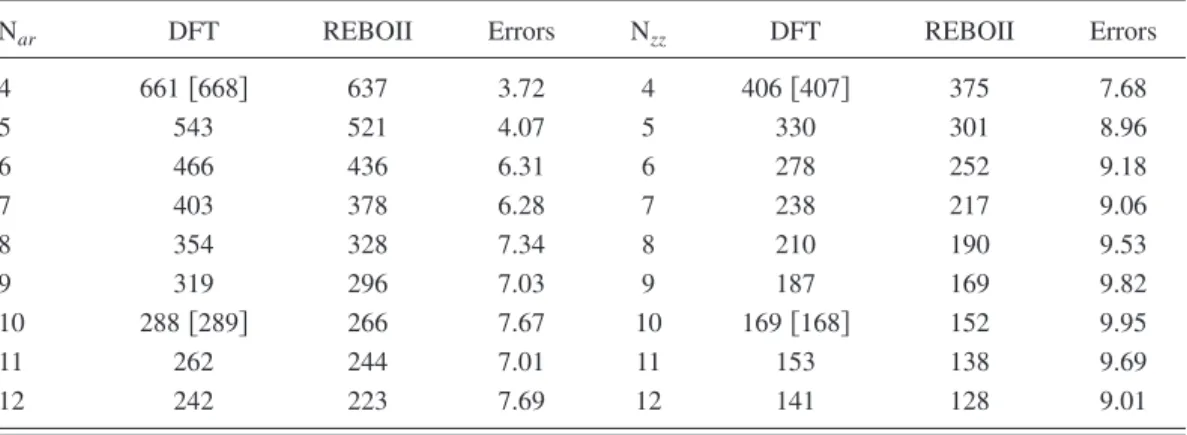
Table IIreports the RBLM frequencies at the⌫-point of different GNRs calculated by using DFT and the REBOII potential. In a recent article, Zhou et al.16 calculated the RBLM on nine different H-terminated armchair and zigzag GNRs 共N varying from 4 to 12兲 from DFT-based methods using plane waves, LDA, and the projector augmented-waves formalism as implemented in theVASPcode. The DFT frequencies obtained by these authors are also reported in Table II and complete our data. We observe a very good agreement between our calculated DFT frequencies and those from Zhou et al., showing the good accuracy of our pseudopotentials and orbital-localized basis sets. In addition, the deviation of the RBLM frequencies obtained with REBOII is smaller than 10% with respect to the DFT ones
and becomes roughly constant for the wider GNRs, high-lighting the transferability of the empirical REBOII potential for all the GNRs.
Panel A of Fig. 8 displays the linear fit of the RBLM frequencies 共兲 calculated using DFT and the REBOII po-tential as a function of the inverse of the square root of the GNR width共W兲.39The fitting formula used is given by
= a
冑
1W+ b, 共5兲
where a and b are the two-dimensional constants. The linear fit gives the parameters a = 1606.1 cm−1Å1/2 and b
= −214.7 cm−1 for the REBOII model, whereas the
param-eters a = 1667.9 cm−1Å1/2and b = −210.2 cm−1are obtained
for the DFT frequencies. These two sets of parameters are in agreement with those reported in Ref. 16. In a recent paper, Yamada et al.17 calculated the phonon dispersions of GNRs using a force-field model. Their RBLM frequencies at the ⌫-point are displayed in the panel B of Fig. 8. We observe that the frequencies reported by these authors are close to the TABLE II. Comparison between the RBLM frequencies共in cm−1兲 of armchair 共N
ar兲 and zigzag 共Nzz兲
GNRs within DFT共from Ref. 16兲 and REBOII 共this work兲 frameworks. The errors 共in percent兲 are also indicated. Our DFT results are shown between brackets in the DFT column when available.
Nar DFT REBOII Errors Nzz DFT REBOII Errors
4 661关668兴 637 3.72 4 406关407兴 375 7.68 5 543 521 4.07 5 330 301 8.96 6 466 436 6.31 6 278 252 9.18 7 403 378 6.28 7 238 217 9.06 8 354 328 7.34 8 210 190 9.53 9 319 296 7.03 9 187 169 9.82 10 288关289兴 266 7.67 10 169关168兴 152 9.95 11 262 244 7.01 11 153 138 9.69 12 242 223 7.69 12 141 128 9.01 0.20 0.25 0.30 0.35 0.40 0.45 0.50 0.55 100 200 300 400 500 600 700A REBOII DFT Linear fit of REBOII Linear fit of DFT R B LM w ave number (cm -1) W-1/2(Å-1/2) 0.20 0.25 0.30 0.35 0.40 0.45 0.50 0.55
B Linear fit of REBOII Linear fit of DFT Yamada et al. Linear fit of Yamada
W-1/2(Å-1/2)
FIG. 8. 共Color online兲 A: Linear fit 共solid line兲 of the RBLM frequencies共full circles兲 as a function of the inverse of the square root of the GNR width. The C-H bonds are not included in the calculation of the width of ribbons. The triangles represent our DFT results and the dotted line represents the linear fit. B: The linear fits of the RBLM frequencies of the REBOII and the DFT are, respec-tively, the dotted and the full lines. The squares represent RBLM frequencies from Yamada et al.共Ref.17兲. A linear fit is displayed on the figure by the thin straight line. Results from Yamada et al.共Ref. 17兲 are separated from DFT and REBOII ones for presentation purpose.
VANDESCUREN et al. PHYSICAL REVIEW B 78, 195401共2008兲
DFT ones for large nanoribbons but deviate from the DFT straight line when the width of the GNR decreases. Although there are not enough data to perform an accurate comparison, these results show how nice an empirical model can fit DFT calculations.
Finally, since the REBOII frequencies are always lower than the DFT ones, a scaling factor共␥兲 can be applied to the REBOII frequencies 共REBOIIk 兲 to improve their agreement with the DFT ones共DFTk 兲. This scaling factor was calculated by minimizing the relative error⌬ defined as
⌬共␥兲 =
冑
兺
k共DFTk
−␥REBOIIk 兲2
兺
k共␥REBOIIk 兲2 , 共6兲
where the sums are over all the GNR structures considered in TableII. The minimization of Eq.共6兲 provides a scaling fac-tor␥= 1.07 with an error共⌬兲 of 2.2%. After this simple cor-rection, the REBOII potential can predict with a better accu-racy the frequencies of the RBLM mode, expectedly for all ribbon geometries共with zigzag, armchair, or chiral edges兲.
IV. CONCLUSIONS
In this work, we have investigated the intrinsic phonon modes of GNRs 共i.e., modes which are absent in pristine graphene sheets兲 by using the REBOII force-field and first-principles methods. While phonons are extremely sensitive to the used potential, the comparison between the REBOII frequencies and the DFT ones indicates that this force field is well suited for an accurate determination of phonon modes in sp2bonded systems such as graphitic nanoribbons. The
larg-est relative difference between the calculated frequencies ob-tained within these two models is less than 10%.
Three modes have been studied in details in this paper. The first one already discovered in dispersion relations
cal-culated by Yamamoto et al.14is an edge mode existing only in armchair GNRs. The second one is a hydrogen mode ap-pearing in our VDOS exclusively in zigzag and armchair GNRs saturated with hydrogens. The last one brought out in a theoretical work by Zhou et al.16 on Raman-active modes in GNRs is the Raman radial-breathing-like mode. For this latter mode, we have also calculated that a scaling factor of 1.07 improves the agreement between the calculated RBLM frequencies obtained within the REBOII force field and the DFT ones.
Finally, we think that the computational strategy proposed in this work, using the REBOII force field and the spectral moment method coupling, will be a step forward in the fu-ture for the investigation of defects phonon modes in carbon nanotubes. Indeed, these materials constitute a challenge for first-principles methods due to their important number of at-oms. In addition, the dimension of their dynamical matrices is very large and the standard diagonalization methods fail or require long computational time to determine their eigenval-ues and eigenvectors.
ACKNOWLEDGMENTS
M.V. and L.H. are supported by the Belgian National Fund for Scientific Research 共FNRS兲. P.H. is supported by the European Commission under the 6 Framework Pro-gramme 共STREP project BNC tubes under Contract No. NMP4-CT-2006-0335D兲. A portion of this research was sponsored by the Scientific User Facilities Division, Office of Basic Energy Sciences, U. S. Department of Energy. The authors acknowledge the use of the Namur Interuniversity Scientific Computing Facility 共Namur-ISCF兲, a common project between FNRS, SUN Microsystems, and Les Fac-ultés Universitaires Notre-Dame de la Paix共FUNDP兲.
1K. S. Novoselov, A. K. Geim, S. V. Morozov, D. Jiang, Y.
Zhang, S. V. Dubonos, I. V. Grigorieva, and A. A. Firsov, Sci-ence 306, 666共2004兲.
2A. K. Geim and K. S. Novoselov, Nature Mater. 6, 183共2007兲. 3M. I. Katsnelson, Mater. Today 10, 20共2007兲.
4L. Tapasztó, G. Dobrik, Ph. Lambin, and L. P. Biró, Nat.
Nano-technol. 3, 397共2008兲.
5Y. Zhang, Y. W. Tan, H. L. Stormer, and Ph. Kim, Nature
共Lon-don兲 438, 201 共2005兲.
6D. A. Abanin, P. A. Lee, and L. S. Levitov, Phys. Rev. Lett. 96,
176803共2006兲.
7K. Nomura and A. H. MacDonald, Phys. Rev. Lett. 96, 256602
共2006兲.
8S. Bhattacharjee and K. Sengupta, Phys. Rev. Lett. 97, 217001
共2006兲.
9F. Miao, S. Wijeratne, Y. Zhang, U. C. Coskun, W. Bao, and C.
N. Lau, Science 317, 1530共2007兲.
10M. Fujita, K. Wakabayashi, K. Nakada, and K. Kusakabe, J.
Phys. Soc. Jpn. 65, 1920共1996兲.
11K. I. Sasaki, J. Jiang, R. Saito, S. Onari, and Y. Tanaka, J. Phys.
Soc. Jpn. 76, 033702共2007兲.
12M. Igami, M. Fujita, and S. Mizuno, Synth. Met. 103, 2576
共1999兲.
13T. Tanaka, A. Tajima, R. Mariizumi, M. Hosoda, R. Ohno, E.
Rokuda, C. Oshima, and S. Otani, Solid State Commun. 123, 33 共2002兲.
14T. Yamamoto, K. Watanabe, and K. Mii, Phys. Rev. B 70,
245402共2004兲.
15D. W. Brenner, Phys. Rev. B 42, 9458共1990兲.
16J. Zhou and J. Dong, Appl. Phys. Lett. 91, 173108共2007兲. 17M. Yamada, Y. Yamakita, and K. Ohno, Phys. Rev. B 77,
054302共2008兲.
18D. W. Brenner, O. A. Shenderova, J. A. Harrison, S. J. Stuart, B.
Nii, and S. B. Sinnott, J. Phys.: Condens. Matter 14, 783共2002兲.
19O. Shenderova, V. Zhirnov, and D. W. Brenner, Crit. Rev. Solid
State Mater. Sci. 27, 227共2002兲.
20D. Sanchez-Portal, P. Ordejon, E. Artacho, and J. M. Soler, Int. J.
Quantum Chem. 65, 453共1997兲.
22N. Troullier and J. L. Martins, Phys. Rev. B 43, 1993共1991兲. 23E. Artacho, D. Sanchez-Portal, P. Ordejon, A. Garcia, and J. M.
Soler, Phys. Status Solidi B 215, 809共1999兲.
24H. J. Monkhorst and J. D. Pack, Phys. Rev. B 13, 5188共1976兲. 25K. Parlinski, Z. Q. Li, and Y. Kawazoe, Phys. Rev. Lett. 78,
4063共1997兲.
26P. Hermet, J.-L. Bantignies, A. Rahmani, J.-L. Sauvajol, and M.
R. Johnson, J. Phys.: Condens. Matter 16, 7385共2004兲.
27It has been shown that LDA and generalized gradient
approxi-mation 共GGA兲 give similar results for phonon computation of graphite. In particular phonon frequencies have been calculated to be lower by 2% in GGA than in LDA关L. Wirtz and A. Rubio, Solid State Commun. 131, 141共2004兲兴.
28J. Tersoff, Phys. Rev. Lett. 56, 632共1986兲. 29J. Tersoff, Phys. Rev. Lett. 61, 2879共1988兲.
30R. Al-Jishi and G. Dresselhaus, Phys. Rev. B 26, 4514共1982兲. 31C. Lanczos, J. Res. Natl. Bur. Stand. 45, 255共1950兲.
32K. Sbai, A. Rahmani, H. Chadli, J.-L. Bantignies, P. Hermet, and
J.-L. Sauvajol, J. Phys. Chem. B 110, 12388共2006兲.
33H. Chadli, A. Rahmani, K. Sbai, P. Hermet, S. Rols, and J.-L.
Sauvajol, Phys. Rev. B 74, 205412共2006兲.
34R. Haydock, V. Heine, and M. J. Kelly, J. Phys. C 8, 2591
共1975兲.
35C. Benoit, E. Royer, and G. Poussigue, J. Phys.: Condens. Matter 4, 3125共1992兲.
36Q. Ding, Q. Jiang, Z. Jin, and D. Tian, Fullerene Sci. Technol. 4,
31共1996兲.
37This comparison method has already been used with defects in
carbon nanotubes. M. Vandescuren, H. Amara, R. Langlet, and Ph. Lambin, Carbon 45, 349共2007兲.
38The recursion method is useful as a global method providing an
overall view on phonon modes and allowing comparisons of the intensities of the peaks in VDOS spectra. However, when very precise characterizations are needed, the diagonalization method is the only alternative.
39The width of the ribbon is calculated without the C-H bond.
Namely, it is the distance between the outmost carbons in the relaxed structure.
VANDESCUREN et al. PHYSICAL REVIEW B 78, 195401共2008兲