HAL Id: hal-01006208
https://hal.inria.fr/hal-01006208
Submitted on 9 Mar 2015
HAL is a multi-disciplinary open access
archive for the deposit and dissemination of
sci-entific research documents, whether they are
pub-lished or not. The documents may come from
teaching and research institutions in France or
abroad, or from public or private research centers.
L’archive ouverte pluridisciplinaire HAL, est
destinée au dépôt et à la diffusion de documents
scientifiques de niveau recherche, publiés ou non,
émanant des établissements d’enseignement et de
recherche français ou étrangers, des laboratoires
publics ou privés.
Distributed under a Creative Commons Attribution - NonCommercial| 4.0 International
License
Raphael Ernani Rodrigues, Péricles Alves, Fernando Pereira, Laure Gonnord
To cite this version:
Raphael Ernani Rodrigues, Péricles Alves, Fernando Pereira, Laure Gonnord. Real-World Loops are
Easy to Predict: A Case Study. Workshop on Software Termination (WST’14), Jul 2014, Vienne,
Austria. �hal-01006208�
Raphael E. Rodrigues
1, Péricles R. O. Alves
2, Fernando M. Q.
Pereira
3, and Laure Gonnord
41..3 Department of Computer Science, UFMG
6627 Antônio Carlos Av, 31.270-010, Belo Horizonte, Brazil {raphael,periclesrafael,fernando}@dcc.ufmg.br
4 Université Lyon1 & Laboratoire d’Informatique du Parallélisme (UMR CNRS / ENS Lyon / UCB Lyon 1 / INRIA)
46 allée d’Italie, 69 364 Lyon, France [email protected]
Abstract
In this paper we study the relevance of fast and simple solutions to compute approximations of the number of iterations of loops (loop trip count) of imperative real-world programs. The context of this work is the use of these approximations in compiler optimizations: most of the time, the optimizations yield greater benefits for large trip counts, and are either innocuous or detrimental for small ones.
In this particular work, we argue that, although predicting exactly the trip count of a loop is undecidable, most of the time, there is no need to use computationally expensive state-of-the-art methods to compute (an approximation of) it.
We support our position with an actual case study. We show that a fast predictor can be used to speedup the JavaScript JIT compiler of Firefox - one of the most well-engineered runtime environments in use today.
We have accurately predicted over 85% of all the interval loops found in typical JavaScript benchmarks, and in millions of lines of C code. Furthermore, we have been able to speedup several JavaScript programs by over 5%, reaching 24% of improvement in one benchmark.
1998 ACM Subject Classification D.3.4 [Processors]: Compilers, F.3.2 [Semantics of Programming Languages]: Program Analysis
Keywords and phrases Just-in-time Compilation, Loop Analysis, Trip Count Prediction
Digital Object Identifier 10.4230/LIPIcs.xxx.yyy.p
1
Introduction
The Trip Count of a loop determines how many times this loop iterates during the execution of a program. The problem of estimating this value before the loop executes is important in several ways. In critical real-time systems, a (safe) overapproximation of the actual number of loops is required to compute safe Worst-Case Execution Times (WCETs). Therefore, the academia has spent substantial effort in the development of accurate methods to estimate the trip count of loops [1, 4, 7]. These usual techniques rely on expensive deduction systems, typically based on SAT solvers, Linear Programming or costly relational analyses.
In compilers however, there is no need for such precise and costly solutions. But there is still a need for a trip count analysis, because loops that tend to run for long time are good candidates for unrolling and vectorization. Thus, walking in the opposite direction, we make a case for a fast trip count predictor in this paper.
The contributions of the paper are thus :
A simple and easy-to-implement heuristic for approximating the number of loops during the execution of a given program;
© Raphael E. Rodrigues and Péricles R. O. Alves and Fernando M. Q. Pereira and Laure Gonnord; licensed under Creative Commons License CC-BY
Vienna Summer of Logic.
Editors: Billy Editor and Bill Editors; pp. 1–5
Leibniz International Proceedings in Informatics
2 Real-world loops are easy to predict : a case study
The use of this simple heuristic inside the Mozilla Javascript Just in Time Compiler and the application to speed up the execution of some javascript programs from the literature. With this case study, we want to argue that :
Apart from classical applications for termination and safe precise predictions of trip counts, compilers and JIT compilers are potential clients for fast (and sometimes non safe) methods; Most of the loops of classical benchmarks are easy to predict;
There is still a place for much clever heuristics or methods for the remaining loops !
2
Fast Trip Count Prediction
In this section we explain our motivation to only focus on simple loops, coming from previous work on invariant generation. We also give an algorithm to dynamically infer an approximation of the trip count of a given loop just before the actual execution of the first loop in the code (thus, dynamically).
2.1
Motivation and inspiration: simple loops invariant generation
techniques
Previous work on numerical invariant generation with abstract interpretation techniques [2, 6] led us to ask ourselves how complicated are the loops in actual programs.
In these work, the author locally use (an adaptation of the so-called) acceleration tech-niques [3] that compute exact fixpoints of (a small class of) numerical transitions in the more general context of abstract interpretation. These abstract acceleration techniques have shown their effectiveness in terms of precision at a minimum supplementary cost. The experiments show that in many of the analyzed programs, static analyzers get more precise results just because they are able to precisely deal with loops of the form for (int i = M; i < N; i++) (which is an example of a accelerable loop [6]) in the most precise way.
Following these experiments, we decided to implement a light and fast heuristic to dynam-ically compute an approximation of the number of executions of loop to be executed, whose main specification is to be as precise as possible in the case of such simple loops.
2.2
A fast trip count prediction for “simple loops”
We apply our heuristic dynamically. In other words, we instrument a program - or its inter-preter - to estimate the trip count immediately before the first iteration of the loops. Our instrumentation inspects the state of the variables used in the stop condition of each loop.
In the sequel, we only consider perfect loops with a single “interval” exit-condition, i.e. loops of the form : while (e1 ./ e2) { some computation }. For this kind of loops, we assume that the trip count will be the absolute difference between e1 and e2. For instance, in
a loop such as for (int i = M; i < N; i++), we say that its trip count will be |val(N) -val(i)| (val(x) is the runtime value of x when the test is performed).
For each loop of this form, we insert a new instruction before the loop, according to Algo-rithm 11. Let us point out that this algorithm only performs a single O(1) operation per loop,
without actually looking inside the body of the loop.
However, for loops of the form for (int i = M; i < N; i=i+s) (s and N invariants in the loops), this heuristic gives an overapproximation of the total number of loops, and the most precise result if s = 1. There is no guarantee of precision for the general case, of course, but the experiments will show that this simple-blind instrumentation fits our needs in practice. Because
our heuristic is so simple, we can execute it quickly. This perfectly suits the needs of a JIT compiler.
Algorithm 1 Trip Count Instrumentation Heuristic
Input: Loop L
Output: Loop L’ with new instructions that estimate its minimum trip count 1: if comparison e1< e2controls loop exit then
2: Insert instruction tripcount = |e1− e2| before L, giving L0.
3: end if
Algorithm 2 Trip Count Instrumentation Based on Patterns of Update
Input: Loop L
Output: Instrumented Loop L’ with new instructions that estimate its minimum trip count 1: if comparison e1< e2controls loop exit then
2: (i1, i2, s) = inductionV ars(e1, e2), where s is max step and i is initial value of e.
3: if ∃ i1, i2, s then
4: Insert instruction tripcount = |(i2− i1)/s| before L, giving L0.
5: end if 6: end if
A more elaborate analysis. To demonstrate that our heuristic is precise despite its simplicity, we shall compare it against a more elaborate one, described in algorithm 2. The function inductionVars finds the update pattern of variables used in loop conditions that leads to the minimum trip count possible. We analyze the possible paths of a single iteration to discover a step s that makes the value of e1 and e2 to become closer each iteration. Some
variables may increase or decrease, depending on the execution path within a single iteration, and are called non-monotonic variables. We consider that loops controlled by non-monotonic variables have the step s equal to 1. This heuristic is more precise than the simple one in loops that have steps different than 1, like for (int i = M; i < N; i+=4).
3
Use in Just-in-time compilation, implementation and results
3.1
Hot code detection in JIT compilers
Virtual environments that combine interpretation and compilation face a difficult question: when to invoke the JIT compiler [5]? Premature compilation might produce binaries that do not run long enough to amortize the cost of the JIT transformation. On the other hand, late compilation might delay the optimization of critical parts of the program. As an example, the Firefox browser separates native execution in two parts. After a few rounds of interpretation, the baseline compiler translates the program into non-optimized native code. Once this basic native code is deemed hot, it is re-compiled, this time by IonMonkey, an optimizing compiler. Figure 1 illustrates this behavior.
The moment when any of these code transformations happens is determined by thresholds, which count discrete events. A discrete event is either an invocation of a function, or an iteration of a loop [5]. Once a threshold is reached, the execution environment sends that code unit to the JIT compiler. We use our trip count predictor to identify that a threshold will be reached and call the JIT compiler earlier.
We have deployed our predictor in the interpreter and in the baseline compiler used in Firefox, as we illustrate in Figure 1. The current distribution of Firefox calls the baseline compiler after 10 events, and the optimizing compiler after 1,000 events. If we predict that a loop will run for more than 10 iterations, we call the baseline compiler immediately, bypassing the warm-up period. Similarly, once in native mode, we call the optimizing compiler immediately upon finding a loop that we estimate to run more than 1,000 times.
4 Real-world loops are easy to predict : a case study
First‐level
compila0on Second‐level compila0on
Deop0miza0on
1,000
itera0ons Op0mizing JIT Baseline JIT Trip Count Predic0on Trip Count Predic0on 10 itera0ons Op0mized machine code Bytecode
interpreter machine code Generic
un0l something goes wrong…
.js
Figure 1 Life cycle of a JavaScript program in our runtime environment. We can perform trip count prediction at two different execution stages.
C programs [0,√N ] ]√N , N/2] ]N/2, N [ [N , N ] ]N , 2 ∗ N ] ]2 ∗ N , N2] ]N2, +∞] 433.milc 14 0 0 435,514,912 38,360 9,984 1,032,930 444.namd 0 0 0 21,602,688 8,065 3,174 0 450.soplex 1,851 367 112 186,939 12,784 10,231 43,338 470.lbm 0 0 0 53,333 0 64 0 401.bzip2 5,270,006 2 311,724 14,386,219 15,987,072 1,502,759 28,939,274 403.gcc 420,390 17 326 17,252,944 1,841,701 283,373 343,054 429.mcf 96,576 87 42 555 2,643,736 634,623 1,705,369 445.gobmk 8,392 20 400 651,081 70,492 117 20,141 456.hmmer 0 0 0 31,551,408 8,512,797 3,893,744 3,273,429 458.sjeng 0 620 2,565,378 41,787,788 3,423,766 7,917 1,038,075 462.libquantum 0 0 0 8,182,095 0 1 0 464.h264ref 367,010 0 0 302,394,768 12,636,622 5,636,387 10,703,859 473.astar 7,147 0 0 74,614,711 602,244 2,550 609,708 Total 6,171,386 1,113 2,877,982 948,179,441 45,777,639 11,984,924 47,709,177 Total (%) 0.58% 0.00% 0.27% 89.22% 4.31% 1.13% 4.49% JavaScript ]1,√N ] ]√N , N/2] ]N/2, N ] [N, N ] [N, 2N [ [2N, N2[ [N2, ∞[ SunSpider 1.0 0.0% 0.0% 0.0% 89.2% 2.0% 4.7% 4.1% V8 v6 0.6% 1.7% 0.0% 94.8% 2.3% 0.0% 0.6% Kraken 1.1 0.8% 0.0% 3.2% 83.9% 1.6% 2.4% 8.1%
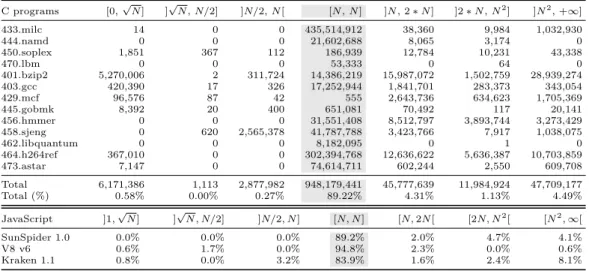
Figure 2 Hit rate of our simple heuristic for C (top) and JavaScript (Bottom).
3.2
Experiments
We measure the precision of our heuristic by comparing its results against the actual trip count observed during the concrete execution of programs. We have implemented our algorithm both in the LLVM compiler and in Mozilla Firefox. LLVM gives us the opportunity to test our approach in very large programs; Firefox let us demonstrate its effectiveness in one of the most well-engineered JIT compilers in use today.
Precision. We group results in interval orders to measure the precision of our predictor. N denotes the number of iterations of a loop observed via profiling, so the interval [N, N ] gives us the exact predictions. The interval [N, N ] is marked in gray in Figure 2. The other intervals are under or upper approximations. We only produce estimates for interval loops, that account for 71% of the loops in our benchmarks. We collect results for each execution of the loops; hence, the same loop might contribute several times to our final averages.
Figure 2 compares estimated and actual trip counts that we have collected with our profiler. We have correctly predicted 89.2% of the loops in the SPEC benchmarks and approximately 90% in the JavaScript benchmarks. To give some perspective on these results, we compare them against those produced by Algorithm 2, that allowed us to predict correctly 90.0% of the C/C++ benchmarks loops visited - an improvement of 0.8% on the result of the simple heuristic. We believe that this extra precision is not worth the linear complexity of the more elaborate test, at least in the world of JIT compilers.
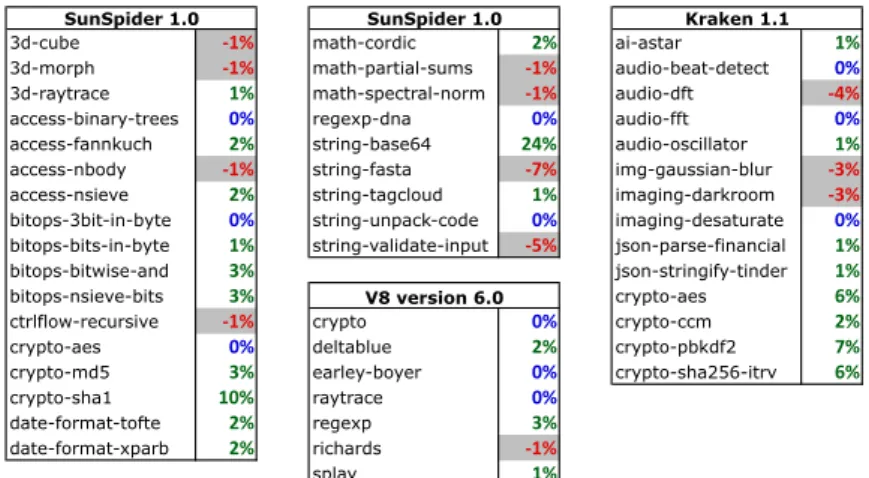
Speeding up Just-In-Time Compilers. Figure 3 shows the speedup that we obtain using our trip count predictor to perform earlier invocation of the JIT compiler. Each number is the average of 100 runs. We call the baseline compiler immediately once we predict that a loop will iterate 10 times, and we call IonMonkey immediately once we predict that a loop will iterate
3d-cube -‐1% math-cordic 2% ai-astar 1%
3d-morph -‐1% math-partial-sums -‐1% audio-beat-detect 0%
3d-raytrace 1% math-spectral-norm -‐1% audio-dft -‐4%
access-binary-trees 0% regexp-dna 0% audio-fft 0%
access-fannkuch 2% string-base64 24% audio-oscillator 1%
access-nbody -‐1% string-fasta -‐7% img-gaussian-blur -‐3%
access-nsieve 2% string-tagcloud 1% imaging-darkroom -‐3%
bitops-3bit-in-byte 0% string-unpack-code 0% imaging-desaturate 0%
bitops-bits-in-byte 1% string-validate-input -‐5% json-parse-financial 1%
bitops-bitwise-and 3% json-stringify-tinder 1%
bitops-nsieve-bits 3% crypto-aes 6%
ctrlflow-recursive -‐1% crypto 0% crypto-ccm 2%
crypto-aes 0% deltablue 2% crypto-pbkdf2 7%
crypto-md5 3% earley-boyer 0% crypto-sha256-itrv 6%
crypto-sha1 10% raytrace 0%
date-format-tofte 2% regexp 3%
date-format-xparb 2% richards -‐1%
splay 1%
SunSpider 1.0 SunSpider 1.0 Kraken 1.1
V8 version 6.0
Figure 3 Speedup due to trip count predictor for benchmarks distributed with Firefox.
1,000 times. Figure 3, reveals that our technique has been able to speed up some benchmarks by a substantial factor. We have also detected slowdowns in a few scripts. This negative behavior happens in benchmarks that iterate for a very short time. In this case, early compilation is not able to pay off the cost of code generation.
4
Conclusion
In this paper, we have presented a heuristic to predict the trip count of loops. We have performed experiments in well-known public benchmarks showing that our technique is able to achieve a good precision, despite of the simplicity of our approach. Our Code is available at https://code.google.com/p/dynamic-loop-prediction/
Moreover these experiments show that interval loops represent 70% of our benchmarks and a simple heuristic is the most precise in 80% of these interval loops. These results advocate the use of simple preprocessing for proving the termination (or counting the number of loops) of real-world programs that may include proper slicing and simple pattern-matching.
Future work may include the extraction of the remaining challenging loops for the community because there is still an open space to be explored.
References
1 C. Alias, A. Darte, P. Feautrier, and L. Gonnord. Multi-dimensional rankings, program termination, and complexity bounds of flowchart programs. In SAS, pages 117–133. Springer, 2010.
2 C. Ancourt, F. Coelho, and F. Irigoin. A modular static analysis approach to affine loop invariants detection. Electronic Notes in Theoretical Computer Science, 267(1):3 – 16, 2010.
3 S. Bardin, A. Finkel, J. Leroux, and L. Petrucci. Fast: Fast acceleration of symbolic transition systems. In Computer Aided Verification, 15th International Conference, CAV 2003, Boulder, CO, USA, July 8-12, 2003, Proceedings, volume 2725 of Lecture Notes in Computer Science, pages 118–121. Springer, 2003.
4 G. Bhargav and S. Gulwani. A numerical abstract domain based on expression abstraction and max operator with application in timing analysis. In CAV, pages 370–384. Springer, 2008.
5 E. Duesterwald and V. Bala. Software profiling for hot path prediction: Less is more. In ASPLOS, pages 202–211. ACM, 2000.
6 L. Gonnord and P. Schrammel. Abstract Acceleration in Linear Relation Analysis. Science of Computer Programming, under press, 2013.
7 J. Gustafsson, A. Ermedahl, C. Sandberg, and B. Lisper. Automatic derivation of loop bounds and infeasible paths for wcet analysis using abstract execution. In RTSS, pages 57–66. IEEE, 2006.