HAL Id: hal-01927533
https://hal-amu.archives-ouvertes.fr/hal-01927533
Submitted on 19 Nov 2018
HAL is a multi-disciplinary open access archive for the deposit and dissemination of sci-entific research documents, whether they are pub-lished or not. The documents may come from teaching and research institutions in France or abroad, or from public or private research centers.
L’archive ouverte pluridisciplinaire HAL, est destinée au dépôt et à la diffusion de documents scientifiques de niveau recherche, publiés ou non, émanant des établissements d’enseignement et de recherche français ou étrangers, des laboratoires publics ou privés.
Hinfinity Tracking Observer-Based Control of the Buck
Power Converters
Abdelhamid Rabhi, N. Msirdi, M. Chadli
To cite this version:
Abdelhamid Rabhi, N. Msirdi, M. Chadli. Hinfinity Tracking Observer-Based Control of the Buck Power Converters. SEB 2012 Sustainability in Energy and Buildings, 2012, Berlin, Heidelberg, France. pp.169–176. �hal-01927533�
H Tracking Observer-Based Control of the
Buck Power Converters
Rabhi1, M. Chadli1 and N. K. M’Sirdi2
1University of Picardie Jules Verne, UPJV-MIS (EA 4290)
7, Rue du Moulin Neuf - 80000, Amiens – France.
2LSIS, CNRS UMR 6168. Dom. Univ. St Jérôme, Av. Escadrille,
Normandie– Niémen 13397, Marseille Cedex 20, France
Abstract-
In this paper, an H robust observer based control is proposed for guaranteeing tracking performances of closed loop nonlinear systems. This approach is used to controlling DC-to-DC switched power converters of Buck type. The results are given in terms of linear matrix inequalities and they guarantee global asymptotic stability of the tracking error. The design conditions obtained using Lyapunov approach are given in terms of solvability as a set of Linear Matrix Inequities (LMIs) terms.
Index Terms - DC to DC converters, Observer, Controller, T-S models, LMI.
1 Introduction
DC to DC converters are electronic devices, used to regulate the output voltage. There are three main types of switched power converters respectively called Boost, Buck and Buck-Boost. Switched mode DC-to-DC power converters have recently aroused and kept increasing deal of interest both in power electronics and in automatic control. This is due to their wide applicability domain that ranges from domestic equipments to sophisticated communication systems.
Recently, because of their intrinsic nonlinearity, these systems represent a challenging field for control algorithms. Several control techniques have been used in this area. These control methods use the approaches of: frequency analysis in the classical control theory,
time analysis in the modern control theory, both frequency analysis and time analysis domains in the post modern (digital and robust) control theory, and soft computing (fuzzy logic, neural networks and genetic algorithms) in the intelligent control theory [1, 2, 3, 4, 5]. This paper is organized as follows. In section 2, we present the converter nonlinear model and its representation by T-S fuzzy model. Section 3 presents the robust control objectives and design methodology of the controller based on a T-S converter. In section 4, simulation results are given to highlight the effectiveness of the controller design procedure and confirm the obtained good performance. Finally section 5 concludes this paper.
2 Buck Converter Modeling
The Buck converter has a highly non-linear characteristic, due to the incorporated switch. This converter accepts a source voltage, noted Vg and
produces a lower output voltage, Vc with
high efficiency.
There are several modeling techniques used to model the Buck converters [6,7]. Figure 1 shows an electrical circuit to describe a DC-DC buck converter. The circuit operates according to the so-called Pulse Width Modulation (PWM) principle. The switching period is T and the duty cycle is (t). When the switch is on position 1, the DC source supplies power to the circuit which results an output voltage across the resistor. When the switch changes its position to 0, the energy stored in the inductor and capacitor will discharge through the resistor.
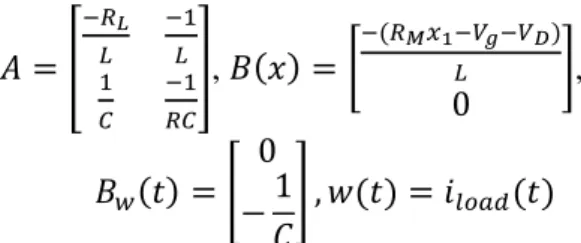
Using the Kirchhoff’s laws, the Buck converter differential equation is deduced and then its model can be represented in the state-space by the following nonlinear model :
(1) where and , ! " #, $ %&"' () * +,-.
x1 and x2 denote the inductor current
( +,-.) and the output capacitor voltage (Vc), respectively.
The control input for the above model is the duty cycle (t), called duty ratio function.
Appropriately controlling the switching position can maintain the output voltage at a desired level lower than the source one.
According to Buck converter circuit, we denote that
/ 01 2 2 /
-Nonlinear model (1) can be then represented by two local LTI models. The overall T-S fuzzy model for the Buck Boost converter can be written as follows:
(
)
2 ( ( )) 1( )
( )
( )
( )
( )
( )
n z t i i i w ix t
Ax t Bu t B w t
y t
Cx t
= == µ
+
+
=
(2) Where 3$ ,%& 45 / 018& 6& 7
" )
3 %
& 45 / - & 6& 7
8
" )
[ ]
0 1C= and the membership
functions are given by:
9
:0 ; <=0 ; <= 0 ; >?,
9
3 0 ; <=0 ; >?0 ; >?It is important to note that the model (2) represents exactly the nonlinear model (1) in the domain @ / 01 / - .
3 DC-DC Converters controller design Our objective in this paper is to guarantee a convergence of Vin to Vref
while iload varies. It is considered as a
disturbance and then must be rejected. Since the state variables are not fully measurable, we propose a fuzzy state observer for fuzzy model (3). The considered observer is represented as follows:
A B C0 D A 0 80 E & EA
1F3 0F
EA ( A
While the considered TS fuzzy controller represented by:
( )
2 1 ˆ ( ) i i ( ) i u t h z K x t = = (4)where x t( ) is the state estimation, Li and i
K are observer gains and controller
gains respectively to be determined.
To design a controller based on observer with H∞ performance, the following
result is used [15][19].
Theorem: Given a prescribed scalar
0
γ > , there exists an observer-based fuzzy control (4) law which makes the
H∞ norm of fuzzy system (2) less than
γ if there exist symmetric matrices 0
X > , Y>0, Qi >0, Pi, matrices Mi and i
J , i<j=1,2,…n, such that the following
LMI hold: 2 T T T T i i i i w w i XA +AX B M+ +M B +γ− B B <P (5a) 2 2 2 2 T T T i j j i i j T T T T j i w w ij ij XA AX B M B M M B M B γ− B B P P + + + + + + < + (5b) T T i i i i AY YA C J+ + +J C Q< (5c) 1 1 1 0 T n T n T n P P XC P XC P CX CX I < − (5d)
The controller gains Ki and the observer
gains Li are given by 1 , i i K =M X− (6) 1 , i i L =Y J− (7)
Proof: See for example [15]
4 Simulation results
The proposed T-S Model and controller are tested by simulation. The electrical parameters of the simulated Buck Boost converter are given in table I. These (3)
parameters allow a continuous conduction mode.
TABLE I: STUDIED BUCK CONVERTER PARAMETERS Parameters Values RM 0,27 L 98,58 mH VD 0,82V RL 48,5 m
This section shows efficiency of designed control system and our design approach through computer simulations.
The software package
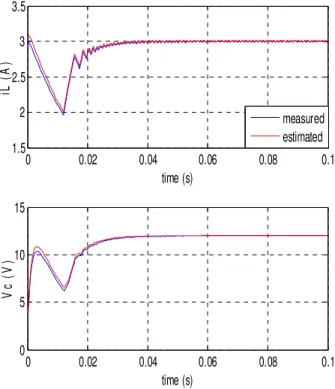
MATLAB/SIMULINK and LMI Control Toolbox is used for the simulations. The simulation in Figure 1 shows the response of the buck converter. It is a comparison of estimated and measured states.
Figure 1: Comparison of estimated and measured states
It is clear that the different states of model coincide with measurements. To verify the performance of our approach, we take a variable load and compare the developed controller with PI controller with Vin = Vg = 30V, Vref =
12V.
Figure 2: Comparative results of proposed controller (red line) and PI controller response
output voltage.
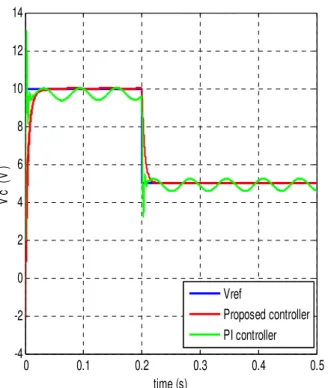
We verify also the proposed algorithm when the reference value varies between two values below the input voltage. Figure 3 shows the simulation results of the designed inverter when the reference value varies between two values. We note that the output converges to the reference and the controller provides good stability compared with PI controller.
Thus, it can be seen that the robustness of proposed controller is guaranteed even if both the load and the reference vary. 0 0.02 0.04 0.06 0.08 0.1 1.5 2 2.5 3 3.5 time (s) iL ( A ) 0 0.02 0.04 0.06 0.08 0.1 0 5 10 15 time (s) V c (V ) measured estimated 0 0.02 0.04 0.06 0.08 0.1 -5 0 5 10 15 20 time (s) V c (V )
Figure 3: Comparative results when the reference value varies between two values
5 Conclusions
In this paper, T-S fuzzy model and a robust control scheme for parallel DC-DC buck converters is proposed. Then observer-based control is given using Lyapunov method. The design conditions are formulated in LMIs terms and guarantee H∞ performance.
Simulations show that the proposed controller guarantees asymptotic convergence of the state to a desired output voltage with load change.
6 References
[1] S.C. Tan, Y.M. Lai and C.K. Tse, A unified approach to the design of PWM based sliding mode voltage controllers for basic DC-DC converters in continuous conduction mode, IEEE Transactions on Circuits and Systems I, Vol. 53, No. 8, pp.1816-1827, August 2006.
[2] A. Prodic, et al., “Design and Implementation of a Digital PWM Controller for a High-Frequency Switching DC-DC Power Converter, Proceedings of the 27th Annual Conference of the IEEE Industrial Electronics Society, 2001, pp. 893–898. [3] P. Mattavelli, L. Rossetto, G. Spiazzi, and
P. Tenti, “General-purpose fuzzy controller for dc/dc converters,” in Proc. IEEE Power Electron. Spec. Conf., 1995, pp. 723–730.
[4] S.G. Kadwane, Amit kumar, B.M. Karan, T Ghose ” Online Trained Simulation and DSP Implementation of Dynamic Back Propagation Neural Network for Buck Converter”, ACSE Journal, Volume (6), Issue (1), January, 2006.
[5] S. G. Kadwane, Swapnil Gupta, B. M. Karan, T Ghose “Practical implementation of GA tuned DC-DC converter”, ACSE Journal, Volume (6), Issue (1), January, 2006.
[6] A.J. Calderon, B.M. Vinagre, V. Feliu “Fractional order control strategies for power electronic buck converters” Signal Processing 86 (2006) 2803–2819. [7] Carolina ALBEA-S´ANCHEZ, “Control
Design for Electronic Power Converters” thesis of University of Grenoble, 2010. [8] M. Takagi and M. Sugeno, “Fuzzy
identification of systems and its application to modelling and control”, IEEE Trans. on Systems Man and Cybernetics-part C, 15 (1), pp. 116-132, 1985.
[9] K. Tanaka, T. Ikeda, O. Wang, “Fuzzy regulator and fuzzy observer : relaxed stability conditions and LMI based design”, IEEE Trans. on Fuzzy Systems, 6 (2), pp. 250-256, 1998.
[10] M. Chadli and A. El Hajjaji,
“Observer-based robust fuzzy control of nonlinear systems with parametric uncertainties- comment on”, Fuzzy Sets and Systems Journal, Vol. 157(9), pp. 1276-1281, 2006.
[11] S.C Cao, N. W. Rees, G. Feng. “Hinf
control of uncertain fuzzy continuous-time systems”, Fuzzy sets and systems, 115, pp. 171-190,200.
[12] M. Chadli, D. Maquin, J. Ragot, "Stability
analysis and design for continuous-time Takagi-Sugeno control systems", International Journal of Fuzzy Systems, vol. 7, no. 3, 2005 0 0.1 0.2 0.3 0.4 0.5 -4 -2 0 2 4 6 8 10 12 14 time (s) V c (V ) Vref Proposed controller PI controller
[13] T. M. Guerra, L. Vermeiren, “LMI-based
relaxed nonquadratic stabilization conditions for nonlinear systems in the Takagi–Sugeno's form”, Automatica, Vo. 40(5), pp. 823-829. 2004.
[14] H. J. Lee, J. B. Park, G. Chen, “Robust
fuzzy control of nonlinear systems with parametric uncertainties”, IEEE Trans. on Fuzzy Systems, 9(2), pp. 369379, 2001. [15] C. Lin, Q. Wang, T. Lee, “Improvement
on observer-based Hinf control for T-S fuzzy systems”, Automatica, vol. 41, pp 1651-1656, 2005.
[16] S. Tong et al. “Fuzzy robust tracking
control for uncertain nonlinear systems”, International Journal of approximate reasoning (30), pp. 73-90, 2002.
[17] S. Boyd. et al. Linear matrix inequalities
in systems and control theory. Philadelphia, PA: SIAM, 1994.
[18] B. S. Chen, C. H. Lee, and Y. C. Chang, “
H∞tracking design of uncertain nonliear
SISO systems: Adaptive fuzzy approach,” IEEE Trans. Fuzzy Syst. Vol. 4, no. 1, pp. 32-43, Feb. 1996.
[19] M. Oudghiri, M. Chadli and A. El Hajjaji,
“Design of Robust Output H Fuzzy Controller Using One-Step Procedure” , The 15th IEEE Mediterranean Conference
on control and Automation MED’ 07, Athens, Greece, June 27-29, 2007.