Influence of dabigatran and rivaroxaban on routine coagulation assays
A nationwide Belgian survey
Marjan Van Blerk1; Els Bailleul2; Bernard Chatelain2; Anne Demulder2; Katrien Devreese2; Jonathan Douxfils2; Kristin Jochmans2;
François Mullier2; Walter Wijns2; Mohamed Rida Soumali1; Wim Coucke1; Kris Vernelen1; Philippe Van de Walle1
1Department of Quality of Medical Laboratories, Scientific Institute of Public Health, Brussels, Belgium; 2EQA Advisory Board, Belgium
Summary
The Belgian national External Quality Assessment Scheme performed a nationwide survey using lyophilised plasma samples spiked with dabigatran or rivaroxaban to demonstrate to the Belgian clinical lab-oratories how these drugs affect their routine coagulation assays pro-thrombin time (PT), activated partial thromboplastin time (aPTT), fibri-nogen and antithrombin. Virtually all Belgian laboratories performing routine coagulation testing (189/192) participated in the survey. Both, dabigatran and rivaroxaban significantly prolonged the PT and aPTT in a concentration- and reagent-dependent manner. PT reagents were more influenced by rivaroxaban than by dabigatran and aPTT reagents more influenced by dabigatran than by rivaroxaban. Among PT reagents, Neoplastin R® was the most sensitive to rivaroxaban and
In-novin® and Thromborel S® the least sensitive. Converting PT results to
INR only increased the variability between reagents. Among aPTT reagents, Actin FSL® was the least sensitive to dabigatran while the
other aPTT reagents showed slightly higher sensitivities. The presence of dabigatran led to falsely reduced fibrinogen concentrations when measured with a low thrombin concentration reagent. The presence of dabigatran caused an overestimation of the antithrombin level when measured with a thrombin-based activity assay and the presence of rivaroxaban an overestimation of the antithrombin level when measured with a FXa-based assay. Instrument-related differences were found for all tested parameters. In conclusion, this paper pro-vides detailed information on the effect of dabigatran and riva-roxaban on routine coagulation assays as performed with a large number of reagent/instrument combinations.
Keywords
Dabigatran, external quality assessment, rivaroxaban, routine coagu-lation assays
Correspondence to:
Marjan Van Blerk
Wetenschappelijk Instituut Volksgezondheid Kwaliteit van medische laboratoria J. Wytsmanstraat 14
1050 Brussels, Belgium
Tel.: +32 2 642 53 83, Fax: +32 2 642 56 45 E-mail: [email protected]
Received: February 20, 2014
Accepted after major revision: August 2, 2014 Epub ahead of print: September 18, 2014
http://dx.doi.org/10.1160/TH14-02-0161 Thromb Haemost 2014; 112: ■■■
Introduction
The direct oral anticoagulants (DOAC) dabigatran etexilate
(Pra-daxa®, Boehringer Ingelheim International GmbH, Ingelheim am
Rhein, Germany) and rivaroxaban (Xarelto®, Bayer Pharma AG,
Berlin, Germany) have now been in clinical use for a few years. In Belgium, both drugs have been approved for the prevention of thromboembolic events after elective hip- or knee-replacement surgery and for the prevention of stroke and systemic embolism in patients with atrial fibrillation. Rivaroxaban has also been ap-proved for the treatment and secondary prevention of venous thromboembolism (VTE). In contrast to the vitamin K antagonists (VKA) inhibiting the activation of several coagulation factors, these DOAC specifically target either thrombin or activated factor X (FXa). Dabigatran etexilate is an oral prodrug that is hydrolysed in the liver to dabigatran, a reversible, specific and direct inhibitor of both free and clot bound thrombin (1). Rivaroxaban is an oral direct inhibitor of free, prothrombinase bound and clot associated FXa (2). Both drugs have a rapid onset of action (1–3 hours [h])
and short half-lives (8–15 h). Compared to the VKA, there are minimal food interactions and very limited drug interactions.
For the majority of patients, these drugs are prescribed at fixed doses and do not require routine coagulation monitoring (3). However, their presence can significantly influence coagulation as-says, potentially leading to incorrect interpretation of test results. The Subcommittee on Control of Anticoagulation of the Scientific and Standardization Committee of the International Society on Thrombosis and Haemostasis and the British Committee for Stan-dards in Haematology recommend that laboratories are aware of the sensitivity of their assays to each of these drugs (4, 5). There-fore, the Belgian national External Quality Assessment Scheme (EQAS) for blood coagulation, performed a nationwide survey using dabigatran or rivaroxaban spiked pooled normal human plasma to investigate and illustrate to the Belgian clinical labora-tories the impact of these drugs on their routine coagulation as-says. Most published data on the effect of dabigatran and riva-roxaban on routine coagulation assays lack details regarding the instruments used, creating some limitations for application of
these observations by clinical laboratories. This paper aims to pro-vide information on the effect of dabigatran and rivaroxaban on routine coagulation assays as performed with a large number of reagent/instrument combinations.
Materials and methods
Study design: sample material and distribution
In April 2012, five lyophilised plasma samples were sent to the 192 Belgian clinical laboratories performing routine coagulation test-ing. The samples consisted of a plasma pool from 12 healthy vol-unteers spiked with dabigatran or rivaroxaban at the following final concentrations: 0 µg/l, 100 and 250 µg/l dabigatran, 120 and 290 µg/l rivaroxaban. The samples were purchased from Hyphen BioMed (Neuville sur Oise, France). They were packaged in ac-cordance with postal regulations and distributed by overnight mail. The samples were tested negative for hepatitis B surface antigen and antibodies to hepatitis C virus and human immuno-deficiency viruses 1 and 2.
Dabigatran and rivaroxaban concentrations were only revealed to the laboratories after receipt of the results.
Study design: sample analysis
Participants were requested to reconstitute the lyophilised plasmas with 1.0 ml distilled water and to incubate them with gentle mix-ing for at least 15 minutes at room temperature before analysis. They were asked to determine the following coagulation assays:
prothrombin time (PT), activated partial thromboplastin time (aPTT), fibrinogen and antithrombin. They were also required to mention the reagent and analyser used for testing and were asked to process the samples according to their usual procedures.
Participants could submit their results via a secured website. Results had to be returned within 2 weeks.
Study design: reporting of results to participants
A full report including the results of the survey as well as com-ments and recommendations from the advisory board was sent to the laboratories in December 2012.
Statistical analysis
Method-specific medians and robust standard deviations were cal-culated for all methods with ≥ 4 reported results (interquartile-range based method of Tukey). Differences between methods were assessed by means of non-parametric statistics (Wilcoxon test with subsequent Bonferroni correction of the p-values). P-values less than 0.05 were considered to be statistically significant.
Results
Of the 192 Belgian clinical laboratories performing routine coagu-lation testing, 189 participated in the survey (response rate of 98.3 %). All participating laboratories returned results for PT and aPTT, 183 laboratories returned results for fibrinogen and 69 for antithrombin.
Effect of dabigatran and rivaroxaban on PT results
Six different reagents were used, which were all Quick type meth-ods (6, 7). About two thirds of the participants (62.4 %) used a
rec-ombinant human thromboplastin: Innovin® (Siemens Healthcare
Diagnostics, Marburg, Germany, 28.0 % of the participants),
Rec-ombiPlasTin 2G® (Instrumentation Laboratory, Milan, Italy,
23.8 %) or Neoplastin R® (Diagnostica Stago, Asnières, France,
10.6 %). The remaining participants utilised the reagents Neoplas-tin CI Plus® (rabbit brain thromboplastin, Diagnostica Stago,
29.1 %), Thromborel S® (human placental thromboplastin, Siemens
Healthcare Diagnostics, 6.9 %) or TriniCLOT PT Excel S® (rabbit
brain thromboplastin, Diagnostica Stago, only three laboratories).
▶
Table 1 summarises the influence of dabigatran and riva-roxaban on the PT results. Both, dabigatran and rivariva-roxaban signifi-cantly prolonged the PT in a concentration- and reagent-dependent manner but the sensitivity to dabigatran was low: 100 and 250 µg/l dabigatran prolonged the PT only 1.2 and 1.4 times the basal value, respectively. The PT was more sensitive to rivaroxaban: 120 and 290 µg/l rivaroxaban prolonged the PT 1.4 and 1.9 times the basal value. At 120 µg/l rivaroxaban, all PT results were prolonged.The agreement between laboratories using the same reagent was good, with coefficients of variation (CVs) ranging between 1.2 and 4.2 %, but there was a wide variation in responsiveness
be-Reagent Innovin Neoplastin CI Plus Neoplastin R RecombiPlasTin 2G Thromborel S Global result N 53 55 20 45 13 189 100D 1.14 (1.3 %) 1.23 (1.9 %) 1.26 (1.3 %) 1.17 (1.2 %) 1.20 (1.5 %) 1.18 (4.5 %) 250D 1.33 (3.1 %) 1.47 (1.7 %) 1.52 (1.4 %) 1.35 (1.7 %) 1.43 (1.4 %) 1.39 (7.2 %) 120R 1.15 (1.5 %) 1.37 (2.3 %) 1.56 (3.5 %) 1.37 (1.2 %) 1.14 (1.6 %) 1.35 (12.3 %) 290R 1.34 (2.8 %) 1.88 (3.3 %) 2.35 (4.2 %) 1.95 (1.4 %) 1.36 (3.5 %) 1.87 (23.3 %) Table 1: Effect of dabigatran and rivaroxaban on PT results. Results
are expressed as PT ratio, i. e. the ratio of the clotting time measurement of the sample spiked with dabigatran or rivaroxaban compared with the clot-ting time of the plasma pool. The 1st column shows the reagents used, the 2nd column the number of results and the 3rd to the 6th column the method-specific median PT ratios obtained for the samples containing 100 and 250 µg/l dabigatran (100D and 250D) and 120 and 290 µg/l rivaroxaban (120R and 290R), respectively. Method-specific medians and coefficients of vari-ation (between brackets) are shown for all methods with ≥ 4 reported re-sults.
(containing ~100 NIH units/ml of thrombin, Siemens Healthcare
Diagnostics, 26.8 %), Fibrinogen C® (containing ~35 NIH units/ml
of thrombin, Instrumentation Laboratory, 12.6 %), Multifibren U®
(containing ~50 NIH units/ml of thrombin, Siemens Healthcare tween reagents. The reagents Innovin® and Thromborel S® were the
least sensitive to rivaroxaban with 290 µg/l prolonging the PT clot-ting time only 1.3 fold. Neoplastin R® was the most sensitive with
290 µg/l rivaroxaban prolonging the PT 2.4 fold.
▶
Table 2 compares, for the rivaroxaban-spiked samples, thePT results expressed as ratio with the international normalised ra-tios (INR) reported by the participants. For the low rivaroxaban concentration, the overall CVs for PT ratio and INR were 12.3 % and 14.6 %, respectively, and for the high rivaroxaban concen-tration, 23.3 and 32.0 %, respectively, indicating that the INR re-sults showed a wider spread of values, especially at the high riva-roxaban concentration. Indeed, 290 µg/l rivariva-roxaban yielded a
median INR of 1.6 with the reagents Innovin® and Thromborel S®
compared to a median INR of 2.5 with the reagents Neoplastin CI Plus® and Neoplastin R®.
Effect of dabigatran and rivaroxaban on aPTT results
In total, 10 different reagents were used and the following were
employed by at least four participants: Actin FS® (soya bean
phos-pholipids and ellagic acid as activator, Siemens Healthcare
Diag-nostics, 23.8 % of the participants), STA-PTT A® (cephalin from
rabbit brain and silica as activator, Diagnostica Stago, 16.4 %),
STA-Cephascreen® (cephalin from rabbit brain and polyphenolic
activator, Diagnostica Stago, 16.4 %), SynthASil® (synthetic
phos-pholipids and micronised silica, Instrumentation Laboratory,
11.6 %), APTT-SP® (synthetic phospholipids and micronised silica,
Instrumentation Laboratory, 11.1 %), Actin FSL® (purified soy and
rabbit brain phosphatides and ellagic acid as activator, Siemens Healthcare Diagnostics, 11.1 %), STA-CK Prest® (cephalin from
rabbit brain and kaolin as activator, Diagnostica Stago, 4.2 %) and
TriniCLOT aPTT HS® (porcine and chicken phospholipids and
micronised silica, Diagnostica Stago, 2.6 %).
▶
Table 3 shows the influence of dabigatran and rivaroxaban onthe aPTT results. Both, dabigatran and rivaroxaban significantly prolonged the aPTT in a concentration- and reagent-dependent manner. The aPTT was more influenced by dabigatran than by riva-roxaban: the global aPTT ratio amounted to 2.0 for the high dabi-gatran concentration and to 1.5 for the high rivaroxaban concen-tration. At 100 µg/l dabigatran, all aPTT results were prolonged.
Again, results varied in function of the reagent used. Actin FSL®
was the least sensitive to dabigatran with a median aPTT ratio of 1.7 at 250 µg/l while the other aPTT reagents showed slightly higher sensitivities with ratios ranging between 2 and 2.15. At 290 µg/l rivaroxaban, median aPTT ratios ranged between 1.4 and 1.7.
Effect of dabigatran and rivaroxaban on fibrinogen results
Most of the participants (86.3 %) used for fibrinogen determi-nation a Clauss type clotting assay based on the addition of an ex-cess of thrombin to plasma. The following methods were em-ployed by at least four participants: STA-Fibrinogen® (containing ~
80 National Institutes of Health [NIH] units/ml of thrombin, Diag-nostica Stago, 39.3 % of the participants), Thrombin Reagent®
Reagent Innovin Neoplastin CI Plus Neoplastin R RecombiPlasTin 2G Thromborel S Global result N 53 55 20 45 13 189 PT ratio 120R 1.15 (1.5 %) 1.37 (2.3 %) 1.56 (3.5 %) 1.37 (1.2 %) 1.14 (1.6 %) 1.35 (12.3 %) PT INR 120R 1.32 (2.8 %) 1.64 (4.5 %) 1.67 (4.5 %) 1.43 (4.9 %) 1.35 (3.3 %) 1.45 (14.6 %) PT ratio 290R 1.34 (2.8 %) 1.88 (3.3 %) 2.35 (4.2 %) 1.95 (1.4 %) 1.36 (3.5 %) 1.87 (23.3 %) PT INR 290R 1.55 (4.8 %) 2.52 (5.3 %) 2.52 (2.5 %) 2.00 (4.8 %) 1.61 (3.7 %) 2.03 (32.0 %) Table 2: Comparison of the PT results of the rivaroxaban-spiked samples expressed as ratio and as INR. The 1st column shows the
reagents used, the 2nd column the number of results, the 3rd and 5th column
the method-specific median PT ratios and the 4th and 6th column the
method-specific median INR results reported by the participants for the samples con-taining 120 and 290 µg/l rivaroxaban (120R and 290R), respectively. Method-specific medians and coefficients of variation (between brackets) are shown for all methods with ≥ 4 reported results.
Reagent Actin FS Actin FSL APTT-SP STA-CK Prest STA-Cephascreen STA-PTT A SynthASil TriniCLOT aPTT HS Global result N 45 21 21 8 31 31 22 5 189 100D 1.64 (3.2 %) 1.43 (1.2 %) 1.63 (2.7 %) 1.71 (1.4 %) 1.61 (1.2 %) 1.64 (1.4 %) 1.67 (1.8 %) 1.67 (3.7 %) 1.63 (2.7 %) 250D 2.06 (3.4 %) 1.71 (1.3 %) 2.05 (2.1 %) 2.15 (1.6 %) 2.02 (1.2 %) 2.04 (1.9 %) 2.10 (2.4 %) 2.02 (1.7 %) 2.04 (3.4 %) 120R 1.32 (1.8 %) 1.23 (1.7 %) 1.22 (2.8 %) 1.34 (1.5 %) 1.26 (1.3 %) 1.24 (1.5 %) 1.33 (2.8 %) 1.24 (1.4 %) 1.27 (4.8 %) 290R 1.66 (2.8 %) 1.44 (2.1 %) 1.44 (2.0 %) 1.63 (2.4 %) 1.49 (1.5 %) 1.45 (1.1 %) 1.57 (2.8 %) 1.44 (1.8 %) 1.50 (9.0 %) Table 3: Effect of dabigatran and rivaroxaban on aPTT results. Results
are expressed as aPTT ratio, i. e. the ratio of the clotting time measurement of the sample spiked with dabigatran or rivaroxaban compared with the clot-ting time of the plasma pool. Data are presented as in Table 1.
Diagnostics, 3.3 %) and QFA Thrombin® (containing ~100 NIH
units/ml of thrombin, Instrumentation Laboratory, 2.2 %). De-rived fibrinogen results extrapolated from clot kinetics during PT testing were reported by 13.7 % of the participants and were
mainly obtained with the RecombiPlasTin 2G® reagent
(Instru-mentation Laboratory, 10.4 %).
▶
Table 4 displays the impact of dabigatran and rivaroxaban onthe fibrinogen results. The Clauss fibrinogen assay Fibrinogen C®
significantly underestimated the fibrinogen level of the
dabi-gatran-spiked samples. The median fibrinogen concentration ob-tained with this reagent amounted to 2.4 g/l for the sample con-taining no dabigatran and decreased to 1.8 g/l and 1.3 g/l for the samples with 100 and 250 µg/l dabigatran, respectively. This underestimation of the fibrinogen concentration also had an im-pact on the interpretation of the results. Indeed, 65.2 % of the users
of the Fibrinogen C® reagent considered the plasma pool as normal
while respectively 30 % and none of them still considered the samples with 100 and 250 µg/l dabigatran as normal.
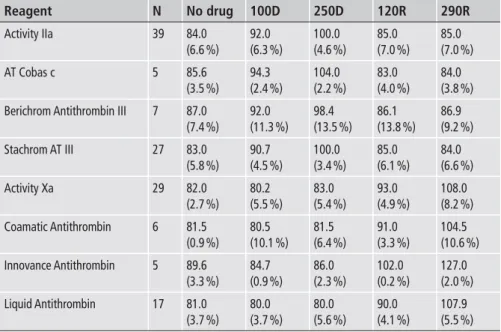
Reagent Clauss Fibrinogen C Multifibren U QFA Thrombin STA-Fibrinogen Thrombin Reagent PT derived RecombiPlasTin 2G Innovin Global result N 158 23 6 4 72 49 25 19 4 183 No drug 2.21 (11.8 %) 2.10 (5.3 %) 2.11 5.6 % 2.15 (8.9 %) 2.42 (4.7 %) 2.05 (4.7 %) 2.02 (6.6 %) 2.03 (5.3 %) 1.96 (4.4 %) 2.18 (12.6 %) 100D 2.16 (14.8 %) 1.75 (4.2 %) 2.10 (5.7 %) 2.04 (9.7 %) 2.39 (4.3 %) 2.03 (6.2 %) 2.08 (8.6 %) 2.14 (5.9 %) 2.10 (2.6 %) 2.14 (14.9 %) 250D 2.13 (16.0 %) 1.33 (5.6 %) 2.10 (3.8 %) 2.04 (6.9 %) 2.39 (6.2 %) 2.01 (5.5 %) 2.22 (7.3 %) 2.25 (5.8 %) 1.96 (2.6 %) 2.15 (14.1 %) 120R 2.15 (12.1 %) 2.05 (4.0 %) 2.08 (2.1 %) 2.11 (5.8 %) 2.40 (5.3 %) 2.01 (6.3 %) 2.12 (6.6 %) 2.19 (3.6 %) 2.12 (5.4 %) 2.15 (11.4 %) 290R 2.16 (12.4 %) 1.97 (9.2 %) 2.09 (3.6 %) 2.04 (4.6 %) 2.38 (4.7 %) 2.04 (5.1 %) 2.10 (18.4 %) 2.18 (19.4 %) 1.98 (6.7 %) 2.15 (12.4 %) Reagent Activity IIa AT Cobas c
Berichrom Antithrombin III Stachrom AT III Activity Xa Coamatic Antithrombin Innovance Antithrombin Liquid Antithrombin N 39 5 7 27 29 6 5 17 No drug 84.0 (6.6 %) 85.6 (3.5 %) 87.0 (7.4 %) 83.0 (5.8 %) 82.0 (2.7 %) 81.5 (0.9 %) 89.6 (3.3 %) 81.0 (3.7 %) 100D 92.0 (6.3 %) 94.3 (2.4 %) 92.0 (11.3 %) 90.7 (4.5 %) 80.2 (5.5 %) 80.5 (10.1 %) 84.7 (0.9 %) 80.0 (3.7 %) 250D 100.0 (4.6 %) 104.0 (2.2 %) 98.4 (13.5 %) 100.0 (3.4 %) 83.0 (5.4 %) 81.5 (6.4 %) 86.0 (2.3 %) 80.0 (5.6 %) 120R 85.0 (7.0 %) 83.0 (4.0 %) 86.1 (13.8 %) 85.0 (6.1 %) 93.0 (4.9 %) 91.0 (3.3 %) 102.0 (0.2 %) 90.0 (4.1 %) 290R 85.0 (7.0 %) 84.0 (3.8 %) 86.9 (9.2 %) 84.0 (6.6 %) 108.0 (8.2 %) 104.5 (10.6 %) 127.0 (2.0 %) 107.9 (5.5 %)
Table 4: Effect of dabigatran and riva-roxaban on fibrinogen results. Results are
ex-pressed in g/l. The upper part of the table indi-cates the fibrinogen results obtained with Clauss type clotting assays and the lower part the de-rived fibrinogen results extrapolated from clot kinetics during PT testing. The 1st column shows
the reagents used, the 2nd column the number of
results and the 3rd to the 7th column the
method-specific median fibrinogen concentration obtained for the samples containing no drug, 100 and 250 µg/l dabigatran (100D and 250D) and 120 and 290 µg/l rivaroxaban (120R and 290R), respectively. Method-specific medians and coeffi-cients of variation (between brackets) are shown for all methods with ≥ 4 reported results.
Table 5: Effect of dabigatran and riva-roxaban on antithrombin results. Results are
expressed in %. The upper part of the table indi-cates the antithrombin results obtained with thrombin-based antithrombin activity assays and the lower part the results obtained with FXa-based antithrombin activity assays. Data are presented as in Table 4.
The other Clauss type clotting assays were not significantly af-fected by dabigatran or rivaroxaban at the concentrations tested.
Effect of dabigatran and rivaroxaban on antithrombin results
More than half of the laboratories (56.5 %) used an antithrombin activity assay based on the inhibition of thrombin: Stachrom AT III® (Diagnostica Stago, 39.1 % of the participants), Berichrom
Antithrombin III® (Siemens Healthcare Diagnostics, 10.1 %) or AT
Cobas c® (Roche, Mannheim, Germany, 7.2 %). One laboratory
de-termined the antithrombin concentration with an immunological
method (Immage AT3® (Beckman Coulter, Fullerton, CA, USA).
The other participants (42.0 %) used an antithrombin activity assay based on the inhibition of FXa: HemosIL Liquid Antithrom-bin® (Instrumentation Laboratory, 24.6 % of the participants),
Coa-matic Antithrombin® (Chromogenix, Milan, Italy, 8.7 %),
Innov-ance Antithrombin® (Siemens Healthcare Diagnostics, 7.2 %) and
Biophen AT® (Hyphen BioMed, 1 participant).
▶
Table 5 shows the impact of dabigatran and rivaroxaban onthe antithrombin results. The median antithrombin activity of the plasma pool obtained with the thrombin-based methods was 84 % (range: 72–91 %).The median antithrombin activity obtained with the FXa-based assays was 82 % (range: 72–92 %). Of the 63
partici-pants providing an interpretation, 77.8 % considered the anti-thrombin level of this sample as normal, 12.7 % as borderline and 9.5 % as low.
The thrombin-based antithrombin activity assays significantly overestimated the antithrombin level of the dabigatran-spiked samples. At 250 µg/l dabigatran, the median increase in anti-thrombin level was 15 % when measured with the Berichrom
Anti-thrombin III® reagent and 21 % when measured with the Stachrom
AT III® or AT Cobas c® reagent. The FXa-based antithrombin
activ-ity assays significantly overestimated the antithrombin level of the rivaroxaban-spiked samples. At 290 µg/l rivaroxaban, the median increase in antithrombin level was 29 % when measured with the
Coamatic Antithrombin® reagent, 33 % with the Liquid
Antithrom-bin® reagent and 44 % with the Innovance Antithrombin® reagent.
As expected, the FXa-based antithrombin activity assays were unaffected by the presence of dabigatran and the thrombin-based antithrombin activity assays unaffected by the presence of riva-roxaban.
The overestimation of the antithrombin activity in the presence of dabigatran or rivaroxaban also had an impact on the interpre-tation of the results. Of the users of a thrombin-based antithrom-bin activity assay, 74.3 % considered the sample without dabigatran as normal while all of them considered the sample with 250 µg/l dabigatran as normal. Of the users of a FXa- based antithrombin
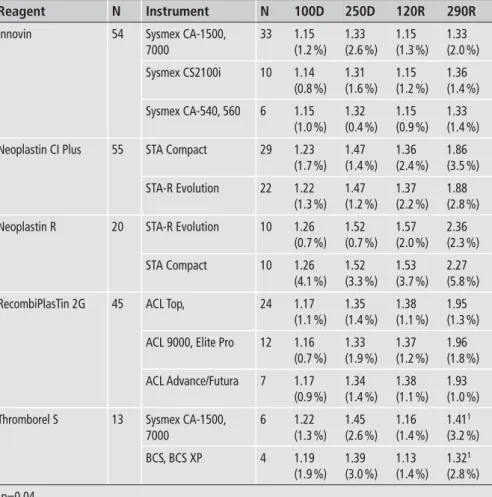
Reagent Innovin Neoplastin CI Plus Neoplastin R RecombiPlasTin 2G Thromborel S 1p=0.04. N 54 55 20 45 13 Instrument Sysmex CA-1500, 7000 Sysmex CS2100i Sysmex CA-540, 560 STA Compact STA-R Evolution STA-R Evolution STA Compact ACL Top, ACL 9000, Elite Pro ACL Advance/Futura Sysmex CA-1500, 7000 BCS, BCS XP N 33 10 6 29 22 10 10 24 12 7 6 4 100D 1.15 (1.2 %) 1.14 (0.8 %) 1.15 (1.0 %) 1.23 (1.7 %) 1.22 (1.3 %) 1.26 (0.7 %) 1.26 (4.1 %) 1.17 (1.1 %) 1.16 (0.7 %) 1.17 (0.9 %) 1.22 (1.3 %) 1.19 (1.9 %) 250D 1.33 (2.6 %) 1.31 (1.6 %) 1.32 (0.4 %) 1.47 (1.4 %) 1.47 (1.2 %) 1.52 (0.7 %) 1.52 (3.3 %) 1.35 (1.4 %) 1.33 (1.9 %) 1.34 (1.4 %) 1.45 (2.6 %) 1.39 (3.0 %) 120R 1.15 (1.3 %) 1.15 (1.2 %) 1.15 (0.9 %) 1.36 (2.4 %) 1.37 (2.2 %) 1.57 (2.0 %) 1.53 (3.7 %) 1.38 (1.1 %) 1.37 (1.2 %) 1.38 (1.1 %) 1.16 (1.4 %) 1.13 (1.4 %) 290R 1.33 (2.0 %) 1.36 (1.4 %) 1.33 (1.4 %) 1.86 (3.5 %) 1.88 (2.8 %) 2.36 (2.3 %) 2.27 (5.8 %) 1.95 (1.3 %) 1.96 (1.8 %) 1.93 (1.0 %) 1.411 (3.2 %) 1.321 (2.8 %)
Table 6: Influence of instrument on PT re-sults. Results are expressed as PT ratio, i. e. the
ratio of the clotting time measurement of the sample spiked with dabigatran or rivaroxaban compared with the clotting time of the plasma pool. The 1st column shows the reagents and the
3rd column the instruments used. The 2nd and 4th
column indicate the number of results. The last four columns show the method-specific median PT ratios obtained for the samples containing 100 and 250 µg/l dabigatran (100D and 250D) and 120 and 290 µg/l rivaroxaban (120R and 290R), respectively. Method-specific medians and coefficients of variation (between brackets) are shown for all methods with ≥ 4 reported results. Similar instruments from the same manufacturer are grouped into a single category.
activity assay, 81.5 % considered the sample without rivaroxaban as normal while all of them considered the sample with 290 µg/l riva-roxaban as normal.
Effect of instrument on test results
Altogether 23 different coagulometers from five different manu-facturers were used. One third of the participants (38.6 %) used a
coagulometer with mechanical clot detection (STA-R Evolution®
(20.6 %) or STA Compact® (18.0 %), both Diagnostica Stago). The
remaining participants used coagulometers with photo-optical clot detection mainly from Siemens Healthcare Diagnostics (33.9 %, CA-1500® and CA-7000® (20.1 %), CS-2100i® (6.3 %), Sysmex
CA-540® and CA-560® (4.2 %), BCS® and BCS XP® (3.2 %)) or
In-strumentation Laboratory (24.3 %, ACL TOP® series (13.8 %), ACL
9000® and ACL Elite Pro® (6.9 %), ACL Advance® and ACL Futura®
(3.7 %)).
▶
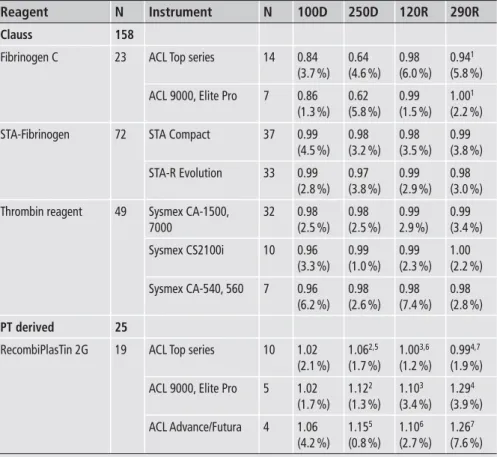
Tables 6, 7, 8 and 9 show the influence of theinstru-mentation on the PT, aPTT, fibrinogen and antithrombin results, respectively. Similar instruments from the same manufacturer were grouped into a single category.
PT ratios obtained with Thromborel S® were higher when
deter-mined on a Sysmex CA-1500® or CA-7000® instrument than when
determined on a BCS® or BCS XP®. The difference reached
statisti-cal significance only at the high rivaroxaban concentration.
aPTT ratios obtained with Actin FS® were systematically and
significantly lower when determined on a Sysmex CA-1500® or
CA-7000® instrument than when determined on a CS2100i® or an
instrument of the ACL Top® series.
aPTT ratios obtained with SynthASil® were significantly higher
when determined on an ACL Elite Pro® or ACL 9000® than when
determined on an instrument of the ACL Top® series (all
Instru-mentation Laboratory but different measuring principle).
In the presence of dabigatran or rivaroxaban, PT derived
fibri-nogen results obtained with RecombiPlasTin 2G® were falsely
elev-ated when determined on an ACL Elite Pro®, ACL 9000®, ACL
Fu-tura® or ACL Advance® but not when determined on an instrument
of the ACL Top® series. Differences were significant for the high
dabigatran and both rivaroxaban concentrations. At 290 µg/l riva-roxaban, the median increase in PT-derived fibrinogen
concen-tration was 29 % when measured on an ACL Elite Pro® or ACL
9000® and 26 % when measured on an ACL Futura® or ACL
Ad-vance®.
At 250 µg/l dabigatran, the antithrombin activity obtained with
Stachrom AT III® was significantly higher when determined on a
STA-R Evolution® than when determined on a STA Compact® but
the difference was not clinically relevant.
Reagent Innovin Neoplastin CI Plus Neoplastin R RecombiPlasTin 2G Thromborel S 1p=0.04. N 54 55 20 45 13 Instrument Sysmex CA-1500, 7000 Sysmex CS2100i Sysmex CA-540, 560 STA Compact STA-R Evolution STA-R Evolution STA Compact ACL Top, ACL 9000, Elite Pro ACL Advance/Futura Sysmex CA-1500, 7000 BCS, BCS XP N 33 10 6 29 22 10 10 24 12 7 6 4 100D 1.15 (1.2 %) 1.14 (0.8 %) 1.15 (1.0 %) 1.23 (1.7 %) 1.22 (1.3 %) 1.26 (0.7 %) 1.26 (4.1 %) 1.17 (1.1 %) 1.16 (0.7 %) 1.17 (0.9 %) 1.22 (1.3 %) 1.19 (1.9 %) 250D 1.33 (2.6 %) 1.31 (1.6 %) 1.32 (0.4 %) 1.47 (1.4 %) 1.47 (1.2 %) 1.52 (0.7 %) 1.52 (3.3 %) 1.35 (1.4 %) 1.33 (1.9 %) 1.34 (1.4 %) 1.45 (2.6 %) 1.39 (3.0 %) 120R 1.15 (1.3 %) 1.15 (1.2 %) 1.15 (0.9 %) 1.36 (2.4 %) 1.37 (2.2 %) 1.57 (2.0 %) 1.53 (3.7 %) 1.38 (1.1 %) 1.37 (1.2 %) 1.38 (1.1 %) 1.16 (1.4 %) 1.13 (1.4 %) 290R 1.33 (2.0 %) 1.36 (1.4 %) 1.33 (1.4 %) 1.86 (3.5 %) 1.88 (2.8 %) 2.36 (2.3 %) 2.27 (5.8 %) 1.95 (1.3 %) 1.96 (1.8 %) 1.93 (1.0 %) 1.411 (3.2 %) 1.321 (2.8 %)
Table 7: Influence of instrument on aPTT re-sults. Results are expressed as aPTT ratio, i. e. the
ratio of the clotting time measurement of the sample spiked with dabigatran or rivaroxaban compared with the clotting time of the plasma pool. Data are presented as in Table 6.
Discussion
Several DOAC such as dabigatran etexilate and rivaroxaban, have been developed for prophylaxis and treatment of thromboembolic disorders. Due to their predictable pharmacokinetic and pharma-codynamic profile and wide therapeutic window, these agents do not require therapeutic monitoring. However, their presence sig-nificantly influences coagulation assays, especially in high-dose use or after blood sampling at the peak level. Hence, it is recom-mended that laboratories are aware of the sensitivity of their assays to each DOAC (4, 5). Therefore, the Belgian EQAS for blood co-agulation organised a nationwide survey to inform the Belgian clinical laboratories on how dabigatran and rivaroxaban affect their routine tests of haemostasis. For practical and ethical reasons, an in vitro approach with lyophilised plasma samples spiked with dabigatran or rivaroxaban was chosen.
We selected the plasma concentrations for our study, taking into account pharmacological and clinical data published so far. In the paragraph on pharmacodynamic properties in the ’Summary of Product Characteristics’ of dabigatran ([8], version at the end of 2011), Boehringer Ingelheim stated that plasma concentrations above 200 µg/l measured at through after 150 mg dabigatran twice daily dosing were associated with an increased risk of bleeding. We wanted to show the laboratories the impact of dabigatran at a con-centration possibly associated with this safety issue. As cut-off values for bleeding risk were not available for rivaroxaban, we used a similar approach as for dabigatran by considering a plasma con-centration above the 90th percentile of rivaroxaban trough levels as
being associated with an increased risk of bleeding. In the ’Sum-mary of Product Characteristics’ of rivaroxaban (9), it is stated that
the 90th percentile of rivaroxaban plasma concentrations measured
at trough was about 239 µg/l in patients treated with rivaroxaban
Reagent Clauss Fibrinogen C STA-Fibrinogen Thrombin reagent PT derived RecombiPlasTin 2G 1p=0.01, 2p=0.01, 3p=0.02, 4p=0.0002, 5p=0.006, 6p=0.03, 7p=0.04. N 158 23 72 49 25 19 Instrument
ACL Top series ACL 9000, Elite Pro STA Compact STA-R Evolution Sysmex CA-1500, 7000 Sysmex CS2100i Sysmex CA-540, 560
ACL Top series ACL 9000, Elite Pro ACL Advance/Futura N 14 7 37 33 32 10 7 10 5 4 100D 0.84 (3.7 %) 0.86 (1.3 %) 0.99 (4.5 %) 0.99 (2.8 %) 0.98 (2.5 %) 0.96 (3.3 %) 0.96 (6.2 %) 1.02 (2.1 %) 1.02 (1.7 %) 1.06 (4.2 %) 250D 0.64 (4.6 %) 0.62 (5.8 %) 0.98 (3.2 %) 0.97 (3.8 %) 0.98 (2.5 %) 0.99 (1.0 %) 0.98 (2.6 %) 1.062,5 (1.7 %) 1.122 (1.3 %) 1.155 (0.8 %) 120R 0.98 (6.0 %) 0.99 (1.5 %) 0.98 (3.5 %) 0.99 (2.9 %) 0.99 2.9 %) 0.99 (2.3 %) 0.98 (7.4 %) 1.003,6 (1.2 %) 1.103 (3.4 %) 1.106 (2.7 %) 290R 0.941 (5.8 %) 1.001 (2.2 %) 0.99 (3.8 %) 0.98 (3.0 %) 0.99 (3.4 %) 1.00 (2.2 %) 0.98 (2.8 %) 0.994,7 (1.9 %) 1.294 (3.9 %) 1.267 (7.6 %) Reagent Activity IIa Stachrom AT III 1p=0.02. N 39 27 Instrument STA-R Evolution STA Compact N 18 8 100D 1.11 (3.5 %) 1.07 (2.7 %) 250D 1.231 (3.4 %) 1.191 (1.9 %) 120R 1.00 (4.3 %) 1.01 (1.0 %) 290R 1.00 (0.9 %) 1.00 (1.3 %)
Table 8: Influence of instrument on fibri-nogen results. Results are expressed as ratio,
i. e. the ratio of the fibrinogen concentration of the sample spiked with dabigatran or riva-roxaban compared with the fibrinogen concen-tration of the plasma pool. Data are presented as in Table 6.
Table 9: Influence of instrument on anti-thrombin results. Results are expressed as
ratio, i. e. the ratio of the antithrombin activity of the sample spiked with dabigatran or riva-roxaban compared with the antithrombin activity of the plasma pool. Data are presented as in Table 6.
20 mg once daily for the treatment of acute deep venous thrombo-sis.
After processing all the data, the participants were provided with a full report including the results of the survey as well as com-ments and recommendations edited by the advisory board (inter-pretation of test results with reference to the dose and time interval between drug intake and blood sampling, situations in which measuring the plasma concentration of the drug may be necessary, …), in order to draw attention to the importance of careful inter-pretation of coagulation test results in patients taking dabigatran or rivaroxaban.
All but three Belgian clinical laboratories performing coagu-lation testing participated in the survey. As expected, many differ-ent reagdiffer-ent/instrumdiffer-ent combinations were reported. In total, six PT, 10 aPTT, 11 fibrinogen and seven antithrombin reagents were used in various combinations with 23 different instruments. Most participants used manufacturer-specific reagent/instrument com-binations (
▶
Tables 6-9).Both, dabigatran and rivaroxaban significantly prolonged the PT and aPTT in a concentration- and reagent-dependent manner. PT reagents were more influenced by rivaroxaban than by dabi-gatran and aPTT reagents more influenced by dabidabi-gatran than by rivaroxaban. However, as the molar concentration is higher for rivaroxaban than for dabigatran (30 % for the higher concen-tration and 25 % for the lower concenconcen-tration), the difference in the effect of dabigatran and rivaroxaban on aPTT and PT results could also have been partly due to the difference in molar concentration and not only to the drug target.
In this study, all PT reagents were Quick type methods, which are, in general, more sensitive to dabigatran and rivaroxaban than Owren type PT assays (10–12). Quick (plain) reagents differ from Owren (combined) reagents by the fact that Owren type assays are independent of the contents of factor V and fibrinogen in the pa-tient’s plasma since they contain adsorbed bovine plasma provid-ing these factors and that they use a smaller sample volume in the reaction mixture (6, 7, 11, 13). Therefore, since Owren methods use a higher final dilution of the plasma sample, they are probably less sensitive to interfering substances (5, 11, 12).
Expression of the PT results as INR, which is common practice in monitoring VKA therapy, did not reduce but even increased the variability between reagents, indicating that the INR cannot be ap-plied to rivaroxaban nor to dabigatran (4, 5). Indeed, the conven-tional INR system was developed specifically for monitoring the VKAs and corrects for varying sensitivities of thromboplastin reagents to reductions in the levels of vitamin K–dependent clot-ting factors and not for different sensitivities to DOAC (14, 15).
The agreement between laboratories using the same reagent was good despite differences in reagent lots. However, as men-tioned in earlier publications (10–12, 16–25), there was a wide variation in responsiveness between reagents. Among PT reagents, Neoplastin R® was the most sensitive to rivaroxaban while Innovin®
and Thromborel S® were the least sensitive. The difference in
sensi-tivity was not related to the source of tissue factor (e. g. rabbit brain, human placenta and relipidated recombinant human tissue
factor) since recombinant human Innovin® was the least sensitive
to rivaroxaban and Neoplastin R®, another recombinant human
thromboplastin, the most sensitive. The difference in sensitivity was neither related to the mean normal prothrombin time (MNPT) nor to the ISI values used by the participants. Indeed, median MNPT were 10.9 seconds (sec) (range: 8.6–11.6 sec), 11.6 sec (range: 10.5–12.7), 10.8 sec (range: 10.0–12.3 sec), 13.1 sec
(12.3–14.0 sec) and 13.8 sec (12.5–14.4 sec) for Innovin®,
Throm-borel S®, RecombiPlasTin 2G®, Neoplastin CI Plus® and Neoplastin
R®, respectively, and median ISI values 1.04 (range: 0.93–1.13), 1.03
(range: 0.99–1.12), 0.97 (range: 0.95–1.05), 1.32 (range: 1.29–1.33) and 0.98 (range: 0.95–1.07). The variation in responsiveness could be due to the composition of the reagents. Indeed, it has been demonstrated that the PT sensitivity toward rivaroxaban increases by decreasing the concentration of tissue factor or by increasing the concentration of phospholipids or NaCl and that increasing the percentage phosphatidylserine generally decreases rivaroxaban sensitivity, while including phosphatidylethanolamine generally
increases rivaroxaban sensitivity (26). The TriniCLOT PT Excel S®
reagent, only used by three participants, proved to be very sensi-tive to rivaroxaban (data not shown). The lipid component in this reagent has been shown to be responsible for a reduced activation of factor V resulting in limited FXa formation and a strong sensi-tivity to inhibition by rivaroxaban (27).
The aPTT reagents differed also in their sensitivity to DOAC but this variability was substantially less compared to the
variabil-ity in responsiveness of the PT reagents to rivaroxaban. Actin FSL®
was the least sensitive to dabigatran while the other aPTT reagents showed slightly higher sensitivities. aPTT reagents vary in type of contact activator (e. g. ellagic acid, kaolin or micronised silica), phospholipid source (e. g. rabbit brain cephalin, soy bean phos-pholipid extract or synthetic phosphos-pholipid mixtures), total concen-tration of phospholipids and relative percentage of individual phospholipid components (e. g. % of phosphatidylserine, phospha-tidylinositol, phosphatidylethanolamine, phosphatidylcholine,…). These factors could influence the responsiveness of aPTT reagents to DOAC as has been demonstrated for the sensitivity to heparin, lupus anticoagulant antibodies and clotting factor deficiencies (28–32).
It is important that laboratories and clinicians are aware of the influence of dabigatran and rivaroxaban on the PT and aPTT reagents used in order to be able to correctly interpret the results. Indeed, the same PT or aPTT result in a patient taking dabigatran or rivaroxaban will point to a much lower drug concentration when determined with a sensitive than a less sensitive reagent.
As previously reported (12, 17, 33), the presence of dabigatran led to falsely reduced fibrinogen concentrations when measured with the Clauss fibrinogen assay Fibrinogen C®. A concentration of
100 µg/l dabigatran caused a negative median bias of 16 % and 250 µg/l a negative median bias of almost 40 %. This fibrinogen method uses a low thrombin concentration (~ 35 NIH units/ml) and is, therefore, more sensitive to increasing concentrations of dabigatran (17). An alternative Clauss fibrinogen assay (QFA thrombin) from the same manufacturer with a high thrombin con-centration (~100 NIH units/ml) was not affected. The other Clauss type clotting assays were unaffected by dabigatran at the drug
con-centrations studied although interferences have been described
with the reagents Multifibren U® (12) and STA-Fibrinogen® (17),
containing ~50 and 80 NIH units/ml of thrombin, respectively. The presence of both dabigatran and rivaroxaban led to falsely elevated PT derived fibrinogen concentrations when measured
with RecombiPlasTin 2G® on the Elite Pro®, ACL 9000®, ACL
ad-vance® or ACL Futura®. A concentration of 120 µg/l rivaroxaban
caused a positive median bias of 10 % and 290 µg/l a positive medi-an bias of almost 30 %. A concentration of 250 µg/l dabigatrmedi-an caused a positive median bias of 15 %. Both drugs had no effect when the fibrinogen concentration was determined on
instru-ments of the ACL Top® series. In surveys of the Belgian EQAS for
blood coagulation, the same phenomenon is observed on samples from patients taking VKA: PT derived fibrinogen results obtained
on such samples with RecombiPlasTin 2G® are also systematically
and markedly higher when determined on an Elite Pro®, ACL
9000®, ACL advance® or ACL Futura® than when determined on an
instrument of the ACL Top® series (data not shown).
As our results show, it is important that clinicians are aware of the effect of dabigatran and rivaroxaban on the reagent/instru-ment combination used for fibrinogen testing to avoid inappropri-ate result interpretation, misdiagnosis and treatment errors.
As mentioned in earlier publications (11, 12, 18, 23, 34), the presence of dabigatran caused an overestimation of the antithrom-bin level when measured with a thromantithrom-bin-based antithromantithrom-bin ac-tivity assay and the presence of rivaroxaban an overestimation of the antithrombin level when measured with an antithrombin ac-tivity assay based on FXa inhibition. The factitious elevation of antithrombin activity was approximately 20 % at 250 µg/l dabi-gatran and approximately 30 % at 290 µg/l rivaroxaban. Hence, these assays have the potential to falsely indicate a normal result in a patient with antithrombin deficiency. Therefore, it is important that clinicians are aware of the effect of dabigatran or rivaroxaban on the method used in the laboratory, otherwise the diagnosis of antithrombin deficiency may be missed. Overestimation can be avoided by using a FXa-based antithrombin method to measure antithrombin activity in patients on dabigatran and an thrombin based method to measure antithrombin activity in patients on rivaroxaban (35).
The sensitivity to dabigatran and rivaroxaban did not only de-pend on the reagent but also on the instrument used, and instru-ment-related differences were found for all tested parameters. The principle of clot detection (mechanical measurement for the Stago instruments and photo-optical for the other instruments) could play a role in the sensitivity to DOAC. Furthermore, for instru-ments with optical detection, there are numerous variables poten-tially affecting the sensitivity to DOAC as wavelength and data analysis used for the determination of the clotting time (endpoint, delta optical density, first or second derivative). The largest instru-ment-related differences in this study were observed for the
PT-derived fibrinogen results obtained with RecombiPlasTin 2G®. At
290 µg/l rivaroxaban, the PT derived fibrinogen concentration was overestimated by almost 30 % when determined on an ACL Elite Pro®, ACL 9000®, ACL Futura® or ACL Advance® but not when
de-termined on an instrument of the ACL Top® series. This
instru-ment-related difference accounts for the high coefficient of vari-ation (19.4 %) of the sample containing 290 µg/l rivaroxaban in
▶
Table 4 and is likely to be due to the difference in measuringprinciple between the instruments: ACL 9000® and Elite Pro® using
nephelometry to detect clot formation and based on centrifugal
analysis technology, ACL Advance® and ACL Futura® using
turbidi-metric clot detection and the ACL Top® series using turbidimetric
clot detection and reading the PT clotting assay at 671 nm. Smaller
instrument-related differences were observed for Thromborel S®
and Actin FS® when used in combination with Siemens
instru-ments with different algorithms for determination of the clotting time and/or different measuring principles: BCS® and BCS XP®
using fixed absorbance for determination of the clotting time (i. e. calculating the time for a predefined change of absorbance over
the baseline optical density [36]), Sysmex CA-1500® and CA-7000®
using nephelometric clot detection and point of inflexion for de-termination of the clotting time (i. e. recording the endpoint when the total change of absorbance/scatter of 50 % has been reached causing the inflexion of the curve [36]) and Sysmex CS2100i® using
turbidimetric clot detection and point of inflexion. Hence, it is im-portant that laboratories define the sensitivity of their own
What is known about this topic?
•
The direct oral anticoagulants dabigatran and rivaroxaban have variable effects on routine coagulation tests depending on the type and concentration of the drug and the type of reagent used.•
The Subcommittee on Control of Anticoagulation of the Scientific and Standardization Committee of the International Society on Thrombosis and Haemostasis and the British Committee for Stan-dards in Haematology recommend that laboratories are aware of the sensitivity of their assays to these drugs.What does this paper add?
•
This paper provides detailed information on the effect of dabi-gatran and rivaroxaban on the coagulation assays PT, aPTT, fibri-nogen and antithrombin as performed with a large number of reagent/instrument combinations in a routine setting based on the results of a nationwide survey, in which virtually all Belgian clinical laboratories participated.•
The results of this study indicate that the sensitivity to dabigatran and rivaroxaban does not only depend on the reagent but also on the instrument used. Some of the instrument-related differences were of clinical importance.•
Our data demonstrate that there is a wide variation in responsive-ness between reagent/instrument combinations but that the agreement between laboratories using the same reagent/instru-ment combination is good. Hence, our data provide clinical lab-oratories with useful information on the impact of dabigatran and rivaroxaban on the coagulation assays PT, aPTT, fibrinogen and antithrombin as performed with their reagent/instrument combi-nations and may help them to interpret these tests properly in pa-tients taking dabigatran or rivaroxaban.reagent/instrument combination to each DOAC in order to inter-pret coagulation testing properly in patients taking these drugs.
The use of plasma samples spiked with dabigatran or riva-roxaban and not from patients taking dabigatran or rivariva-roxaban is a limitation of our study. Indeed, our results do not reflect the inter-individual variability from patients taking these drugs (14, 23, 37–42). However, our in vitro approach with use of the same normal plasma pool for both drugs allowed us to study the impact of therapeutic concentrations of both dabigatran and rivaroxaban on various reagent/instrument combinations in a large number of laboratories. Strong points of our study include the blinded study design, the inter-laboratory setting with almost 200 participating laboratories and the variety of reagent/instrument combinations employed which made it possible to study also the impact of in-strumentation on the obtained results.
The Belgian EQAS plans to send on a regular basis samples spiked with different concentrations of DOAC in order to keep laboratories aware of the influence of these drugs on their routine coagulation tests.
In conclusion, this paper provides detailed information on the effect of dabigatran and rivaroxaban on routine coagulation assays as performed with a large number of reagent/instrument combi-nations. The current study also illustrates the value of a national EQAS as a tool to provide laboratories insight into the response of their reagent/instrument combination to dabigatran and riva-roxaban and underlines its educational role.
Acknowledgements
Samples were produced by Hyphen BioMed and kindly provided by Bayer Pharma and Boehringer Ingelheim.
Conflicts of interest
None declared.
References
1. Hankey GJ, Eikelboom JW. Dabigatran etexilate: a new oral thrombin inhibitor. Circulation 2011; 123: 1436–1450.
2. Perzborn E, Strassburger J, Wilmen A, et al. In vitro and in vivo studies of the novel antithrombotic agent BAY 59–7939 – an oral, direct Factor Xa inhibitor. J Thromb Haemost 2005; 3: 514–521.
3. Baglin T. The role of the laboratory in treatment with new oral anticoagulants. J Thromb Haemost 2013; 11 (Suppl 1): 122–128.
4. Baglin T, Keeling D, Kitchen S. Effects on routine coagulation screens and as-sessment of anticoagulant intensity in patients taking oral dabigatran or riva-roxaban: Guidance from the British Committee for Standards in Haematology. Br J Haematol 2012; 159: 427–429.
5. Baglin T, Hillarp A, Tripodi A, et al. Measuring oral direct inhibitors of throm-bin and factor Xa: a recommendation from the Subcommittee on Control of Anticoagulation of the Scientific and Standardization Committee of the Inter-national Society on Thrombosis and Haemostasis. J Thromb Haemost 2013; 11: 756–760.
6. Quick AJ, Stanley-Brown M, Bancroft FW. A study of the coagulation defect in hemophilia and in jaundice. Am J Med Sci 1935; 190: 501–511.
7. Quick AJ. The prothrombin time in haemophilia and in obstructive jaundice. J Biol Chem 1935; 109: 73–74.
8. EMA. Boehringer Ingelheim International GmbH: Pradaxa® (dabigatran etex-ilate) Summary of Product Characteristics. Available at: http://www.ema.euro
pa.eu/docs/en_GB/document_library/EPAR_-_Product_Information/ human/000829/WC500041059.pdf. Accessed February 11, 2014.
9. EMA. Bayer Pharma AG: Xarelto® (rivaroxaban) Summary of Product Charac-teristics. Available at: http://www.ema.europa.eu/docs/en_GB/document_li brary/EPAR_-_Product_Information/human/000944/WC500057108.pdf. Ac-cessed February 11, 2014.
10. Helin TA., Pakkanen A, Lassila R, et al. Laboratory assessment of novel oral anticoagulants: method suitability and variability between coagulation labora-tories. Clin Chem 2013; 59: 807–814.
11. Hillarp A, Baghaei F, Fagerberg Blixter I, et al. Effects of the oral, direct factor Xa inhibitor rivaroxaban on commonly used coagulation assays. J Thromb Hae-most 2011; 9: 133–139.
12. Lindahl TL, Baghaei F, Fagerberg Blixter I, et al. Effects of the oral, direct throm-bin inhibitor dabigatran on five common coagulation assays. Thromb Haemost 2011; 105: 371–378.
13. Owren PA. Thrombotest. A new method for controlling anticoagulant therapy. Lancet 1959; 2: 754–758.
14. Lindhoff-Last E, Samama MM, Ortel TL, et al. Assays for measuring riva-roxaban: their suitability and limitations. Ther Drug Monit 2010; 32: 673–679. 15. Samama MM, Contant G, Spiro T, et al. Laboratory assessment of rivaroxaban: a
review. Thromb J 2013; 11: 11.
16. Asmis LM, Alberio L, Angelillo-Scherrer A, et al. Rivaroxaban: quantification by anti-FXa assay and influence on coagulation tests. A study in 9 Swiss labora-tories. Thromb Res 2012; 129: 492–498.
17. Dager WE, Gosselin RC, Kitchen S, et al. Dabigatran effects on the international normalized ratio, activated partial thromboplastin time, thrombin time, and fi-brinogen: a multicentre, in vitro study. Ann Pharmacother 2012; 46: 1627–1636. 18. Douxfils J, Mullier F, Robert S, et al. Impact of dabigatran on a large panel of
routine or specific coagulation assays. Laboratory recommendations for moni-toring of dabigatran etexilate. Thromb Haemost 2012; 107: 985–997.
19. Douxfils J, Mullier F, Loosen C, et al. Assessment of the impact of rivaroxaban on coagulation assays: laboratory recommendations for the monitoring of riva-roxaban and review of the literature. Thromb Res 2012; 130: 956–966. 20. Harenberg J, Giese C, Marx Svetlana, et al. Determination of dabigatran in
human plasma samples. Semin Thromb Hemost 2012; 38: 16–22.
21. Harenberg J, Erdle S, Marx S, et al. Determination of rivaroxaban in human plasma samples. Semin Thromb Hemost 2012; 38: 178–184.
22. Harenberg J, Marx S, Erdle S, et al. Determination of the anticoagulant effects of new oral anticoagulants: an unmet need. Expert Rev Hematol 2012; 5: 107–113. 23. Mani H, Hesse C, Stratmann G, et al. Rivaroxaban differentially influences ex
vivo global coagulation assays based on the administration time. Thromb Hae-most 2011; 106: 156–164.
24. Samama MM, Martinoli JL, Le Flem L, et al. Assessment of laboratory assays to measure rivaroxaban – on oral, direct factor Xa inhibitor. Thromb Haemost 2010; 103: 815–825.
25. Van Ryn J, Stangier J, Haertter S, et al. Dabigatran etexilate – a novel, reversible, oral direct thrombin inhibitor: interpretation of coagulation assays and reversal of anticoagulant activity. Thromb Haemost 2010; 103: 1116–1127.
26. Smith SA, Morissey JH. Thromboplastin composition affects the sensitivity of prothrombin time clotting tests to direct factor Xa inhibitors. Blood 2007;110: Abstract 928.
27. Kluft C, van Leuven K, Laterveer R, et al. Evidence that the effects of riva-roxaban are dependent on the degree of activation of the coagulation system. ISTH Amsterdam July 2013, 4th, oral communication 81.3 (http://www.event ure-online.com/eventure/publicAbstractView.do?id=216647&congres-sId=6839).
28. Kitchen S, Cartwright I, Woods TAL, et al. Lipid composition of seven APTT reagents in relation to heparin sensitivity. Br J Haematol 1999; 106: 801–808. 29. Okuda M, Yamamoto Y. Usefulness of synthetic phospholipid in measurement
of activated partial thromboplastin time: a new preparation procedure to reduce batch difference, Clin Lab Haem 2004; 26, 215–223.
30. Bowyer A, Kitchen S, Makris M. The responsiveness of different APTT reagents to mild factor VIII, IX and XI deficiencies. Int J Lab Hematol 2011; 33: 154–158. 31. Fritsma GA, Dembitzer FR, Randhawa A, et al. Recommendations for appropri-ate activappropri-ated partial thromboplastin time reagent selection and utilization. Am J Clin Pathol 2012; 137: 904–908.
32. Pengo V, Tripodi A, Reber G, et al. Update of the guidelines for lupus anticoagu-lant detection. Subcommittee on Lupus Anticoaguanticoagu-lant/Antiphospholipid
Anti-body of the Scientific and Standardisation Committee of the International So-ciety on Thrombosis and Haemostasis. J Thromb Haemost 2009; 7: 1737–1740. 33. Halbmayer WM, Weigel G, Quehenberger P, et al. Interference of the new oral
anticoagulant dabigatran with frequently used coagulation tests. Clin Chem Lab Med 2012; 50: 1601–1605.
34. Adcock DM, Gosselin R, Kitchen S, et al. The effect of dabigatran on select specialty coagulation assays. Am J Clin Pathol 2013; 139: 102–109.
35. Tripodi A. The laboratory and the new oral anticoagulants. Clin Chem 2012; 59: 353–362.
36. Qari MH. High throughput coagulation analyzers review. Comb Chem High Througput Screen 2005; 8: 353–360.
37. Douxfils J, Dogné JM, Mullier F, et al. Comparison of calibrated dilute thrombin time and aPTT tests with LC-MS/MS for the therapeutic monitoring of patients treated with dabigatran etexilate. Thromb Haemost 2013; 110: 543–549. 38. Douxfils J, Tamigniau A, Chatelain B, et al. Comparison of calibrated
chromo-genic anti-Xa assay and PT tests with LC-MS/MS for the therapeutic monitor-ing of patients treated with rivaroxaban. Thromb Haemost 2013; 110: 723–731.
39. Freyburger G, Macouillard G, Labrouche S, et al. Coagulation parameters in pa-tients receiving dabigatran etexilate or rivaroxaban: two observational studies in patients undergoing total hip or total knee replacement. Thromb Res 2011; 127: 457–465.
40. Hawes EM, Deal AM, Funk-Adcock D, et al. Performance of coagulation tests in patients on therapeutic doses of dabigatran: a cross-sectional pharmacody-namic study based on peak and trough plasma levels. J Thromb Haemost 2013; 11: 1493–1502.
41. Molenaar PJ, Dinkelaar J, Leyte A. Measuring rivaroxaban in a clinical labora-tory setting, using common coagulation assays, Xa inhibition and thrombin generation. Clin Chem Lab Med 2012; 50: 1799–1807.
42. Samama MM, Guinet C, Le Flem L, et al. Measurement of dabigatran and riva-roxaban in primary prevention of venous thromboembolism in 106 patients, who have undergone major orthopedic surgery: an observational study. J Thromb Thrombolysis 2013; 35: 140–146.