RESEARCH OUTPUTS / RÉSULTATS DE RECHERCHE
Author(s) - Auteur(s) :
Publication date - Date de publication :
Permanent link - Permalien :
Rights / License - Licence de droit d’auteur :
Bibliothèque Universitaire Moretus Plantin
Institutional Repository - Research Portal
Dépôt Institutionnel - Portail de la Recherche
researchportal.unamur.be
University of Namur
Multi-objective genetic algorithm for the optimization of a flat-plate solar thermal
collector
Mayer, Alexandre; Gaouyat, Lucie; Nicolay, Delphine; Carletti, Timoteo; Deparis, Olivier
Published in: Optics Express DOI: 10.1364/OE.22.0A1641 Publication date: 2014 Document VersionEarly version, also known as pre-print Link to publication
Citation for pulished version (HARVARD):
Mayer, A, Gaouyat, L, Nicolay, D, Carletti, T & Deparis, O 2014, 'Multi-objective genetic algorithm for the optimization of a flat-plate solar thermal collector', Optics Express, vol. 22, no. 21, pp. A1641-A1649. https://doi.org/10.1364/OE.22.0A1641
General rights
Copyright and moral rights for the publications made accessible in the public portal are retained by the authors and/or other copyright owners and it is a condition of accessing publications that users recognise and abide by the legal requirements associated with these rights. • Users may download and print one copy of any publication from the public portal for the purpose of private study or research. • You may not further distribute the material or use it for any profit-making activity or commercial gain
• You may freely distribute the URL identifying the publication in the public portal ? Take down policy
If you believe that this document breaches copyright please contact us providing details, and we will remove access to the work immediately and investigate your claim.
A multi-objective genetic algorithm for
the optimization of a solar thermal
collector
Alexandre Mayer1,∗, Lucie Gaouyat1, Delphine Nicolay2, Timoteo
Carletti2and Olivier Deparis1
1Laboratoire de Physique du Solide, University of Namur, Rue de Bruxelles 61, 5000 Namur,
Belgium
2Department of Mathematics, University of Namur, Rempart de la Vierge 8, 5000 Namur,
Belgium
Abstract: We present a multi-objective genetic algorithm we developed for the optimization of a solar thermal collector. This collector consists of a waffle-shaped Al substrate with NiCrOxcermet and SnO2anti-reflection
conformal coatings. Optimal geometrical parameters are determined in order to (i) maximize the solar absorptanceαand (ii) minimize the thermal emittance ε. The multi-objective genetic algorithm eventually provides a whole set of Pareto-optimal solutions for the optimization of α andε, which turn out to be competitive with record values found in the literature. In particular, a solution that enablesα= 97.8% andε= 4.8% was found.
© 2014 Optical Society of America
OCIS codes: (350.6050) Solar energy; (310.6845) Thin film devices and applications; (350.4600) Optical engineering; (000.3860) Mathematical methods in physics.
References and links
1. X.-F. Li, Y.-R. Chen, J. Miao, P. Zhou, Y.-X. Zheng, L.-Y. Chen, and Y.-P. Lee, “High solar absorption of a multilayered thin film structure,” Opt. Express 15(4), 1907–1912 (2007).
2. F. Cao, K. McEnaney, G. Chen, and Z. Ren, “A review of cermet-based spectrally selective solar absorbers,” Energy Environ. Sci. 7, 1615–1627 (2014).
3. C.E. Kennedy, “Review of Mid- to High-Temperature Solar Selective Absorber Materials,” NREL/TP-520-31267, National Renewable Energy Laboratory, Colorado, July 2002.
4. R.A. Buhrman, “Physics of solar selective surfaces,” in Physics of solar selective surfaces, K.W. B¨oer, ed. (Springer, 1986), vol. 3, chap. 4.
5. T. Bostr¨om, E. W¨ackelg˚ard, and G. Westin, “Solution chemical route to nickel-alumina coatings for thermal solar absorbers,” Sol. Energy 74, 497–503 (2003).
6. V. Teixeira, E. Sousa, M.F. Costa, C. Nunes, L. Rosa, and M.J. Carvalho, “Spectrally selective composite coatings of Cr-Cr2O3and Mo-Al2O3for solar energy applications,” Thin Solid Films 392, 320–326 (2001).
7. S. Zhao and E. W¨ackelg˚ard, “The optical properties of sputtered composite of Al-AlN,” Sol. Energ. Mat. Sol. C. 90 (13), 1861–1874 (2006).
8. S. Zhao and E. W¨ackelg˚ard, “Optimization of solar absorbing three-layer coatings,” Sol. Energ. Mat. Sol. C. 90(3), 243–261 (2006).
9. L. Gaouyat, F. Mirabella, and O. Deparis, “Critical tuning of magnetron sputtering process parameters for op-timized solar selective absorption of NiCrOx cermet coatings on aluminium substrate,” Appl. Surf. Sci. 271, 113–117 (2013).
10. L. Gaouyat, Z. He, J.-F. Colomer, Ph. Lambin, F. Mirabella, D. Schryvers, and O. Deparis, “Revealing the inner-most nanostructure of sputtered NiCrOx solar absorber cermets,” Sol. Energ. Mat. Sol. C. 122, 303–308 (2014). 11. D. Chester, P. Bermel, J.D. Joannopoulos, M. Soljacic, I. Celanovic, “Design and global optimization of
12. A. Lasagni, M. Nejati, R. Clasen, and F. M¨ucklich, “Periodic surface structuring of metals by laser interference metallurgy as a new fabrication method of textured solar selective absorbers,” Adv. Eng. Mater. 8 (6), 580–584 (2006).
13. M. Shimizu, K. Takeuchi, H. Sai, F. Iguchi, N. Sata, and H. Yugami, “High-temperature solar selective absorber material using surface microcavity structures,” Proc. ASME 5, 783–787 (2011).
14. J.H. Holland, Adaptation in Natural and Artificial Systems (University of Michigan Press, 1975).
15. K.A. De Jong, An analysis of the behaviors of genetic adaptative systems, PhD thesis (University of Michigan, 1975).
16. D.E. Goldberg, Genetic Algorithms in Search, Optimization and Machine Learning (Addison-Weley, 1989). 17. R. Judson, “Genetic Algorithms and their use in Chemistry,” in Reviews in Computational Chemistry, K.B.
Lipkowitz and D.B. Boyd, ed. (VCH Publishers, 1997), vol. 10, chap. 1.
18. R.L. Haupt and D.H. Werner, Genetic Algorithms in Electromagnetics (Wiley&Sons, 2007).
19. K. Deb, “Multi-objective evolutionary algorithms: Introducing bias among Pareto-optimal solutions,” in
Ad-vances in Evolutionary Computing (Springer-Verlag, 2003), pp. 263–292.
20. D. Nicolay, Mod´elisation et apprentissage des r´eseaux de neurones artificiels, Master thesis (University of Na-mur, 2012).
21. J.-P. Vigneron, F. Forati, D. Andr´e, A. Castiaux, I. Derycke, and A. Dereux, “Theory of electromagnetic energy transfer in three-dimensional structures,” Ultramicroscopy 61, 21–27 (1995).
22. J.-P. Vigneron and V. Lousse, “Variation of a photonic crystal color with the miller indices of the exposed sur-face,” Proc. SPIE 6128, 61281G (2006).
23. O. Stenzel, The Physics of Thin Film Optical Spectra: An Introduction (Springer, 2005).
1. Introduction
Solar thermal collectors are a nice example of the use of a renewable energy, i.e. the Sun, since without the need of additional electric energy consumption they allow to heat water for domestic use or even for producing electricity from collected thermal energy.[1, 2] Amongst all possibilities for producing solar absorbers,[3] cermets, in the form of thin films, are to-day the only industrial alternative. Cermets are nanostructured composites in which metallic nanoparticles are embedded in a ceramic matrix. This structure is especially adapted for strong absorption in the UV-visible region, due to plasmonic absorption in the particles and interband electronic transitions in the matrix.[4] As the cermet coating is deposited on an IR-reflective substrate, its IR-transparency actually allows the solar collector to have a low emittance, there-fore reducing thermal losses. Many cermet materials such as Ni-Al2O3, Cr-Cr2O3, Al-AlN and
Ni-NiO are known to be good candidates.[5, 6, 7, 8] Thanks to a previous work by Gaouyat
et al.,[9, 10] Ni-NiCrOxwas found to be an ideal candidate for solar absorber applications
be-cause of its various absorption mechanisms. In order to reach higher performances, cermets are always coupled with an anti-reflection layer in a tandem absorber system.[11] Tin oxide was chosen for its ability to be produced by sputtering in addition to its anti-reflective property. It was proven in a previous work that a structuration of the substrate can lead to a further increase of the absorption.[12] Following the study of Shimizu et al.,[13] we will consider waffle-like patterns consisting of the periodic repetition of truncated inverted pyramids. The confrontation of tandem solar absorbers with and without substrate structuration will be considered in this study in order to understand the role of this additional feature.
The optothermal properties of solar absorbers are characterized by two quantities: the solar absorptanceα and the thermal emittanceε. They describe respectively the absorber ability to harvest the sun radiation and to avoid thermal losses calculated from the black-body spectrum of the absorber. In order to maximize the efficiency of the collector, the solar absorptanceα
should be maximized and the thermal emittanceε should be minimized. We hence need to conjointly optimizeα andεin order to achieve an efficient collector. This optimization is of-ten done empirically since a complete investigation of all possible combinations of parameters would be untractable. The usual parameters are the thicknesses of the layers or the metal content of cermet layers.[11] In the present work, the parameters to be optimized are not only the thick-nesses of the tandem absorber layers (NiCrOxand SnO2), but also the geometrical parameters
of the waffle-like structure.
Nature has developed its own algorithms for determining optimal solutions. With genetic algorithms (GA), we actually mimic natural selection in order to determine the optimal param-eters of complex problems in physics.[14, 15, 16] The idea consists in working with a popu-lation of individuals, each of them representing a given set of physical parameters. The initial population usually consists of random individuals. The best individuals are then selected. They generate new individuals for the next generation. Random mutations in the coding of parameters are finally introduced. When applied from generation to generation, this evolutionary strategy makes it possible to determine the global optimum of a problem. These general principles ac-tually leave room for a variety of interpretations regarding the way a genetic algorithm should be implemented.[17, 18] There are indeed different ways to assign a fitness to each individual, different strategies for the selection, different methods for the crossing and mutation of param-eters. Every developer of a genetic algorithm will finally implement his own tricks to converge more efficiently to the solution. For a given implementation of a genetic algorithm, a decision must be taken for the size of the population, the rate of crossover and the rate of mutation. This is essentially done from experience.
We present in this work a multi-objective genetic algorithm we developed for the optimiza-tion of a solar thermal collector that consists of a waffle-shaped Al substrate with NiCrOxand
SnO2conformal coatings. The geometrical parameters of this system must be adjusted in order
to achieve two objectives: (i) to maximize the absorptanceα and (ii) to minimize the emit-tanceε. The details of this algorithm are presented in Sec. II. Sec. III then presents the results achieved with the solar thermal collector. Sec. IV finally concludes this work.
2. Multi-objective genetic algorithm
Let ~f = ~f(~x) be an objective function of m components f1(~x), . . . , fm(~x). Each component fj(~x)
depends on n physical parameters xi, where xi∈ [xmini , xmaxi ] with a specified granularity of ∆xiin
the representation of each parameter. We want to find, amongst this whole set of possibilities for the parameters xi, the values that maximize globally the different components of the objective
function.
Each parameter xiis actually represented by a string of nibits (0 or 1), also called a ”gene”. niis chosen so that (xmaxi − xmini )/(2ni− 1) ≤ ∆xi. The value of the physical parameter xiis then
given by xi= xmini + hgene ii × ∆xi, where hgene ii ∈ [0, 2ni− 1] stands for the value coded by
the gene i in Gray binary coding.[17] The genetic algorithm must reject gene values that lead to xi> xmaxi in order to achieve a strict enforcement of our parameter specifications. A given
set of parameters {xi}ni=1is finally represented by the juxtaposition of the n genes used for the
representation of each parameter. These strings of n genes are also called ”DNA”. The genetic algorithm actually works on the DNA representation of parameters when searching for optimal solutions.
We work with a population of npop=100 individuals. Each individual has its own DNA. It
is therefore representative of a given set of parameters {xi}ni=1. The initial population usually
consists of random individuals. These individuals must be evaluated in order to determine the corresponding values of the objective function ~f. We must also define an effective fitness feff
for the classification of these individuals. Working with feff= ∑mj=1wjfj, where wj are
arbi-trary weighting factors, would lead the GA to optimize a specific linear combination of the components fj of the objective function, without taking into account how individuals
actu-ally compare for each fj. We will work instead with an effective fitness feffthat depends on
the Pareto-classification of these individuals.[18, 19, 20] This classification is based on the concept of dominance: a solution ~x1is dominated by the solution ~x2if fj(~x2) ≥ fj(~x1)∀ j and
effec-tive fitness feff, which is given with details in the Appendix, will be higher for individuals that
are not dominated. This will force the GA to establish a whole set of Pareto-optimal solutions, instead of just focussing on a specific linear combination of the fj.
The individuals are then sorted according to this effective fitness. npop/2 individuals (”the
parents”) are selected by a rank-based ”Roulette Wheel Selection”.[17, 18] This is a random selection procedure in which the probability for an individual to be selected is proportional to its weight on a ”wheel”. The individual with the highest effective fitness receives a weight equal to npop, the second-best individual receives a weight equal to npop− 1, etc. The last individual
receives a weight equal to 1. Individuals with a higher effective fitness have thus more chance to be selected. A given individual can be selected several times. This enables the best individuals to progressively dominate the population.
The parents are transferred to the next generation. In addition, they generate new individuals (”the children”). For any pair of parents, two children are obtained either (i) by a one-point crossover of the parents’ DNA (probability of 90%), or (ii) by a simple replication of the par-ents’ DNA (probability of 10%). The position in the chain of bits at which the two parts of the parents’ DNA is exchanged is chosen randomly.[17, 18] The transmission of unchanged individuals to the next generation enables the conservation of good solutions. The exploration of new solutions is achieved by the individuals obtained when crossing the parents’ DNA. We finally introduce random mutations: each bit of the children’s DNA has a probability of 1% to be reversed. This is an essential ingredient for the exploration of parameters. It enables indeed a final refinement of the parameters.
These steps of selection, crossover and mutation must be repeated from generation to gen-eration until convergence is achieved (maximum of 100 gengen-erations). By this game of natural selection, the genetic algorithm will progressively determine optimal solutions for the problem considered. We implemented elitism in order to make sure that the individuals that provide the best values for f1, . . . , fmand ∑mj=1fj are not lost when going from one generation to the next.
We also replaced the bottom 10% of the population by random individuals. This enables the introduction of seeds to optimal solutions that may have been missing in the initial population. 3. Optimization of a solar thermal collector
We can apply now the multi-objective genetic algorithm to the optimization of a solar ther-mal collector. In a previous work by Gaouyat et al.,[9, 10] a flat aluminium substrate with NiCrOx and anti-reflection (AR) coatings was studied with the objective of developing
high-performance solar thermal collectors. The NiCrOxceramic-metal (cermet) composite was
cho-sen because of its high durability and attractive absorption/emission selectivity.[3] It was shown that NiCrOxis an ideal candidate for the development of efficient solar thermal collectors.
In order to build an efficient solar thermal collector, we need to (i) maximize the solar ab-sorptanceα and (ii) minimize the thermal emittanceε.[9, 10] These quantities are defined by
α=R0∞[1 − R(λ)]BS(λ)dλ/ R∞ 0 BS(λ)dλ andε= R∞ 0 [1 − R(λ)]Ba(λ)dλ/ R∞ 0 Ba(λ)dλ, where
BS(λ) is the solar irradiance spectrum (Air Mass 1.5), Ba(λ) is the black-body spectrum of the
absorber at 373 K and R(λ) is the reflectance of the system for a radiation of wavelengthλ at normal incidence.α represents the fraction of the solar irradiance spectrum (BS) that is
effec-tively absorbed by the system.ε represents the fraction of the absorber black-body spectrum (Ba) that will escape the system (equivalent of thermal losses).
Values of α = 91.2% and ε= 1.5% were achieved in a previous work by considering a bi-layer stack of NiCrOx/AR deposited on a flat Al substrate.[10] We seek at improving this
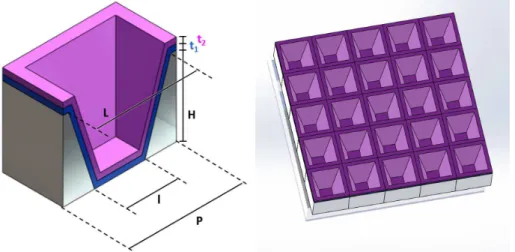
result by considering a waffle-shaped structuration of the substrate (see Fig. 1). We take SnO2
as material for the anti-reflection coating. The geometrical parameters that characterize the Al substrate are the period P, the height H of the holes, the ratio f between the width L of the holes
on the upper side and the period ( f = L/P), and finally the ratio r between the width l of the holes on the bottom side and the width L of the holes on the upper side (r = l/L). Conformal coatings of NiCrOx(thickness t1) and SnO2(thickness t2) are then added to this structure.
Fig. 1. Waffle-shaped Al substrate with NiCrOxand SnO2conformal coatings. This struc-ture is considered for the development of high-performance solar thermal collectors.
The optical properties of this waffle-shaped Al/NiCrOx/SnO2system were simulated by the
Rigorous Coupled-Waves Analysis method for the calculation of R(λ).[21, 22] The optical properties of the different materials were taken from the literature and UV-visible and IR el-lipsometric measurements.[8, 9, 23] We then used the multi-objective genetic algorithm to de-termine optimal geometrical parameters. The objective function had two components: f1=α
and f2= 1 −ε (α must be maximized;εmust be minimized). There were six parameters to
determine: P, H, f , r, t1and t2. We considered P values between 500 and 1500 nm (step of 5
nm) and H values between 500 and 2500 nm (step of 5 nm). These boundaries left P and H in the same range as the incident wavelengths. We took f between 0.5 and 0.99 (step of 0.01) and r between 0 and 0.99 (step of 0.01) in order to explore the full range of inverted pyramidal shapes. We took finally t1and t2between 50 nm and 100 nm (step of 5 nm) in order to be
rep-resentative of layer thicknesses obtained by physical vapor deposition (PVD). These parameter specifications left us with 48,763,605,000 possibilities to explore. Only 2377 evaluations of the fitness were however required by the GA.
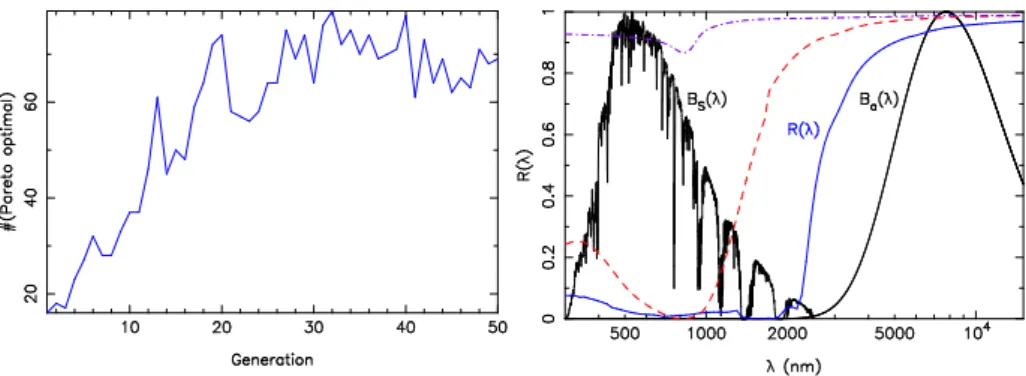
Fig. 2 shows that the genetic algorithm progressively established a whole set of
Pareto-optimal solutions. The number of these solutions increases indeed progressively to 70 on
aver-age after 30 generations. These solutions all provide ( f1, f2) values with a distinct advantage
compared to the rest of the population. No individual in the whole population provides indeed better values for both f1and f2. Amongst this set of Pareto-optimal solutions, individuals that
are better for f1are necessarily weaker for f2. This is illustrated in Table 1, where a selection of
Pareto-optimal solutions is provided. Table 1 also provides the solution that maximizes f1+ f2.
These results compare very well with the values ofα=91.2% andε=1.5% achieved in previ-ous work with a flat Al/NiCrOx/AR configuration[10] and with the record values ofα=97% and ε=5% obtained on a 3-layers stack.[8] The calculation accounts not only for the enhancement ofα, but also for the combined optimization of bothα andε. The higher values achieved for the absorptanceα are coupled with an increase of the emittanceε. The optimization process deals indeed with the cut-off wavelengthλcat which the reflectance goes essentially from zero
defi-Fig. 2. Left: number of Pareto-optimal solutions when searching for P, H, f , r, t1 and
t2 with the objective of optimizing the parametersα and ε of a solar thermal collector; Right: reflectance spectrum of the waffle-shaped Al/NiCrOx/SnO2structure that provides α = 97.8% and ε = 4.8% (solid), a flat Al/NiCrOx/SnO2structure with t1= t2= 50 nm (dashed) and a flat uncoated Al (dot-dashed). The figure includes the normalized solar irradiance spectrum BS(λ ) and the normalized black-body spectrum Ba(λ ) of the absorber at 373 K. P (nm) H (nm) f r t1(nm) t2(nm) α ε 1345 1960 0.96 0.45 50 50 97.8% 4.8% f1+f2max 1435 1975 0.99 0.31 55 50 98.4% 5.8% P-optimal 795 1590 0.90 0.28 50 50 96.1% 4.1% P-optimal 560 545 0.95 0.28 50 50 95.2% 3.7% P-optimal
Table 1. Parameters relevant to the optimization ofα and ε of a solar thermal collector. The first line corresponds to the solution that maximizes f1+ f2. The next three lines correspond to selected Pareto-optimal solutions.
nitions ofα andεand the representations of BS(λ) and Ba(λ) in Fig. 2). This increase of the
emittanceε to values that stay below 5.8% for the solutions presented in Table 1 is however low enough to maintain strong performances.
The solution that provides the maximal value for f1+ f2gives absorptance and emittance
values ofα= 97.8% andε= 4.8%. The reflectance R(λ) associated with this solution is shown in Fig. 2. The figure includes for comparison the reflectance spectrum of a flat uncoated Al as well as the reflectance spectrum of a flat Al/NiCrOx/SnO2stack with t1= t2= 50 nm. These
results confirm that the cermet and anti-reflection coatings play their role in reducing signifi-cantly the reflectance R(λ) in the main part of the solar spectrum BS(λ). This explains the high
values ofα. R(λ) then increases rapidly to values that are close to 1 for the main part of the absorber black-body spectrum Ba(λ). This explains the small values ofε.
As the solar and black-body spectra only slightly overlap, a conjoint optimization of both the solar absorptanceα and the thermal emittance ε was indeed possible. The transition in the reflectance must however be sharp and located at a wisely chosen cut-off wavelength (λc). This cut-off wavelength depends on the black-body temperature because of optimization
considerations.[2] The ideal reflectance curve of a solar absorber is represented in Fig. 4 of Ref. [2]. It indicates a cut-off wavelengthλcat around 2.5µm, for a 373 K black-body temperature.
With the addition of the underlying structure, the cut-off wavelength observed in Fig. 2 with our Al/NiCrOx/SnO2configuration has shifted from 1.5µm to 2.5µm indeed. The shift ofλc
to longer wavelengths leads to a strong increase of the solar absorptanceα. It also leads to a slight increase of the thermal emittanceε. Emittance values of the order of 5% are however
tolerable as they do not spoil performances.
The comparison between the flat and waffle-shaped Al/NiCrOx/SnO2configurations proves
that the pattering of the Al substrate has a significant impact on the reflectance spectrum and therefore on the absorptanceα and the emittance ε. Values ofα= 84.9% andε= 1.7% are indeed obtained with the flat Al/NiCrOx/SnO2configuration (taking t1=t2=50 nm), while values
ofα= 97.8% andε= 4.8% are obtained with the waffle-shaped configuration. The solutions listed in Table 1 represent different alternatives for the realization of a high-performance so-lar thermal collector. The optimization significantly enhanced the soso-lar absorptanceα with a reasonably moderate increase of the thermal emittanceε, hence reaching the expected record performances. Making a choice between these different solutions will depend on the trade-off we want to have betweenαandεand on other practical issues.
4. Conclusion
We applied a multi-objective genetic algorithm to the optimization of a solar thermal collector that consists of a waffle-shaped Al substrate with NiCrOxand SnO2conformal coatings. This
problem involved the determination of optimal geometrical parameters in order to (i) maximize the solar absorptanceα and (ii) minimize the thermal emittanceε. By using a multi-objective genetic algorithm, we actually obtained a whole set of Pareto-optimal solutions. These solu-tions represent different alternatives for the realization of a collector, the choice of a particular solution depending on a trade-off betweenα andε. The values ofα = 97.8% andε= 4.8% achieved in this work turn out to be competitive with record values found in the literature. Approaching this problem by a systematic scan on parameters would have been untractable considering the huge number of possibilities (48,763,605,000) and the time required for each evaluation of the fitness (up to 30 hours on a supercalculator). The genetic algorithm could how-ever address this problem by evaluating in parallel only a reduced number of possibilities. This proves the interest of multi-objective genetic algorithms for addressing complex optimization problems in physics.
Acknowledgements
A.M. is funded by the Fund for Scientific Research (F.R.S.-FNRS) of Belgium. L.G. is sup-ported by FNRS-FRIA. D.N. and T.C. acknowledge the Belgian Network DYSCO (Dynami-cal Systems, Control, and Optimization), funded by the Interuniversity Attraction Poles Pro-gramme and initiated by the Belgian Science Policy Office. A.M, D.N. and T.C. are members of naXys, Namur Center for Complex Systems. This research used resources of the ”Plate-forme Technologique de Calcul Intensif (PTCI)” (http://www.ptci.unamur.be) located at the University of Namur, Belgium, which is supported by the F.R.S.-FNRS under the convention No. 2.4520.11. The PTCI is member of the ”Consortium des Equipements de Calcul Intensif (CECI)” (http://www.ceci-hpc.be). Erwin Volon is acknowledged for his Solid Works represen-tations of the Al/NiCrOx/SnO2structure.
Appendix: Effective fitness based on a Pareto-classification of the population
We define in this Appendix the effective fitness feff that was used with the multi-objective
genetic algorithm.[20] We refer as previously by npopto the size of the population, by n to the
number of parameters xi and by m to the number of components fjof the objective function.
Pareto-optimal solutions were defined as solutions that are not dominated. They receive a rank of 1. Solutions that are only dominated by solutions of rank 1 receive a rank of 2. Solutions of rank 3 are only dominated by solutions of rank 1 and 2. We can proceed in this way and attribute a rank to the whole population. The effective fitness feffmust be higher for individuals
of lower rank if we want the GA to search for Pareto-optimal solutions.
We proceed therefore in the following way to define the effective fitness: all individuals of rank 1 receive an effective fitness of npop. We then define a sharing function in order to reduce,
amongst individuals of the same rank, the effective fitness of individuals that are too close from each other. This will indeed avoid early convergence of the GA to a given individual. For individuals of the same rank, we define a distance matrix whose components are defined by
dk,l=
q
∑nl=1(xi[k] − xi[l])2/(ximax− xmini )2, where xi[k] refers to the parameter xiof an
individ-ual k, xmax
i = maxk∈[1,npop]xi[k] and xmini = mink∈[1,npop]xi[k]. The sharing function between two
individuals is then defined by Sk,l= 1−(dk,l/σshare)2if dk,l≤σshareand 0 otherwise. Following
Refs [19, 20], we takeσshare= 0.5/n
√
10. We then define the niche count of a given individual by mk= ∑lSk,l, where the sum is restricted to individuals of the same rank. The effective fitness
of each individual is finally divided by its niche count. The effective fitness of all individuals of rank 2 is then initialized with a value of 0.99 × feff,min[rank 1], where feff,min[rank 1] refers to
the minimal value of the effective fitness for the individuals of rank 1. We proceed by comput-ing the distance matrix dk,l, the sharing function Sk,land the niche count mkfor all individuals
of rank 2. Their effective fitness is then divided by their niche count. We continue in this way until the whole population has been attributed an effective fitness.