PEAPOLES DEMOCRATIC REPUBLIC OF ALGERIA
MINISTRY OF HIGHER EDUCATION AND SCIENTIFIC RESEARCH FACULTY OF ARTS
DEPARTEMENT OF FOREIGN LANGUAGES
Dissertation Submitted in Partial Fulfilment of the Requirements for the Degree of Master in Applied Language Studies
Presented by: Supervised by: Miss. Laâla Djamila Dr. Youcef Beghoul
Examined by: Dr. Khiar Atamna
JUNE: 2010
SHIFTS IN TRANSLATING LEXICAL COHESION FROM
ARABIC INTO ENGLISH:
THE CASE OF FIRST YEAR MASTER STUDENTS OF ENGLISH AT
MENTOURI UNIVERSITY OF CONSTANTINE
Dedication
To Dad
for his devotion to my education
I dedicate
Acknowledgements
First of all, my special thanks to my supervisor, Dr Youcef Beghoul, for being kind enough to accept directing this work with all his academic engagements. I would also like to thank him for his advice and for his patience with me throughout the stages of this research. I would also like to thank the examiner Dr Khiar Atamna for accepting to read this work and for his advice and suggestions.
I am extremely grateful to all my friends and colleagues who helped me with the references.
Abstract
This study seeks to investigate how frequently first year master students of English shift the source text (Arabic) lexical cohesive patterns in the target language (English), as well as the textual and the semantic implications resulting from translation. To check the effectiveness of these translation shifts in establishing both the textual and the discoursal equivalence, a translation test is administered. The results show that the students shift most of the ST lexical ties, and their shifts are not as successful as to establish textual and discoursal equivalence. This is because the students fail in making accurate interpretations and in dealing with a text as a whole unit of discourse.
List of Tables
Page
Table1: Basic Conjunction Relationship in English 19
Table 2: Common General Nouns in English 22
Table 3: Reiteration by the Same Item in the Arabic Text 57
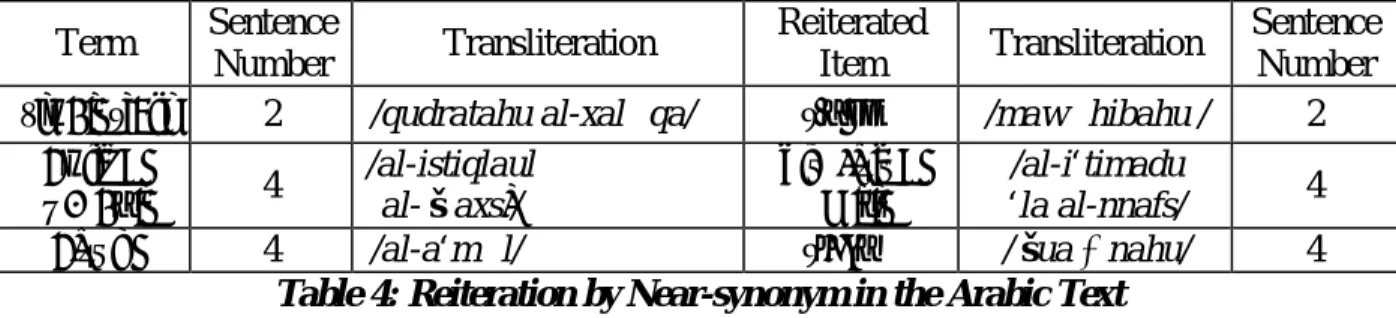
Table 4: Reiteration by Near-synonym in the Arabic Text 58
Table 5: Collocations in the Arabic Text 59
Table 6: Shifts and Formal Correspondences in the Students’ Translation 60 Table 7: Types of Translation Shifts in the Students’ Translation 61 Table 8: Types of Grammatical Shifts in the Students’ Translation 61
List of Abbreviations ST: Source text TT: Target text SL: Source language TL: Target language L2: Second language M: Modifier Q: Qualifier
List of Figures and Graphs
Figures Page
Figure 1: Types of Cohesion in English 16
Figure 2: Types of Shifts in the Current Study 53
Figure 3: Shifts and Formal Correspondences in the Students’ Translation 60 Figure 4: Types of Translation Shifts in the Students’ Translation 61
Graphs
Graph 1: Types of Grammatical Shifts in the Students’ Translation 62
Transliteration of the Arabic Writing System
In this dissertation the following transliteration system is used when representing Arabic script.
Consonants
Arabic letter Transliteration Arabic letter Transliteration
ء ? ض ḍ ب b ط ṭ ت t ظ ẓ ث ṯ ع c ج j غ ġ ح ẖ ف f خ χ ق q د d ك k ذ ḏ ل l ر r م m ز z ن n س s ه h ش š و w ص ş ى y
Vowels
Arabic letter Transliteration Arabic letter Transliteration
َـــــــــ a ا ــــــــ ā
ُـــــــــ u و ــــــــ
ū
ِـــــــــ i ي ــــــــــ
Contents
Page
Introduction 1
Chapter I: Discourse Analysis and Cohesion
Introduction 7
I. 1 What is Discourse Analysis? 7
I. 1.1 What is Discourse? 8
I. 1.1.1 Written Discourse 10
I. 1.1.1.1 Text 11
I. 1.1.1.1 Texture 11
I. 2 Cohesion 12
I. 3.1 Types of Cohesive Devices 15
I. 3.1.1 Reference 16 I. 3.1.2 Substitution 17 I. 3.1.3 Ellipses 18 I. 3.1.4 Conjunctions 18 I. 3.1.5 Lexical Cohesion 19 I. 3.1.5.1 Reiteration 19 I. 3.1.5.2 Collocations 22
I. 4 Lexical Cohesion and Text Meaning 26
Conclusion 28
Chapter II: Lexical Cohesion and Translation
Introduction 29
II. 1 Cohesion and Translation 29
II. 2 Lexical Cohesion and Translation 34
II. 3 Translation Shifts 39
II. 3.1 Formal Correspondences 40
II. 3.2 Textual Equivalence 42
II. 3.2.1 Catford’s Taxonomies to Textual Equivalence 43
II. .2.1.1 Level Shifts 43
II.3.2.1.2.Category Shifts 43
II.3.2.2. Baker’s Translation Shifts to Textual Equivalence
ix
II.3.2.2.1. Addition and Omission Shifts 50
II.3.2.2.2. Semantic Shifts 51
Conclusion 53
Chapter III: The Analysis of the Students’ Translation
Introduction 54
III. 1 Population of the Study 54
III. 2 Test 55
III. 3 Procedure 56
III. 4 Identification of lexical Ties in the Arabic Text 56
III. 4.1 Reiteration of the Same Lexical Term 58
III. 4.2 Reiteration by Near-Synonymy 59
III. 4.3 Collocations 60
III. 5 Data Analysis 60
III. 5.1 Quantitative Analysis 60
III. 5.1.1 Formal Correspondences 60
III. 5.1.2 Translation Shifts 61
III. 5.2 Qualitative Analysis 62
III. 5.2.1 Grammatical Shifts 62
III. 5.2.1.1 Unit Shifts 63
III. 5.2.1.2 level Shifts 66
III. 5.2.1.3 Intra-system Shifts 67
III. 5.2.1.4 Class Shifts 69
III. 5.2.1.5 Structure Shifts 70
III. 5.2.2 Semantic Shifts 70
III. 5.2.3 Shifts by Omission 79
III. .2.4 Shifts by Addition 81
Conclusion 84
General Conclusion 85
Bibliography 86
Appendix 88
Introduction Aim of the Study
The current study has been set out to investigate the phenomenon of shifts in translation. It is an investigation which is actually rooted in the domain of discourse analysis. It is based on Halliday and Hasan’s “Cohesion in English” model (1976) where they made a distinction between five types of cohesive markers, namely reference, substitution, conjunctions, ellipses and lexical cohesion. They mention that these cohesive markers create the semantic unity of text and that the selection of types of cohesive markers used in a particular text affects its meaning. The same thing in the process of translation, the selection of the cohesive devices by the translator to re-create the ST message will also affect the TT meaning. So, cohesive ties are very important aspects of language that translators should take into account, because, as Yule (2006:12) asserts, they may cause, or be the source of, difficulty in translation. To achieve depth in the analysis, the focus of this research is limited to the investigation of shifts involving lexical cohesion. Lexical cohesion is said to be achieved by the selection of vocabulary. It is divided into two classes: reiteration and collocation. Reiteration is subdivided into four cohesive effects: word repetition, synonym, superordinate and general word. A collocation is a predisposed combination of words that tend to regularly co-occur (e.g. orange and peel). All semantic relations not classified under the class of reiteration are attributed to the class of collocation (Hallidy and Hasan, 1976).
Lexical ties that occur naturally in the source text (ST), creating cohesion and providing texture, can rarely if ever be replicated in the TT (Baker 2002:206). The difficulty of recognizing and successfully dealing with elements of lexical cohesion is a
constant challenge to the translator and one which demands some translation decisions if the same or similar level of lexical cohesion is to be achieved in the target text (TT) as is present in the source text (ST). These decisions are those choices that might lead a translator achieve appropriate products in the target language (TL), and they are those choices that should involve awareness of discourse features and the differences between languages. The translator should decide whether the source text lexical patterns can successfully be transferred into the target language or need to be altered in some form in order to adhere to the accepted norms of the target language. At the same time, the translator must consider the impact of such re-presentation upon the transfer of intent of the ST.
On the part of the translated text, translator’s decisions are those changes known as “translation shifts”. For Catford (1965: 27), shifts are those “departures from formal correspondence in the process of going from SL to TL”. According to him, shifts are those changes which satisfy the condition that a competent bilingual can identify the relationship between ST and TT patterns as textual equivalence. Shifts may occur when there is no formal correspondence between the two languages involving the process of translation. Catford (1965) proposes two major types of shifts; these are level shift and category shift. The first occurs when a SL item at one linguistic level has a TL translation equivalent at a different level. It involves shifts from grammar to lexis and vise versa. The second involves four sub-types of shifts: class, structure, system and unit shifts. Structure shifts occur in grammatical structure. It may occur in all ranks in translation. Class shifts occurs when the SL item is translated into different class in the TL, for example translation of a verb by an adjective or a verb by a noun. Unit shift may occur when a unit at one rank in the SL is translated into a unit at a different rank in the TL. Intra-system shifts occur
within a system, when translation involves selection of a non-corresponding term in the TL systems which approximately correspond formally. As Catford (1965) states, intra-system shifts occur internally, within a system; that is for those cases where SL and TL posses systems which approximately correspond formally as to their constitution, but when translation involves selection of a non-corresponding term in the TL system, for example a term which is definite in the source text translated as indefinite one. Besides the above grammatical shifts, semantic shifts, shifts by addition and shifts by omission are also considered, by some linguists, as translation decisions to get textual equivalence across ST-TT pair.
Baker (1992) for instance states that different grammatical structures in the SL and the TL may cause remarkable changes in the way the information or a message is carried across. She states that “The grammatical structure of the target language may require the translator to add or delete information” (Baker 1992: 206), or make some changes in “the meaning” of some lexical terms. That is to say, to achieve lexical cohesion equivalence across two distinct linguistic codes, the translator may make some sorts of shifts by omitting, adding, or altering the meaning of the target text lexical ties.
This research is based on both Catford and Baker’s proposed types of shifts to textual equivalence. It tries to know how frequently first year master students of English shift the Arabic lexical cohesive patterns in TL (English). It also aims at examining the likely consequences of shifts in lexical cohesion that occurred through translation. It tries to check whether these shifts are as positive as to establish cohesion in lexical equivalence. This research is, thus, aims at answering the following question:
Research Question
How frequently do first year master students of English shift the Arabic lexical ties into English, and do these shifts establish textual and discoursal equivalence in the target language?
Research Hypotheses
Because they have very different origins, Arabic and English bear many systemic differences. Based on this theoretical assumption, we postulate that first year master students of English tend to shift most of the Arabic lexical ties rather than maintaining them in the TL (English), and these shifts fail most of the times in establishing textual and discursive equivalence. They are motivated by the students’ wrong interpretation of lexical ties and their work at word level not at a discoursal one.
Research Tools
To test the research hypothesis and to establish its validity, a translation test is necessary because it is the most suitable methodological procedure. This test will be administered to a random sample among first year master students of English. It consists of an Arabic text that tends to be translated into English. It should be noted that the register of the text is not so important as the present research is concerned with shifts at a textual level not at a stylistic one.
To achieve the aim of this research, we need to adopt both quantitative and qualitative methods. On the one hand, the quantitative method helps answering the first part of the question: how frequently first year master students shift the Arabic lexical ties into English? On the other hand, the qualitative analysis helps answering the second part: do these shifts establish equivalence in lexical cohesion in the target language?
Subjects
We will select a sample of 30 students among first year master students of English at Mentouri University of Constantine during the 2008-2009 academic year. All of them belong to the same option, which is Applied Language Studies where they are supposed to have the same level of education. They are those ones who have fair knowledge of both Arabic and English and are not just beginners in translation, as they would have been dealing with translation since their second year at the university.
Structure of the Study
This study consists of two main parts: a theoretical part and a practical one. The theoretical part will consist of two chapters while the practical one will consist of one chapter.
The first chapter will begin with a definition of discourse. The emphasis will be on written discourse and its main patterns and characteristics i.e. “text” and “texture”. The notion of “cohesion” and “coherence”, as inter-related textual aspects, will be fully investigated. A full description of the cohesive markers in English, as they are presented by Halliday and Hasan (1976), along with the five categories of cohesion (reference, substitution, ellipsis, conjunctions, and lexical cohesion) that they suggested, will be discussed and illustrated.
As it was mentioned earlier, this research is an attempt to examine the students’ shifts in translating lexical cohesion. This type of cohesion will be given more importance than any other type in this chapter.
The second chapter will establish the theoretical framework of the current study. It will present cohesion as one of the textual aspects of discourse that tends to differ across
languages. It will also illustrate the main problems concerning the translation of lexical cohesion, explain the concept of shifts in translation, and the types of shifts to achieve textual equivalence suggested by both Catford (1965) and Baker (1992).
The third chapter will deal with the identification of the cohesive patterns in the source text (Arabic) as a first step to facilitate the analysis. Then, it will quantitatively and qualitatively deal with the analysis of the students’ production in TL. It will give statistical measurements of the shifts as well as the formal correspondences, i.e., it will give statistical measurements about the elements which are said to be altered in the TL and the elements that are said to be maintained. It will also give statistical measurements about the distribution of each type of shift. Then, it will examine the affect of these shifts on TT meaning in comparison with the original.
Chapter I: Discourse Analysis and Cohesion
Introduction 7
II. 1 What is Discourse Analysis? 7
II. 1.1 What is Discourse? 8
II. 1.1.1 Written Discourse 10
II. 1.1.1.1 Text 11
II. 1.1.1.1 Texture 11
II. 2 Cohesion 12
II. 3.1 Types of Cohesive Devices 15
II. 3.1.1 Reference 16
II. 3.1.2 Substitution 17
II. 3.1.3 Ellipses 18
II. 3.1.4 Conjunctions 18
II. 3.1.5 Lexical Cohesion 19
II. 3.1.5.1 Reiteration 19
II. 3.1.5.2 Collocations 22
II. 4 Lexical Cohesion and Text Meaning 26
Chapter I
Discourse Analysis and Cohesion Introduction
Discourse analysis is the branch that is concerned with the study of the regular patterns of any piece of language, be it spoken or written. Among these regularities is cohesion. It is a concept that is said to be identified in terms of textual devices. These devices involve the different lexico-grammatical patterns such as conjunctions, ellipses, substitution, reference, and lexical cohesion.
In this chapter, we will present a general overview about discourse analysis, its concern, and the focus will be upon the concept of cohesion and its different types, especially lexical cohesion as it is the main concern of this research.
I.1 What is Discourse Analysis?
Discourse analysis is a branch that attempts to study language beyond the limits of the sentence, .i.e. it studies the relationship between language and the context in which it is used. It refers to the investigation into the way sentences “are put to communicative use in the performing of social actions” (Widdowson, 2007: 47). Discourse analysis is a study that deals with how people understand each other, make sense of what they read or hear, recognize whether a text is meaningful well-structured unit or not, and how they understand what is communicated rather than said. To illustrate this argument, let us consider the following example which is adopted from Cook (1989: 03):
a) This box contains, on average, 100 Large Plain Paper Clips. ‘Applied Linguistics’ is not the same therefore as ‘Linguistics’. The tea’s as hot as it could be. This is Willie Worm. Just send 12 Guinness ‘cool token’ bottle tops.
b) Playback. Raymond Chandler. Penguin Books in the voice in association with Hamish Hamilton. To Jean and Helga, without whom this book could never have been written. One. The voice on the telephone seemed to be sharp and peremptory, but I didn’t hear too well what it said - partly because I was only half awake and partially because I was holding the receiver upside down.
Cook comments that, although, both passages are mad up of five correct utterances each, any reader may feel that the second passage (b) is a meaningful unified whole contrary to the first one (a) which gives the feeling that it lacks unity and it does not make sense. The second passage involves some sort of linguistic forms and structures that make it hang together and appear as a meaningful whole, and although the reader is apart from making this meaning, s/he could provide large amount of information which are not explicitly mentioned. For example: s/he may indicate that the text is only a beginning of something, guess who is ‘Jean’ and ‘Helga’, identify text title, genre, author, publisher, context, intended audience, etc. So, the reader /listener can work up on the different features of the utterances and sentences to grasp the intended meaning of a writer/speaker. These features are those language characteristics and structures that discourse analysis tries to identify. For example, it tries to examine turn-taking in conversations, monologues, chats, classroom talks, and different speech interactions, or trucking the themes in written texts such as letters, notices, newspaper articles, recipes, etc. Discourse analysts are, thus, concerned with the study of the components of both written and spoken discourses.
Because there is no agreement among linguists as to the use of the term discourse (some use it for spoken form of language, and others use it for the written form), it needs more clarification and specification for its use in this research.
I. 1.1 What is Discourse?
Originally, the word ‘discourse’ comes from the Latin word ‘discursus’ which means ‘conversation/speech’. The term ‘discourse’ has very broad meanings. Some linguists use it to refer to texts, while others claim that it denotes speech. In the analysis of spoken discourse some problems are said to be posed, mainly, because of the number of interlocutors who may vary in the use of non- verbal utterances and the possibility of regular
interruptions. However, the study of written discourse is less problematic than the spoken one, because the analyst will not have to encounter with such factors, and because writers have more time to construct and to look over what they have written.
Generally, any piece of language, written or spoken, involves particular forms and structures. According to McCarthy (1991:12), discourse of whatever type is usually assumed to be meaningful, well-structured, and leads to a successful communication. This means that its words and sentences “are interrelated in conventional formulae”. These conventional formulae involve all those norms and rules people follow when they speak or write. Beaugrande (1981, Quoted in Madoui 2004: 21- 22) suggestes seven criteria which have to be fullfilled to qualify any type of discourse .These include:
- Cohesion: refers to formal surface relations between the sentences that make up the text.
- Coherence: refers to the underlying relations that hold between propositions of the sentences making up the text and which establish their relevance to the central thought of the text.
- Intentionality: refers to the text producer’s attempt at handling the linguistic resources of the text in a way that meets her intentions and communicates the message to be conveyed, in an appropriate and successful way.
- Acceptability: refers to the receiver’s ability to perceive any relevance of the text in question. A reader, for example, who cannot identify the relevance of the material in question would not be able to recognize the textuality of the text and would be unable to assign the material its property as a text.
- Informality: refers to the newness or the giveness of the information presented in the text, i.e. whether the information in the text is known or not to the receiver. A text to be informative must assure a balance between giveness and newness. A reader would not find informative a text speaks only of what is already known. On the other hand, a reader would neither find informative a text that sweeps the ground with what is totally new.
- Situationality: concerns the factors that make up a text relevant to a situation of occurrence. So, it is important to determine what is said, by whom, why, when, and where.
- Intertextuality: refers to the factors that make the use of one text dependent upon knowledge of previous texts. A text, in fact, belongs to a wider universe of discourse and it is in this sense that the text receiver is actually able to perceive the intended message.
I. 1.1.1 Written Discourse
Written discourse is a structured, pre-planned, and possibly revised form of language that is produced, most of the time, by only one interlocutor. The writer of the text knows what and how to write and s/he tends to look over what s/he has written, decides whether it is good or not, wrong or not, then corrects it or throws it away. Written discourse is a standalone medium contrary to the spoken one which is more contextual and situational. It is a medium that does not allow for the possibility of playing with intonation and pitch, which can serve as discourse markers in the verbal discourse. Writers tend to follow some norms and rules when they create texts. These rules represent the various linguistic devices which create links across the boundaries of sentences and also chain together related items. They tend to create text cohesion and help readers make sense of the texts they read.
McCarthy (1991:152) points out that the basic unit in written discourse is the sentence. He considers it as the most obvious grammatical unit that is “dismissed as being of dubious value as a unit of discourse”. A written text can be recognized as a text if it contains more than one sentence, either following one another or imbedded within one another. However, the notion of the text is slightly different in Haliday and Hasan (1976), Van Dijk (1977), and Widdowson (2007) definitions.
I.1.1.1.1 Text
A text is a unified semantic unit which refers to any spoken or written passage of whatever length. It is called by Halliday and Hasan ‘super –sentence’, because it differs from other grammatical forms like a clause or a sentence that are considered as abstract units of linguistic analysis. They wrote that “a text is not restricted to number of sentences” but it is “REALIZED BY or encoded in sentences” (1976:2). Van Dijk (1977:03) states that a text is called a text only when “utterances are reconstructed in terms of larger units where they tend to be acceptable discourses of language” and “if they are really well-formed and interpretable”. The quality of being well-formed and interpretable refers to text meaning and unity which in turn refers to writer’s linguistic choices of the linguistic patterns to transmit ideas, thoughts and beliefs or any other thing to people. These people are those readers or listeners who have to interpret what is intended. In this, Widdowson (2007:04) mentioned that a text is a piece of writing that could be recognized as it has been produced for a communicative purpose, i.e. the main function of the text is to get a message across.
I.1.1.1.2 Texture
Texture is said to be provided by the cohesive relations. Halliday and Hasan (1976:02) point out that “what distinguishes a text from non-text is its texture”. That is to say, the presence of the linguistic features in a passage made up of more than one sentence contributes in the total unity of this passage and gives it texture. The interpretation of two sentences (that form a text or a part of it) as a whole, for instance, is highly dependent on the interpretation of those linguistic ties. For example:
Wash and core six cooking apples. Put them into a fireproof dish (ibid: 3).
Here, the pronoun ‘them’ in the second sentence refers back to the ‘six cooking apples’ in the first sentence. This reoccurrence function of ‘them’ links the two sentences.
The interpretation of the second sentence depends on the first. The cohesive relation between ‘them’ and ‘the six cooking apples’ creates texture. This is because both of the terms have the same reference or ‘COREFERENTAL’ as it is called by the authors. The identity of reference is one instance of the cohesive ties that create texture. Different cohesive ties will be discussed in the chapter in question. Yet before doing so, the two concepts of textuality, namely cohesion and coherence need more identification. I. 2 Cohesion
Cohesion is a network of lexico-grammatical relations which link various parts of a text and that can be defined as continuity to its total unity. It is a relational aspect of language that distinguishes connected meaningful texts from those which are not. In other words, cohesion is a textual aspect of discourse that is explicitly expressed by different kinds of linguistic markers. It helps readers make sense of what they read and what writers want to convey. This, of course, depends on the accurate interpretations of the cohesive devices which are interdependent and involve presupposition. In Halliday and Hasan’ words (1976: 04):
Cohesion occurs where the INTERPRETATION of some elements in the discourse is dependent on that of another. The one PRESUPPOSES the other in the sense that, it cannot be effectively decoded except by recourse to it. When this happens, a relation of cohesion is set up, and the two elements, the presupposing and the presupposed, are thereby at least potentially integrated into a text.
The following is an example suggested by Yule (2006:125) to illustrate the importance of the cohesive ties in creating text unity and meaning:
My father once brought a Lincoln convertible. He did it by saving every penny he could. That car would be worth a fortune nowadays. However, he sold it to help pay for my college. Sometimes I think I’d rather have the convertible. (Underlined words are by the author of this work).
As readers, we assume that this is a meaningful whole. This text makes sense through the function of its various cohesive markers. It is clear that the underlined items are referents: the pronoun ‘he’ stands for ‘my father’, ‘my’ refers to the speaker ‘I’, and both ‘that car’ and the ‘convertible’ refer to the ‘Lincoln convertible’. The cohesive relationships between elements in a text are affected by the existence of the referring item and the presence of the item to which it refers. In this example, there are some other cohesive types between sentences. These connective items share the same elements of meaning, such as ‘money’ and ‘time’. ‘Money’ is a hyponym where ‘bought’, ‘saving’, ‘penny’, ‘worth a fortune’, ‘sold pay’, are related in meaning and ‘time’ includes ‘once’, ‘nowadays’, and ‘sometimes’. In addition, the element ‘however’ makes the relationship of what follows to what went before. Halliday and Hasan (1976: 08) also point out that cohesion is usually defined in relation to the boundaries between sentences and within a sentence. They argue that cohesion within a sentence is of less impotence because sentences are naturally cohesive thanks to their grammatical structure. To illustrate this, they propose the fallowing example:
If you happen to meet the admiral, don’t tell him his ships go down. (ibid: 08) Here there is no need for cohesion to make this sentence hang together, because it is already cohesive through its grammatical structure. It is clear that both items ‘him’ and ‘his’ refer to the ‘admiral’. This cohesive relation is created through the rule of pronominalization. From a grammatical point of view, a sentence like ‘John took John’s hat off and hang John’s hat on a peg’ (ibid:08), never occurs in the normal use of language. Reference can be identified by pronominal forms, so that we get this sentence; ‘John took his hat off and hung it on a peg’. Reference is one type of grammatical cohesion that operates at the inter-sentential level. Yet, there are other cohesive devices which are
structurally determined like lexical cohesion. Both types of cohesion are needed for writers and readers to identify the flow of ideas, reach text meaning and unity i.e. text coherence. It is clear from the above discussion that Halliday and Hasan conceive the cohesive categories as the basis of coherence. This is obviously said in their own words “cohesive ties between sentences [are] the ONLY source of texture” (ibid:02). However, this concept is challenged by many discourse analysts who believe that the concept of coherence is not always dependent on the occurrence of the linguistic ties and that cohesion is only “a guide to coherence” (MacCarthy, 1991:26). Among those discourse analysts are Brown and Yule (1983:194-5) who raised two critical questions:
a. Is Halliday and Hasan’s cohesion necessary to the identification of a text? b. Is such cohesion sufficient to guarantee identification as a text?
They view that a reader will automatically assume ‘semantic relations’ when encountering a text and interpret sentences in the light of the previous ones. Therefore, texture, in the sense of ‘explicit realization of semantic relations,’ is not critical to the identification of texts. They conducted a small experiment by scrambling the sentences in the following text while retaining the formal cohesion.
[1] A man in white clothes, who could only be the surviving half-breed, was running as one does run when Death is the pace-maker. [2] The white figure lay motionless in the middle of the great plain. [3] Behind him, only a few yards in his rear, bounded the high ebony figure of Zambo, our devoted negro. [4] An instant afterwards Zambo rose, looked at the prostrate man, and then, waving his hand joyously to us, came running in our direction. [5] They rolled on the ground together. [6] Even as we looked, he sprang upon the back of the fugitive and flung his arms round his neck. (Reorganized in the order 1, 3, 6, 5, 4, 2, this passage is taken from Sir Arthur Conan Doyle’s The Lost World, 1912), (ibid: 197).
The experiment was to show that it would not be easy for the reader to interpret such a ‘collection of sentences’ even with the presence of all the cohesive relationships. They show that cohesion alone is never sufficient for the identification of a text.
The main difference between the view of Halliday and Hasan and that of Brown and Yule lies in explicitness. While the first pair emphasise the explicit expressions of semantic relations, the second advocate the underling semantic relation that has the cohesive power, and that a text could be interpreted without any presence of the cohesive markers. However, if we compare Halliday and Hasan’s view of cohesion and Brown and Yule’s refutations, we will find that all agree that semantic relations do exist in a text and help constitute its coherence.
In the following, we will present Halliday and Hasan’s types of cohesive devices that may be established in a text.
I. 2.1 Types of Cohesive Devices
A device or a tie is a term which involves the meaning of connection. It is a term “for one occurrence of a pair of cohesively related items” (Halliday and Hasan, 1976: 2). Different types of cohesive ties can be recognized within a text with different frequency. It is a notion which helps analyze text cohesion and identify the relation between its propositions.
Halliday and Hasan distinguish between five types of ties, namely reference, conjunctions, ellipses, substitution, and lexical cohesion. These lexico-grammatical devices are summarised by Williams (1983 cited in Kennedy, 2003) in the following diagram:
Figure 1: Types of Cohesion in English
I. 2.1.1 Reference
Reference is an identity relationship that exists between two linguistic elements in a textual environment. It is a device which allows the reader to trace entities and events in the text. There are three main types of reference involving pronouns, demonstratives and comparatives. These cohesive items cannot be interpreted semantically on their own right; rather they make reference to something else within the text.
One important thing that is left to be said about reference is that it is of three types, namely, anaphoric, cataphoric and exophoric. The first two types are belonging to what Halliday and Hasan (1976) called endophoric reference, because both of them account for the relationship between two linguistic elements within a text. The former occurs when the writer refers back to someone or something that has been previously identified. This helps avoid redundant repetition. For example (King, 2000:77):
Julies saw the tulips she wanted as they were the deep purple she loved.
Lexical Grammatical Reiteration Reference Substitution Ellipses Logical Connectives Pronominal Demonstrative Comparative Exophoric Anaphoric Cataphoric Additive Contrastive Amplifying Exemplifying Causal Alternative Explanatory Excluding Temporal Summary Reiteratio n Collocation Nomominal Verbal Clausal Cohesive Ties Reiteration
The second, i.e. the cataphoric reference is less common. It occurs when writers refer forward to someone or something that has not yet been identified. For example:
They pressed round him in ragged fashion to take their money. Andy, David, Phil, Stephen, Bob (McCarthy, 1991: 35).
In this example, ‘they’ and ‘their’, refer forward to ‘Andy’, ‘David’, ‘Phil’, ‘Stephen’ and ‘Bob’. The third type of reference refers to the relationship that plays no part in textual cohesion but rather in the context of situation. For example:
For he’s jolly good fell. And so say all of us. (Halliday and Hasan, 1976:32) The pronoun ‘he’ is not made explicit in the text. Yet ‘his’ identity is known for those who share the same context.
I. 2.1.2 Substitution
In contrast to reference, substitution is a grammatical relationship rather than a semantic one. It is a relation that holds between linguistic forms rather than between linguistic forms and their meaning. That is to say, it refers not to a specific entity but to a class of items. It refers to “the replacement of one item by another” (Halliday and Hasan, 1976:88). It operates either at a nominal, verbal, or clausal level. McCarthy (1991) mentioned that ‘one/s’, ‘do/did’, ‘so/ not’, are the most common used items for substitution in English. Here are some examples from Foley and Hall (2005:35-36):
Ø Nominal: I really like sweet sherry but my husband prefers dry one.(Sherry) Davis appeared in numerous major films but practically no great ones.(Films)
The boys went out night after night and some did not return. (Boys) Ø Verbal: She doesn’t know any more than I do.(Know)
At the time, they lived very near to where I did.(Lived) Ø Clausal: Do you think WAO phones will ever catch on? I think so.
I. 2.1.3 Ellipsis
Ellipsis is an omission of a linguistic element. It can be thought of as a zero tie or nothing. This is because the tie is left unsaid. Yet, what is left unsaid is nevertheless understood. It should be noted that every utterance that is not fully explicit is elliptical. Ellipsis refers only to those cases where the grammatical structure points to an expression that can fill the gap in question (Baker 1992:187). “When we talk of ellipses […] we are referring specially to sentences, clauses, etc whose structure is such as to presuppose some preceding item which then serves as the source of the missing information” (Halliday and Hasan , ibid:143). Ellipsis like substitution operates at a nominal, verbal, and clausal level. For example:
Ø Nominal: They are small; take two. (Cookies). Ø Verbal: Were you typing? No, I wasn’t. (Typing).
Ø Clausal: I don’t know how to work this computer. I have to learn how (To work the computer) (Hatch, 1992: 225).
I. 2.1.4 Conjunction
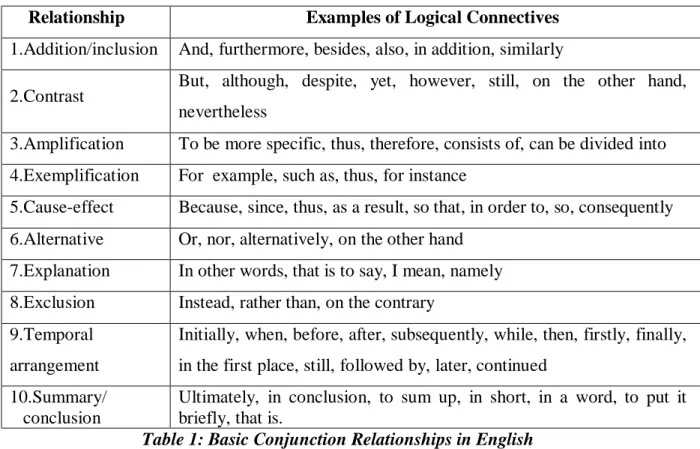
Conjunction is the fourth type of the cohesive ties in Halliday and Hasan’s modal. It is a formal marker which “explicitly draws attention to the type of relationship which exists between one sentence or clause and another” (Cook, 1989:21). It helps readers relate the ongoing discourse and its preceding part. To use Baker’s words “[the] conjunction signals the way the writer wants the reader to relate what is about to be said to what has been said before” (Baker, 1992:190). There are several kinds of conjunctive relations. Kennedy (2003:325) summarizes the most common conjunction relationships in the following table:
Relationship Examples of Logical Connectives 1.Addition/inclusion And, furthermore, besides, also, in addition, similarly
2.Contrast But, although, despite, yet, however, still, on the other hand, nevertheless
3.Amplification To be more specific, thus, therefore, consists of, can be divided into 4.Exemplification For example, such as, thus, for instance
5.Cause-effect Because, since, thus, as a result, so that, in order to, so, consequently 6.Alternative Or, nor, alternatively, on the other hand
7.Explanation In other words, that is to say, I mean, namely 8.Exclusion Instead, rather than, on the contrary
9.Temporal arrangement
Initially, when, before, after, subsequently, while, then, firstly, finally, in the first place, still, followed by, later, continued
10.Summary/ conclusion
Ultimately, in conclusion, to sum up, in short, in a word, to put it briefly, that is.
Table 1: Basic Conjunction Relationships in English
I. 2.1.5 Lexical Cohesion
Lexical cohesion is the fifth type of cohesion markers in Halliday and Hasan’s model. It refers to the role played by the selection of vocabulary. It is of two principle kinds, namely reiteration and collocation.
I. 2.1.5.1 Reiteration
This type of lexical cohesion can be achieved by:
• Reiteration of the Same Item
Of all the lexical cohesion devices, the most common form is repetition, which is simply repeated words or word-phrases, threading through the text. That is to say, the same item refers to itself in a previous linguistic environment. For example:
There was a large mushroom growing near her, about the same height as herself; and, when she had looked under it, it occurred to her that she might as well look and see what was on the top of it. She stretched herself up on tiptoe, and peeped over the edge of the mushroom… (Halliday and Hasan, 1976: 278) .
Here, the term ‘mushroom’, which occurs at the last line of this example, refers back to ‘mushroom’ at the first line. This re-occurrence of the same term creates a lexical cohesive tie. Halliday and Hasan distinguish between two types of repetition:
• Repetition with identity of reference Ø Mary bit into a peach.
Ø Unfortunately the peach wasn't ripe.
• Repetition without identity of reference Ø Mary ate some peaches.
Ø She likes peaches very much (Morris and Hirst 1991: 21).
So, repetition is not like reference, because it does not necessarily involve the same identity. Baker (1992:203) wrote that if the sentence ‘the boy is going to fall if he doesn’t take care’ followed by this sentence ‘boys can be so silly’, repetition of boy-boys still be an instance of reiteration, even though the two items do not have the same reference.
• Reiteration by Synonym
Reiteration does not involve the repetition of the same item, but it also involves the use of a synonym and near-synonym. Synonym is a term which is used to mean ‘the sameness of meaning’ (Palmer 1981:59). A semantic relationship between a term and its synonym/near- synonym within a text creates a strong cohesive tie. For example:
a. ) Accordingly… I took leave, and turned to the ascent of the peak. The climb is perfectly easy…
b. ) Then quickly rose Sir Bedivere, and ran, and leaping down the ridges lightly, plung’d among the bulrush beds, and clutch the sword. And lightly wheel’d and threw it. The great brand made light’nings in the splendour of the moon… Halliday and Hasan (1976: 178). The example (a) is an instance of reiteration by synonym; ‘climb’ refers back to ‘accent’. Yet, (b) is an instance by near-synonym. The term ‘brand’ refers back to ‘sword’.
• Reiteration by Superordinate
Superordinate or a hyponym is also an instance of reiteration. The first is called ‘upper class’, and the second is called ‘lower class’ (Palmer 1981:76). Both terms involve
the notion of inclusion. Let us consider the following example:
Henry’s bought himself a new Jaguar. He practically lives in the car. (Halliday and Hasan 1976: 178). The term ‘car’ in the second sentence refers back to ‘Jaguar’ in the first sentence, of which is a superordinate.
• Reiteration by General Term
A general term is that noun having generalized reference within the major noun classes, such as ‘place noun’, ‘fact noun’, ‘action noun’, and the like. These items play a significant role in creating cohesion. A general noun in cohesive function is usually accompanied by the anaphoric reference ‘the’. The interpretation of the general noun plus a determiner like ‘the’ is only possible by reference to something that has gone before. In this respect, the general term functions as reference as in: “it seems to have mad very little impression and on the man. It seems to have made very little impression on him” (ibid: 275). The only difference between cohesion by reference ‘him’ and the noun ‘man’ is that this latter opens up another possibility of introducing an interpersonal element into the meaning. The following table presents some examples of general nouns proposed by Haliday and Hasan:
Type Examples
human people, person, man, woman child, boy, girl
non-human animate creature
inanimate Concrete Count thing, object
inanimate Concrete mass stuff
inanimate abstract business, affairs, matters
action move
place place
fact question, idea
Table 2: Common General Nouns in English
There remains one point to be added to round off this limited discussion of reiteration as one of lexical cohesion types. A lexical item is not bound to a particular grammatical category, or to a particular morphological form, i.e. a term may appear in different inflectional or derivational forms that are often said to be guided by the context. However, it does not much matter, since each sets and pairs are cohesive anyway. For example, there is just one lexical item boy in a text which may appear in different forms such as ‘boy, boys, boy’s and boys’ as instances of re-occurrence. Similarly, ‘talk, talks, talking, and talked’ all represent a single lexical item ‘talk’. There are no perfectly clear criteria for deciding just how far this principle can be extended; for example, ‘go, goes, going, gone, and went’ are all one lexical item, and so ‘good, better, and best’.
Now, let us move to collocations as the second type of lexical cohesion. I. 2.1.5.2 Collocations
Firth (1951, cited in Fan 2008) is the first to establish the expression ‘collocations’ as a technical linguistic term. The concept of collocation in Firthian terms developed in connection with his ‘Theory of Meaning’. Firth distinguishes three levels of meaning: ‘meaning by collocation’, the ‘conceptual or idea approach to the meaning of words’, and
‘contextual meaning’. The first refer to the co-occurrences of words in general (frequent or rare), second to habitual co-occurrences of words, and the third refers to the number of consecutive words or an order of ‘mutual expectancy’. He sees that collocations exclusively as habitual co-occurrences of mutually predicting lexical items such as (‘dark’ + ‘night’) and (‘silly’ + ‘ass’).
Halliday (1966) was one of the first to build on Firth’s concept of collocation. He considers collocations as a syntagmatic association of lexical items of all probabilities which occur in a certain distance from each other. He defines ‘probability’ as “the frequency of the item in a stated environment relative to its total frequency of occurrence” (Halliday 1966:156). However, he did not really give a precise definition of the notion ‘distance’. Halliday and Hasan (1976) define the term ‘distance’ as a relative proximity in the sense of separating one item from another, i.e. the number of words or clauses or sentences in between. For example, if the term ‘sunset’ which refers to a particular event considered as a perceptual phenomenon and ‘sundown’ which refers to the same event considered as defining a moment in time, occur in adjacent sentences, they tend to exert a very strong cohesive force. Morrist and Hirst (1991:20) see that distance between words is important. They argue that if two words are related in meaning but are apart in the text, then they may not actually refer to each other. For example, if ‘grow’ and ‘fruit’ occur in the same sentence, it is much more likely that ‘grow’ actually refers to the ‘fruit’ and occurs in the same sentence. The cohesive relation seems to be much stronger than if ‘grow’ appears in a separate sentence or paragraph.
Halliday and Hasan (1976:187) consider all lexical items that systematically relate to each other in a given text as collocations. They have also called them ‘collocational cohesion’. Sinclair pointed out that “the occurrence of two or more words within a short
space of each other in a text” is a collocation (1991:170). Halliday and Hasan made from the concept of collocation a property of text lexical cohesion. “It is a cohesion created by the selection of vocabulary”. Any co-occurring terms tend to have a cohesive force in any piece of discourse. The relative strength of collocational terms is a function of two kinds of relatedness, one kind being related in the linguistic system and the other being relatedness in the text.
The text is a lexical environment within which lexical items are said to collocate. The structure of the text naturally makes words refer and collocate to each other. In this respect Halliday and Hasan mentioned that:
EVERY lexical item MAY enter into a cohesive relation, but by itself it carries no indication whether it is functioning cohesively or not. That can be established only by reference to the text. [This is because] discourse does not wander at random from one topic to another but runs on reasonably systematic lines with a certain consistency of topic and predictability of development. Most discourse is well organised, and the patterned occurrence of lexical items is a natural consequence of this (ibid: 288).
This seems to suggest that a particular collocational environment is said to be built up in the course of the creation of the text. The lexical environment determines the meaning of words, and words create a cohesive force that strengthens its meaning. In other words, the text provides the context for the creation and interpretation of words, just as the words help create the texture of the text.
However, this does not mean that collocational terms do not have their own meaning, i.e. ‘their own collocational history’ in a linguistic system (ibid). Collocations are said to relate in a linguistic system where they occur together in a regular way. They create a cohesive force which can be influenced by the degrees of proximity in the linguistic system. There are always restrictions on the way words can be combined to convey meaning. Such restrictions - Baker (1992:47) argues- are usually written down in a form of rules which determine the
‘admissible’ and ‘inadmissible’ occurrences. For example, a determiner cannot come after a noun, and ‘that beautiful girl the is’ is not an acceptable combination in English. Similarly, ‘deliver a verdict’ and ‘pronounce verdicts’ are acceptable collocations in English. Yet, ‘deliver a sentence’ is not. Plenty of examples of common collocations in English are given by Palmer (1981), such as ‘rancid butter’ and ‘addled eggs’ and not ‘rancid eggs’ and ‘addled butter’ although both ‘rancid and addled’ carry the meaning of a state of being rotten. These words have a strong collocational range. It should be noted here, also, that there are some other words which have a weak collocational range. Baker (1992: 49) states that “Every word in a language can be said to have a range of items with which it is compatible, to a greater or lesser degree”. For example, the English verb ‘shrug’ typically occurs with ‘shoulder’ and does not have a particularly strong link with any other word in the language. ‘Run’, by contrast, has a vast collocational range, some of its typical collocates being ‘company’, ‘business’, ‘show’, ‘car’, ‘stocking’, ‘nose’, ‘wild’, ‘bill’, ‘river’, ‘course’, ‘water’, and ‘colour’ (ibid).
Halliday and Hasan distinguished various meaning relations of collocational cohesion that can be established within a text. These include:
a .Relation of Autonomy: words that have different senses and stand in opposition to one another, such as ‘hate’ /’like’, ‘wet’ / ‘dry’, ‘crowded’ / ‘desert’, etc.
b. Relation of Complementarity: lexical items are used in contrast to each other. They are mutually exclusive terms, such as ‘girl’ /’boy’, ‘stand up’/ ‘set down’, and the like. c. Relation of Part to Whole: one lexical item is related to a more general class to which it is a part such as ‘car’… ‘box’… ‘lid’.
d. Relation of Par-part: whereby two or more lexical items belong to the same general class such as ‘mouth…’ ‘chin’, ‘verse…’ ‘chorus.’
e. Relation of Co-hyponymy; whereby words belong to the same general class as ‘chair’ and ‘table’ (both are hyponyms of furniture).
f. Words Down from the Same Ordered Series: such as ‘dollar,’ ‘cent,’ ‘north,’ ‘south,’ ‘colonel’ ‘brigadier’, ‘Tuesday’, ‘Thursday, ‘etc.
Halliday and Hasan (ibid: 290-1) state that the recognition of the pairs of chains that share the tendency of occurring together in a given text depends largely on the reader. It is very much dependent on common sense and one’s knowledge of the language. In fact, a native speaker would be able to distinguish between significant patterns of cohesion and insignificant ones. The most important thing is to use common sense, combined with the nature and structure of vocabulary. For example, the term ‘agreed’ in the sense of ‘exclamation’, or ‘good’ in a ‘moral context’, there is likely to be no significant association between the two occurrences. Yet, by paling the common sense, there might be quite a significant tie between the first of these and a different but related word such as ‘virtue’ or ‘judgement’.
I. 3 Lexical Cohesion and Text Meaning
In texts, lexical cohesion is the result of chains of related words that contribute to the continuity of lexical meaning. These lexical chains are a direct result of units of text being about the same thing, and finding text structure involves finding units of text that are about the same thing. Determining the structure of text is an essential step in determining the deep meaning of the text. The lexical chains also provide a semantic context for interpreting words, concepts, and sentences (Morris and Hirst, 1991).
Lexical patterns occur not simply between pairs of words but over a succession of a number of nearby related words spanning a topical unit of the text. There is a distance relation between each word in the chain, and the words co-occur within a given span.
Lexical ties do not stop at sentence boundaries. They can connect a pair of adjacent words or range over an entire text. Lexical ties tend to delineate portions of text that have a strong unity of meaning. For example (ibid: 26):
In front of me lay a virgin crescent cut out of pine bush. A dozen houses were going up, in various stages of construction, surrounded by hummocks of dry earth and stands of precariously tall trees nude halfway up their trunks. They were the kind of trees you might see in the mountains.
lexical chains spanning these three sentences is ‘virgin’, ‘pine’, ‘bush’, ‘trees’, ‘trunks’, and ‘trees’.
Lexical chains provide an easy-to-determine context to aid in the resolution of ambiguity and in the narrowing to a specific meaning of a word. They provide a clue for the determination of discourse structure, and hence the larger meaning of the text. They help in determining the flow of ideas and the change in the topics or ideas being discussed, and, hence, will have an effect on potential referents. Therefore, if we do not understand the meaning of words and structures used in a text, we cannot work out its implied meaning. The major importance of lexical chains is that they provide a clue for the determination of text meaning and structure. When a chunk of text forms a unit within a discourse, there is a tendency for related words to be used. It follows that if lexical chains can be determined, they will tend to indicate the structure of the text. Lexical chains are a clear indication of the linguistic segmentation. When “a lexical chain ends, there is a tendency for a linguistic segment to end, as the lexical chains tend to indicate the topicality of segments” (ibid: 28).
It may be remarked from the above discussion that lexical cohesion is so important in making text meaning as well as cohesion. Even if we have the different grammatical categories to establish text cohesion, lexical cohesion remains as the most necessary
condition to make this. This is because “grammatical cohesion displayed by any piece of discourse, will not form a text unless this is matched by cohesive patterning of a lexical kind” (Halliday and Hasan, 1976: 292).
Conclusion
In this chapter we have gone through the main concepts that are related to discourse; be they, text, texture, cohesion, and the different types of cohesive devices. We have reviewed cohesion and lexical cohesion in particular, as an important textual aspect of discourse that contributes to a great extent to text structure and meaning.
In the following chapter, we will consider lexical cohesion as one of the textual regularities that plays vital role in assessing a successful transmission of source text message in target language, and the possible difficulties that the translator may encounter while translating, as well as the possible ways to cope with the differences between languages.
Chapter II: Lexical Cohesion and Translation
Introduction
29 III. 1 Cohesion and Translation
29 III. 2 Lexical Cohesion and Translation
34 III. 3 Translation Shifts
39 III. 3.1. Formal Correspondences
40 III. 3.2 Textual Equivalence
42 III. 3.2.1 Catford’s Taxonomies to Textual Equivalence
43 III. .2.1.1 Level Shifts
43 III.3.2.1.2.Category Shifts
43 II.3.2.2. Baker’s Translation Shifts to Textual Equivalence
II.3.2.2.1. Addition and Omission Shifts
50 II.3.2.2.2. Semantic Shifts
51 Conclusion
53 49
Chapter II
Lexical Cohesion and Translation Introduction
The production of an appropriate target text is said to be determined, to a great extent, by the manner in which the translator deals with the textual features revealed by the source text. For expressing a certain message, the translator generally opts for a formulation which best serves this purpose. In close connection to this aspect, the cohesive elements placed in the source text are creators of the framework within which the message is to be understood. They need to be given a considered attention by the translator who would never strive to preserve all of them, but rather s/he would try to reflect the target text ones. This tendency can best be achieved by accurate interpretations and appropriate translation decisions. This is because, languages are said to differ greatly in the use of cohesive patterns.
This chapter identifies cohesion and lexical cohesion in particular, as one of the discourse regularities that are undoubtedly of a significant importance in assessing the transference of source text massage, and in dictating an appropriate approach or decisions to get the textual equivalence across ST-TT pair.
I. 1 Cohesion and Translation
Translation is said to be viewed as an act of communication that is necessarily related to at least the linguistic and discoursal systems holding for the two languages involved in the process of translation, i.e. source text (ST) and target text (TT). It is a process that requires a complex text and discourse processing (Blum Kulka, 1986).
Cohesive devices contribute to texture and are motivated by the linguistic as well as the communicative factors of both ST and TT languages, so that they need to be given a
considered attention by the translator when transferring from one language into another. In other words, the different textual chains need to be considered along their communicative and discursive potential by the translator. In this respect, Hatim and Mason state that “Texture need to be seen as an integral part of what one is doing with one’s language” (1990, 194-5).
Cohesion is arguably one of the most challenging issues in translation as each language has its own set of cohesive devices and a unique manner in which these devices are used. Every language “has its own patterns to convey the interrelationship of persons and events; in no language may these patterns be ignored”. In other words, each language has what we might call general preferences for certain cohesive patterns over others. For example, both the studies of Berman (1978 cited in Blum-Kulka, (1986) and Stemmer (1981 cited in Blum-Kulka, (1986), which are concerned with the analysis of the use of the cohesive devices between English and Hebrew, show that lexical cohesion was overrepresented in the translation of Hebrew learners to English texts. The learners tended to prefer lexical cohesion over referential linkage. They shifted most of the grammatical ties such as pronouns and demonstratives that are used to refer to entities and events in the source text, into lexical terms in the target language. In other words, the learners preferred repeating the same lexical elements rather than referring to them by other grammatical terms (Blum-Kulka 1986:19). Similarly, Callow (as discussed in Baker 1992) explains that, unlike English which tends to rely heavily on pronominal reference in tracing participants, Brazilian Portuguese generally seems to be more in favour of lexical repetition. In addition, he views that Portuguese inflects verbs for person and number, and such grammatical features provide additional means of relating process and actions to specific participants without the use of independent pronouns. Baker (1992), in turn, illustrates the tendency in
English for relatively small chunks of text to be explicitly conjoined in unambiguous ways using a wide variety of conjunctions and a highly developed system of punctuation. In contrast, Arabic tends to use a relatively small number of conjunctions which must be interpreted according to the addressee’s ability to infer relationships. The following example discussed in Baker (1992: 184) is an article from Playboy Magazine on Akio Morita, Chairman of the Portuguese:
ST: Surrounded by the toys and the gadgets of his calling – tape recorders, mini television sets, world-band radios– he is the quintessential Japanese combination that has conquered the world: a thinker turned businessman. As the eldest son of a wealthy sake and soy-sauce producer in conservative Nagoya, he was expected to take over the family business – and perhaps become the 15th generation of Morita Mayors in the local community. Instead, he spent his time taking apart clocks and listening to Western classical music and preferred the study of physics to business. During World War Two, he went into naval research as a lieutenant, working on a thermal-guided missile and other projects, and it was there that he met his future partner, Ibuka. After the war, the two set up a business after a false start in the home-appliance market manufacturing rice cookers.
TT: Produto de uma cultura que valoriza a sutileza e as maneiras indiretas, Morita, com seu jeito franco, é a ponte ideal entre o Japão e o Ocidente. Filho mais velho de um próspero produtor de oleo de soja e de saquê, em Nagoya, os pais de Morita esperavam que ele assumisse o controle dos negócios da famila. Ao invés disso, Morita passava o tempo desmontando relógios, ouvindo música clássica occidental e preferindo estudar Fisica a se meter em negócios. Durante a Segunda Guerra Mundial dedicou-se à pesquisa naval, como civil, e foi nessa época que fez a sociedade numa fábrica de panelas de cozinhar arroz. Produção total: 100 panelas.
Baker (1992: 185) points out that English prefers to pick up the reference by means of a pronoun while Portuguese prefers lexical repetition. Baker also notices that within the main paragraph under examination, Portuguese further repeats Morita twice while English persists in using pronominal reference. She notes further that the finite verbs in the Portuguese text establish additional cohesive links with Morita because they are marked for person.