HAL Id: tel-01535554
https://tel.archives-ouvertes.fr/tel-01535554
Submitted on 9 Jun 2017HAL is a multi-disciplinary open access archive for the deposit and dissemination of sci-entific research documents, whether they are pub-lished or not. The documents may come from teaching and research institutions in France or
L’archive ouverte pluridisciplinaire HAL, est destinée au dépôt et à la diffusion de documents scientifiques de niveau recherche, publiés ou non, émanant des établissements d’enseignement et de recherche français ou étrangers, des laboratoires
Influence of the difference between expectation &
perception on affective judgment : from consumers’
memory to product design : how to deal with variability
among individuals’ expectations?
Sabine Rizzo
To cite this version:
Sabine Rizzo. Influence of the difference between expectation & perception on affective judgment : from consumers’ memory to product design : how to deal with variability among individuals’ expecta-tions?. Cognitive Sciences. Université de Lyon, 2016. English. �NNT : 2016LYSE1262�. �tel-01535554�
THESE de DOCTORAT DE L’UNIVERSITE DE LYON
opérée au sein de
l’Université Claude Bernard Lyon 1
Ecole Doctorale
N° 476(Ecole doctorale Neurosciences et Cognition)
Spécialité de doctorat
:Sciences Cognitives
Soutenue le 05/12/2016, par :
Sabine RIZZO
Influence of the difference between
expectation & perception
on affective judgment
-
From consumers’ memory to product design: how to deal with
variability among individuals’ expectations?
-Devant le jury composé de :
Pr Gervais, Rémy Président du jury
Dr Chollet, Sylvie, HDR Rapporteur
Dr Schifferstein, N.J.Hendrik Rapporteur
Dr Giboreau, Agnès , HDR Directrice de thèse
THESE DE DOCTORAT EN SCIENCES COGNITIVES
Ecole Doctorale
N° 476Neurosciences et Cognition
Influence of the difference between expectation &
perception on affective judgment
-
From consumers’ memory to product design: how to deal with
variability among individuals’ expectations?
-Sabine RIZZO
Soutenue le 05 décembre 2016 devant le jury composé de :
Dr Chollet, Sylvie, HDR Rapporteur
Dr Schifferstein, N.J.Hendrik Rapporteur
Pr Gervais, Rémy Examinateur
Dr Giboreau, Agnès, HDR Directrice de thèse
UNIVERSITE CLAUDE BERNARD - LYON 1
Président de l’Université
Président du Conseil Académique
Vice-président du Conseil d’Administration
Vice-président du Conseil Formation et Vie Universitaire Vice-président de la Commission Recherche
Directeur Général des Services
M. le Professeur Frédéric FLEURY
M. le Professeur Hamda BEN HADID M. le Professeur Didier REVEL
M. le Professeur Philippe CHEVALIER M. Fabrice VALLÉE
M. Alain HELLEU
COMPOSANTES SANTE
Faculté de Médecine Lyon Est – Claude Bernard
Faculté de Médecine et de Maïeutique Lyon Sud – Charles Mérieux
Faculté d’Odontologie
Institut des Sciences Pharmaceutiques et Biologiques Institut des Sciences et Techniques de la Réadaptation Département de formation et Centre de Recherche en Biologie Humaine
Directeur : M. le Professeur J. ETIENNE Directeur : Mme la Professeure C. BURILLON Directeur : M. le Professeur D. BOURGEOIS Directeur : Mme la Professeure C.
VINCIGUERRA
Directeur : M. le Professeur Y. MATILLON Directeur : Mme la Professeure A-M. SCHOTT
COMPOSANTES ET DEPARTEMENTS DE SCIENCES ET
TECHNOLOGIE
Faculté des Sciences et Technologies Département Biologie
Département Chimie Biochimie Département GEP
Département Informatique Département Mathématiques Département Mécanique Département Physique
UFR Sciences et Techniques des Activités Physiques et Sportives
Observatoire des Sciences de l’Univers de Lyon Polytech Lyon
Ecole Supérieure de Chimie Physique Electronique Institut Universitaire de Technologie de Lyon 1 Ecole Supérieure du Professorat et de l’Education Institut de Science Financière et d'Assurances
Directeur : M. F. DE MARCHI
Directeur : M. le Professeur F. THEVENARD Directeur : Mme C. FELIX
Directeur : M. Hassan HAMMOURI
Directeur : M. le Professeur S. AKKOUCHE Directeur : M. le Professeur G. TOMANOV Directeur : M. le Professeur H. BEN HADID Directeur : M. le Professeur J-C PLENET Directeur : M. Y.VANPOULLE
Directeur : M. B. GUIDERDONI Directeur : M. le Professeur E.PERRIN Directeur : M. G. PIGNAULT
Directeur : M. le Professeur C. VITON
Directeur : M. le Professeur A. MOUGNIOTTE Directeur : M. N. LEBOISNE
Summary
One challenge when dealing with the launching of new products is to understand consumers’ expectations towards the product experience. Many innovations fail because they do not address the right expectations, for the right consumers, and for the right product.
Theories in cognitive psychology allow us to improve current methodologies of consumer tests and to design food products based on the knowledge of consumers. The objective of this research is to better understand the influence of the discrepancy between consumers’ expectations and perceptions on the affective judgment in the context of food consumption. Within the framework of Grounded and Embodied cognition, we use theories developed on Perceptual Symbol System assuming a strong relationship between concepts and sensory perceptions. Three studies were conducted on familiar and non-familiar product ranges. Results allow us to conclude that consumers’ expectations are defined as ad-hoc categories dependent on a situation of consumption, i.e. a motivation to consume the product in a determined context of consumption. Properties of the category define cognitive expectations and sensory expectations of the product. Thus, we provide evidence that concepts and sensory perceptions are strongly related through retrieval of categories.
The results of this thesis also provide methodological improvements to elicit consumers’ expectations through categorization tasks and to screen samples fitting the best with consumers’ expectations through affective judgment.
Key words
Categorization, Expectations, Food, Sensory Disconfirmation of Expectations, Affective Judgment
Résumé
Le lancement d’un nouveau produit sur le marché est une étape à risque pour l’entreprise qui peut se conclure par un échec. Une raison partielle de cet échec est que le produit ne correspond pas aux attentes des consommateurs. L’enjeu consiste donc à mieux comprendre et intégrer dans le design de produits les attentes des consommateurs.
Les théories contemporaines en psychologie cognitive nous permettent d'améliorer les méthodologies actuelles de tests consommateurs et à concevoir les produits sur la base des connaissances des consommateurs. L'objectif de cette recherche est de mieux comprendre l'influence d’une adéquation entre les attentes des consommateurs et leurs perceptions sur leurs jugements affectifs dans le contexte de consommation alimentaire. Dans le champ de la cognition incarnée et située, nous avons utilisé la théorie du Perceptual Symbol System qui suppose une forte relation entre les concepts et les propriétés sensorielles. Trois études ont été menées sur des gammes de produits familiers et non familiers. Les résultats nous permettent de conclure que les attentes des consommateurs sont des catégories ad-hoc dépendantes d'une situation de consommation, c’est-à-dire une motivation à consommer le produit dans un contexte de consommation donné. Les propriétés de la catégorie définissent les attentes de type concepts et les propriétés sensorielles attendues du produit. Ainsi, nous avons mis en évidence que les concepts et les propriétés sensorielles sont associées à travers les catégories réactivées en mémoire.
Les résultats de cette thèse ont aussi permis de proposer des améliorations aux méthodologies de tests consommateurs. Plus particulièrement, ces méthodologies permettent d’une part d’expliciter les attentes des consommateurs à travers une tâche de catégorisation et d’autre part de sélectionner les produits les plus adéquats aux attentes des consommateurs à travers l’évaluation
de leurs jugements affectifs.
Mots-clés
Remerciements
De nombreuses personnes ont participé à la réalisation de ce travail. La première raison étant que durant mon parcours d’ingénieur je m’étais posé la question de savoir si je souhaitais faire une thèse par la suite. La réponse avait été aisée. Je ne le souhaitais pas. Si j’ai aujourd’hui terminé ce travail de plus de trois ans je le dois donc à la participation de mon entourage qui a su me donner goût à la recherche, me soutenir et me montrer l’intérêt de réaliser un doctorat. La seconde raison est que l’exercice est particulièrement difficile et requiert des compétences de rigueur scientifique, de remise en question, d’équilibre entre sa vie professionnelle et familiale. Ces compétences ne faisaient pas partie au début de cette thèse de mes principales qualités. Je suis donc encore plus redevable à ces personnes pour ce qu’elles m’ont apporté, leur soutien, et la foi qu’elles ont placée en moi.
Je tiens tout d’abord à remercier les membres du jury pour avoir accepté de remettre en question mes apports scientifiques, et l’éclairage qu’ils leur ont donné. Aux Docteur Chollet, Docteur Schifferstein et Professeur Gervais, je vous remercie d’avoir lu mes travaux, de m’avoir accordé du temps pour les questionner et m’écouter durant ma soutenance. Je remercierai aussi tout spécialement le docteur Schifferstein pour les discussions que nous avons pu avoir et qui m’ont permis de mûrir encore ma réflexion sur ma recherche.
Je tiens ensuite à remercier tout spécialement Agnès, ma directrice de thèse qui m’a permis de réaliser ma recherche au sein de l’Institut Paul Bocuse. A Agnès, je tiens à te faire part de toute ma reconnaissance pour ton soutien constant durant ces quatre années ensemble, depuis la préparation du dossier CIFRE jusqu’à la soutenance de cette thèse, et même encore aujourd’hui. Je pense que j’ai été extrêmement chanceuse de bénéficier de tes conseils. Tu m’as aidé à m’épanouir professionnellement, à être plus sûre de moi et à mieux comprendre ce que j’étais capable de réaliser. Tu es quelqu’un de très compréhensif, qui a toujours su prendre en compte et comprendre mes contraintes personnelles. Pour toutes ces raisons et bien d’autres pour lesquelles il me faudrait encore sûrement une page supplémentaire merci de tout cœur.
A Michel, expert en sciences du consommateur et sensorielles chez Danone, je tiens à exprimer toute ma gratitude. Tu es à l’origine de mon envie de faire une thèse. Merci d’avoir cru en moi quand je n’étais qu’une petite stagiaire au sein de SBS. Merci d’avoir pris de ton temps et énergie pour mettre au jour ce projet et pour le suivre durant toutes ces années. Tu as aussi continuellement challengé mes résultats et mes méthodes me permettant ainsi de m’améliorer. Merci donc de m’avoir permis de réaliser cette thèse. Si je suis docteur aujourd’hui je te le dois en grande partie.
A Sabine, sensory and consumer manager au sein de SBS chez Danone, qui a été mon manager durant ces trois années, je tiens à te remercier pour tout ce que tu m’as apporté. Ce fût quelque part une première pour nous deux en tant que doctorante et manager et je tiens à dire que tu as parfaitement remplie ton rôle. Tu m’as aidé à construire ce long projet, à le rendre d’intérêt pour Danone. Merci d’avoir été à l’écoute, d’avoir répondu à mes doutes et de m’avoir fait prendre du recul sur ce travail et son importance, ce qui est le plus dur quand on est en thèse. Pour tout cela, je te suis reconnaissante. Merci d’avoir été un manager présent. Tout simplement.
A Cécile, group leader au sein de SBS chez Danone, tu as été une véritable « maman » pour moi. On pourrait entendre ce mot d’une manière péjorative, cependant il a une réelle importance pour moi et je le formule avec tout ce qu’il implique. Tu m’as véritablement aidée à me construire chez Danone, en me donnant toujours des retours très avisés sur ma place au sein de l’entreprise, ce que j’apportais, mes qualités et mes points à améliorer. Tu m’as aidé à mettre en valeur mon travail. Je tiens à te remercier pour tout ce que cette relation a impliqué pour moi. Toi seule sauras en comprendre toute l’importance.
Il serait difficile de continuer à remercier une par une toutes les personnes qui m’ont accompagné sans y consacrer des dizaines de pages, aussi vais-je devoir synthétiser.
Je souhaite remercier tout d’abord toute l’équipe de l’Institut Paul Bocuse et plus précisément le centre de recherche pour m’avoir accueilli durant ces longs mois de labeur. Dans ce cadre magnifique et grâce à l’équipe, le travail a tout de suite été plus agréable. Je tiens donc à remercier d’une part les grands, Laure, Jérémie, Chelo, Estelle, Anne-Cécile, Olga mais aussi les petits, merci à Camille, Gaétan, Anastasia, Jérémy, Sonia, Adriana pour la vie qu’ils mettent dans l’open space.
Merci tout spécialement aux anciennes de l’Institut, aujourd’hui docteurs, qui ont été une grande source d’inspiration, et de joie au quotidien ! Merci à celle qui est et restera toujours Yoda, celle qui est et restera toujours la compagne des grandes étapes, Laura, celle qui restera ma meilleure compagne de chambre étudiante, Céline, Carole et Julie. Merci de même à Rémy pour ton aide au quotidien quand à mes pauvres facultés en technologies diverses et variées. Merci enfin à Paul pour sa joyeuse compagnie !
Je souhaite remercier également toute l’équipe SBS chez Danone, qui m’a accueilli chaleureusement depuis ma sortie toute neuve de l’école et m’a soutenu durant toutes ces années. Je regrouperai dans cette section toute personne ayant eu un jour son bureau en D1 Nord. Merci donc tout spécialement aux membres du steering Sophie, Muriel, Marie-Agnès, Claire, Anne-Sophie, Jamie, et Nathalie. Merci de même aux membres très privatif du club des fumeurs, Sandrine, Cédric, Jérémie qui m’ont inlassablement écouté et conseillé durant ces temps de pauses nécessaires. Merci à mes précédentes managers, Nicole et Julie, pour votre gentillesse et vos conseils. Merci à mes compagnons de pâquerette, toujours disponibles et de bonne humeur, faisant ainsi de mon bureau un endroit privilégié pour travailler Denis, Louis, Pauline, Elodie, Carol-Anne. Merci à la personne qui a ensoleillé mes journées avec son sourire et sa patience à toute épreuve, Elodie. Merci également à Marthe pour ton extrême gentillesse et tous les instants passés à compter les voitures dans les bouchons. Merci à Alex, Laure, Florence, Priscila, Marion pour les sorties. Merci à Marie-Claude, Perrine, Isabelle, Emma, Marie, Laurence, Pierrick, Isabelle.B, Véronique pour m’avoir aidé depuis mon arrivée. Je tiens à remercier tout spécialement celle qui prend la relève avec brio et à qui je souhaite la plus belle des réussites, Julie.P.
Je tiens à remercier plus généralement toutes les personnes de l’aile D1 Nord que j’ai côtoyées au quotidien. Je citerai notamment Jean-Phi, merci pour ta bonne humeur/humour, ta gentillesse, ton soutien !
Je tiens à remercier aussi tout spécialement Docteur Bressoud, Professeur Versace et Professeur Dacremont pour leur aide et leur participation à mes comités de thèse.
Je terminerai ces remerciements par ma famille, soutien à toute épreuve, vous avez été là sans relâche, vous m’avez encouragé, aidé. Merci tout spécialement à ma sœur, Ségolène, qui comprendra l’implication de ces mots: merci pour tout.
Je tiens finalement à dédier ce travail à ma fille, Sixtine, qui à 5 ans ne veut toujours pas faire une thèse. Un jour tu changeras peut-être d’avis. En attendant, ces derniers mots sont pour toi : le travail a été dur, j’ai fait beaucoup de sacrifices mais cela en valait la peine. Je n’ai jamais lâché grâce à toutes ces personnes et aujourd’hui j’y suis arrivée.
Publications
Peer-rewieved Journal
x Rizzo S., Boesen-Mariani S., Rogeaux M., Giboreau A. What can consumers really do in a sorting task of strawberry fresh dairy products? Submitted to Food Quality and Preference.
Oral Communications
x Rizzo S., Giboreau A. (2014). A study of free-sorting variability between and within subjects. In Summer school - Food &Hospitality research: From preparation to consumption, 3-4 juillet, Lyon, France.
x Meiselman H.L., van Zyl H., Spinelli S., Cunha L.M., Giboreau A., Rizzo S., Lassallette C.P. (2014). Translation of emotion terms among (European) languages. In Eurosense- A Sense of life – 6th European conference, 7-10 september, Copenhagen, Denmark.
Proceedings
x Rizzo S., Boesen-Mariani S., Rogeaux M., Giboreau A. (2014). Espace perceptif des yaourts à la fraise avec et sans information. In Journée du Sensolier, 14 octobre, Paris, France. x Rizzo S., Boesen-Mariani S., Rogeaux M., Giboreau A. (2015). From categorization to
expectations: a study of individual variability. In Two days of cross disciplinary workshop Social Science, Cognitive Science, Economics, 21-22 September 2015, France.
Poster
x Rizzo S., Boesen-Mariani S., Rogeaux M., Giboreau A. (2015). A study on perception and expectations variability among consumers. Poster presented In Journée de l’Ecole Doctorale Lyon 1, 29 April 2015, Lyon, France.
x Rizzo S., Boesen-Mariani S., Rogeaux M., Giboreau A. (2015). Dealing with innovation: a new approach based on free sorting to evaluate expectations for an unfamiliar product. Poster presented In 11th Pangborn Sensory Science Symposium, 23-27 August 2015, Gothenburg, Sweden.
Table of Contents
Summary………..……4 Key words………..…..4 Résumé………..……5 Mots-clés………..……5 Remerciements………..…..6 Publications……….9 Figures………..…..13 Chapter 1: Introduction………..………..15Chapter 2: Bibliographical Review………..………..19
1. From perception to expectations, a categorization-based process……….21
1.1. Perception……….21
1.2. Memory………....28
1.3. Expectations………34
2. From expectations to affective judgment………..……….39
2.1. Cognitive dissonance and categorization………40
2.2. Effect of sensory disconfirmation of expectations on hedonic judgment……….….41
Chapter 3: Research question………..………50
Chapter 4: From cognitive associations to sensory expectations through ad-hoc categories….……….……..55
Introduction………..……….56
1. Study 1A: Cognitive associations induce sensory expectations………57
1.1. Research question………..……….57
1.2. Methodology………..………57
1.3. Results………..……….61
1.4. Main conclusions………..………..63
1.5. Methodological limits………..……….63
1.6. New proposal of study based on insights………65
2. Study 1B: Expectations are framed by ad-hoc categories depending on contexts and subjects………..………66
2.1. Research question and hypothesis………..…..66
2.3.
Results………..………..6
8 2.4. Main results ... 70
2.5. Methodological limits ... 70
2.5.1. New proposal of study based on insights ... 72
3. Discussion ... 73
Chapter 5: From sensory perceptions to cognitive expectations; variability among subjects……….….76
Introduction ... 77
1. Study 2A: influence of sensory perceptions on cognitive expectations ... 78
1.1. Research question ... 78
1.2. Methodology ... 78
1.3. Results... 85
1.4. Main results ... 97
1.5. Methodological limits ... 97
3.1. New proposal of study based on insights ... 99
2. Study 2B: diversity of cognitive expectations induced by sensory perception between subjects ... 100 2.1. Research question ... 100 2.2. Methodology ... 101 2.3. Results... 103 2.4. Main conclusions ... 108 2.5. Methodological limits ... 108 3. Discussion ... 110
Chapter 6: Influence of sensory disconfirmation of expectations on affective judgment……….……….……….113
Introduction ... 114
1. Study 3A: understanding the link between ad-hoc categories and sensory disconfirmation of expectations ... 115
1.1. Research question ... 115
1.2. Methodology ... 115
1.3. Results... 117
2. Study 3B: Influence of a sensory disconfirmation of expectations on affective judgments………...119 2.1. Research question ... 119 2.2. Methodology ... 120 2.3. Results... 126 2.4. Main conclusions ... 137 2.5. Methodological limits ... 137 4. Discussion ... 140 Chapter 7: Conclusions……….………..……….143
Chapter 8: General discussion...………...……….….……….………149
Going further with sorting task in a food product design ... 153
Inter-individual differences taken into account in methodologies ... 155
Expectations: a dynamic process over time ...157
Bibliography….……….……….……….………...159
Figures
Figure 1: Scheme of modal symbol system from perceptual states (source: Barsalou, 1999) ... 277
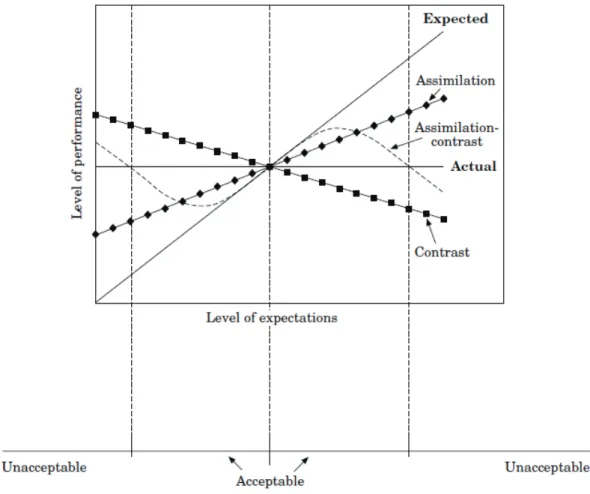
Figure 2: Theories of disconfirmation of expectations (source: Schifferstein et al, 1999) ... 422
Figure 3: Theoretical background of research ... 52
Figure 4 : Experimental background of research ... 53
Figure 5 : Research scheme of Chapter 4 ... 58
Figure 6: Photos of the range of strawberry fresh dairy products selected for the study ... 60
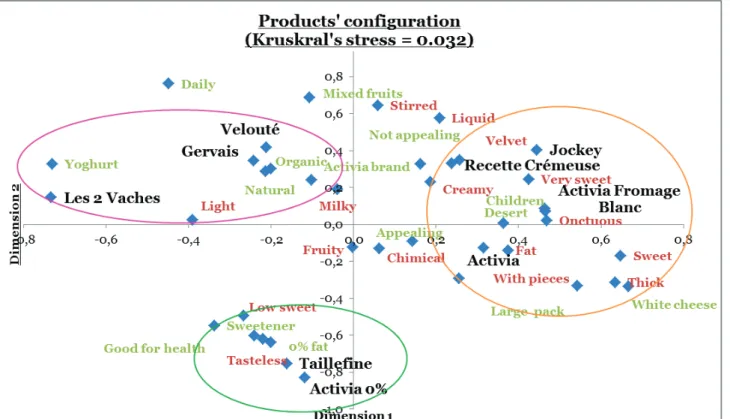
Figure 7 : Configuration of products without tasting obtained with the MDS and grouped with HAC ... 64
Figure 8: Configuration obtained with MDS in “percept” condition ... 70
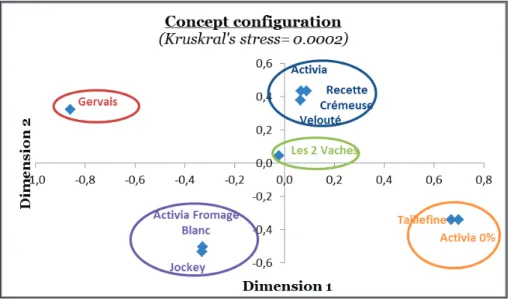
Figure 9 : Configuration obtained with MDS in concept condition... 71
Figure 10: Research Scheme of Chapter 5 ... 80
Figure 11: Cold tea drinks product presented for tasting ... 82
Figure 12: Methodology for the comparative condition ... 83
Figure 13: Methodology for the monadic condition ... 84
Figure 14:Boards of cognitive expectations defined by the consumers through collages ... 85
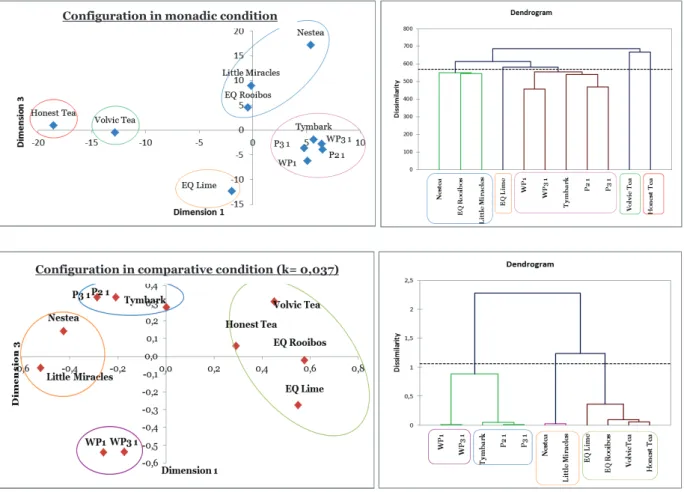
Figure 15: Mappings representing products configuration and dendograms based on HAC ... 90
Figure 16: Repartition of the number of descriptors between the two conditions ... 91
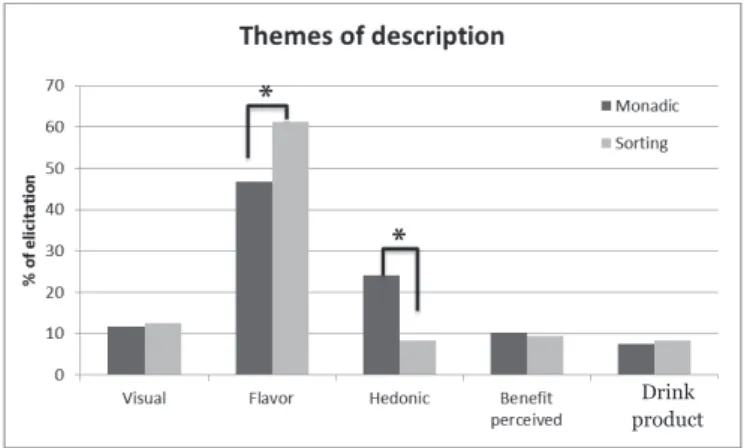
Figure 17: Verbatim elicited for the two conditions and grouped under 5 themes ... 92
Figure 18: Percentages of elicitation for each thematic descriptor for standardized data ... 93
Figure 19: Frequency of elicitation for the two conditions for Little Miracles and Nestea... 95
Figure 20: The frequency of elicitation for the two conditions for Honest Tea and Volvic Mint Tea ... 96
Figure 21: Research aims of studies 2A and 2B ... 101
Figure 22: Mapping obtained with MDS and projection of sensory descriptors for the four clusters ... 105
Figure 23: Mapping obtained with MDS and projection of associated boards for clusters of subjects ... 109
Figure 24 : Research scheme of chapter 6 ... 116
Figure 25: Procedure in two steps. Before consumption / After consumption ... 115
Figure 26: 1/ Frequency of elicitation of verbatim before (concept) and after (tasting) consumption .... 121
Figure 27: Procedure of assessment (repeated for the 4 samples) ... 124
Figure 28: Boards of pictures illustrating the benefits fitting with the motivation and the context ... 125
Figure 29: Boards of pictures illustrating two false negative benefits ... 126
Figure 30: Means of assessment of fitting with expectations for each product for each cluster ... 129
Figure 31: Means of assessment of surprise for each product for each cluster ... 129
Figure 32: Means of assessment of overall liking for each product for each cluster ... 131
Figure 33: Means of assessment of affective items for each product for cluster 1 ... 132
Figure 34: Percentage of elicitations of the reasons why the product does not fit with expectations ... 134
Figure 35: Means of assessment of fitting with benefits for each product for cluster 1 ... 135
Figure 36: Means of assessment of themes of characterization between clusters ... 138
Figure 37 : Final theoretical model of the research ... 148
Figure 38: Overview of the research ... 154
Figure 39: Configuration of products for group 1 of subjects (Kruskral’s stress = 0.045) ... 180
Figure 41: Description of each EGD ... 182
Figure 42 : Ten products presented for the tasting session ... 183
Figure 43 : Sensory perception of consumers for each product among three main sensory modalities . 185 Figure 44: Frequency of associations for each board of expectation and product ... 191
Figure 45: Steps followed during the focus-group ... 196
Figure 46: Means of assessment of affective items for each product for cluster 2 ... 211
Figure 47: Means of assessment of affective items for each product for cluster 3 ... 213
Figure 48: Percentage of elicitations of the reasons why the product does not fit with expectations ... 214
Figure 49: Percentage of elicitations of the reasons why the product does not fit with expectations ... 215
Figure 50: Means of assessment of fitting with benefits for each product for cluster 2 ... 215
Figure 51: Means of assessment of fitting with benefits for each product for cluster 3 ... 216
Tables
Table 1: Categorization of affective states _______________________________________________________ 46 Table 2 : The structure of verbatim in cognitive and sensoryassociations __________________________ 63 Table 3: Frequencies of elicitation of descriptors for the two conditions) ___________________________ 94 Table 4: Frequencies of elicitation of descriptors for the two conditions ____________________________ 96 Table 5: A summary of the descriptors most elicited and discriminating samples among the conditions 94 Table 6: Comparison of distribution between comparative and monadic conditions _________________ 98 Table 7: Significant associations with situation of consumption for each product in the two conditions 99 Table 8: Table of ARV coefficients ____________________________________________________________ 106 Table 9: tems significantly differentiating clusters of consumers (10%) ___________________________ 110 Table 10: Description of the assessment of the three items _______________________________________ 119 Table 11: Description of the assessment of the three sensory items ________________________________ 120 Table 12: Description of products _____________________________________________________________ 125 Table 13: Number of subjects per cluster obtained with HAC _____________________________________ 128 Table 14: Frequencies of check for each product and each context for cluster 1._____________________ 136 Table 15: Summary of the results for each cluster _______________________________________________ 137 Table 16: Table of ARV coefficients between configurations for each cluster and the whole set (global) 180 Table 17: Description of the nature of sensory disconfirmation of expectations _____________________ 198 Table 18: List of affective items induced by a sensory disconfirmation of expectations ______________ 201 Table 19 : Frequencies of check for each product and each context for cluster 2 _________________ 213216 Table 20: Frequencies of check for each product and each context for cluster 3. ____________________ 217
The main standard action used to pilot food design and take the decision to launch a product on the market is consumers liking. However around 76% of FMCG (Fast Moving Consumer Goods) innovations launched on the Western Europe market fail (Nielsen, 2014). This data provides strong evidence that prediction tools based on liking assessment are no longer sufficient. Indeed, these failures can partly be explained by the fact that the product does not meet consumers’ expectations (Buck, 2007). In line with the current stream of research, companies want to go beyond liking assessment and study how to improve consumer tests and measures in order to get a better prediction of a successful product (Edwards et al., 2013; Gutjar et al., 2015; Meiselman, 2013; Thomson, 2010; Thomson and Crocker, 2015).
To be successful, a product needs to be repeatedly purchased and integrated into consumers’ habits. This can be viewed as determined partly by consumers’ expectations. Indeed, the confirmation or disconfirmation of his/her expectations toward the product induces either the rejection of a product, or his/her potential repeated use of it (Anderson, 1973; Brunel and Gallen, 2012; Caporale and Monteleone, 2004; Deliza and MacFie, 1996). Therefore, the purchase of a product is highly correlated to product experience and thus, dependent on many factors related to the consumer, the product and the context of consumption (Jaeger, 2006; Meiselman, 2013; Rozin and Tuorila, 1993).
One of the factors determining product experience is the consumer’s expectations. Before even tasting the product, the consumer expects to experience several key product characteristics, benefits, and feelings based on available information at the time of purchase (Olson and Jacob, 1972; Steenkamp, 1990). Our research is focused on better understanding the expectations as an individual cognitive process impacting on food perception. This knowledge will then be integrated into the food product design process of industries such as Danone.
Moreover, consumers’ expectations and perceptions are related to the whole product experience and to the congruence between its components. In other words product characteristics, i.e. the recipe, the brand and packaging combined, should ensure that the expectations and perceptions of the consumers are met, leading to its repeated use and therefore to a successful launch of the product (Thomson and Crocker, 2015).
Product renovation and innovation are mainly driven by the marketing or through technical improvements proposed by research and development teams. In most cases, the consumer target is already determined through sociodemographic criteria such as gender, age, and profession, together with consumption habits. Prototypes, internally selected by the team, are then tested with
consumers through laboratory trials with the objective of screening the proposed products based on liking assessments. The prototype obtaining the highest score is then launched on the market. As many research studies have shown (Boutrolle et al., 2007; Delarue and Boutrolle, 2010; Köster et al., 2003), assessment of liking with a Central Location Test is not really predictive of the consumers’ experience. Some improvements have already been proposed, namely:
x to ensure more accurate predictability regarding the context of consumption, methodologies such as Home-Use-Tests have been developed to assess the performance of products at consumers’ homes in their “usual” situation of consumption (Boutrolle, 2007), x to assess the congruency between components of the full product experience, tests have been realized in branded conditions and additional criteria, such as emotions or benefits, complement the overall liking scores (Jaeger, 2006; Meiselman; Piqueras-Fiszman and Jaeger; Thomson et al., 2010),
x to take the variability of perception into account, inter-individual effects have been integrated with predictive tools of Preference Mapping, basing the results on a clusterisation of consumers on liking assessment (Rivière, 2007).
In the stream of improving consumer tests, we propose to better understand how expectations are involved in consumer judgment and more specifically, to focus on one variable not so often taken into account: the memory of consumers (Köster, 2009, 2006). Indeed, we consider memory as an important factor inducing the definition of expectations, impacting perceptual process and furthermore highlighting differences among individuals.
In the framework of the research, we therefore aim at better understanding memory as a cognitive process influencing consumers’ expectations and perceptions and how this influences their affective judgments. This understanding will be used to support an explanation of the potential limits of current methodologies of consumers tests, and how to improve them with the final objective of allowing food product design based on protocols integrating theories of cognitive psychology.
In other words, our research aim is to study the influence of relations between expectations, memory and perceptions on the affective judgments of consumers in a food context.
To reach this objective, our research is realized in connection between three domains:
x Cognitive psychology allowing the use of theoretical models of memory and perception processes. Knowledge on the structure of memory and interactions between perception
and memory will be used to support the research and the design of studies. Knowledge relating to alternative measures of feelings induced by the adequacy between expectations and perception will be gathered to improve the standard hedonic protocols used in food process design.
x Marketing research allowing a deeper understanding of the effects of expectations on the full product experience, especially in relation to the brand. Research conducted in this area will not only provide much information on the affective states related to food consumption, but also to the role of the memory in relation to expectations and food perception.
x Food science allowing us to take into account the sensory properties of the product in the methodologies of assessment of expectations and perceptions.
To sum-up, this research has a business issue: integrating consumers’ expectations as a key driver in food product design. This issue will be solved based on research insights in cognitive psychology and marketing and specific studies aimed at better understanding the role of memory in expectation and perception processes. Finally, this work will be used to improve current methodologies of consumer tests.
Chapter 2: Bibliographical
Review
Our research objective focuses on the relation between expectation, memory, perception and affective judgment. We aim at using theories in cognitive psychology to design consumer tests integrating knowledge acquired during these cognitive processes. This bibliographical review is based on a literature in cognitive psychology but also includes food sciences and marketing research to define main concepts used in our studies.
Considering consumer expectations is necessary to ensure the success of a new product launch on the market (Cardello, 2007). Indeed failings are partly due to a mismatch between what consumers expect from the product before consuming it and once they have consumed it. Therefore, designing a product based on what consumers really expect lowers the risk of product failure on the market by diminishing the risk that the product will not be recognized by the consumers (Tuorila et al., 1998) or not made it their own (Gallen and Pantin-Sohier, 2012; Gallen and Sirieix, 2011).
It is difficult for food industries to foresee consumer expectations because they rely on the relation between external information available on the product and internal information, i.e. knowledge, built on previous experiences by the subject (Cardello, 1995). In other words, consumers expectations are established during the integration of newly-presented cues about the food regarding existing knowledge based on previous experiences (Piqueras-Fiszman and Spence, 2015). Some external information can be misleading for the consumers and result in a disparity between expectation and perception. The phenomenon of mismatch relates to the fact that consumers may have different perceptions, partly because of different knowledge acquired through their experiences.
Moreover, variability among consumers has to be taken into account in product design as well as in the evaluation of product expectation and experience. Indeed product experience takes into account experiences referring to all human-product interactions (Hekkert and Schifferstein, 2008). It involves the characteristics of the user, those of the product and of the context framing the interaction (physical, economic and social) (Desmet and Hekkert, 2007). Different factors are involved in the variability of perception and choice of consumers: psychological, sociocultural, physiological factors (Köster, 2009). Amongst these factors, psychological factors (especially memory) are often omitted when studying consumers expectations and perceptions (Köster, 2003).
Therefore, we think that avoiding a mismatch between consumer expectation and perception should be possible by ensuring that the right product has been proposed to meet to the
consumers’ expectations. This is an essential condition to avoid a possible failure of a product on the market.
Expectations have been studied a lot in food sciences by investigating the influence of external information on consumer perception and judgment towards food (Caporale et al., 2006; Cardello, 2003; Cardello and Sawyer, 1992; Lenglet, 2014; Di Monaco et al., 2004; Siegrist and Cousin, 2009). These studies focused on the effect of mismatch between perception and expectations mainly by comparing experimental factors such as brand, manufacturing process, origin of products, or written information on sensory characteristics. They did not specifically assess the role of consumer memory which is our purpose. Better understanding the relationship between memory and expectation and how this link can affect perception and consumer judgment is our main question in this research.
This bibliographical review aims at defining how the following main concepts relate to each other: expectations, perception, memory and affective judgment. The first section is dedicated to defining the cognitive processes underlying perception, memory and expectation. The second section is dedicated to the analysis of existing knowledge on the relationship between expectation and product experience, and to a better understanding of how perception and specifically the congruence or mismatch between expectation and perception induce different affective judgments for the consumers.
1. From perception to expectations, a categorization-based process
This chapter is dedicated to a review in cognitive psychology and is divided into three parts. Firstly we define perception to better understand how a product is perceived by subjects. The second part defines memory and leads to its description as a categorization-based process. The third part is dedicated to the definition of expectation and its relationship with memory and perception.
1.1. Perception
1.1.1. Perception: an interpretation of stimulus
Perception is defined as “the faculty by which an organism becomes aware of his environment based on information collected by the senses” (Houdé et al., 2004). Subjects are
confronted by many sources of information while they evolve in their environment. This information helps them adapt their behavior.
Perception is activated through a stimulus that is apprehended by the subject, consciously or not. This element of the environment arouses a response from the subject (Masmoudi, 2010). Physico-chemical characteristics of the stimulus activate a stimulation pattern on the senses. These characteristics include for example a pattern of light, a gradient of chemical molecules, or the temperature. All sensory systems are involved in food perception: vision, audition, trigeminal, touch, smell and taste (Depledt, 2009; Giboreau and Body, 2007). The physico-chemical characteristics stimulate the senses through a conversion of physical or chemicals signals in nervous influx translated by the cortex (Bertrand and Garnier, 2005).
Physical and chemical information collected by sensory receptors is various and perception is multimodal, meaning that the pattern of activation of a given stimulus involves different sensory systems (Auvray and Spence, 2008). One example is the McGurk effect: a subject is looking at a video showing a man pronouncing the phoneme /ga/while the soundtrack is broadcasting the phoneme /ba/. The subject will hear a third phoneme /da/(Mcgurk and Macdonald, 1976). Regarding food perception, there are many examples which highlight this multimodality of perception. Sensory integration does not only concern in-mouth perception. For example dining in the dark with no visual cues, induces a decrease of taste and smell perception (Spence, 2012) and the color of a food is a well-known factor influencing odor perception (Morrot et al., 2001), or taste perception (Zampini et al., 2008). For instance: odors can elicit changes in perceived sweetness (Stevenson et al., 1999); increasing the level of sucrose or citric acid decreases the perceived viscosity of a solution (Christensen, 1980); increasing the level of sucrose in a chewing-gum can increase the perception of mint-flavor (Davidson et al., 1999); olfactory compounds such as butyl acetate induce a fruit odor and also activity in trigeminal nerve (Cain, 1974).
Sensory signals collected by the senses converge to a single meaning, giving congruent information to identify the stimuli. This automatic process is the integration of all sources of sensory information. It improves timeliness and efficiency of perception (Spence and Deroy, 2013).
At product level cross-modalities between senses are not only induced by the recipe itself, but also by interactions with the packaging among other things. The surface texture (the roughness or granulosity) of a container not only has an impact on the perceived texture (the crunchiness or thickness) of the recipe by the subjects (Piqueras-Fiszman and Spence, 2012) but also has an
impact on the taste (Becker et al., 2011). The color of the packaging has also been demonstrated as an impact factor on taste perception (Piqueras-Fiszman and Spence, 2011). These crossmodal correspondences are not only induced during recipe tasting but also through the experience
involving the environment, i.e. the context of consumption1.
Therefore the combination of sensory information through perception induces an estimation of the properties of the object close to reality and also depends on the weight given to each sensory variables by the subject (Driver and Spence, 2000).
Indeed, perception leads to a percept : “an accessible, subjective, reportable experience that takes the form of an activation of a certain category in mind” (Brosch et al., 2010). This percept is an individual representation of the perceived object at a given moment, not the general concept but the combination of all available information at the considered instant of perception. Physical characteristics are not translated and integrated in the same way by different subjects and at different stages of perception.
To sum-up, perception is a cognitive process integrating multimodal sensory sources leading to an individual percept. Therefore, we aim at integrating individual differences of perception.
1.1.2. Grounded cognition: perception relates to previous experiences
Differences between subjects are not only noticeable at the physiological level but also through associations between sensory modalities and knowledge. For example, a lemon drink is faster and more easily identified if the color is yellow rather than green (Zampini et al., 2008). This combination of sensory information induces the emergence of knowledge stored in the subject’s memory depending on previous experiences (Versace et al., 2009). Two kinds of processes are defined by the literature:
x Bottom-up processes, driven by information from the environment, leading to a code that is universal for all subjects. In other words, the output is the same independently of the individual (Lemaire, 1999; Marr, 1982; Marr and Nishihara, 1978).
x Top-down processes, driven by individual knowledge, giving an individual interpretation, a meaning to perceptual information (Firestone and Scholl, 2015; Lemaire, 1999; Versace et al., 2014).
Therefore individual mechanisms, such as attention or memory, are involved in perception and influence the way an object is perceived through the integration of sensory information and the interpretation of the physical characteristics.
In cognitive psychology, different theories of relation between memory and perception have been defined in the literature. Research in food science has proved the importance of the context on the product experience, i.e. the environment in which the product is consumed (Boutrolle et al., 2005; Cardello, 1995; Meiselman, 2013; Piqueras-Fiszman and Jaeger, 2014; Rozin and Tuorila, 1993a). Regarding theories in cognitive psychology, our approach will be based in the background of Grounded Cognition. This theory stipulates that cognition relates to the previous experiences of the subject and is situated (Barsalou, 2008). In other words, cognition is strongly related to interactions between a subject and his environment (Wilson, 2002). Grounded Cognition relates to Embodied Cognition which places the body at the center of the cognition (Varela et al., 1992) and emphasizes the role of the situation in the relation with cognitive processes (Pecher and Zwaan, 2005). It comes from the ecological theory of perception (Chemero, 2011) led by Gibson proposing that the environment plays a central role in a subject’s perception (Gibson, 1979). In other words perception is action-oriented and guides behavior to adapt to the environment. Understanding of sentences and texts need to be situated for example (Clark and Marshall, 1981). Thus, Grounded Cognition postulates strong interactions between memory, perception and action related to the situation
Three different principles underlie Grounded Cognition. The first one relates to the relation between perception and memory. This theory moves away from the computational model (Neisser, 1967). Perception is no longer seen as a sequential treatment where sensory information is treated by perceptive mechanism (bottom-up process) and then influenced by a feedback of long-term memory on the perceptive treatment of sensory information (top-down process) (Versace et al., 2014). Embodied Cognition and Grounded Cognition argue that cognition is a dynamical system defined as “a set of quantitative variables changing continually, concurrently, and interdependently over time” (Chemero, 2011). In other words these processes are not fixed entities but dynamic ones depending on the situation (Versace et al., 2009). In this way, prior learning and action reduce the level of information integrated by the subject by selecting only the pertinent one through the environment, brain or body (Glenberg et al., 2013; Wilson, 2002;
Wilson and Golonka, 2013). Memory and perception and action are no longer considered as separated systems (Barsalou, 2008).
The second one relates to the structure of cognitive processes. Standard theories of cognition separate semantic memory from episodic memory (Tulving, 1985). It assumes that representation built from bottom-up processes during subjects’ experiences are then transduced into amodal conceptual knowledge in semantic memory (Barsalou et al., 2003). In Embodied and Grounded Cognitions, long-term memory is a single system updated through the subjects’ experiences (Versace et al., 2009). Knowledge is grounded, i.e. representations are integrated across the sensory-motors modalities of the experience (Barsalou, 2008).
The third one relates to the knowledge retrieval during perceptive process. The theory stipulates that subjects simulate possible interactions with the environment, therefore inducting a retrieval of knowledge dependent of the situation (Barsalou et al., 2003). Due to the role of the interaction with the body, re-enactment of knowledge during perception is based on sensory-motors properties constrained by these possible interactions: the simulation recreates a partial experience referring to the full experience that has been stored (Barsalou, 2008).
To sum-up, perception is a grounded (i.e. related to sensory –motor properties) and situated (i.e. related to a context) cognitive process. Memory is integrated with perception as a retrieval of knowledge related to previous experiences.
1.1.3. The Perceptual Symbol System
The theory of Embodied and Grounded Cognition gives a frame to the link between memory and perception related to the interaction between the subjects and their environment, i.e. the situation. This theory also redefines memory in its nature and the process of retrieval during perceptive process. Thus, it has an impact on the definition of representation, knowledge and concepts regarding perceptual storage.
Knowledge stored in memory is composed of units; i.e. concepts (Barsalou et al., 2003). In classical theories of cognitive psychology, concepts are defined as mental states having semantic properties and explaining behavior and cognitive processes of subjects. Concepts are also mental representations (Machery, 2004).
Perceptual Symbol System (PSS) is the main theory illustrating Grounded Cognition and defining the nature of knowledge in this perspective. This theory has been defended by Barsalou (Barsalou, 1999). Knowledge is retrieved from simulations of past experiences and grounded in motor-sensory properties as defined in the Grounded Cognition model. Barsalou defines the notion of the perceptive symbol as: perceptual knowledge arising during simulation of perceptive states and constituting the representations retrieved during perception. In other words, these perceptive symbols are concepts stored in the memory and related to perceptive (i.e. sensory-motor) states.
Two principles underlie the definition of perceptive symbols: knowledge is modal and analogical (Figure 1). The modal aspect is due to the fact that the simulation of each concept is inducing the retrieval of the pattern of sensory-motor modalities encoded during past experiences of this concept. The analogical aspect is defined by the activation of the same neuronal pattern and the same regions of the brain as the one activated during related past experiences (Barsalou et al., 2003; Wu and Barsalou, 2009). Thus the representation of one object is a combination of different perceptive symbols. Concepts are then characterized by perceptual properties (Goldstone and Barsalou, 1998); not only semantic ones.
For example many patterns of the sensory-motor information of a chair are stored in the memory related to different past experiences. Each pattern relates a situation, a concept and sensory-motor properties. Thus conceptualizing, for example, sitting in a living room chair feeling relaxed, induces the simulation of settings, i.e. the living room, the action, i.e. sitting, and the benefit, i.e. feeling relaxed. These concepts are components of an overall representation of the chair related to specific sensory-motor modalities simulated for this situation (Yeh and Barsalou, 2006). This theory can also be applied to less detailed concepts, namely representations that are not related to a specific context by activating a pattern of less specific sensory information. In other words information can be coded by neurons in a more qualitative way without details (for example a vertical edge without precision on the length) leading to the activation of a generic image (Barsalou, 1999).
Figure 1: Scheme of modal symbol system from perceptual states (source: Barsalou, 1999)
In other words, Perceptual Symbol Systems as an illustration of memory process in Grounded Cognition considers a strong relation between the situation, the involved sensory-motors modalities and the concepts. It is worth noting that this is a dynamical system updated on experiences of the subject leading to an update of associations between perceptual states and concepts.
Conceptualization is thus the process of creating a mental representation related to a defined pattern of sensory-motor information named percept and inducing an affective reaction (Carey, 2011).
To sum-up, Perceptual Symbol System defines knowledge as a simulation of a perceptual state, i.e. sensory-motor properties related to a concept in a given situation.
1.1.4. Reminder: perception is multisensorial, situated and involves top-down processes
We consider the Perceptual Symbol System as a reference model for perceptive processes. To develop the use of the symbolic side of the perception, we need to better understand memory and, more precisely, how concepts are organized in the subjects’ knowledge.
1.2. Memory
Knowledge is organized in categories (Lemaire, 1999). “Categorization is a fundamental process whereby variables perceptual inputs are reduced progressively to a small number of equivalence classes, called “categories” whose memory representations called “concept” mediate thinking and adaptive action” (Schyns, 1997). A category is defined as a group of objects sharing similar criteria (Reed, 1972). A stimulus is therefore always categorized and identified on specific modalities: “That thing is round and nubbly and orange in color… therefore it must be an orange” (Bruner, 1957). Different theories of categorization have been proposed based on different properties sharing the same two fundamental principles.
1.2.1. Theories of concept and categorization
Various theories of concepts related to different rules of categorization have been detailed in the literature. By assuming the background of Grounded Cognition, the definition of concept differs from the classical theories and rules used to categorize. More precisely, the logic applied to group objects under the same category is not the same.
Perception is an integrative multimodal process influenced by attention and memory leading from a grounded stimulus in a given situation to an individual percept. Integrating top-down processes induces an interpretation of the stimulus according to the context of perception. Attention is involved in the perceptive process by first selecting the sensory information taken into account. Memory is solicited throughout the perceptive process by ensuring a retrieval of knowledge related to concepts associated to this information; this retrieval being strongly dependent of the context.
The aim of this paragraph is to describe the specificity of the definition of concept in the framework of Grounded Cognition compared to classical theories in cognitive psychology. Thus
we will not make a detailed review of theories of concepts and categorizations2.
x In the classical theory a concept of a category of objects is a definition. In other words the concept of the category is defined as the set of properties that are sufficient and necessary for membership within the category (Machery, 2004; Margolis, 1994; Murphy, 2004). Therefore, objects are grouped under the same category because they are the only ones to share the whole same set of attributes (Margolis, 1994). Categories are defined by a set of properties which values are discrete (Bruner, 1957). A specific hierarchisation of these categories allows making inferences between categories (Collins and Quillian, 1969). For example, according to Collins and Quillian, “canary” relates to “birds” that relates to “animal”. The main criticism of this theory is that not all the members are equivalent in a defined category depending on the situation of the subject.
x In the probabilistic theories three main examples of concepts are defined: prototype, exemplars and the explanation-based approach. The prototype and exemplars theories of concepts are based on the assessment of the typicality of the members of the category. Typicality measures the level of representativeness of an object as a member of the category. The more typical the member is, the more representative it is (Rosch, 1978; Rosch and Mervis, 1975). This theory also infers that categories are less structured and more labile. Indeed, the more typical a member is, the more properties it shares with other members, but it can also own some specific attributes not shared by the other members. Typicality of a member relies on the measure of “family resemblance”, namely the number of properties shared with other members of the group. One principle of this theory relates to probability of associations between properties. Some associations are much rarer and therefore are used less to build categories.
x Prototypical theory: concepts are defined as prototypes, i.e. a concept of a category of objects is a prototype (Hampton, 1979; Rosch and Mervis, 1975). In other words, a concept is a set of statistical knowledge of properties that must be owned by membership within a category (Machery, 2004). Objects grouped under the same category are not equivalent, meaning that one member illustrates all the properties of the category best and is therefore used as a referent of this category (Posner et al., 1967; Reed, 1972). The prototype is a central and abstract object of the category. It is
the most typical member of the category (Rosch and Mervis, 1975). The categorization process is therefore based on the closer similarities between the object and the prototype of the category. In this case the properties considered to assess the proximity between the two members are selected. This also infers that at some point the properties do not have the same weight in the definition of the category. Reed has shown that the predominant strategy to categorize new exemplars is based on the distance between the object and the prototypes of the closest categories (Reed, 1972). Differences of categorization are dependent on the previous experiences of the subjects. In other words, how they are able to extract the more relevant information and use it as criteria of categorization to identify an exemplar as a member of a category. As not all the members are equivalent or organized by their proximity to the prototype of the category, therefore, properties are no longer discrete values.
x Exemplar theory, developed by Medin and Schaffer, refutes the organization of
categories around a central, ideal member of the category (Medin and Schaffer, 1978). Categories are shaped by different exemplars stored in memory. Exemplars are defined as objects following the rules defining the category. The process of categorization is thus not the same, which means that the similarity is assessed by comparing objects to the whole set of the category members rather than to the prototype. All the exemplars are associated with points on a multidimensional space. The process is a calculation of the proximity of the object to other points on the space (Reed, 1972). The contextual effect is also taken into account as properties relating to all the members are stored with all their own criteria. Thus analogical process is also related to the criteria stored in memory based on previous experiences. Medin and Shafer gave the following examples : if the size is more relevant than the domesticity criteria to distinguish a cat from a dog, learning only about size would not be efficient for later experiences; indeed learning about domesticity as a property of the dog category can help to distinguish it from a wolf (Medin and Schaffer, 1978).
x Explanation-based theory, developed by Murphy and Medin, defines a concept as a group of objects sharing explanations about properties owned by the members (Machery, 2004; Murphy and Medin, 1985). Concept is not only a description of properties but knowledge about the function of each property shared by the members of the category, for example the coat of dogs to protect them from the cold. Based on these three main probabilistic theories, some hybrid models of concept have been developed. As the concept of schemes that is a hybrid theory between exemplars and
prototype. In other words, this theory of schemes assumes that organization in categories is made around a central member, but it can also regroup specific members less typical of, but still related to, this category because of past experiences (Smith et al., 1988) Another model considers the prototype as an ideal. The ideal is not the member owning most of the properties of the category, but the one owning the properties that a perfect member of the category should have (Machery, 2004).
x In the theory of perceptual states, based in the framework of the Grounded Cognition and Perceptual Symbol System, the definition of concept changes. Concepts are defined as perceptual states (Barsalou, 1999; Barsalou et al., 2003; Prinz, 2002). Retrieving a concept from memory induces a simulation of the properties encoded during previous experiences related to this concept. Sensory modalities are related to the concept encoded during subject’s experience (Goldstone and Barsalou, 1998). For example, thinking about a property owned by an object induces visualizing the object. Concepts are defined as the representation of a category that is dynamic among contexts (Prinz, 2002). These categories are called “ad-hoc categories” (Barsalou, 1983).
To sum-up, in the framework of Grounded Cognition concepts are defined as perceptual states, meaning representations of dynamic categories depending on the context. This theory differs from classical theories as the members share necessarily goal-derived properties and do not refer to statistical inferences but to previous experiences.
1.2.2. “Ad-hoc” categories in food consumption
Based on Grounded Cognition, perception is a cognitive process helping the subject to identify and simulate hypothesis in order to interact with objects in the most efficient way with the environment. A concept cannot be dissociated from its context, meaning that categories stored in the memory are retrieved depending on the situation and therefore on the motivation of the subject. Within this framework, Barsalou has developed “Ad-hoc” categories (Barsalou, 1983). Members of the category share the main following properties: they all fit within a goal defined by the subjects. One example given by Barsalou is the category of “objects to take in case of fire” that will group together “children”, “photos”, “jewels” and “papers”. These members shared few structural properties but all met the same motivation which defined the category.
In common with any action, food consumption is associated with a context and also the motivation to drink or eat a product. Motivation is an individual state aroused by a need and leading to activities of consumption to the achievement of a specific goal (Arnould et al., 2004; Hanna,
1980)3. In a given context, this goal is achieved through the definition of the desired consequences
of the food consumption, i.e. the benefits4 (Gutman, 1982). The consequences can be defined as
functional (“food to support my immunity”, “drink to quench my thirst”), or as emotional (“food to feel happy”, “food to feel serene”) (Thomson, 2007). Affective dimensions are taken into account in goal definition because they shape the context of consumption (Niedenthal et al., 1999). Previous experiences are better stored in memory when associated with a high affective arousal (Baumgartner et al., 1992). Thus ad-hoc categories can relate to a motivation defined by affective reaction. Niedenthal et al give as an example the following situations which can be categorized together as fear-based reactions: “the sound of an air attack”, “a snake on the road” and “admonition from a manager”.
These categories are dependent on the individual as they rely on shared motivational aspects. Consumer implication for example is a function of the motivation associated with food consumption (Arnould et al., 2004). Implication is mainly defined in marketing research related to the brand, but it can also relate to the category of the product (Gutman, 1982; Thomson, 2007). Involvement of consumers for specific benefits related to the product can influence their perception (Ares et al., 2010). Implication is also defined through the usage of the product. A study realized by Medin and Lynch showed that depending on the implication of the subjects with the objects, categorization is not the same (Medin et al., 1997). Different types of tree experts (taxonomists, maintenance workers and landscape workers) were asked to sort trees. Results showed that sorting was different among experts. Indeed landscape workers sort trees among goal-derived criteria, i.e. functional criteria, whereas taxonomists and maintenance workers differed in using different morphological features. Expertise referring also to sensory abilities or professional knowledge induces variability among subjects (Ballester et al., 2008; Chollet and Valentin, 2000; Faye et al., 2013; Lelièvre, 2010). Faye compared the categorization of wine glasses made by different groups of subjects with several levels of experiences in wine. Results showed differences of categorization and description between naïve subjects and connoisseurs (Faye et al., 2013). Furthermore in a product experience framework, expertise also relates to the knowledge acquired about the brand as loyalty, familiarity, objective and perceived, i.e subjective,
3 The purpose is not to make a classification of individual needs but define motivation and its translation in a food
consumption context
knowledge (Cho, 2011; Korchia, 2001). In studies related to brand category, categorization of a novel product is also different among subjects depending on their implication to the brand (Kreuzbauer and Malter, 2005). Thus, we consider that these various factors relate to familiarity. It is define more broadly by “how much a person thinks she/he knows about the product” or “how much a person knows about the product” (Park and Lessig, 1981). Taking into account all the components of the product experiences: recipe, packaging, brand and context of consumption, we extend familiarity to a reference to usage, conceptual knowledge and implication inducing a variability in the construct of ad-hoc categories.
Furthermore, these categories are also context-dependent. Context is defined with all the parameters that are noticeable in the environment to define an event (time, location, social etc) (Cardello, 1995). In cognitive psychology, situation is defined initially by spatial and temporal parameters (Yeh and Barsalou, 2006). More precisely, a situation can be defined from an entire physical setting to an adjacent stimulus. In other words, by context, we do not only mean physical environment, but also the level of sensory information available on the product through the different objects next to the target object. Some studies have shown the impact of: environmental parameters (Barsalou, 1982; Boutrolle, 2007; Joubert, 2008); information on brand or on the packaging (Becker et al., 2011; Di Monaco et al., 2004; Varela et al., 2010); and on the diversity of sensory information (Bech-Larsen and Nielsen, 1999; Breivik and Supphellen, 2003).
Ad-hoc categories follow the fundamental principles of categorization shared by classical theories. For example, some members of the category can be more typical than others. Two fundamental principles underlie categorization: “to provide maximum information with the least cognitive effort” and assert through the categories that “the perceived world come as structured information rather than as arbitrary” (Rosch, 1978). The first principle is about cognitive economy, meaning that categorizing allows extracting more information with the least cognitive effort. Indeed, identifying the stimulus is always related to a specific purpose. In this case, the level of categorization, or the number of attributes taken into account in the mechanism, will be the chosen function of the goal of the subject to adapt his behavior. The second principle is about combining the attributes in order to be as close as possible to the reality of perception. The structure of the world is an empirical link based on our senses. This congruency of associations between attributes is dependent on many factors such as species, culture, context, etc.
Categorizing a stimulus is activating the inductive aspects that define the category, namely the sufficient criteria to define the category. These attributes allow associating the stimulus to the given category. For example, the sufficient or inductive criteria for the category of “birds” are
“wings”. Categorizing is also activating deductive attributes, namely attributes of the category that will be associated to the stimulus. For example, a deductive criterion of the category “birds” is “flying”.
To sum-up, concepts are representation of knowledge stored in memory and structured into ad-hoc categories. The latter are defined by a sharing of goal-derived properties. In food consumption these properties are called situation of consumption, i.e. a motivation to consume the product in a given context of consumption.
1.2.3. Reminder: memory is organized in ad-hoc categories
1.3. Expectations
This section on expectations is mainly based on food science literature. The objective is to highlight the discrepancy between actual theories developed in cognitive psychology regarding perception and memory, and the state of food science regarding expectations.
In common with all actions, food consumption is always related to a motive. If the subject choses to eat or drink some food, then he expects the precise attributes of the food experience to fulfill his expectations. For example, if someone wants to drink because he feels thirsty, then he will search for a product that he imagines is refreshing, liquid, transparent and not sweet. The consumers’ expectations (before consumption) influence the way the product is perceived and
Categorization is a process of identification structuring memory into groups of objects sharing similar criteria. Different theories have been proposed to explain how a subject can identify an object and categorize it. The common theme to all these theories is the sharing of properties between members and an inference of the properties of the category to the object. When focusing on food consumption, motivation and the context of consumption play a significant role, thus, “ad-hoc” categories seem to be the most efficient way to study the role of memory in the perceptive process. Categorization is made under a specific situation of consumption, i.e. a motivation to consume the product in a given context of consumption.