HAL Id: tel-02612246
https://tel.archives-ouvertes.fr/tel-02612246
Submitted on 19 May 2020HAL is a multi-disciplinary open access archive for the deposit and dissemination of sci-entific research documents, whether they are pub-lished or not. The documents may come from teaching and research institutions in France or abroad, or from public or private research centers.
L’archive ouverte pluridisciplinaire HAL, est destinée au dépôt et à la diffusion de documents scientifiques de niveau recherche, publiés ou non, émanant des établissements d’enseignement et de recherche français ou étrangers, des laboratoires publics ou privés.
state information
Luan Chen
To cite this version:
Luan Chen. Enhancing indoor location fingerprinting using channel state information. Signal and Image processing. Conservatoire national des arts et metiers - CNAM, 2020. English. �NNT : 2020CNAM1281�. �tel-02612246�
Centre d’Études et De Recherche en Informatique et Communications (CEDRIC)
THÈSE DE DOCTORAT
présentée par :
Luan CHEN
soutenue le :
15 Avril 2020
pour obtenir le grade de : Docteur du Conservatoire National des Arts et Métiers Discipline : Génie Informatique, Automatique et Traitement du Signal
Spécialité : Radiocommunications
Enhancing Indoor Location Fingerprinting using
Channel State Information
THÈSE dirigée par
M. LE RUYET Didier Professeur des Universités, CNAM ET co-encadrée par
Mme. AHRIZ Iness Maître de conférences, CNAM
RAPPORTEURS
M. BOYER Rémy Professeur des Universités, Université de Lille M. CANCES Jean-Pierre Professeur des Universités, Université de Limoges PRÉSIDENT DU JURY
M. DENBY Bruce Professeur des Universités, Sorbonne Université EXAMINATEURS
Mme. BAUDOIN Geneviève Professeur, ESIEE Paris
The whole journey of my Ph.D. study would not have been accomplished without the supports from lots of amazing people.
First and foremost, I would like to express my greatest gratitude to my thesis super-visors Prof. Didier Le Ruyet and Dr. Iness Ahriz. They have guided me throughout the research process, taught me how to frame problems and analyze them, inspired me to conquer all the tough challenges. Beyond this, Didier’s unfailingly positive attitude and his excellent advice can always help me walk out of our meeting with a newfound vigor and enthusiasm for my coming works. In addition, Iness’s ability to get to the heart of the issue incredibly facilitated my research and I really appreciate her thoughtful caring to my daily life in Paris. I have benefited tremendously from both relationships and fell extremely privileged to have worked with them in the past three years.
I am immensely grateful to my former supervisor Prof. Hong Sun. Without her recommendation, I would not have this opportunity to study in CNAM and finally obtain the doctoral degree. I also greatly appreciate Dr. Haijian Zhang’s research guidance before my Ph.D. study in Wuhan University. Besides, Mr. Christophe Alexandre had done a great contribution in the hardware part of my thesis and I will be always thankful for that.
I thank my fellow lab mates Wafa Njima, Stanley Smith, Bastien Ligneul, Chaima Zammali, Xinying Cheng, Xiaotian Fu, Bruno Fontana da Silva, Yang Wu, Yi Yu, etc.. This wonderful experience we have shared in the lab will always be kept in my mind. I also cherish the enjoyable memories in Paris with my friends Gang Liu, Chenguang Liu
and Xiangli Yang.
Meanwhile, I would also like to send heartfelt thanks to my thesis jury members for their valuable and constructive suggestions, which further help to improve my research work towards perfection.
My graduate work was fully supported by the China Scholarship Council (CSC). I will bear in mind with enduring appreciations.
Last but not least, I thank my parents and my girlfriend Qian Zhang for their uncon-ditional love and endless support at any time. Hereby, I wish all the beloved ones to enjoy a happy and healthy life in the years to come.
The expeditious development of wireless communications and ubiquitous deployment of Wi-Fi systems indoors have nurtured considerable commercial and industrial indoor Loca-tion based Services (LBSs) in the field of Internet of Things (IoT). The most fundamental functionality is to pinpoint the location of the target via wireless devices. To this end, the pattern-matching based Location Fingerprinting (LF) stands out as a promising technique which can return the best-fitted location estimation among a set of geo-tagged Reference Points (RPs), enabling accurate position determination even in the complex multipath-rich environments. For the existing indoor LF solutions, most previous works appeal to the simple and easily-accessible Received Signal Strength (RSS) fingerprint as the indicator of Medium Access Control (MAC) layer’s link quality. However, RSS suffers from dramatic performance degradation due to sophisticated environmental dynamics. In contrast, the fine-grained Physical (PHY) layer Channel State Information (CSI) characterizes the chan-nel qualities on the level of multiple orthogonal subcarriers, thus capable of bringing richer location-specific information for indoor fingerprinting. Meanwhile, this intricate structure of CSI inevitably leads to an increased computational complexity for the practical local-ization implementation. In addition, the harsh indoor environment can also breed similar radio signatures among certain predefined reference points, which may be randomly dis-tributed in the area of interest, thus mightily tampering the location mapping accuracy.
To work out these dilemmas, in this thesis, we design and implement two CSI-based indoor location fingerprinting systems, namely EntLoc and AngLoc. For EntLoc, a power-based tap filtering scheme is first proposed to remove the noisy component in raw CSI measurements. To capture the most informative statistical channel information while
maintaining the structural simplicity, we adopt the Autoregressive (AR) modeling based entropy of CSI amplitude as the location fingerprint to construct a robust offline radio map. In the online phase, we employ the succinct Manhattan distance as similarity metric and resort to the flexible kernel regression approach to accurately figure out the target’s position. As an upgraded version of EntLoc, AngLoc system leverages the well-known An-gle of Arrival (AoA) as an additional fingerprint, which can be accurately retrieved from CSI phase through an enhanced subspace based algorithm. This dedicated mechanism serves to further eliminate the error-prone RP candidates, thus fertilizing the opportu-nity to achieve the decimeter-level positioning accuracy. Specifically, apart from the AR entropy-based fingerprint generating for CSI amplitude in the offline phase, we also study some deep-rooted phase errors in the raw CSIs and utilize several phase calibration algo-rithms to mitigate them, which guarantees a reliable angular fingerprint estimation. In the online phase, by exploiting both CSI amplitude and phase information, a novel bivariate kernel regression scheme is proposed to precisely infer the target’s location. Furthermore, the entire indoor experiments are conducted on the lightweight HummingBoard platform, which tremendously facilitates the time-consuming and labor-intensive fingerprinting im-plementation. Besides, the results from extensive indoor experiments validate the superior localization performance of our proposed systems over previous approaches.
Keywords: Indoor localization, channel state information, entropy, array signal pro-cessing, kernel regression.
Le développement rapide des communications sans fil et le déploiement omniprésent des systèmes Wi-Fi ont nourri des services commerciaux et industriels de géolocalisation (LBS) dans le domaine de l’Internet des objets (IoT). La fonctionnalité la plus fondamentale consiste à localiser l’emplacement de la cible via des appareils sans fil. À cette fin, la localisation par empreinte radio (LF) basée sur la correspondance de motifs se distingue comme une technique prometteuse qui peut renvoyer l’estimation de l’emplacement la plus fine à partir d’un ensemble de points de référence (RP) géolocalisés, permettant une détermination précise de la position, même dans les environnement complexes riches en trajets multiples. Pour les solutions LF d’intérieur existantes, la plupart des travaux précédents font appel à l’empreinte RSS (Received Signal Strength) simple et facilement accessible comme indicateur de la qualité de liaison de la couche MAC (Medium Access Control). Cependant, RSS souffre d’une dégradation spectaculaire des performances due à une dynamique environnementale importante. L’information sur l’état du canal (CSI) de la couche physique indique la qualité du canal au niveau de plusieurs sous-porteuses orthogonales, donc capable d’apporter des informations spécifiques à l’emplacement plus riches pour les empreintes digitales en intérieur. Cette structure complexe de CSI conduit inévitablement à une complexité de calcul accrue pour la mise en œuvre pratique de la localisation. En outre, l’environnement intérieur hostile peut également générer des signatures radio similaires parmi certains points de référence prédéfinis, qui peuvent être distribués de manière aléatoire dans la zone d’intérêt, altérant ainsi la précision de la cartographie de localisation.
Pour résoudre ces dilemmes, dans cette thèse, nous concevons et mettons en œuvre
deux systèmes d’empreintes de localisation en intérieur basés sur CSI, à savoir EntLoc et AngLoc. Pour EntLoc, un schéma de filtrage des mesures basé sur la puissance est d’abord proposé pour supprimer la composante bruyante dans les mesures CSI brutes. Pour capturer les informations de canal statistique les plus informatives tout en partageant la simplicité structurelle du RSS, nous adoptons l’entropie basée sur la modélisation au-torégressive (AR) de l’amplitude CSI comme empreinte de l’emplacement pour construire une carte radio hors ligne robuste. Dans la phase en ligne, nous utilisons la distance de Manhattan comme métrique de similarité et avons recouru au schéma de régression par noyaux pour déterminer avec précision la position de la cible. En tant que version améliorée d’EntLoc, le système AngLoc exploite l’angle d’arrivée bien connu (AoA) comme empreinte supplémentaire, qui peut être récupérée avec précision à partir de la phase CSI grâce à un algorithme par sous-espace. Ce mécanisme dédié sert à éliminer davantage les candidats RP sujets aux erreurs, permettant ainsi d’atteindre la précision au niveau du décimètre. Plus précisément, en plus de la génération d’empreintes digitales basée sur l’entropie AR pour l’amplitude CSI dans la phase hors ligne, nous étudions égale-ment certaines erreurs de phase profondéégale-ment enracinées dans les CSI bruts et utilisons plusieurs algorithmes d’étalonnage de phase pour les atténuer et garantir une estimation d’empreinte angulaire fiable. Dans la phase en ligne, en exploitant à la fois les informa-tions d’amplitude et de phase CSI, un nouveau schéma de régression par noyaux bivarié est proposé pour déduire précisément l’emplacement de la cible. En outre, toutes les ex-périences en intérieur sont menées sur la plate-forme légère HummingBoard, ce qui facilite considérablement la mise en œuvre des empreintes digitales chronophages et laborieuses. En outre, les résultats d’expériences montrent les meilleures performances de localisation de nos systèmes proposés par rapport aux approches précédentes.
Mots clés: Localisation indoor, informations des canaux, entropie, traitement du signal du réseau, régression par noyaux.
Chapitre 1: Introduction
Avec la prolifération à grande échelle des communications sans fil et de l’informatique om-niprésente, le service basé sur la localisation (LBS) est devenu un catalyseur clé pour une myriade d’applications de pointe dans le domaine de l’Internet des objets (IoT). Malgré cela, le système mondial de navigation par satellite (GNSS) peut déjà offrir une localisa-tion extérieure réussie et précise. Cependant, il souffre d’une dégradalocalisa-tion spectaculaire des performances dans l’environnement intérieur complexe en raison du blocage des sig-naux satellites. Grâce à la disponibilité omniprésente et au déploiement à faible coût, la connaissance de la localisation intérieure basée sur le Wi-Fi se distingue comme l’une des solutions les plus attrayantes vis à vis des autres techniques de communication sans fil. Parmi les solutions émergentes pour le positionnement intérieur basé sur le Wi-Fi, l’empreinte digitale de localisation (LF) bénéficie d’un mécanisme de correspondance de modèle, qui comprend une phase de formation hors ligne et une phase d’estimation de lo-calisation en ligne. Plus précisément, dans la phase hors ligne, les signatures sans fil sont collectées sur un ensemble de points de référence (RP) géolocalisés dans la zone d’intérêt pour construire la base de données d’empreintes digitales (carte radio par exemple). Pen-dant la phase en ligne, la signature mesurée à une position inconnue est associée à la carte radio hors ligne pour renvoyer l’estimation de l’emplacement la mieux adaptée.
Comparé à la puissance du signal reçu (RSS) qui souffre d’une dégradation spectacu-laire des performances due à la décoloration par trajets multiples à petite échelle et à la
dynamique temporelle à l’intérieur, les informations d’état de canal (CSI) de couche PHY sont capables de caractériser le canal pour chaque paire d’antennes d’émission-réception au niveau de plusieurs sous-porteuses orthogonales. Ainsi, il peut servir de géo-signature préférable pour apporter des informations spécifiques à l’emplacement plus riche.
Dans cette thèse, nous proposons d’abord EntLoc, un système d’empreinte digitale de localisation probabiliste basé sur le Wi-Fi utilisant des informations d’amplitude CSI. Il recourt à la métrique entropique basée sur la modélisation autorégressive (AR), qui équivaut à une transformation directe à partir de la PDF d’origine des amplitudes CSI sous forme de densité spectrale de puissance (PSD). Grâce à des expériences approfondies menées dans des bancs d’essai réalistes, nous démontrons que notre métrique entropique AR proposée surpasse son empreinte digitale CSI ou RSS d’origine. Comment exploiter correctement les informations de phase CSI dans notre système d’empreintes digitales de localisation basé sur l’entropie reste ouvert.
Inspiré par les récents progrès du traitement du signal en réseau phasé, l’exploitation de l’AoA comme empreinte digitale supplémentaire nous permet de revisiter l’exploitation de la phase CSI avec un nouvel horizon. Étant donné qu’il peut exister des candidats RP distants dont les lectures AoA diffèrent beaucoup de celles de la cible en ligne, ces faux RP hors ligne peuvent être exclus pour affiner davantage la précision de la prise d’empreintes digitales de l’emplacement. Sur cette base, nous concevons plus avant AngLoc, un sys-tème de localisation intérieure probabiliste compatible AoA utilisant un appareil Wi-Fi standard. Toutes les expériences sont menées sur la plate-forme légère HummingBoard, ce qui facilite considérablement la mise en œuvre des empreintes digitales chronophages et laborieuses. Les résultats expérimentaux valident les performances supérieures de notre système proposé par rapport aux approches d’empreintes digitales de localisation précé-dentes.
Chapitre 2: Préliminaires
Dans ce chapitre, nous examinerons l’empreinte digitale du signal sans fil de base de cette thèse, c’est-à-dire les informations sur l’état des canaux.
Dans les systèmes de communication sans fil, le récepteur de signaux opère une estima-tion de canal grâce au mécanisme de sondage de canal. Plus précisément, pour le système IEEE 802.11n basé sur les paquets, l’émetteur envoie des séquences d’information, y com-pris la trame à haut débit (HT-LTF) dans le préambule. Une fois que le récepteur détecte la position de départ du premier HT-LTF, il commence à dériver immédiatement les in-formations sur l’état du canal. Plus précisément, CSI décrit les propriétés des canaux de la couche PHY dans le domaine fréquentiel et révèle les effets combinés de la propagation par trajets multiples du signal qui inclut l’atténuation d’amplitude et le décalage de phase. La réponse en fréquence du canal (CFR) est représentée par chaque entrée CSI. Il peut être exprimé par
H(f ) = |H(f )|ej∠H(f ) (1)
ici H(f ) est la valeur complexe de CFR à la sous-porteuse avec une fréquence centrale de f . |H(f )| et ∠H(f) désignent respectivement son amplitude et sa phase. De plus, le domaine fréquentiel CFR se compose d’une réponse amplitude-fréquence et d’une réponse phase-fréquence, caractérisant l’évanouissement sélectif en fréquence provoqué par les phases constructives et destructrices dans l’environnement riche en trajets multiples. Il contient ainsi plus d’informations sur les canaux que la mesure RSS basée sur la puissance.
Chapitre 3: Empreinte radio de localisation basée sur l’entropie
AR en utilisant l’amplitude CSI
Dans ce chapitre, nous proposons EntLoc, un système d’empreinte digitale de localisation intérieure basé sur CSI utilisant l’empreinte entropique AR structurellement simple et spatialement informative. La conception détaillée de la majeure partie d’EntLoc sera présentée. De plus, nous mettons en œuvre des expériences en intérieur approfondies et dédiées pour évaluer les performances du système proposé.
War-Driving Training DataOffline Testing DataOnline
Pre-processing
Raw Database Statistical Fingerprint
Dimension Reduction
Offline Radio Map
Online
Fingerprint Mapping Estimated Location
CFR Matrix CIR Tap Filtering AR Entropy Vector
Ⅳ:
Ⅰ: Ⅱ: Ⅲ:
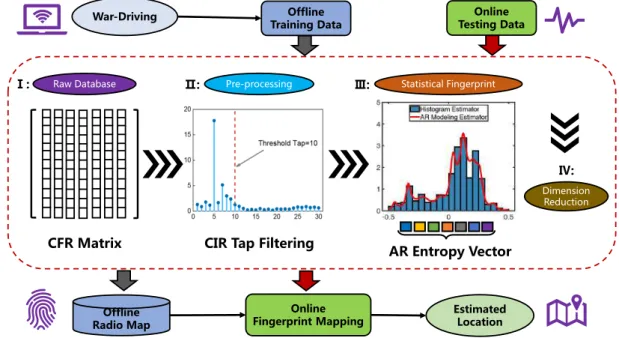
Figure 1: L’architecture du système EntLoc.
L’architecture du Système EntLoc
L’architecture globale du système proposé est illustrée sur la Figure 1. En général, il se compose de deux composants principaux: la construction de la carte radio des em-preintes digitales hors ligne et l’estimation de la position de la cible en ligne. Pour la construction de la base de données d’empreintes digitales CSI, une fois que les paquets CFR bruts reçus ont été transmis on utilise d’abord un schéma de prétraitement basé sur le filtrage des données pour extraire les composants les plus informatifs et les plus dépendants de l’emplacement dans le scénario d’intérieur riche en trajets multiples. Par la suite, nous modélisons les caractéristiques statistiques de l’amplitude CFR filtrée en calculant une métrique entropique basée sur la modélisation AR, puis construisons une
carte radio d’empreintes digitales représentative après avoir supprimé les sous-porteuses ambiguës. Ensuite, pour le processus d’estimation d’emplacement en ligne, lorsqu’une cible mobile arrive dans la zone d’intérêt, elle exécute les mêmes procédures pour acquérir le vecteur d’entropie et les compare aux attributs hors ligne appris. Enfin, l’approche de régression du noyau basée sur la distance de Manhattan peut être pleinement exploitée pour accomplir l’estimation de la position physique de la cible mobile.
Dans ce qui suit, nous décrirons les empreintes digitales plus basées sur l’entropie générées dans le système EntLoc.
Estimation des empreintes digitales d’entropie AR
Rappelons que la métrique d’entropie est considérée comme une empreinte digitale de localisation souhaitée en raison de sa simplicité structurelle ainsi que de son mode de réalisation statistique d’informations riches spécifiques à la localisation. En réalité, il est impossible de dériver directement l’entropie de Shannon à partir de données réelles. La raison de ce dilemme est double: (i) Étant donné que le vrai PDF est normalement inconnu, l’approximation d’entropie n’est accessible qu’à partir des simples échantillons de données. (ii) Le calcul conventionnel de l’entropie de Shannon nécessite une intégration numérique lourde car il n’existe pas de substitut de forme fermée.
Pour relever les défis ci-dessus, dans cette thèse, nous proposons d’estimer avec pré-cision l’entropie en s’appuyant sur l’approche de modélisation AR, dont le principe de base est d’estimer la PSD équivalente au PDF d’un processus AR de variance unitaire. Cette contrainte de variance unitaire est importée pour répondre aux exigences de base du PDF (c’est-à-dire une fonction positive unitaire). Plus précisément, nous définissons une notation générale de l’amplitude CSI β d’une sous-porteuse et l’ensemble des relations PDF-PSD est présenté par
p(β) = SW(β) =
σϵ2 |1 +∑p
i=1aie−j2πiβ|2
, β ∈ [−0.5, 0.5] (2)
ici p(β) et SW(β) sont respectivement le PDF et le PSD d’amplitude β. L’ensemble de {ai}1≤i≤p sont les coefficients AR d’un processus AR d’ordre p et σ2ϵ est l’erreur de
prédiction du modèle qui est choisi de telle sorte que∫0.5
−0.5SW(β)dβ = 1. Il est à noter que
puisque la loi est modélisée comme la restriction du spectre sur l’intervalle de [−0.5, +0.5], les données d’amplitude doivent d’abord être redimensionnées sur cet intervalle.
Pour résoudre l’équation (2), un ordre de modèle approprié p doit d’abord être choisi car un ordre faible conduit à une résolution inadéquate et un ordre élevé entraîne des pics parasites (variance excessive). Nous adoptons ainsi la technique de la famille exponentielle-ment intégrée (EEF) pour déterminer l’ordre du modèle AR en raison de ses performances supérieures grâce à nos expériences approfondies. Par la suite, les coefficients AR et son erreur de prédiction de modèle correspondante peuvent être estimés en résolvant les équa-tions de Yule-Walker bien connues en utilisant la récursion de Levinson-Durbin. Une fois que l’AR PDF est déterminé à partir de (2), le calcul d’entropie peut alors être exprimé par la forme suivante:
ˆ ϕβ = − ∫ 0.5 −0.5p(β) logˆ p(β)dβˆ = − ∫ 0.5 −0.5 ˆ SW(β) logSˆW(β)dβ (3)
En outre, en appliquant la formule de Plancherel-Parseval sur le côté droit de (3), une alternative de forme fermée réalisable sans aucune intégration numérique peut être obtenue comme ˆ ϕβ = − ∞ ∑ i=−∞ RW(i)ZW∗ (i) (4)
ici (·)∗ est l’opérateur conjugué et ZW(i) désigne la composante ith du cepstrum du pro-cessus AR, qui peut être obtenue en appliquant l’IFFT à logSˆW(β). RW(i) représente la
fonction d’autocorrélation des données d’amplitude.
Résultats Expérimentaux
La figure 2 montre le plan d’étage du laboratoire de 15m × 15m avec un couloir prin-cipal le long de plusieurs bureaux et salles de réunion. L’ordinateur portable HP servant d’émetteur de signal est fixé sur la table du bureau central. En mode injection, il est conçu pour transmettre par intermittence à raison de 100 paquets par seconde en utilisant une seule antenne d’émission. Il convient de mentionner qu’un réglage de l’émetteur est
hautement suffisant et bien exécuté dans ce scénario de laboratoire. Si nécessaire, nous pouvons recourir à plusieurs émetteurs pour le futur banc d’essai plus grand. Les points bleus représentés sur la Figure 2 désignent les 70 points de référence d’entraînement avec un espacement d’un mètre et les 30 emplacements de test sont marqués comme des étoiles rouges. Dans la phase de formation hors ligne, les mesures CSI sont collectées par le HMB léger à ces points de référence pour construire la carte radio brute. À chaque point, environ 5000 paquets CSI sont stockés sous forme de signatures RF dans le micrologiciel. Dans la phase en ligne, nous déplaçons ensuite le récepteur HMB parmi 30 emplacements de test pour obtenir la même taille de paquets CSI. De plus, toutes les extrémités du récepteur sont placées à la même hauteur, construisant une plate-forme 2-D simple pour l’estimation précise de la position intérieure.
15m 3m 7m 15m 3m 5m TX Table RX
Figure 2: Le plan d’étage de notre laboratoire.
En termes de précision de localisation, notre système EntLoc est alors prêt à défier d’autres systèmes d’empreintes digitales de localisation existants. Plus spécifiquement, comme mentionné dans la section précédente, nous concevons un cadre équitable pour comparer notre approche de localisation basée sur l’entropie AR proposée avec les sys-tèmes de type PinLoc, FIFS et Horus, respectivement. Comme on peut le voir dans la
Figure 3, notre système proposé atteint l’erreur au 90e centile de 2.69m, ce qui surpasse l’approche de type PinLoc, FIFS et Horus avec le même niveau d’erreur de 63%, 57% et 28%, respectivement. 0 2 4 6 8 10 Localization Error (m) 0 0.2 0.4 0.6 0.8 1 CDF EntLoc PinLoc-like FIFS Horus
Chapitre 4: Amélioration de la localisation d’empreintes
ra-dio assistée par AoA impliquant la phase CSI
Dans ce chapitre, nous présentons AngLoc, un système amélioré d’empreinte digitale de lo-calisation intérieure basé sur l’entropie AR impliquant une empreinte AoA supplémentaire. La précision de localisation résultante a été améliorée par rapport à EntLoc.
Figure 4: Un exemple illustratif du mécanisme du système AngLoc.
Avant d’énumérer les contributions de ce chapitre, en comparaison avec le système EntLoc susmentionné, nous élaborons d’abord le concept de base et la mise à niveau majeure de notre système de positionnement AngLoc proposé. Comme illustré dans la Figure 4, notre solution intégrée AoA adopte le concept méthodologique de la technique bien connue des k-voisins les plus proches (kNN) et dévoile deux informations heuristiques:
(i) Pour certains récepteurs de surveillance hors ligne aux positions RP correspondantes, qu’ils soient à proximité (en bleu) du récepteur en ligne (en rouge) ou à distance (en vert), leurs mesures CSI peuvent partager les mêmes valeurs d’entropie.
(ii) Ces récepteurs voisins enregistrent également les AoA similaires des chemins inci-dents parallèles avec ce récepteur en ligne, que ce soit pour les chemins directs dans le scénario LoS ou les chemins réfléchis dans la condition NLoS. Par conséquent, le récepteur distant peut être exclu de manière sélective conformément à la différence AoA distincte, ce qui améliore encore la précision d’estimation de l’emplacement.
En conséquence, en adoptant l’approche de raffinage RP assistée par AoA ci-dessus, notre système de positionnement AngLoc hérité est capable d’atteindre des performances de localisation supérieures à son système EntLoc prédécesseur.
Entropy Estimation AoA Estimation War-Driving Tap Filtering Phase Calibration Radio Map RP Candidates Refining Bivariate Kernel Regression Estimated Location CSI Matrix Online Data
Offline Phase Online Phase
Preprocessing
Packets
Subcarriers
Figure 5: L’architecture globale du système AngLoc.
L’architecture du Système AngLoc
Comme illustré dans la Figure 5, l’architecture globale de notre système AngLoc pro-posé a une conception par blocs. Pour être précis, dans le bloc de construction de carte radio hors ligne, une fois que les mesures CSI brutes ont été enregistrées, nous introduisons d’abord un schéma de filtrage des données pour extraire le composant le plus informatif spécifique à l’emplacement des CSI bruyants. Dans le but d’une estimation précise de l’AoA, plusieurs techniques d’étalonnage de phase sont ensuite exploitées pour compenser les décalages de phase correspondants, qui existent dans les appareils WiFi courants. Par la suite, pour les amplitudes CSI, nous les modélisons statistiquement comme la métrique d’entropie AR simplement structurelle. L’algorithme JADE-MUSIC est ensuite adopté pour les phases CSI pour déduire les estimations angulaires. Par conséquent, l’intégralité de la base de données hors ligne peut être pleinement réalisée par l’intégration des em-preintes entropiques et AoA, en utilisant pleinement les informations d’amplitude et de phase CSI. Pour le bloc d’estimation d’emplacement en ligne, lorsqu’une cible mobile entre dans la zone d’intérêt, elle exécute les mêmes protocoles de prétraitement pour obtenir les estimations d’entropie et d’AoA. La tâche d’estimation d’emplacement suivante comprend
alors deux étapes principales:
(i) Le vecteur d’entropie en ligne est d’abord associé à une base de données hors ligne pour trouver les candidats les plus probables parmi les postes RP les plus proches.
(ii) Parmi ces emplacements candidats, un nouveau schéma de régression par noyau bivarié est proposé pour réduire davantage le nombre de RP sujets aux erreurs, abordant ainsi la détermination de l’emplacement de la cible avec une précision améliorée.
Résultats Expérimentaux
La Figure 6 affiche le plan détaillé de la salle de classe utilisée pour les tests. Tout d’abord, l’ordinateur portable sert d’émetteur de signal dont le placement est fixé sur la table et connu a priori. En mode d’injection de paquets, il est conçu pour envoyer par intermittence à raison de 100 paquets par seconde en utilisant une seule antenne d’émission. Il est à noter qu’un tel réglage d’antenne répond à l’exigence d’une cartographie spatiale directe, qui peut produire des données CSI sans CSD. Pendant ce temps, la précision de localisation peut également être garantie avec le coût de calcul le plus bas. Pour la disposition expérimentale, les points bleus montrés sur la figure 6 indiquent les 40 emplacements RP d’entraînement avec un espacement d’un mètre et les 28 positions de test sont marquées comme des étoiles rouges. Pendant la phase de formation hors ligne, environ 5000 paquets CSI sont collectés et stockés par le HMB léger à chaque point de référence pour créer la carte radio CSI brute. Dans la phase en ligne, nous déplaçons ce récepteur HMB parmi tous les emplacements de test pour acquérir la même taille de paquets CSI à des fins de localisation. De plus, chaque extrémité du récepteur fonctionne à la même hauteur, construisant une plate-forme 2-D simple pour l’estimation précise de la position intérieure.
En vertu de la fonction de distribution cumulative (CDF), nous évaluons d’abord la précision de localisation de notre système AngLoc proposé par rapport à l’état de l’art. Comme on peut l’observer dans la Figure 7, pour l’environnement de laboratoire, notre
12.6m
7.8m
PC Table
TX
RX
Figure 6: Le plan d’étage de notre salle de classe.
système proposé est capable d’atteindre l’erreur du 90e centile de 2.27 m, ce qui surpasse les systèmes EntLoc, PinLoc-like, FIFS et Horus avec la même erreur niveau de 2.69 m, 4.15 m, 5.56 m et 5.64 m, respectivement. De même, dans le scénario de la salle de classe, nous pouvons remarquer dans la Figure 8 que AngLoc précède toujours les autres rivaux en termes d’erreur du 90e centile. Concrètement, il peut garantir que 90% des emplacements de test ont une erreur de positionnement inférieure à 1.99 m, dépassant les systèmes EntLoc, PinLoc-like, FIFS et Horus avec le même pourcentage d’erreur de 82.1%, 64.3%, 57.1% et 28.6%, respectivement.
0 2 4 6 8 10 Localization Error (m) 0 0.2 0.4 0.6 0.8 1 CDF AngLoc EntLoc PinLoc-like FIFS Horus
Figure 7: Précision de localisation pour le laboratoire.
0 1 2 3 4 5 6 Localization Error (m) 0 0.2 0.4 0.6 0.8 1 CDF AngLoc EntLoc PinLoc-like FIFS Horus
Chapitre 5: Conclusion
Sur la base de la conception de systèmes d’empreintes digitales de localisation efficaces, nous résumons cette thèse dans ce qui suit.
Premièrement, en raison de la présence d’une limitation de la bande passante du canal et du bruit non intentionnel des appareils, nous concevons un schéma de filtrage des données basé sur la puissance pour atténuer largement le bruit de mesure CSI. De plus, nous nous penchons également sur certains problèmes d’erreur de phase CSI profondément enracinés et réussissons à tirer parti de plusieurs techniques d’étalonnage de phase pour acquérir des mesures CSI adéquates et fiables.
Deuxièmement, afin d’exploiter l’inférence probabiliste des propriétés complexes des canaux sans fil intérieurs, nous avons recours à la métrique d’entropie basée sur la mod-élisation AR, qui partage la simplicité structurelle avec RSS tout en exploitant les riches informations statistiques sur les canaux. Sur cette base, nous avons proposé EntLoc, un système de localisation d’empreintes digitales basé sur l’amplitude CSI utilisant un appareil Wi-Fi commercial.
Troisièmement, au-dessus du système de positionnement EntLoc, qui exploite unique-ment les informations d’amplitude CSI, nous développons un prototype d’AngLoc, un sys-tème amélioré d’empreinte digitale de localisation impliquant des informations de phase CSI. Il est capable de libérer tous les potentiels liés à la localisation en utilisant des em-preintes digitales supplémentaires basées sur l’AoA.
Enfin et surtout, tout au long de l’étude pratique du positionnement intérieur basé sur CSI, nous parvenons progressivement à développer la plate-forme d’acquisition de données CSI plus légère et réalisable basée sur le système embarqué HummingBoard Pro. Il facilite considérablement notre processus d’enquête sur les sites de localisation.
Acknowledgements i
Abstract iii
Résumé v
Table of Contents xxi
List of Figures xxiv
List of Tables xxviii
Abbreviations xxix
Symbols xxxi
1 Introduction 1
1.1 Motivation . . . 2 1.2 Contributions . . . 7 1.3 Structure of the Thesis . . . 8 1.4 Related Publications . . . 10
2 Technical Background 11
2.1 Introduction . . . 12 2.2 Wi-Fi based Physical Measurements . . . 12 2.2.1 Power based Measurement . . . 12 2.2.2 Temporal Measurement . . . 14 2.2.3 Angular Measurement . . . 16 2.2.4 Channel Response based Measurement . . . 17
2.2.4.1 MIMO-OFDM Mechanism . . . 17 2.2.4.2 Channel State Information . . . 19 2.3 Wi-Fi based Localization Algorithms . . . 21 2.3.1 Geometric Mapping . . . 21 2.3.1.1 Trilateration . . . 22 2.3.1.2 Triangulation . . . 23 2.3.2 Location Fingerprinting . . . 25 2.3.2.1 Deterministic Methods . . . 26 2.3.2.2 Probabilistic Methods . . . 27
3 AR Entropy based Location Fingerprinting using CSI Amplitude 29 3.1 Introduction . . . 30 3.1.1 Literature Review . . . 30 3.1.2 Contributions . . . 31 3.1.3 Chapter Organization . . . 32 3.2 Localization Methodology . . . 32 3.2.1 EntLoc System Architecture . . . 32 3.2.2 Offline Radio Map Construction . . . 33 3.2.2.1 Tap Filtering Preprocessing Technique . . . 34 3.2.2.2 AR Entropy Estimation . . . 38 3.2.3 Online Location Estimation . . . 46 3.2.3.1 Distance-based Proximity Comparison . . . 46 3.2.3.2 Kernel Regression . . . 47 3.3 Performance Evaluation . . . 48 3.3.1 Experimental Setup . . . 48 3.3.1.1 Experimental Presentation . . . 48 3.3.1.2 Benchmarks and Performance Metrics . . . 51 3.3.2 Numerical Results . . . 52 3.3.2.1 AR Entropy Property Study . . . 52 3.3.2.2 Localization Accuracy . . . 53 3.3.2.3 Impact of Preprocessing Technique . . . 58 3.3.2.4 Impact of Packet Number for Entropy Estimation . . . 59 3.3.2.5 Impact of RX Antenna Numbers . . . 60 3.4 Summary . . . 62
4 Enhanced AoA-aware Fingerprint Localization involving CSI Phase 63 4.1 Introduction . . . 64 4.1.1 State-of-the-Art . . . 64 4.1.2 Contributions . . . 65 4.1.3 Chapter Organization . . . 67 4.2 Localization Methodology . . . 67 4.2.1 AngLoc System Architecture . . . 67 4.2.2 Offline Fingerprint Database Generation . . . 68 4.2.2.1 CSI Phase Calibration . . . 68 4.2.2.2 Enhanced AoA Fingerprint Estimation . . . 72 4.2.3 Online Position Determination . . . 78 4.2.3.1 Similarity Metric Calculation . . . 78 4.2.3.2 Bivariate Kernel Regression . . . 79 4.3 Performance Evaluation . . . 80 4.3.1 Experimental Setup . . . 80 4.3.2 Numerical Results . . . 83 4.3.2.1 Impact of Packet Number Selection for Entropy Estimate . 83 4.3.2.2 Impact of Packet Number Selection for AoA Estimate . . . 84 4.3.2.3 Impact of Kernel Regression Parameters . . . 85 4.3.2.4 Localization Accuracy . . . 86 4.3.2.5 AoA Estimation Accuracy in LoS Condition . . . 90 4.3.2.6 Impact of AoA Proximity in NLoS Condition . . . 91 4.4 Discussions . . . 92 4.4.1 Device Orientation Calibration . . . 92 4.4.2 Alternative Hardware Implementation . . . 93 4.5 Summary . . . 93
5 Conclusions and Future Works 95
5.1 Dissertation Conclusions . . . 96 5.2 Perspectives for Future Works . . . 97
1 L’architecture du système EntLoc. . . x
2 Le plan d’étage de notre laboratoire. . . xiii
3 Précision de la localisation de l’EntLoc proposé par rapport à l’état de l’art. xiv
4 Un exemple illustratif du mécanisme du système AngLoc. . . xv
5 L’architecture globale du système AngLoc. . . xvi
6 Le plan d’étage de notre salle de classe. . . xviii
7 Précision de localisation pour le laboratoire. . . xix
8 Précision de localisation pour la salle de classe. . . xix
1.1 Different applications of location based services. . . 3
1.2 Diagram for typical indoor multipath propagation. . . 4
2.2 The diagram of the TOA technique. . . 15
2.3 The diagram of the TDOA technique. . . 15
2.4 MIMO-OFDM transceiver architecture. . . 18
2.5 A simple diagram of the channel impulse response. . . 20
2.6 An example of CIR time samples with 20 MHz bandwidth . . . 20
2.9 The basic system flow diagram for Wi-Fi fingerprint localization. . . 25
3.1 The EntLoc system architecture. . . 33
3.2 Channel impulse response. . . 35
3.3 Power threshold. . . 35
3.4 The raw CFR. . . 37
3.5 CFR after tap filtering. . . 37
3.6 AR modeling based PDF estimation at location #1. . . 43
3.7 AR modeling based PDF estimation at location #2. . . 43
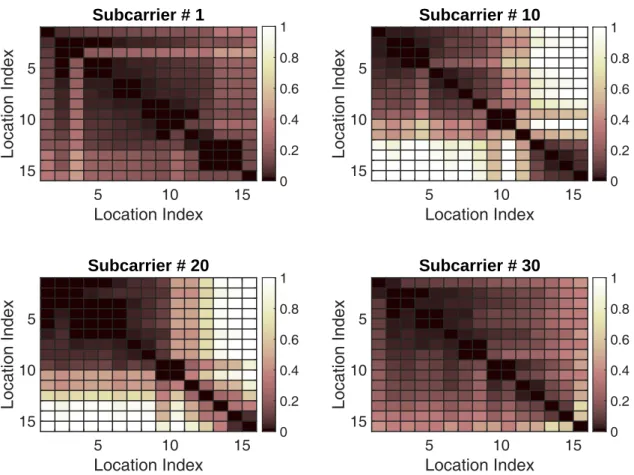
3.8 Ambiguity test for 4 subcarriers, namely #1, #10, #20 and #30. . . 44
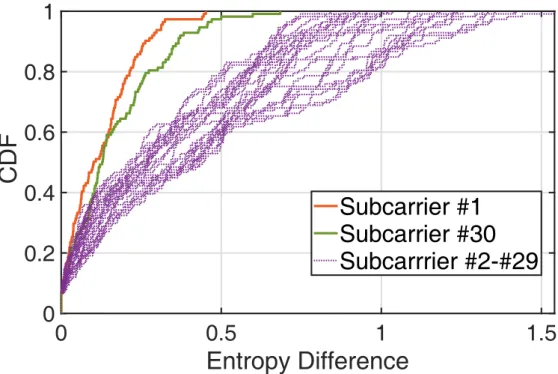
3.9 Ambiguity test for all 30 available subcarriers. . . 45
3.10 A simple example of the kernel function with ρ = 2. . . . 47
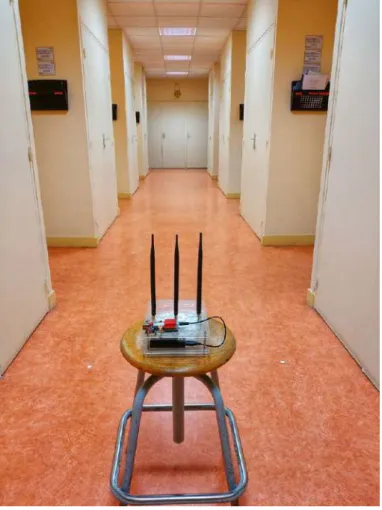
3.11 CNAM laboratory scenario. . . 49
3.12 The laptop with Intel 5300 NIC as signal transmitter. . . 50
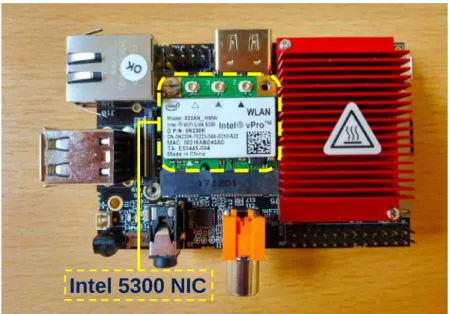
3.13 The HummingBoard Pro as mobile receiver. . . 50
3.14 The floor plan of our laboratory. . . 51
3.15 Temporal stability for three fingerprint signatures during the entire working times of one day (8 hours). . . 53
3.16 Proximity test under LoS condition. . . 54
3.17 Proximity test under NLoS condition. . . 54
3.18 Localization accuracy of AR entropy against its original CFR amplitude. . . 55
3.19 Localization accuracy of AR entropy against its time domain CIR. . . 56
3.21 AR entropy box plot for raw CFR. . . 58
3.22 AR entropy box plot for filtered CFR. . . 58
3.23 AR entropy variances for raw CFR and filtered CFR. . . 59
3.24 AR entropy variance changes with different CFR packet number selections. 60
3.25 Localization accuracy under three different RX antenna configurations. . . . 61
4.1 An illustrative example of the AngLoc system mechanism. . . 65
4.2 The overall AngLoc system architecture. . . 68
4.3 CFR phase changes after SFO, STO and CFO removal. . . 70
4.4 CIR amplitude changes after SFO, STO and CFO removal. . . 71
4.5 An incident signal arrives at an antenna array with an angle θ. . . . 73
4.6 The mechanism of forward-backward spatial smoothing. . . 75
4.7 Optimal smoothing length selection through AoA spectrum. . . 76
4.8 The comparison of AoA estimation with and without multi-packet smoothing. 77
4.9 CNAM classroom scenario. . . 81
4.10 The floor plan of our classroom. . . 82
4.11 AoA estimation errors by using different number of CSI packets. . . 84
4.12 Optimal neighbor number selection for laboratory testbed. . . 86
4.13 Optimal neighbor number selection for classroom testbeds. . . 86
4.14 Localization accuracy for the laboratory. . . 87
4.15 Localization accuracy for the classroom. . . 87
4.16 Bar plot of localization mean error comparison for both testbeds. . . 88
4.18 The box plot for AoA differences between 20 test locations and their corre-sponding 4 neighboring RP locations. . . 92
3.1 Detailed localization accuracy of all different methods . . . 57
4.1 Summary of parameters for both testbeds . . . 85
4.2 Localization accuracy for the laboratory scenario . . . 89
4.3 Localization accuracy for the classroom scenario . . . 89
LBS Location-Based Service IoT Internet of Things
GNSS Global Navigation Satellite System GPS Global Positioning System
WLAN Wireless Local Area Network RFID Radio Frequency Identification UWB Ultra Wideband
IPS Indoor Positioning System LF Location Fingerprinting ToF Time of Flight
AoA Angle of Arrival LoS Line-of-Sight RP Reference Point
RSS Received Signal Strength MAC Medium Access Control
IEEE Institute of Electrical and Electronics Engineers MIMO Multiple-Input Mulitiple-Output
OFDM Orthogonal Frequency Division Multiplexing NIC Network Interface Card
CSI Channel State Information PDF Probability Distribution Function
PSD Power Spectral Density
JADE Joint Angle and Delay Estimation MUSIC Multiple Signal Classification FEC Forward Error Correction MCS Modulation and Coding Scheme QAM Quadrature Amplitude Modulation STBC Space-Time Block Coding
CSD Cyclic Shift Diversity SMM Spatial Mapping Matrix IFFT Inverse Fast Fourier Transform DAC Digital-to-Analog Converting
HT-LTF High Throughput-Long Training Fields CFR Channel Frequency Response
CIR Channel Impulse Response kNN k-Nearest Neighbors KLD Kullback-Leibler Divergence MAP Maximum A Posteriori AP Access Point
SNR Signal-to-Noise Ratio
AWGN Additive White Gaussian Noise EEF Exponentially Embedded Family GLRT Generalized Likelihood Ratio Test RBF Radial Basis Function
SFO Sampling Frequency Offset STO Symbol Timing Offset CFO Carrier Frequency Offset CPO Carrier Phase Offset PDP Power Delay Profile PLL Phase Locked Loop
(·)⊤ The transpose operator (·)∗ The conjugate operator
(·)H The Hermitian transpose operator E{·} The expectation operator
δ(·) The Dirac delta function ∥ · ∥1 The ℓ1 norm operator
◦ The Hadamard product operator ⊗ The Kronecker product operator
ℓm The coordinates of the mth RP
ℓo The coordinates of the online unknown target
ˆ
ℓo The estimated coordinates of the online unknown target
Nss The number of spatial streams
Nsts The number of space-time streams
Nt The number of transmit antennas
Nr The number of receive antennas
M The number of reference points
S The number of access points
K The number of OFDM subcarriers of one CSI packet
R The dimensionality of one CSI packet measured at one RP location from a single AP
N The number of CSI packets
L The number of multipaths
Hsm The N × R dimensional CSI matrix which are acquired at the mthRP
from the sth AP
Hm The N × SR dimensional CSI signature set which are acquired at the
mthRP
Gso The N × R dimensional CSI matrix which are acquired at the target’s
unknown location from the sthAP
Go The N × SR dimensional CSI signature set which are acquired at the
target’s unknown location
ˆ
ΦHs
m The AR entropy vector of CSI amplitudes at the m
thRP from the sth
AP
ˆ
ΦGs
o The AR entropy vector of CSI amplitudes at the target’s unknown
lo-cation from the sthAP
ˆ
θs
m The AoA estimate at the mthRP location from the sthAP
ˆ
τs
m The ToF estimate at the mthRP location from the sth AP
ˆ
θos The AoA estimate at the target’s unknown location from the s th
AP
ˆ
τos The ToF estimate at the target’s unknown location from the s th
AP K The probability kernel function
Dm The Manhattan distance of AR entropy between the online fingerprints
at target’s unknown location and the offline fingerprints at the mthRP
Dm The Edclidean distance of AoA-ToF between the online fingerprints at
target’s unknown location and the offline fingerprints at the mthRP
we The weighting factor for AR entropy based kernel function
wa The weighting factor for AoA based kernel function
ρe The AR entropy based kernel coefficient
Introduction
Contents
1.1 Motivation . . . . 2 1.2 Contributions . . . . 7 1.3 Structure of the Thesis . . . . 8 1.4 Related Publications . . . . 10
1.1
Motivation
With the wide-scale proliferation of wireless communication and ubiquitous computing, Location-Based Service (LBS) has emerged as a key enabler for myriad cutting-edge ap-plications in the domain of Internet of Things (IoT) [1, 2, 3]. Examples of such widespread LBSs can be categorized into a number of groups. To name a few, for visually-impaired individuals, it is imperative for them to receive autonomous and accurate navigation ser-vices in the complicated surroundings. In the modern mega warehouse, by leveraging the logistic tracing and monitoring, staff can detect the goods and inventory in real time, which enormously facilitates the operation efficiency. The consumers in the fancy commer-cial mall usually desire the dedicated product information through the proximity-based marketing advertisements. For some sensitive facilities like banking systems, the topic of intruder tracking is also of great significance in order to guarantee a round-the-clock security level and so forth. Accordingly, in order to meet the pressing need of human social activities, the most fundamental common ground for these LBS applications is to precisely and effectively pinpoint the location of the target in a wireless manner.
To this end, the well-known Global Navigation Satellite System (GNSS) such as Global Positioning System (GPS) from the U.S. can already offer successful and accurate local-ization in the outdoor space. However, it suffers dramatic performance degradation in the complex indoor environment due to the blockage of satellite signals. Moreover, the location resolution demand for indoor positioning schemes is generally higher than that in the outdoor scenarios. Consequently, in addition to providing the seamless and ubiquitous location-aware services indoors, it brings us new challenges for designing indoor localiza-tion systems which are capable of covering the requirements of high accuracy, time-critical constraints and energy efficiency. As illustrated in Figure 1.1, we further present a wide variety of LBS applications from outdoor to indoor situations.
In light of the continuous mobile technique innovation and its hardware upgrading, accurate, reliable and ubiquitous indoor localization solutions have been extensively stud-ied in recent years [4, 5, 6]. Such examples comprise not only well-known Wireless Local Area Network (WLAN) based technologies like Wi-Fi [7, 8, 9], Bluetooth [10], Radio
Fre-Health Care
LBS
Military Navigation Disaster Warning Traffic MonitoringO
ut
door
Indoor
Retail Advertising Bank SurveillanceFigure 1.1: Different applications of location based services.
quency Identification (RFID) [11], Ultra Wideband (UWB) [12], but also some emerging areas such as infrared [13], visible light [14, 15], ultrasound [16], geomagnetic field [17] and so forth. Among these techniques, the Wi-Fi based positioning is probably of the greatest popularity, mainly owing to the pervasive availability of the high-throughput and low-cost Wi-Fi technology. Thereupon, indoor position determination can be then op-erated in Wi-Fi based communication systems through firmware upgrades and software implementations.
In general, conventional Wi-Fi based Indoor Positioning Systems (IPSs) either adopt geometric mapping approach or resort to the Location Fingerprinting (LF) [18]. For geo-metric mapping, intermediate spatial parameters like distance or direction are first derived from certain physical measurements. Typical parameters include Time of Flight (ToF) [19] and Angle of Arrival (AoA) [20]. Then, target’s physical location can be further inferred by using geometric algorithms (e.g., trilateration or triangulation). Nevertheless, the perfor-mance of geometric mapping approach heavily relies on the Line-of-Sight (LoS) condition. In wireless communications, when a signal emitted from a transmitter is reflected or scat-tered by a scatterer, an attenuated copy of the original signal is generated and reaches the receiver through a different path. The phenomenon that a signal is received by two
or more paths is known as multipath propagation [21]. Figure 1.2 displays a typical in-door multipath propagation scenario. The rich inin-door multipath and shadowing effects, to a great extent, blur the monotonous relation between physical measurements and dis-tances, complicate RF propagation modeling, and thus degenerate positioning accuracy. This makes geometric mapping less eligible for the sophisticated indoor environment with rich hindrances and room partitions. As an emerging alternative for indoor positioning,
TX RX
Direct Path
Figure 1.2: Diagram for typical indoor multipath propagation.
location fingerprinting benefits from a pattern-matching mechanism, which comprises of-fline training phase and online location estimation phase. Specifically, in the ofof-fline phase, wireless signatures are collected at a set of geo-tagged Reference Points (RPs) in the area of interest to construct the fingerprint database (a.k.a. radio map). During the online phase, the measured signature at an unknown position is matched with the offline radio map to return the best-fitted location estimation.
Although the mainstream Wi-Fi fingerprinting systems take the simple Received Signal Strength (RSS) as the indicator of Medium Access Control (MAC) layer’s link quality, it suffers dramatic performance degradation due to small-scale multipath fading and tempo-ral dynamics indoors. In Institute of Electrical and Electronics Engineers (IEEE) 802.11 n/ac standard, Wi-Fi networks use Multiple-Input Mulitiple-Output (MIMO) [22, 23] and Orthogonal Frequency Division Multiplexing (OFDM) [24] techniques to modulate data on different orthogonal sub-channels and transmit them over multiple transmit-receive
(TX-RX) antenna pairs simultaneously. Therefore, it can reflect the fine-grained channel feature known as channel response, which can be partially extracted from many commer-cial off-the-shelf Wi-Fi Network Interface Cards (NICs) [25, 26] in the format of Channel State Information (CSI). Specifically, CSI is aggregated by a set of channel estimations depicting the amplitude and phase information of each OFDM subcarrier. Different from coarse-grained RSS, the Physical (PHY) layer CSI measurement can serve as a preferable location signature characterized by the small-scale multipath fading, which significantly de-teriorates the quality of its RSS counterpart. Furthermore, CSI indicates channel qualities in the level of multiple subcarriers and thus provides richer location-specific information than RSS-based localization schemes.
In principle, Wi-Fi fingerprinting algorithms can be categorized into deterministic and probabilistic ones [8]. Deterministic approaches enjoy the easy implementation but fail to fully exploit environmental fluctuations, which consequently renders the location esti-mation error-prone. In contrast, probabilistic methods embrace the channel variation by inferring a signal distribution based statistical model, thus obtaining more robust and ac-curate positioning performance than its deterministic adversary. Nevertheless, there still exists three underlying challenges for probabilistic Wi-Fi fingerprinting systems:
(i) The accurate approximation of Probability Distribution Function (PDF) is largely driven by massive storage of signal measurements [27], which in turn brings huge system burden and computational requirement.
(ii) Most probabilistic location-aware solutions are well established on the assumption of Gaussian-distributed measurements [28, 29]. However, due to the complex na-ture of indoor environment and the imperfection of wireless devices, some practical measurements appear to be non-Gaussian distributed or even do not fit any known distribution [30, 31, 32]. This then complicates the fingerprinting process and incurs severe ambiguity for location estimation.
(iii) When it comes to multivariate fingerprint structure (e.g. multi-subcarrier CSI), traditional probabilistic methods turn powerless since existing statistical tools only work for measurements with identifiable distributions [33].
Therefore, it would be highly desirable for a fingerprint which shares the simplicity of RSS (scalar) and meanwhile conserves rich statistical location-specific information.
To address the aforementioned substantial challenges, in this thesis, we first propose EntLoc [34], a Wi-Fi based probabilistic indoor location fingerprinting system using CSI amplitude information. It resorts to the Autoregressive (AR) modeling based Shannon entropy metric [35, 36], which equals a direct transformation from the original PDF of CSI amplitudes. Unlike traditional data-adaptive histogram estimator which entails a slow convergence rate, AR modeling approach provides a feasible parametric workaround to accurately infer the PDF in the form of Power Spectral Density (PSD) [37, 38]. De-spite its structural simplicity, this novel entropy fingerprint embodies the whole statistical information of CSI amplitudes. Through extensive experiments conducted in realistic testbeds, we demonstrate that our proposed AR entropy metric outperforms its original CSI or RSS fingerprint [34]. However, since CSI phases of one subcarrier are generally uniformly distributed [39], this quantifies each RP location with an equally maximized entropy value (a.k.a. Gibbs’ inequality [40]), thereby hampering the location distinction to a great extend. How to properly exploit CSI phase information in our entropy-based location fingerprinting system still remains open.
Inspired by the recent advancement of phased array signal processing [20], leveraging AoA as supplementary fingerprint enables us to revisit CSI phase exploitation with a fresh horizon. Given the fact that there may exist some remote RP candidates whose AoA read-ings differ a lot with those around the online target, these false offline RPs can be ruled out to further refine the location fingerprinting accuracy. On this basis, we design AngLoc [41], an AoA-aware probabilistic indoor localization system using commercial off-the-shelf Wi-Fi device. To remove the noisy component from the raw CSI measurements, we first introduce a power-based tap filtering scheme to preserve the most informative CSI signa-tures. For the purpose of precise AoA estimation, a set of phase calibration techniques are then employed to mitigate dramatic phase drifts. Subsequently, for the offline radio map construction, the pre-processed CSIs are simultaneously fed to two independent fin-gerprint generators, namely AR modeling based entropy estimator for CSI amplitude and the enhanced AoA-ToF estimator driven by Joint Angle and Delay Estimation (JADE)
Multiple Signal Classification (MUSIC) algorithm [42, 43, 44]. It is worth noting that ToF is utilized here to create measurable phase shift across subcarriers, by which realizes vir-tual antenna extension to overcome the antenna number restriction for classical MUSIC algorithm [20]. The other trick of ToF here is to identify the first incoming path (not necessarily the direct path) as the angular fingerprint benchmark, which serves to guar-antee similar AoA recordings around closely-spaced RPs. Moreover, in the online phase, due to the simple structure of the radio map, the succinct Manhattan distance and Eu-clidean distance can be fully competent as the similarity metrics for AR entropy and AoA fingerprints, respectively. Afterwards, we propose an optimal bivariate kernel regression scheme to accurately infer the target’s physical location. The entire experiments are con-ducted on the lightweight HummingBoard platform [45], which tremendously facilitates the time-consuming and labor-intensive fingerprinting implementation. Experimental re-sults validate the superior performance of our proposed system over previous location fingerprinting approaches.
1.2
Contributions
In a nutshell, the major contributions of this thesis can be summarized and laid out below:
• The first contribution of this dissertation is that we design an AR entropy based indoor location fingerprinting system using fine-grained channel state information, namely EntLoc. As far as we are aware of, this is the first work to statistically study the AR modeling based entropy signature in CSI fingerprint localization system. This simple fingerprint structure helps decrease the pattern-matching complexity and its informative statistical embodiment also facilitates the location estimation accuracy.
• As an upgraded version of EntLoc, the pioneering AngLoc system is further pro-posed as the second main contribution of this thesis. Specifically, in AngLoc, we constructively incorporate the angular signature (AoA information) in CSI entropy based indoor location fingerprinting system, which manages to narrow down the
error-prone RP candidates and further improves the positioning accuracy. It even fertilizes the opportunity to achieve a decimeter-level localization precision in our indoor experimental testbed.
• Since the raw CSI measurements retrieved from commercial Wi-Fi NICs contain var-ious noises, which may severely jeopardize the localization performance, such noises have to be first removed before proceeding to conduct the location fingerprinting process. Accordingly, we propose a power-based tap-filtering program alongwith several CSI phase calibration pre-processing techniques to effectively mitigate CSI noisy component and sanitize CSI phase errors, respectively.
• Recall that for the part of the aforementioned AngLoc system, we fully exploit both CSI amplitude and phase information to pinpoint the online target’s physical po-sition. The respective AR entropy and AoA information are designated as dual location fingerprints in AngLoc. On this basis, we design a feasible bivariate kernel regression scheme for the online location estimation stage, which organically com-bines the weighting factors for both amplitude based entropy and phase-based AoA fingerprints.
• Last but not least, in view of the cumbersome laboring process for the traditional offline fingerprint database construction, based on the Linux CSI tool with a mod-ified firmware, we build and implement extensive experiments on the lightweight HummingBoard Pro device for different indoor testbeds. In addition to the superior localization performance, our mobile CSI receiver prototype remarkably enhances the location fingerprinting efficiency.
1.3
Structure of the Thesis
This thesis focuses on the problem of Wi-Fi based indoor fingerprint localization using channel state information. We successfully and effectively design the whole framework of two location fingerprinting systems which leverage the AR entropy and enhanced AoA estimates as their location signatures, achieving a superior localization performance over
the previous approaches. The remainder of this dissertation is organized as follows:
Chapter 2 reviews the overall technical background which is closely related to the domain of Wi-Fi based indoor localization. To be specific, we first introduce some Wi-Fi based physical measurements, which are extremely crucial to the localization performance, and discuss their respective strength and weakness in a comparative manner. Next, we dive into the two basic categories of the localization algorithms and present the relevant examples for both indoor location-aware techniques.
Chapter 3 lays out the in-depth structural presentation of our proposed EntLoc system. First of all, we investigate several representative literature reviews to reach an overview un-derstanding for the state-of-the-art. The overall EntLoc system architecture is then given in the sequel. In the offline phase, we introduce the tap filtering pre-processing scheme and the detailed fingerprint generation process of the CSI amplitude based AR entropy. As for the online stage, the distance-based proximity comparison is carried out and then fed to the kernel regression algorithm to estimate the target’s position. Subsequently, we evaluate the EntLoc’s localization performance in comparison with the state-of-the-art. In addition, the impacts of some defining experimental factors are also discussed in this chapter.
Chapter 4 further proceeds to illustrate the updated design of the AngLoc system. Specifically, compared with aforementioned EntLoc system, there are three significant up-grades in the AngLoc system. Firstly, since the raw CSI measurements are full of phase errors and ineligible for the accurate AoA estimation, we employ a set of phase calibration techniques for the CSI pre-processing to effectively mitigate these phase offsets. Secondly, after acquiring the AR entropy fingerprint, we leverage an enhanced subspace based al-gorithm to estimate the AoA information, which serves as an additional fingerprint to further improve the location fingerprinting accuracy. Thirdly, in view of the AngLoc’s dual-fingerprint structure, we propose a novel bivariate kernel regression scheme to pre-cisely infer the final location. In addition to providing the experimental evaluations for AngLoc, we also discuss some unsolved issues which may further increase the efficiency and accuracy of our AngLoc system.
Chapter 5 draws the conclusions of this thesis by briefly reviewing our main contri-butions. Moreover, we highlight some potential research directions that can be further explored in our future works.
1.4
Related Publications
The content of this dissertation is mainly based on the following publications:
• Luan Chen, Iness Ahriz and Didier Le Ruyet. “AoA-aware Probabilistic Indoor Location Fingerprinting using Channel State Information”, IEEE Internet of Things Journal, 2020. (IF: 9.515)
• Luan Chen, Iness Ahriz and Didier Le Ruyet. “CSI-based Probabilistic Indoor Position Determination: An Entropy Solution”, IEEE Access, 2019. (IF: 4.098)
• Luan Chen, Iness Ahriz, Didier Le Ruyet and Hong Sun. “Probabilistic Indoor Position Determination via Channel Impulse Response”, in Proceedings of the 29th Annual IEEE International Symposium on Personal, Indoor, and Mobile Radio Com-munications (PIMRC), 2018.
• Luan Chen, Iness Ahriz, Hong Sun and Didier Le Ruyet. “Source Position Estima-tion via Subspace based Joint Sparse Recovery”, in Proceedings of the 13th IEEE International Conference on Signal Processing (ICSP), 2016.
Technical Background
Contents
2.1 Introduction . . . . 12 2.2 Wi-Fi based Physical Measurements . . . . 12
2.2.1 Power based Measurement . . . 12 2.2.2 Temporal Measurement . . . 14 2.2.3 Angular Measurement . . . 16 2.2.4 Channel Response based Measurement . . . 17 2.2.4.1 MIMO-OFDM Mechanism . . . 17 2.2.4.2 Channel State Information . . . 19
2.3 Wi-Fi based Localization Algorithms . . . . 21
2.3.1 Geometric Mapping . . . 21 2.3.1.1 Trilateration . . . 22 2.3.1.2 Triangulation . . . 23 2.3.2 Location Fingerprinting . . . 25 2.3.2.1 Deterministic Methods . . . 26 2.3.2.2 Probabilistic Methods . . . 27 11
2.1
Introduction
In this chapter, we will review some technical backgrounds of Wi-Fi based indoor localiza-tion, whose methodological concepts are widely covered throughout this dissertation. Since the radio measurement lays the firm foundation for a decent wireless positioning system, we first study some typical WLAN measurements according to the wireless signal char-acteristics, such as signal transmission power decay, transmission time delay, transceiver spatial relations and the channel properties, etc.. Both the advantages and weaknesses for each signal measurement will be also discussed in particular.
In addition, by focusing on the Wi-Fi based indoor position determination, we will elu-cidate the principle of two conventional wireless localization algorithms, i.e., the geometric mapping approach and the location fingerprinting method. Some well-known localization methodologies for both algorithms will be also introduced, respectively.
2.2
Wi-Fi based Physical Measurements
For Wi-Fi based indoor location-aware solutions, acquiring an appropriate kind of physical measurement is of great importance for the accurate indoor position determination. There are many factors or properties which need to be considered when it comes to determine a good candidate. Such properties include the signal accessibility, the structure complexity, location dependency, power consumption and the robustness against environmental dy-namics, etc.. In this section, we will present some popular physical measurements in the domain of indoor localization and compare them on the basis of these signal properties.
2.2.1 Power based Measurement
Signal power is widely used in both geometric mapping (especially in ranging) and location fingerprinting due to its handy accessibility from myriad commercial off-the-shelf wireless devices. Particularly, the MAC layer power signature, namely RSS, is one of the most prevalent power features, which attracts extensive popularities in the wireless