HAL Id: hal-02879293
https://hal.archives-ouvertes.fr/hal-02879293
Submitted on 23 Jun 2020
HAL is a multi-disciplinary open access
archive for the deposit and dissemination of
sci-entific research documents, whether they are
pub-lished or not. The documents may come from
teaching and research institutions in France or
abroad, or from public or private research centers.
L’archive ouverte pluridisciplinaire HAL, est
destinée au dépôt et à la diffusion de documents
scientifiques de niveau recherche, publiés ou non,
émanant des établissements d’enseignement et de
recherche français ou étrangers, des laboratoires
publics ou privés.
Transformer-based Argument Mining for Healthcare
Applications
Tobias Mayer, Elena Cabrio, Serena Villata
To cite this version:
Tobias Mayer, Elena Cabrio, Serena Villata. Transformer-based Argument Mining for Healthcare
Applications. ECAI 2020 - 24th European Conference on Artificial Intelligence, Aug 2020, Santiago
de Compostela / Online, Spain. �hal-02879293�
Transformer-based Argument Mining
for Healthcare Applications
Tobias Mayer and Elena Cabrio and Serena Villata
1Abstract. Argument(ation) Mining (AM) typically aims at iden-tifying argumentative components in text and predicting the rela-tions among them. Evidence-based decision making in the health-care domain targets at supporting clinicians in their deliberation pro-cess to establish the best course of action for the case under evalu-ation. Although the reasoning stage of this kind of frameworks re-ceived considerable attention, little effort has been devoted to the mining stage. We extended an existing dataset by annotating 500 ab-stracts of Randomized Controlled Trials (RCT) from the MEDLINE database, leading to a dataset of 4198 argument components and 2601 argument relations on different diseases (i.e., neoplasm, glau-coma, hepatitis, diabetes, hypertension). We propose a complete ar-gument mining pipeline for RCTs, classifying arar-gument components as evidence and claims, and predicting the relation, i.e., attack or sup-port, holding between those argument components. We experiment with deep bidirectional transformers in combination with different neural architectures (i.e., LSTM, GRU and CRF) and obtain a macro F1-score of .87 for component detection and .68 for relation predic-tion, outperforming current state-of-the-art end-to-end AM systems.
1
Introduction
In the healthcare domain, there is an increasing interest in the de-velopment of intelligent systems able to support and ease clini-cians’ everyday activities. These systems apply to clinical trials, clinical guidelines, and electronic health records, and their solu-tions range from the automated detection of PICO2 elements [19] in health records to evidence-based reasoning for decision mak-ing [18, 8, 24, 35]. These applications highlight the need of clini-cians to be supplied with frameworks able to extract, from the huge quantity of data available for the different diseases and treatments, the exact information they necessitate and to present this informa-tion in a structured way, easy to be (possibly semi-automatically) analyzed. Argument(ation) Mining (AM) [30, 22, 7] deals with find-ing argumentative structures in text. Standard tasks in AM consist in the detection of argument components (i.e., evidence and claims), and the prediction of the relations (i.e., attack and support) holding among them. Given its aptness to automatically detect in text those argumentative structures that are at the basis of evidence-based rea-soning applications, AM represents a potential valuable contribution in the healthcare domain.
However, despite its natural employment in healthcare applica-tions, only few approaches have applied AM methods to this kind
1 Universit´e Cˆote d’Azur, CNRS, Inria, I3S, France, email: {tmayer,
vil-lata}@i3s.unice.fr, [email protected]
2Patient Problem or Population, Intervention, Comparison or Control, and
Outcome.
of text [14, 25, 26], and their contribution is limited to the detection of argument components, disregarding the more complex phase of predicting the relations among them. In addition, no huge annotated dataset for AM is available for the healthcare domain. In this paper, we cover this gap, and we answer the following research question: how to define a complete AM pipeline for clinical trials?To answer this question, we propose a deep bidirectional transformer approach combined with different neural networks to address the AM tasks of component detection and relation prediction in Randomized Con-trolled Trials, and we evaluate this approach on a new huge corpus of 659 abstracts from the MEDLINE database.
More precisely, the contributions of this paper are as follows:
1. We build a new dataset from the MEDLINE database, consisting of 4198 argument components and 2601 argument relations on five different diseases (neoplasm, glaucoma, hepatitis, diabetes, hypertension)3;
2. We present a complete AM pipeline for clinical trials relying on deep bidirectional transformers combined with different neu-ral networks, i.e., Long Short-Term Memory (LSTM) networks, Gated Recurrent Unit (GRU) networks, and Conditional Random Fields (CRFs)4;
3. Our extensive evaluation of various AM architectures (e.g., for persuasive essays) reveals that current approaches are unable to adequately address the challenges raised by medical text and we show that transformer-based approaches outperform these AM pipelines as well as standard baselines.
In the following, Section 2 compares the proposed approach with related work. We then describe the corpus we built, the methods we employed and the experimental setting. Finally, we report the ob-tained results and we address an error analysis before concluding.
2
Related work
One of the latest advances in artificial argumentation [2] is the so-called Argument(ation) Mining [30, 22, 7]. Argument mining con-sists of two standard tasks: (i) the identification of arguments within the text, that may be further split in the detection of argument com-ponents (e.g., claims, evidence) and the identification of their textual boundaries. Different methods have been used for this task (e.g., Sup-port Vector Machines (SVMs), Na¨ıve Bayes classifiers, and Neural Networks (NNs)); (ii) the prediction of the relations holding between the arguments identified in the first stage. They are used to build the
3The newly created dataset, called AbstRCT, and the annotation guidelines
are available here: https://gitlab.com/tomaye/abstrct/
4The source code is available here: https://gitlab.com/tomaye/
argument graphs, in which the relations connecting the retrieved ar-gumentative components correspond to the edges. Different methods have been employed to address these tasks, from standard SVMs to NNs. AM methods have been applied to heterogeneous types of tex-tual documents, e.g., persuasive essays [38], scientific articles [39], Wikipedia articles [4], political speeches and debates [27], and peer reviews [17]. However, only few approaches [42, 14, 25, 26] fo-cused on automatically detecting argumentative structures from tex-tual documents in the medical domain, such as clinical trials, clinical guidelines, and Electronic Health Records.
Few approaches consider the whole AM pipeline in different ap-plication scenarios. In particular, Stab and Gurevych [38] propose a feature-based Integer Linear Programming approach to jointly model argument component types and argumentative relations in persua-sive essays. Differently from our data, essays have exactly one major claim each. The authors impose the constraint such that each claim has no more than one parent, while no constraint holds in our case. In contrast with this approach, Eger et al. [11] present neural end-to-end learning methods in AM, which do not require the hand-crafting of features or constraints, using the persuasive essays dataset. They employ TreeLSTM on dependency trees [28] to identify both compo-nents and relations between them. They decouple component classifi-cation and relation classificlassifi-cation, but they are jointly learned, using a dependency parser to calculate the features. In our approach, we also decouple the two classification tasks, in line with the claim of [11] that decoupling component and relation classification improves the performance. Furthermore, the same work addresses component de-tection as a multi-class sequence tagging problem [37]. Differently from their approach, which does not scale with long texts as it relies on dependency tree distance, our approach is distance independent. In addition, whilst persuasive essay components are usually linked to components close by in the text, in our dataset links may span across the whole RCT abstract.
Recent approaches for link prediction rely on pointer net-works [34] where a sequence-to-sequence model with attention takes as input argument components and returns the links between them. In these approaches, neither the boundary detection task nor the rela-tion classificarela-tion one are tackled. Another approach to link predic-tion relies on structured learning [12]. The authors propose a general approach employing structured multi-objective learning with resid-ual networks, similar to approaches on structured learning on fac-tor graphs [29]. Recently, the argument classification task was ad-dressed with contextualized word embeddings [36]. However, dif-ferently from our approach, they assume components are given, and boundary detection is not considered. In line with their work, we experimented with the BERT [10] base model to address parts of the AM pipeline [26]. Contrary to this preliminary work, we now employ and evaluated various contextualized language models and architec-tures on each task to span the full AM pipeline.
3
Corpus creation
To address AM on clinical data, we rely on and extend our previous dataset [25], the only available corpus of Randomized Controlled Trial abstracts annotated with the different argument components (evidence, claims and major claims). Such corpus contains the same abstracts used in the corpus of RCT abstracts of [40], that were re-trieved directly from PubMed5by searching for the disease name and
5 PubMed (https://www.ncbi.nlm.nih.gov/pubmed/) is a free
search engine accessing primarily the MEDLINE database on life sciences and biomedical topics.
specifying that it has to be a RCT. The first version of the corpus with coarse labels contained 919 argument components (615 evidence and 304 claims) from 159 abstracts comprising 4 different diseases (i.e., glaucoma, hypertension, hepatitis b, diabetes).
To obtain more training data, we have extracted from PubMed 500 additional abstracts following Strategy 1 in [40]. We selected neo-plasm6 as a topic, assuming that the abstracts would cover
experi-ments over dysfunctions related to different parts of the human body (providing therefore a good generalization as for training instances). Annotation was started after a training phase, where amongst oth-ers the component boundaries were topic of discussion. Gold labels were set after a reconciliation phase, during which the annotators tried to reach an agreement. While the number of annotators vary for the two annotation phases (component and relation annotation), the inter-annotator agreement (IAA) was always calculated with three annotators based on a shared subset of the data. The third annotator was participating in each training and reconciliation phase as well.
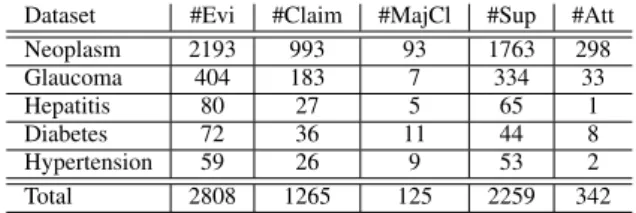
In the following, we describe the data annotation process for the argument components in the neoplasm dataset, and for the argumen-tative relations in the whole dataset. Table 1 reports on the statistics of the final dataset.
Dataset #Evi #Claim #MajCl #Sup #Att Neoplasm 2193 993 93 1763 298 Glaucoma 404 183 7 334 33 Hepatitis 80 27 5 65 1 Diabetes 72 36 11 44 8 Hypertension 59 26 9 53 2 Total 2808 1265 125 2259 342 Table 1. Statistics of the extended dataset. Showing the numbers of evidence, claims, major claims, supporting and attacking relations for each
disease-based subset, respectively.
3.1
Annotation of argument components
Following the guidelines for the annotation of argument components in RCT abstracts provided in [25], two annotators with background in computational linguistics7carried out the annotation of the 500
ab-stracts on neoplasm. IAA among the annotators has been calculated on 30 abstracts, resulting in a Fleiss’ kappa of 0.72 for argumentative components and 0.68 for the more fine-grained distinction between claims and evidence (meaning substantial agreement for both tasks). Example 1 shows a sample annotated abstract, where claims are writ-ten in bold, major claims are highlighted with a dashed underline, and evidence are written in italics.
Claims In the context of RCT abstracts, a claim is a concluding statement made by the author about the outcome of the study. It gen-erally describes the relation of a new treatment (intervention arm) with respect to existing treatments (control arm) and is derived from the described results. Major claims are more a general/concluding claim, which is supported by more specific claims. The concluding statements do not have to occur at the end of the abstract, and may
6While neoplasms can either be benign or malignant, the vast majority of
articles is about malignant neoplasm (cancer). We stick with neoplasm as a term, since this was the MeSH term used for the PubMed query.
7In [15], researchers with different backgrounds (biology, computer science,
argumentation pedagogy, and BioNLP) have annotated medical data for an AM task, showing to perform equally well despite their backgrounds.
also occur at the beginning of the text as an introductory claim, as in Example 1. Given the negligible occurrences of major claims in our dataset, we merge them with the claims for the classification task.
Evidence An evidence in RCT abstracts is an observation or mea-surement in the study, which supports or attacks another argument component, usually a claim. Those observations comprise side ef-fects and the measured outcome of the intervention and control arm. They are observed facts, and therefore credible without further justi-fications, as this is the ground truth the argumentation is based on. Example 1 Extracellular adenosine 5’-triphosphate (ATP) is
volved in the regulation of a variety of biologic processes, in-cluding neurotransmission, muscle contraction, and liver glu-cose metabolism, via purinergic receptors. [In nonrandomized studies involving patients with different tumor types including non-small-cell lung cancer (NSCLC), ATP infusion appeared to inhibit loss of weight and deterioration of quality of life (QOL) and performance status]. We conducted a randomized clinical trial to evaluate the effects of ATP in patients with advanced NSCLC (stage IIIB or IV). [...] Fifty-eight patients were randomly as-signed to receive either 10 intravenous 30-hour ATP infusions, with the infusions given at 2- to 4-week intervals, or no ATP. Out-come parameters were assessed every 4 weeks until 28 weeks. Between-group differences were tested for statistical significance by use of repeated-measures analysis, and reported P values are two-sided. Twenty-eight patients were allocated to receive ATP treatment and 30 received no ATP. [Mean weight changes per 4-week period were -1.0 kg (95% confidence interval [CI]= 1.5 to -0.5) in the control group and 0.2 kg (95% CI =-0.2 to +0.6) in the ATP group (P=.002)]1. [Serum albumin concentration
de-clined by -1.2 g/L (95% CI=-2.0 to -0.4) per 4 weeks in the con-trol group but remained stable (0.0g/L; 95% CI=-0.3 to +0.3) in the ATP group (P =.006)]2. [Elbow flexor muscle strength
de-clined by -5.5% (95% CI=-9.6% to -1.4%) per 4 weeks in the con-trol group but remained stable (0.0%; 95% CI=-1.4% to +1.4%) in the ATP group (P=.01)]3. [A similar pattern was observed
for knee extensor muscles (P =.02)]4. [The effects of ATP on
body weight, muscle strength, and albumin concentration were especially marked in cachectic patients (P=.0002, P=.0001, and P=. 0001, respectively, for ATP versus no ATP)]5. [...] This
ran-domized trial demonstrates that [ATP has beneficial effects on weight, muscle strength, and QOL in patients with advanced NSCLC]1.
3.2
Annotation of argumentative relations
As a next step towards modeling the argumentative structures in the data, it is crucial to annotate the relations, i.e., directed links con-necting the components. Those relations are concon-necting argument components to form the graph like structure of an argument. The relation is a directed link from an outgoing node (i.e., the source) to a target node. The nature of the relation can be supporting or at-tacking, meaning that the source component is justifying or under-mining the target component. Links can occur only between certain components: evidence can be connected to either a claim or another evidence, whereas claims can only point to other claims (including major claims). The polarity of the relation (supporting or attacking) does not limit the possibility to what type of component a component can be connected. Theoretically, all types of relations are possible be-tween the allowed combination pairs. Practically, some relations oc-cur rather seldom compared to the frequency of others. The number of outgoing links from a component may exceed one. Furthermore, in rare cases, components cannot be connected at all. This can hap-pen for major claims in the beginning of an abstract, whose function
is to point out a related problem, unconnected to the outcome of the study itself.
Attack A component is attacking another one, if it is i) contra-dicting the proposition of the target component, or ii) undercutting its implicit assumption of significance, i.e., stating that the observed effects are not statistically significant. The latter case is shown in Ex-ample 2. Here, evidence 1 is attacked by evidence 2, challenging the generality of the prior observation.
Example 2 [True acupuncture was associated with 0.8 fewer hot flashes per day than sham at 6 weeks,]1 [but the difference did
not reach statistical significance (95% CI, -0.7 to 2.4; P = .3).]2
The partial-attack is used when the source component is not in full contradiction, but weakening the target component by constraining its proposition. Those can be implicit statements about the signifi-cance of the study outcome, which usually occur between two claims (see Example 3). Attacks and partial-attacks are identified with a unique class for the relation classification task.
Example 3 [SLN biopsy is an effective and well-tolerated proce-dure.]1[However, its safety should be confirmed by the results
of larger randomized trials and meta-analyses.]2
Support All statements or observations justifying the proposition of the target component are considered as supporting the target (even if they justify only parts of the target component). In Example 1, all the evidence support claim 1.
We carried out the annotation of argumentative relations over the whole dataset of RCT abstracts, including both the first version of the dataset [25] and the newly collected abstracts on neoplasm. An expert in the medical domain (a pharmacist) validated the annotation guidelines before starting the annotation process. IAA has been cal-culated on 30 abstracts annotated in parallel by three annotators (the same two annotators that carried out the argument component anno-tation, plus one additional annotator), resulting in a Fleiss’ kappa of 0.62. The annotation of the remaining abstracts was carried out by one of the above mentioned annotators.
4
The AM pipeline for clinical trials
In this section, we first describe the argument component detection and relation classification tasks, and then we report about the exper-imental setting to solve these tasks.
4.1
Argument Component Detection
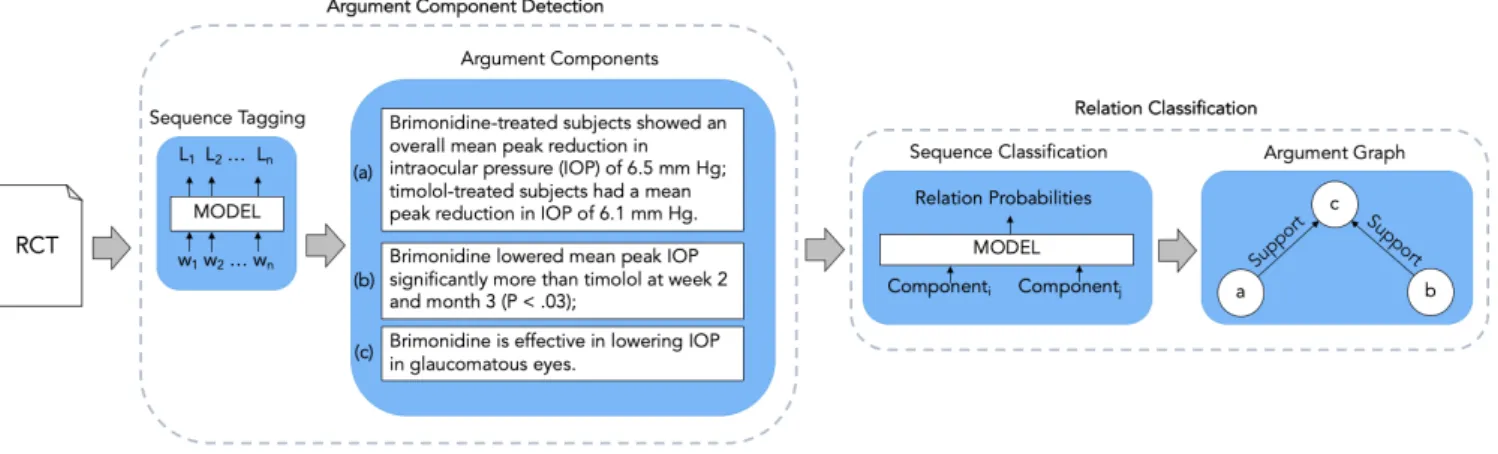
The first step of the AM pipeline (visualized in Figure 1) is the tection of argumentative components and their boundaries. As de-scribed above, most of the AM approaches classify the type of com-ponent assuming the boundaries of argument comcom-ponents as given. To merge the component classification and boundary detection into one problem, we cast the component detection as sequence tagging task. Following the BIO-tagging scheme, each token should be la-beled as either being at the Beginning, Inside or Outside of a compo-nent. As we have two component types in AM, this translates into a sequence tagging problem with five labels, i.e., Claim, I-Claim, B-Evidence, I-Evidence and Outside. To model the temporal dynamics of sequence tagging problems, usually Recurrent Neural Networks
Figure 1. Illustration of the full argument mining pipeline on clinical trials.
(RNN) are used. In our experiments, we evaluate different combi-nations of RNNs with various types of pre-trained word represen-tations. Each embedding method is combined with uni- or bidirec-tional LSTMs or GRUs with and without a CRF as a last layer. Fur-thermore, we are the first to do token level classification on AM by fine-tuning different transformer models.
Embeddings There are two ways to create an input word sentation for sequence modelling. One way is to look up the repre-sentation from pre-trained embeddings. This static method has the advantage that one does not need to train its own embeddings. How-ever, the vocabulary is limited, and the context of the word is not considered. State-of-the-art embeddings are generated dynamically from the context of the target word based on pre-trained language models (LM) [1, 10, 33]. In our experiments, we consider both kinds of embeddings. Furthermore, since our data is from the medical do-main containing very specific terminology which might not be cov-ered in the vocabulary of general word embeddings, we experiment with different approaches to overcome this problem.
As for the static embeddings, we employ GloVe [31] and extvec [20] embeddings, which are commonly used and are based on aggregated global word-word co-occurence statistics trained on Wikipedia and the Gigaword 5 corpus. Words are considered to be the smallest unit. Contrary to that, fastText [13] and byte-pair em-beddings BPEmb [16] use subword segments to increase the ca-pability of their vocabulary and might because of that be a better choice for a setting with unusual and specific terminology. Moving to the dynamically generated embeddings, Embeddings from Language Models (ELMo) [33] are generating the representation of a word by contextualizing it with the whole input sentence. They use a bidirec-tional LSTM to independently train a left-to-right and right-to-left character based LM. We use the ELMo model trained on PubMed to have a model which is trained on the type of data we are using. For the same reason, we use the on PubMed trained Contextualized String Embeddings (FlairPM) [1], another character-based language model. We compare them directly to embeddings trained on web con-tent, Wikipedia, subtitles and news (FlairMulti). The third type of dynamic embedding are Bidirectional Encoder Representations from Transformers (BERT) [10]. The language model considers subwords and the position of the word in the sentence to give the final
repre-sentation of a word.
Transformers can be used as features to an RNN, but also have the possibility to fine-tune the pre-trained model on a target dataset, which we make use of. Beside the original BERT, which is pre-trained on the BooksCorpus and English Wikipedia, there exists multiple other BERT models by now. BioBERT [21] is pre-trained on large-scale biomedical corpora outperforming the general BERT model in representative biomedical text mining tasks. The authors initialize the weights with the original BERT model and train on PubMed abstracts and full articles. Therefore, the vocabulary is the same as for the original BERT. Contrary to that, SciBERT [5] is trained from scratch with an own vocabulary. While SciBERT is trained on full papers from Semantic Scholar it also contains biomed-ical data, but to a smaller degree than BioBERT. We chose to use the uncased SciBERT model, meaning that we ignore the capitalization of words. As it was the case for the original BERT, the uncased model of SciBERT performs slightly better for sentence classification tasks than the cased model. Another new model, which outperforms BERT on the General Language Understanding Evaluation (GLUE) bench-mark, is RoBERTa [23]. There, the BERT pre-training procedure is modified by exchanging static with dynamic masking, using larger byte-pair encoding and batches size, and increasing the size of the dataset.
4.2
Relation Classification
After the argument component detection, the next step is to deter-mine which relations hold between the different components (Fig-ure 1). We extract valid BI tag sequences from the previous step, which are then considered to be the argumentative components of one RCT. Those sequences are phrases and do not necessarily corre-spond to full sentences. The list of components then serves as input for the relation classification. As explained in Section 2, the relation classification task can be tackled with different approaches. We treat it as a sequence classification problem, where the sequence consists of a pair of two components, and the task is to learn the relation between them. For this purpose, we use self-attending transformers, since these models are dominating the benchmarks for tasks which involve classifying the status between two sentences [10]. Treating it
as a sequence classification problem gives us two options to model it: (i) jointly modelling the relations by classifying all possible ar-gumentative component combinations or (ii) predicting possible link candidates for each entity and then classifying the relation only for plausible entity pairs. In the literature, both methods are represented. Therefore, we decided to evaluate both ways of solving the problem. We experiment with various transformer architectures and compare them with state-of-the-art AM models, i.e., the Tree-LSTM based end-to-end system from Miwa and Bansal [28] as employed by Eger et al. [11], and the multi-objective residual network of Galassi et al. [12]. For option (i), we use bi-directional transformers [10], which consists of an encoder and decoder which themselves consists of multi-head self-attention layer each followed by a fully-connected dense layer. Contrary to the sequence tagging transformer, where each token of the sequence has a representation which is fed into the RNN, for sequence classification a pooled representation of the whole sequence is needed. This representation is passed into a lin-ear layer with a softmax which decodes it into a distribution over the target classes. We treat it as a three class classification problem (Sup-port, Attack and NoRelation). We refer to this type of transformer as SentClf. Using this architecture one component can have relations with multiple other components, since each component combination is classified independently. This is not the case in a multiple choice setting (MultiChoice), where possible links are predicted taking the other combinations into account and which we employ for (ii). Here, each component (source) is given the list of all the other components as possible target relation candidates and the goal is to determine the most probable candidate as a target component from this list. This problem definition corresponds to the grounded common sense in-ference problem [43]. To model components which have no outgo-ing link to other components, we add the noLink option to the choice selection. As an encoder for phrase pairs, we evaluate various BERT models which are explained in the transformers section, just as we do for the SentClf task. With respect to the neural transformer architec-ture, a multiple choice setting means that each choice is represented by a vector Ci∈ RH, where H is the hidden size of the output of an
encoder. The trainable weight is a vector V ∈ RHwhose dot product with the choice vector Ciis the score of the choice. The probability
distribution over all possible choices is given by the softmax, where n is the number of choices:
Pi=
eV ·Ci
Pn j=1e
V ·Cj (1)
The component combination with the highest score of having a link between them is then passed into a linear layer to determine which kind of relation is holding between the two components, i.e., Attack or Support. The MultiChoice model is trained jointly with two losses, i.e., one for the multiple choice task and one for for the relation clas-sification task.
Furthermore, we experimented with linear options for link pre-diction, such as matrix or tensor factorization. Those methods are widely used on graph data, e.g., knowledge graphs, to discover new links between existing nodes [41]. The matrix or tensor representa-tion of the graph data is decomposed and a model specific scoring function, which assigns a score to each triple8, is minimized, like a loss function in neural architectures. We experiment by combining those graph-based embeddings and enriching the nodes with linguis-tic features/embeddings to learn hybrid graph embeddings for rela-tions and discover new links between arguments. The tested linear
8A triple consists of a subject (source node), a predicate (labeled edge
be-tween nodes) and an object (target node).
models are: TuckER [3], TransE [6] and ComplEX [41]. Unfortu-nately, those models did not learn a meaningful relation representa-tion. We assume this might be due to our relatively small graph data. In the literature, the smallest dataset these models have been exper-imented on has around 93k triples [9], whereas our dataset has less than 20k.
4.3
Experimental Setup
For sequence tagging, each of the above mentioned embeddings were combined with either (i) a GRU, (ii) a GRU with a CRF, (iii) a LSTM, or (iv) a LSTM with a CRF. Additionally, the best performing static and dynamic embeddings were concatenated and evaluated as if they were one embedding. The Flair [1] PyTorch NLP framework ver-sion 0.4.1 was used for implementing the sequence tagging task. For BERT, we use the PyTorch implementation of huggingface9version 2.3. Hyper parameter tuning was done with hyperopt10version 0.1.2. The learning rate was selected from {0.05, 0.1, 0.15, 0.2}, RNN lay-ers {1, 2}, hidden size {32, 64, 128, 256}, dropout {0.1, 0.2, 0.5}, and batch size from {8, 16, 32}. The RNNs were trained over 100 epochs with early stopping and SGD optimizer. For fine-tuning the BERT model, we used the uncased base model with 12 transformer blocks, a hidden size of 768, 12 attention heads, a learning rate of 2e-5 with Adam optimizer for 3 epochs. The same configuration was used for fine-tuning Sci- and BioBERT. For SciBERT, we used the uncased model with the SciBERT vocabulary. For BioBERT, we used version 1.1. For RoBERTa, we increased the number of epochs for fine-tuning to 10, as it was done in the original paper. The best learn-ing rate was 3e-5 on our task. The number of choices for the multiple choice model was 6. Batch size was 8 with a maximum sequence length of 256 subword tokens per input example. We split our neo-plasm corpus such that 350 abstracts are assigned to the train, 50 to the development, and 100 to the test set. Additionally, we use the first version of the dataset [25] to create two extra test sets, both compris-ing 100 abstracts. The first one includes only glaucoma, whereas the second is a mixed set with 20 abstracts of each disease in the dataset (neoplasm, glaucoma, hypertension, hepatitis and diabetes), respec-tively.
5
Evaluation
This section presents and discusses the empirical results of our AM pipeline for RCTs.
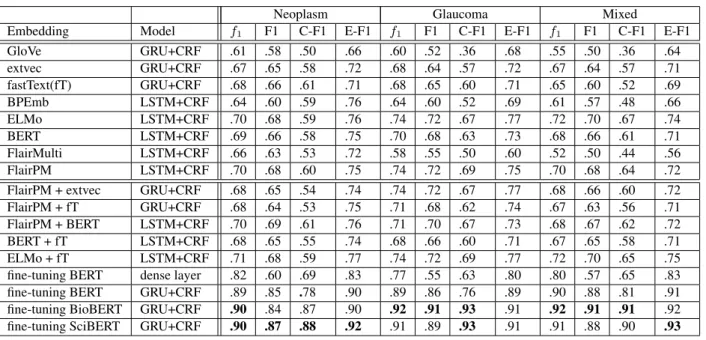
Sequence Tagging We show the results for the best performing RNN models and the best performing embedding combinations in Table 2. Results are given on all three test sets in micro and macro multi-class F1-score and for claim and evidence, respectively. Com-paring the static word embeddings, fastText with a GRU and a CRF is the best performing combination, where extvec is only slightly worse and is usually better for evidence classification. For the dynamic em-beddings coming from LMs, the ones trained on the medical domain corpus, i.e., FlairPM and ELMo, show similar performances with a macro F1-score of .68 on the neoplasm test set. They have the edge over the non-specialized LMs like BERT with .66 or FlairMulti with .63 macro F1-score. Concatenating static and dynamic embeddings does not bring a notable difference, when taking all test sets into ac-count. Generally, evidence scores are higher than claim scores, lead-ing to the conclusion that claims are more diverse than evidence. The
9https://github.com/huggingface/transformers 10https://github.com/hyperopt/hyperopt
Neoplasm Glaucoma Mixed
Embedding Model f1 F1 C-F1 E-F1 f1 F1 C-F1 E-F1 f1 F1 C-F1 E-F1
GloVe GRU+CRF .61 .58 .50 .66 .60 .52 .36 .68 .55 .50 .36 .64 extvec GRU+CRF .67 .65 .58 .72 .68 .64 .57 .72 .67 .64 .57 .71 fastText(fT) GRU+CRF .68 .66 .61 .71 .68 .65 .60 .71 .65 .60 .52 .69 BPEmb LSTM+CRF .64 .60 .59 .76 .64 .60 .52 .69 .61 .57 .48 .66 ELMo LSTM+CRF .70 .68 .59 .76 .74 .72 .67 .77 .72 .70 .67 .74 BERT LSTM+CRF .69 .66 .58 .75 .70 .68 .63 .73 .68 .66 .61 .71 FlairMulti LSTM+CRF .66 .63 .53 .72 .58 .55 .50 .60 .52 .50 .44 .56 FlairPM LSTM+CRF .70 .68 .60 .75 .74 .72 .69 .75 .70 .68 .64 .72 FlairPM + extvec GRU+CRF .68 .65 .54 .74 .74 .72 .67 .77 .68 .66 .60 .72 FlairPM + fT GRU+CRF .68 .64 .53 .75 .71 .68 .62 .74 .67 .63 .56 .71 FlairPM + BERT LSTM+CRF .70 .69 .61 .76 .71 .70 .67 .73 .68 .67 .62 .72 BERT + fT LSTM+CRF .68 .65 .55 .74 .68 .66 .60 .71 .67 .65 .58 .71 ELMo + fT LSTM+CRF .71 .68 .59 .77 .74 .72 .69 .77 .72 .70 .65 .75 fine-tuning BERT dense layer .82 .60 .69 .83 .77 .55 .63 .80 .80 .57 .65 .83 fine-tuning BERT GRU+CRF .89 .85 .78 .90 .89 .86 .76 .89 .90 .88 .81 .91 fine-tuning BioBERT GRU+CRF .90 .84 .87 .90 .92 .91 .93 .91 .92 .91 .91 .92 fine-tuning SciBERT GRU+CRF .90 .87 .88 .92 .91 .89 .93 .91 .91 .88 .90 .93
Table 2. Results of the multi-class sequence tagging task are given in micro F1 (f1) and macro F1 (F1). The binary F1 for claims are reported as C-F1 and for
evidence as E-F1. Best scores in each column are marked in bold; significance was tested with a two-sided Wilcoxon signed rank test.
explanation is that, since natural language reports of measurements in clinical trials vary mostly only in the measured parameter and its values, claims can be made about almost everything. Another ob-servation is that the performance of the models trained on neoplasm data do not significantly decrease for test sets on other disease treat-ments. This fact supports our choice of a more general high level disease type like neoplasm for training the models. The performance for many model combinations even increases on the glaucoma test set. The glaucoma test set comprises only a handful of different glau-coma treatments and is therefore less diversified than the neoplasm or mixed test sets. Looking at the main difference in the results, fine-tuning BERT outperforms all other model combinations, where the version with a GRU and CRF is the best performing model. Fine-tuning without any kind of sequence modelling on top of it results in worse performance. Especially with respect to the validity of BIO se-quences, where disproportionately many invalid sequences are gen-erated. This is not useful when extracting the components based on BIO-scheme. Comparing the specialized with the general models, Bio- and SciBERT show a better performance than the general BERT model, where the cased BioBERT tends to be more reliable for the out of domain test data. This is in line with the findings that the cased transformer model works better for tasks like Named Entity Recogni-tion (NER), which is also a sequence tagging task. The difference on our data is marginal: while for NER the casing of a word is relevant, in our task it does not seem to be a sensitive information.
Relation Classification The results for relation classification are shown in Table 3. The numbers are not calculated on gold stan-dard, but show the actual relation classification performance when the components come from the sequence tagging module of the pipeline. We used the best performing sequence tagger, i.e. the fine-tuned SciBERT with a GRU and CRF. We follow previous work on AM [32] and consider the overlap percentage of the components to determine the base if a predicted component matches the annotated component in the gold standard. Since in our data a lot of the com-ponents span over 50% or more of a sentence and the exact boundary
detection is not always clear, even for human annotators, we consider a predicted and a gold standard component as matched, when at least 75% of the words overlap.
Method Neoplasm Glaucoma Mixed Tree-LSTM .37 .44 .39 Residual network .42 .38 .43 BERT MultiChoice .58 .56 .55 BioBERT MultiChoice .61 .58 .57 SciBERT MultiChoice .63 .59 .60 BERT SentClf .62 .53 .66 BioBERT SentClf .64 .58 .61 SciBERT SentClf .68 .62 .69 RoBERTa .67 .66 .67 Table 3. Results of the relation classification task, given in macro F1-score.
The Tree-LSTM based end-to-end system performed the worst with a F1-score of .37. This can be explained by the positional encod-ing in the persuasive essay dataset beencod-ing more relevant than in ours. There, components are likely to link to a neighboring component, whereas in our dataset the position of a component only partially plays a role, and therefore the distance in the dependency tree is not a meaningful feature. Furthermore, the authors specify that their sys-tem does not scale with increasing text length [11]. Especially de-tailed reports of measurements can make RCT abstracts quite long, such that this system becomes not applicable for this type of data.
The residual network performed better with a F1-score of .42. The main problem here is that it learns a multi-objective for link predic-tion, relation classification and type classification for source and tar-get component, where the latter classification step is already covered by the sequence tagger and therefore unnecessary at this step.
Similar to sequence tagging, one can see a notable increase in per-formance when applying a BERT model. Comparing the specialized and general BERT model, the Bio- and SciBERT increase the perfor-mance by up to .06 F1-score. Interestingly, RoBERTa delivers
com-parable results even though it is a model trained on general data. We speculate that parts of the web crawl data which was used to train RoBERTa contain PubMed articles, since they are freely available on the web. Independently of that, RoBERTa shows more reliable re-sults when looking at the performance on the out of domain test sets. While SciBERT as the best performing system on the in-domain test set drops .06 points on the glaucoma test set, RoBERTa stays almost the same and only drops from .67 to .66 F1-score. Looking at the difference between the MultiChoice and SentClf architectures, the SentClf delivers slightly better results, but the drawback is that this technique tends to link components to multiple components. Since most of our components have only one outgoing edge, it creates a lot of false positives, i.e., links which do not exist.
While our dataset consists of only study abstracts for practical rea-sons, the pipeline can be applied on full text articles as well. Alas, we cannot provide a quantitative analysis on full articles due to missing annotated data. In preliminary experiments on full articles, we have observed a notable increase of false positives in the relation classifi-cation, which is the expected consequence of an increased number of components. Furthermore, with the number of components rising in the double-digit range, the multiple-choice architecture loses its pre-dictive power. We leave further investigations to determine the exact limit of this architecture applied on full text articles to future work.
Error Analysis Common mistakes for the sequence tagger are the invalid BIO sequences. Especially when there are multiple compo-nents in one sentence, the tagger tends to mislabel B- tokens as I-tokens. This is due to the natural imbalance between B- and I- to-kens. Training the sequence tagging without the BIO scheme using only claim and evidence as labels, poses problems when multiple components are following each other in the text. They would be ex-tracted as one single component instead. This is a common case in concluding sentences at the end of a study, which strikingly often comprise multiple claims. Further experiments could go in the di-rection of weighted loss functions like focal loss to overcome this problem. Notable mistakes arise for determining the exact compo-nent boundaries. Especially in the case of connectives, e.g., however, which have sometimes nothing but a conjunctive function, and in other cases signal a constraint of a previous statement. Another mis-take is the misclassification of the description of the initial state of the participant groups as an observation of the study and therefore an evidence, e.g., there were no significant differences in pregnancy-induced hypertension across supplement groups. In the study abstract these descriptions occur usually relatively close to the actual result description, which means that adding information of the position in the text will not avoid this error. While only some abstracts are struc-tured, the full study report does usually have separated sections. This structure can be exploited when analysing full reports, and in the simplest case one would analyse only the sections of interest.
Concerning link prediction, general components like the differ-ence was not statistically significantare problematic, since it could be linked to most of the components/outcomes of the trial. Here, a positional distance encoding could be beneficial, since those com-ponents are usually connected to the previous component. In gen-eral, most of the errors in the MultiChoice architecture were made in the multiple choice part by predicting a wrong link and not at the stage of classifying the relation type. Interestingly, comparing the two domain adapted models, Bio- and SciBERT, there were no regular errors, which allows any conclusion about the advantages or disadvantages of one model. Looking at the confusion matrices, all tested SentClf models show a higher error rate for the NoRelation
class. Both transformer approaches have in common the problem of dealing with negations and limitations or associating the polarity of a measurement and therefore confusing support and attack.
Example 4 [more research about the exact components of a VR intervention and choice of outcomes to measure effectiveness is required]source[Conducting a pragmatic trial of effectiveness
of a VR intervention among cancer survivors is both feasible and acceptable]target
Example 5 [this did not translate into improved progression-free survival (PFS) or overall survival]source[The addition of
gemcitabine to carboplatin plus paclitaxel increased treatment burden, reduced PFS time, and did not improve OS in patients with advanced epithelial ovarian cancer]target
Example 4 shows two claims with a limiting/attacking relation, which was wrongly classified as supporting. For Example 5, not im-proving progression-free survival (PFS)corresponds to a reduced PFS time, while for other factors reducing the value means it is ben-eficial and therefore improving some study parameter. Here, the in-clusion of external expert knowledge is crucial to learn these fine nuances. The polarity of a measurement cannot be learnt from tex-tual features alone. Especially in the medical domain, there are com-plex interrelationships which are not often explicitly mentioned and therefore are impossible to capture with a model trained solely on character-based input. Phrases like increased the blood pressure by Xor showed no symptom of Y can connote different messages de-pending on the context. Future work needs to consider this challenge of incorporating external expert knowledge. While we do not think this is a problem limited to a special domain, we consider it greatly important for understanding and representing medical text.
6
Conclusion
To support clinicians in decision making or in (semi)-automatically filling evidence tables for systematic reviews in evidence-based medicine, we propose a complete argument mining pipeline for the healthcare domain. To this aim, we built a novel corpus of health-care texts (i.e., RCT abstracts) from the MEDLINE database, which are annotated with argumentative components and relations. Indeed, we show that state-of-the-art argument mining systems are unable to satisfactorily tackle the two tasks of argument component detection and relation prediction on this kind of text, given its peculiar features (e.g., component relations spanning across the whole RCT abstract). We expect that our work will have a large impact for clinicians as it is a crucial step towards AI supported clinical deliberation at a large scale.
We employ a sequence tagging approach combining a domain spe-cific BERT model with a GRU and CRF to identify and classify argument components. We cast the relation classification task as a multiple choice problem and compare it with recent transformers for sequence classification. In our extensive evaluation, addressed on a newly AM annotated dataset of RCTs, we investigate the use of dif-ferent neural transformer architectures and pre-trained models in this pipeline, showing an improvement of the results in comparison with standard baselines and state-of-the-art AM systems.
For future work, we will annotate relations across different RCTs to allow reasoning on the resulting argument graphs and clustering of arguments about the same disease. Furthermore, we will inves-tigate different ways to efficiently deal with medical abbreviations and incorporate a distance parameter to overcome the problem that
general components talking about limitations are linked to unrelated components far away in the text of the RCT abstract.
ACKNOWLEDGEMENTS
This work is partly funded by the French government labelled PIA program under its IDEX UCA JEDI project (ANR-15-IDEX-0001). This work has been supported by the French government, through the 3IA Cˆote d’Azur Investments in the Future project managed by the National Research Agency (ANR) with the reference number ANR-19-P3IA-0002
REFERENCES
[1] Alan Akbik, Duncan Blythe, and Roland Vollgraf, ‘Contextual string embeddings for sequence labeling’, in Proc. of COLING 2018, pp. 1638–1649, (2018).
[2] Katie Atkinson, Pietro Baroni, Massimiliano Giacomin, Anthony Hunter, Henry Prakken, Chris Reed, Guillermo Ricardo Simari, Matthias Thimm, and Serena Villata, ‘Towards artificial argumenta-tion’, AI Magazine, 38(3), 25–36, (2017).
[3] Ivana Balazevic, Carl Allen, and Timothy Hospedales, ‘TuckER: Ten-sor factorization for knowledge graph completion’, in Proc. of EMNLP-IJCNLP 2019, pp. 5185–5194, (2019).
[4] Roy Bar-Haim, Indrajit Bhattacharya, Francesco Dinuzzo, Amrita Saha, and Noam Slonim, ‘Stance classification of context-dependent claims’, in Proc. of EACL 2017, pp. 251–261, (2017).
[5] Iz Beltagy, Kyle Lo, and Arman Cohan, ‘SciBERT: A pretrained lan-guage model for scientific text’, in Proc. of EMNLP-IJCNLP 2019, pp. 3615–3620, (2019).
[6] Antoine Bordes, Nicolas Usunier, Alberto Garc´ıa-Dur´an, Jason Weston, and Oksana Yakhnenko, ‘Translating embeddings for modeling multi-relational data’, in Proc. of NIPS 2013, pp. 2787–2795, (2013). [7] Elena Cabrio and Serena Villata, ‘Five years of argument mining: a
data-driven analysis’, in Proc. of IJCAI 2018, pp. 5427–5433, (2018). [8] Robert Craven, Francesca Toni, Cristian Cadar, Adrian Hadad, and
Matthew Williams, ‘Efficient argumentation for medical decision-making’, in Proc. of KR 2012, pp. 598–602, (2012).
[9] Tim Dettmers, Minervini Pasquale, Stenetorp Pontus, and Sebastian Riedel, ‘Convolutional 2d knowledge graph embeddings’, in Proc. of AAAI 2018, pp. 1811–1818, (February 2018).
[10] Jacob Devlin, Ming-Wei Chang, Kenton Lee, and Kristina Toutanova, ‘BERT: Pre-training of deep bidirectional transformers for language understanding’, in Proc. of NAACL-HLT 2019, pp. 4171–4186, (2019). [11] Steffen Eger, Johannes Daxenberger, and Iryna Gurevych, ‘Neural end-to-end learning for computational argumentation mining’, in Proc. of ACL 2017, pp. 11–22, (2017).
[12] Andrea Galassi, Marco Lippi, and Paolo Torroni, ‘Argumentative link prediction using residual networks and multi-objective learning’, in Proc. of ArgMining 2018 workshop, pp. 1–10, (2018).
[13] Edouard Grave, Piotr Bojanowski, Prakhar Gupta, Armand Joulin, and Tomas Mikolov, ‘Learning word vectors for 157 languages’, in Proc. of LREC 2018, pp. 3483–3487, (2018).
[14] Nancy Green, ‘Argumentation for scientific claims in a biomedical re-search article’, in Proc. of ArgNLP 2014 workshop, (2014).
[15] Nancy Green, ‘Annotating evidence-based argumentation in biomedical text’, IEEE BIBM 2015, 922–929, (2015).
[16] Benjamin Heinzerling and Michael Strube, ‘Bpemb: Tokenization-free pre-trained subword embeddings in 275 languages’, in Proc. of LREC 2018, pp. 2989–2993, (2018).
[17] Xinyu Hua, Mitko Nikolov, Nikhil Badugu, and Lu Wang, ‘Argument mining for understanding peer reviews’, in Proc. of NAACL-HLT 2019, p. 2131–2137, (2019).
[18] Anthony Hunter and Matthew Williams, ‘Aggregating evidence about the positive and negative effects of treatments’, Artificial Intelligence in Medicine, 56(3), 173–190, (2012).
[19] Di Jin and Peter Szolovits, ‘PICO element detection in medical text via long short-term memory neural networks’, in Proc. of BioNLP 2018 workshop, pp. 67–75, (2018).
[20] Alexandros Komninos and Suresh Manandhar, ‘Dependency based em-beddings for sentence classification tasks’, in Proc. of NAACL-HLT 2016, pp. 1490–1500, (2016).
[21] Jinhyuk Lee, Wonjin Yoon, Sungdong Kim, Donghyeon Kim, Sunkyu Kim, Chan Ho So, and Jaewoo Kang, ‘BioBERT: a pre-trained biomed-ical language representation model for biomedbiomed-ical text mining’, Bioin-formatics, (2019).
[22] Marco Lippi and Paolo Torroni, ‘Argumentation mining: State of the art and emerging trends’, ACM Trans. Internet Techn., 16(2), 10, (2016). [23] Yinhan Liu, Myle Ott, Naman Goyal, Jingfei Du, Mandar Joshi, Danqi
Chen, Omer Levy, Mike Lewis, Luke Zettlemoyer, and Veselin Stoy-anov, ‘Roberta: A robustly optimized BERT pretraining approach’, CoRR, abs/1907.11692, (2019).
[24] Luca Longo and Lucy Hederman, ‘Argumentation theory for decision support in health-care: A comparison with machine learning’, in Proc. of BHI 2013, pp. 168–180, (2013).
[25] Tobias Mayer, Elena Cabrio, Marco Lippi, Paolo Torroni, and Serena Villata, ‘Argument mining on clinical trials’, in Proc. of COMMA 2018, pp. 137–148, (2018).
[26] Tobias Mayer, Elena Cabrio, and Serena Villata, ‘ACTA a tool for ar-gumentative clinical trial analysis’, in Proc. of IJCAI 2019, pp. 6551– 6553, (2019).
[27] Stefano Menini, Elena Cabrio, Sara Tonelli, and Serena Villata, ‘Never retreat, never retract: Argumentation analysis for political speeches’, in Proc. of AAAI 2018, pp. 4889–4896, (2018).
[28] Makoto Miwa and Mohit Bansal, ‘End-to-end relation extraction us-ing lstms on sequences and tree structures’, in Proc. of ACL 2016, pp. 1105–1116, (2016).
[29] Vlad Niculae, Joonsuk Park, and Claire Cardie, ‘Argument mining with structured SVMs and RNNs’, in Proc. of ACL 2017, pp. 985–995, (2017).
[30] Andreas Peldszus and Manfred Stede, ‘From argument diagrams to ar-gumentation mining in texts: A survey’, Int. J. Cogn. Inform. Nat. In-tell., 7(1), 1–31, (2013).
[31] Jeffrey Pennington, Richard Socher, and Christopher D. Manning, ‘Glove: Global vectors for word representation’, in Proc. of EMNLP 2014, pp. 1532–1543, (2014).
[32] Isaac Persing and Vincent Ng, ‘End-to-end argumentation mining in student essays’, in Proc. of NAACL-HLT 2016, pp. 1384–1394, (2016). [33] Matthew Peters, Mark Neumann, Mohit Iyyer, Matt Gardner, Christo-pher Clark, Kenton Lee, and Luke Zettlemoyer, ‘Deep contextualized word representations’, in Proc. of NAACL-HLT 2018, pp. 2227–2237, (2018).
[34] Peter Potash, Alexey Romanov, and Anna Rumshisky, ‘Here’s my point: Joint pointer architecture for argument mining’, in Proc. of EMNLP 2017, pp. 1364–1373, (2017).
[35] Malik Al Qassas, Daniela Fogli, Massimiliano Giacomin, and Gio-vanni Guida, ‘Analysis of clinical discussions based on argumentation schemes’, Procedia Computer Science, 64, 282–289, (2015). [36] Nils Reimers, Benjamin Schiller, Tilman Beck, Johannes Daxenberger,
Christian Stab, and Iryna Gurevych, ‘Classification and clustering of ar-guments with contextualized word embeddings’, in Proc. of ACL 2019, pp. 567–578, (2019).
[37] Anders Søgaard and Yoav Goldberg, ‘Deep multi-task learning with low level tasks supervised at lower layers’, in Proc. of ACL 2016, pp. 231–235, (2016).
[38] Christian Stab and Iryna Gurevych, ‘Parsing argumentation structures in persuasive essays’, Comput. Linguist., 43(3), 619–659, (2017). [39] Simone Teufel, Advaith Siddharthan, and Colin Batchelor, ‘Towards
domain-independent argumentative zoning: Evidence from chemistry and computational linguistics’, in Proc. of EMNLP 2009, pp. 1493– 1502, (2009).
[40] Antonio Trenta, Anthony Hunter, and Sebastian Riedel, ‘Extraction of evidence tables from abstracts of randomized clinical trials us-ing a maximum entropy classifier and global constraints’, CoRR, abs/1509.05209, (2015).
[41] Th´eo Trouillon, Johannes Welbl, Sebastian Riedel, ´Eric Gaussier, and Guillaume Bouchard, ‘Complex embeddings for simple link predic-tion’, in Proc. of ICML 2016, pp. 2071–2080, (2016).
[42] Jure Zabkar, Martin Mozina, Jerneja Videcnik, and Ivan Bratko, ‘Ar-gument based machine learning in a medical domain’, in Proc. of COMMA 2006, pp. 59–70, (2006).
[43] Rowan Zellers, Yonatan Bisk, Roy Schwartz, and Yejin Choi, ‘SWAG: A large-scale adversarial dataset for grounded commonsense infer-ence’, in Proc. of EMNLP 2018, pp. 93–104, (2018).