REGIONAL ANAESTHESIA
Deltoid, triceps, or both responses improve the success
rate of the interscalene catheter surgical block compared
with the biceps response
A. Borgeat
1*, G. Ekatodramis
1, S. Guzzella
1, P. Ruland
1, G. Votta-Velis
2and J. Aguirre
11Department of Anaesthesiology, Balgrist University Hospital, Forchstrasse 340, CH-8008 Zurich, Switzerland 2
Department of Anaesthesiology, University of Illinois at Chicago, Chicago, IL, USA * Corresponding author. E-mail: [email protected]
Editor’s key points
† Infraclavicular block is better when the posterior cord of the brachial plexus is stimulated during placement. † However, biceps (anterior
fibres) and deltoid muscle (posterior fibres)
stimulation have previously produced similar success rates after single-injection
interscalene block. † This study compared
these techniques using ropivacaine infusion for 48 h after shoulder surgery.
† Eliciting a deltoid, triceps, or both responses was more successful than eliciting a biceps response.
Background.The influence of the muscular response elicited by neurostimulation on the success rate of interscalene block using a catheter (ISC) is unknown. In this investigation, we compared the success rate of ISC placement as indicated by biceps or deltoid, triceps, or both twitches.
Methods.Three hundred (ASA I–II) patients presenting for elective arthroscopic rotator cuff repair were prospectively randomized to assessment by biceps (Group B) or deltoid, triceps, or both twitches (Group DT). All ISCs were placed with the aid of neurostimulation. The tip of the stimulating needle was placed after disappearance of either biceps or deltoid, triceps, or both twitches at 0.3 mA. The catheter was advanced 2 –3 cm past the tip of the needle and the block was performed using 40 ml ropivacaine 0.5%. Successful block was defined as sensory block of the supraclavicular nerve and sensory and motor block involving the axillary, radial, median, and musculocutaneous nerves within 30 min.
Results. Success rate was 98.6% in Group DT compared with 92.5% in Group B (95% confidence interval 0.01– 0.11; P,0.02). Supplemental analgesics during handling of the posterior part of the shoulder capsule were needed in two patients in Group DT and seven patients in Group B. Three patients in Group B had an incomplete radial nerve distribution anaesthesia necessitating general anaesthesia. One patient in Group B had an incomplete posterior block extension of the supraclavicular nerve. No acute or late complications were observed.
Conclusions.Eliciting deltoid, triceps, or both twitches was associated with a higher success rate compared with eliciting biceps twitches during continuous interscalene block. Keywords: anaesthetics, local; brachial plexus; nerve block; regional anaesthesia; ropivacaine
Accepted for publication: 9 May 2012
Pain after shoulder surgery is severe, particularly after rotator cuff repair,1 2and is best treated using continuous intersca-lene analgesia.3This technique allows early and efficient re-habilitation,4 decreases side-effects,5and improves patient satisfaction.6Recent studies have investigated the relation-ship between the type of muscular response and the success rate during single-shot infraclavicular block.7–9 All have shown that a stimulation of the posterior cord (radial response) was associated with more frequent success com-pared with stimulation of the median or lateral cord. The most often encountered muscular twitches when performing interscalene block are biceps, innervated by the anterior
fibres of C5 and C6, and deltoid or proximal triceps response, innervated by the posterior fibres of C5 and C6.10 11It has been shown for single-shot interscalene block that both biceps and deltoid twitches were associated with a similar success rate.12 The aim of this trial was to compare the success rate of interscalene catheter (ISC) placement associated with either a biceps or a deltoid, triceps, or both responses. We hypothesize that posterior stimulation of the trunk (deltoid/triceps response) was associated with a higher anaesthetic block success rate for the interscalene anaesthesia than anterior trunk stimulation (biceps response).
After obtaining institutional ethics committee approval (Gesundheitsdirektion des Kantons Zu¨rich, Kantonale Ethik-Kommission) and written informed consent, 300 consecutive adult patients of both sexes (ASA physical status I or II; age 18–65 yr; weight 50–95 kg) undergoing an elective arthro-scopic shoulder rotator cuff repair were entered in the study. Exclusion criteria were any contraindications to inter-scalene block, known allergy to ropivacaine or opioids, and chronic treatment with opioids. Patients were assigned according to a computerized randomization list to either group biceps twitches (Group B) or deltoid, triceps, or both twitches (Group DT). The assigned group determined the final chosen muscular response (either biceps or deltoid, triceps, or both) to elicit for the placement of the ISC. The in-ability to place the ISC was considered as an exclusion criter-ion during the study. The placement of the ISC was standardized for all patients. On the day of surgery, all patients were premedicated with oral midazolam 0.1 mg kg211 h before surgery. On arrival in the induction room, a 20 G i.v. catheter was inserted into a vein in the arm not re-quiring surgery. All interscalene blocks were performed using the modified lateral approach13and identified using a nerve stimulator (Stimuplexw
, HNS 11; B. Braun Melsungen AG, Mel-sungen, Germany) connected to the proximal end of the metal inner part of the stimulating needle (Polymedicw
, 21 G stimulation needle; Te me na SAS, Carnie`res-sur-Seine, France).
In Group B, the placement of the needle was considered successful when a contraction of the biceps muscle vanished with a current output of exactly 0.3 mA. The impulse duration was 0.1 ms and the stimulation frequency 2 Hz. In Group DT, the placement of the needle was considered successful when a contraction of the deltoid or proximal triceps muscle van-ished exactly with the same neurostimulator settings as for Group B (0.3 mA; 0.1 ms, 2 Hz). In the case of persistent muscle twitch below 0.3 mA, the needle was withdrawn or redirected until the muscle twitch vanished at exactly 0.3 mA. For the placement of the perineural catheter, the cannula-over-needle technique was used with a plastic cannula (Polymedicw
, Polyplex N50-T, 18 G external diam-eter, Te me na SAS). The catheter (Polymedicw
, Polyplex W50, 20 G with stylet, Te me na SAS) was introduced distally and advanced 2 – 3 cm past the tip of the stimulating needle. The catheter was tunnelled subcutaneously over 4 –5 cm through an 18 G i.v. cannula in the direction of the opposite shoulder and fixed to the skin with a transparent adhesive tape. Interscalene block was performed in all patients with ropivacaine 0.5% 40 ml (200 mg) given through the catheter. To maintain blinding, an anaesthetist neither involved in the study nor aware of the patient’s group assignment was re-sponsible for the assessment of the block and the occurrence of acute complications (central nervous system or cardiac toxicity) and side-effects (Horner syndrome and hoarseness). The block was considered successful when a sensory block (inability to recognize cold temperature in the territory of the
paraesthesia at the tip of the first and third finger) and a motor block (inability to abduct the arm and to extend or flex the forearm involving the axillary, radial and musculocu-taneous nerves) were present within 30 min after the admin-istration of the local anaesthetic and no supplementary analgesics were required during surgery for pain in the surgi-cal field. Complete sensory block of the supraclavicular nerve (anterior and posterior skin territory of the shoulder) was also considered necessary for a successful block. When the block was complete, upon patient request, sedation with propofol using the target-controlled infusion (TCI) technique (Diprifu-sor including the Marsh programme for propofol, Graseby: Sims Graseby Limited, Watford, Herts, UK) was allowed up to a maximum effect-site concentration of 0.5 mg ml21. Sedation was titrated to keep a Ramsay sedation score of 2 (patient awake and relaxed). Block failure was defined as in-complete block if one or more of the axillary, radial, and mus-culocutaneous nerves or inadequate extension of the block over the anterior or posterior shoulder or the need for supple-mentary analgesics (TCI remifentanil including the Minto pro-gramme, Graseby: Sims Graseby Limited) because of pain in the operative field during surgery.
Postoperative analgesia was started 6 h after the initial block (t¼0) (Pain Management Provider, Abbott Laboratories, North Chicago, IL, USA) with a patient with a baseline infu-sion of 8 ml h21, a bolus dose of 5 ml with a lockout time of 20 min, using ropivacaine 0.3% for the first 24 h and then ropivacaine 0.2% for the next 24 h until the end of the study (t¼48). All patients received i.v. proparacetamol 2 g four times daily. Supplementary subcutaneous morphine (0.1 mg kg21) was available for rescue medication. The study period ended 48 h after start of the continuous infusion of ropivacaine.
A research nurse not involved in the protocol was respon-sible for assessing pain twice a day by means of a visual ana-logue scale (VAS) (from 0 mm, no pain, to 100 mm, worst pain imaginable) at rest and during shoulder mobilization (passive abduction of the arm). The ISC was observed daily for signs of inflammation (redness or pain on pressure at the puncture site) or infection (presence of pus at the punc-ture site). All the patients were observed independently by a surgeon and an anaesthetist 6 weeks after surgery to examine for neurological complications, defined as any sensory –motor deficit impairing normal daily life or pain not directly related to the surgical procedure. The occurrence of one of these events was considered as a neurological complication.
Statistical analysis
According to previous data,14the success rate of ISC varies in about 15% (80– 95% success rate). Our hypothesis was that the deltoid, triceps, or both responses will provide a 5% higher success rate compared with the biceps response. Based on these data, a power analysis indicated that a sample size of 144 patients per group was sufficient to
have an 80% power at the 95% significance level. To com-pensate for possible dropouts, we decided to include 150 patients per group. Patient data were compared with the Mann– Whitney test and expressed as mean (SD). Success rate and adverse effects were analysed with the x2 test. The confidence interval for the difference between two inde-pendent proportions was calculated according to the method described by Newcombe.15 A P-value of ,0.05 was consid-ered significant. For statistical analysis, the software SPSS for windows, version 11.5 (SPSS, Chicago, IL, USA), was used.
Results
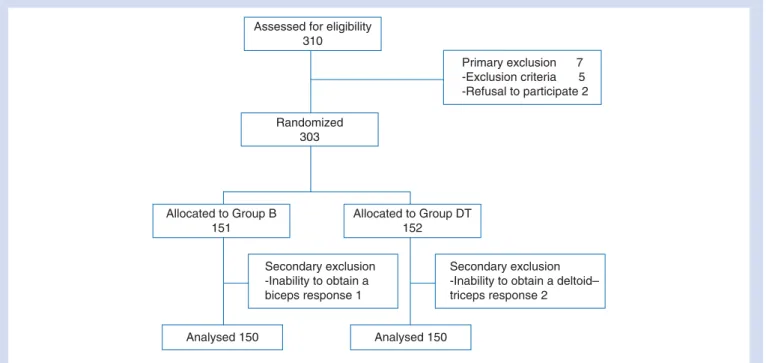
A total of 310 patients undergoing arthroscopic rotator cuff repair were consecutively enrolled in this prospective study (Fig.1). The placement of the ISC was uneventful in 97.5%. One patient in Group B and two in Group DT were excluded because of the inability to elicit the expected twitch, and so data from 300 patients were analysed (Table 1). Two patients in each group needed a second insertion due to resistance during catheter threading. One catheter in Group DT was dislocated after 42 h. No patient had to be excluded because of technical problems with catheter placement.
Successful block occurred in 148 patients (98.6%) in Group DT compared with 139 patients (92.5%) in Group B (P,0.02) (Table2).
In Group DT, a deltoid response was observed in 42%, a triceps in 39%, and a mixed response in 19% of the patients. In Group DT, two patients needed supplementary analgesics during manipulation of the posterior part of the shoulder capsule. Of these two patients, one had a triceps response and one a deltoid response. In Group B, three patients had an incomplete radial block and received preoperative
general anaesthesia and seven patients needed supplemen-tary analgesics during handling of the posterior part of the shoulder capsule. Pain occurring during manipulation of the posterior part of the shoulder capsule was rapidly and effectively controlled with a TCI remifentanil effect-site con-centration of 1.9–2.8 ng ml21. Local infiltration of the skin with 5 ml lidocaine 1% at the posterior portal site was needed in one and three patients in Groups DT and B, respectively.
The occurrence of side-effects was similar in both groups (Table3). No central nervous system or cardiac toxicity was observed in either group. No infection at the insertion site was noted and no patient had signs or symptoms of neuropathy at 6 weeks after operation.
Among those who had a successful surgical block, no patient needed supplementary opioids. Among the block fail-ures who received supplementary analgesics during surgery, eight out of 10 patients needed supplementary morphine during mobilization, but not at rest, between the start of mobilization (t¼24) until t¼48. No supplementary morphine was needed for any patient during the last 6 h of the study.
Assessed for eligibility 310 Analysed 150 Allocated to Group B 151 Primary exclusion 7 -Exclusion criteria 5 -Refusal to participate 2 Randomized 303 Allocated to Group DT 152 Secondary exclusion -Inability to obtain a biceps response 1 Analysed 150 Secondary exclusion -Inability to obtain a deltoid– triceps response 2
Fig 1 Patient flow diagram. Study design according to the CONSORT statement.
Table 1Patient and surgical characteristics. Data are expressed as mean (SD). DT, deltoid/triceps; B, biceps
Group DT (n5150) Group B (n5150) Age (yr) 48 (15) 53 (11) Gender (M/F) 102/48 111/39 Weight (kg) 76 (17) 82 (18) Duration of surgery (min) 110 (52) 104 (49)
Discussion
This study showed that for the placement of ISC, a deltoid, triceps, or both were associated with a higher anaesthetic block success rate compared with the biceps motor response. In Group B, a higher incidence of incomplete radial and suprascapular nerve block was observed. We compared these two types of muscular responses because the biceps response is associated with the anterolateral part of the upper trunk and the deltoid, triceps, or both with the posterior part.10
The results of this investigation are in accordance with those found after single-shot coracoid infraclavicular block, demonstrating a higher success rate after stimulation of the posterior cord. Lecamwasam and colleagues8 observed a 5.8% failure rate after posterior cord stimulation compared with 28.3% and 15.4% after lateral and medial cord stimula-tion, respectively. Using the same approach, Minville and colleagues9noted that after block of the musculocutaneous nerve, subsequent injection on a radial response resulted in a more reliable success rate than injection with an ulnar or median response. We have no clear evidence to explain the different results observed in the present study and those of Silverstein and colleagues12 who found a similar success
following issues may explain this discrepancy. First, in Silver-stein and colleagues’ investigation, the block was performed through the needle, while in ours, it was done through the catheter. Secondly, in our work, the number of patients per group was higher (two groups of 150 compared with 61/54 and 45 with a mixed response), and therefore we had a greater chance to observe a significant difference.
One may wonder if the catheter is still at the desired location after having been advanced for about 2 cm past the tip of the stimulating needle. We used a multi-orifice catheter (with no end hole), the first and last holes being 1.0 and 2.0 cm proximal to the end of the catheter. This means that a large amount of local anaesthetic has been placed very close to the tip of the stimulating needle, even if the catheter did not follow the ideal direction. The position of the tip of the catheter is of minor interest since no drug can be distributed to the tissue from the last centimetre of the catheter.
Brachial plexus anatomy at this level may explain the differences in success rate associated with a deltoid, triceps, or both compared with a biceps response. The inter-scalene space is surrounded by the prevertebral fascia, a firm, tough membrane that lies in front of the prevertebral muscles, which extends sideways across the scalenus anter-ior, scalenus medius, and levator scapulae muscles, getting thinner as it progresses distally.11 In addition, the fibres that form the musculocutaneous nerve are located antero-laterally.10 Thus, it is possible that the presence of this fascia between the tip of the stimulating needle and the anterolateral part of the upper trunk will still allow a twitch of a biceps, despite a current as low as 0.3 mA. This situation will prevent a good spread of the local anaesthetics within the interscalene space, explaining the incomplete block of the radial nerve. In cases of deltoid, triceps, or both motor responses, this scenario is unlikely to occur, since the fibres for these nerves are located on the posterior side of the upper trunk, making the possibility that the fascia is between the tip of the stimulating needle and the posterior part of the trunk very unlikely.10 16
Nine patients (two and seven in Groups DT and B, respect-ively) received supplementary analgesics (remifentanil) during surgical manipulation of the posterior part of the shoulder capsule. This pain is most likely associated with an insufficient block of the lateral branch of the suprascapu-lar nerve. The suprascapusuprascapu-lar nerve originates from the C5 and C6 nerve roots of the superior trunk, with a contribution from C4 usually present as well. It provides sensation for a significant amount of the posterior shoulder capsule and may leave the upper trunk at different levels, sometimes very proximally.16 It may then be difficult to block it in some patients, especially the lateral branch.
The block extension of the lateral branch of the supracla-vicular nerve was insufficient in one and three patients in Groups D/T and B, respectively. This is easy to manage since subcutaneous infiltration with any local anaesthetic at the arthroscopic portal puncture site will be sufficient to
Table 3Adverse effects and complications expressed as numbers. DT, deltoid/triceps; B, biceps; LA, local anaesthetic; CNS, central nervous system. No significant differences between the groups Group DT (n5150) Group B (n5150) Horner syndrome 8 12 Hoarseness 6 8
Pain (local burning) during LA application 24 30 Paraesthesia during puncture 1 0 CNS toxicity 0 0 Cardiac toxicity 0 0 Catheter infection 0 0 deltoid/triceps; B, biceps. *P,0.02.†Patients who had local
infiltration at the posterior portal site.
Group DT (n5150)
Group B (n5150) Success rate 148* 139 Incomplete radial block 0 3 Incomplete posterior extension of the
supraclavicular nerve
0 1†
Supplementary analgesics during surgery 1† 5
Supplementary analgesics during surgery and incomplete posterior extension of supraclavicular nerve
control pain during placement of the arthroscope. Insuffi-cient block is explained by the location of this nerve, which is quite posterior and in the remote position of its lateral branch. The presence of the median scalene muscle between the trunks and the supraclavicular nerve can also hinder the diffusion of the local anaesthetics towards the suprascapular nerve (Fig.2).17
The incidence of acute or late complications was low and is in accordance with previous investigations.18 19 Post-operative analgesia was excellent (VAS,20) in all patients with successful blocks, confirming results from previous studies using patient-controlled interscalene analgesia.3 5 Among those who had insufficient suprascapular block, 80% received supplementary morphine for mobilization during the first 48 postoperative hours.
One limitation of this study is that the placement of tip of the catheter was not specifically identified. This was not done since no drug can be distributed to the tissue from the last centimetre of the catheter. The improvement of 6% with the deltoid/proximal triceps may also seem trivial and its clinical significance debatable.
In conclusion, in this study, we found that stimulation of the posterior part (deltoid, triceps, or both) of the upper trunk provided a significantly higher and more reliable anaesthetic block success rate compared with the anterior part (biceps) and it is preferable during ISC placement.
Declaration of interest
None declared.
Funding
Financial support was provided solely by departmental sources.
References
1 Ianotti J, Naranja J, Gartsman G. Surgical treatment of the intact cuff and repairable cuff defect. Arthroscopic and open techni-ques. In: Norris TR, ed. Orthopaedic Knowledge Update: Shoulder and Elbow, 1st Edn. Rosemont, IL: American Academy of Ortho-paedic Surgeons, 1997; 151 –5
2 Brown DD, Friedman RJ. Postoperative rehabilitation following total shoulder arthroplasty. Orthop Clin North Am 1998; 29: 535– 47
3 Borgeat A, Schappi B, Biasca N, Gerber C. Patient-controlled analgesia after major shoulder surgery: patient-controlled interscalene analgesia versus patient-controlled analgesia. Anesthesiology 1997; 87: 1343– 7
4 Ilfeld BM, Vandenborne K, Duncan PW, et al. Ambulatory continu-ous interscalene nerve blocks decrease the time to discharge readiness after total shoulder arthroplasty: a randomized, triple-masked, placebo-controlled study. Anesthesiology 2006; 105: 999– 1007
5 Borgeat A, Tewes E, Biasca N, Gerber C. Patient-controlled inter-scalene analgesia with ropivacaine after major shoulder surgery: PCIA vs PCA. Br J Anaesth 1998; 81: 603 –5
6 Enneking FK, Wedel DJ. The art and science of peripheral nerve blocks. Anesth Analg 2000; 90: 1–2
7 Bloc S, Garnier T, Komly B, et al. Single-stimulation, low-volume infraclavicular plexus block: influence of the evoked distal motor response on success rate. Reg Anesth Pain Med 2006; 31: 433 –7
Lateral Cephalad Medial Caudal ASM Trunk MSM Ib SCN Lb SCN SCN SCMM
Fig 2 Anatomy of the interscalene brachial plexus. SCMM, sternocleidomastoid muscle; MSM, middle scalene muscle; ASM, anterior scalene muscle; Ib SCN, intermediate branch of the supraclavicular nerve; Lb SCN, lateral branch of the supraclavicular nerve.
lar block. Anesth Analg 2006; 102: 1564– 8
9 Minville V, Fourcade O, Bourdet B, et al. The optimal motor response for infraclavicular brachial plexus block. Anesth Analg 2007; 104: 448– 51
10 Zancolli E, Cozzi E. Atlas of Surgical Anatomy of the Hand, 1st Edn. Edinburgh: Churchill Livingstone Inc., 1992: 573– 6
11 Sinnatamby C. Last’s Anatomy: Regional and Applied, 11th Edn. Edinburgh: Churchill Livingstone Inc., 2006: 345
12 Silverstein WB, Saiyed MU, Brown AR. Interscalene block with a nerve stimulator: a deltoid motor response is a satisfactory endpoint for successful block. Reg Anesth Pain Med 2000; 25: 356– 9
13 Borgeat A, Ekatodramis G. Anaesthesia for shoulder surgery. Best Pract Res Clin Anaesthesiol 2002; 16: 211– 25
2002; 14: 546– 56
15 Newcombe RG. Interval estimation for the difference between in-dependent proportions: comparison of eleven methods. Stat Med 1998; 17: 873– 90
16 Barber FA. Suprascapular nerve block for shoulder arthroscopy. Arthroscopy 2005; 21: 1015.e1–4
17 Mehta A, Birch R. Supraclavicular nerve injury: the neglected nerve? Injury 1997; 28: 491–2
18 Borgeat A, Dullenkopf A, Ekatodramis G, Nagy L. Evaluation of the lateral modified approach for continuous interscalene block after shoulder surgery. Anesthesiology 2003; 99: 436– 42
19 Borgeat A, Ekatodramis G, Kalberer F, Benz C. Acute and nonacute complications associated with interscalene block and shoulder surgery: a prospective study. Anesthesiology 2001; 95: 875– 80