386
Ann. occup. Hyg., Vol. 46, Supplement 1, pp. 386–389, 2002 © 2002 British Occupational Hygiene Society Published by Oxford University Press DOI: 10.1093/annhyg/mef691
Size-selective Personal Air Sampling: a New Approach
Using Porous Foams
C. MÖHLMANN
1*, R. J. AITKEN
2, L. C. KENNY
3, P. GÖRNER
4,
T. VUDUC
5and G. ZAMBELLI
6*Author to whom correspondence should be addressed. e-mail: [email protected]
1Berufsgenossenschaftliches Institut für Arbeitssicherheit, D-53754 Sankt Augustin, Germany; 2Institute of Occupational Medicine, 8 Roxburgh Place, Edinburgh EH8 9SU, UK; 3Health and Safety
Laboratory, Broad Lane, Sheffield S3 7HQ, UK; 4Institut National de Recherche et de Sécurité, Av. de
Bourgogne, F-54501 Vandœuvre les Nancy, France; 5Institut Universitaire Romand de Santé au
Travail, 19, rue du Bugnon, CH-1005 Lausanne, Switzerland; 6Lavoro e Ambiente s.r.l., Via Cartesio
30, I-47100 Forli, Italy
Simultaneous sampling of three dust fractions (inhalable, thoracic, respirable) has been achieved using porous polyurethane foams, which serve both as selecting and sampling media. The particle penetration was measured in laboratory tests. Foam geometries were predicted using a semi-empirical model. Prototype samplers were constructed based on the IOM and GSP inhalable personal samplers. Weighing and chemical analysis procedures were checked for the foams.
Keywords: foam; size-selective sampling
INTRODUCTION
Occupational diseases of the respiratory tract related to exposure to airborne substances are a major factor in the compensation by occupational insurances in all member states of the European Union. In order to get reliable data of worker’s exposure, a measurement system ideally needs to be able to determine the three particle fractions in accordance with the standard EN 481 (CEN, 1993).
Within a European project (SMT4-CT96-2137) a new reference method for the simultaneous measure-ment of hazardous particulate matter in accordance with EN 481 is being developed. This development includes the design and testing of two three-stage personal air samplers based on the existing IOM and GSP samplers for the inhalable fraction incorporating additional porous plastic foams. Suitable analytical procedures are also being assessed.
Polyurethane foam has been found to serve well as a sampling and selection medium for particles (Aitken et al., 1993; Vincent et al., 1993; Chung et
al., 1997; Chen et al., 1998; Kenny et al., 1998, 1999; Page et al., 2000).
MATERIALS AND METHODS
The physical and chemical behaviour of porous foams was investigated using optical and scanning electron microscopy, pressure drop measurements, and elemental and organic chemical analyses (atomic absorption spectrometry, inductively coupled plasma mass spectrometry, extraction of organics and mass spectrometry).
A semi-empirical model was developed and used to predict foam plug geometries, suitable as good starting points for particle penetration tests using polydisperse dusts (glass microspheres) in wind tunnel (velocity: 0.15 m/s) and calm air chamber tests (Görner et al., 2001). The foams were mounted in a holder or prototype sampler, and the penetration was compared with an empty reference holder or the surrounding total airborne dust, respectively. Particle distributions were measured with aerosol particle sizers (TSI, St Paul, MN). The resulting 50% penetra-tion particle diameters (D50) were compared with
those required by EN 481.
The analysis of dust-loaded foams was checked by weighing experiments and suitable chemical analysis
Size-selective personal air sampling 387
procedures. Additional field tests with three-stage prototype samplers were carried out.
RESULTS AND DISCUSSION
Characterization of foams
The first steps were to assess the quality of poly-urethane foams with open cell surfaces between the filaments and to determine their porosity. The struc-ture of porous polyurethane foam is shown in Fig. 1 and is characterized by recurrent elements.
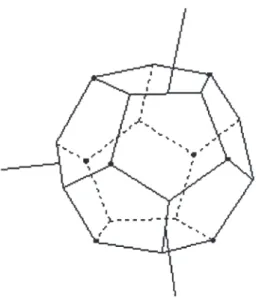
Manufacturers describe the porosity of foams in terms of pores per inch (ppi). The range generally deliverable is ~10–100 ppi. A foam cell is ideally characterized by a regular dodecahedron (Fig. 2), that is, 12 pentagons in a football-like configuration. The cell diameter in this ideal shape is used to
charac-terize the porosity. It allows the more precise deter-mination of the foam material rather than the empirical value p.p.i., and is the parameter on which the manufacturers own quality systems are based. The cell diameter can easily be measured by optical microscopy with a SD of ~5%.
A theoretical model to predict foam plug geometries for desired aerodynamic functions sup-ports the developments. With the help of this semi-empirical model, originally proposed by Vincent et
al. (1993) and reformulated by Kenny et al. (2001), we can determine the penetration P of particles passing through such a foam material.
The model uses impaction and sedimentation components, represented by the Stokes number, St = Dae2 γU/(18ηd
f), and the gravitational
param-eter, Ng = Dae2γg/(18ηU). t is the thickness of the
foam the particles have to pass through and df is the filament diameter, namely the solid parts or the edges of the cell. The parameters are given in SI units. The filament diameter has an empirical relationship to the cell diameter (Kenny et al., 2001).
Using this model, we can determine the penetration starting with a selected foam geometry. Alterna-tively, if we fix the penetration as 0.5 for a certain particle diameter (e.g. 4.3 or 11.7 µm) according to the respirable and thoracic dust fraction (CEN, 1993), we can deduce the foam geometry. In this way, we have a good starting point to construct prototype samplers.
Several tests for particle penetration through foam plugs with nominal porosities of between 45 and 170 p.p.i. (equal to 1.5 and ~0.25 mm cell diameter) were carried out (Kenny et al., 2001). The results indicated that selected foams with predicted geometry and porosity comply with the required penetration curves sufficiently well.
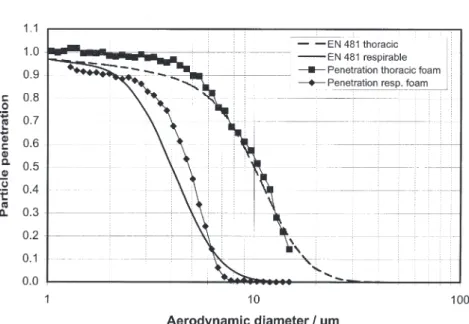
The data in Fig. 3 represent the particle penetration through two different foam modules in a prototype sampler based on the GSP inhalable sampler (similar to Fig. 4, upper row). Further results are given else-where (Görner et al., 2001). Typical cell diameters of the foams used are 480 and 1600 µm.
Analysis of foams
Besides the development of a sampler, special attention is paid to the development of suitable analytical procedures to determine the mass and chemical composition of the sampled dust collected in each stage. For gravimetric analysis, foams are weighed before and after sampling, as they serve both as selecting and dust-retaining media. Tests showed that the dependency on humidity is similar to membrane filters, and the SD of weighing is <0.1 mg. Using better controlled conditions, such as in a glove
Fig. 1. Polyurethane foam of 90 p.p.i.
Fig. 2. Shape of an idealised foam cell, combining multiple pores: dodecahedron. P ( ) ln t df ---- 5.486St{ 2.382+3.891Ng0.880}×104 =
388 C. Möhlmann et al.
box, even one order of magnitude less can be reached. A limit of quantification is typically 0.6 mg. As a comparison, the typical limit of quantification of a membrane filter used in a GSP inhalable sampler by gravimetic analysis is 1 mg.
The chemical analysis of elements in the sampled dust can be performed using atomic absorption spec-trometry or inductively coupled plasma with mass spectrometry with an acid digestion (HCl 25%,
HNO3 65%, 1:2) of the foam matrix, similar to standard procedures for membrane filters (BIA Folder, 2001). The foam material is sufficiently destroyed to reach the inner dust deposits. Because of high impurities in the polyurethane material, the analysis of calcium and tin is not recommended. In addition to the analysis of elements in dust loadings, the ability of sampling organic compounds is also investigated.
Fig. 3. Penetration of particles through foam plugs with selected geometry and porosity in a prototype sampler.
Size-selective personal air sampling 389
Prototype samplers
On the basis of the semi-empirical model, various plug geometries for the two size-selective foam plugs were chosen to fit into the modified IOM and GSP inhalable samplers. Penetration tests were conducted in the laboratory to show the applicability (Görner et
al., 2001) and match with the sampling conventions. Prototype samplers have been constructed and further field tests will be undertaken to provide information on the handling.
The three-stage samplers consist of two foam modules and one membrane filter in series (Fig. 4). By the appropriate choice of foam selection charac-teristics, a sampler of this type can collect the respir-able fraction on the filter, the thoracic fraction on the filter plus the adjacent foam plug, and the inhalable fraction on the filter plus both plugs. The design details are to be discussed with potential manufac-turers.
CONCLUSIONS
Porous polyurethane foam was found to be a suit-able particle-selecting and sampling medium. The most important characteristic of a foam is its cell diameter, which can be measured sufficiently well. Appropriate geometries of foam plugs can be found with the help of penetration tests, so that the thoracic and respirable dust fractions can be separated in personal air samplers based on the IOM and GSP inhalable samplers. Weighing procedures can be applied to determine the mass loading of a foam. Standard elemental analyses are seen to be applicable after adaptation to the special needs of the poly-urethane matrix.
At the end of the project, recommendations for subsequent use in different national air sampling systems shall be given in order to reach a higher degree of European harmonization in measuring occupational exposures.
Acknowledgements—The work was supported by the European Commission, Directorate General Research, under contract SMT4-CT96–2137. Further funding for part of the work was provided by the Nickel Producers Environmental Research Association (NiPERA). The authors wish to acknowledge the experimental contribution of Geoffrey Beaumont, IOM, Richard Wrobel, INRS, and the support from Recticel Inter-national Development Center, Wetteren, Belgium.
REFERENCES
Aitken RJ, Vincent JH, Mark D. (1993) Application of porous foams as size selectors for biologically relevant samplers. Appl Occup Environ Hyg; 8: 363–9.
BIA Folder. (2001) Measurement of hazardous substances. Berlin: Erich Schmidt Verlag. ISBN 3 503 02085 3. CEN. (1993) EN 481: Workplace atmospheres: size fraction
definitions for measurement of airborne particles. Brussels: Comité Européen de Normalisation.
Chen C-C, Lai C-Y, Sih T-S, Yeh W-Y. (1998) Development of respirable aerosol sampler using porous foams. Am Ind Hyg Assoc J; 59: 766–73.
Chung KYK, Aitken RJ, Bradley DR. (1997) Development and testing of a new sampler for welding fume. Ann Occup Hyg; 41: 335–72.
Görner P, Wrobel R, Fabriès J-F, Aitken RJ, Kenny LC, Moehlmann C. (2001) Measurement of sampling efficiency of porous foam aerosol sampler prototypes. J Aerosol Sci; 32 (suppl. 1): 1063–4.
Kenny LC, Stancliffe JD, Crook B, Stagg S, Griffiths WD, Stewart IW, Futter SJ. (1998) The adaptation of existing personal inhalable aerosol samplers for bioaerosol sampling. AIHA J; 59: 831–41.
Kenny LC, Bowry A, Crook B, Stancliffe JD. (1999) Field testing of a personal size-selective bioaerosol sampler. Ann Occup Hyg; 43: 393–404.
Kenny LC, Aitken RJ, Görner P. (2001) Investigation and application of a model for porous foam aerosol penetration. J Aerosol Sci; 32: 271–85.
Page SJ, Volkwein JC, Baron PA, Deye GJ. (2000) Particulate penetration of porous foam used as a low flow rate respirable dust size classifier. Appl Occup Environ Hyg; 15: 561–8. Vincent JH, Aitken RJ, Mark D. (1993) Porous plastic foam
filtration media: penetration characteristics and applications in particle size-selective sampling. J Aerosol Sci; 24: 929–44.