Characterization of Resistance, Evaluation of the Attractiveness of
Plant Odors, and Effect of Leaf Color on Different Onion Cultivars to
Onion Thrips (Thysanoptera: Thripidae)
JOHN DIAZ-MONTANO,1,2,3JO´ZSEF FAIL,4MARK DEUTSCHLANDER,5BRIAN A. NAULT,1 ANDANTHONY M. SHELTON1
J. Econ. Entomol. 105(2): 632Ð641 (2012); DOI: http://dx.doi.org/10.1603/EC11233
ABSTRACT Onion thrips, Thrips tabaci Lindeman (Thysanoptera: Thripidae), is a worldwide pest of onion, Allium cepa L. In Þeld studies on onion resistance conducted in 2007 and 2008 using 49 cultivars, 11 showed low leaf damage by T. tabaci. In laboratory studies, the 11 cultivars, along with two susceptible checks and four additional cultivars, were evaluated to characterize resistance to T. tabaci and to determine if color and/or light reßectance were associated with resistance to T. tabaci. No-choice tests were performed with adults and the numbers of eggs and larvae were counted on each cultivar after three and 10 d, respectively. In choice tests in which all cultivars were planted together in a circle in a single pot, 100 adults were released and the number of adults on each plant was evaluated 24 h later. The behavioral response of walking T. tabaci adults to plant odors was studied in a glass Y-tube olfactometer. The reßectance spectrum of leaves was measured using a UV-VIS spectrophotometer. Results indicate that resistant cultivars showed an interme-diate-high antibiotic effect to T. tabaci and all of them showed a very strong antixenotic effect. There were no signiÞcant preferences in the response of walking T. tabaci adults to plant odors. The two susceptible cultivars had the highest values of leaf reßectance for the Þrst (275Ð375 nm) and second (310Ð410 nm) theoretical photopigment-system of T. tabaci, and these values were signiÞcantly different from most resistant cultivars. These results suggest a strong response of T. tabaci to onion cultivars with higher reßectance in the ultraviolet range (270Ð400 nm). Overall, these results appear promising in helping to identify categories of resistance to T. tabaci in onions that can be used in breeding programs.
Resumen El trips de la cebolla, Thrips tabaci Lindeman (Thysanoptera: Thripidae), es una plaga
cosmo-polita de la cebolla, Allium cepa L. En estudios en campo entre 2007 y 2008, se evaluo´ la resistencia de 49 genotipos de cebolla, y 11 mostraron menor dan˜o de la hoja por T. tabaci (Diaz-Montano et al. 2010). En estudios en laboratorio, los 11 genotipos, adema´s de dos testigos susceptibles y otros cuatro genotipos fueron evaluados para caracterizar resistencia a T. tabaci y para determinar si el color y/o luz reßejada por las hojas estaba asociado con resistencia a T. tabaci. Experimentos de no-seleccio´n fueron llevados a cabo con adultos y el nu´mero de huevos y larvas fue contado en cada genotipo despue´s de 3 y 10 dõ´as, respectivamente. En experimentos de libre seleccio´n, diferentes genotipos fueron sembrados en cõ´rculo en un mismo recipiente, 100 adultos fueron liberados y el nu´mero de adultos en cada planta fue contado 24 horas despue´s. La respuesta de adultos de T. tabaci hacia olores de las plantas fue estudiada usando un olfacto´metro de vidrio en forma de Y. La reßectancia del espectro de las hojas fue medida usando un espectro´metro Ultravioleta-Visible (UV-VIS). Los resultados indican que los genotipos resistentes mostraron un nivel intermedio-alto de antibiosis a T. tabaci y un nivel muy fuerte de antixenosis. No se presentaron diferencias signiÞcativas en la preferencia de adultos de T. tabaci hacia olores de plantas. Las variedades susceptibles tuvieron los valores mas altos de luz reßejada en el primer (275Ð375 nm) y segundo (310Ð410 nm) sistema teo´rico del fotopig-mento de T. tabaci y estos valores fueron signiÞcativamente diferentes a valores en la mayorõ´a de genotipos resistentes. Estos resultados sugieren una fuerte atraccio´n de T. tabaci a variedades de cebolla con las mas altas reßectancias en el rango UV (270Ð400 nm). En general, estos resultados son promisorios y ayudan a identiÞcar las categorõ´as de resistencia de la cebolla a T. tabaci que pueden ser incluidas en programas de mejoramiento de cebolla.
KEY WORDS Thrips tabaci, Allium cepa, onion resistance, olfactometer, leaf color
1Department of Entomology, Cornell UniversityÐNYSAES, 630 W.
North Street, Geneva, NY 14456.
2Current address: Stored Product Insect Research Unit, USDAÐ
ARS Center for Grain and Animal Health Research, 1515 College Av., Manhattan, KS 66502.
3Corresponding author, e-mail: [email protected].
4Department of Entomology, Corvinus University of Budapest,
29-43 Villa´nyi u´t, Budapest, H-1118.
5Department of Biology, Hobart and William Smith Colleges, 300
Pulteney Street, Geneva, NY 14456. 0022-0493/12/0632Ð0641$04.00/0䉷 2012 Entomological Society of America
Onion thrips, Thrips tabaci Lindeman (Thysanoptera: Thripidae), is believed to be a native from the eastern Mediterranean region (Mound and Walker 1982, Mound 1997). T. tabaci is a polyphagous pest with a wide host range of⬎100 plant species in ⬎40 families (Ghabn 1948, Morison 1957, Ananthakrishnan 1973). However, onion is a favorite host (Lewis 1973, 1997) and T. tabaci is a cosmopolitan pest of onions wherever they are grown (Lewis 1997), including New York state where a total of 4,330 ha were planted in 2010 (NASS 2011).
The rapid development time of T. tabaci from egg to adult in⬍15 d at temperatures between 23 and 30⬚C (Lall and Singh 1968, Gawaad and El-Shazli 1971, Edelson and Magaro 1988, Arrieche et al. 2006) and its high reproductive capacity frequently lead to popu-lation outbreaks of this thrips species, especially in hot, dry weather (Bailey 1934, Rueda et al. 2007). T. tabaci feeding on onion causes silvery leaf spots that turn into white blotches followed by the development silvery patches along the leaves (Bailey 1938), and this re-duces the photosynthetic ability of the plant (Parrella and Lewis 1997). Its feeding can reduce onion bulb weight (Kendall and Capinera 1987, Fournier et al. 1995, Rueda et al. 2007, Diaz-Montano et al. 2010) and cause yield losses ⬎50% (Fournier et al. 1995, Waiganjo et al. 2008). T. tabaci is also a vector of Iris
yellow spot virus(IYSV) (family Bunyaviridae, genus
Tospovirus) (Pozzer et al. 1999, Kritzman et al. 2001), which was conÞrmed in the United States in 1989 in Idaho and Oregon (Hall et al. 1993). IYSV has spread to several important onion producing states in the United States (Gent et al. 2006), including New York where it was conÞrmed in the summer of 2006 (Hoe-pting et al. 2007). This virus can reduce bulb size (Gent et al. 2004) and may cause crop losses up to 100% (Pozzer et al. 1999).
Use of foliar insecticides is the most common tactic to control T. tabaci on onion, but T. tabaci is difÞcult to control because insects are found mainly in the narrow spaces between the inner leaves (Shelton et al. 1987) where spray coverage may be deÞcient. This strategy has led to the development of populations resistant to pyrethroid and organophosphate insecti-cides in New York (Shelton et al. 2003, 2006), Canada (MacIntyre Allen et al. 2005), and other regions of the world (Martin et al. 2003, Herron et al. 2008, Morishita 2008). For a more comprehensive review of the his-tory, biology, ecology, and management of T. tabaci see Diaz-Montano et al. (2011).
It is important to Þnd alternative management strat-egies and host plant resistance is an important one that should be a foundation of an integrated pest manage-ment (IPM) program (Panda and Khush 1995, Ken-nedy 2008). Moreover, the use of resistant cultivars could reduce the application of insecticides. Since the 1930s, studies on onion resistance to T. tabaci have been conducted and resistance has been associated with bulb color (Verma 1966, Lall and Singh 1968, Brar et al. 1993) and leaf structure and color (Jones et al. 1934, 1935; Coudriet et al. 1979; Pawar et al. 1987; Patil et al. 1988; Loges et al. 2004a,b; Huda´k and Pe´nzes
2004; Diaz-Montano et al. 2010). Despite these efforts on onion resistance to T. tabaci, we are not aware of any studies regarding the mechanisms or categories of resistance. There are three categories that character-ize host plant resistance to insects: antibiosis, which adversely affects the biology of the insect; antixenosis or non preference, in which the plant is a poor host for the insect and the insect does not feed, lay eggs, or Þnd shelter on it, and; tolerance, the ability of a plant to withstand or recover from insect feeding (Painter 1951, Smith 2005). Jones et al. (1935) compared T.
tabacipopulations on 44 onion cultivars and found that the resistant variety ÔWhite Persian,Õ which has light green leaves, had signiÞcantly lower numbers of T.
tabaci than all others. Diaz-Montano et al. (2010) screened 49 onion varieties and found 11 onion cul-tivars that were considered resistant to T. tabaci be-cause they had very little leaf damage as well as lower populations of T. tabaci larvae compared with suscep-tible cultivars. These resistant varieties had yellowÐ green colored foliage compared with the susceptible ones that had blueÐ green color foliage. They sug-gested that such differences in onion leaf color are strongly associated with resistance to T. tabaci. While no direct measurements have been made to charac-terize visual sensitivity in T. tabaci, comparative stud-ies have characterized the photopigment systems of two other thrips species. By measuring electroretino-grams in response to ßashes of monochromatic light between 365 and 630 nm, Matteson et al. (1992) de-termined two spectral regions in visual sensitivity in the western ßower thrips, Frankliniella occidentalis (Pergande), one in the ultraviolet-A (UV-A) range (between 315Ð 400 nm, sensitivity peak not deter-mined) and one in the human visible range with a peak sensitivity around 545 nm. It has also been demon-strated that the thrips Caliothrips phaseoli (Hood) responds to solar UV-B (ⱕ315 nm) radiation (Mazza et al. 1999, 2002). Mazza et al. (2010) studied behav-ioral responses (i.e., phototaxis) of C. phaseoli to monochromatic radiation (UV-B, UV-A, and visible wavelengths) from 250 to 590 nm and thrips seemed to have negative phototactic behavior to wavelengths between 290 and 400 nm. These studies suggest that visual cues, in particular in the UV spectrum, may be an important aspect in insect-plant interactions for thrips.
To elucidate the categories of resistance of onion cultivars to T. tabaci and to determine if there is a relationship between onion leaf color and onion re-sistance to T. tabaci, the present studies were conducted with the objectives of characterizing re-sistance of onion cultivars to T. tabaci by means of no-choice and choice tests and measuring the light reßectance of onion leaves of susceptible and resistant cultivars. In addition, the role of odor cues in host selections was examined via choice tests.
Materials and Methods
Insect Culture and Plant Material. T. tabaci
col-lected from onion Þelds in Yates Co., NY, in August 2008 and were maintained on onion plants under lab-oratory conditions at 25⬚C and 20Ð40% RH, with a photoperiod of 14:10 (L:D) h. Onions were grown in pots (10.0 cm in diameter⫻ 10.0 cm in height) with four plants per pot.
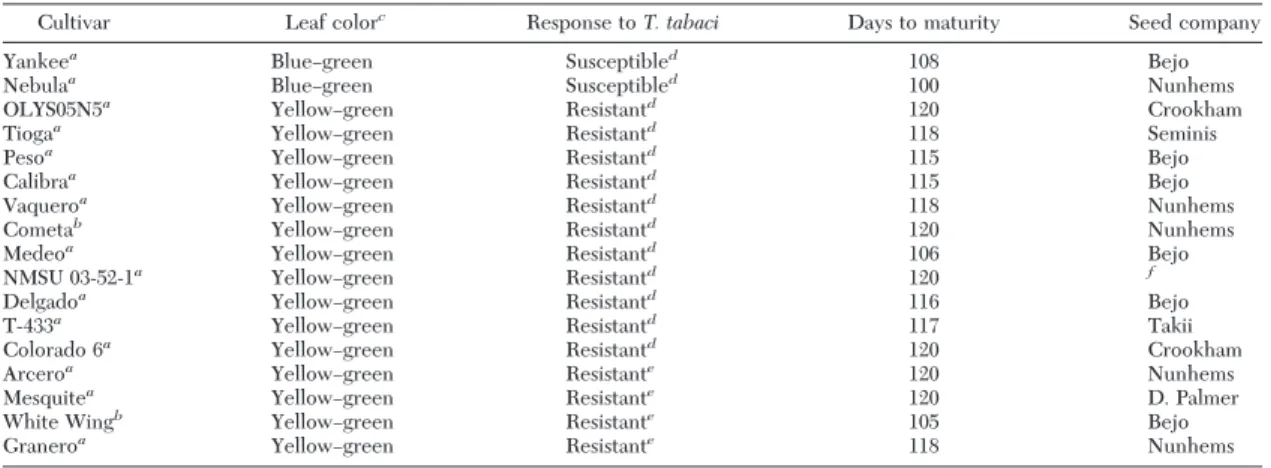
In this study, a total of 17 onion cultivars (Table 1) were used. In previous Þeld studies we identiÞed 11 cultivars that we deÞned to be resistant to T. tabaci based on statistically lower numbers of larvae and lower leaf damage ratings than susceptible cultivars (Diaz-Montano et al. 2010). The cultivars ÔNebulaÕ and ÔYankeeÕ were used as the susceptible checks in all the experiments. The other four cultivars were conÞrmed as resistant in other studies (Diaz-Montano 2011). Information on days to maturity and bulb color was obtained from the respective companies or the breeder (Table 1). Plants were seeded into 200 cell 4.5 cm deep plug trays with one seed per cell Þlled with Cornell mix soil (Boodley and Sheldrake 1977), and then grown under greenhouse conditions at 20 Ð30⬚C and 20 Ð 40% RH with supplemental lights set for a period of 14:10 (L:D) h.
No-Choice Oviposition Test. No-choice tests were
performed with the onion cultivars mentioned above (Table 1). After 8 wk in the greenhouse, 10 onion plants per cultivar (between 10 and 15 cm in length and with four leaves) were transplanted individually into 3.8 cm diameter ⫻ 14.0 cm deep plastic Cone-tainers (Ray Leach Conetainer, Hummert Interna-tional, Earth City, MO) Þlled with Cornell mix soil (Boodley and Sheldrake 1977) and each plant was infested with two similar-aged T. tabaci adults. Then a 3.5 cm diameter⫻ 18.0 cm height plastic tube (Petro Packaging Company Inc., Cranford, NJ) was inserted into the soil of each plastic Cone-tainer and the upper side of the tube was covered with an organdy cloth (5⫻ 5 cm) attached by a rubber band. The
Cone-tainers were placed in racks arranged in a completely randomized design and the racks were put in a climatic chamber (25Ð30⬚C and 40% RH, with supplemental lights set for a period of 14:10 [L:D] h).
To have similar-aged adults in all the Cone-tainers, before the experiments several T. tabaci adults were placed on the susceptible variety, ÔNebula,Õ and al-lowed to lay eggs. Adults were removed after 48 h. The development time of T. tabaci on onion from egg to adult is 13.9 d at 30.8⬚C (Lall and Singh 1968) and 14.2 d at 23⬚C (Arrieche et al. 2006). Therefore, thrips in this study were left for 15 d until they developed into adults before placing them inside the Cone-tain-ers.
The number of eggs laid by the two adults was counted after 3 d of conÞnement. To make the eggs more visible for recording after the period of conÞne-ment, the leaves of each onion plant were placed inside a beaker (100 ml) Þlled with water, put in a microwave for 40 s and then the eggs were counted using a stereomicroscope. Placing the leaves in the microwave makes the eggs expand so they become easier to locate and record.
No-Choice Progeny Test. In this experiment exactly
the same set up was used as in the no-choice ovipo-sition test: 10 plants per cultivar were transplanted individually into Cone-tainers and each plant was in-fested with two similar-aged T. tabaci adults conÞned by the cloth covered plastic tube. The T. tabaci prog-eny (larvae) in each Cone-tainer was counted after 10 d of conÞnement with the two T. tabaci adults. This test was repeated one more time with new plants and adult thrips.
Antixenosis (Choice Tests). Antixenosis was
as-sessed on the same cultivars (Table 1) used in the no-choice tests but not the cultivar ÔMesquiteÕ (lack of seed). After 10 wk in the greenhouse, one plant of each cultivar was transplanted and arranged in a circle Table 1. List of onion cultivars used in this study
Cultivar Leaf colorc
Response to T. tabaci Days to maturity Seed company
Yankeea BlueÐgreen Susceptibled 108 Bejo
Nebulaa BlueÐgreen Susceptibled 100 Nunhems
OLYS05N5a YellowÐgreen Resistantd 120 Crookham
Tiogaa YellowÐgreen Resistantd 118 Seminis
Pesoa YellowÐgreen Resistantd 115 Bejo
Calibraa YellowÐgreen Resistantd 115 Bejo
Vaqueroa YellowÐgreen Resistantd 118 Nunhems
Cometab YellowÐgreen Resistantd 120 Nunhems
Medeoa YellowÐgreen Resistantd 106 Bejo
NMSU 03-52-1a YellowÐgreen Resistantd 120 f
Delgadoa YellowÐgreen Resistantd 116 Bejo
T-433a YellowÐgreen Resistantd 117 Takii
Colorado 6a YellowÐgreen Resistantd 120 Crookham
Arceroa YellowÐgreen Resistante 120 Nunhems
Mesquitea YellowÐgreen Resistante 120 D. Palmer
White Wingb YellowÐgreen Resistante 105 Bejo
Graneroa YellowÐgreen Resistante 118 Nunhems
Bulb color:ayellow,bwhite.
cLeaf color obtained by personal observation. dAccording to Diaz-Montano et al. (2010).
eOnion cultivars conÞrmed as resistant in other studies (Diaz-Montano 2011).
fOnion line developed in the program of C.S. Cramer. Department of Plant and Environmental Science, New Mexico State University, Las
in a single pot (20 cm in diameter⫻ 20 cm in height, with a distance of⬇3.0 cm between plants). Plants in the pots were randomized and the pots were arranged in a randomized complete block randomized design with six replications in a climatic chamber as in the no-choice tests. The test was replicated one more time. In total, 100 T. tabaci adults were released on a Þlter paper (15 cm diameter) placed at the center of the circle of potted plants. The number of adults on each plant was counted 24 h later.
Olfactometer Experiments. Orientation to or away
from a host is one potential aspect of antixenosis. The behavioral response of T. tabaci adults to 17 different onion cultivars (Table 1) was studied using a glass Y-tube olfactometer (5 mm inner diameter, 8 cm in length for the base of the tube, and two 5 cm length arms of the tube with an angle of 45⬚ between them) partially following the methods described by Koschier et al. (2000) and Davidson et al. (2008). The Y-tube was placed inside a box (26⫻ 18 ⫻ 18.5 cm) with its inner walls covered with white paper. The base of the Y-tube was connected to a pump that created suction and resulted in an airßow that was regulated to 10 cm/s (⬇0.12 liter/min) in the base using an airßow meter (Cole Parmer, Vernon Hills, IL) connected to the silicone tubing between the base of the Y-tube and the pump. Each end of the two arms was connected to a glass jar (473 ml, wide mouth glass jar 7.5 cm in diameter⫻ 12 cm in height with a metal screw cap) by means of two polypropylene bulkhead compres-sion unions (06390 Ð20, Cole Parmer) drilled into the metal screw cap. The air was Þrst puriÞed by passage through a charcoal Þlter (8131, Alltech, Activated Charcoal Trap, Alltech Associates, Inc., DeerÞeld, IL; 37 cm in length⫻ 5.1 cm in diameter acrylic tube). All connections between the pump, the airßow meter, the Y-tube, the two glass jars and the charcoal Þlter were made with rigid silicone tubing (6.4 mm inner diam-eter, R-06406 Ð72, Cole Parmer). Before using the ol-factometer, the Y-tube and the two jars connected with the silicone tubing were placed into a bucket Þlled with water to ensure there was no air leakage through the connections. A smoke test showed that at the Y junction the air of the odor-laden arm did not mix with the air of the clean-air arm. After the set up was complete, the Y-tube was positioned at an incline of 25⬚ in the box and the air was drawn through the Y-tube for 5 min before introducing the Þrst T. tabaci adult. Experiments were carried out in a dark room at 20 Ð24⬚C and 40Ð45% RH. Illumination was provided by two ßuorescent tubes Þxed⬇40 cm above the box. After 10 wk in the greenhouse, onion plants from the 17 cultivars (Table 1) were placed individually in the odor-laden jar. Plants were gently removed from the potting medium and the soil from the roots was washed off before being placed into the jar. Before they were used, T. tabaci adults of unknown age were conÞned individually inside 0.6 ml Eppendorf poly-merase chain reaction (PCR) microcentrifuge tubes (Laboratory Products Sales Inc., Rochester, NY). A single thrips of unknown age that had been starved for 2 h was released inside the Y-tube by placing the
microcentrifuge tube at the base of the Y-olfactometer after disconnecting the silicone tubing at the base of the Y-tube. The recording time was started after the silicone tube was reconnected to the Y-tube and stopped when the T. tabaci adult reached the far end of one of the arms (clean-air or odor-laden). When a thrips made no choice within 5 min, it was removed and replaced by another thrips adult. There were 40 replications (T. tabaci adults) per each of the 17 onion cultivars evaluated resulting in a total of 680 thrips for the entire experiment. Four plants were used per each cultivar. After 10 thrips were tested, the onion plant was replaced with a new one and the Y-olfactometer set up was alternated 180⬚ to avoid potential position effects. After each cultivar was evaluated, the entire set up was washed with acetone (10%).
Reflectance Spectrophotometry. The light
reßec-tance of onion leaves was measured on the 17 cultivars in Table 1. After 8 wk in the greenhouse, four onion plants per cultivar were transplanted into plastic pots (15.0 cm in diameter⫻ 15.0 cm in height, with four plants per pot) Þlled with Cornell mix soil (Boodley and Sheldrake 1977). Plants were kept in the green-house and after 4 wk they were moved to an onion Þeld in Elba, NY. There were 10 pots per cultivar for a total of 40 plants per each cultivar. After, 3 wk onion leaves were collected from the Þeld to measure their spectral reßectance. Four outer undamaged leaves per cultivar were carefully removed and placed inside labeled plastic bags. Leaves were collected in the morning and their spectral reßectance was assessed when the leaves were returned to the laboratory within 3 h. Until the measurements were completed, all leaves were kept in sealed plastic bags in a plastic cooler.
The reßectance spectrum of the leaves was re-corded using an USB2000 spectrophotometer with an internal CCD and diffraction grating capable of UV detection and a PX-2 pulsed Xenon light source (Ocean Optics, Dunedin, FL). The spectrophotome-ter and the lamp were connected through a bifurcated Þber optic (Ocean Optics R200 Ð7-UV/VIS), Þtted at the common end with a copper cylinder to standardize measuring distance (⬇5 mm) and spot size (⬇7 mm) and to shield out ambient light. The probe was held perpendicular to the leaf surface. Four readings were taken on every leaf on intact upper surface areas, where the leaf cuticle was intact, resulting in a total of 16 readings per onion cultivar. Each individual Ôread-ingÕ was the result of averaging 20, 10 ms duration ßashes of the pulsed xenon lamp. Reßectance was corrected for Ôdark noiseÕ of the CCD detector and was calculated relative to a WS-2 white standard using Ocean Optics, Inc. Base32 operating software and the following equation:
% Reßectance⫽ [(S⫺ D)/(R⫺ D)]⫻ 100% “. . . where Sis the intensity of the particular wave-length, Dis the dark intensity at wavelength, and Ris the reference intensity at wavelength” (Ocean Optics Inc. 2003). Although, spectral reßectance was determined every one-third of a nanometer from 170
nm to 880 nm a more limited spectral range was used in our analyses (see below).
Raw spectra were imported into a spreadsheet pro-gram, and then ÔsmoothedÕ by rounding down the wavelength values to an integer at which the reßec-tance was recorded and calculating the mean of the recorded values for every nm in the recording range. The following variables were computed from the smoothed spectra: 1) Brightness, which constitutes an estimate of the area under the spectral curve or total light reßected by the leaves, was calculated as the average reßectance (Rav), between 270 and 650 nm. 2) The relative amount of UV reßectance or “UV chroma” was calculated as reßectance in the UV range (270 Ð 400 nm) divided by total reßectance [(R270 Ð 400/ R270 Ð 650)⫻ 100] and expressed as a percentage. Al-though the range of vision and the photopigments that
T. tabacipossess remain unknown, based on electro-retinogram recordings on F. occidentalis (Matteson et al. 1992) and observed behavioral response of C.
phaseoli(Mazza et al. 2010), it was hypothesized that
T. tabaci has four potential photopigment-systems with different (but partly overlapping) ranges of sen-sitivity. We use the term Ôphotopigment systemÕ to describe 1) traditional photopigments that undergo chemical changes in response to different light wave-lengths and 2) nontraditional mechanisms for detect-ing light, such as detection of ßorescence caused by UV radiation (e.g., Mazza et al. 2010). The average reßectance (brightness) was computed from the re-corded reßectance spectra of onion leaves in the range of sensitivity of all four theoretical photopigment-systems of T. tabaci. Note, that this type of analysis is not modeling sensitivity based on photopigment data (such as what has been done with other organisms, e.g., Stoddard and Prum 2008), rather we are simply
dividing up the spectrum to reßect where potential peaks of photosensitivity may be for T. tabaci. Accord-ingly, the average reßectance was computed in the range of sensitivity of the 3) Þrst, 275Ð375 nm (Ravps1); 4) second, 310 Ð 410 nm (Ravps2); 5) third, 410 Ð510 nm (Ravps3); and 6) fourth, 460 Ð 630 nm (Ravps4) theoret-ical photopigment-systems of T. tabaci.
Statistical Analyses. For the no-choice oviposition
and Antixenosis tests, analysis of variance (ANOVA) for T. tabaci populations (eggs and adults, respec-tively) among onion cultivars was conducted by using PROC GLM (SAS Institute 2003). Multiple compari-sons were computed by using TukeyÕs studentized (honestly signiÞcant difference) range test (P⬍ 0.05) (SAS Institute 2003). The no-choice progeny (larvae) test data did not meet the assumption of homogeneity of variance; therefore, the GamesÐHowell test was used for pair-wise comparison of the cultivars (SPSS Inc. 2009). For the Olfactometer experiments, the response of T. tabaci adults to plant odor or the control for each onion cultivar was compared by the2test for goodness-of-Þt (␣ ⫽ 0.05) by using PROC FREQ (SAS Institute 2003). The reßectance spectrum of the leaves data were analyzed using Predictive Analytics Soft-Ware (PASW) Statistics (SPSS Inc. 2009). All six com-puted variables met the assumption of normality. In the case of all computed variables the untransformed data did not meet the assumption of homogeneity of variances; therefore, the GamesÐHowell test was used for pair wise comparisons of the cultivars. All data are reported as original means (⫾95% conÞdence limit). Pearson correlation coefÞcients were calculated be-tween T. tabaci adults in the Free-Choice Antixenosis Experiment (Table 2), the intensity of reßectance in the sensitivity range of the four theoretical photopig-Table 2. No-choice progeny test and no-choice oviposition test: number of T. tabaci larvae and eggs per plant produced by two confined adults on different onion cultivars, 10 and 3 d after infestation, respectively; free-choice antixenosis test: number of T. tabaci adults per plant found on cultivars after 24 h of releasing 100 adults per replicate
Cultivar No-choice progeny test
larvae (mean⫾ SD)a No-choice oviposition test
eggs (mean⫾ SD)b Free-choice antixenosis test
adults (mean⫾ SD)c
Yankee 23.3⫾ 6.4ad 6.9⫾ 2.0abe 15.6⫾ 3.0ae
Nebula 21.7⫾ 7.1a 8.8⫾ 1.6a 15.9⫾ 2.2a
T-433 16.1⫾ 8.6ab 3.3⫾ 2.5cde 5.8⫾ 2.8b Peso 14.2⫾ 4.9b 3.4⫾ 1.6cde 5.5⫾ 1.2b Tioga 13.3⫾ 5.7bc 3.1⫾ 1.9cde 4.9⫾ 1.8b Calibra 12.2⫾ 4.9bc 2.3⫾ 1.3e 5.0⫾ 1.6b Granero 12.2⫾ 7.2bc 3.2⫾ 1.5cde 3.8⫾ 2.2b Mesquite 11.9⫾ 4.5bc 2.9⫾ 1.8de Arcero 11.7⫾ 5.0bc 5.9⫾ 1.8abc 4.5⫾ 2.1b OLYS05N5 11.7⫾ 7.0bc 2.9⫾ 1.8de 4.8⫾ 1.7b Vaquero 10.7⫾ 4.5bc 2.3⫾ 1.5e 4.8⫾ 2.2b Cometa 10.7⫾ 6.9bc 3.5⫾ 1.6cde 4.5⫾ 1.9b NMSU 03-52-1 10.4⫾ 4.4bc 2.6⫾ 2.0e 3.8⫾ 1.5b Medeo 10.2⫾ 3.8bc 2.7⫾ 1.7de 5.3⫾ 1.8b Colorado 6 9.6⫾ 3.7bc 3.2⫾ 2.2cde 4.2⫾ 2.2b White Wing 9.4⫾ 4.9bc 5.6⫾ 2.1bcd 4.0⫾ 1.9b Delgado 8.1⫾ 3.7c 2.3⫾ 1.6e 3.6⫾ 1.4b aAverage of 20 replicates. bAverage of 10 replicates.
cAverage of 12 replicates, 100 adults per replicate.
dWithin a column, means followed by different letters are signiÞcantly different (P⬍0.05; GamesÐHowell test). eWithin a column, means followed by different letters are signiÞcantly different (P⬍0.05; TukeyÕs test).
ment-systems and the UV chroma among the cultivars (Table 3).
Results
No-Choice Oviposition Test. This experiment was
performed to observe the number of eggs laid by two
T. tabaciconÞned adults to plants for 3 d. Differences in number of eggs per plant were ca four-fold between the most (Nebula, 8.8 eggs per plant) and least (ÔCali-bra,Õ ÔVaquero,Õ and ÔDelgado,Õ all with 2.3 eggs per plant) susceptible cultivars. Both susceptible checks (ÔYankeeÕ and Nebula) had signiÞcantly (F ⫽ 9.98; df⫽ 16, 9; P ⬍ 0.001) higher numbers of T. tabaci eggs per plant than all other cultivars, except ÔArceroÕ and ÔWhite WingÕ (Table 2).
No-Choice Progeny Test. Two no-choice
experi-ments were performed to observe the number of lar-vae produced by two T. tabaci adults conÞned for 10 d. Although the tests were run on separate dates, they were conducted using identical procedures and thus the two tests were combined and analyzed as a single set of data to increase the power of the test. There were signiÞcant differences (F⫽ 10.62; df ⫽ 16, 19; P ⬍ 0.001) in numbers of T. tabaci larvae per plant among the onion cultivars (Table 2). The difference in num-bers of larvae produced was ca three-fold between the most (Yankee, 23.3 larvae per plant) and least (Del-gado, 8.1 larvae per plant) susceptible cultivars. Both susceptible checks (Yankee and Nebula) had signiÞ-cantly higher numbers of T. tabaci larvae per plant than all the cultivars except for ÔT-433.Õ The number of larvae in the cultivar T-433 was not signiÞcantly dif-ferent from any other resistant cultivar with the ex-ception of Delgado, which supported the lowest larval population (Table 2).
Antixenosis (Choice Tests). Two choice tests were
conducted to assess antixenosis or nonpreference of T.
tabaciadults to the different onion cultivars after 24 h.
As in the no-choice progeny test, two tests were run on separate dates but were conducted using identical procedures and therefore the two tests were com-bined and analyzed as a single set of data to increase the power of the test. The two susceptible checks (Yankee and Nebula) had signiÞcantly (F ⫽ 41.65; df⫽ 15, 11; P ⬍ 0.001) more T. tabaci adults per plant than all the other cultivars (Table 2). Differences between the numbers of adults were ⬇3- to 5-fold higher for the two susceptible checks compared with the other cultivars. The number of adults per plant on the resistant cultivars did not differ signiÞcantly.
Olfactometer. There were no signiÞcant differences
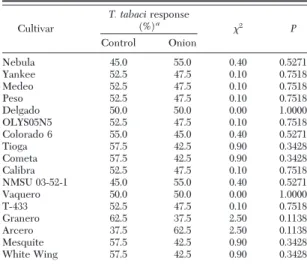
(P⬍ 0.05) in the response of walking T. tabaci adults to plant odors or to the control (Table 4). Of the 680
T. tabaciadults used in this experiment, 481 (71%) reached the far end of one the arms before 60 s and 611 (90%) before 120 s.
Reflectance Spectrophotometry. The
spectropho-tometer device measures a reßectance spectrum from 170 to 880 nm but for the purpose of this study only the spectral reßectance in the theoretical visual spectrum of T. tabaci was analyzed, that is, 270 Ð 650 nm. The brightness (Rav) or the total light reßected by the leaves on the different onion cultivars ranged between 6.7 and 10.7% (Table 3). The susceptible cultivar Yan-kee had the highest reßectance (10.7%) and was sig-niÞcantly (P ⬍ 0.026) different from all the other cultivars except from ÔPesoÕ with a value of 9.9%. The other susceptible cultivar, Nebula, had a value of 9.2% and was signiÞcantly different from eight other cul-tivars (P⬍ 0.048).
The results from the Þrst theoretical photopigment-system of T. tabaci (Ravps1, from 275 to 375 nm) showed that the susceptible cultivars Yankee and Neb-ula, with the highest reßectance values, were signiÞ-cantly different from 14 (P⬍ 0.0002) and 12 (P ⬍ 0.0005) other onion cultivars, respectively (Table 3). A similar outcome was observed in the second theo-Table 3. Reflectance (%) of: Brightness (Rav, 270 – 650 nm), relative amt of UV reflectance or UV Chroma关(R270 – 400/R270 – 650)ⴛ
100兴, and the four theoretical photopigment-systems of T. tabaci 关(Ravps1, 275–375 nm), (Ravps2, 310 – 410 nm), (Ravps3, 410 –510 nm),
and (Ravps4, 460 – 630 nm)兴 on 17 onion cultivars
Cultivars Ravps1 Ravps2 Ravps3 Ravps4 UV Chroma Rav
Yankee 9.7⫾ 0.8a 8.8⫾ 0.7a 9.1⫾ 0.6a 12.4⫾ 0.8a 29.9⫾ 1.6a 10.7⫾ 0.6a Nebula 8.0⫾ 0.6ab 7.4⫾ 0.5ab 8.2⫾ 0.4ab 10.8⫾ 0.5aÐc 29.2⫾ 1.0a 9.2⫾ 0.5b Peso 7.7⫾ 1.2aÐc 7.4⫾ 1.1aÐc 8.8⫾ 0.9aÐc 12.2⫾ 1.0ab 25.8⫾ 1.8aÐf 9.9⫾ 1.0aÐc Tioga 6.6⫾ 0.6bc 6.5⫾ 0.6bÐd 7.3⫾ 0.6bÐd 9.4⫾ 0.6dÐf 28.2⫾ 0.7ab 8.0⫾ 0.6bÐe Vaquero 6.6⫾ 0.8bÐd 6.3⫾ 0.7bÐe 7.7⫾ 0.8aÐd 10.3⫾ 0.8bÐe 26.6⫾ 0.9bc 8.4⫾ 0.8bÐd Medeo 6.3⫾ 0.3c 5.8⫾ 0.3cÐe 6.7⫾ 0.4de 9.3⫾ 0.4ef 27.4⫾ 0.7aÐc 7.7⫾ 0.4de White Wing 6.0⫾ 0.5cd 5.9⫾ 0.5cÐf 7.3⫾ 0.6bÐd 10.8⫾ 0.8aÐe 24.5⫾ 0.6de 8.4⫾ 0.6bÐd Granero 5.9⫾ 0.6cÐe 5.8⫾ 0.6cÐf 7.6⫾ 0.7aÐd 11.4⫾ 0.7ab 23.2⫾ 0.8eÐg 8.7⫾ 0.6bÐd Mesquite 5.7⫾ 0.5cÐe 5.4⫾ 0.5cÐf 6.7⫾ 0.4dÐf 9.2⫾ 0.4ef 25.9⫾ 0.8cd 7.4⫾ 0.4dÐf Calibra 5.5⫾ 0.4cÐe 5.3⫾ 0.4dÐf 6.0⫾ 0.4ef 8.2⫾ 0.5f 27.6⫾ 0.5aÐc 6.8⫾ 0.4ef NMSU 03-52-1 5.4⫾ 0.5cÐe 5.3⫾ 0.5cÐg 7.2⫾ 0.5bÐd 10.9⫾ 0.6 aÐc 22.4⫾ 0.9fg 8.2⫾ 0.5bÐd T-433 5.1⫾ 0.3de 5.1⫾ 0.3eÐg 7.2⫾ 0.3cd 11.0⫾ 0.4ab 21.5⫾ 0.6gh 8.2⫾ 0.3cd Delgado 4.7⫾ 0.4ef 4.8⫾ 0.4fÐh 7.7⫾ 0.5aÐd 11.0⫾ 0.6aÐc 20.1⫾ 0.8 h 8.1⫾ 0.5bÐd Colorado 6 4.7⫾ 0.4ef 4.7⫾ 0.4fÐh 6.5⫾ 0.5dÐf 10.3⫾ 0.6bÐe 21.4⫾ 0.7gh 7.6⫾ 0.5dÐf OLYS05N5 4.0⫾ 0.4fg 4.0⫾ 0.4hi 5.7⫾ 0.4f 9.3⫾ 0.5dÐf 20.1⫾ 0.8 h 6.8⫾ 0.4ef Arcero 3.3⫾ 0.6 g 4.0⫾ 0.6 g-i 7.7⫾ 0.7aÐd 11.0⫾ 0.8aÐd 15.9⫾ 1.5i 7.7⫾ 0.7dÐf Cometa 3.0⫾ 0.4 g 3.4⫾ 0.4i 6.6⫾ 0.4dÐf 9.8⫾ 0.4cÐe 15.9⫾ 1.5i 6.7⫾ 0.4f
Average of 16 replicates.
Within a column, means followed by different letters are signiÞcantly different (P⬍0.05; GamesÐHowell test). All data are reported as original means (⫾95% conÞdence limit).
retical photopigment-system of T. tabaci (Ravps2, from 310 to 410 nm) where the susceptible cultivars Yankee and Nebula again had the highest values of reßec-tance and were signiÞcantly different from 14 (P⬍ 0.002) and 12 (P⬍ 0.022) cultivars, respectively (Ta-ble 3). In the third theoretical photopigment-system of T. tabaci (Ravps3, from 410 to 510 nm) the values of the two susceptible cultivars Yankee and Nebula were signiÞcantly different from 10 (P⬍ 0.004) and seven (P⬍ 0.025) out of the other 15 cultivars, respectively (Table 3). In the fourth theoretical photopigment-system of T. tabaci (Ravps4, from 460 to 630 nm) the values of the susceptible cultivars Yankee and Nebula were signiÞcantly different from eight (P⬍ 0.028) and Þve (P⬍ 0.048) cultivars, respectively (Table 3). The Pearson correlation coefÞcients between the number of T. tabaci adults in the Free-Choice Antixenosis Experiment (Table 2) and the intensity of reßectance values measured in the sensitivity range of the four theoretical photopigment-systems (Table 3) among the cultivars were 0.71 (P⬍ 0.0021), 0.69 (P ⬍ 0.0028), 0.55 (P⬍ 0.0278), and 0.35 (P ⬍ 0.1862), respectively. The relative amount of UV reßectance (UV Chroma, R270 Ð 400/R270 Ð 650) was ca two-fold between the susceptible checks (Yankee, 29.9% and Nebula, 29.2%) and the cultivars with the lowest amount re-ßected (ÔCometaÕ and Arcero, both with 15.9%) (Ta-ble 3). The amount of UV reßectance in the two susceptible cultivars was signiÞcantly (P⬍ 0.046) dif-ferent from 11 other cultivars that had values between 15.9 and 26.6%. The Pearson correlation coefÞcient between the number of T. tabaci adults in the Free-Choice Antixenosis Experiment (Table 2) and the UV Chroma (Table 3) among the cultivar was 0.55 (P⬍ 0.0258).
Discussion
Results from the free-choice experiments (Table 2) suggest a very strong antixenotic effect present in all the resistant cultivars and this supports our previous research (Diaz-Montano et al. 2010) where T. tabaci were more attracted to susceptible cultivars with blueÐ green leaf color than to resistant cultivars that had yellowÐ green leaf color. However, to interpret the result of the no-choice oviposition test is not straightforward because sometimes it is not easy to differentiate the effect of antibiosis from antixenosis on reduced fecundity of the thrips adults (Panda and Khush 1995, Smith 2005). The strong antixenosis found in all the resistant cultivars in the free-choice tests may be caused by a plant trait that could have reduced the oviposition of T. tabaci even in the no-choice ovipo-sition test. The observed reduced fecundity could have been because of an initial indirect feeding anti-xenotic effect, that is, reduced feeding, which is as-sociated with reduced oviposition (Bell and Puterka 2004). However, it could also have been the result of the adverse effects on the biology of T. tabaci adults through feeding on the resistant cultivars for 3 d.
In the no-choice oviposition test, which lasted for 3 d, there were signiÞcantly more eggs laid on cultivars Arcero and White Wing than on cultivars Calibra, Delgado, ÔNMSU 03Ð52-1Õ and Vaquero; however, there were no signiÞcant differences in the number of larvae on these cultivars, in the no-choice progeny test, which lasted for 10 d. This result could be either because of increased number of eggs laid by T. tabaci adults on the cultivars Calibra, Delgado, NMSU 03Ð 52-1, and Vaquero after the fourth day of the no-choice progeny test, or more likely because of higher egg and/or larval mortality on the cultivars Arcero and White Wing. Based on this conclusion, it seems that the cultivars Arcero and White Wing have greater antibiotic resistance than the cultivars Calibra, Del-gado, NMSU 03Ð52-1, and Vaquero.
However, the cultivars T-433, Peso, and Delgado had statistically equal numbers of eggs laid, but sig-niÞcantly fewer larvae were found on Delgado than on the other two cultivars. Therefore, it appears that Delgado has greater antibiotic resistance than T-433 and Peso. Similarly, statistically equal numbers of eggs were laid on the susceptible cultivars Nebula, Yankee, and Arcero, and signiÞcantly fewer larvae were found on Arcero than on the two susceptible onion cultivars. This also suggests an antibiotic effect present in the cultivar Arcero. The same phenomenon was observed in the cultivars White Wing and Yankee, suggesting a strong antibiotic effect in White Wing.
The cultivar T-433 had signiÞcantly fewer eggs laid in the no-choice oviposition test compared with the susceptible controls; however, the number of larvae found on this cultivar was statistically equal to the susceptible Nebula and Yankee in the no-choice prog-eny test. This suggests that the observed reduced fe-cundity of the thrips adults in the no-choice oviposi-tion test was due more to an initial antixenotic effect rather than to antibiosis. Thus, further experiments are Table 4. Attractiveness assessment of different onion cultivars
odors to T. tabaci adults in Y-tube olfactometer experiments
Cultivar T. tabaciresponse (%)a 2 P Control Onion Nebula 45.0 55.0 0.40 0.5271 Yankee 52.5 47.5 0.10 0.7518 Medeo 52.5 47.5 0.10 0.7518 Peso 52.5 47.5 0.10 0.7518 Delgado 50.0 50.0 0.00 1.0000 OLYS05N5 52.5 47.5 0.10 0.7518 Colorado 6 55.0 45.0 0.40 0.5271 Tioga 57.5 42.5 0.90 0.3428 Cometa 57.5 42.5 0.90 0.3428 Calibra 52.5 47.5 0.10 0.7518 NMSU 03-52-1 45.0 55.0 0.40 0.5271 Vaquero 50.0 50.0 0.00 1.0000 T-433 52.5 47.5 0.10 0.7518 Granero 62.5 37.5 2.50 0.1138 Arcero 37.5 62.5 2.50 0.1138 Mesquite 57.5 42.5 0.90 0.3428 White Wing 57.5 42.5 0.90 0.3428
aThere were 40 replications (T. tabaci adults) per cultivar (df⫽ 1,
39). When a thrips made no choice within 5 min, it was replaced. However, 90% of the thrips reached the far end of one the arms before 2 min.
needed to quantify the contribution of antibiotic re-sistance to the overall rere-sistance of a given cultivar. However, comparing the results of our choice and no-choice tests, the above described conclusions re-garding this category of resistance seem reasonable.
The free-choice experiments (Table 2) showed a strong antixenotic effect present in all the resistant cultivars. The results of the no-choice tests (Table 2) documented signiÞcant differences between the num-bers of larvae and eggs found in some of the cultivars, suggesting an intermediate-high antibiotic effect to T.
tabaciamong the resistant cultivars. According to the results of the no-choice oviposition test (Table 2), it seems that Calibra, Delgado, NMSU 03Ð52-1, and Va-quero possess plant trait(s) that result in the strongest antixenotic resistance among the tested 17 cultivars and it is coupled with moderate antibiotic resistance only in Delgado. Arcero and White Wing seem to possess the strongest antibiotic resistance among the tested 17 cultivars but their antixenotic resistance is only evident in the free-choice test (Table 2). Calibra and T-433 seem to have the weakest antibiotic resis-tance, even weaker than the two susceptible cultivars, Nebula and Yankee. However, it is more than com-pensated by strong antixenotic resistance, suggesting a more important role of antixenosis in the overall resistance of these two cultivars.
Other studies using Y-tube devices have shown pos-itive responses of T. tabaci (den Belder et al. 2001) and
Frankliniella occidentalis Pergande (de Kogel et al. 1999, Koschier et al. 2000, Davidson et al. 2008) to different plant volatiles. A study using a straight-tube olfactometer showed responses of Megalurothrips
sjostedti (Trybom) to ßowers of different cowpea,
Vigna unguiculata(L.) Walp., varieties (Ekesi et al. 1998). However, our study on behavioral responses of walking T. tabaci adults in the Y-tube olfactometer suggests that there is not an oriented movement to-ward the onion plant odors, regardless of their sus-ceptibility to T. tabaci. According to this study, plant odor does not appear to be the central factor deter-mining T. tabaci resistance in onion plants.
In our previous research (Diaz-Montano et al. 2010), we suggested that onion leaf color might be a key factor associated with resistance and/or suscep-tibility of onion cultivars to T. tabaci because all re-sistant onion cultivars had a visual yellowÐ green leaf color while all susceptible cultivars had blueÐ green leaf color. In this study, two susceptible cultivars Neb-ula and Yankee, with blueÐ green leaf color, were included, and they had the highest values of leaf re-ßectance in the sensitivity range of the Þrst (275Ð375 nm) and second (310 Ð 410 nm) theoretical photopig-ment-system of T. tabaci and based on these values Yankee was signiÞcantly different from 14, and Nebula from 12 of the 15 resistant cultivars. Similarly, Nebula and Yankee had the highest UV Chroma values, and based on these values they were signiÞcantly different from 11 of the 15 resistant cultivars. Because the two susceptible cultivars Nebula and Yankee always had the highest number of thrips compared with other onion cultivars, both in our previous studies
(Diaz-Montano et al. 2010) and in this study, these results suggest a positive response of T. tabaci to onion cul-tivars with higher reßectance in the UV range (270 Ð 400 nm).
The statistically signiÞcant correlation coefÞcients between T. tabaci adults in the Free-Choice Antix-enosis Experiment and the measured reßectance val-ues of the onion leaves in the sensitivity range of the Þrst two theoretical photopigment-systems of onion thrips and the UV Chroma [0.71 (P⬍ 0.0021), 0.69 (P ⬍ 0.0028), and 0.55 (P ⬍ 0.0258), respectively] might also indicate a preference of T. tabaci to onion cultivars with higher reßectance in the UV range (270 Ð 400 nm). However, there is no evidence sup-porting this and an observed correlation is never a proof of causal relationship. Furthermore, it is in con-trast with the well-documented behavior of thrips, especially anthophilous species that seem to avoid surfaces with high reßection in the UV range of light (Kirk 1984).
Our present work corroborates our previous re-search Þndings from Þeld studies (Diaz-Montano et al. 2010) where resistant cultivars had low numbers of T.
tabaciand low thrips feeding leaf damage ratings. The results from our laboratory experiments help to iden-tify antibiosis and antixenosis as categories of resis-tance to T. tabaci in onions, but additional work is needed to understand the actual mechanisms causing such differences in oviposition, larval development, and adult preference. The reßectance spectrophotom-etry study suggests a strong relationship between light spectra reßected by onion leaves and onion resistance to T. tabaci. Some studies have shown that some her-bivores guard themselves from direct solar radiation by staying on lower leaf surfaces (Wahl 2008, Ohtsuka and Osakabe 2009). According to this study, T. tabaci prefer onion cultivars that reßect a higher amount of light; and it is possible that this characteristic may provide T. tabaci with shelter from heat and may make these onion cultivars a more preferable host.
This study indicates a strong response of T. tabaci to onion cultivars with higher reßectance in the UV range; however, the range of vision and the photopig-ment-systems of T. tabaci are unknown. Therefore, future work should focus on studies using electroreti-nogram recordings and/or observing behavioral re-sponses on T. tabaci to different frequencies of light spectra to determine the photopigment-systems of T.
tabaci.Additionally, the genetic basis of color in on-ions and its inßuence on the behavior of T. tabaci warrant further investigation.
Acknowledgments
We thank Christy Hoepting and Carol MacNeil (Cornell), Ja¨n Van Der Heide (Bejo Seeds), Howard Schwartz and Michael Bartolo (CSU), and Chris Cramer (NMSU) for pro-viding seeds; Marc Fuchs, Phillip GrifÞths, Akiko Seto, Fran-c¸oise Vermeylen, John Barnard, Mao Chen, Mei Cheung, Hilda Collins, Anuar Morales, Xiaoxia Liu, Yunhe Li, Cynthia (Simon) Hsu, Derek Battin, and Alvaro Romero for helping in different aspects of this study. This research was partially
funded by the New York State Onion Research and Devel-opment Program and the New York Farm Viability Initiative. The publication costs of this research paper were funded by the Griswold Endowment, Department of Entomology, Cor-nell University.
References Cited
Ananthakrishnan, T. N. 1973. Thrips: biology and control.
Macmillan, India.
Arrieche, N., R. Paz, A. Montagne, and J. Morales. 2006.
Estudios biologicos de Thrips tabaci Lindeman (Thys-anoptera: Thripidae) en cebolla, en el estado Lara, Ven-ezuela. Bioagro 18: 149 Ð156.
Bailey, S. F. 1934. A winter study of the onion thrips in
California. Calif. State Dep. Agr. Mo. Bull. 23: 149 Ð152.
Bailey, S. F. 1938. Thrips of economic importance in
Cali-fornia. Univ. Calif., Coll. Agric. Agric. Exp. Stn. Cir. 346: 1Ð77.
Bell, R. L., and G. L. Puterka. 2004. Modes of host plant
resistance to pear psylla: a review. Acta Hort. (ISHS). 663: 183Ð188.
Boodley, J. W., and R. Sheldrake. 1977. Cornell peat-lite
mixes for commercial plant growing. Cornell Univ. Coop. Ext. Div. Inf. Bull. 43.
Brar, K. S., A. S. Sidhu, and M. L. Chadha. 1993. Screening
onion varieties for resistance to Thrips tabaci Lind. and
Helicoverpa armigera(Hubner). J. Insect. Sci. 6: 123Ð124.
Coudriet, D. L., A. N. Kishaba, J. D. McCreight, and G. W. Bohn. 1979. Varietal resistance in onions to thrips. J.
Econ. Entomol. 72: 614 Ð 615.
Davidson, M. M., N. B. Perry, L. Larsen, V. C. Green, R. C. Butler, and D.A.J. Teulon. 2008. 4-pyridyl carbonyl
compounds as thrips lures: effectiveness for western ßower thrips in Y-tube bioassays. J. Agric. Food Chem. 56: 6554 Ð 6561.
de Kogel, W. J., E. H. Koschier, and J. H. Visser. 1999. Y-tube
olfactometer to determine the attractiveness of plant volatiles to western ßower thrips. Proc. Exp. Appl. En-tomol., N.E.V. Amsterdam. 10: 131Ð135.
den Belder, E., J. Elderson, and I. Agca. 2001. Is olfactory
orientation of Thrips tabaci disrupted by a non-host plant? Proc. Exp. Appl. Entomol., N.E.V. Amsterdam. 12: 61Ð 64.
Diaz-Montano, J. 2011. Resistance to onion thrips (Thrips tabaciLindeman) and incidence of Iris yellow spot virus in onions. Ph. D. thesis, Cornell University, Ithaca, NY.
Diaz-Montano, J., M. Fuchs, B. A. Nault, and A. M. Shelton. 2010. Evaluation of onion cultivars for resistance to
on-ion thrips (Thysanoptera: Thripidae) and Iris Yellow Spot Virus. J. Econ. Entomol. 103: 925Ð937.
Diaz-Montano, J., M. Fuchs, B. A. Nault, J. Fail, and A. M. Shelton. 2011. Onion thrips (Thysanoptera: Thripidae):
a global pest of increasing concern in onion. J. Econ. Entomol. 104: 1Ð13.
Edelson, J. V., and J. J. Magaro. 1988. Development of onion
thrips, Thrips tabaci Lindeman, as a function of temper-ature. Southwest. Entomol. 13: 171Ð176.
Ekesi, S., N. K. Maniania, and I. Onu. 1998. Antibiosis and
antixenosis of two cowpea varieties to the legume ßower thrips. Afr. Crop Sci. J. 6: 49 Ð59.
Fournier, F., G. Boivin, and R. K. Stewart. 1995. Effect of Thrips tabaci(Thysanoptera: Thripidae) on yellow onion yields and economic thresholds for its management. J. Econ. Entomol. 88: 1401Ð1407.
Gawaad, A.A.A., and A. Y. El-Shazli. 1971. Studies on Thrips tabaciLindman. VII. Effect of food on the life cycle. Z. Angew. Entomol. 67: 27Ð30.
Gent, D. H., H. R. Schwartz, and R. Khosla. 2004.
Distribu-tion and incidence of Iris yellow spot virus in Colorado and its relation to onion plant population and yield. Plant Dis. 88: 446 Ð 452.
Gent, D. H., L. J. du Toit, S. F. Fichtner, S. K. Mohan, H. R. Pappu, and H. F. Schwartz. 2006. Iris yellow spot virus:
an emerging threat to onion bulb and seed production. Plant Dis. 90: 1468 Ð1480.
Ghabn, A.A.A. E. 1948. Contribution to the knowledge of
the biology of Thrips tabaci Lind. in Egypt. Bull. Soc. Fouad. I. Entomol. 32: 123Ð174.
Hall, J. M., K. Mohan, E. A. Knott, and J. W. Moyer. 1993.
Tospoviruses associated with scape blight of onion
(Al-lium cepa) seed crops in Idaho. Plant Dis. 77: 952.
Herron, G. A., T. M. James, and J. H. Mo. 2008. Australian
populations of onion thrips, Thrips tabaci Lindeman (Thysanoptera: Thripidae), are resistant to some insec-ticides used for their control. Aust. J. Entomol. 47: 361Ð 364.
Hoepting, C. A., H. F. Schwartz, and H. R. Pappu. 2007. First
report of Iris yellow spot virus on onion in New York. Plant Dis. 91: 327.
Huda´k, K., and B. Pe´nzes. 2004. Factors inßuencing the
population of the onion thrips on onion. Acta Phyto-pathol. Entomol. Hung. 39: 193Ð197.
Jones, H. A., S. F. Bailey, and S. L. Emsweller. 1934. Thrips
resistance in the onion. Hilgardia 8: 215Ð232.
Jones, H. A., S. F. Bailey, and S. L. Emsweller. 1935. Field
studies of Thrips tabaci Lind. with special reference to resistance in onions. J. Econ. Entomol. 28: 678 Ð 680.
Kendall, D. M., and J. L. Capinera. 1987. Susceptibility of
onion growth stages to onion thrips (Thysanoptera: Thripidae) damage and mechanical defoliation. Environ. Entomol. 16: 859 Ð 863.
Kennedy, G. G. 2008. Integration of insect-resistant
genet-ically modiÞed crops within IPM programs, pp. 1Ð26. In J. Romeis, A. M. Shelton, and G.G. Kennedy (eds.), Inte-gration of insect-resistant genetically modiÞed crops within IPM programs. Springer, Amsterdam, The Neth-erlands.
Kirk, W.D.J. 1984. Ecologically selective coloured traps.
Ecol. Entomol. 9: 35Ð 41.
Koschier, E. H., W. J. de Kogel, and J. H. Visser. 2000.
As-sessing the attractiveness of volatile plant compounds to western ßower thrips Frankliniella occidentalis. J. Chem. Ecol. 26: 2643Ð2655.
Kritzman, A., M. Lampel, B. Raccah, and A. Gera. 2001.
Distribution and transmission of Iris yellow spot virus. Plant Dis. 85: 838 Ð 842.
Lall, B. S., and L. M. Singh. 1968. Biology and control of the
onion thrips in India. J. Econ. Entomol. 61: 676 Ð 679.
Lewis, T. 1973. Thrips: their biology, ecology and economic
importance. Academic, London, United Kingdom.
Lewis, T. 1997. Pest thrips in perspective, pp. 1Ð13. In T.
Lewis (ed.), Thrips as Crop Pests. CAB International, New York.
Loges, V., M. A. Lemos, L. V. Resende, D. Menezes, J. A. Candeia, and V. F. Santos. 2004a. Correlac¸o˜es entre
car-acteres agronoˆmicos associados a` resisteˆncia a tripes em cebola. Hortic. Bras. 22: 624 Ð 627.
Loges, V., M. A. Lemos, L. V. Resende, D. Menezes, J. A. Candeia, and V. F. Santos. 2004b. Resisteˆncia de
culti-vares e hõ´bridos de cebola a tripes. Hortic. Bras. 22: 222Ð 225.
MacIntyre Allen, J. K., C. D. Scott-Dupree, J. H. Tolman, and C. R. Harris. 2005. Resistance of Thrips tabaci to
pyre-throid and organophosphorus insecticides in Ontario, Canada. Pest. Manag. Sci. 61: 809 Ð 815.
Martin, N. A., P. J. Workman, and R. C. Butler. 2003.
In-secticide resistance in onion thrips (Thrips tabaci) (Thy-sanoptera: Thripidae). N.Z.J. Crop Hortic. 31: 99 Ð106.
Matteson, N. A., I. Terry, A. Ascoli-Christensen, and C. Gil-bert. 1992. Spectral efÞciency of the western ßower
thrips, Frankliniella occidentalis. J. Insect. Physiol. 38: 453Ð 459.
Mazza, C. A., J. Zavala, A. L. Scopel, and C. L. Ballare´. 1999.
Perception of solar UVB radiation by phytophagous in-sects: behavioral responses and ecosystem implications. Proc. Natl. Acad. Sci. U.S.A. 96: 980 Ð985.
Mazza, C. A., M. M. Izaguirre, J. Zavala, A. L. Scopel, and C. L. Ballare´. 2002. Insect perception of ambient
ultravio-let-B radiation. Ecol. Lett. 5: 722Ð726.
Mazza, C. A., M. M. Izaguirre, J. Curiale, and C. L. Ballare. 2010. A look into the invisible: ultraviolet-B sensitivity in
an insect (Caliothrips phaseoli) revealed through a be-havioural action spectrum. Proc. R. Soc. B. 277: 367Ð373.
Morishita, M. 2008. Pyrethroid-resistant onion thrips, Thrips tabaci Lindeman (Thysanoptera: Thripidae), in-festing persimmon fruit. Appl. Entomol. Zool. 43: 25Ð31.
Morison, G. D. 1957. A review of British glasshouse
Thys-anoptera. Trans. R. Entomol. Soc. Lond. 109: 467Ð520.
Mound, L. A. 1997. Biological diversity, pp. 197Ð215. In T.
Lewis (ed.), Thrips as crop pests. CAB International, New York.
Mound, L. A., and A. K. Walker. 1982. Terebrantia (Insecta:
Thysanoptera). Fauna of New Zealand, no. 1.
(NASS) National Agricultural Statistics Service. 2011.
Vegeta-bles 2010 summary. NASS, USDA. (http://usda.mannlib. cornell.edu/usda/current/VegeSumm/VegeSumm-01-27-2011.pdf).
Ocean Optics Inc. 2003. OOIBase32 spectrometer
operat-ing softwareÐ operatoperat-ing instructions. Dunedin, FL.
Ohtsuka, K., and M. Osakabe. 2009. Deleterious effects of
UV-B radiation on herbivorous spider mites: they can avoid it by remaining on lower leaf surfaces. Environ. Entomol. 38: 920 Ð929.
Painter, R. H. 1951. Insect resistance in crop plants.
Mac-Millan Co., New York.
Panda, N., and G. S. Khush. 1995. Host plant resistance to
insects. CAB International, Wallingford, United King-dom.
Parrella, M. P., and T. Lewis. 1997. Integrated pest
man-agement (IPM) in Þeld crops, pp. 595Ð 614. In T. Lewis (ed.), Thrips as crop pests. CAB International, New York.
Patil, A. P., R. N. Nawale, D. S. Ajri, and P. R. Moholkar. 1988.
Field screening of onion cultivars for their reaction to thrips. Indian Cocoa, Arecanut & Spices J. 12: 10 Ð11.
Pawar, D. B., U. N. Mote, P. N. Kale, and D. S. Ajri. 1987.
IdentiÞcation of resistant sources for thrips in onion. Curr. Res. Report 3: 115Ð117.
Pozzer, L., I. C. Bezerra, R. Kormelink, M. Prins, D. Peters, R. de O. Resende, and A. C. de A´ vila. 1999.
Character-ization of a tospovirus isolate of iris yellow spot virus associated with a disease in onion Þelds in Brazil. Plant Dis. 83: 345Ð350.
Rueda, A., F. R. Badenes-Perez, and A. M. Shelton. 2007.
Developing economic thresholds for onion thrips in Hon-duras. Crop Prot. 26: 1099 Ð1107.
SAS Institute. 2003. SAS/STAT userÕs guide, version 9.1.3.
SAS Institute, Cary, NC.
Shelton, A. M., J. P. Nyrop, R. C. North, C. Petzoldt, and R. Foster. 1987. Development and use of a dynamic
se-quential sampling program for onion thrips, Thrips tabaci, on onions. J. Econ. Entomol. 80: 1051Ð1056.
Shelton, A. M., B. A. Nault, J. Plate, and J. Z. Zhao. 2003.
Regional and temporal variation in susceptibility to -Cy-halothrin in onion thrips, Thrips tabaci (Thysanoptera: Thripidae) in onion Þelds in New York. J. Econ. Entomol. 96: 1843Ð1848.
Shelton, A. M., J. Z. Zhao, B. A. Nault, J. Plate, F. R. Musser, and E. Larentzaki. 2006. Patterns of insecticide
resis-tance in onion thrips (Thysanoptera: Thripidae) in onion Þelds in New York. J. Econ. Entomol. 99: 1798 Ð1804.
Smith, C. M. 2005. Plant resistance to arthropods: molecular
and conventional approaches. Springer, Amsterdam, The Netherlands.
SPSS Inc. 2009. PASW statistics, version 18.0. SPSS Inc.,
Chicago, IL.
Stoddard, M. C., and R. O. Prum. 2008. Evolution of avian
plumage color in a tetrahedral color space: a phylogenetic analysis of new world buntings. Am. Nat. 171: 755Ð776.
Verma, S. K. 1966. Studies on the host preference of the
onion thrips, Thrips tabaci Lindeman to the varieties of onion. Indian J. Entomol. 28: 396 Ð398.
Wahl, M. 2008. Ecological modulation of environmental
stress: interactions between ultraviolet radiation, epibi-otic snail embryos, plants and herbivores. J. Anim. Ecol. 77: 549 Ð557.
Waiganjo, M. M., J. M. Mueke, and L. M. Gitonga. 2008.
Susceptible onion growth stages for selective and eco-nomic protection from onion thrips infestation, pp. 193Ð 200. In R. K Prange and S. D. Bishop (eds.), Proceedings, Symposium: sustainability through integrated and or-ganic horticulture. International symposium of the Inter-national Society for Horticultural Science (ISHS), 13Ð19 August 2006, Seoul, Korea. Publication Acta Horticultu-rae. International Society for Horticultural Science, Leu-ven, Belgium.