1996 Oxford University Press Nucleic Acids Research, 1996, Vol. 24, No. 1 21–25
The SWISS-PROT protein sequence data bank and its
new supplement TREMBL
Amos Bairoch and Rolf Apweiler
1Department of Medical Biochemistry, University of Geneva, 1 rue Michel Servet, 1211 Geneva 4, Switzerland and
1The EMBL Outstation–The European Bioinformatics Institute, Hinxton Hall, Hinxton, Cambridge CB10 1RQ, UK
Received October 3, 1995; Revised and Accepted October 13, 1995
ABSTRACT
SWISS-PROT is a curated protein sequence database which strives to provide a high level of annotation (such as the description of the function of a protein, its domain structure, post-translational modifications, variants, etc), a minimal level of redundancy and a high level of integration with other databases. Recent developments of the database include: an increase in the number and scope of model organisms; cross-ref-erences to seven additional databases; a variety of new documentation files; the creation of TREMBL, an unannotated supplement to SWISS-PROT. This sup-plement consists of entries in SWISS-PROT-like format derived from the translation of all coding sequences (CDS) in the EMBL nucleotide sequence database, except CDS already included in SWISS-PROT.
INTRODUCTION
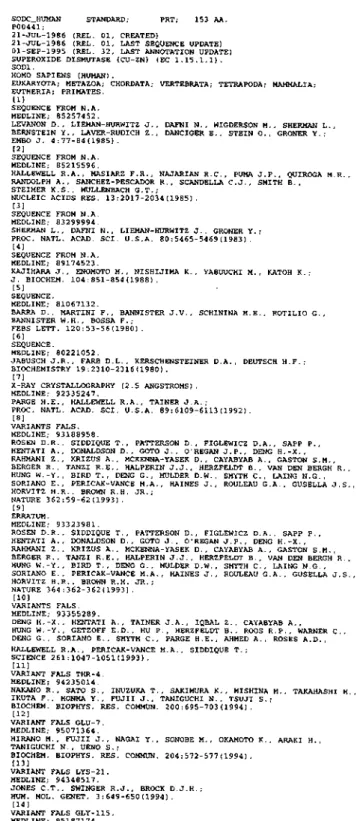
SWISS-PROT (1) is an annotated protein sequence database established in 1986 and maintained collaboratively, since 1987, by the Department of Medical Biochemistry of the University of Geneva and the EMBL Data Library (now the EMBL Outstation– The European Bioinformatics Institute; 2). The SWISS-PROT protein sequence data bank consists of sequence entries. Se-quence entries are composed of different line types, each with their own format. For standardization purposes the format of SWISS-PROT (3) follows as closely as possible that of the EMBL nucleotide sequence database. A sample SWISS-PROT entry is shown in Figure 1.
The SWISS-PROT database distinguishes itself from other protein sequence databases by three distinct criteria.
Annotation
In SWISS-PROT, as in most other sequence databases, two classes of data can be distinguished, the core data and the annotation. For each sequence entry the core data consists of the sequence data, the citation information (bibliographical refer-ences) and the taxonomic data (description of the biological source of the protein), while the annotation consists of a description of the following items: (i) function(s) of the protein; (ii) post-translational modification(s), for example carbohy-drates, phosphorylation, acetylation, GPI-anchor, etc.; (iii)
do-mains and sites, for example calcium binding regions, ATP binding sites, zinc fingers, homeobox, kringle, etc.; (iv) second-ary structure; (v) quaternsecond-ary structure; (vi) similarities to other proteins; (vii) disease(s) associated with deficiency of the protein; (viii) sequence conflicts, variants, etc.
We try to include as much annotation information as possible in SWISS-PROT. To obtain this information we use, in addition to the publications that report new sequence data, review articles to periodically update the annotations of families or groups of proteins. We also make use of external experts, who have been recruited to send us their comments and updates concerning specific groups of proteins.
We believe that our having systematic recourse both to publica-tions other than those reporting the core data and to subject referees represents a unique and beneficial feature of SWISS-PROT.
In SWISS-PROT annotation is mainly found in the comment lines (CC), in the feature table (FT) and in the keyword lines (KW). Most comments are classified by ‘topics’, an approach which permits easy retrieval of specific categories of data from the database.
Minimal redundancy
Many sequence databases contain, for a given protein sequence, separate entries which correspond to different literature reports. In SWISS-PROT we try as much as possible to merge all these data, so as to minimize the redundancy of the database. If conflicts exist between various sequencing reports they are indicated in the feature table of the corresponding entry.
Integration with other databases
It is important to provide the users of biomolecular databases with a degree of integration between the three types of sequence-related databases (nucleic acid sequences, protein sequences and protein tertiary structures), as well as with specialized data collections. SWISS-PROT is currently cross-referenced with 24 different databases. Cross-references are provided in the form of pointers to information related to SWISS-PROT entries and found in data collections other than SWISS-PROT. For example, the sample sequence shown in Figure 1 contains data bank reference (DR) lines that point to EMBL, PIR, OMIM and PROSITE. In this particular example it is therefore possible to retrieve the nucleic acid sequence(s) that encodes that protein (EMBL), the description of genetic disease(s) associated with that protein (OMIM) or the pattern specific for that family of proteins (PROSITE).
23
Nucleic Acids Research, 1994, Vol. 22, No. 1Nucleic Acids Research, 1996, Vol. 24, No. 1 23 RECENT DEVELOPMENTS
Model organisms
We have selected a number of organisms that are the target of genome sequencing and/or mapping projects and for which we intend to: (i) be as complete as possible (all sequences available at a given time should be immediately included in SWISS-PROT, including sequence corrections and updates); (ii) provide a higher level of annotation; (iii) cross-reference to specialized databases that contain, among other data, some genetic information about the genes that code for these proteins; (iv) provide specific indices or documents.
The organisms currently selected are: Arabidopsis thaliana (mouse-ear cress); Bacillus subtilis; Caenorhabditis elegans (worm); Dictyostelium discoideum (slime mold); Drosophila
melanogaster (fruit fly); Escherichia coli; Haemophilus influen-zae; Homo sapiens (human); Saccharomyces cerevisiae (budding
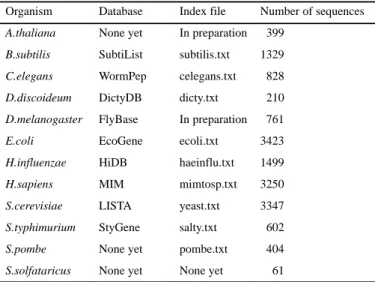
yeast); Salmonella typhimurium; Schizosaccharomyces pombe (fission yeast); Sulfolobus solfataricus. Details of the database entries for these organisms are given in Table 1.
Table 1. Organisms entered in the data bank
Organism Database Index file Number of sequences A.thaliana None yet In preparation 399
B.subtilis SubtiList subtilis.txt 1329 C.elegans WormPep celegans.txt 828 D.discoideum DictyDB dicty.txt 210 D.melanogaster FlyBase In preparation 761 E.coli EcoGene ecoli.txt 3423 H.influenzae HiDB haeinflu.txt 1499 H.sapiens MIM mimtosp.txt 3250 S.cerevisiae LISTA yeast.txt 3347 S.typhimurium StyGene salty.txt 602 S.pombe None yet pombe.txt 404 S.solfataricus None yet None yet 61
Collectively these organisms represent 30% of the total number of sequence entries in SWISS-PROT.
In the last few months we have included in SWISS-PROT fully annotated versions of the protein sequence entries encoded on the complete genome of Haemophilus influenzae, as well as entries originating from the full sequence of yeast chromosomes I, II, III, V, VI, VIII, IX and XI.
Documentation files
SWISS-PROT is distributed with a large number of documenta-tion files. Some of these files have been available for a long time (the user manual, release notes, the various indices for authors, citations, keywords, etc.), but many have been created recently and we are continuously adding new files. Table 2 list all the documents that are currently available or that will be added in the next few months.
New cross-references
We have recently added cross-references that link SWISS-PROT to the following databases:
(i) the LISTA database of yeast (Saccharomyces cerevisiae) genes coding for proteins prepared under the supervisation of Patrick Linder at the University of Geneva (4);
(ii) the Saccharomyces Genome Database (SGD or SacchDB) prepared under the supervisation of Mike Cherry at Stanford University;
(iii) the Yeast Electrophoresis Protein Database (YEPD) prepared under the supervisation of Jim Garrells from the Quest Protein Database Center of the Cold Spring Harbor Laboratory (5);
(iv) the StyGene section of the StySeq/StyMap integrated
Salmonella typhimurium LT2 database prepared by Ken Rudd at
the National Center for Biotechnology Information (NCBI); (v) the SubtiList relational database for the Bacillus subtilis 168 genome prepared under the supervisation of Ivan Moszer at the Pasteur Institute (6);
(vi) the database of Homology-derived Secondary Structure of Proteins (HSSP) prepared under the supervisation of Chris Sander at the EMBL (7);
(vii) the transcription factor database (Transfac) developed by Edgar Wingender and Rainer Knueppel from the Gesellschaft fuer Biotechnologische Forschung mbH in Braunschweig (8).
Currently, SWISS-PROT is linked to 24 different databases and has consolidated its role as the major focal point of biomolecular database interconnectivity. In release 32 there were an average of 3.5 cross-references for each sequence entry.
TREMBL, an unannotated supplement to SWISS-PROT
Ongoing genome sequencing and mapping projects have dra-matically increased the number of protein sequences to be incorporated into SWISS-PROT. Since we do not want to dilute the quality standards of SWISS-PROT by incorporating se-quences without proper sequence analysis and annotation, we cannot speed up the incorporation of new incoming data indefinitely. However, as we also want to make the sequences available as fast as possible we will introduce with SWISS-PROT release 33 an unannotated supplement to SWISS-PROT. This supplement consists of entries in SWISS-PROT-like format derived from the translation of all coding sequences (CDS) in the EMBL nucleotide sequence database, except CDS already included in SWISS-PROT.
We name this supplement TREMBL (TRanslation from EMBL), since the translation tools used to create translations of the CDS are based on the program ‘TREMBL’ written by Thure Etzold at the EMBL in Heidelberg.
Translation of all CDS in the EMBL nucleotide sequence database release 44 resulted in the creation of 145 000 TREMBL pre-entries. Around 65 000 of these pre-entries were already present as sequence reports in SWISS-PROT and were excluded from TREMBL. The remaining ∼80 000 sequence entries have been automatically merged whenever possible, to reduce redun-dancy in TREMBL. This step led to ∼70 000 TREMBL entries, which supplement SWISS-PROT.
Table 2.
File name Description userman.txt User manual relnotes.txt Release notes
submit.txt Submission of sequence data to the SWISS-PROT data bank* shortdes.txt Short description of entries in SWISS-PROT
jourlist.txt List of abbreviations for journals cited keywlist.txt List of keywords in use
speclist.txt List of organism identification codes
experts.txt List of on-line experts for PROSITE and SWISS-PROT acindex.txt Accession number index
autindex.txt Author index citindex.txt Citation index keyindex.txt Keyword index speindex.txt Species index
7tmrlist.txt List of 7-transmembrane G-linked receptor entries aatrnasy.txt List of aminoacyl-tRNA synthetases*
allergen.txt Nomenclature and index of allergen sequences*
cdlist.txt CD nomenclature for surface proteins of human leucocytes celegans.txt Index of Caenorhabditis elegans entries and corresponding
gene designations and WormPep cross-references
dicty.txt Index of Dictyostelium discoideum entries and corresponding gene designations and DictyDB cross-references
ec2dtosp.txt Index of Escherichia coli gene–protein database entries referenced in SWISS-PROT
ecoli.txt Index of Escherichia coli K12 chromosomal entries and corresponding EcoGene cross-references
embltosp.txt Index of EMBL database entries referenced in SWISS-PROT extradom.txt Nomenclature of extracellular domains*
glycosyl.txt Index of glycosyl hydrolases classified by families on the basis of sequence similarities
haeinflu.txt Index of Haemophilus influenzae RD chromosomal entries* hoxlist.txt Vertebrate homeobox proteins: nomenclature and index
humchr21.txt Index of protein sequence entries encoded on human chromosome 21*
humchr22.txt Index of protein sequence entries encoded on human chromosome 22*
humchry.txt Index of protein sequence entries encoded on human chromosome Y*
mimtosp.txt Index of MIM entries referenced in SWISS-PROT nomlist.txt List of nomenclature-related references for proteins pdbtosp.txt Index of Brookhaven PDB entries referenced in SWISS-PROT peptidas.txt Classification of peptidase families and index of peptidase
entries*
plastid.txt List of chloroplast- and cyanelle-encoded proteins pombe.txt Index of Schizosaccharomyces pombe entries in
SWISS-PROT and corresponding gene designations* restric.txt List of restriction enzymes and methylases entries
ribosomp.txt Index of ribosomal proteins classified by families on the basis of sequence similarities
salty.txt Index of Salmonella typhimurium LT2 chromosomal entries and corresponding StyGene cross-references*
subtilis.txt Index of Bacillus subtilis 168 chromosomal entries and corresponding SubtiList cross-references*
yeast.txt Index of Saccharomyces cerevisiae entries and corresponding gene designations
yeast1.txt Yeast chromosome I entries* yeast2.txt Yeast chromosome II entries* yeast3.txt Yeast chromosome III entries yeast5.txt Yeast chromosome V entries* yeast6.txt Yeast chromosome VI entries* yeast8.txt Yeast chromosome VIII entries* yeast9.txt Yeast chromosome IX entries* yeast11.txt Yeast chromosome XI entries Documents created since last year are flagged with an asterisk.
We have split TREMBL into two main sections, SP-TREMBL and REM-TREMBL. SP-TREMBL (SWISS-PROT TREMBL) contains entries (∼55 000) which should be incorporated into SWISS-PROT. SWISS-PROT accession numbers have been as-signed to these entries. SP-TREMBL is partially redundant against SWISS-PROT, since ∼30 000 of these SP-TREMBL entries are only additional sequence reports of proteins already in SWISS-PROT. We will try to merge these sequence reports as fast as possible with the already existing SWISS-PROT entries for these proteins, so as to make SWISS-PROT and TREMBL completely non-redundant. REM-TREMBL (REMaining TREMBL) contains those entries (∼15 000) that we do not wish to include in SWISS-PROT. This section is organized into four subsections.
(i) Most REM-TREMBL entries are immunoglobulins and T-cell receptors. We have stopped entering immunoglobulins and T-cell receptors into SWISS-PROT, because we want to keep only germ line gene-derived translations of these proteins in SWISS-PROT and not all known somatic recombinant variations of these proteins. At the moment there are >10 000 immuno-globulins and T cell receptors in TREMBL. We would like to create a specialized database dealing with these sequences as a further supplement to SWISS-PROT and keep only a representa-tive cross-section of these proteins in SWISS-PROT.
(ii) Another category of data which will not be included in SWISS-PROT is synthetic sequences. Again, we do not want to leave these entries in TREMBL. Ideally one should build a
specialized database for artificial sequences as a further supple-ment to SWISS-PROT.
(iii) A third subsection consists of fragments with less than seven amino acids.
(iv) The last subsection consists of CDS translations where we have strong evidence to believe that these CDS are not coding for real proteins.
The creation of TREMBL as a supplement to SWISS-PROT was not only for the purpose of producing a more complete and up to date protein sequence collection. We used this task to also achieve a deeper integration of the EMBL nucleotide sequence database with SWISS-PROT + TREMBL.
We used the PID, the Protein IDentification number found in the /db_xref qualifier tagged to every CDS in the EMBL nucleotide sequence database, as the ID of the TREMBL entries created from these CDS. In all 65 000 cases where an EMBL nucleotide sequence database CDS was already present as a sequence report in SWISS-PROT the SWISS-PROT DR lines of the corresponding SWISS-PROT entries have been updated by citing the EMBL AC number as primary identifier and the PID as secondary identifier. In all cases where a PID is already integrated into SWISS-PROT a /db_xref qualifier citing the corresponding SWISS-PROT entry is added to the EMBL nucleotide sequence database CDS labelled with this PID.
This approach enables us to point precisely from a given SWISS-PROT entry to one of potentially many CDS in the
25
Nucleic Acids Research, 1994, Vol. 22, No. 1Nucleic Acids Research, 1996, Vol. 24, No. 1 25
corresponding EMBL entry, and vice versa. This change will allow the development of software tools that automatically retrieve that part of a nucleotide sequence entry that codes for a specific protein. This will be especially useful in the context of the World Wide Web, as it will render obsolete the current situation where, for example, one needs to retrieve the complete sequence of a yeast chromosome when one wants the nucleotide sequence coding for a specific protein encoded on that chromosome.
PRACTICAL INFORMATION Content of the current release
Release 32.0 of SWISS-PROT (October 1995) contains 48 440 sequence entries, comprising 17 000 000 amino acids abstracted from ∼43 000 references. The data file (sequences and annota-tions) requires 90 Mb disk storage space. The documentation and index files require ∼30 Mb disk space. No restrictions are placed on use or redistribution of the data.
How to obtain SWISS-PROT
SWISS-PROT is distributed on CD-ROM by the EMBL Outstation–the European Bioinformatics Institute (EBI) (2). The CD-ROM contains both SWISS-PROT and the EMBL nucleo-tide sequence database, as well as other data collections and some database query and retrieval software for MS-DOS and Apple MacIntosh computers. For all enquiries regarding subscription to and distribution of SWISS-PROT one should contact The EMBL Outstation–The European Bioinformatics Institute, Hinxton Hall, Hinxton, Cambridge CB10 1RQ, UK (tel +44 1223 494 400; fax +44 1223 494 468; email [email protected]).
Individual sequence entries can be obtained from the EBI file server. Detailed instructions on how to make the best use of this service and, in particular, on how to obtain protein sequences can be obtained by query to the network address [email protected]
HELP HELP PROT
If you have access to a computer system linked to the Internet you can obtain SWISS-PROT using ftp (File Transfer Protocol) from the following file servers:
EBI anonymous ftp server (ftp.ebi.ac.uk or 192.54.41.33); NCBI Repository, National Library of Medicine, NIH, Washington, DC (ncbi.nlm.nih.gov or 130.14.20.1);
ExPASy (Expert Protein Analysis System) server, University of Geneva, Switzerland (expasy.hcuge.ch or 129.195.254.61);
National Institute of Genetics (Japan) ftp server (ftp.nig.ac.jp or 133.39.16.66).
How to submit data to SWISS-PROT
To submit data to SWISS-PROT and for all enquiries regarding submission to SWISS-PROT one should contact SWISS-PROT, The EMBL Outstation–The European Bioinformatics Institute, Hinxton Hall, Hinxton, Cambridge CB10 1RQ, UK [tel. +44
1223 494 462; fax +44 1223 494 468; email [email protected] (for submissions), [email protected] (for enquiries)].
Interactive access to SWISS-PROT
The most efficient and user friendly way to browse interactively in SWISS-PROT is to use the World Wide Web (WWW) molecular biology server ExPASy (9), as well as that developed by the EBI. WWW is a global information retrieval system merging the power of worldwide networks, hypertext and multimedia. Through hypertext links it gives access to documents and information available on thousands of servers around the world. To access a WWW server one needs a WWW browser. Popular browsers available for most computer platforms include Mosaic, developed at the National Center for Supercomputing Applications (NCSA) of the University of Illinois at Champaign (obtainable by anonymous ftp from ftp.ncsa.uiuc.edu), and Netscape Navigator, from Netscape Communications Corp. (available from ftp.netscape.com). Using a WWW browser one has access to all the hypertext documents stored on the ExPASy and EBI servers (as well as many other WWW servers).
The ExPASy server was made available to the public in September 1993. On August 1995 a cumulative total of 2 000 000 connections was attained. It may be accessed through its Uniform Resource Locator (URL, the addressing system defined in WWW) which is http://expasy.hcuge.ch/. The EBI server is accessible under http://www.ebi.ac.uk/.
Release frequency
The present distribution frequency is four releases per year, although weekly updates are also available. These updates are available by anonymous ftp. Three files are updated every week: new_seq.dat, containing all the new entries since the last full release; upd_seq.dat, containing the entries for which the sequence data has been updated since the last release; upd_ann.dat, containing the entries for which one or more annotation fields have been updated since the last release. These files are available on the EBI, NCBI and ExPASy servers, whose Internet addresses are listed above.
REFERENCES
1 Bairoch,A. and Boeckmann,B. (1994) Nucleic Acids Res., 22, 3578–3580. 2 Emmert,D.B., Stoehr,P.J., Stoesser,G. and Cameron,G.N. (1994) Nucleic
Acids Res., 22, 3445–3449.
3 Bairoch,A. (1995) SWISS-PROT Protein Sequence Data Bank User Manual, Release 32, October.
4 Doelz,R., Mosse,M.-O., Slonimski,P.P., Bairoch,A. and Linder,P. (1994) Nucleic Acids Res., 22, 3459–3461.
5 Latter,G.I., Boutell,T., Monardo,P.J., Kobayashi,R., Futcher,B., McLaughlin,C.S. and Garrels,J.I. (1995) Electrophoresis, 16, 1170–1174. 6 Moszer,I., Glaser,P. and Danchin,A. (1995) Microbiology, 141, 261–268. 7 Sander,C. and Schneider,R. (1994) Nucleic Acids Res., 22, 3597–3599. 8 Wingender,E. (1994) J. Biotechnol., 35, 273–280.
9 Appel,R.D., Bairoch,A. and Hochstrasser,D.F. (1994) Trends Biochem. Sci., 19, 258–260.