Journal of Antimicrobial Chemotherapy (1989) 24, 387-395
How predictable is development of resistance after pMactam therapy in
Enterobacter cloacae infection?
M. Micbea-Hamzehpoor and J. C. Pecbere
Departement de Microbiologie, Centre Medical Universitaire, 9 avenue de Champel, 1211 Genive 4, Switzerland
Certain non-fastidious Gram-negative bacilli, notably Enterobacter cloacae, although classified as susceptible by usual in-vitro susceptibility testing, often become resistant in patients treated with newer /J-lactam antibiotics. Here various in-vitro tests were carried out together with an animal model allowing the quantifi-cation of resistance that emerges after short term therapy. Mice were challenged (10* cfu plus talcum) intraperitoneally with one each of four strains of Ent. cloacae. Two hours later, a single /Mactam dose was administered subcutancously. The following day, the peritoneal bacterial population was analysed by using antibiotic-containing gradient plates. Development of resistance after therapy varied according to the compound considered. Imipenem (SOmg/kg) produced no resistance, and piperacillin (200mg/kg) only a few, while resistance occurred frequently after therapy with aztreonam (50 mg/kg), ceftazidime (50 mg/kg), cefotaxime (50 mg/kg) and cefpirome (50 mg/kg). MICs increased by at least 16-fold when resistance developed. No simple correlations were found between these in-vivo results and initial MICs, killing kinetics, frequency of resistant variants within the bacterial populations before therapy, initial MIC of these variants or antibiotic concentra-tions assayed in peritoneal fluid 60 min after dosing. The most reliable predictive in-vitro test appeared to be the determination of resistance emerging in broth containing at least 16 times the MIC of the antibiotic tested. Such a test is unlikely to be used on a routine basis. When a /Mactam compound seems appropriate for treating an Enterobacter infection, it may be advisable to avoid drugs that are prone prone to produce resistance in experimental or clinical infections, whatever the results of conventional in-vitro susceptibility tests.
Introduction
During recent years, the development of bacterial resistance after therapy with newer 0-lactam antibiotics has been a concern (Sanders & Sanders, 1985). Bacterial species possessing this capacity include mainly non-fastidious Gram-negative aerobic bacilli, notably Enterobacter cloacae. These organisms are often classified as susceptible with the conventional susceptibility testing, causing 'very major' errors (Sanders, 1984) potentially harmful for the patients. In our laboratory, we have developed a murine model to detect and quantify resistance emerging after short-time therapy (Pechere et al., 1986). In this model, we have shown that resistance could occur after a single administration of a /Mactam compound but the rate of resistance varied according to the compound considered (Marchou et al., 19876). Ceftriaxone, a third generation cephalosporin, appeared to be the most prone to select resistance in Ent. cloacae
388 M. Mkbbt-Hamzefapoor and J. C. Pechtre
infections, followed by carumonam, a monobactam. No resistance occurred after therapy with either cefepime (previously BMY28142) a newer cephalosporin, or SCH 34343, a new penem. Since these observations may help the clinician, we carried out experiments with six other currently used /J-lactam compounds and four strains of
Ent. cloacae. The in-vivo results were matched with various in-vitro tests carried out
with the same strains and the same antibiotics. Materials and methods
Antibiotics, strains and culture media
Aztreonam, ceftazidime, cefotaxime, cefpirome, imipenem and piperacillin were kindly supplied by their respective manufacturers in the form of powder of known potency, from which fresh working solutions were prepared immediately before use. Four clinical isolates of Ent. cloacae, strains 218, 219, 895 and 908, previously described by Marchou et al. (1987a) were studied. Strains were maintained in skim milk and stored at — 70°C. At the start of the study, the strains were thawed and plated on blood agar to check purity. Mueller-Hinton broth and agar (Oxoid Ltd, Basingstoke, Hampshire, England) were used for all precultures, in-vitro tests, colony counts and antibiotic-containing gradient plates. The incubation temperature was 35°C.
Susceptibility testing
Antimicrobial activity was determined by two methods. The first was a microdilution technique for determination of MICs (Thornsberry et al., 1983). The second uses antibiotic-containing gradient plates (Bryson & Szybalski, 1952) as described previously (Michea-Hamzehpour et al., 1987). This method allowed the definition of two levels of antibiotic activity. The first level was read at the boundary concentration. The boundary is the relatively sharp limit separating the confluent growth at lower antibiotic concentrations from the zone of higher antibiotic concentrations, where only single colonies grow. The second level of antibiotic activity, called the no-growth concentration in this article, was the minimal concentration inhibiting all visible growth.
Killing effect and emergence of resistance in vitro
Strains of Ent. cloacae were grown overnight in broth and inocula were diluted in order to provide approximately 3xl07cfu/ml and added to broth (final volume 5 ml)
containing 16 times the MIC of the drug to be tested. Cells were subcultured immediately and after 6 and 12 h of incubation. For viable counts, a portion (01 ml) was sampled from each vial, diluted serially into 0-9% NaCl and plated on antibiotic-free agar. Colonies were enumerated after 24 h of incubation. For determination of boundary concentrations, another portion (0-1 ml) of bacterial culture was transferred to antibiotic-free broth and incubated overnight. Then 0-1 ml of this culture was spread uniformly over the antibiotic-containing gradient plates. After incubation for 24 h, bacterial growth was examined as described in the susceptibility testing section.
Frequency of resistant variants
Portions (0-1 ml) of an overnight broth culture were uniformly spread on antibiotic-free agar (after proper dilution) and antibiotic-containing agar (undiluted inoculum).
Resistance developing during pMactam therapy 389 Antibiotic concentrations were four and eight times the corresponding MICs. Colonies were counted after 24 h of incubation.
Animal model
Swiss ICR female mice, weighing 20 to 30 g, were conditioned for one week after receipt from the breeders and kept in conventional cages with free access to water and antibiotic-free chow. Inoculum was prepared from an overnight broth culture and diluted with 0-9% NaCl. One ml of this overnight diluted culture containing approxi-mately 10s cfu and 125 mg of sterile talcum (magnesium hydropolysilicate) was injected
intraperitoneally to establish peritonitis. Talcum was used as a foreign body in order to obtain lethal sepsis in all control mice (Pechere et al., 1986). Two hours after bacterial challenge, a single dose of antibiotic was administered subcutaneously. Twenty-two hours later, mice were killed by hyperanaesthesia and peritoneal fluid was sampled and plated after appropriate dilutions on antibiotic-free agar for colony counts, whereas the rest of the sample was placed in antibiotic-free broth to allow overnight growth for further susceptibility testing. Data were compared from treated and untreated control animals. A significant shift towards resistance was defined as an increase of the boundary concentration by at least four-fold.
Antibiotic assay
Drug concentrations in peritoneal fluid of uninfected mice were determined by a microbiological assay, as previously described (Michea-Hamzehpour et al., 1986).
Results
Susceptibility testing before therapy
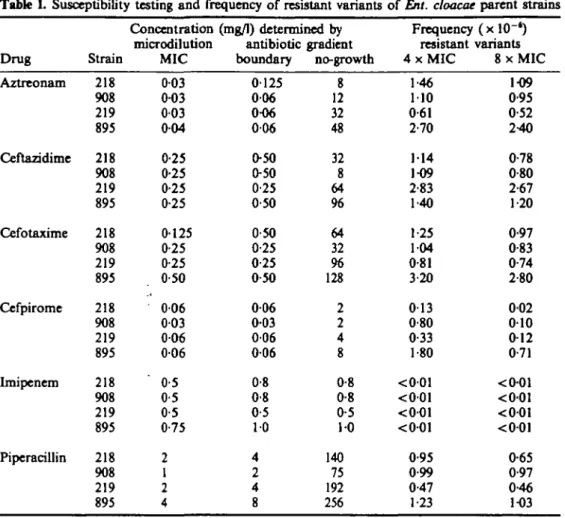
Before therapeutic exposure, the four strains of Ent. cloacae were susceptible to the antibiotics tested (Table I). On a concentration basis aztreonam and cefpirome were the most potent drugs. All strains exhibited a similar susceptibility profile to /Mactam antibiotics. MICs as determined by microdilution and boundary concentrations as assessed on antibiotic-containing gradient plates were equivalent within one dilution. Single colonies grew beyond the boundary concentration on gradient agar for all drugs except imipenem. The no-growth concentrations varied from strain to strain, isolate 895 showing the highest values.
Frequency of resistant variants
Actual inoculum size in these experiments was (mean±s.D.) 115±0-33 x lO'cfu. Similar growth (0-46-3-20 x 106 colonies) was observed on plates containing aztreonam,
ceftazidime, cefotaxime or piperaciUin (Table I). Resistant variants were less frequent on cefpirome agar, while imipenem agar yielded no growth. Plates seeded with strain 895 showed higher frequency of variants with all antibiotics except on ceftazidime agar, where strain 219 appeared to contain more variants. The MICs of resistant variants were remarkably stable after several subpassages in antibiotic-free agar or broth.
390 M. MkUa-Hamzefapoor and J. C Pectere
Tabk L Susceptibility testing and frequency of resistant variants of Ent. cloacae parent strains
Drug Aztreonam Ceftazidime Cefotaxnne Cefpirome Lmipcnem Pipcracillin Strain 218 908 219 895 218 908 219 895 218 908 219 895 218 908 219 895 218 908 219 895 218 908 219 895 Concentration microdilution MIC 003 0-O3 003 004 0-25 0-25 0-25 0-25 0125 0-25 0-25 0-50 006 003 006 006 0-5 0-5 0-5 0-75 2 1 2 4 (mg/1) determined by antibiotic boundary 0125 006 0-06 006 0-50 0-50 0-25 0-50 0-50 0-25 0-25 0-50 006 0-03 006 0-06 0-8 0-8 0-5 10 4 2 4 8 gradient no-growth 8 12 32 48 32 8 64 % 64 32 96 128 2 2 4 8 0-8 0-8 0-5 10 140 75 192 256 Frequency resistant 4 x M I C 1-46 110 0-61 2-70 114 1-09 2-83 1-40 1-25 104 0-81 3-20 013 0-80 0-33 1-80 <001 <001 <001 <001 0-95 0-99 0-47 1-23 (xlO-*) variants 8 x M I C 1-09 0-95 0-52 2-40 0-78 0-80 2-67 1-20 0-97 0-83 0-74 2-80 002 010 0-12 071 <0-01 <001 <001 <001 0-65 0-97 0-46 1-03
In-vitro killing studies
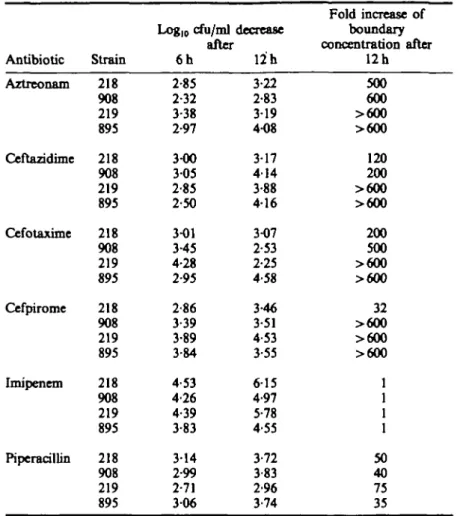
Actual inoculum size was (mean±s.D.) 3-3 ±0-89 x 107cfu/ml. Viable counts decreased
by more than 2 logs under all test conditions (Table II). Imipenem was the most bactericidal compound (3-8-4-5 Iog10/ml decrease after 6 h, compared to 2-9-3-4 in the
case of the five other antibiotics). Generally less viable cells were found after 12 h (except in four cases). After 24 h of incubation, regrowth was observed in all cases (data not shown).
Emergence of resistance in vitro
Increase in the boundary concentration was measured after 12 h of drug exposure in the vials used for killing studies. Subcultures were made into antibiotic-free broth, then on antibiotic-containing gradients. The decrease in susceptibilities was impressive with aztreonam, ceftazidime, cefotaxime and cefpirome, and notably less striking with piperacillin (Table II). No resistance developed when imipenem was tested.
Resistance developing daring (Hactain therapy
Table n . Killing studies and susceptibility testing by antibiotic-containing gradient agar of Ent. cloacae parent strains (inoculum 3-3 ± 0-89 x 107 cfu/ml)
after 6 and 12 h of incubation in Mueller-Hinton broth containing 16 x MIC of each of six antibiotics
391 Antibiotic Aztreonam Ceftazidime Cefotaxime Cefpirome I mi pen em Piperacillin Strain 218 908 219 895 218 908 219 895 218 908 219 895 218 908 219 895 218 908 219 895 218 908 219 895 Logl0 cfu/ml after 6h 2-85 2-32 3-38 2-97 3-00 305 2-85 2-50 3-01 3-45 4-28 2-95 2-86 3-39 3-89 3-84 4-53 4-26 4-39 3-83 314 2-99 2-71 306 decrease 12 h 3-22 2-83 319 4-08 317 414 3-88 416 3-07 2-53 2-25 4-58 3-46 3-51 4-53 3-55 615 4-97 5-78 4-55 3-72 3-83 2-96 3-74 Fold increase of boundary concentration after 12h 500 600 >6O0 >600 120 200 >600 >600 200 500 >600 >600 32 >600 >600 >600 1 1 1 1 50 40 75 35 Animal studies
Thirty-six infected, but untreated, mice were used as controls. Severe peritonitis was observed in all cases. At autopsy, the peritoneal fluid was purulent and contained 3-49 ± 1-19 x 10'° cfu/ml. Since the number of peritoneal bacteria at the time of death clearly surpassed the injected inoculum (1 -51 ±0-46 x 10s cfu/ml), an actual infection
occurred in all cases.
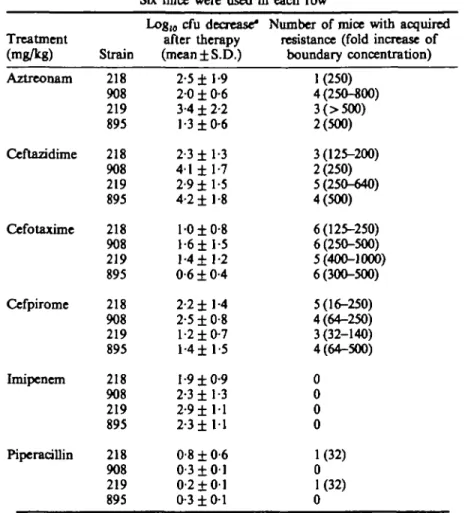
One hundred forty four infected mice were treated. Therapeutic activity was assessed by comparing the number of peritoneal viable counts in control and treated animals (Table III). All treatments produced antibacterial effect, which varied according to the drug. The most efficient antibiotics were aztreonam, ceftazidime, cefpirome and imipenem. Cefotaxime and above all, piperacillin produced less killing (P < 0-05) compared to the four others by student's t test). Development of resistance after therapy varied according to the compound considered. Imipenem produced no
resist-392 M. MJchea-Hamzehpoiir and J. C Pecbire
Table III. Bacterial population analysis of peritoneal fluid after a single dose therapy in mice challenged with Ent. cloacae (inoculum: 1-5 ± 0-46 x 10* cfu).
Six mice were used in each row Treatment (mg/kg) Aztreonam Ceftazidime Cefotaxime Cefpirome Imipenem Piperacillin Strain 218 908 219 895 218 908 219 895 218 908 219 895 218 908 219 895 218 908 219 895 218 908 219 895
Log|0 cfu decrease* after therapy (mean±S.D.) 2-5 ±1-9 2 0 ± 0-6 3-4 ± 2-2 1-3 ±0-6 2-3 ±1-3 4-1 ± 1-7 2-9 ±1-5 4-2 ±1-8 10 ±0-8 l - 6 ± 1-5 1-4 ±1-2 0-6 ± 0-4 2-2 ±1-4 2-5 ±0-8 1-2 ±0-7 l - 4 ± 1-5 1-9 ± 0 - 9 2-3 ±1-3 2-9 ± 1 1 2-3 ± 1 1 0-8 ± 0-6 0-3 ± 0 1 0-2 ± 0 1 0-3 ± 0 1
Number of mice with acquired resistance (fold increase of
boundary concentration) 1(250) 4(25O-«00) 3(>5O0) 2(500) 3(125-200) 2(250) 5(250-640) 4(500) 6(125-250) 6(250-500) 5(400-1000) 6(300-500) 5(16-250) 4(64-250) 3(32-140) 4(64-500) 0 0 0 0 1(32) 0 1(32) 0
"As determined in peritoneal fluid after companion with control animal*.
ance, and piperacillin only a little, while more resistance occurred frequently after therapy with the four other drugs. Analysis by the chi square test applied to these results (with three degrees of freedom to take into account the data of each strain separately) showed that the difference between imipenem and piperacillin on the one hand, and the four other drugs on the other hand, was significant (P < 0-05), but not the differences between aztreonam, cefotaxime, ceftazidime and cefpirome or between imipenem and piperacillin.
Antibiotic assays
Antibiotic concentrations in peritoneal fluid of non-infected mice 60 min after subcuta-neous administration are presented in Table FV. All these concentrations were well above the initial MICs of the organisms causing the infection.
Resistance developing during fMactam therapy 393
Table IV. Antibiotic concentration in peritoneal fluid of non-infected mice 60min after /Mactam subcutaneous
administration Antibiotic Aztreonam Ceftazidime Cefotaxime Cefpirome Imipenem Piperacillin dosage (mg/kg) 50 50 50 50 50 200 Antibiotic concentration in peritoneal fluid' (mg/1) 36-4 57-8 34-4 35-7 12-3 51-8 'Mean of three determinations.
Discussion
The present study confirmed that development of resistance depended on the /Mactam administered to the animal. Imipenem and piperacillin, as cefepime (ex BMY 28142) and SCH 34343 in previous studies (Marchou et al., 19876) were less prone to produce resistance in Ent. cloacae infection than the other compounds tested. The mechanisms by which Enterobacter spp. can escape the lethal effects of potent antibiotics such as third-generation cephalosporins is complex. Ent. cloacae possesses the ampC gene (Lindberg & Normark, 1988) encoding for /Mactamases falling into class I of the Richmond & Sykes' classification (Richmond & Sykes, 1973). The most convincing indication that /Mactamases are associated with resistance was provided by transfer of the chromosomal bla gene from a stably derepressed mutant of Ent. cloacae into
Escherichia coli, leading to acquisition of /Mactam resistance by the recipient Esch. coli
(Seeberg et al., 1983). Enterobacter populations are heterogenous with regard to /?-lactamase production. The wild type cells produce basal low levels of enzymes, which can be greatly increased by induction (Lindberg & Normark, 1987). Linked to the inducibility is the ability to undergo mutation to high level constitutive /Mactamase production. Such mutants occurred at high frequency (10~5 to 10"7) and appeared to
be highly resistant to penicillins (including piperacillin), and the cephalosporins tested; they exhibited decreased susceptibility to aztreonam, but remained susceptible to imipenem. Whether the resistance is caused by inducible wild type cells or by constitu-tive hyperproducer mutants has been a matter of controversy, but several lines of evidence favour the second hypothesis (Livermore & Young, 1987; Marchou et al., 1987a). Consistently /Mactamase production by all four Ent. cloacae strains used in our study was inducible (Marchou et al., 1987a), and that did not correlate the emergence of resistance in the mice. However, limited penetration of the antibiotic into the bacterial cell is an important consideration for the understanding of resistance. Several studies have shown that relative impermeability of the outer membrane acts synergisti-cally with enzymatic inactivation to produce resistance (Marchou et al., 1987a; Sawai, Yamaguchi & Hiruma, 1988). In our study, this interactive system probably accounted for the performance of imipenem, whose compact molecular structure (MW299) endowed it with the highest penetration rate among all /Mactams tested in reconstituted proteoliposomes with porins of Esch. coli (Yoshimura & Nikaido, 1985) or in intact cells of Esch. coli, Ent. cloacae and Citrobacter frewdii (Hashizume, Yamaguchi &
394 M. Mkb^a-Hamzefapour and J. C. Pecbere
Sawai, 1986). The inability of piperacillin to select resistance in the mouse does not fit the model however, as this drug is rapidly hydrolysed by Ent. cloacae /?-lactamase (unpublished personal results) and exhibited a slow relative permeability rate (Yochi-mura & Nikaido, 1985).
The question of resistance developing during therapy is even more knotty since, besides bacterial characteristics, pharmacokinetics and host factors also contribute. The prediction of successful therapy which is the major issue of susceptibility testing appears here specially difficult. It has been well recognized (Sanders, 1984) that conventional tests fail to detect these types of resistance. MICs were consistently poor predictors of response of infection in-vivo. The MICs of the resistant variants, as determined by the no-growth concentrations, together with the antibiotic concentra-tions obtained in the peritoneal fluid, were thought to be associated with further emergence of resistance in the mouse (Marchou el al., 19876). Unfortunately this assumption did not hold in the present study, as eloquently illustrated by the pipera-cillin and the cefpirome results (Tables I and III).
Also disappointing was the frequency of resistant variants. For instance, in aztreonam experiments conducted with strains 219 and 895 respectively, the number of colonies growing on agar plates containing four or eight times the MIC did not correlate accurately with the murine trials.
In a study dealing with a few human cases of meningitis caused by Enterobacter and
Serratia spp. (Eng et al., 1987) the extent to which an isolate was killed by cefotaxime
or latamoxef in a 6-h in-vitro incubation showed good correlation with the clinical outcome. However, once again, the present study cannot support this view, as compounds showing similar killing effects against a specific strain did not necessarily display different resistant rates in the animal.
Finally, the most reliable in-vitro test in this study was the determination of the emergence of resistance in broth containing 16 times the MIC of the drug as shown in Table II. Piperacillin and imipenem performed better, both in-vitro and in-vivo. One must admit however that such a test, although easy to perform in a research laboratory, would be difficult to carry out on a routine basis. On practical grounds, a pragmatic attitude is probably relevant. When a /Mactam antibiotic seems indicated for treating an Ent. cloacae infection recognized as such, it is probably advisable to select a molecule which is less likely to produce resistance, as shown in the murine model. Imipenem, piperacillin, as well as cefepime and SCH 34343 (Marchou et al., 19876) belong to this list.
Acknowledgements
This work was supported by the Fonds National Suisse de la Recherche Scientifique (grant 3,079-087). We are indebted to Lasta Kocjancic and Anneliese Kahr for their helpful technical assistance.
References
Bryson, V. & Szybalslri, W. (1952). Microbial selection. Science 116, 45-51.
Eng, R. H. K., Chcrubin, C. E., Pccherc, J.-C. & Beam, T. R. (1987). Treatment failures of cefotaxime and latamoxef in meningitis caused by Enterobacter and Serratia spp. Journal of Antimicrobial Chemotherapy 20, 903-11.
Resistance developing during pMactam therapy 395 Hashizume, T., Yamaguchi, A. & Sawai, T. (1986). Outer membrane permeability of imipenem
in comparison with other /Mactam antibiotics. Journal of Antibiotics 39, 153-6.
Lindberg, F. & Normark, S. (1987). Common mechanism of ampC /Mactamase induction in enterobacteria: regulation of the cloned Enterobacter cloacae P99 /Mactamase gene. Journal of Bacteriology 169, 758-63.
Livermore, D. M. & Young, Y.-J. (1987). 0-Lactamase lability and inducer power of newer /?-lactam antibiotics in relation to their activity against /Mactamase-inducibility mutants of Pseudomonas aeruginosa. Journal of Infectious Diseases 155, 775-82.
Marchou, B., Bellido, F., Charnas, R., Lucain, C. & Pechere, J.-C. (1987a). Contribution of fi-lactamase hydrolysis and outer membrane permeability to ceftriaxone resistance in Enterobacter cloacae. Antimicrobial Agents and Chemotherapy 31, 1589-95.
Marchou, B., Michea-Hamzehpour, M., Lucain, C. & Pechere, J.-C. (19876). Development of fi-lactam-resistant Enterobacter cloacae in mice. Journal of Infectious Diseases 156, 369-73. Michea-Hamzehpour, M., Auckenthaler, R., Regamey, P. & Pechere, J.-C. (1987). Resistance
occurring after fluoroquinolone therapy of experimental Pseudomonas aeruginosa peritonitis. Antimicrobial Agents and Chemotherapy 31, 1803-8.
Michea-Hamzehpour, M., Pechere, J.-C, Marchou, B. & Auckenthaler, R. (1986). Combination therapy: a way to limit emergence of resistance? American Journal of Medicine 80, Suppl. 6B, 138-42.
Pechere, J. C , Marchou, B., Michea-Hamzehpour, M. & Auckenthaler, R. (1986). Emergence of resistance after therapy with antibiotics used alone or combined in a murine model. Journal of Antimicrobial Chemotherapy 17, Suppl. A, 11-8.
Richmond, M. H. & Sykes, R. B. (1973). The /Mactamases of Gram-negative bacteria and their possible physiological role. Advances in Microbial Physiology 9, 31-88.
Sanders, C. C. (1984). Failure to detect resistance in antimicrobial susceptibility tests. A "very major" error of increasing concern. Antimicrobic Newsletter 1, 27-31.
Sanders, C. C. & Sanders, W. E. (1985). Microbial resistance to newer generation /Mactam antibiotics: clinical and laboratory implications. Journal of Infectious Diseases 151, 399-406. Sawai, T., Yamaguchi, A. & Hiruma, R. (1988). Effect of interaction between outer membrane
permeability and /Mactamase production or resistance to /Mactam agents in Gram-negative bacteria. Reviews of Infectious Diseases 10, 761-4.
Seeberg, A. H., Tolxdorff-Neutzling, R. M. & Wiedemann, B. (1983). Chromosomal /?-lactamases of Enterobacter cloacae are responsible for resistance to third-generation cephalosporins. Antimicrobial Agents and Chemotherapy 23, 918-25.
Thornsberry, G, Anhalt, J., Barry, A. L., Gerlach, E. H., Hossom, J., Jones, R. N. et al. (1983). Methods for Dilution Antimicrobial Susceptibility Tests for Bacteria that Grow Aerobically. Vol. 3, pp. 48-56. National Committee for Clinical Laboratory Standards, Villanova, PA. Yoshimura, F. & Nikaido, H. (1985). Diffusion of /Mactam antibiotics through the porin
channels of Escherichia coli K-12. Antimicrobial Agents and Chemotherapy 27, 84-92. (Received 20 February 1989; accepted 1 May 1989)