Publisher’s version / Version de l'éditeur:
ACEE World Conference on Educational Multimedia, Hypermedia and
Telecommunications, 2003
READ THESE TERMS AND CONDITIONS CAREFULLY BEFORE USING THIS WEBSITE. https://nrc-publications.canada.ca/eng/copyright
Vous avez des questions? Nous pouvons vous aider. Pour communiquer directement avec un auteur, consultez la première page de la revue dans laquelle son article a été publié afin de trouver ses coordonnées. Si vous n’arrivez pas à les repérer, communiquez avec nous à [email protected].
Questions? Contact the NRC Publications Archive team at
[email protected]. If you wish to email the authors directly, please see the first page of the publication for their contact information.
NRC Publications Archive
Archives des publications du CNRC
This publication could be one of several versions: author’s original, accepted manuscript or the publisher’s version. / La version de cette publication peut être l’une des suivantes : la version prépublication de l’auteur, la version acceptée du manuscrit ou la version de l’éditeur.
Access and use of this website and the material on it are subject to the Terms and Conditions set forth at
Using Visual Materials to Engage Learners
Goldfarb, Ilia; Kondratova, Irina
https://publications-cnrc.canada.ca/fra/droits
L’accès à ce site Web et l’utilisation de son contenu sont assujettis aux conditions présentées dans le site LISEZ CES CONDITIONS ATTENTIVEMENT AVANT D’UTILISER CE SITE WEB.
NRC Publications Record / Notice d'Archives des publications de CNRC:
https://nrc-publications.canada.ca/eng/view/object/?id=0144379f-3dff-4189-9e76-39c59213d1b3 https://publications-cnrc.canada.ca/fra/voir/objet/?id=0144379f-3dff-4189-9e76-39c59213d1b3
National Research Council Canada Institute for Information Technology Conseil national de recherches Canada Institut de technologie de l'information
Using Visual Materials to Engage Learners *
Goldfarb, I., Kondratova, I.
June 2003
* published in Proceedings of the ED-Media 2003. ACEE World Conference on
Educational Multimedia, Hypermedia and Telecommunications. Honolulu, Hawaii, USA. June 23-28, 2003. NRC 45798.
Copyright 2003 by
National Research Council of Canada
Permission is granted to quote short excerpts and to reproduce figures and tables from this report, provided that the source of such material is fully acknowledged.
Using Visual Materials to Engage Learners
Ilia Goldfarb,
Faculty of Education, University of New Brunswick, Canada [email protected]
Irina Kondratova,
National Research Council Institute for Information Technology e-Business [email protected]
Abstract: The objective of the Spirit of Democracy international project is to enhance the capacity
of civic educators in Russia to develop and sustain a dynamic and vibrant program of citizenship education. This goal is being met by providing online resources for teachers in Canada and Russia. The Spirit of Democracy project’s learning approach is based on the ideas of Vygotsky and on the concepts of Situated Learning and Anchored Instruction. Within the Spirit of Democracy project developers create learning opportunities using situations and springboards. The uniqueness of the approach taken by the project is that researchers use authentic materials to engage students in learning and discovery. A very important role is assigned to visual materials. All visuals used in learning springboards can be divided into three categories: “real life” pictures, illustrations to create specific environments, and art masterpieces to attract and engage in discussions of democratic issues.
Introduction: Importance of Visuals in Educational Resources
“The world of just text is irrevocably dead” (ArtsEDNet, 1997). This statement belongs to Allen De Bevoise, one of North America’s leading innovators in interactive technology. He is not the only digital media guru who supports this view. The director emeritus of the National Gallery of Art, J. Carter Brown, advisor and consultant to Bill Gates and the founder of the OVATION - The Arts Network - the premier provider of arts and cultural programming on US television also believes in the central place of images in education: “ We are in a new age where the image can now be central, thanks to technology in a large part. Images are around us. Today, they have the potential to be as fundamental to education as words and numbers, adding significantly to the excitement, depth and relevance of what and how children learn” (ArtsEdNet, 1997).
Until quite recently, the publishers of instructional materials rarely used visuals due to the high cost of producing pictures as compared to textual materials. However, the cost of reproducing pictures is not a factor when the materials are distributed electronically, such as materials involved in computer-based instruction, Web publishing or CD-ROM – based materials (Morrison et al., 2001) The development of technological means for producing and manipulating visual information allowed wide-spread use of visuals in instructional materials. In order to fully realize the potential benefits of using pictorial information in teaching, it is necessary for pictorial presentation to be done well. “Unfortunately, much of this swing toward more pictorial treatments has not been informed by a principled understanding of how people learn (or fail to learn) from pictures. Rather, it seems to be driven largely by a mixture of naive intuitions about the instructional efficacy of pictures and the technical capacity to include them cheaply and easily” (Lowe, 2001, p. 202).
It is well known that vision, for humans, represents the richest source of information. Seeing and hearing, and particularly seeing, belong to so-called “far senses” that are crucially important in the human survival mechanism. It is well documented that, when compared to other senses, vision predominates them (Seculer and Blake, 1990).
There is a general belief that illustrated text is more conducive to learning. According to Levie & Lentz (1982), pictures help readers to better learn the illustrated textual information, but do not have any effect on the comprehension of the information that is not illustrated. As shown by Peeck (1987), visual images are particularly useful to illustrate the spatial relationships described in the text. “ For example, in a text describing the relationship between the position of the moon relative to the earth and sun during a lunar eclipse, a picture of this spatial relations would benefit the reader. Pictorial representations are also beneficial when used to illustrate abstract material and the
main ideas in the text” (Morrison et al., 2001, p. 155). However, research shows that the most effective use of illustrations in learning materials is achieved when the learner interacts with the illustration, for example, by labelling parts of the picture, tracing the picture or answering questions about the picture (Dean& Kulhavy, 1981; Winn and Holliday, 1982).
Fleming & Levie (1978) report that print and pictures are available for processing longer. The implications of this are that print and pictures are more suitable for presentation of complex tasks that require prolonged attention (Fleming, 1987). Pictures are also better remembered than words (Gagne & Rohwer, 1969), which sometimes cause an undesired effect, when a picture gives too much information that is difficult to process.
There is an extensive body of knowledge on the general principles of graphic interface design and visual presentation in the graphic design field. Recently this knowledge was extended to include human computer interface and visual design principles for instructional multimedia (Misanchuk et al., 2000).
Using Visuals to Engage Students in Democratic Discussions
Brief Description of the Project
The Spirit of Democracy project is an international project that aims to strengthen the commitment to democratic ideals and institutions in Russia (The Spirit of Democracy, 2002a). It was initiated by the University of New Brunswick Faculty of Education Citizenship Education Research and Development Group in partnership with the Russian Association for Civic Education and Uchitelskaya Gazeta (an influential Russian School Teachers’ newspaper). The project began in 2000 and was made possible through a financial contribution by the Canadian International Development Agency.
The objective of the project is to enhance the capacity of civic educators to develop and sustain a dynamic and vibrant program of citizenship education. This goal is being met through supporting teachers in Canada and Russia by providing resources and training that will assist them in engaging their students in a thoughtful consideration of the ideas that shape democratic societies.
To accomplish these goals, the principal focus of the project is on the creation of on-line citizenship education resources intended for use by teachers in Russia and Canada. The pedagogical approaches adapted by the project include blended learning, situated learning, and creative use of Web media and visual materials to effectively teach democracy on the Web.
The Spirit of Democracy project’s learning approach is based on the ideas of Lev Semenovich Vygotsky who is widely known as “The Mozart of Psychology”. Vygotsky, along with Piaget and Bruner, developed the foundation for the concepts of Situated Learning and Anchored Instruction (The Spirit of Democracy, 2002b). The Situated Learning approach is based on Situated Cognition Theory that suggests that learning is tied to authentic activity, context and culture (Brown et al. 1989): An authentic context for citizenship learning must be a situation in which “real” citizens might be required to think and to act. It can be current, historical, or both; it can be near or far in both time and place (Hughes et al. 2000).
Principles of Web Design and Vygotsky’s Theory
Hung (2001) applies Vygotsky’s theory to design principles of Web-based learning and establishes connections between principles drawn from Vygotskian thought and design considerations for Web-based learning. For example, he relates Principle A “Learning is demand driven - dependent on engagement in practice” to a requirement for a Web learning environment to have personalized content for the learner. Principle B “Learning is a
social act/construction mediated between social beings through language, signs, genres, and tools” is related to such
design considerations as social, communicative and collaborative dimensions of Web-based learning. Principle E
“Learning is embedded in rich cultural and social context – acquiring both implicit and explicit knowledge” – Hung
suggests that a Web-based learning environment should allow learners to access learning materials in the local context. Principle G “ Learning is to transfer knowledge from one situation to another, discovering relational and
associated meanings in concepts” is related by Hung to a Web-based learning environment that facilitates learning
through observation of visual artifacts.
The above design considerations for Web-based learning closely coincide with the design methodology implemented by the Spirit of Democracy project. The project Web site provides personalized resources for Canadian
and Russian teachers and students (Principle A). Collaborative dimensions are addressed by providing a Discussion board for students and teachers (Principle B). The project Web site consists of two separate sites (Russian and Canadian) that provide resources based on the local context (Principle E), and visuals play a prominent role in the collection of the project’s online learning resources (Principle G).
Using Visual Materials on the Project’s Website
The Spirit of Democracy project is using the Web to deliver online resources: content, instructions, along with a discussion environment for teachers and students. These curriculum resources can be used as a complete set of materials or as individual lesson topics for different subjects such as Social Studies, History, Citizenship Education, etc. The Canadian and Russian project teams are developing project materials for similar topics based on local context. As a result, the information presented on the Canadian site is relevant to the lives of young Canadians, and the content on the Russian site may differ and is relevant to the lives of Russian students (Goldfarb & Kondratova, 2002).
Within the Spirit of Democracy project, developers, on both sides, create learning opportunities using situations and springboards (anchors). The situations present democratic issues and concepts, for example, the value of loyalty, the meaning of privacy, the freedom of religion, etc. The uniqueness of the approach taken by the project is that researchers use authentic materials to engage students in learning and discovery.
It is difficult to overestimate the importance of proper use of visual materials for this international project that involves Russian and Canadian participants. In Russian culture historically images always played of very important, central role. For example, in 17th-19th centuries icons were present in almost every Russian home, even the poorest ones. At the end of the 19th – beginning of the 20th century the Russian vanguard art movement revolutionized modern art. During the Soviet era propaganda media used the power of images to influence people’s minds. And even today, in the age of television and mass media you can see huge lineups at the entrance of art museums and art shows in Russia.
All visuals used in the project’s springboards could be divided into three distinct categories: “real life” pictures, illustrations (to create specific environment) and powerful art masterpieces (to attract and engage).
Visuals to Present “Real Life” Examples
To present “real life” examples that are used in class discussions, project teams are using photographs of real events, historical documents and artifacts. For example, one of the springboards of the Civil Disobedience topic, the “Self-Immolation”, contains a shocking photograph of a real event of self-immolation performed by a Bhuddist Monk in Vietnam in 1963 (The Spirit of Democracy, 2002c). Another example would be a springboard on the same topic of Civil Disobedience. The “Emily Davison and the Derby” springboard tells the story of the most famous act associated with the Suffragettes movement. Emily Wilding Davison, a participant in this movement for women’s right to vote, threw herself under the King's horse at the June 1913 Derby, in protest, and died (The Spirit of Democracy, 2002d). The story is told using the historical picture of the event and a photograph of the authentic 1913 police report (Fig. 1).
The use of photographs in these cases recreates “real life” events and helps students to relive the events, connect with them and create personal opinions. This goal is achieved by having authentic photographs with numerous historical details that help students to personally associate with the story.
Visuals to Create Specific Environments
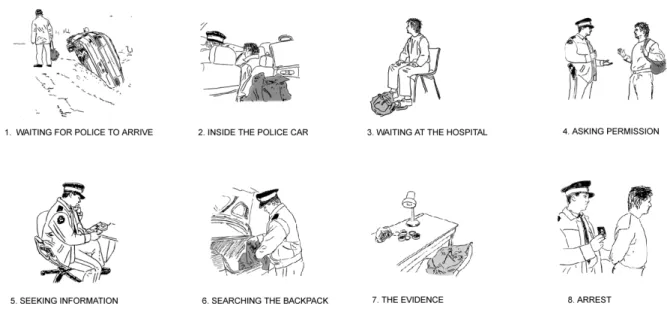
In cases where springboards are required to immerse students in specific environments, the situation is usually presented to students by showing a sequence of 6-8 illustrations. These illustrations should be descriptive enough to tell the story and appealing enough to draw the students in to a discussion about a particular topic. To achieve these results, the project illustrator works closely with researchers to portray the situations they want to use.
The topic of “Privacy” is a good example of such joint work between a researcher and an illustrator. One of the scenarios dealing with the topic of “Legal Aspects of Privacy” involves a discussion on the case of unreasonable search and seizure (Mr. Bagnell’s case). In the learning activity “You Be the Judge” students need to learn all the details of the case and make a legal judgment (The Spirit of Democracy, 2002e). The factual materials of the case are presented as a series of illustrations that lead students through the sequence of events of the actual case (Fig. 2). One of the important conditions of this activity is to create an illusion of the court environment and help students experience the process of rendering a fair judgment. The use of visuals here is much more appropriate than the use of newspaper or magazine articles. Such articles usually contain judgmental opinions that may influence students’ decisions one way or another.
Figure 2: Mr. Bagnell’s case
The researcher needed to spend a considerable amount of time working with the illustrator on the details of each scene, making sure that it properly presents all the facts of the case without any additional visual information that might influence students’ opinion. In this particular case illustrations are much more appropriate than photographs of actors playing roles in recreations of real events.
Another set of illustrations was created for the “Images of Chile” springboard that is used to initiate students’ discussion about “due process” and, in particular, human rights violations as one of the most important aspects of this concept (The Spirit of Democracy, 2002f). Working closely with a researcher, an illustrator portrays the story of a person missing after a confrontation with Chilean police. Students are presented with carefully designed illustrations and asked to discuss what fundamental rights have been violated, how the due process of law
could be properly applied in this situation, and what are the basic differences between a democratic country and dictatorial regime. The visual story is supported by several hyperlinks to the Amnesty International Web site with articles about human rights violations in different countries such as Cuba, Guatemala, Bosnia and to the UN’s Commission on Human Rights Web site.
Visuals to Engage Students
To engage students in discussion of citizenship issues project developers use a technique borrowed from the advertisement industry – creating an emotional appeal to the story that is directed towards the student’s feelings and focuses on emotions such as fear, joy, pride, vanity, and love. By using images of famous paintings in the context of springboards researchers attract students’ attention to controversial issues and create follow up activities that involve students in making decisions and taking sides in passionate discussions.
An example of this type of activity is the “Rokeby Venus” springboard portraying Mary Richardson and her most famous militant act. Mary Richardson took an active role in the Suffragettes movement in the beginning of the 20th century. In protest against the government's treatment of a fellow suffragette leader Mrs. Pankhurst, she slashed with a small axe, the Rokeby Venus painting in the National Gallery in March 1914. The springboard (The Spirit of Democracy, 2002g) contains a photograph of Mary Richardson, authentic documents about the case and a picture of the “Rokeby Venus” painting. The contrast between the beautiful image of Venus on the painting by Velasquez and the violent act of protest against the government by slashing the painting with the meat chopper engages students into the discovery and thinking process about one of the extreme acts of civil disobedience.
One more example of using images of art masterpieces, creatively, to engage students in discussion about democratic issues, like “Freedom of religion”, is an interactive presentation of the famous Russian painting “Boyarynya Morozova” by Surikov (The Spirit of Democracy 2002h). In this painting, the artist depicts Feodosiya Morozova, who was an active supporter of the old-believer movement in the Russian church, and a crowd made up of vivid individuals that watch her being sent into exile for her religious beliefs (Fig. 3). The image map of the painting is hyperlinked to the close-ups of the individual characters portrayed by the painter (Fig. 4). During the class discussion the teacher can, using this interactive image, focus student’s attention on different human faces in this complex masterpiece portraying a whole range of attitudes towards religion. This approach helps to initiate a group discussion about a real historical event and how different people with their own beliefs and values view this event.
Conclusions
The design approach adapted by project for creation of online learning resources is based on principles drawn from Vygotskian thought. The project is using authentic materials to engage students in learning and discovery. A very important role is assigned to visual materials that are used to present real life examples, create specific environments to facilitate the thinking process, and to engage learners in thoughtful discussions.
Today we can already call this project a success – the Russian team have developed and posted on the project Web site about 60 different topics related to citizenship and democracy, and the Canadian team posted about 30 such topics. Researchers and teachers develop these topics collaboratively. Project materials posted on the Web have already been successfully tried by Canadian and Russian teachers in a classroom environment and received positive responses. Today many participating Canadian and Russian schools are, on a daily basis, using the project’s Web-based resources to conduct classes and educate youngsters on democratic values and the spirit of democracy.
Acknowledgements
The authors would like to acknowledge the financial support provided for the project by the Canadian International Development Agency and the University of New Brunswick.
References
ArtsEdNet. (1997). The power of images in education.
http://it.wce.wwu.edu/necc97/poster4/ArtsEdNet/WebWhacker/WW81.html
Brown, J.S., Collings, A., & Duguid, P., 1989, Situated Cognition and the Culture of learning, Educational Researcher, 18 (1): 32-41.
Dean, R.S. & Kulhavy, R.W. (1981). The influence of spatial organization in prose learning. Journal of Educational Psychology,
73: 57-64.
Fleming, M.L. (1987). Displays and Communication. In Robert M Gagne (Ed.) Instructional Technology Foundations, Hillsdale, NJ: Lawrence Erlbaum Associates: 233-260.
Fleming, M.L & Levie, W.H. (1978). Instructional message design: Principles from the behavioural sciences. Englewood Cliffs, NJ: Educational Technology.
Hughes, A., S., Long, N., & Perry, M., 2000, Learning the Spirit of Democracy: The Project’s Background and an Illustration.
Proceedings of the Conference Citizenship 2020: Assuming Responsibility for Our Future, McGill Institute for the Study of Canada, Montreal.
Hung, D., 2001, Design Principles for Web-Based Learning: Implications from Vygotskian Thought, Educational Technology,
May-June 2001: 33-41.
Gagne, R. M. & Rohwer, W.D. (1969). Instructional Psychology. Annual Review of Psychology, 20: 381-418.
Goldfarb, I. & Kondratova, I. (2002). Cross-cultural Internet based resource for teaching democracy, Proceedings of International
Conference on Computers in Education - ICCE 2002, Eds. Kinshuk, R. Lewis, K. Akahori, R. Kemp, T. Okamoto, L. Henderson, and C. H. Lee, IEEE Computer Society: 1174-1178.
Levie, W.H. & Lentz, R. (1982). Effects of text illustrations: A review of Research. Educational Communications and
Technology Journal, 30: 195-232.
Lowe, R. (2001). Supporting effective reading of pictorial materials in visually oriented learning environments. Innovation in
Open & Distance learning. Successful Development of Online and Web-Based learning, Eds. Fred Lockwood& Ann Gooley, Kogan Page Limited: 201-212.
Misanchuk, E.R., Schwier, R.A. & Boling, E. (2000) Visual Design for Instructional Multimedia, CD-ROM hypertextbook, University of Saskatchewan U-Learn Extension Division.
Peeck, J. (1987). The role of illustrations in processing and remembering illustrated texts. In D. M. Willows & H.A. Houghton (Eds.), The psychology of illustration: Volume 1. Basic Research: New York, NY: Springer-Verlag: 114-151.
Seculer, R. and Blake, R. (1990). Perception. Second Edition, New York, McGraw-Hill.
The Spirit of Democracy Project, 2002a, Home Page, http://www.unb.ca/democracy/Project/Project2.html
The Spirit of Democracy Project. (2002b). The Spirit of Democracy Learning Approach,
http://www.unb.ca/democracy/Project/IdeasInDemocracy/SituatedLearning/SituatedLearning1.html
The Spirit of Democracy Project. (2002 c). Self – Immolation,
http://www.unb.ca/democracy/Project/IdeasInDemocracy/TheConsentOf/CivilDisobedience/CivilDisobedience9.html
The Spirit of Democracy Project. (2002d). Emily Davison and the Derby,
http://www.unb.ca/democracy/Project/IdeasInDemocracy/TheConsentOf/CivilDisobedience/CivilDisobedience3.html
The Spirit of Democracy Project. (2002e). You Be the Judge,
http://www.unb.ca/democracy/Project/IdeasInDemocracy/privacy/LegalPrivacy/LegalPrivacy2.html
The Spirit of Democracy Project (2002 f). The Images of Chili,
http://www.unb.ca/democracy/Project/IdeasInDemocracy/dueProcess/ImagesOfChile/ImagesOfChile.html
The Spirit of Democracy Project. (2002g). The Rokeby Venus,
http://www.unb.ca/democracy/Project/IdeasInDemocracy/TheConsentOf/CivilDisobedience/CivilDisobedience4.html
The Spirit of Democracy Project. (2002h). Boyarynya Morozova.
http://www.unb.ca/democracy/Project/IncludeIdeas/RecentExamples/workshopFreedoms/FundamentalFreedoms.htm
Winn, W.D. & Holliday, W.G. (1982). Design principles for diagrams and charts. In D. Jonassen (Ed.), The technology of text, Volume 1. Englewood Cliffs, NJ: Educational Technology Publications: 277-299.