arXiv:0807.0859v1 [hep-ex] 5 Jul 2008
Search for charged Higgs bosons decaying to top and bottom quarks in p¯
p collisions
V.M. Abazov36, B. Abbott75, M. Abolins65, B.S. Acharya29, M. Adams51, T. Adams49, E. Aguilo6, M. Ahsan59, G.D. Alexeev36, G. Alkhazov40, A. Alton64,a, G. Alverson63, G.A. Alves2, M. Anastasoaie35, L.S. Ancu35, T. Andeen53, S. Anderson45, B. Andrieu17, M.S. Anzelc53, M. Aoki50, Y. Arnoud14, M. Arov60,
M. Arthaud18, A. Askew49, B. ˚Asman41, A.C.S. Assis Jesus3, O. Atramentov49, C. Avila8, F. Badaud13, L. Bagby50, B. Baldin50, D.V. Bandurin59, P. Banerjee29, S. Banerjee29, E. Barberis63, A.-F. Barfuss15, P. Bargassa80, P. Baringer58, J. Barreto2, J.F. Bartlett50, U. Bassler18, D. Bauer43, S. Beale6, A. Bean58, M. Begalli3, M. Begel73, C. Belanger-Champagne41, L. Bellantoni50, A. Bellavance50, J.A. Benitez65, S.B. Beri27,
G. Bernardi17, R. Bernhard23, I. Bertram42, M. Besan¸con18, R. Beuselinck43, V.A. Bezzubov39, P.C. Bhat50, V. Bhatnagar27, C. Biscarat20, G. Blazey52, F. Blekman43, S. Blessing49, D. Bloch19, K. Bloom67, A. Boehnlein50,
D. Boline62, T.A. Bolton59, E.E. Boos38, G. Borissov42, T. Bose77, A. Brandt78, R. Brock65, G. Brooijmans70, A. Bross50, D. Brown81, X.B. Bu7, N.J. Buchanan49, D. Buchholz53, M. Buehler81, V. Buescher22, V. Bunichev38, S. Burdin42,b, T.H. Burnett82, C.P. Buszello43, J.M. Butler62, P. Calfayan25, S. Calvet16, J. Cammin71, W. Carvalho3, B.C.K. Casey50, H. Castilla-Valdez33, S. Chakrabarti18, D. Chakraborty52, K. Chan6,
K.M. Chan55, A. Chandra48, F. Charles19,‡, E. Cheu45, F. Chevallier14, D.K. Cho62, S. Choi32, B. Choudhary28, L. Christofek77, T. Christoudias43, S. Cihangir50, D. Claes67, J. Clutter58, M. Cooke80, W.E. Cooper50, M. Corcoran80, F. Couderc18, M.-C. Cousinou15, S. Cr´ep´e-Renaudin14, V. Cuplov59, D. Cutts77, M. ´Cwiok30, H. da Motta2, A. Das45, G. Davies43, K. De78, S.J. de Jong35, E. De La Cruz-Burelo64, C. De Oliveira Martins3,
J.D. Degenhardt64, F. D´eliot18, M. Demarteau50, R. Demina71, D. Denisov50, S.P. Denisov39, S. Desai50, H.T. Diehl50, M. Diesburg50, A. Dominguez67, H. Dong72, L.V. Dudko38, L. Duflot16, S.R. Dugad29, D. Duggan49, A. Duperrin15, J. Dyer65, A. Dyshkant52, M. Eads67, D. Edmunds65, J. Ellison48, V.D. Elvira50,
Y. Enari77, S. Eno61, P. Ermolov38,‡, H. Evans54, A. Evdokimov73, V.N. Evdokimov39, A.V. Ferapontov59, T. Ferbel71, F. Fiedler24, F. Filthaut35, W. Fisher50, H.E. Fisk50, M. Fortner52, H. Fox42, S. Fu50, S. Fuess50,
T. Gadfort70, C.F. Galea35, E. Gallas50, C. Garcia71, A. Garcia-Bellido82, V. Gavrilov37, P. Gay13, W. Geist19, D. Gel´e19, C.E. Gerber51, Y. Gershtein49, D. Gillberg6, G. Ginther71, N. Gollub41, B. G´omez8, A. Goussiou82, P.D. Grannis72, H. Greenlee50, Z.D. Greenwood60, E.M. Gregores4, G. Grenier20, Ph. Gris13,
J.-F. Grivaz16, A. Grohsjean25, S. Gr¨unendahl50, M.W. Gr¨unewald30, F. Guo72, J. Guo72, G. Gutierrez50, P. Gutierrez75, A. Haas70, N.J. Hadley61, P. Haefner25, S. Hagopian49, J. Haley68, I. Hall65, R.E. Hall47, L. Han7, K. Harder44, A. Harel71, J.M. Hauptman57, R. Hauser65, J. Hays43, T. Hebbeker21, D. Hedin52, J.G. Hegeman34, A.P. Heinson48, U. Heintz62, C. Hensel22,d, K. Herner72, G. Hesketh63, M.D. Hildreth55, R. Hirosky81, J.D. Hobbs72, B. Hoeneisen12, H. Hoeth26, M. Hohlfeld22, S. Hossain75, P. Houben34, Y. Hu72, Z. Hubacek10, V. Hynek9, I. Iashvili69, R. Illingworth50, A.S. Ito50, S. Jabeen62, M. Jaffr´e16, S. Jain75, K. Jakobs23,
C. Jarvis61, R. Jesik43, K. Johns45, C. Johnson70, M. Johnson50, A. Jonckheere50, P. Jonsson43, A. Juste50, E. Kajfasz15, J.M. Kalk60, D. Karmanov38, P.A. Kasper50, I. Katsanos70, D. Kau49, V. Kaushik78, R. Kehoe79, S. Kermiche15, S. Kertzscher6, N. Khalatyan50, A. Khanov76, A. Kharchilava69, Y.M. Kharzheev36, D. Khatidze70,
T.J. Kim31, M.H. Kirby53, M. Kirsch21, B. Klima50, J.M. Kohli27, J.-P. Konrath23, A.V. Kozelov39, J. Kraus65, T. Kuhl24, A. Kumar69, A. Kupco11, T. Kurˇca20, V.A. Kuzmin38, J. Kvita9, F. Lacroix13, D. Lam55, S. Lammers70,
G. Landsberg77, P. Lebrun20, W.M. Lee50, A. Leflat38, J. Lellouch17, J. Li78, L. Li48, Q.Z. Li50, S.M. Lietti5, J.G.R. Lima52, D. Lincoln50, J. Linnemann65, V.V. Lipaev39, R. Lipton50, Y. Liu7, Z. Liu6, A. Lobodenko40, M. Lokajicek11, P. Love42, H.J. Lubatti82, R. Luna3, A.L. Lyon50, A.K.A. Maciel2, D. Mackin80, R.J. Madaras46,
P. M¨attig26, C. Magass21, A. Magerkurth64, P.K. Mal82, H.B. Malbouisson3, S. Malik67, V.L. Malyshev36, H.S. Mao50, Y. Maravin59, B. Martin14, R. McCarthy72, A. Melnitchouk66, L. Mendoza8, P.G. Mercadante5,
M. Merkin38, K.W. Merritt50, A. Meyer21, J. Meyer22,d, T. Millet20, J. Mitrevski70, R.K. Mommsen44, N.K. Mondal29, R.W. Moore6, T. Moulik58, G.S. Muanza20, M. Mulhearn70, O. Mundal22, L. Mundim3, E. Nagy15, M. Naimuddin50, M. Narain77, N.A. Naumann35, H.A. Neal64, J.P. Negret8, P. Neustroev40, H. Nilsen23, H. Nogima3, S.F. Novaes5, T. Nunnemann25, V. O’Dell50, D.C. O’Neil6, G. Obrant40, C. Ochando16, D. Onoprienko59, N. Oshima50, N. Osman43, J. Osta55, R. Otec10, G.J. Otero y Garz´on50, M. Owen44, P. Padley80,
M. Pangilinan77, N. Parashar56, S.-J. Park22,d, S.K. Park31, J. Parsons70, R. Partridge77, N. Parua54, A. Patwa73, G. Pawloski80, B. Penning23, M. Perfilov38, K. Peters44, Y. Peters26, P. P´etroff16, M. Petteni43, R. Piegaia1,
J. Piper65, M.-A. Pleier22, P.L.M. Podesta-Lerma33,c, V.M. Podstavkov50, Y. Pogorelov55, M.-E. Pol2, P. Polozov37, B.G. Pope65, A.V. Popov39, C. Potter6, W.L. Prado da Silva3, H.B. Prosper49, S. Protopopescu73, J. Qian64, A. Quadt22,d, B. Quinn66, A. Rakitine42, M.S. Rangel2, K. Ranjan28, P.N. Ratoff42, P. Renkel79, S. Reucroft63,
P. Rich44, J. Rieger54, M. Rijssenbeek72, I. Ripp-Baudot19, F. Rizatdinova76, S. Robinson43, R.F. Rodrigues3, M. Rominsky75, C. Royon18, P. Rubinov50, R. Ruchti55, G. Safronov37, G. Sajot14, A. S´anchez-Hern´andez33,
M.P. Sanders17, B. Sanghi50, G. Savage50, L. Sawyer60, T. Scanlon43, D. Schaile25, R.D. Schamberger72, Y. Scheglov40, H. Schellman53, T. Schliephake26, C. Schwanenberger44, A. Schwartzman68, R. Schwienhorst65,
J. Sekaric49, H. Severini75, E. Shabalina51, M. Shamim59, V. Shary18, A.A. Shchukin39, R.K. Shivpuri28, V. Siccardi19, V. Simak10, V. Sirotenko50, P. Skubic75, P. Slattery71, D. Smirnov55, G.R. Snow67, J. Snow74, S. Snyder73, S. S¨oldner-Rembold44, L. Sonnenschein17, A. Sopczak42, M. Sosebee78, K. Soustruznik9, B. Spurlock78, J. Stark14, J. Steele60, V. Stolin37, D.A. Stoyanova39, J. Strandberg64, S. Strandberg41, M.A. Strang69, E. Strauss72,
M. Strauss75, R. Str¨ohmer25, D. Strom53, L. Stutte50, S. Sumowidagdo49, P. Svoisky55, A. Sznajder3, P. Tamburello45, A. Tanasijczuk1, W. Taylor6, B. Tiller25, F. Tissandier13, M. Titov18, V.V. Tokmenin36, T. Toole61, I. Torchiani23, T. Trefzger24, D. Tsybychev72, B. Tuchming18, C. Tully68, P.M. Tuts70, R. Unalan65, L. Uvarov40, S. Uvarov40, S. Uzunyan52, B. Vachon6, P.J. van den Berg34, R. Van Kooten54, W.M. van Leeuwen34,
N. Varelas51, E.W. Varnes45, I.A. Vasilyev39, M. Vaupel26, P. Verdier20, L.S. Vertogradov36, M. Verzocchi50, F. Villeneuve-Seguier43, P. Vint43, P. Vokac10, E. Von Toerne59, M. Voutilainen68,e, R. Wagner68, H.D. Wahl49, L. Wang61, M.H.L.S. Wang50, J. Warchol55, G. Watts82, M. Wayne55, G. Weber24, M. Weber50,
L. Welty-Rieger54, A. Wenger23,f, N. Wermes22, M. Wetstein61, A. White78, D. Wicke26, G.W. Wilson58, S.J. Wimpenny48, M. Wobisch60, D.R. Wood63, T.R. Wyatt44, Y. Xie77, S. Yacoob53, R. Yamada50, T. Yasuda50,
Y.A. Yatsunenko36, H. Yin7, K. Yip73, H.D. Yoo77, S.W. Youn53, J. Yu78, C. Zeitnitz26, T. Zhao82, B. Zhou64, J. Zhu72, M. Zielinski71, D. Zieminska54, A. Zieminski54,‡, L. Zivkovic70, V. Zutshi52, and E.G. Zverev38
(The DØ Collaboration)
1
Universidad de Buenos Aires, Buenos Aires, Argentina
2
LAFEX, Centro Brasileiro de Pesquisas F´ısicas, Rio de Janeiro, Brazil
3Universidade do Estado do Rio de Janeiro, Rio de Janeiro, Brazil 4
Universidade Federal do ABC, Santo Andr´e, Brazil
5
Instituto de F´ısica Te´orica, Universidade Estadual Paulista, S˜ao Paulo, Brazil
6University of Alberta, Edmonton, Alberta, Canada,
Simon Fraser University, Burnaby, British Columbia, Canada, York University, Toronto, Ontario, Canada, and McGill University, Montreal, Quebec, Canada
7University of Science and Technology of China, Hefei, People’s Republic of China 8
Universidad de los Andes, Bogot´a, Colombia
9
Center for Particle Physics, Charles University, Prague, Czech Republic
10
Czech Technical University, Prague, Czech Republic
11
Center for Particle Physics, Institute of Physics,
Academy of Sciences of the Czech Republic, Prague, Czech Republic
12Universidad San Francisco de Quito, Quito, Ecuador 13
LPC, Univ Blaise Pascal, CNRS/IN2P3, Clermont, France
14
LPSC, Universit´e Joseph Fourier Grenoble 1, CNRS/IN2P3, Institut National Polytechnique de Grenoble, France
15
CPPM, Aix-Marseille Universit´e, CNRS/IN2P3, Marseille, France
16
LAL, Univ Paris-Sud, IN2P3/CNRS, Orsay, France
17LPNHE, IN2P3/CNRS, Universit´es Paris VI and VII, Paris, France 18
DAPNIA/Service de Physique des Particules, CEA, Saclay, France
19
IPHC, Universit´e Louis Pasteur et Universit´e de Haute Alsace, CNRS/IN2P3, Strasbourg, France
20
IPNL, Universit´e Lyon 1, CNRS/IN2P3, Villeurbanne, France and Universit´e de Lyon, Lyon, France
21
III. Physikalisches Institut A, RWTH Aachen University, Aachen, Germany
22
Physikalisches Institut, Universit¨at Bonn, Bonn, Germany
23
Physikalisches Institut, Universit¨at Freiburg, Freiburg, Germany
24Institut f¨ur Physik, Universit¨at Mainz, Mainz, Germany 25
Ludwig-Maximilians-Universit¨at M¨unchen, M¨unchen, Germany
26
Fachbereich Physik, University of Wuppertal, Wuppertal, Germany
27Panjab University, Chandigarh, India 28
Delhi University, Delhi, India
29
30
University College Dublin, Dublin, Ireland
31
Korea Detector Laboratory, Korea University, Seoul, Korea
32SungKyunKwan University, Suwon, Korea 33
CINVESTAV, Mexico City, Mexico
34
FOM-Institute NIKHEF and University of Amsterdam/NIKHEF, Amsterdam, The Netherlands
35Radboud University Nijmegen/NIKHEF, Nijmegen, The Netherlands 36
Joint Institute for Nuclear Research, Dubna, Russia
37
Institute for Theoretical and Experimental Physics, Moscow, Russia
38Moscow State University, Moscow, Russia 39Institute for High Energy Physics, Protvino, Russia 40
Petersburg Nuclear Physics Institute, St. Petersburg, Russia
41
Lund University, Lund, Sweden, Royal Institute of Technology and Stockholm University, Stockholm, Sweden, and Uppsala University, Uppsala, Sweden
42
Lancaster University, Lancaster, United Kingdom
43
Imperial College, London, United Kingdom
44University of Manchester, Manchester, United Kingdom 45
University of Arizona, Tucson, Arizona 85721, USA
46
Lawrence Berkeley National Laboratory and University of California, Berkeley, California 94720, USA
47California State University, Fresno, California 93740, USA 48
University of California, Riverside, California 92521, USA
49
Florida State University, Tallahassee, Florida 32306, USA
50
Fermi National Accelerator Laboratory, Batavia, Illinois 60510, USA
51
University of Illinois at Chicago, Chicago, Illinois 60607, USA
52
Northern Illinois University, DeKalb, Illinois 60115, USA
53
Northwestern University, Evanston, Illinois 60208, USA
54Indiana University, Bloomington, Indiana 47405, USA 55
University of Notre Dame, Notre Dame, Indiana 46556, USA
56
Purdue University Calumet, Hammond, Indiana 46323, USA
57Iowa State University, Ames, Iowa 50011, USA 58
University of Kansas, Lawrence, Kansas 66045, USA
59
Kansas State University, Manhattan, Kansas 66506, USA
60Louisiana Tech University, Ruston, Louisiana 71272, USA 61
University of Maryland, College Park, Maryland 20742, USA
62
Boston University, Boston, Massachusetts 02215, USA
63Northeastern University, Boston, Massachusetts 02115, USA 64
University of Michigan, Ann Arbor, Michigan 48109, USA
65
Michigan State University, East Lansing, Michigan 48824, USA
66University of Mississippi, University, Mississippi 38677, USA 67University of Nebraska, Lincoln, Nebraska 68588, USA 68
Princeton University, Princeton, New Jersey 08544, USA
69
State University of New York, Buffalo, New York 14260, USA
70Columbia University, New York, New York 10027, USA 71
University of Rochester, Rochester, New York 14627, USA
72
State University of New York, Stony Brook, New York 11794, USA
73Brookhaven National Laboratory, Upton, New York 11973, USA 74
Langston University, Langston, Oklahoma 73050, USA
75
University of Oklahoma, Norman, Oklahoma 73019, USA
76Oklahoma State University, Stillwater, Oklahoma 74078, USA 77Brown University, Providence, Rhode Island 02912, USA
78
University of Texas, Arlington, Texas 76019, USA
79
Southern Methodist University, Dallas, Texas 75275, USA
80Rice University, Houston, Texas 77005, USA 81
University of Virginia, Charlottesville, Virginia 22901, USA and
82
University of Washington, Seattle, Washington 98195, USA (Dated: July 5, 2008)
We describe a search for production of a charged Higgs boson, q ¯q′
→ H+, reconstructed in the t¯b final state in the mass range 180 ≤ MH+≤ 300 GeV. The search was undertaken at the Fermilab
Tevatron collider with a center-of-mass energy√s = 1.96 TeV and uses 0.9 fb−1 of data collected
with the D0 detector. We find no evidence for charged Higgs boson production and set upper limits on the production cross section in the Types I, II and III two-Higgs-doublet models (2HDMs). An excluded region in the (MH+,tan β) plane for Type I 2HDM is presented.
In the standard model (SM), one SU (2) doublet in-duces electroweak symmetry breaking, which leads to a single elementary scalar particle: the neutral Higgs boson. Two SU (2) doublets perform the task of elec-troweak symmetry breaking in two-Higgs-doublet models (2HDMs) [1]. This leads to five physical Higgs bosons among which two carry charge. Hence the discovery of a charged Higgs boson would be unambiguous evi-dence of new physics beyond the SM. Various types of 2HDMs are distinguished by their strategy for avoiding flavor-changing neutral currents (FCNCs). In the Type I 2HDM, only one of these doublets couples to fermions. In the Type II 2HDM, a symmetry is imposed so that one doublet couples to up-type fermions and the other cou-ples to down-type fermions; an approach used in minimal supersymmetry extensions [1]. In Type III 2HDMs, both doublets couple to fermions, no symmetry is imposed and FCNCs are avoided by other methods. For example, in one Type III model, FCNCs are suppressed by the small mass of the first and second generation quarks [2].
In this Letter we present the first search for a charged Higgs boson (H+) directly produced by quark-antiquark annihilation, and decaying into the t¯b [3] final state, in the 180 ≤ MH+ ≤ 300 GeV mass range. In most models this decay dominates for large regions of param-eter space when the H+ mass (M
H+) is greater than the mass of the top quark (mt). Exploring the mass range MH+ > mt is complementary to previous Teva-tron searches [4] that have been performed in top quark decays for the MH+ < mt region. We analyze 0.9 fb−1 of data from p¯p collisions at a center-of-mass energy of √
s = 1.96 TeV recorded from August 2002 to Decem-ber 2006 using the D0 detector [5]. Since the D0 single top quark analysis [6] reconstructs precisely the same fi-nal state in the s-channel W+→ t¯b process, we use the dataset from that search.
Direct searches for a charged Higgs boson have been performed at the CERN e+e− collider (LEP) [7] and the Fermilab Tevatron collider [4], while indirect searches have been undertaken at the B factories [8, 9]. No ev-idence for H+ has been found so far. Limits on the charged Higgs mass and the ratio of vacuum expecta-tion values of the two Higgs fields (tan β) are typically calculated in the context of the Type II 2HDM [10]. The combined results from the LEP experiments and those from B factories yield MH+ > 78.6 GeV [10] and MH+ > 295 GeV [8], respectively, at the 95% C.L. and assuming Type II 2HDM.
The charged Higgs Yukawa couplings carry informa-tion about new physics beyond the SM and it has been noted that 2HDM couplings in Types I and II 2HDM can be quite large [11]. For a Type III 2HDM, large contri-butions from heavy quark-antiquark annihilation can be expected if the top-quark/charm-quark mixing parame-ter (ξU
tc) is large [2]. In many models, if MH+ > mt, then the branching fraction of the charged Higgs boson to t¯b
is of order unity, owing to the mass dependence of the couplings and the large top quark mass.
We use the program comphep [12] to simulate charged Higgs boson production and selected decay q ¯q′→ H+→ t¯b → W+b¯b → ℓ+νb¯b where ℓ represents an electron or muon. This is done for seven MH+ values ranging from 180 to 300 GeV. The lower mass value is dictated by the kinematics of the decay H+ → t¯b which requires MH+ > mt+ mb, where mb is the mass of the bottom quark. The upper mass value is chosen based on the fact that, in this mass range, the production cross sec-tion decreases by approximately an order of magnitude for any of the models considered. The couplings are set to produce pure chiral state samples that are combined in different proportions to simulate the desired 2HDM type. The size of the interference term proportional to the product of the left and right-handed couplings is con-sidered negligible. The size of this interference term is of order 1% of the total amplitude in the tan β < 30 region for the Type II 2HDM, much less than 1% for the Type I 2HDM and non-relevant for a Type III 2HDM. Each choice of couplings determines the total width, ΓH+, and the initial-state quark flavor composition. This quark fla-vor composition of the signal samples is determined by the value of the element |Vij| of the Cabibbo-Kobayashi-Maskawa (CKM) matrix [13] and the CTEQ6L1 parton distribution functions (PDFs) [16]. In these simulated signal samples, ΓH+ ranges from approximately 4 GeV for MH+ = 180 GeV to 9 GeV for MH+= 300 GeV.
In order to simulate the kinematic distributions of a particular model, the left-handed and right-handed signal samples are combined with event weights equal to the fraction of the production cross section associated with the left-handed or right-handed coupling contribution. The Type II 2HDM couplings for right-handed (R) and left-handed (L) chiral states are VCKMqq′ gmq′tan β/(
√ 2MW) and VCKMqq′ gmqcot β/( √ 2MW), where Vqq ′ CKM is the CKM matrix element, mq/mq′ the up/down-type quark mass, MW the mass of the W boson and g the SM weak coupling constant. The R(L) couplings in Type I and III 2HDMs are Vqq′gmq′tan β/(
√ 2MW) (−Vqq′gmqtan β/(
√
2MW)) and −(VCKMYˆD)qq′ (( ˆYU†VCKM)qq′), where ˆYijU,D=ξp2mimj/v, v is the vaccum expectation value and ξ is taken as a free parameter of the model. For the simulation of Type I 2HDM, left-handed and right-handed samples are added in equal proportion. For the simulation of Type II 2HDM, signal samples are combined to simulate four tan β values or ranges: tan β < 0.1, tan β = 1, tan β = 5, and tan β > 10. The Type I 2HDM and tan β = 1 Type II models share the same left/right-handed proportions. For the Type III 2HDM as described in [2], quark-antiquark annihilation is dominated by right-handed couplings. This model is simulated using
the same proportions of left-handed and right-handed samples as used to simulate the tan β > 10 Type II model. This approach provides an adequate simulation of signal event kinematics only for model parameter values that result in a charged Higgs width comparable or smaller than the experimental mass resolution of O(10) GeV.
Background contributions from W +jets and top quark pair (t¯t) production are modeled using the alpgen Monte Carlo (MC) event generator [14]. The single top quark samples are generated with the SingleTop [15] MC event generator. For both samples, we assume a top quark mass of 175 GeV and use the CTEQ6L1 PDFs. Af-ter generation, the events are passed through a geant-based simulation [17] of the D0 detector and subsequently through standard reconstruction procedures that correct differences between the simulation and data.
The background contribution from misreconstructed multijet events is modeled using data events containing misidentified leptons and is normalized to the signal data together with the W +jets sample, which contains leptons from the W boson decay [6].
We search for charged Higgs bosons in the H+ → t¯b → ℓ+νb¯b final state, and hence require that events satisfy triggers with a jet and an electron or muon. Se-lections that are identical to the two-jet analysis chan-nel for the D0 single top quark analysis [6] are imposed on each observable in the data, background and charged Higgs boson signal samples to select events with t¯b final state signatures. Events are required to have a primary vertex with three or more tracks attached and a lepton originating from the primary vertex [6]. The electron (muon) channel selection requires only one isolated elec-tron (muon) with ET > 15 (pT > 18) GeV within the pseudorapidity region |η| < 1.1 (2.0). Events with two isolated leptons are rejected. For both channels, events are required to have missing transverse energy within 15 < 6ET < 200 GeV. We require that events have exactly two jets, with the highest pT jet satisfying pT > 25 GeV and |η| < 2.5, and the second jet satisfying pT > 20 GeV and |η| < 3.4.
Since both jets of the signal events are b jets, we se-lect data events having one or two jets identified as such via a neural network-based tagging algorithm [18]. MC simulated events are weighted using a b-tag probability derived from data. The signal acceptances after the com-plete selection increase monotonically in the mass range 200 < MH+ < 300 GeV, for example, from (0.48±0.06)% to (1.24 ± 0.20)% for tan β < 0.1, statistical and system-atic uncertainties included. The signal acceptances for a given MH+ decreases by at most 0.12% with increasing tan β.
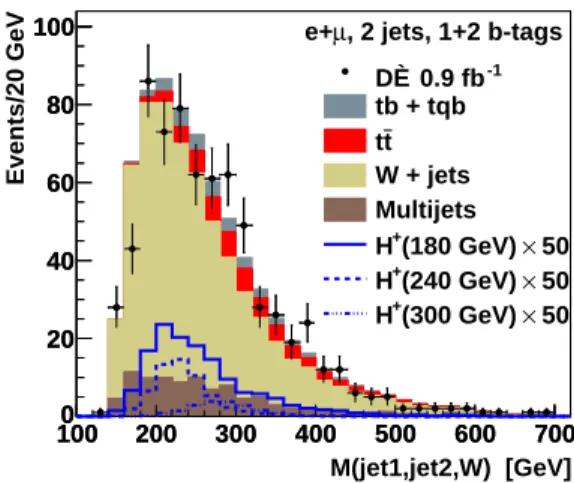
A distinctive feature of signal events is the large mass of the charged Higgs boson. We therefore use the re-constructed invariant mass of the top and bottom quark system as the discriminating variable for the charged
M(jet1,jet2,W) [GeV] 100 200 300 400 500 600 700 Events/20 GeV 0 20 40 60 80 100 1000 200 300 400 500 600 700 20 40 60 80 100 -1 DØ 0.9 fb tb + tqb t t W + jets Multijets 50 × (180 GeV) + H 50 × (240 GeV) + H 50 × (300 GeV) + H , 2 jets, 1+2 b-tags µ e+
FIG. 1: Distribution of the discriminating variable, M(jet1, jet2, W ), for the signal, background model and data, for the combined electron and muon channels with exactly two jets and with one or two b tags. The signal distributions cor-respond to a Type III 2HDM for charged Higgs boson masses 180, 240, 300 GeV, and are normalized according to the pro-duction cross section presented in Ref. [2] scaled by a factor of 50.
Higgs signal. We define this variable as the invariant mass M (jet1, jet2, W ). In the reconstruction of the W boson, there are up to two possible solutions for the neu-trino momentum component along the beam axis (pz). In these cases, the solution with the smallest absolute value of the pz momentum is chosen. Figure 1 shows the M (jet1, jet2, W ) distribution after selection, with an ex-ample signal normalized to the production cross section for a Type III 2HDM [2] and for three different mass values.
The data yield for all analysis channels combined amounts to 697 events, after the complete selection. Sim-ilarly, for the sum of all background sources, the total expected yield is 721±42. For the separate background sources, the yields are 531 for W +jets, 95 for multijets, 59 for t¯t and 36 for the single top background.
The systematic uncertainties on the signal and back-ground model are estimated using the methods described in Ref. [6]. Two of the dominant sources of systematic uncertainty arise from the jet energy scale (JES) correc-tion uncertainty and the uncertainty on the b-tag rates applied to MC events (described above). For the H+ sig-nal, the uncertainty on the model-dependent proportion of initial-state parton flavor contribution plays a domi-nant role. Simulated signal events with different exclu-sive initial-state quark combinations are used to assess the latter source of uncertainty. A value of 10% is as-signed based on variations in yield and shape of the re-constructed invariant mass distribution.
We observe no excess of data over background and pro-ceed to set upper limits on H+ boson production. We construct a binned likelihood function and use Bayesian statistics to calculate upper limits on the signal
produc-TABLE I: Observed limits on the production cross section (in pb) times branching fraction σ(q ¯q′
→ H+) × B(H+
→ t¯b). The expected limits are shown in parenthesis for comparison. These limits apply to the Type II 2HDM. The limits obtained for tan β = 1 and tan β > 10 are also valid for Type I and Type III 2HDMs, respectively. Limits shown in square brack-ets are only valid for the general production of a charged scalar via a purely left-handed coupling with width smaller than the experimental resolution. These limits are not valid for the production of a charged Higgs boson in Type II 2HDM since the charged Higgs width is expected to be larger than the experimental resolution.
MH+ (GeV) tanβ < 0.1 tanβ = 1 tanβ = 5 tanβ > 10
180 12.9 (11.4) 14.3 (12.2) 13.7 (11.7) 13.7 (12.2) 200 [ 5.9 (9.6) ] 6.3 (9.9) 6.5 (10.0) 6.5 (10.0) 220 [ 2.9 (4.2) ] 3.0 (4.4) 3.0 (4.5) 3.0 (4.5) 240 [ 2.3 (3.1) ] 2.4 (3.3) 2.6 (3.5) 2.6 (3.5) 260 [ 3.0 (2.8) ] 3.0 (2.9) 3.0 (3.0) 3.0 (3.0) 280 [ 4.0 (2.6) ] 4.2 (2.7) 4.5 (2.9) 4.5 (2.9) 300 [ 4.5 (2.4) ] 4.7 (2.4) 4.9 (2.5) 4.9 (2.5)
tion cross section times the branching fraction (σ × B) to the t¯b final state. A flat positive prior is used for the sig-nal cross section. All sources of systematic uncertainty and their correlations are taken into account in calculat-ing σ × B upper limits for different 2HDM types at the 95% C.L. At the level of precision reported, the observed limits are insensitive to changes in top mass in the range 170 < mt< 175 GeV. The observed and expected σ × B limits are reported in Table I.
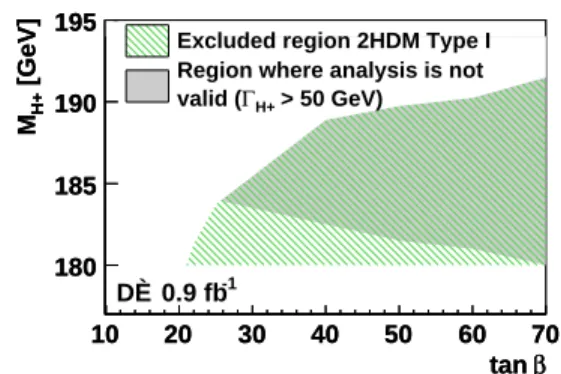
The σ × B upper limits obtained are compared to the expected signal cross section in the Type I 2HDM to exclude a region of the MH+ and tan β parameter space, shown in Fig. 2. The analysis sensitivity is currently not sufficient to exclude regions of tan β < 100 in the Type II 2HDM. In a Type III 2HDM [2], the charged Higgs boson width depends quadratically on the mixing parameter ξ. This limits our ability to exclude regions in the MH+ and ξ parameter space.
In summary, we have performed the first direct search for the production of charged Higgs bosons in the re-action q ¯q′ → H+ → t¯b and we have presented limits on the production cross section times branching frac-tion for Types I, II and III 2HDMs in the mass range 180 ≤ MH+ ≤ 300 GeV. A region in the MH+ vs tan β plane has been excluded at the 95% C.L. for Type I 2HDMs.
We thank the staffs at Fermilab and collaborating institutions, and acknowledge support from the DOE and NSF (USA); CEA and CNRS/IN2P3 (France); FASI, Rosatom and RFBR (Russia); CNPq, FAPERJ, FAPESP and FUNDUNESP (Brazil); DAE and DST (India); Colciencias (Colombia); CONACyT (Mexico); KRF and KOSEF (Korea); CONICET and UBACyT (Argentina); FOM (The Netherlands); STFC (United Kingdom); MSMT and GACR (Czech Republic); CRC
β tan 10 20 30 40 50 60 70 [GeV] H+ M 180 185 190 195
Excluded region 2HDM Type I > 50 GeV)
H+
Γ
valid (
Region where analysis is not
-1 DØ 0.9 fb β tan 10 20 30 40 50 60 70 [GeV] H+ M 180 185 190 195
FIG. 2: The 95% C.L. excluded region in the MH+ vs tan β
space for Type I 2HDM. The region for which ΓH+>50 GeV
indicates the approximate area where the charged Higgs width is significantly larger than the detector resolution and hence the analysis is not valid.
Program, CFI, NSERC and WestGrid Project (Canada); BMBF and DFG (Germany); SFI (Ireland); The Swedish Research Council (Sweden); CAS and CNSF (China); and the Alexander von Humboldt Foundation (Ger-many).
[a] Visitor from Augustana College, Sioux Falls, SD, USA. [b] Visitor from The University of Liverpool, Liverpool, UK. [c] Visitor from ICN-UNAM, Mexico City, Mexico.
[d] Visitor from II. Physikalisches Institut, Georg-August-University, G¨ottingen, Germany.
[e] Visitor from Helsinki Institute of Physics, Helsinki, Fin-land.
[f] Visitor from Universit¨at Z¨urich, Z¨urich, Switzerland. [‡] Deceased.
[1] J. Gunion et al., The Higgs Hunter’s Guide, Frontiers in Physics (Addison-Wesley, Redwood City, CA, 1990). [2] H.-J. He and C.-P. Yuan, Phys. Rev. Lett. 83, 28 (1999). [3] We use the H+
notation to refer to both H+
and its charge conjugate state H−. Similarly, the t¯b notation is
used here to represent both the t¯b state and its charge conjugate state ¯tb.
[4] B. Abbott et al. (D0 Collaboration), Phys. Rev. Lett. 82, 4975 (1999); V.M. Abazov et al. (D0 Collaboration), Phys. Rev. Lett. 88, 151803 (2002); A. Abulencia et al. (CDF Collaboration), Phys. Rev. Lett. 96, 042003 (2006).
[5] V.M. Abazov et al. (D0 Collaboration), Nucl. Instrum. Methods A 565, 463 (2006).
[6] V.M. Abazov et al. (D0 Collaboration), Phys. Rev. Lett. 98, 181802 (2007); V.M. Abazov et al. (D0 Collabora-tion), accepted by Phys. Rev. D, arXiv:0803.0739 [hep-ex].
[7] G. Abbiendi et al. (OPAL Collaboration), Eur. Phys. J. C 7, 407 (1999); R. Barate et al. (ALEPH Collabo-ration), Phys. Lett. B 543, 1 (2002); J. Abdallah et al. (DELPHI Collaboration), Phys. Lett. B 525, 17 (2002); P. Achard et al. (L3 Collaboration), Phys. Lett. B 575,
208 (2003).
[8] M. Misiak et al., Phys. Rev. Lett. 98, 022002 (2007). [9] A.G. Akeroyd and S. Recksiegel, J. Phys. G 29, 2311
(2003).
[10] W.-M. Yao et al., J. Phys. G 33, 1 (2006). [11] D.P. Roy, Mod. Phys. Lett. A 19, 1813 (2004).
[12] E. Boos et al., (comphep Collaboration), Nucl. Instrum. Methods A 534, 250 (2004).
[13] N. Cabibbo, Phys. Rev. Lett. 10, 531 (1963); M. Kobayashi and K. Maskawa, Prog. Theor. Phys. 49,
652 (1973).
[14] M.L. Mangano et al., J. High Energy Phys. 0307, 001 (2003). We used alpgen version 2.05.
[15] E. Boos et al., Phys. Atom. Nucl. 69, 1317 (2006). [16] J. Pumplin et al., J. High Energy Phys. 0207, 012 (2002). [17] R. Brun and F. Carminati, CERN Program Library Long
Writeup W5013, 1993.