SHORT REPORT
Too much of too little: xylitol, an unusual trigger of a chronic
metabolic hyperchloremic acidosis
David Wille&Mathias Hauri-Hohl&Priska Vonbach&
Maren Tomaske&Beth Padden&Vera Bernet
Received: 7 May 2010 / Revised: 18 June 2010 / Accepted: 22 June 2010 / Published online: 13 July 2010 # Springer-Verlag 2010
Abstract Homeopathic globules are frequently used in children as a first-line treatment. Most of these globules are coated with sugar substitutes like xylitol; these substitutes are known for their laxative effect. Our patient shows that consumption of globules coated with xylitol does not have only laxative effects. It may cause indeed considerable weight loss and life-threatening enteral bicarbonate loss by diarrhea when overdosed in an infant.
Keywords Children . Metabolic acidosis . Xylitol . Enteral bicarbonate loss
Introduction
Natural health products enjoy a high acceptance by a wide public and are considered to be safe, equally effective and associated with less adverse effects compared to conven-tional medicine [2] despite the enormous lack of randomized, placebo-controlled studies.
Homeopathic globules are small beads that contain ethanol-based liquids as an active agent in a homeopathic dose and include xylitol instilled with the ‘active principle’. These globules are also commercialized outside Switzerland. Xylitol is a natural constituent of fruit; it is produced as part of the human metabolic process, is widely used as a sweetener and bulking agent and is not considered cariogenic [1, 3, 5]. Its beneficial effect on modulating bacterial colonization of the oral cavity and for otitis media prophylaxis has prompted studies to investigate the gastrointestinal tolerance of large doses of chronically ingested xylitol. These studies demonstrate an acceptable tolerance even in 6-month-old infants [5].
In this report, we describe an infant with a severe metabolic acidosis and failure to thrive due to chronic diarrhea caused by excessive consumption of xylitol-containing homeopathic globules.
Case report
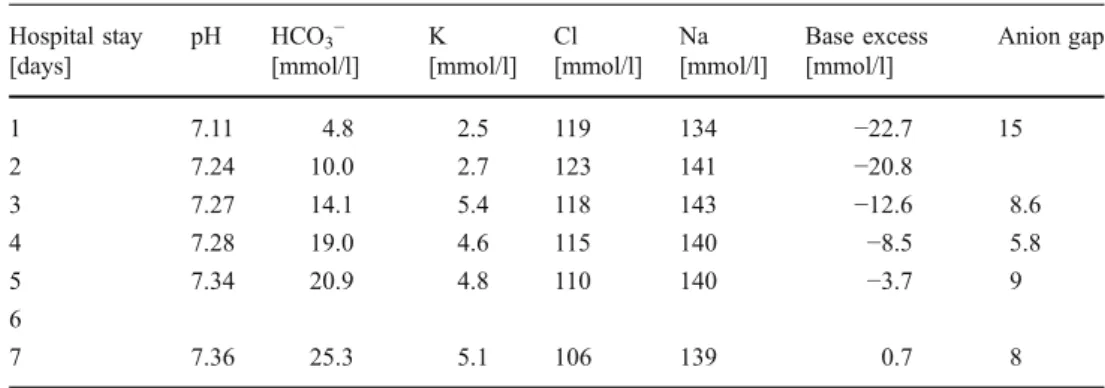
A 9-week-old female was referred to a level-three intensive care unit for evaluation and management of severe metabolic hyperchloremic acidosis with bicarbonate deple-tion and hypokalemia. On admission, the infant was pale though peripherally warm, uneasy, showing only mild signs of clinical dehydration but demonstrating an accelerated and forced breathing pattern. The abdomen was tender and tympanic with elevated intestinal sounds. Initial blood pH was 7.11, CO22.0 kPa, base excess−22.7 and bicarbonate
4.8 mmol/l with a normal serum anion gap (Table 1). Glucose and ammonia levels were in normal range and lactate was slightly elevated.
Screening of the urine did not suggest any substance abuse; the analysis of the urine did not show any evidence
David Wille and Mathias Hauri-Hohl share first authorship. D. Wille
:
M. Hauri-Hohl:
B. Padden:
V. Bernet (*) Department of Intensive Care and Neonatology, University Children’s Hospital,Steinwiesstr. 75,
CH-8032 Zurich, Switzerland e-mail: [email protected] P. Vonbach
Department of Hospital Pharmacy, University Children’s Hospital, Zurich, Switzerland
M. Tomaske
Department of Pediatrics, Triemli Hospital Zurich, Zurich, Switzerland
Eur J Pediatr (2010) 169:1549–1551 DOI 10.1007/s00431-010-1249-9
of a specific metabolic disorder (amino acids and organic acids in the urine were tested with normal findings). The screening for metabolic disorders (hypothyroidism, phenyl-ketonuria, adrenogenital syndrome, galactosemia, medium-chain-acyl-CoA-dehydrogenase deficiency and biotinidase deficiency) performed on the fourth day of life was inconspicuous. Additionally, renal function (creatinine and urea) was normal; we had no clinical and laboratory findings suggesting renal tubular acidosis. Renal ultrasound was not performed.
An extensive patient history revealed, except for intermittent maternal ethanol abuse in the first trimester, an uneventful pregnancy and the baby was born at term with inconspicuous body measures as the first desired child to an unmarried couple. Due to insufficient breastfeeding, she was started on formula milk, which according to the mother was badly tolerated with colicky pain. This led to a frequent switch of brands of formula. Frequent (up to 12 times a day) watery diarrhea started in the fourth week of life, worsening dramatically 3 weeks prior to admission. A weight loss of 6% was observed within 2 weeks prior to admission. The mother did not recall fever or other symptoms suggesting an infectious cause of the diarrhea. From the third week of life onwards, the baby was reportedly restless, apparently suffering from colicky pain and drinking small portions (50–60 ml) greedily every 1– 2 h, even at night. The mother sought out medical advice on several occasions consulting her pediatrician, child welfare clinic and midwife. The pediatrician screened stool samples for bacterial agents twice; both showed normal results. The family history concerning gastrointestinal disorders was uneventful.
On the second day after admission, the mother was interviewed again regarding the child’s medication history. Prior to the onset of diarrhea, she had initiated a therapy for the baby’s apparent colic and sleeping disorders using two sorts of over-the-counter homeopathic globules. As symptoms failed to improve, she increased the dosage to approximately 80 globules—roughly 100 mg xylitol per kilogram body weight—per day in particular in the late evening hours. At the
drugstore, the mother was instructed to give globules before every feeding; she did not mention the high-frequency feedings (nearly every 2 h). Because the medication was of homeopathic origin, the mother thought this information might be insignificant for the medical team.
During the hospital stay, the child improved gradually after an initial period of parenteral nutrition and omission of any other medication, took up a regular feeding and defecation pattern on formula milk and showed a—although delayed—normalization of the metabolic disturbance. A follow-up at 3 months later showed the child in good condition.
Discussion
We describe a case of an infant with a severe metabolic disturbance and failure to thrive due to chronic diarrhea caused by excessive consumption of xylitol-containing homeopathic globules.
There were no clinical and laboratory findings suggesting a metabolic disorder or proximal renal tubular acidosis. From our point of view, the metabolic acidosis in our infant was due to the enteral bicarbonate loss caused by xylitol-containing homeopathic globules.
Natural health products like homeopathic globules are promoted to be equally or more effective and less toxic than conventional drugs and are increasingly used by many parents for their infants during the last decades [2, 7]. In a study from Zuzak in 2010, 2,143 cases of accidental intake of homeopathic remedies in children in Switzerland were reported, no severe signs or symptoms after intake were described and nine children had minor symptoms only [7]. In contrast, in a study from 2002 to 2007, 233 reports of suspected adverse reactions to natural health products in Italy were collected [2]; 17% of the collected data involved children in the range of 0–14 years. Hospitalization was reported in 35% and 6% were reported to have life-threatening events. Gastrointestinal symptoms like abdominal pain, nausea, vomiting and
Hospital stay [days] pH HCO3− [mmol/l] K [mmol/l] Cl [mmol/l] Na [mmol/l] Base excess [mmol/l] Anion gap 1 7.11 4.8 2.5 119 134 −22.7 15 2 7.24 10.0 2.7 123 141 −20.8 3 7.27 14.1 5.4 118 143 −12.6 8.6 4 7.28 19.0 4.6 115 140 −8.5 5.8 5 7.34 20.9 4.8 110 140 −3.7 9 6 7 7.36 25.3 5.1 106 139 0.7 8
Table 1 Metabolic progress during hospital stay
dyspepsia were found in about 50% [2]. The main contributing factor for the side effect of globules is the use of sugar alcohols like xylitol with a dose-dependent osmotic laxative effect. In adults, xylitol is well tolerated in doses up to 100 g per day [5]. Wang describes the induction of osmotic diarrhea after an intake of more than 20 g xylitol [6]. In a study by Salminen, three of five subjects suffered diarrhea after an intake of 30 g xylitol [3]. Tsuneyuki described the induction of osmotic diarrhea after a minimum dose of xylitol of 380 mg per kilogram of body weight for male adults [4]. Ly pointed out that young children are not accustomed to the consumption of several grams of xylitol per day [1]. In one study with 13 healthy children (ages 7–16 years), four had diarrhea at a daily dose of 65 g xylitol [6].
From the author’s perspective, there is no published data showing a case of severe metabolic acidosis after an overdose of xylitol consumption in a child.
Our patient shows that xylitol ingestion does not only have laxative effects but may cause considerable weight loss and life-threatening enteral bicarbonate loss when overdosed in infants. Pediatricians should be aware of this potential risk and inform parents, particularly when homeopathic globules are given to very young infants.
Conflicts of interest There is no conflict of interest for any of the authors involved in the paper. The authors have no financial relationship with any organizations.
References
1. Ly KA, Milgrom P, Rothen M (2008) The potential of dental-protective chewing gum in oral health interventions. J Am Dent Assoc 139:553–563
2. Menniti-Ippolito F, Mazzanti G, Santuccio C et al (2008) Surveillance of suspected adverse reactions to natural health products in Italy. Pharmacoepidemiol Drug Saf 17:626–635 3. Salminen E, Salminen S, Porkka L et al (1989) Xylitol vs.
glucose: effect on the rate of gastric emptying and motilin, insulin, and gastric inhibitory polypeptide release. Am J Clin Nutr 49:1228–1232
4. Tsuneyuki OT, Nakamura S (2007) Threshold for transitory diarrhea induced by ingestion of xylitol und lactitol in young male and female adults. J Nutr Sci Vitaminol 53:13–20
5. Vernacchio L, Vezina RM, Mitchell AA (2007) Tolerability of oral xylitol solution in young children: implications for otitis media prophylaxis. Int J Pediatr Otorhinolaryngol 71:89–94
6. Wang Y-M, van Eys J (1981) Nutritional significance of fructose and sugar alcohols. Annu Rev Nutr 1:437–447
7. Zuzak T, Rauber-Lüthy C, Simoes-Wüst A (2010) Accidental intakes of remedies from complementary and alternative medicine in children—analysis of data from the Swiss Toxicological Information Centre. Eur J Pediatr 169:681–688