Publisher’s version / Version de l'éditeur:
Vous avez des questions? Nous pouvons vous aider. Pour communiquer directement avec un auteur, consultez la première page de la revue dans laquelle son article a été publié afin de trouver ses coordonnées. Si vous n’arrivez pas à les repérer, communiquez avec nous à [email protected].
Questions? Contact the NRC Publications Archive team at
[email protected]. If you wish to email the authors directly, please see the first page of the publication for their contact information.
https://publications-cnrc.canada.ca/fra/droits
L’accès à ce site Web et l’utilisation de son contenu sont assujettis aux conditions présentées dans le site
LISEZ CES CONDITIONS ATTENTIVEMENT AVANT D’UTILISER CE SITE WEB.
Canadian Building Digest; no. CBD-56, 1964-08
READ THESE TERMS AND CONDITIONS CAREFULLY BEFORE USING THIS WEBSITE. https://nrc-publications.canada.ca/eng/copyright
NRC Publications Archive Record / Notice des Archives des publications du CNRC :
https://nrc-publications.canada.ca/eng/view/object/?id=a600d4b1-34ea-4c3f-956f-8954e2926b38
https://publications-cnrc.canada.ca/fra/voir/objet/?id=a600d4b1-34ea-4c3f-956f-8954e2926b38
NRC Publications Archive
Archives des publications du CNRC
For the publisher’s version, please access the DOI link below./ Pour consulter la version de l’éditeur, utilisez le lien DOI ci-dessous.
https://doi.org/10.4224/20325075
Access and use of this website and the material on it are subject to the Terms and Conditions set forth at
Thermal and moisture deformations in building materials
Canadian Building Digest
Division of Building Research, National Research Council Canada
CBD 56
Thermal and Moisture Deformations
in Building Materials
Originally published August 1964 M.C. Baker
Please note
This publication is a part of a discontinued series and is archived here as an historical reference. Readers should consult design and regulatory experts for guidance on the applicability of the information to current construction practice.
Many buildings become disfigured soon after their completion from cracking of glass and finishes, spalling of surfaces, failure of mastic joints, and occasionally, the breaking loose of a material from those surrounding it. Such failures are always unsightly. In addition, cracks in exterior finishes may destroy their weathering qualities and allow severe wetting or rain penetration. This in turn may lead to serious structural weakening of the building elements as deterioration proceeds. The mechanisms responsible for such failures are usually associated with deformations in materials due to moisture content and temperature changes or chemical action. Cracking occurs when stresses are induced in materials by restraint to deformation imposed by adjacent materials.
Any rational approach to building design recognizes the importance of a knowledge of the dimensional stability characteristics of materials, and this has been discussed to some extent inCBD 30, 48and54in relation to other topics. This Digest is an extension of the discussion, and is concerned mainly with deformations resulting from changes in temperature and moisture content in building materials. It is by no means a simple topic, and much information about the inter-relationship of the mechanisms involved is not available. Enough is at hand, however, to allow an assessment of the nature of the problems that may arise, and by careful design and construction to avoid some of the more obvious causes of failure.
Factors Causing Deformations
Deformations of building materials, elements and structures may be due to any one or a combination of the four causes listed below:
1. applied loads resulting in elastic and inelastic deformations; 2. temperature changes resulting in expansions or contractions; 3. moisture content changes resulting in swelling or shrinkage;
4. chemical action in the presence of moist air or water resulting in volume change, usually expansion.
Stress in a building material is a state induced by a loading force, the amount of stress depending on the magnitude of the loading. Under a loading force an unrestrained material deforms, although in some the deformation may be quite small. The deformation per unit of the original dimension is called the strain. Most materials have elastic properties, and within certain limits of loading the deformation due to simple compression or tension loading is directly proportional to the load and to the stress induced by the load. This constant of proportionality, the ratio of stress under load to the accompanying strain, represents the inherent ability of the material to resist elastic deformation and is known as the modulus of elasticity, E.
load per unit area stress
E = =
deformation per unit dimension strain
The value of E in tension may be more readily understood if it is regarded as the stress in pounds per square inch required to strain a material 100 per cent (deformation equal to the original length), assuming that it will continue to act elastically with the same stress-strain proportionality over this range of deformation.
In the elastic range of deformation the material returns to its original dimension or shape when the load is removed. When subjected to sustained or long-term loading, many building materials experience additional deformation, which does not fully disappear when the loading is removed. This deformation is called creep or plastic flow and has been discussed in relation to structural deflections inCBD 54.
Temperature Changes. Most materials expand when heated and contract when cooled. For solid
materials the increase in length per unit length for one degree rise in temperature is known as the linear coefficient of thermal expansion. Values for the linear coefficients of thermal expansion for most materials used in building have been determined by various laboratories and are available in handbooks. These are sometimes related to the Centigrade scale and sometimes to the Fahrenheit scale and for definite temperature ranges and moisture contents. It is a simple matter, therefore, to determine the linear deformation due to temperature change for any building material that is unrestrained, and to use design judgement for further assessment.
Moisture Content Changes. Materials capable of absorbing water expand as they do so and
contract again on drying. As many common building materials have a porous structure and can absorb water more or less readily, the nature and magnitude of moisture deformations assume considerable importance. Moisture deformation, like thermal deformation, is generally reversible, except in such materials as concretes, mortars and plasters. For these the initial shrinkage that occurs during drying in curing may be considerably greater than any following reversible deformation. This fact is important in relation to the use of these materials when they are cast in place. Precast material has an advantage in this respect. The large irreversible deformation can take place during the curing before the building elements are incorporated in a building structure.
Chemical Action. Chemical action between building materials generally occurs only in the
presence of moisture. A chemical change results from the interaction of two or more substances to form other substances. Water itself may be one of the substances involved in the chemical change, or it may merely act as a carrier to bring together substances that can interact. For instance, moisture can cause corrosion of metal fastenings but can also leach out corrosive agents from other building materials that may intensify the corrosion.
A variety of other chemical actions can cause abnormal deformations in building materials; among these might be mentioned the expansive reaction that can occur in concrete involving alkali and dolomitic limestone aggregate like that found at Kingston, Ontario.
Although each of the causes of failure by cracking, as discussed above, has similar importance and all are inter-related, only thermal deformations and deformations due to moisture will be treated in more detail in this Digest. It is important first, however, to examine the concept of restraint.
Effect of Restraint
Many building elements are assembled with a minimum of restraint to allow for changes in dimension. Failures occur when clearances are insufficient, fasteners do not allow movement or deformations are greater than sealants or gaskets can accommodate.
When materials are restrained by connection to other building materials to form a building element, deformations from temperature change and changes of moisture content may be restricted. Instead, stresses may be induced that resist the deformation and keep it to a very small value. If these exceed the strength of the material it will crack.
Induced stresses resulting from restraint to thermal and shrinkage deformations are believed responsible for most cracking in building materials. It is helpful to consider the factors that affect them:
1. the amount of deformation in the unrestrained material; 2. the elastic deformation depending on the modulus of elasticity;
3. creep deformation depending on the creep characteristics of the material;
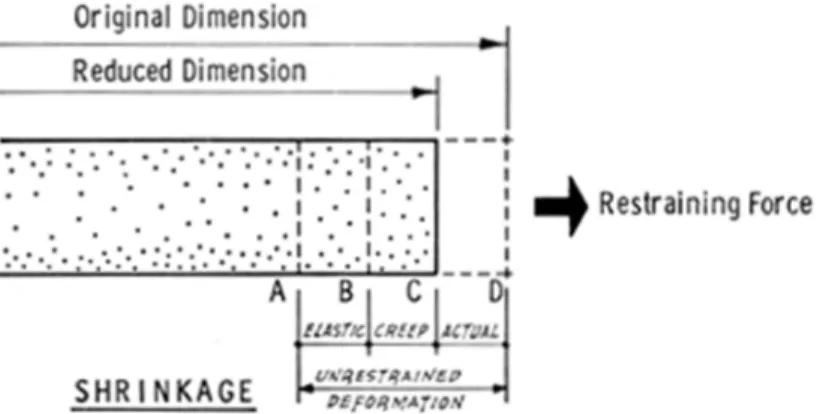
4. degree of restraint to deformation depending on the connection to other elements of a structure. The inter-relationship of these factors is indicated in Figure 1. If any material were unrestrained, shrinkage or expansion would tend to change the length by an amount indicated by AD in the diagram. If there were restraint to the deformation, the actual change in dimension would be something less than AD as is indicated by BD. This would represent the change in length under the induced loading for a no-creep material such as steel. It would also represent the change in length for most building materials where there is an instantaneous or rapid application of loading. If the time of load application is sufficient, and it usually will be for induced loading from temperature and moisture changes, creep or plastic flow in the material may take place. The actual length change will therefore be even less than BD and probably somewhat as shown by CD.
Figure 1. Factors affecting deformations.
The illustration is schematic only, to show how the actual deformation will always be less than the unrestrained deformation, depending inversely on the degree of restraint. It does not indicate the relative size of the deformations involved. The elastic deformation is proportional to the induced stress and inversely proportional to the modulus of elasticity. The creep deformation increases with induced stress and depends on the duration of time the stress is acting. It is very difficult to determine a quantitative value for the actual movement because compensating changes often occur in the other factors when any one of them is changed.
Magnitude of Deformations
Although it may not be possible to determine the exact deformations or stresses set up by temperature and moisture content changes, it is possible to compute them approximately if the effect of creep is ignored. Then, knowing the general effect of creep, one can make a reasonable assessment as a guide to rational design.
Concrete may be used as an example. With a strength of 250 pounds per square inch in tension and 2500 pounds per square inch in compression, it has a modulus of elasticity of 2.5 x 10⁶pound per square inch. Using the stress-strain ratio previously described, it is possible to
determine the strain that would cause failure. 250
Strain (tension) = X 100 = 0.01 per cent
2.5 X 10⁶
2500
Strain (compression) = X 100 = 0.10 per cent
2.5 X 10⁶
Using a linear coefficient of thermal expansion of 6 x 10⁻⁶inch per inch per Fahrenheit degree it
is possible to calculate the temperature change that would produce these deformations, or the deformations that would occur for the normal temperature range the material will encounter in service. The short-term temperature changes may often be as much as 80 F degrees for material exposed to outside weather conditions. In Canada the seasonal temperature changes, considering radiation effects as described inCBD 47, may be as much as 230 F degrees for dark-coloured materials backed by insulation. Considering the 80 F degree change, the corresponding deformation would be 80 x 6 x 10-6x 100 = ± 0.05 per cent. The strength of
concrete in tension is low, and it may be noted that this temperature deformation is five times the strain necessary to cause tension cracking.
Moisture content changes can cause deformations in concrete ranging from 0.01 to as high as 0.2 per cent for some lightweight aggregate concretes, and is about 0.04 for normal dense concrete block upon extreme changes in moisture content.
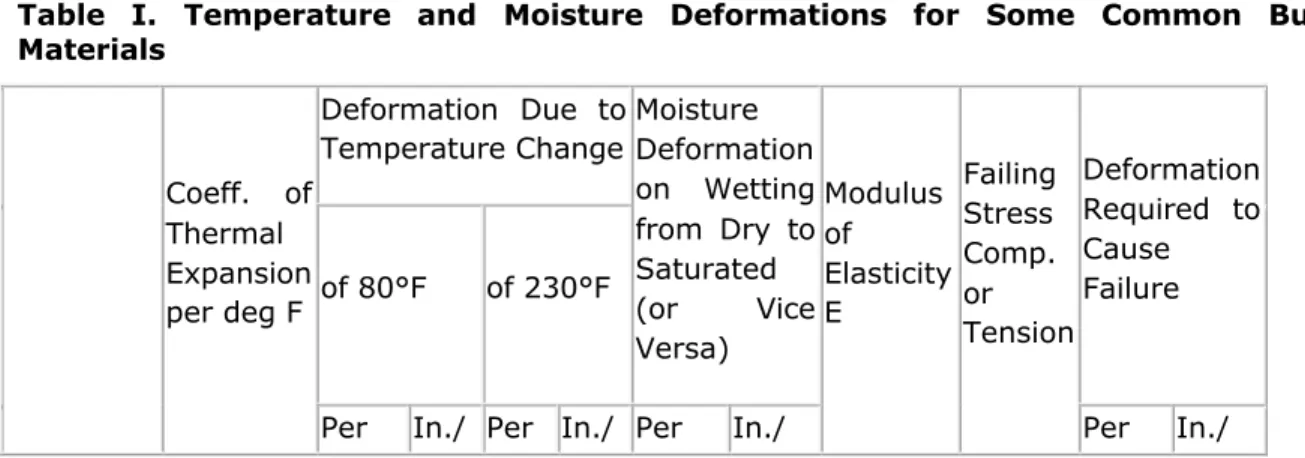
Table I. Temperature and Moisture Deformations for Some Common Building Materials Coeff. of Thermal Expansion per deg F Deformation Due to Temperature Change Moisture Deformation on Wetting from Dry to Saturated (or Vice Versa) Modulus of Elasticity E Failing Stress Comp. or Tension Deformation Required to Cause Failure of 80°F of 230°F
Cent 10 ft Cent 10 ft Cent 10 ft Cent 10 ft Normal Dense Concrete 6x10⁻⁶ 0.05 0.06 0.14 0.17 0.03 0.04 2.5x10⁶ 2500C 250T 0.10 0.01 0.12 0.01 Brick 3x10⁻⁶ 0.024 0.03 0.07 0.08 0.007 0.008 3x10⁶ 6000C 500T 0.20 0.016 0.24 0.02 Marble and Dense Limestone 3x10⁻⁶ 0.024 0.03 0.07 0.08 <.001 - 10x106 25000C 600T 0.25 0.006 0.30 0.007 Sandstone 7x10⁻⁶ 0.056 0.07 0.16 0.19 0.07 0.08 5x10⁶ 12000C 400T 0.24 0.008 0.29 0.01 Reinforced Polyester 10x10-6 0.08 0.10 0.23 0.28 <.001 - 1.5x10⁶ 15000T 1.00 1.20 Steel 7x10⁻⁶ 0.056 0.07 0.16 0.19 none - 30x106 40000T (yield point) 0.13 0.15 Copper 10x10-6 0.08 0.10 0.23 0.28 none - 17x106 50000T 0.29 0.35 Aluminum 14x10-6 0.11 0.13 0.32 0.38 none - 10.3x10640000T 0.39 0.47
Values similar to those discussed above for concrete have been calculated for a number of other common building materials. These are shown in Table I, which is intended to give the designer some indication of the extent of movement to which various materials are liable. The values used for the coefficient of thermal expansion, modulus of elasticity, moisture deformation and failing stress are mean values for materials where there is a wide range, depending on the specific type. If the reader wishes to make similar calculations, the specific values will normally be available to him from engineering handbooks or other sources.
Some metals have been included in Table I to indicate the sort of temperature deformations that need to be considered. This is of considerable importance in relation to joints made watertight with caulking materials and metal combined with other building materials. One application, for instance, where this is frequently ignored is in metal flashings combined with waterproof roof coverings. Temperature deformations in such cases can often buckle the flashings, break open joints, and sometimes also tear the material away from mechanical
fastenings. Failure is frequently indicated by penetration of water under the flashings, with subsequent deterioration of adjacent materials.
The moisture response of most plastics will be negligible, but in general they exhibit high thermal coefficients - as much as five times those for inorganic materials. Reinforcing with glass or other fibres can greatly reduce the thermal expansion, as is indicated for the reinforced polyester in Table I, and results also in an increased modulus of elasticity.
Recommendations
Precise recommendations for the reduction or elimination of cracking and failure of building materials cannot be given because of the complicated nature of the mechanisms involved and the large range of circumstances in application. Certain general recommendations however, can be made that normally should result in a reduction of the number of serious failures sometimes apparent in modern buildings.
The designer must have a knowledge of material properties and make allowance for the deformations or stresses anticipated for the material during construction and in service if cracking failure is to be avoided. Such allowance involves choice of material, fixing and jointing techniques, size limitation and reinforcing.
Materials with high initial irreversible shrinkage require maturing before use. Those that deform considerably with temperature and moisture changes may need to be avoided for exterior use. If they are used, conditions of restraint require careful consideration; protection against moisture during construction and control of drying after construction may be essential. Panels fitted into rectangular frames, as occurs with windows, and most curtain wall systems involve consideration of differential movements between panel and frame materials. Modification of the conditions to which a material is subjected may be possible. The temperature range can be reduced by using light colours or shading devices, and fluctuations, by materials of a high heat capacity.
Conclusion
This Digest has attempted to show the need for greater consideration in design of the deformations and induced stresses that can and do occur in restrained building materials from temperature and moisture changes. Discussion has been confined to materials, but conditions of restraint involving building elements or structures must also be carefully examined especially in larger buildings where roof slabs may be rigidly attached to walls. Differential deformation or warping of materials can also take place as a result of temperature and moisture variations through the thickness of materials or assemblies. This may tend to complicate the assessment of deformations or induced stresses, but a rational judgement must be made in design if building elements are to perform in a satisfactory manner. (The reader is referred also to Principles of Modern Buildings, vol. l, Department of Scientific and Industrial Research, Building Research Station London, H.M.S.O., 1959.)