HAL Id: hal-02193867
https://hal.archives-ouvertes.fr/hal-02193867
Submitted on 24 Jul 2019
HAL is a multi-disciplinary open access
archive for the deposit and dissemination of
sci-entific research documents, whether they are
pub-lished or not. The documents may come from
teaching and research institutions in France or
abroad, or from public or private research centers.
L’archive ouverte pluridisciplinaire HAL, est
destinée au dépôt et à la diffusion de documents
scientifiques de niveau recherche, publiés ou non,
émanant des établissements d’enseignement et de
recherche français ou étrangers, des laboratoires
publics ou privés.
Empirical Evaluation of Sequence-to-Sequence Models
for Word Discovery in Low-resource Settings
Marcely Zanon Boito, Aline Villavicencio, Laurent Besacier
To cite this version:
Marcely Zanon Boito, Aline Villavicencio, Laurent Besacier. Empirical Evaluation of
Sequence-to-Sequence Models for Word Discovery in Low-resource Settings. Interspeech 2019, Sep 2019, Graz,
Austria. �hal-02193867�
Empirical Evaluation of Sequence-to-Sequence Models for Word Discovery in
Low-resource Settings
Marcely Zanon Boito
1, Aline Villavicencio
2,3, Laurent Besacier
11
Laboratoire d’Informatique de Grenoble, Univ. Grenoble Alpes (UGA), France
2School of Computer Science and Electronic Engineering, University of Essex, UK
3
Institute of Informatics, Federal University of Rio Grande do Sul, Brazil
contact: [email protected]
Abstract
Since Bahdanau et al. [1] first introduced attention for neural machine translation, most sequence-to-sequence models made use of attention mechanisms [2, 3, 4]. While they pro-duce soft-alignment matrices that could be interpreted as align-ment between target and source languages, we lack metrics to quantify their quality, being unclear which approach produces the best alignments. This paper presents an empirical evalu-ation of 3 of the main sequence-to-sequence models for word discovery from unsegmented phoneme sequences: CNN, RNN and Transformer-based. This task consists in aligning word se-quences in a source language with phoneme sese-quences in a tar-get language, inferring from it word segmentation on the tartar-get side [5]. Evaluating word segmentation quality can be seen as an extrinsic evaluation of the soft-alignment matrices produced during training. Our experiments in a low-resource scenario on Mboshi and English languages (both aligned to French) show that RNNs surprisingly outperform CNNs and Transformer for this task. Our results are confirmed by an intrinsic evalua-tion of alignment quality through the use Average Normalized Entropy (ANE). Lastly, we improve our best word discovery model by using an alignment entropy confidence measure that accumulates ANE over all the occurrences of a given alignment pair in the collection.
Index Terms: sequence-to-sequence models, soft-alignment matrices, word discovery, low-resource languages, computa-tional language documentation
1. Introduction
Sequence-to-Sequence (S2S) models can solve many tasks where source and target sequences have different lengths. For learning to focus on specific parts of the input at decoding time, most of these models are equipped with attention mech-anisms [1, 2, 3, 4, 6]. By-products of the attention are soft-alignment probability matrices, that can be interpreted as align-ment between target and source. However, we lack metrics to quantify their quality. Moreover, while these models perform very well in a typical use case, it is not clear how they would be affected by low-resource scenarios.
This paper proposes an empirical evaluation of well-known S2S models for a particular S2S modeling task. This task con-sists of aligning word sequences in a source language with phoneme sequences in a target language, inferring from it word segmentation on the target side [5]. We concentrate on three models: Convolutional Neural Networks (CNN) [2], Recurrent Neural Networks (RNN) [1] and Transformer-based models [3]. While this word segmentation task can be used for the extrinsic evaluation of the soft-alignment probability matrices produced
during S2S learning, we also introduce Average Normalized Entropy (ANE), a task-agnostic confidence metric to quantify the quality of the source-to-target alignments obtained. Experi-ments performed on a low-resource scenario for two languages (Mboshi and English) using equivalently sized corpora aligned to French, are, to our knowledge, the first empirical evaluation of these well-known S2S models for a word segmentation task. We also illustrate how our entropy-based metric can be used in a language documentation scenario, helping a linguist to effi-ciently discover types, in an unknown language, from an unseg-mented sequence of phonemes. This work is thus also a contri-bution to the emerging computational language documentation domain [7, 8, 9, 10, 11], whose main goal is the creation of au-tomatic approaches able to help the documentation of the many languages soon to be extinct [12].
Lastly, studies focused on comprehensive attention mech-anisms for NMT [13, 14, 15] lack evaluation of the resulting alignments, and the exceptions [16] do so for the task of word-to-word alignment in well-resourced languages. Differently, our work is not only an empirical evaluation of NMT models focused on alignment quality, but it also tackles data scarcity of low-resource scenarios.
2. Experimental Settings
2.1. Unsupervised Word Segmentation from Speech As in language documentation scenarios available corpora usu-ally contain speech in the language to document aligned with translations in a well-resourced language, Godard et al. [5] in-troduced a pipeline for performing Unsupervised Word Seg-mentation (UWS) from speech. The system outputs time-stamps delimiting stretches of speech, associated with class labels, corresponding to real words in the language. The pipeline consists of first transforming speech into a sequence of phonemes, either through Automatic Unit Discovery (e.g. [17]) or manual transcription. The phoneme sequences, together with their translations, are then fed to an attention-based S2S system that produces soft-alignment probability matrices be-tween target and source languages. The alignment probability distributions between the phonemes and the translation words (as in Figure 1) are used to cluster (segment) together neigh-bor phonemes whose alignment distribution peaks at the same word. The final speech segmentation is evaluated using the Zero Resource Challenge1(ZRC) 2017 evaluation suite (track 2).2
1Available at http://zerospeech.com/2017.
2We increment over [5] by removing silence labels before training,
Figure 1: Soft-alignment probability matrices from the UWS task. ANE values (from left to right) are 0.11, 0.64 and 0.83. The gold segmentation is “BAH1T MAA1MAH0 PAA1PAH0 IH0Z AW1T”, which corresponds to the English sentence “But mama, papa is out”.
2.2. Parallel Speech Corpora
The parallel speech corpora used in this work are the English-French (EN-FR) [18] and the Mboshi-English-French (MB-FR) [19] parallel corpora. EN-FR corpus is a 33,192 sentences mul-tilingual extension from librispeech [20], with English audio books automatically aligned to French translations. MB-FR is a 5,130 sentences corpus from the language documentation pro-cess of Mboshi (Bantu C25), an endangered language spoken in Congo-Brazzaville. Thus, while the former corpus presents larger vocabulary and longer sentences, the latter presents a more tailored environment, with short sentences and simpler vocabulary. In order to provide a fair comparison, as well as to study the impact of corpus size, the EN-FR corpus was also down-sampled to 5K utterances (to the exact same size than the MB-FR corpus). Sub-sampling was conducted preserving the average number of tokens per sentence, shown in Table 1. 2.3. Introducing Average Normalized Entropy (ANE) In this paper, we focus on studying the soft-alignment probabil-ity matrices resulting from the learning of S2S models for the UWS task. To assess the overall quality of these matrices with-out having gold alignment information, we introduce Average Normalized Entropy (ANE).
Definition: Given the source and target pair (s, t) of lengths |s| and |t| respectively, for every phone ti, the normalized entropy
(NE) is computed considering all possible words in s (Equa-tion 1), where P (ti, sj) is the alignment probability between
the phone tiand the word sj (a cell in the matrix). The ANE
for a sentence is then defined by the arithmetic mean over the resulting NE for every phone from the sequence t (Equation 2).
N E(ti, s) = − |s| X j=1 P (ti, sj) · log|s|(P (ti, sj)) (1) AN E(t, s) = P|t| i=1N E(ti, s) |t| (2)
From this definition, we can derive ANE for different granular-ities (sub or supra-sentential) by accumulating its value for the full corpus, for a single type or for a single token. Corpus ANE will be used to summarize the overall performance of a S2S model on a specific corpus. Token ANE extends ANE to tokens
by averaging NE for all phonemes from a single (discovered) token. Type ANE results from averaging the ANE for every to-ken instance of a discovered type. Finally, Alignment ANE is the result of averaging the ANE for every discovered (type, trans-lation word)alignment pair. Intuition that lower ANEs corre-spond to better alignments is exemplified in Figure 1.
3. Empirical Comparison of S2S Models
We compare three NMT models (§3.1, §3.2, §3.3) for UWS, focusing on their ability of aligning words (French) with phonemes (English or Mboshi) in medium-low resource set-tings. The results, an analysis of the impact of data size and quality, and the correlation between intrinsic (ANE) and extrin-sic (boundary F-score) metrics are presented in §3.4. The ap-plication of ANE for type discovery in low-resource settings is presented in §3.5.
3.1. RNN: Attention-based Encoder-Decoder
The classic RNN encoder-decoder model [1] connects a bidi-rectional encoder with an unidibidi-rectional decoder by the use of an alignment module. The RNN encoder learns annotations for every source token, and these are weighted by the alignment module for the generation of every target token. Weights are defined as context vectors, since they capture the importance of every source token for the generation of each target token. Attention mechanism: a context vector for a decoder step t is computed using the set of source annotations H and the last state of the decoder network (translation context). The attention is the result of the weighted sum of the source annotations H (with H = h1, ..., hA) and their α probabilities (3) obtained
through a feed-forward network align (4).
ct= Att(H, st−1) = A X i=1 αtihi (3) αti= softmax(align(hi, st)) (4) 3.2. Transformer
Transformer [3] is a fully attentional S2S architecture, which has obtained state-of-the-art results for several NMT shared tasks. It replaces the use of sequential cell units (such as LSTM) by Multi-Head Attention (MHA) operations, which make the architecture considerably faster. Both encoder and decoder net-works are stacked layers sets that receive source and target se-quences, embedded and concatenated with positional encoding. An encoder layer is made of two sub-layers: a Self-Attention MHA and a feed-forward. A decoder layer is made of three layers: a masked Self-Attention MHA (no access to sub-sequent positions); an Encoder-Decoder MHA (operation over the encoder stack’s final output and the decoder self-attention output); and a feed-forward sub-layer. Dropout and residual connections are applied between all sub-layers. Final output probabilities are generated by applying a linear projection over the decoder stack’s output, followed by a softmax operation. Multi-head attention mechanism: attention is seen as a map-ping problem: given a pair of key-value vectors and a query vector, the task is the computation of the weighted sum of the given values (output). In this setup, weights are learned by com-patibility functions between key-query pairs (of dimension dk).
Table 1: Statistics of the three source-target data sets.
#types #tokens average( token length) average( #tokens / sentence) corpus source target source target source target source target EN-FR (33k) 21,083 33,135 381,044 467,475 4.37 4.57 11.48 14.08 EN-FR (5k) 8,740 12,226 59,090 72,670 4.38 4.57 11.52 14.17 MB-FR (5k) 6,633 5,162 30,556 42,715 4.18 4.39 5.96 8.33
Dot-Product (SDP) Attentionfunction is computed as: Att(V, K, Q) = sof tmax(QK
T
√ dk
)V (5) In practice, several attentions are computed for a given QKV set. The QKV set is first projected into h different spaces (mul-tiple heads), where the SDP attention is computed in parallel. Resulting values for all heads are then concatenated and once again projected, yielding the layer’s output. (6) and (7) illustrate the process, in which H is the set of h heads (H = h1, ..., hh)
and f is a linear projection. Self-Attention defines the case where query and values come from same source (learning com-patibility functions within the same sequence of elements).
M ultiHead(V, K, Q) = f (Concat(H)) (6) hi= Att(fi(V ), fi(K), fi(Q)) (7)
3.3. CNN: Pervasive Attention
Different from the previous models, which are based on encoder-decoder structures interfaced by attention mechanisms, this approach relies on a single 2D CNN across both sequences (no separate coding stages) [2]. Using masked convolutions, an auto-regressive model predicts the next output symbol based on a joint representation of both input and partial output se-quences. Given a source-target pair (s, t) of lengths |s| and |t| respectively, tokens are first embed in dsand dt dimensional
spaces via look-up tables. Token embeddings {x1, . . . , x|s|}
and {y1, . . . , y|t|} are then concatenated to form a 3D tensor
X ∈ R|t|×|s|×f0, with f
0= dt+ ds, where:
Xij= [yi xj] (8)
Each convolutional layer l ∈ {1, . . . , L} of the model produces a tensor Hl of size |t| × |s| × fl, where fl is the number of
output channels for that layer. To compute a distribution over the tokens in the output vocabulary, the second dimension of the tensor is used. This dimension is of variable length (given by the input sequence) and it is collapsed by max or average pooling to obtain the tensor HLPoolof size |t|×fL. Finally, 1×1 convolution
followed by a softmax operation are applied, resulting in the distribution over the target vocabulary for the next output token. Attention mechanism: joint encoding acts as an attention-like mechanism, since individual source elements are re-encoded as the output is generated. The self-attention approach of [21] is applied. It computes the attention weight tensor α, of size |t| × |s|, from the last activation tensor HL, to pool the elements of
the same tensor along the source dimension, as follows: α = softmax (W1tanh (HLW2)) (9)
HLAtt = αHL. (10)
where W1 ∈ Rfaand W2 ∈ Rfa×fL are weight tensors that
map the fLdimensional features in HLto the attention weights
via an fadimensional intermediate representation.
3.4. Comparing S2S Architectures
For each S2S architecture, and each of the three corpora, we train five models (runs) with different initialization seeds.3 Be-fore segmenting, we average the produced matrices from the five different runs as in [5]. Evaluation is done in a bilingual segmentation condition that corresponds to the real UWS task. In addition, we also perform segmentation in a monolingual condition, where a phoneme sequence is segmented with re-gards to the corresponding word sequence (transcription) in the same language (hence monolingual).4 Our networks are
opti-mized for the monolingual task. Across all architectures, we use embeddings of size 64 and batch size of 32 (5K data set), or embeddings of size 128 and batch size of 64 (33K data set). Dropout of 0.5 and early-stopping procedure are applied in all cases. RNN models have only one layer, a bi-directional en-coder, and cell size equal to the embedding size, as in [5]. CNN models use the hyper-parameters from [2] with only 3 layers (5K data set), or 6 (33K data set), and kernel size of 3. Trans-former models were optimized starting from the original hyper-parameters of [3]. Best results (among 50 setups) were achieved using 2 heads, 3 layers (encoder and decoder), warm-up of 5K steps, and using cross-entropy loss without label-smoothing. Finally, for selecting which head to use for UWS, we exper-imented using the last layer’s averaged heads, or by selecting the head with minimum corpus ANE. While the results were not significantly different, we kept the ANE selection. 3.4.1. Unsupervised Word Segmentation Results
The word boundary F-scores5 for the task of UWS from phoneme sequence (in Mboshi or English) are presented in Ta-ble 2, with monolingual results shown for information only (topline). Surprisingly, RNN models outperform the more re-cent (CNN and Transformer) approaches. One possible expla-nation is the lower number of parameters (for a 5K setup, in average 700K parameters are trained, while CNN needs an ad-ditional 30.79% and Transformer 5.31%). However, for 33K setups, CNNs actually need 30% less parameters than RNNs, but still perform worse. Transformer’s low performance could be due to the use of several heads “distributing” alignment in-formation across different matrices. Nonetheless, we evaluated averaged heads and single-head models, and these resulted in significant decreases in performance. This suggests that this ar-chitecture may not need to learn explicit alignment to translate, but instead it could be capturing different kinds of linguistic information, as discussed in the original paper and in its exam-ples [3]. Also, on the decoder side, the behavior of the self-attention mechanism on phoneme units is unclear and
under-3RNN, CNN and Transformer implementations from [22, 2, 23]
re-spectively.
4This task can be seen as an automatic extraction of a pronunciation
lexicon from parallel words/phonemes sequences.
5For CNN and RNN, average standard deviation for the bilingual
Table 2: Boundary F-scores for the UWS task. Bilingual Monolingual EN 33K RNN 77.10 99.80 CNN 71.30 98.60 Transformer 52.70 94.90 EN 5K RNN 70.40 99.30 CNN 55.90 98.80 Transformer 52.50 80.90 MB 5K RNN 74.00 92.50 CNN 68.20 89.80 Transformer 66.40 83.50
studied so far. For the encoder, Voita et al. [15] performed after-training encoder head removal based on head confidence, show-ing that after initial trainshow-ing, most heads were not necessary for maintaining translation performance. Hence, we find the Multi-head mechanism interpretation challenging, and maybe not suitable for a direct word segmentation application, such as our method.
As in [24], our best UWS method (RNN) for the bilingual task does not reach the performance level of a strong Bayesian baseline [25] with F-scores of 89.80 (EN33K), 87.93 (EN5K), and 77.00 (MB5K). However, even if we only evaluate word segmentation performance, our neural approaches learn to seg-ment and align, whereas this baseline only learns to segseg-ment. Section 3.5 will leverage those alignments for a type discovery task useful in language documentation.
The Pearson’s ρ correlation coefficients between ANE and boundary F-scores for all mono and bilingual runs of all cor-pora (N = 30) are −0.98 (RNN), −0.97 (CNN), and −0, 66 (Transformer), with p-values smaller than 10−5. These strong negative correlations confirm our hypothesis that lower ANEs correspond to sharper and better alignments.
3.4.2. Impact of Data Size and Quality
EN33K and EN5K results of Table 2 allow us to analyze the impact of data size on the S2S models. For the bilingual task, RNN performance drops by 7% on average, whereas perfor-mance drop is bigger for CNN (14-15%). Transformer performs poorly in both cases, and increasing data size from 5K to 33K seems to help only for a trivial task (see monolingual results).
The EN5K and MB5K results of Table 2 reflect the impact of language pairs on the S2S models. We know from [26, 27] that English should be easier to segment than Mboshi, and this was confirmed by both dpseg and monolingual results. How-ever, this trend is not confirmed in the bilingual task, where the quality of the (sentence aligned) parallel corpus seems to have more impact (higher boundary F-scores for MB5K than for EN5K for all S2S models). As shown in Table 1, MB-FR corpus has shorter sentences and smaller lexicon diversity, while EN-FR is made of automatically aligned books (noisy alignments), what may explain our experimental results.
3.5. Type Discovery in Low-Resource Settings
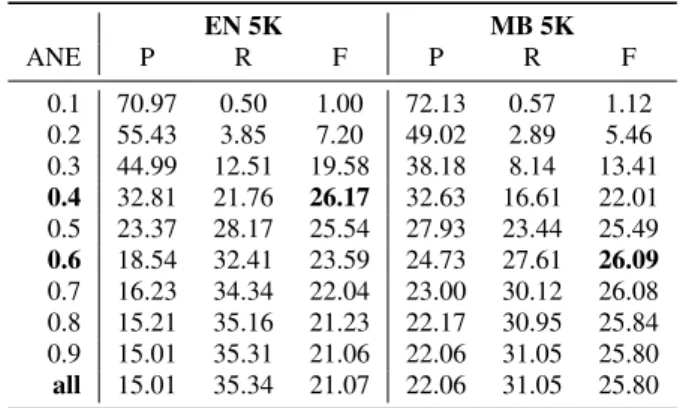
We investigate the use of Alignment ANE as a confidence mea-sure. From the RNN models, we extract and rank the discovered types by their ANE, and examine if it can be used to separate true words in the discovered vocabulary from the rest. The results for low-resource scenarios (only 5K) in Table 3 sug-gest that low ANE corresponds to the portion of the
discov-Table 3: Type retrieval results (RNN) using ANE for keeping most confident (type, translation) pairs (for ex: ANE=0.4 means we keep only pairs whose ANE is below 0.4).
EN 5K MB 5K ANE P R F P R F 0.1 70.97 0.50 1.00 72.13 0.57 1.12 0.2 55.43 3.85 7.20 49.02 2.89 5.46 0.3 44.99 12.51 19.58 38.18 8.14 13.41 0.4 32.81 21.76 26.17 32.63 16.61 22.01 0.5 23.37 28.17 25.54 27.93 23.44 25.49 0.6 18.54 32.41 23.59 24.73 27.61 26.09 0.7 16.23 34.34 22.04 23.00 30.12 26.08 0.8 15.21 35.16 21.23 22.17 30.95 25.84 0.9 15.01 35.31 21.06 22.06 31.05 25.80 all 15.01 35.34 21.07 22.06 31.05 25.80
Table 4: Top 5 low and high ANE ranking for the discovered types (EN5K), with gold transcription and aligned information between parentheses (respectively). “INV” means incorrect type.
Top Low ANE Top High ANE 1 SER1 (sir, EOS token) AH0 (a, convenable) 2 HHAH1SH (hush, chut) IH1 (INV, ah) 3 FIH1SHER0 (fisher, fisher) D (INV, riant) 4 KLER1K (clerk, clerc) N (INV, obit) 5 KIH1S (kiss, embrasse) YUW1 (you, diable)
ered vocabulary the network is confident about, and these are, in most of the cases, true discovered lexical items (first row, P ≥ 70%).6 As we keep higher Alignment ANE values, we increase recall but loose precision. This suggests that, in a doc-umentation scenario, ANE could be used as a confidence mea-sure by a linguist to extract a list of types with higher precision, without having to pass through all the discovered vocabulary. Moreover, as exemplified for EN5K in Table 4, we also retrieve aligned information (translation candidates) for the generated lexicon.
4. Conclusions
We presented an empirical evaluation of different architectures (RNN, CNN and Transformer) with respect to their capacity to align word sequences in a source language with phoneme se-quences in a target language, inferring from it word segmen-tation on the target side (UWS task).7 Although RNNs have
been outperformed by CNN and Transformer-based models for machine translation, for UWS these architectures are still more robust in low-resource scenarios, and present the best segmen-tation results. We also introduced ANE, an intrinsic measure of alignment quality of S2S models. Accumulating it over the dis-covered alignments, we showed it can be used as a confidence measure to select true words, increasing Type F-scores.
6Type ANE for the retrieval task was also investigated, and results
were positive, but slightly worse than the ones from Alignment ANE.
7Pointers for corpora, parameters and implementations available at
5. References
[1] D. Bahdanau, K. Cho, and Y. Bengio, “Neural machine trans-lation by jointly learning to align and translate,” arXiv preprint arXiv:1409.0473, 2014.
[2] M. Elbayad, L. Besacier, and J. Verbeek, “Pervasive attention: 2d convolutional neural networks for sequence-to-sequence predic-tion,” arXiv preprint arXiv:1808.03867, 2018.
[3] A. Vaswani, N. Shazeer, N. Parmar, J. Uszkoreit, L. Jones, A. N. Gomez, Ł. Kaiser, and I. Polosukhin, “Attention is all you need,” in Advances in Neural Information Processing Systems, 2017, pp. 5998–6008.
[4] J. Gehring, M. Auli, D. Grangier, D. Yarats, and Y. N. Dauphin, “Convolutional sequence to sequence learning,” in Proceedings of the 34th International Conference on Machine Learning-Volume 70. JMLR. org, 2017, pp. 1243–1252.
[5] P. Godard, M. Zanon Boito, L. Ondel, A. Berard, F. Yvon, A. Villavicencio, and L. Besacier, “Unsupervised word segmenta-tion from speech with attensegmenta-tion,” in Interspeech, 2018.
[6] I. Sutskever, O. Vinyals, and Q. V. Le, “Sequence to sequence learning with neural networks,” in Advances in Neural Information Processing Systems 27, Z. Ghahramani, M. Welling, C. Cortes, N. D. Lawrence, and K. Q. Weinberger, Eds. Curran Associates, Inc., 2014, pp. 3104–3112. [Online]. Available: http://papers.nips.cc/paper/ 5346-sequence-to-sequence-learning-with-neural-networks.pdf [7] G. Adda, S. St¨uker, M. Adda-Decker, O. Ambouroue, L.
Be-sacier, D. Blachon, H. Bonneau-Maynard, P. Godard, F. Ham-laoui, D. Idiatov, G.-N. Kouarata, L. Lamel, E.-M. Makasso, A. Rialland, M. V. de Velde, F. Yvon, and S. Zerbian, “Break-ing the unwritten language barrier: The BULB project,” Procedia Computer Science, vol. 81, pp. 8–14, 2016.
[8] A. Anastasopoulos and D. Chiang, “A case study on using speech-to-translation alignments for language documentation,” arXiv preprint arXiv:1702.04372, 2017.
[9] L. Besacier, B. Zhou, and Y. Gao, “Towards speech translation of non written languages,” in Spoken Language Technology Work-shop, 2006. IEEE. IEEE, 2006, pp. 222–225.
[10] C. Lignos and C. Yang, “Recession segmentation: simpler on-line word segmentation using limited resources,” in Proceedings of the fourteenth conference on computational natural language learning. Association for Computational Linguistics, 2010, pp. 88–97.
[11] C. Bartels, W. Wang, V. Mitra, C. Richey, A. Kathol, D. Vergyri, H. Bratt, and C. Hung, “Toward human-assisted lexical unit dis-covery without text resources,” in Spoken Language Technology Workshop (SLT), 2016 IEEE. IEEE, 2016, pp. 64–70. [12] P. K. Austin and J. Sallabank, The Cambridge handbook of
en-dangered languages. Cambridge University Press, 2011. [13] K. Song, T. Xu, F. Peng, and J. Lu, “Hybrid self-attention network
for machine translation,” arXiv preprint arXiv:1811.00253, 2018. [14] J. Li, Z. Tu, B. Yang, M. R. Lyu, and T. Zhang, “Multi-head attention with disagreement regularization,” arXiv preprint arXiv:1810.10183, 2018.
[15] E. Voita, D. Talbot, F. Moiseev, R. Sennrich, and I. Titov, “Ana-lyzing multi-head self-attention: Specialized heads do the heavy lifting, the rest can be pruned,” arXiv preprint arXiv:1905.09418, 2019.
[16] T. Zenkel, J. Wuebker, and J. DeNero, “Adding interpretable at-tention to neural translation models improves word alignment,” arXiv preprint arXiv:1901.11359, 2019.
[17] L. Ondel, L. Burget, and J. ˇCernock`y, “Variational inference for acoustic unit discovery,” Procedia Computer Science, vol. 81, pp. 80–86, 2016.
[18] A. C. Kocabiyikoglu, L. Besacier, and O. Kraif, “Augmenting lib-rispeech with french translations: A multimodal corpus for direct speech translation evaluation,” arXiv preprint arXiv:1802.03142, 2018.
[19] P. Godard, G. Adda, M. Adda-Decker, J. Benjumea, L. Be-sacier, J. Cooper-Leavitt, G.-N. Kouarata, L. Lamel, H. Maynard, M. M¨uller et al., “A very low resource language speech corpus for computational language documentation experiments,” arXiv preprint arXiv:1710.03501, 2017.
[20] V. Panayotov, G. Chen, D. Povey, and S. Khudanpur, “Librispeech: An ASR corpus based on public domain audio books,” in 2015 IEEE International Conference on Acoustics, Speech and Signal Processing, ICASSP 2015, South Brisbane, Queensland, Australia, April 19-24, 2015, 2015, pp. 5206– 5210. [Online]. Available: https://doi.org/10.1109/ICASSP.2015. 7178964
[21] Z. Lin, M. Feng, C. dos Santos, M. Yu, B. Xiang, B. Zhou, and Y. Bengio, “A structured self-attentive sentence embedding,” 2017.
[22] A. B´erard, O. Pietquin, C. Servan, and L. Besacier, “Listen and translate: A proof of concept for end-to-end speech-to-text trans-lation,” arXiv preprint arXiv:1612.01744, 2016.
[23] M. Ott, S. Edunov, A. Baevski, A. Fan, S. Gross, N. Ng, D. Grang-ier, and M. Auli, “fairseq: A fast, extensible toolkit for sequence modeling,” arXiv preprint arXiv:1904.01038, 2019.
[24] P. Godard, “Unsupervised word discovery for computational lan-guage documentation,” Ph.D. dissertation, Universit Paris-Saclay, 2019.
[25] S. Goldwater, T. L. Griffiths, and M. Johnson, “A Bayesian frame-work for word segmentation: Exploring the effects of context,” Cognition, vol. 112, no. 1, pp. 21–54, 2009.
[26] A. Fourtassi, B. B¨orschinger, M. Johnson, and E. Dupoux, “Why is english so easy to segment?” in Proceedings of the Fourth An-nual Workshop on Cognitive Modeling and Computational Lin-guistics (CMCL), 2013, pp. 1–10.
[27] A. Rialland, M. E. Aborobongui, M. Adda-Decker, and L. Lamel, “Dropping of the class-prefix consonant, vowel elision and auto-matic phonological mining in embosi (bantu c 25),” in Selected Proceedings of the 44th Annual Conference on African Linguis-tics, 2015, pp. 7–10.