Publisher’s version / Version de l'éditeur:
Vous avez des questions? Nous pouvons vous aider. Pour communiquer directement avec un auteur, consultez la
première page de la revue dans laquelle son article a été publié afin de trouver ses coordonnées. Si vous n’arrivez pas à les repérer, communiquez avec nous à [email protected].
Questions? Contact the NRC Publications Archive team at
[email protected]. If you wish to email the authors directly, please see the first page of the publication for their contact information.
https://publications-cnrc.canada.ca/fra/droits
L’accès à ce site Web et l’utilisation de son contenu sont assujettis aux conditions présentées dans le site LISEZ CES CONDITIONS ATTENTIVEMENT AVANT D’UTILISER CE SITE WEB.
Internal Report (National Research Council of Canada. Division of Building Research), 1962-01-01
READ THESE TERMS AND CONDITIONS CAREFULLY BEFORE USING THIS WEBSITE.
https://nrc-publications.canada.ca/eng/copyright
NRC Publications Archive Record / Notice des Archives des publications du CNRC : https://nrc-publications.canada.ca/eng/view/object/?id=aeef329f-2442-4860-b300-1f98fcc6a7e3 https://publications-cnrc.canada.ca/fra/voir/objet/?id=aeef329f-2442-4860-b300-1f98fcc6a7e3
Archives des publications du CNRC
For the publisher’s version, please access the DOI link below./ Pour consulter la version de l’éditeur, utilisez le lien DOI ci-dessous.
https://doi.org/10.4224/20386740
Access and use of this website and the material on it are subject to the Terms and Conditions set forth at
NHBA experimental project Mark II Forest Lawn, Alberta Handegord, G. O.
DIVISION OF BUILDING RESEARCH
NHBA EXPERIMENTAL PROJECT MARK
II,FOREST LAWN, ALBERTA
by
G. O. Handegord
Internal Report No. 244 of the
Division of Building Research
OTTAWA
The Division, as a member of the Research Committee of the National House Builders Association has been assisting in the experimental house program
of that Committee. The first experimental house
known as Mark I was constructed at Preston, Ontario in 1957 and a second house to the same design was
constructed at Dartmouth, N.S. in 1958. Experimental
house Mark II was constructed at Forest Lawn, Alberta
in 1959. The Division has undertaken to make
observa-tions of the performance of these experimental houses, but in some cases these have had to be limited to
periodic visits. The Mark II house has been kept
under observation by staff from the Prairie Regional Station at Saskatoon and the results are now reported.
The author, a mechanical engineer, is officer-in-charge of the Prairie Regional Station of the Division located at Saskatoon.
Ottawa
by
G.
o.
HandegordThe Mark II House was built by the L. E. Wade Construction Company of Calgary, Alberta, in the fall of 1959 as part of a program sponsored by the National House
Builders Association. The house is located at 2527 Sable
Drive in the town of Forest Lawn, adjacent to the city of
Calgary, and was officially opened on 5 November 1959. Since
then it has been occupied by Mr. William \¥hite, his wife and
family of three preschool children. Mr. White served as
superintendent for the Wade Construction Company during the construction of the house.
The Mark II House was constructed to demonstrate and evaluate certain design features that had been proposed by the Research Committee of the National House Builders
Association. Following completion of the house, the NHBA
requested that the Division of Building Research of the
National Research Council assist with this project by having one of its staff observe the performance of the house taking
special note of the special features incorporated. As a
result of this request, the author visited the house on
11 March 1960, and the house examined in company with Mr. White. The information obtained during this visit established any
significant changes made to the original design and indicated any aspects of performance that might be related to the special features of the house.
It was recognized that frequent regular visits could not be made by Division of Building Research personnel from Saskatoon and Mr. Vfhite offered to report on any developments
which he observed. Arrangements were made to install a
recording temperature-humidity instrument which Mr. White
agreed to service on a weekly basis. It was thought that
this instrument would at least provide some record of the interior environment which might be used in assessing the performance of the heating system or indicating any unusual humidity condition.
A second visit was made to the house in November 1960, to examine the general condition of the house and to
discuss its performance with Mr. White. This report has been
prepared on the basis of these observations and discussions to provide a record of the features and, to some degree, the
performance of the Mark II House. Considerable credit is due
to Mr. White for his interest and co-operation in this matter,
Special Features of the Mark II House
The floor plan of the Mark II House is shown in Fig. 1; views of the front and rear of the completed bUilding
are shown in Figs. 4 and
5.
Figures 2 and3,
reproducedfrom the drawings used in the construction of the house, illustrate the various special features which were to have
been incorporated. A description of these special features
will be described in this report; supplementary information gained thrOUgh the observations made to date is included where applicable.
Footings
It was originally intended that footings should not be carried below the assumed frost level on the basis that the heat loss from the crawl space would be sufficient
to avoid frost heaving problems. Because of the nature of
the site, considerable fill was necessary and the resultant
foundation walls extend about
5
feet below finish grade.Approximately 3 feet of gravel fill was used in the crawl
space area, and the floor of the crawl space was covered
with a layer of concrete, 1-1/2 inches thick. No vapour
barrier was included in this construction. The foundation
walls are of 4-inch concrete block and perimeter insulation of I-inch thick foamed polystYrene extends from floor level
to 18 inches below grade. The centre bearing wall in the
crawl space consists of 2- by 4-inch studs at 2-foot centres supported on 4-inch concrete block on a 16- by 6-inch concrete
footing 3 feet below the crawl space floor.
In March 1960, examination of the crawl space
re-vealed a slight displacement of the floor adjacent to the centre
footing wall, as shovvn in Fig. 6. In November there appeared
to be no increase in this displacement. During both visits
the dark appearance of some mortar joints, as shown in Fig. 6, suggested moisture being present, but no other evidence of
water seepage was observed. The crawl space was dry and no
cracks were noted in the concrete floor. Floor System
The floor construction was originally planned with
nominal 2- by 8-inch joists spaced 24 inches on centres. A
special cross-grained plywood, 1/2 inch thick, was used as subflooring and nominal 1- by 4-inch strapping, nailed to the underside of the floor joists at mid'-span, served in lieu of
conventional cross bridging. Tile was used as finish flooring
in the kitchen, bath and hall; painted subfloor was the finish surface in the living room and bedrooms.
Many of the people attending the official opening criticized the floor system as being too "springy", and this
has been the chief complaint of the occupants. Excessive
deflection of the subflooring may also have been a contributing factor in producing separation at the joints in the plywood
flooring sheets (Fig. Wセ The high temperatures in the crawl
space would also contribute to this separation, notably due
to shrinkage of the plywood subfloor. Shrinkage of the joists
was reported by the occupant from measurements taken in the
crawl space.
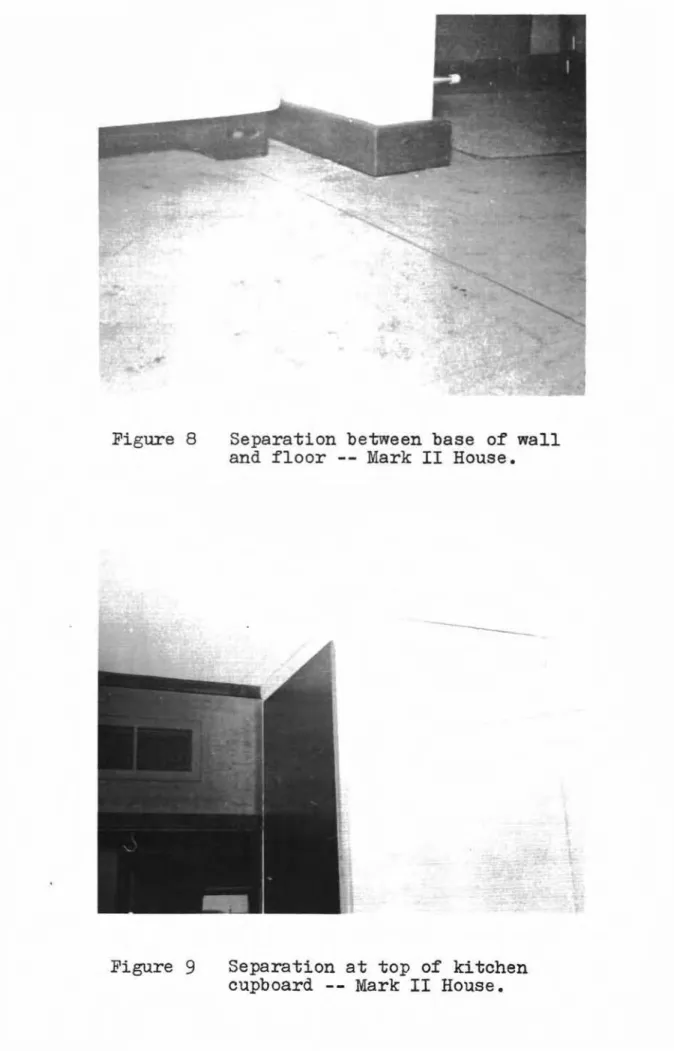
Some separation between the base of the wall and the floor was noticed in March 1960 at the end of the stub wall
adjacent to the refrigerator, as shown in Fig. 8. Some shrinkage
may have occurred in the baseboard, but examination indicated
a gap of some 1/2 inch between plate and subfloor. Evidence
of possible floor deflection was also noted at the top of the
kitchen storage cupboard in Fig.
9.
This is a region of fairlyheavy floor loading. No increase in these separations were
noted in November 1960.
Some checking on the finished surface of the plywood flooring was observed in March 1960, being most severe in the
centre bedroom, as shown in Fig. 10. No significant increase
in the extent or severity of this checking was noted in November. Windows
Fixed windows were used throu@lout the house, with factory sealed double-glazed units installed as shown in
detail in Fig.
3.
The occupants reported no seriouscondensa-tion difficulties during the first winter althOUgh some slight
deterioration of the wood stops had occurred. By November
1960 the caulking compound had become hard and brittle and
more severe condensation at the sill had been observed. In
December 1960 during intentional humidification of the centre bedroom, some condensation between panes in the sealed units was reported.
Attic Ventilation
Perforated hardboard was used as a soffit to permit
entry of outside air for ventilation of the attic space. A
special continuous ridge vent was installed as an exhaust vent. It was reported in March 1960 that under certain conditions snow tended to enter the attic through the ridge vent and the vent had been blocked off for the most part
following this experience (Fig. 2). The attic appeared to be
near the top of the north gable end. The occupant had observed no signs of serious condensation during the winter.
Wall Construction
Nominal 2- by 4-inch framing members spaced 24 inches
o.c. were used in the exterior wall construction. Interior
finish consists of 1/2-inch thick gypsum board and 5/16-inch cross-grained fir plywood provides a combined sheathing siding, with vertical fir battens spaced 2 feet for appearance and for
joint concealment. No sheathing paper was used. The exterior
plywood and battens were finished with three coats of stain. Insulation consists of 2-inch thick rock wool batts protected
by an additional polyethylene vapour barrier. Interior
partitions are of nominal 2- by 3-inch framing at 24 inches o.c. The wall construction had performed quite satisfac-torily except for excessive checking in the exterior plywood
£inish. There had been no obvious evidence o£ condensation
within the wall, and no cracking had occurred in the interior plasterboard, except for a few hairline cracks at corners and wall ceiling intersections.
Roof System
A special type of king post truss spaced at 2-foot
centres was employed as the basic roof structure, (Fig. 2)
and this system appeared to have performed satisfactorily. Roof sheathing consisted of 3/S-inch cross-grained plywood, 14 feet in length, applied so as to extend from ridge to eave
without horizontal joints. No reinforcing was used at the
joints between the ーャェセッッ、 roof sheets; these were simply
caulked and painted. The roofing used was a special liquid
coating called "Permaclad" , and was applied according to the suppliers' directions.
The special roof coating appeared to perform
satisfactorily until the weekend of 2 July 1960 when a hail
storm occurred, followed by rain. Under these conditions,
serious leaks developed at the joints in the ーQSセPP、 roofing.
The occupant observed that rain water, entering thrOUgh the roof, found its way across the polyethylene vapour barrier to the exterior walls, and down the exterior walls between
the vapour barrier and the insulation. Water was observed
at window heads with a considerable amount entering at this
point in the master bedroom. A large puddle formed on the
floor beneath this window and the 、セ。ー・ウ became wet and badly
stained. Subsequent examination of the attic by the occupant
indicated a few wet spots in the wood shaving insulation, but no serious staining of the ceiling occurred.
Following this experience, and after examination of
the roof, asphalt shingles were applied. A sample of the
sheathing taken from the roof after the storm indicated that the original "Perrraclad" coating had become very brittle and had apparently lost its bond to the wood.
Heating and Ventilation System
The heating system used in the Mark II House was a modified form of a "crawl space plenum" system with a down-flow gas-fired forced warm air furnace discharging heated
air directly into the crawl space. It differed from the
conventional crawl space plenum system in that no duct work was used to direct or distribute warm air in the crawl space
and the warm air was discharged to the living space エィイッオセャ
a series of holes drilled in the subfloor around the perimeter of the house rather than thrOUgh conventional registers.
These holes were concealed behind the baseboard which was spaced 3/4 inch from the face of the wall, as shown in the
detail in Fig. 3. It was intended that strips of 3/4-inch
by 3/4-inch lumber could be dropped into this space to cover
some of the holes to permit balancing of the system. The
occupant thOUght that SUfficiently uniform distribution was obtained without resorting to this tecrmique.
Registers were provided near the ceiling in all bedrooms, kitchen, and utility room, to allow the air to return through the hall, kitchen and living room, and be taken into the return air plenum of the furnace thrOUgh two registers located near the ceiling in the furnace closet.
Ventilation was provided for in the design with two ducts formed in the ceiling joist spaces and extending f:om the furnace plenum to the eaves at the front and rear of the
house. These ducts were installed as shovm in the detail in
Fig. 2. Both ducts were equipped with manually operated
dampers for control of the amount of ventilation. The exhaust
of air from the house was provided for by a bathroom exhaust fan and by two ceiling vents, one in the master bedroom and one in the living room, which were equipped with manually operated doors as shovm in Fig. 3 and connected by ducts to
the outside. It was intended that the outside air intakes
and ceiling vents could be opened in winter to provide a means for moisture removal and could be opened in winter to provide a means for moisture removal and could similarly be employed in summer to gain the benefits of night cooling. In winter, except for a short period after occupancy, only
the vent in the master bedroom was kept open. This was
found necessary because of the discomfort from cold 、ッセセ
drafts from the vents, presumably during "off" periods of the
a cooler bedroom and this vent was closed only infrequently. It was also found that cold air issued from the combustion air register at the base of the furnace closet in the kitchen under certain conditions, and this was closed off to avoid
discomfort to those sitting at the kitchen table. The
out-side air intake vents were left open at all times, both summer and winter.
The occupants appeared to be very satisfied with the performance of the heating system, although initially the
noise of operation of the fan was objectionable. Information
regarding the proper adjustment of warm air furnaces was sent to the occupant in March 1960, so that the control settings
and fan speed could be modified if necessary. The occupant
also stated that at first his wife found the floor somewhat too warm but this feature was most desirable from the
stand-point of small children. The occupants thought that dust and
lint were more apparent than in other houses of their experience.
The thermohygrograph records for the heating
periods in the spriLg and fall of 1960 indicated that relative
humidity 」ッョjゥエゥッセウ within the house were similar to those of
houses of the same general character and occupancy in Saskatoon. During zero and subzero weather, minimum humidities of 20 to
25 per cent were experienced as shown in Fig. 11. This figure
is a reproduction of the instrument record for the coldest
period during the time of observation. Figure 12 is a similar
chart for a period of milder weather in November 1960. In
each of these figures the mean hourly outside temperature has also been plotted as a dotted curve, based on information supplied by the Meteorological Office at the City of Calgary Airport.
The most significant feature of the records shown
in Figs. 11 and 12 is in relation to the f re quency of the
temperature control cycle. In most houses with basements,
with conventional forced warm air, gas fired systems, the
"onll and "off" cycle of the furnace, as exemplified by the
temperature variation, involves a period of from 20 to 40 minutes, whereas a period of from 3 to 4 hours for each cycle
may be noted for the Research House. This is the type of
performance that has been noted in a house with a gravity hot water system in Saskatoon and indicates the effect of
high heat storage capacity. In the house with hot water
heating this is due to the mass of the system and water, whereas in the Mark II House it may be due to the thermal
capacity of the concrete slab and floor system. This is not
necessarily a disadvantage of the system and it may be observed that the amplitude of temperature variation of approximately
+2Fo is similar to that obtained in conventional houses even
Operation of the system during hot summer weather required the occupant to control the operation of the fan
manually and to use drapes to reduce solar gain. Normally,
drapes were drawn on those windows facing the sun during the course of the day and the furnace fan was turned on at noon and left in operation until the environment became chilly.
This usually occurred at sunset or thereabouts. Doors were
also opened during periods when cool breezes prevailed.
A reproduction of the record of interior temperature and humidity during one of the warmest outside conditions is shown in Fig. 13, together with the average hourly outside
temperature. This record suggests that the procedure followed
by the occupants resulted in satisfactory conditions being maintained although it is difficult to draw any specific conclusions regarding the inherent merit of the system with-out comparison with other conventional houses under the same
weather conditions. The occupant thought that the conditions
l§i I I
[§I
I I@I
__ l§1-;;r
I I OOOR ELECTRIC PANEL FIGURE UTILITY BATH BEDROOM HATCH 22'x30" 1'"--"1 1 , I , 1 , +----4-KITCHEN PLAN BEDROOM FLOOR HEATING=
LIVING ROOM BEDROOM VENTS IN CEILING セ9
COMa. Ille
セ
"{}
セエ⦅TGMPG
⦅セMMZZ
_I "セ
STORAGE :i'4[ --""
I41\:(:0" 0"'.
セ
•
_I I I I セ⦅ャᄃ 2'.a" 3'-4" 4'-0' ( - - -s
-10'- O·!
' 0 .' セn;
r
I II II - -11 - - 1
t
I
II I II'F 'セセ]]ZZANB
INSUL. WITH METAL FOIL . .u.- I I" I I::I 'I rt---J!'r I I'I I III I III I FURNACE ''1
1=/-ir
セ
4" COMBUSTION AIR PIPE COVERED WITH AlGID INSULATION 3"0" DAMPEA セ| セ II Nセ セiゥ ! I l ' OUTSIDE AlA ADJUSTABLE A.A. GAILLE ON LIVING ROOM SI DE ALSO DETAIL OF FURNACE DAMPERS 8 VENTILATIONSEE FIG. 2 FOA CEILING VENT OETAILS
41 1 6 " POST 2"'6" BLOCKING OVER POSTS COPPER FLYSCREEN lB' WIDTHI Iooo--VENTS CLOSEO
SECT ION AT FRO NT OVERHANG DETAIL A - RIDGE VENT
'''16" 2"x 4"· ..-.---6"! ' 0 -'..,
r
2'-0:-j 10'-0' I j ELEVATION1
2'-0' _ |セG⦅ッG 12 Tセ 6',16' FOOTING{- - AIR FROM EXTERIOR
AIR FLOW DIAGRAM - HEATING aVENTILATION _._AIR FROII INTERIOR
5-2" NAILS 25 - 2' NAILSセ t ! I I NCTE.' I aiセ セエャLom OUT5:;:1L CAD;I:(:E.17 ",:,0 P:"!.WUMtN evc r &ETWE-f.NセGLiGo J;;lISTS Gov」NッGセイ |^Giセセ
BᄋセtaLQNN FOIL (Ol>:£. I'WCT
セiZャ[ッBLZ E.A<:.HUセZョ⦅I ...,... UeNセ cBeNセaNiZBB ZセセoLGRセ[LVBGLBl セji
F:s!::
WII IIセセ セ iセ WI I7'1=,.
7/%,. GZWセG_コイNL i セ セ ",'. I I t ⦅セi コセセL TOP VIEW=
PLYWOOD BRACE SET INTO CUT- OUTS IN RAFTERSaCEILING
spAN.24'-0'
BOTTOM VIEW
ROOF TRUSS DETAILS
I'X4" PLATE
セ[ X%'DRAUGHT STOP IN 4'-0' LENGTHS TO BE PLACED IN POSITION WHEN REOUIREO TOsalセnce HEATING
セ[ PLYWOOD TOP
PLYWOOD DOOR FACE
0/:
SPACER 2'-0'セ[ AIR SPACE
<,
<,
CEILING VENT DETAIL
I 22' X 30' •
OPEN ING DETAIL OF HATCH IN CEILING
IN HALLWAY '/; TEN TEST
SKETCH SHOWING CIRCULATION HOLES
セO / / - - -MGセ BhBLセBLBOf TRUSS .' " '. . セxREB
,,::.4-,%
ZZZZセM Nセ
%'X1%' saseセ FLASHING PLYWOOD I' X 3" 2"X2' I" X 6' 2" X 2' I' X 6' GABLE DETAIL 1'0'DOUBLE GLAZING DETAIL
"0,
'lo
FLEX. BOARD
z'X 4" PLATE
I"X 3" sセttens 2'-0" O.C.
QQセ FIR PLYWOOD SPECIAL CROSS grセinL UNDERLAY GRADE "\ G" "0, 'N !
I
pBGiセ
'. -: -. 16' X 6" CONC FOOTING4" LOOSE FILL INSULATION (WOOD SHAVINGSl
2-2"X4" PLATE VAPOUR BARRIER
it;
GYPSUM BOAR DPOLYETHYLENE vセpour bセrrier
2' INSULATION -_JA
1)1;.'CONC. FLOOR 2 MM. POLYETHYLENE V.B. 4' TH ICK CONC. SLOCK I" POLYSTYRENE INSUL.
SGgrセvelfill セiZセGB
TAMPED セッ セセ Q 0 ( I ' Q{I _ " Z[セ
4X12'Xy; セNセ[ DIA HOLES, I" APART
FIR PLYWOOD »:"
HspecセlL CROSS 2' X B' JOISTS AT 2'-0" C.C. grセin I
..
Figure
4
Mark II House -- front view,11 March 1960.
/
Figure
5
Mark II House -- rear view,Figure
7
Separation of plywood flooring
---Figure
9
Separation at top of kitchen'1
Hf·
"I-I / fIi
I
f-H-fj-I-I fI ffl! I
! セヲMエMhGMKiIii
I-/i:.:+-+
u-
11f!
I-I-f l ヲセᄋZ iII
IIii
7. "r,'
:1; 7
Ii
T "I-I
IJi+-f
rr ' ITIT I /1j I , I I ' I ! --+
I
+
! iI
I 1 I {' I I I I- {,\! i ! II
I I , I , i . I I; , I I I I I +--r .' ,.. J 1,1- .. MセMゥL / : ' " I T- - t ,- - -- - - -- t- I r ! .s : I I I ' : ! ' . r I - - · · / - - f - -I- I---f----I _ , I I _ I _ , i _ _ ' , I . I • ._. +
I-- -- : I ... - II tII
Ir r -I I I I/ " tj''I
> I, iI' ; I' I ,l 'I
' I 'III
I
,I I I ' !I I II r··"'·j - -- -1-1-1I
i i , I I I , I , ' i ! I I I I ! I I II
Lセ, I
I
I ruI
i I r,' ;u • r - , + --j , セ ---T I -- - I ' I . , I I I _i i i
i l , I . 1:'セ I. j _ _ IセLi.
I I • セN ,It r, i I I I" I tf·il-I VI'
I f' , iiセf
j f' M[MMMイMゥセLャ|ャャ!'
'
-f 1---1 ,j I "j-iLlt 1 1 ---j 1 - - -Qll
t, ゥj|セ|NM -I -I
I I . l . ..! III , I .n I I ,", .n ,>1 •• l I II I IIliT['IIJlI
|||iGiihKhMwjャャゥBャャャjQャuャャGヲャhAセエャ|AB{G I'\illil
iTr't1.L+±LU" .
I \\\
t I \ : -I . . ,. . .,....t
I1· .., ;
i ! •I
I \ I 1 I , •LLセN セ I, I I .. , I I ! • t-' ヲMセMNMM f L セNセセ
セ h 8 III lZ 11 16 18 201:'::21. 2 to6 8 10 I:..! 11 ItdHZGッセZNAZNNA I ! .. h II UII:':: II-l'd8:'::0:!2H 2 I. II 8 1012 H It. 1st211!;!21 '! I. (, 8 If! 12)I.HIIK'!II 2'! 21 2 .. f) n Hi1:.!HII'.18:W.!'!:!' 2 4 6 8 III 12H 161820 22Rセ 2 .. 6rhセ
FR .•
: _..---
]tlI1
.:
=;.-
セN」 : t ..:
! '.,: / -:-
:,:
".ff! . .; ,.-/
I.
;'Ii/it .,. / : ' / : : : If.iK.L;·:;.-. . :I·..
,li'FF.l:'jI' : I :
Iit"':I: ;./ ;.'
i.
J :I
T7H.' / f l .GjZセjN t t J エGMcセᄋᄋZエMセ-:,<OセLLZ ,.1 . ' ,: jセZGN^NG . " ,." /.--1../ I ' , + " ZセZᄋZᄋNiセセAセA '.: : :/ GNャゥセ ,; . •セN ,1.: Nイセエ[ZKNZZMiMZセZエM エMMエLKセZ]MMセMMヲMZセ
s.t:
--tp.
'!i /.1/,
I . iJ ;
1.-.:I . .. l : :
J.: : / ..
l . / I ..
NMjセ,. I,
I /
f:r·: .-.I . :
jセ -r-:' ...I : .: l .
!
I
t エZゥセGャfj l If / tJ#-·r
'TC,'t:f;.c."c.',..I
Ii'! ..
! I ·I"I . f' .
: ' . I : . -. ,.J . .I . I' . /
. , . . .. I :le_.⦅セ⦅ェ I . .__セ⦅ZGI'
,-',.'l ! L ..I' . I
" . I '. NセG , I : ,. . / ' :. .I .
:,jI
;t Er=t··.::k-,.I'F'-:l:--rtI' •+ I ': tI 'r:::t:-+If--f..l.' t
.L
rl..•.1-...
i:..l セ ! セ L : Ir-i--;, . L セ T. :-W-.f- ... I : セ ; :.J.. . ...!.i..
!'';' jセ[N[NlエNNZwMjMZZKᄆGQNNャエNNエMiBfョ[• LセL . 1 'I ' . I . . . , ' • • • . . " . • , • . • .t-_I +.r. t '1
L
r I , . ; f-; r ' : . : : : j r " - : i :: : ; 1 .i j : " ' . I ' : : t s J . ' MセL t : _. , . : [セ ; . ' ; , ; : : セヲLセZ .'. ' ; !:f
t;
:: :'
, 1 : ' . . , : ; ; セセhGiMGQゥMZMMGTtr
. L_. -_ . ' . • • " I , • , . . . ' . f.... . .. . • - . '''''.. , - - L - + . _ . 1 I ' • イセ c_r . . " . I ェNェGセ 1 • f , . + . • • I f I ' . , . . . 1 I ' " " , NZセLN +, [ . . 14' - -. '-'-J . , , . i . , t ' , . • . 1-' , • . - - j " • • • '---cr: . , i f- • -r- t--- セN[MM . ' t _• _ . ; . • - ; セZ . : I : I ; ... .. : r -: t : /--- _.".. : : ; : , " . セ⦅Z⦅ _ _ OM⦅セM _ セ i t ' ·GセQ ' • • t · . |ゥZ\セ , l • I ' 1 t t • + I I ' • + . . ' .;:'\l...:I ..t • rセt セエZ[ l セセ i セZ : i セセZ セ -t: _i T f ' fo- t T t t t : セ セセMヲM セ 1: j J : ZZuZZMセQ セM ヲMZZ[ZセNM MセZMM - l セM]ZNZ --,. r '., =-.:.''. , I I .,;..' t ,. , . i- ". " I 'I I ;. t ,• - .1 ' t ,t . . t . "• +. t ' i , "" ' -" '-,'.:セNB Mセ , . -. , . ,... :::t- - 1 , .LMセ j r-- --,.,..,-+ t - : L i , T : . t : +->- Lセエ ; ::- セ MセZLZ ---<- セG - ' : t- ; セM -;' ""[ ·:·t· .-.- -_.- .イMセMMQ ' t - - c:; " . ' I t · : セ- ..t"'j' I , '\ 1-· f , ; ' : .. 1 ; t :l t -i , . ' t · : · A-"'-+ _ ' . • t .- \ ' . I' セlゥZ cF --t: , : __セ : \ : r - ....-:.. ! : . 1- ..! \ . I '. 1 \ l ' l: ,1:-:';;:.' t ' ' I ' . ' ; ' +-:セMゥMNQ . . . ' r -- rel - - . - I rT =t. -: , t ; C , '1 •.セ セセBN : T 11 |セ i : \ 1 ;l \
j t ... 1l
セ-"
セャ\ ; :
L セ Iセ 1 ; l .." ;.1 - t t t [' ..; セ . : , " \ セ \ " セZャ : : ': ': GNGセ GLセセ セZ ; '\ セ| \ +,' • \r;>= '
,1 .... セG '" '; エMセセ " : ' : : ' 1.._ -;- NNNNNセMZZLL|GZZ] r;.' . -F ;1: '. \ \ ' \ ' ;\ : '
1. .: \ " '
it
t , ;It \ \ \ \- \ \ L.l=l .
id.t:_-t="R-=-1 r-±i , Nセ セ t"c
セ':
i:t \ :
ZMセ[ \:1 ,.. \. t. }.-f''te•.-;:_セ1:'tI _,.f.:, . \ ': . \ : " \ : I,..t -'"- - , \ . ' " ",: \" ' \ ' ; \' . , \.t\ \ : ; \" ; \-1 \:, I- ' + 1 "'tf>-= .\- \-tV - t:=+4'=+-,1:,+:t.+NセN| '- G|」セ " 1.\- :- I, \ ; 't \ it |]イセK : \ ᄋMNZNセセ|⦅Lエ]ZtMM]|MGエ
_--t t 1 t:t -t •.•i'.L+-=-1:::;;t:;;:::\::-,=t-=\ ++. ++ '-+=;hc"I _ \ . ' " ,- • I _ - \ - ' :tc::te'.+1
セ i \ 'c;"£\ '.\ ; \ \ - \. \ |セᄋヲN| : \ ' \ \ \, \ \ ||セL| t \ \ \ \Z|ャャセ |セZヲM セZ」ャ
L1
vエャnlセyt
|セ\
\\--b--x:l .... \ ';-'. \
L\i
|ャLLZセイ セヲ|ᆬ|」Z|M」[t'i'\--\!
--:; \. ",. -\ "o[MRMイセセセNBN , \ '7 \- \', \. \, . .エMエセQN M|セnエMGMエN " I . '; \ \ " \ \\ セ |セ|Gャ '- \ t. \- \=-\ct, |ャセ \+:'i=\- \ '\ \\: \--\'\-::\, セエZZG|GMZ|M '-; '\ \ \ \ \t"-+':f-t.';=\ Le4-\ ;\\IT:\-J; \-', \ : \ ' \ ''I:fセ '.
r - セ セ ,'+;"¥Vf--- \ .\=-\ セM .:¥1.:::-' セ
.-,--r
.1-4 |MmAG[MMセMMQMMBMセ " G|MMMMZMエヲヲャMセ⦅ᄋLMMGMエMエMャᄋM|MMMG .-=--r:sVt- MM|MMGMMセ⦅MセセM|BM[MエMGZMBMQZFigure 11 Thermohygrograph イ・」ッイ、セ 11 to 18 March 1960 -- Mark II House. Dotted
>-f-+-fL'f'Lcf--.i
, , , , , , . , , , , , . , " "., " , , , , , , , , , , , r I
ヲセᄋ
_., .
エMセMMLᄋ セLM ' ' f-\ - f - t - + t - I - f H H - + + H H - I - j
|セeエKh|M|hKMi
11+1\\1 \H
|hセNエ|ゥ
HI \\
h|M|{fセ
i \\ \ L"t--1 サMセIn\
rrlli \-\ \\
\-1:t+1\ \\H\\ \IJ\ft\ \\\\\
Gセi||
\\\\ \\\ \
\-'\j \\\\\\ \\\
\"t\ \\'\, \\
\t\ttiJ\\tli\
rrrr
セセKャャゥャエエヲヲゥ|QNN|ヲ|N|||ス|ィiエャiエュュ|||ヲヲゥ|
\\_\1\
セ||⦅セQ|
\\
\\J\ffi-l\ \
\1\.\\ \
\Illi-\\:\lmr
i 6 8 16 12 Ii Ih 18 20 22 2. 21. 6 R 10 12 11 th lR ::'0 22 2 .. 21. 6 8 10 12 I' 16 1ft 20 22 21 2 4 6 8 10 12 11 16 1R :!U :!:.!セ..1. .• tJ a In 12 1 .. 1hI R 211 22 :.!..セ ... h 8 10 12 I .. 10 I H :.!.11 221.' 2 -4 6 8 10 12 14 1618 20 22 24 2 -4 6 8 II
セ
.. --.:t-- -] 」Z Mセ .-+--1·N II -r-f--t',t
⦅jNセJ IイM[GセNセ[G t .n o -1-- :I; .
,. : :'t
,II
i:__セ M[MセセセMN ;;1Rlft· T'[]t , :"I ..
: : f :i ':ti1!!;----··1 ' :I
I ..
..J . '/
. ' : I"iiYff'- - / :iJ . '/ ' . /
.' : セ : : セN.···tlJ!!cT ; I '
f_ ".: :'1-'f .ヲMMセtt
--_.- ⦅NセM⦅N⦅M ",f." /"--- --. ---, -- - - - f ' .. .. --L r -/- - ...J.. .._._0 . . . ., -, . . . " , ' . ' . "", ' .. J . . . . . . ; ' . " , " セ • • " . ' . ' . - " , ' T ' ' . . ...j
_....·[=f[Z
.._J.
ᄋiMセrtfI
- -- - ...-+---- - ... nセセB i]Mセ」NO_AGhᄋ fc Jt
ᄋᄋZエセ[Q 'IP·r:i-.rTf'Ti •r"
I f ····-'f<T; f; Ir:='t'
t.ti"ji 1 I' ,/.·'1"'
1-·..,- .-f·/T=.C+;';t"=iU,--r,.:::f ·1-/ j 1= .- -- :セ--- t;:t.;[セゥMM -.' __i ;-t ZNZセ ---セZA セNZ __i l I J; . . ' +;MセエLr
;';.
t : ;-- ..'1セセセZ[セQ i -- - :: ;;' :::TNMセMZ : - : ! , t-: -MMセヲ[ィセMMKM]Mゥ]ヲセZ :1-- --- -r-, t= M」エZMZセァMセ
..
'l,": セ ..セ B⦅セ⦅MNャNNN __ t-+t-+-1-F 1. _ tf ' , t LNセセI "t·' "1 ' , ェセセGヲGゥ ' I . j ; , t . '''F' , j ; t jUf'LI , . 1 ."". , . GNセj .•t'=.Lj=i;r:ci=-f .£_. - 'T NNBNGセ " , , _ . -- - .--+-- -Mセ ". --+. - - - - • . . 1 ' t - -t--} !- t_ -セM セMセM[ .i. :: t. .... :IT -1 ; C!_k<t=f-t;::: __f::-£Zセ⦅エZセᄆ⦅ZZlM "1'.." 't' 1; セ - f i .; 1 . : i ... : : .,·:-.uF-r ゥZBセ -t;-r:J;·=r-' .- '_. I ,·1 t . ·)w' h ' 1 , I • f • ..(C .... " I • . " . I w ' , -エLZᄆZZエZセN[[Z[エᄋエZᄋᄋN[Nエ[L tr-=.-f·'·- LセBN ᄋᄋLNNNNセZNェᄋャ : t l' J t , _ ' . 1 . . I , ; . : : ; ' : - ; : . r セャ )' .==; ...1 MセQ]ZZNQ]ᄆMセMエZM ---f-.l. t,MセZZMMMエM t ,..--' -:::_ セセセZセ :;::t-:-+ ; - - + - : - - -t: L - t セ L t t ! ; : : : t ⦅セMMエZ BBセN i --; t.'.Mセ t セ '_1 f t · f.: . セMBNNL jセ ; i ,. c_. i ' J GBセQMイM .•:,- MGセセMセZZGZエ . - セNNNNN 1 : + ' - cエ・セ ..セ t+
l " ; fCC .-tLLセZ[C i i ....-t.; .. .. .. .. j 1 + ' t - :-;ei 1 : ' ャZセ . . . : ! ' . ZlZslセNセᄋセQエ :.=ll' i" ヲ セ M ⦅ _ . t t; r -1tl: : , ; r·l'·:Fl:-<-セZエMZB - - -J::-+:'1'· , 1 ·t MセMZM ,-t; i I·' t- - - " \ " \ 1= I エセ \ \ i ' r - -t -4 -"f.t t - .+--t--+ --t- t -n - . セ "\ +t-¥:-f:L t=t::::±Fa::ktli
Mエ]エ]エGQtセャL'f'V
'lI セZMQ,\.== gt
11\ . H
1£,11\; \ \セ d"l lエセQN]|Z セLエG =l:=Tt セェTjZM|Z 1tt
t セ」⦅ -t::FイエエZZエ・エ」セMエエZセj t \ \ \ iセ セャ \\l:lr\ct:
MエK]Zセ\¥A
セyyZQyイエK」[NZ セTQ・fイᆬ 4= - MKZZエ[セyK ,\1\\:1\ F!' ':\\ \.tエ||Z」Z|ZQG|セセ:::t.y1. iIA,- FセMQ|Zエ]ZNZ|]|ZGエN . NZ|Z|ZZエ[||セMセ|MZGZ|GZ :i;=:+=+..v.i=t=±:;t.:±:::±-+·\1._\Y1'.jMZゥZZセセ ::trT+\:tt=£ :j=.|NZZセ ,-,-\.LMセ ,Y+-::\·Cf:,GM|ZセMt ,., -TT |MNセNB NセtBᄋNᄋMエᄋQMM|Mᄋ|MMQM N|セ ltCFTセBZQc 'r,::,\-,y.Bvt-1:·0 't·-\-Yc\·'C'-F'F イ]KMG[ZセZイM
-
:::•..
-セZtM c..; _.... f, ,.-Figure 12 Thermohygrograph イ・」ッイ、セ 7 to 15 November 1960 -- Mark II House. Dotted
ャMwMMjMMlセMャMiMMMゥMMMMKMjMi I I I ! I I I i I I I I J--j I I I I I 1++-+ H
t
t
j , , • , r r r r --セM f -+KMセセ I I I I I+.+-l--+--+-+-+-I I I I エMセM ITI , I I I I I -++ +-+-J-++-+++++I I I I IKセM , ItャMGセ 1-+- -セ ti
j ::Tr-
I MセMM|M|MKKKM|MMMャMャMM -f-f-+-+-:t:.lr-' , r\ L-+-+ \-+-t-+-,I- .-r5' I I I l-Hf+t KBセMM|MM|MMKMT ..j.u-H-r:r
.'.'t'
II f,\1 l-r--It - . , . -Ir1-
t +-\'[J ._ セ I!+I -セ .. ':'- I I - -In \ ... t-+-t-+-++--+-+++-\+'n\\\\
セ
1
\ \ \ \
+-\-\ +---I \|aM|MhM|M|セj
セ
.. \
|セャャMュ⦅セ
I \ \ b \ \11
\ \ "-... "::... -' ClC:i ""'lセ
...
to.セ
3'1.::.::J;=..--\. T i . t.ct=t ct::tCl= セT -"I"W'r\--1,.Figure 13 Thermohygrograph records, 11 to 17 July 1960 -- Mark II House. Dotted