'N j\, /
Discrete Superconducting Vortex Flow
Transistors
by
David Berman
Submitted to the Department of Electrical Engineering and
Computer Science
in partial fulfillment of the requirements for the degree of
Master of Science
at the
MASSACHUSETTS INSTITUTE OF TECHNOLOGY
January 1994
) Massachusetts Institute of Technology 1994. All rights reserved.
Author..
...
Department of Electrical Engineering and Computer Science
January 10, 1994
Certified by....
Terry P. Orlando
Professor of Electrical Engineering
Thesis Supervisor
`-\
p1pI
Aa AAccepted by ... e-d. Mo ....· · ·· · ·ge .
Chairmn
C
Da
t
e de ric
R.
M
o
rgent
ha
le r
Chairman, Departmental Committee on Graduate Students
Discrete Superconducting Vortex Flow Transistors
by
David Berman
Submitted to the Department of Electrical Engineering and Computer Science on January 10, 1994, in partial fulfillment of the
requirements for the degree of Master of Science
Abstract
In this thesis, two versions of a Discrete Superconducting Vortex Flow Transistor (DVFT) are studied. Both overdamped and underdamped versions are fabricated with low Tc Niobium Josephson junctions. We present analytical models for the
operation of the DVFTs that agree with the experimental data. In addition to the
operational model of the DVFT, we also present an example of a circuit
implemen-tation of the DVFT.
Measurements on the overdamped version of the DVFT indicate a current gain of 1.2 when the gate current is injected parallel to the array of junctions. With this manner of gate current injection, the gain is linear in the number of junctions and can be made much greater than 1. Measurements on the underdamped version of the DVFT indicate a transresistance of 2.8Qf with parallel gate current injection.
The overdamped DVFT is better suited for circuit implementation than the un-derdamped version because its operation is nonlatching and is therefore less sensitive to noise.
The conclusion of this thesis is that the DVFT is a viable superconducting transis-tor. The DVFT can be used as a building block to construct complex logic circuitry or as an interface between current based electronics, such as RSFQ logic and voltage based circuits, such as CMOS memory devices.
Thesis Supervisor: Terry P. Orlando Title: Professor of Electrical Engineering
Acknowledgments
I would like to thank Professor T.P. Orlando for his support and guidance throughout this project. I would also like to thank Dr. H.S.J. van der Zant for offering his
expertise in this area as guidance for me and for making himself available to answer
any questions that I had.
I would also like to thank my family and my friends for their support.
This work was supported in part by the Consortium for Superconducting Elec-tronics with partial support from ARPA (contract No. MDA 972-90-C-0021); and we
Contents
1 Introduction
1.1 Superconductivity . ...
1.2 Vortex Flow Transistors . . . . 1.2.1 Low T . . . .
1.2.2 High Tc ...
1.2.3 Discrete VFTs . . . . 2 Overdamped Vortex Flow Transistors
2.1 Introduction. ...
2.2 Experimental results . . . . 2.3 DVFT Analysis . . . .
2.3.1 RSJ model...
2.3.2 Current gain ...
2.4 Comparison to low-T, LJJ and High-Ta-devices 2.5 Conclusions ...
3 Underdamped Vortex Flow Transistors
3.1 Experimental results . . . . 3.2 DVFT Analysis . . . . 3.3 Comparison to LJJ ... 3.4 Conclusions ...
4 Implementation of the DVFT
4.1 Introduction ... 9 9 10 11 11 12 14 14 14 20 20 23 27 31 32 32 34 38 40 41 41...
...
...
...
...
...
.. . . ....
...
. . . . . . . . . . . .4.2 Inverter ... 41
4.3 Oscillator. ... ... 45
5 Conclusion 47
5.1 Summary ... 47
List of Figures
2-1 A layout of the overdamped DVFT showing two possible ways of
in-jecting the gate current. ... 16
2-2 A schematic drawing of the overdamped DVFT with junctions exter-nally shunted with a resistance Ro and resistors R connecting to each
node to uniformly inject the transport current into the array ... 17
2-3 The array voltage as a function of the array transport current for three
different gate currents. The gate current is injected parallel to the array. 17 2-4 The input (gate current) - output (array voltage) characteristic of the
DVFT for four different transport currents through the array. The
gate current is injected parallel to the array. ... 18 2-5 The suppression of the array critical current by the gate current for loop
injection and parallel injection. The dashed lines define the current
gain of the DVFT. ... 19 2-6 The array critical current as a function of the frustration for four
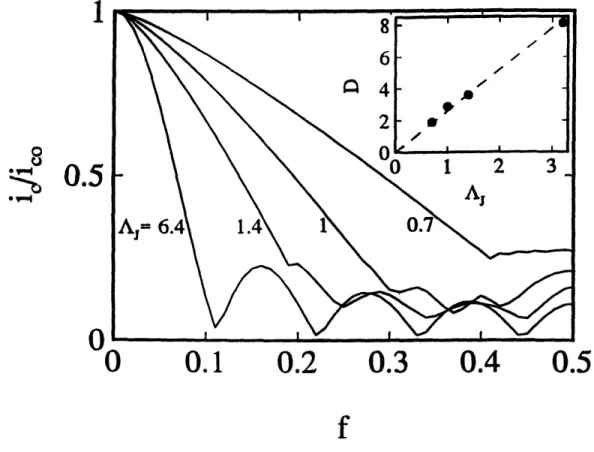
differ-ent values of AJ. The plot is a result of a numerical sumulation on an array with 9 junctions and uniform current injection when considering
self-inductances only. The inset shows the linear dependence of D on AJ for an N = 9 array ... 25
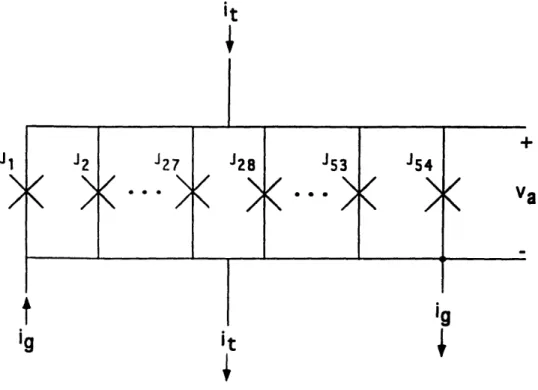
3-1 A schematic drawing of the underdamped DVFT in which the
3-2 The array voltage as a function of the transport current for three dif-ferent gate currents. The inset shows the input-output relation of this
underdamped DVFT for a transport current of it = 33iLA. The slope of the dashed line is the transresistance rm ... 33
4-1 A schematic drawing of a DVFT based inverter. ... 42 4-2 The array critical current as a function of the frustration. The plot is a
result of a numerical simulation on an array with 9 junctions and
List of Tables
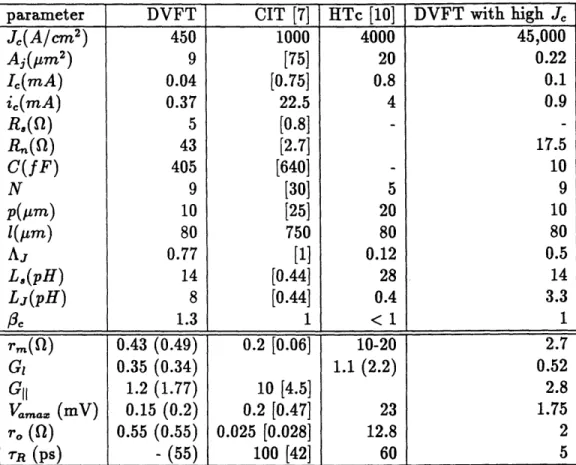
2.1 Summary of the vital characteristics of three non hysteretic
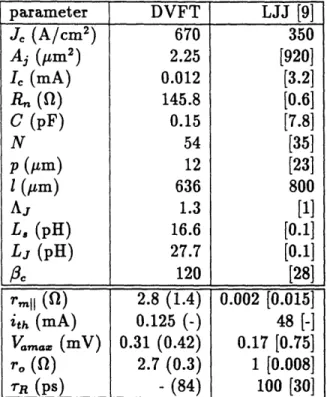
supercon-ducting transistor technologies. ... 29 3.1 Summary of the vital characteristics of two hysteretic superconducting
transistor technologies ... 39 4.1 Oscillation frequency for a single stage DVFT inverter based oscillator 46
Chapter 1
Introduction
1.1 Superconductivity
The field of semiconductor microelectronics has seen great achievements since its conception, but it is generally agreed that it is reaching some fundamental limits in terms of the response time of the transistors and the power consumption caused by the demand for increasing component density. Superconductors offer a potential solution to these problems. The basic element in superconductor microelectronics, the Josephson junction, has an intrinsic switching response time on the order of a
picosecond [1].
There are still some unsolved problems in superconductor-based microelectronics. Up to now, this technology does not have a feasible three-terminal component, or a switch, which is a necessity for the simplicity of logic circuits. In the absence of such a switch, even simple logic operations have required complex engineering solutions
[2, 3].
There are two main material technologies in superconductor electronics. The
major distinction among them is the transition temperature (Ta) of the materials.
T, is the temperature below which the material becomes superconducting. The T¢ of any material is much lower than room temperature, thus refrigeration is needed in order to observe superconducting phenomena. Normally, either liquid helium or liquid nitrogen are used to achieve the necessary temperatures. Helium liquifies at 4.2
K and nitrogen liquifies at 77 K, thus low Tc materials have transition temperatures in the range of 4 K and are measured with liquid helium, and high Tc materials can be measured with liquid nitrogen. Currently, the most commonly used low Tc material is niobium, which has a transition temperature of 9.3 K. Niobium technology is well characterized and controlled. Nevertheless, one would eventually like to operate at the temperature of liquid nitrogen, which is much cheaper than liquid helium. Currently, there is much research in developing a technology that would operate at the higher temperatures. The main material being considered is YBa2CusO7-, which has a Tc3
of 92 K. High Tc technology is in the developmental stage and is much less controlled than low Tc fabrication technology.
The basic building block of most low T, superconducting electronics is the Joseph-son junction. The counterpart of the JosephJoseph-son junction in high Tc electronics is the weak link. A Josephson junction or a weak link can be modeled as an ideal element, exhibiting the DC (equation 1.1) and AC (equation 1.2) Josephson effects, shunted by a parallel combination of a resistor and a capacitor.
i = i, sinG
(1.1)
v= d (1.2)
27r dt
A figure of merit describing this parallel combination is the damping parameter, /3c, which is equal to the Q of the equivalent parallel circuit.
1.2 Vortex Flow Transistors
There have been some previous attempts at constructing a superconducting three-terminal transistor. The most promising results have been demonstrated by using the magnetic flux of a current to control the characteristics of a Josephson system [4, 5, 6, 7]. These systems are commonly referred to as Vortex Flow Transistors (VFTs). VFTs have been made both in low T, and high T, material technologies.
1.2.1
Low Tc
Up to now, the low Tc VFTs have been made using long continuous Josephson junc-tions. There are two versions of low T VFTs; one is a device with overdamped
junctions (the McCumber parameter , < 1) and the other is made with
under-damped junctions ( > 1).
The most prominent characteristic of overdamped VFTs is a nonhysteretic I-V relationship which can be modulated by an external magnetic flux imposed on the Josephson junction by a gate current. Overdamped VFTs based on long Josephson junctions, which are made in low Tc materials, have demonstrated [7] current gains of 10 and transresistances of 0.2 Q1. The disadvantage of the long-junction-based overdamped VFTs is the large size, necessary for high gains (750 /tm in length), low output voltage (< 1 mV), and low output resistance (<< 1 ). Moreover, it is difficult to manipulate the parameters and improve the response time of the device.
In contrast with the overdamped VFTs, underdamped VFTs, which are made only in low Tc technology, demonstrate a hysteretic I-V curve with a magnetic field induced voltage peak in the subgap region. This feature is referred to as the Eck peak [8]. The operation of the underdamped VFTs is based on the modulation of the voltage
position of the Eck peak with the magnetic field of a gate current. Underdamped VFTs with long Josephson junctions have demonstrated [9] output voltages of 0.17
mV, output resistances of 1 F2 and transresistances of about 2 mV. The disadvantages of these devices are similar to their overdamped counterparts: large size (800 m in
length), low output voltage, and difficulty in manipulating the parameters of the device.
1.2.2
High Tc
The VFTs fabricated using high T material technology are similar to the low Tc overdamped VFTs in that they both have nonhysteretic I-V traces and use gate currents to modulate these I-Vs. The high T, VFTs utilize parallel arrays of weak links, rather than Josephson junctions. These VFTs have shown some promising
results [10]. Maximum output voltages of 20 mV and transresistances of the order of 10 Q were obtained. The discrete lattice of weak links permits the high T¢ VFTs to have more efficient magnetic flux coupling, so the device can be made small in size (80 m). The disadvantage of the high Tc devices is that the fabrication technology is not yet fully developed and that the factors determining the performance of these devices are not completely understood.
1.2.3 Discrete VFTs
The high Tc weak link transistors have good current gain and output voltage range, but there is no analytical model that governs the operation of these devices. Therefore, the improvement of the performance of the high T, devices becomes very hard. The low T, technology is very well controlled, and the dynamics of vortex motion is better understood [11]. Therefore, it is possible to construct a model to explain the operation of a vortex flow transistor in low T0 technology. We can also build a device
that is made with low T¢ technology, with the magnetic coupling advantage of the high T, devices. With an understanding of the low Tc devices we hope to improve our understanding of the operation of the technologically important high T, devices. The analog of the high Tc weak link devices in the low Tc technology is a device based on a parallel array of Josephson junctions. We refer to such devices as Discrete Vortex Flow Transistors (DVFTs).
DVFTs are three terminal devices: a gate current regulates the number of vortices in the device; and a bias current causes the vortices to move which leads to a voltage proportional to the number of the vortices. A DVFT consists of a parallel array of Josephson junctions which are coupled to each other by superconducting wires. Each junction is separated from its neighbor by the lattice constant p of the cell. An important parameter in discrete 1D arrays is the penetration depth A, in units of p, which is a measure of the discreteness of the system. For AJ < 1, vortices are well localized objects; whereas, for AJ >> 1 vortices are spread out over several cells. The
penetration depth AJ is defined as
AJ = as (1.3)
Here, L, is the self-inductance of a cell in the array and LJ is the Josephson
induc-tance, L = (o/(2'rI), where (o is the flux quantum and I is the critical current
of a single junction. From measurements of Fiske modes in underdamped arrays, we have determined that in our DVFT geometry, Lo = 1.1 pop [12].
In this thesis, we describe the operation of two versions of Discrete Vortex Flow Transistors. The overdamped DVFT has externally shunted junctions, such that
,3C, - 1. There is also an underdamped version of the DVFT with = 120. The analysis of both versions shows that the underdamped DVFT is more susceptible
to fluctuations of the critical current, so the overdamped DVFT is better suited for circuit implementation. We also describe in detail an inverter implementation of the
DVFT and show the implications of various parameters introduced in the chapter on the overdamped DVFT. We also show an oscillator based on the DVFT inverter. This
oscillator can be used not only to generate clock signals, but to measure delay times
through transmission lines and the inductance per unit length of superconducting lines.
Chapter 2
Overdamped Vortex Flow
Transistors
2.1 Introduction
In this chapter we discuss discrete overdamped vortex flow transistors (DVFTs) made of short niobium Josephson tunnel junctions connected in parallel. The results of our
DVFT are compared with the high T, devices and the long continuous Josephson junctions. We also present model calculations on our DVFT which are in good
agree-ment with our experiagree-mental results. We calculate the current gain, transresistance,
the output voltage and output resistance and discuss how one can improve the
op-eration of an overdamped DVFT and what its limitations are. Our model is also applicable to other 1D discrete systems and can also be used to model long
Joseph-son junctions. Our analysis shows that when disregarding the lower temperatures
and voltage levels in low T, materials, DVFTs made of niobium tunnel junctions can perform at the level comparable to the present high T, flux flow devices.
2.2 Experimental results
Our DVFTs are fabricated with the dual dielectric selective niobium anodization process (DSNAP) technology developed at Lincoln Laboratory. A layout of the device
is shown in Fig. 2-1. A schematic drawing of the device is given in Fig. 2-2. The DVFT consists of an array of N = 9 underdamped Josephson junctions, each shunted with an external resistor R,. The transport current it is injected through a resistor of about 1 fl connected to each node so that the current is uniformly injected along our 1D array. The gate current ig can be applied in two ways; in a loop near the edge of the array or through a line parallel to the array. In this section on the experimental results we will show results with the parallel gate current injection except for the measurement of the gain, where we show the results for both modes of injection.
Each Nb-Al20,-Nb junction has a lithographically defined area of 3 x 3 m2. At
4.2 K the total array critical current in zero magnetic field, ico, is 0.37 mA so that I is 0.04 mA. Thus, the critical current density, Jc, is estimated to be 450 A/cm2. Because
the IcR, = 1.75 mV for these junctions at 4.2 K, the junction normal-state resistance, R. can be estimated as 43 Q. The shunt resistance R, is 5.0 fl, and the capacitance C is 405 fF. The characteristic parameters of our 1D array are the lattice spacing p = 10 Am and Ls = 14 pH. The McCumber parameter is i -= 27rRR2qCI/(o) where Req is the parallel combination the junction resistance Rj and R. 1. The externally shunted junctions are critically damped with ,3c 1.
We have measured the array voltage v as a function of it at 4.2 K for several values of ig as illustrated in Fig. 2-3. The array critical current, i, is the point of the highest zero voltage current in the it-Va characteristic. By increasing ig, ic is suppressed. This is the key point for the operation of the DVFT. In the absence of an applied magnetic field the highest i occurs for ig = 0 and is denoted in this paper as ico. For uniform current injection io = NI,. (Note capital letters denote junction parameters and small letters denote parameters of the full discrete 1D arrays.)
Suppose the array is biased just below i,,co, as shown in Fig. 2-3 by the dotted line
at it = 0.36 mA. For a zero gate current, the voltage is 0, but when i is increased, the operating point moves along the horizontal dotted line (for a non-loaded device), shown in Figure 2-3. As a result, the array voltage, v, increases. If a load is present
1Rj should be taken as the subgap resistance for junctions operating below the gap voltage and
R, for higher voltages. However, for our samples the shunt resistance is much less than R, so that
it
I f JL--1 I _ _ _ _ _ I gi9
i911 glI ItStop layer of Nb
resistor layer
junction
Ij bottom layer of Nb
Figure 2-1: A layout of the overdamped DVFT showing two possible ways of injecting
the gate current.
W~
I
it
i g
_-loop injection
-- ig
it
Figure 2-2: A schematic drawing of the overdamped DVFT with junctions externally shunted with a resistance R, and resistors R connecting to each node to uniformly
inject the transport current into the array.
0.4
._- 0.2
n
v0
0.05
0.1
Va (mV)
Figure 2-3: The array voltage as a function of the array transport current for three different gate currents. The gate current is injected parallel to the array.
0.2
0.15
5E 0.10.05
n
v0
0.1
0.2
0.3
0.4
ig (mA)
Figure 2-4: The input (gate current) - output (array voltage) characteristic of the
DVFT for four different transport currents through the array. The gate current is injected parallel to the array.
at the output of the DVFT, the operating point will move along a load line, the slope of which is equal to -1/RL, where RL is the load resistance.
Fig. 2-4 shows the input-output relation of the DVFT. It shows the array voltage, v,, as a function of ig for several bias values of it when the array is not loaded. For practical applications, the range of the output voltage needs to be as high as possible. Bias currents much lower than io result in a degradation of the output voltage. To keep the voltage levels high, it is desirable to bias it near i,,. There is also an upper limit to the bias of it, beyond which, v will not go down to 0 volts. Thus, for usual operating conditions, the maximum array output voltage in Fig. 2-4 is about 0.15 mV.
The coupling between ig and v is described by the transresistance r,, defined as AV./Aig, which can be obtained from Fig. 2-4. Since these curves resemble more a square root behavior than a straight line, the differential, rm, ranges from 2 l for 0 < i < 0.025 mA, to 0.33 fl for 0.025mA < ig < 0.25 mA. As an estimate of r,, we use the difference between the endpoint values at v = 0 (ig = 0) and v = va,
0.4
0.3
;
0.2
0.1
n
v0
0.1
0.2
0.3
ig (mA)
Figure 2-5: The suppression of the array critical current by the gate current for loop injection and parallel injection. The dashed lines define the current gain of the DVFT.
(ig = 0.35 mA), i.e. r, = 0.15/0.35 = 0.43 Ql. It is desirable to have r, as high as possible, since this factor is proportional to the gain of the device (see next section). Another measure characterizing the performance of the DVFT is G = Ai,/Aig,
the amount of suppression of ic by ig, which is a measure of the current gain of the
device. Fig. 2-5 shows i as a function of ig for the two cases of gate current flowing parallel to the DVFT and flowing through a loop near the DVFT edge. For small ig, the relationship approaches a straight line, the slope of which is equal to G. For
the sample of Fig. 2-5, G = 1.2 for parallel gate currents and G = 0.35 for gate
currents through the loop. Estimates of G, its dependence on N, and the method of flux coupling will be modeled in the next section. We will show that r, depends on
2.3 DVFT Analysis
2.3.1
RSJ model
We have found that the it-va relationship of our arrays can be approximated by an
equivalent RSJ model
= eqic(ig) (i(i ))
1.
(2.1)
where req = (R.IIR j)/N is the equivalent resistance. For our samples, req R,/N.
The array critical current ic in Eq. 2.1 depends on the induced magnetic field and
does not follow the single-junction magnetic field dependence of the critical current. In general, i depends on the number of junctions, the penetration depth and the
way i is injected. Eq. 2.1 works well for high temperatures where fl << 1, but at 4.2 K where P3, 1, deviations are found. ( is temperature dependent through
I,.) We have shown that in underdamped 1D arrays there exist resonances which are associated with standing modes of small amplitude phase oscillations [12]. In Fig.
2-3, the effects of resonances are superimposed on the RSJ-like behavior.
A possible explanation for the RSJ-like behavior is given in Ref. [11]. In that pa-per, the equation of motion for a single, independent vortex in a 1D array is calculated.
This equation of motion along the 1D array is equivalent to the equation of motion for
the phase difference across a single RSJ junction, indicating that the vortex dynamics in 1D arrays is equivalent to single junction dynamics and hence qualitatively similar
current-voltage characteristics are expected. However, this assumes that vortex flow
is the only dynamics in the array. When other dynamics occur, such as Fiske modes, then the simple model presented here must be modified. For f,c < 1 we expect this
simple model to be valid. In further analysis we will use the RSJ-like dependence of Eq. 2.1 and calculate the characteristic properties of DVFTs using typical numbers
for niobium technology at 4.2 K. We will assume the ICR(4.2 K)-product of 1.75 mV and the specific capacitance C' of 45 fF/ pm2 to be independent of J.
Eq. 2.1 shows that to have the output voltage levels as high as possible, reqic must
the gate current well below ico, then Eq. 2.1 shows that the maximum voltage can be
written as
Vamaz reqico = ( P ) *1.75mV. (2.2)
For our sample we expect vaa,, to be 0.2 mV, which is close to the measured value of 0.15 mV. To increase vama, one would like to have Req = R,, indicating intrinsically overdamped junctions. In this respect it is helpful to write the McCumber parameter in terms of the critical current density. For unshunted niobium junctions at 4.2 K, we find
/3c -- (2.3)
when C' is expressed in fF/pm2 and Jc in kA/cm2. For the junctions to be intrinsically overdamped Jc must be at least 45kA. Such high-J, junctions are also needed for
SFQ circuits [3] and have been fabricated [13]. Probably, J, must even be higher,
because the specific capacitance is expected to be larger for these high-J, junctions. The expression for the output resistance in the RSJ model can be derived by taking a derivative of Eq. 2.1
_OVa
reqt
(2.4)
ro = aia = , (2.4)
For transport currents much higher than i, r can be approximated by:
To - req (2.5)
which is R/,IN = 0.55 for our shunted DVFT. From the DC standpoint, it is desirable to have the output resistance as small as possible, but since this device would probably be required to drive transmission lines, r must be matched in order to reduce reflections. Resistances of the order of a few ohms are desirable for many superconducting circuits.
The transresistance, r,, is defined as
Oav av, aic
rm = O- - * (2.6)
The term (-o) will be denoted by G, the current gain. For bias currents close to ico, Eq. 2.6 can be written as
reqGic reqGic
r = (2.7)
indicating that rm depends on the gate current through i and on the manner of its
injection through G. As an estimate of r,, we do not take the differential, but instead the large signal resistance between the endpoints at va = 0 and va = vama. If Aj < 1, then i, is some fraction of io (see calculations next section) so that
rm areqG : aroG (2.8)
and a is a parameter depending on ig and a < 1. For our sample, the measured gain
is 1.2, and this estimate gives with a = 0.5 that rm 0.6req = 0.33 f, in agreement with our experimental value of 0.43 Q. In order to make r,m as high as possible, G and req must be as high as possible.
As an estimate of the response time of our arrays, we can multiply the single
junc-tion response time [14] by the number of juncjunc-tions, N, and the cell-to-cell propagajunc-tion time by the number of cells, N - 1, which gives
rR ~ N2R,qC + (N - 1) /LC. (2.9)
For our DVFT, we can estimate that rR = 56ps. It is convenient to write the expression for the response time in terms of Jc for pc 3 1 and AJ ~ 1,
rR = RqC (3N- 1)
=
8
p
(3N- 1)
(2.10)
with J, in units of kA/cm2. If J = 45 2 so that the junctions are intrinsically overdamped with Req = R, then TR is expected to be about 5 ps for an array with 9
junctions.
2.3.2
Current gain
The current gain G is defined as
NI,
1NI
= x ,_o Nd'oAi - Ai ( Ai LJ2 (2.11)
To get more insight in the factors determining G, we will write the suppression of the
array critical current by ig as a suppression by a perpendicular magnetic field and then we can calculate the critical current suppression numerically as a function of Aj
and N.
Thus, the first step is to write ig in terms of a magnetic field. If ig is supplied
through a filamentary wire as in the discrete device shown in Fig. 2-1, then the
magnetic field is B = itoig/2rr, where r is the distance from the center of the wire.
We integrate the magnetic field over the area of the array to get the total applied magnetic flux linkage and then divide by N - 1 to get the average flux ,p in a unit cell of the array. Therefore,
4wp,
= igM/27r(N - 1), where M is the mutual inductive coupling which depends on the size of the array and the manner of injection of gatecurrent with respect to the Josephson junction array. As shown in Fig. 2-1, the gate
current, ig, can be injected parallel to the length of the array, or into a "loop" located at one side of the array.
It is convenient to define
= 27r- (N-1) ' (2.12)
which and is known as the frustration 2 (N- 1)the number of flux quanta in a unit
cell. Therefore, the gain can be written as
G = D LM N 1 )2 ) (2.13)
N- 1 (27r)2'
where D = -(i. )/ f. Consequently, the problem of estimating G has been reduced to finding two separate terms: M which is a property of the method of inductive coupling, and D which is a property of the array in a magnetic field.
For injection of ig into the loop, Ml is given as
jL
Il+d1
l+d
MtH
IdA
-dxdy = low n d (2.14)Here I is the length of the array which is (N - l)p = 80 pm in our samples; w is the width of the array which is about p = 10 pm; and d is the distance of the
loop from the array which is about 1 m. Therefore, Ml can be approximated by
Mt ; 4.4 ,op = 4L,.
If i is injected parallel to the length of the array, M1 is
MII o w+d' 1 + d'.15)
M1 = Id, dydz Iln n (2.15)
JdI Y d'
Here, d' is the distance of the control line from the array, d' = l1m, so we can
approximate M11by Mll
t
2.4(N - l)1op = 2.2(N - 1)L,. With this manner of gatecurrent injection, we get about a factor of 0.55N increase in G. For current injection
parallel to the array,
1.1 ND (216)
Gl 27r2 A (2.16)
and current injection by a loop is
GI 1 2 (2.17)
The problem of finding G has now been reduced to determining D, the suppression
1
o0
eV" 0.5 *_0
0.1
0.2
0.3
0.4
0.5
f
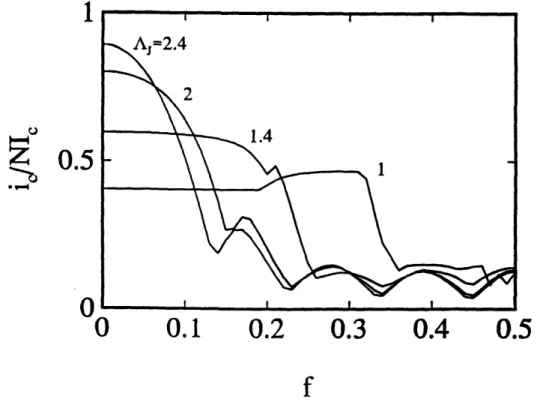
Figure 2-6: The array critical current as a function of the frustration for four different values of A. The plot is a result of a numerical sumulation on an array with 9 junctions and uniform current injection when considering self-inductances only. The inset shows the linear dependence of D on A for an N = 9 array.
junctions depends on the external magnetic flux [15] as
i(f)
=I sin
N7rf
(2.18)
so that D N. Therefore, G can be made larger by decreasing A. As A is decreased below N, self-induced fields by the supercurrents in the DVFT become important and the dependence of i on f must be calculated numerically [16]. The suppression of
i, depends on the manner of injection of current into the array; the current can be
injected uniformly, in the middle of the array, or at one or both edges of the array. In Fig. 2-6, we show the result of numerical calculations for uniform current injection in an array with N = 9. The curves in this plot are obtained from calculations with the self-inductance of the loops only. (Inclusion of all the inductances of the array and different ways of current injection can be accounted for in our simulations [16].)
With Fig. 2-6 and similar curves for various N, we have found D as a function of A, for A < N. The result is shown in the inset of Fig. 2-6. We note that for uniform
current injection and A < N, then D 2.6Aj, independent of N. Therefore, for A < N, Gl 0.15 A (2.19) and 1 GI M 0.26A (2.20) Ai
In our sample with A = 0.76 and for parallel injection of i, we expect G ~ 1.8 which agrees with my measurement of Gi1 = 1.2. Likewise, for loop injection we expect Gt ; 0.34, which agrees well with the experimental value of 0.35. Hence, we
conclude that our model provides good estimates for the gain.
From Eqs. 2.19 and 2.20, we see that the highest gains are found for low AJ values. However, it is difficult to make arrays with AJ much less than 0.1 without making the cells too big. We also see that gains of 10 or higher are difficult to obtain for an array with 9 junctions. One could increase N, in order to increase Gil; however, this will lead to a longer response time and smaller output resistances. Better magnetic coupling, such as with the ground plane 2, also increases G. We also expect that
including mutual inductance effects [16], will not significantly change the value of the gain.
It is also interesting to compare the gain of an array to that of a two junction SQUID, which is an array with N = 2. The gain of the SQUID, Gsq is still given by Eq. 2.13. Also the magnetic coupling M of the SQUID is given by Eqs. 2.14 and 2.15 with w = = p and d = d', since for a square cell, "loop" and "parallel" current injection are the same. Finally, the estimate of D can be derived noting that for AJ < 1, the change of a 1/2 flux quantum of applied field, decreases the critical current of the SQUID from io = 2IC to i(1/2) = In. From Fig. 12.20 of Ref. [14]
which shows I,, as a function of A 2, we find that for the SQUID D = 1.6A. For
2Another possible method of control is to have i flow uniformly through a thin ground plane of
width W placed directly over or under the array. A constant magnetic flux density B = Ioig/2W then passes through the array, and the current gain is then Ggp = D N L,. The width W could
be of the order of p, which means that Gp > Gi. Hence, this method provides a better coupling than the methods using filamentary conductors.
p = 10/ m, d = 1m, and M = 2.4po/p ~ 2.2L,, then
1
GsQ x 0.18A (2.21)
for AJ < 1. Moreover, as AJ approaches zero, Imi,/(2Ic) = 1-rAJ [14] and D = 27rA indicating that the current gain saturates at about 0.7 for the numbers given above.
Consequently, we see that it is difficult to get gains greater than one with this manner of magnetic coupling. We note that GSQ is about 50% lower than GI, as to be expected
from the increased magnetic coupling from all the cells in the array. Moreover, for parallel coupling, GSQ is N times smaller than the array. In both cases the array provides a larger gain than a single two junction SQUID.
There are better ways to couple flux in the SQUID loop (e.g. by using pick-up coils), but there is a trade off. One would like the inductances LCI of the wires used to couple the flux in the loop to be as small as possible. When several loops with control
lines are connected together, the Lcl/lr constant must be kept below the response time of the SQUID, which is TrR. For TR of the order of 10 ps and with r, = 5 Q, L,1 must be smaller than 50 pH. This might in particular be a problem for high-T-devices.
In conclusion, to obtain output voltages of the order of the IcR,-product (1.75 mV for niobium at 4.2 K) one needs intrinsically shunted junctions so that J must be
higher than 45,000 A/cm2. To get the highest gains, AJ must be kept smaller than 1. However, higher gains can also be obtained by increasing the number of junctions
but longer arrays will increase the response time and decrease the output resistance.
2.4 Comparison to low-T, LJJ and High-Tc-devices
The low-T, (niobium) long Josephson junction Current Injection Transistor (CIT) [7], like the junctions in our samples, is shunted by a parallel resistor to make the device
overdamped. The transport current-voltage characteristics of this device follow the
RSJ model, thus its operation is similar to our devices with one major exception that the control current is actually injected into the body of the device. Therefore, in the
CIT, there is no isolation between the input and the output which can be a problem in circuit designs. The current gain for this device has been shown to be G Z e/2AJ,
where e is the length of the device and AJ is the Josephson penetration depth [7]. For a long junction made of electrodes with penetration depth A and thickness greater
than A, then A, = 4/2rtoJch, where h = 2A + t,, and t is the oxide thickness of
the junction.
To make a closer comparison between the DVFT and the CIT, we model the CIT as a DVFT with a rectangular unit cell: the lattice spacing along the direction of the device is given by AJ, and the lattice spacing perpendicular to the device is h. The self inductance L, is modeled as the inductance of a transmission line of length A so
that L, = pohAJ/W.; where Wj is the width of the junction. The "junction" induc-tance is modeled as L = (o/2rJcWjAj.. Consequently, the corresponding AJ = 1,
as to be expected since the penetration depth is the lattice spacing along the array.
The equivalent number of junctions is N - I/A, assuming N > 1. Likewise, the
corresponding resistances and capacitances are N times larger and smaller respec-tively than the total resistance and capacitance. Therefore, ,c remains the same for each cell as for the whole continuous junction. In the upper part of table 2.1, the parameters for the "discrete model" of the CIT are given in brackets. From these
parameters we calculated the output parameters using the formulas for the DVFT.
These output parameters are listed in the lower part of table 2.1 in brackets next to the experimentally measured values. The two sets of numbers agree reasonably well, suggesting the usefulness of our "discrete model." For our "discrete model" of the CIT, a gain of /2Aj translates into G = N/2. This is the same dependence as Eq. 2.19 for Gl[ and AJ = 1, except for a numerical factor of order unity reflecting the different magnetic coupling used in the CIT.
An analogous "discrete model" for high-temperature superconductors was not done because the mechanism of vortex motion is probably not the same as in a Josephson junction or array. However, if the current-phase relation for high-T-devices is sinusoidal, one could still use our estimate of the gain. For the high-T-device of Ref. [10], we predict a gain of 2.2 for loop injection in reasonable agreement with the
parameter DVFT CIT [7] HTc [10] DVFT with high Jc J,(A/cm 2) 450 1000 4000 45,000 Aj(om 2 ) 9 [75] 20 0.22 I,(mA) 0.04 [0.75] 0.8 0.1 i,(mA) 0.37 22.5 4 0.9 R.(Q) 5 [0.8] - -IS(Q) 43 [2.7] 17.5 C(fF) 405 [640] - 10 N 9 [30] 5 9 p(,m) 10 [25] 20 10 I(1,m) 80 750 80 80 AJ 0.77 [1] 0.12 0.5 L(pH) 14 [0.44] 28 14 LJ(pH) 8 [0.44] 0.4 3.3 _ _ 1.3 1 <1 1 rm(1f) 0.43 (0.49) 0.2 [0.06] 10-20 2.7 Gi 0.35 (0.34) 1.1 (2.2) 0.52 G11 1.2 (1.77) 10 [4.5] 2.8 V,,,, (mV) 0.15 (0.2) 0.2 [0.47] 23 1.75 r () 0.55 (0.55) 0.025 [0.028] 12.8 2 TR (ps) -(55) 100 [42] 60 5
Table 2.1: Summary of the vital characteristics of three non hysteretic superconduct-ing transistor technologies.
The parameters for the low-T-devices are taken at 4.2 K, and the ones for the high-T, device at 77 K. The DVFT is the measured array of Figures 2-1 through 2-6. In parentheses, we quote the numbers expected from our model calculation. The high-J
DVFT is a proposed devices based on high critical current density junctions. The CIT is the continuous junction of Ref. [7]; the bracketed numbers refer to the discrete model of the continuous devices as discussed in the text. The high-T, device is the high-temperature superconducting flux flow transistor of Ref. [10].
experimental value of 1.1. In addition, our relation r rG also seems to hold for this high-Te-device as can be seen in table 2.1.
In table 2.1, we summarize the characteristics of our measured DVFT, the CIT
of Ref. [7] and the high-Te flux flow transistor of Ref. [10]. The response times of the
measured three devices are comparable, so it is hard to make a distinction among them in this respect. The CIT has the largest gain; but this is due to it having the largest
effective N. If the other devices were as long, they would have comparable gains. Furthermore, the CIT would be difficult to use in complex circuit designs, because
of the problem of the input not being isolated from the output and the low output
voltages and resistances. The separate control over the resistances, self inductance, and lattice spacing, as well as using the same fabrication technology as other low-T
devices also gives the DVFT a strong advantage over the CIT. The high-Te devices
have the advantage over the low-Te devices, in that the voltage scale is increased by a factor of 100.
In table 2.1 we also list the calculated properties of a DVFT made with niobium technology similar to our measured device, but with intrinsically shunted junctions
requiring critical current densities larger than 45,000 A/cm2. In our calculations, we have taken a junction critical current of 0.1 mA, which is about the critical current
used in the single-flux-quantum (SFQ) technology [3]. With Jc = 45, 000 A/cm2, the junctions are 0.5 x 0.5 Am2, which should be possible with present technology. For
N = 9, gains of about 3, response times around 5 ps, and voltage levels of 1.75 mV are possible. In addition, ro and rmll will be about 2-3 Q. By making the junctions a
factor 6.25 smaller (0.2 by 0.2 rm 2), the gain will still be larger than 1, but r, and rTmll will be about 10 Q. The response time and the voltage levels would remain the
same. Except for the voltage levels, the performance of such DVFT would be the
same as or better than that of the present high-T, devices.
One of the possible applications for the DVFT is to act as an interface between the current based SFQ logic and the voltage based CMOS memory. For this appli-cation, the DVFT must have output voltage levels that are high enough to surpass the threshold levels of the CMOS gates. Output voltages on the order of 0.1 volt
are desirable. The low-To technology will be limited by the IR, product, which is
1.75 mV for Nb at 4.2 K. Therefore, to obtain higher voltage outputs one needs several DVFTs connected in series or stacked on top of each other. The high-T, materials have an advantage in this area because the characteristic voltage scale can be much
higher, although the present value of 0.02 V still seems to be too small. For other applications at 4.2 K where the output voltage is not as important, DVFTs made in
niobium technology are expected to have a comparable or better performance with the advantage of using a reliable technology.
2.5 Conclusions
We have fabricated, measured, and modeled discrete overdamped vortex flow transis-tors made of low-temperature Josephson junctions connected in parallel. The DVFT
compares in performance with the high-temperature superconducting DVFTs except that the output voltage is lower. The DVFT has advantages over the continuous
LJJ in that more freedom can be exercised over the parameters, which is useful in
designing specific devices. Our modeling of these devices shows that overdamped submicron junctions with high critical current densities would be the near optimal
design for DVFTs. It should be possible to stack DVFTs or connect them in series, by
which both the output voltage and the output resistance increase. With 100 DVFTs
in series, we project output voltages greater than 0.1 V and resistances of the order of 100 Q. However, these devices require longer control lines for injecting the gate
currents and the inductances L associated with these lines must be kept small so
Chapter 3
Underdamped Vortex Flow
Transistors
3.1 Experimental results
The underdamped DVFTs are fabricated with a four mask selective-niobium-anodization process (SNAP) technology at Lincoln Laboratory and AT&T. A schematic drawing
of the array is shown in Fig. 3-1. Our underdamped DVFT consists of an array of 54
unshunted Josephson junctions with a lithographically defined area of 1.5 x 1.5 pm2. At 4.2 K, i3(R,) - 100. The transport current is injected into the array at the middle of the sample and the voltage across the array is measured with a pair of leads at the
edge of the array. The gate current is injected from one edge to the other edge of the
array through the superconducting wire connecting all junctions in parallel. We have measured three underdamped DVFTs and we will show here the results of the array
with the highest AJ.
We have measured the it - v. characteristic at 4.2 K for several values of ig as shown in Fig. 3-2. The it-v. characteristic is hysteretic, which is a consequence of
the low damping in the Josephson system. In the absence of an induced magnetic
field, the it-v. characteristic shows a critical current; and above the critical current
the device directly switches to the niobium gap. By applying a gate current, ig, we
it
Jt
a ait
Figure 3-1: A schematic drawing of the underdamped
current is injected into the middle of the array.
50
*_
DVFT in which the transport
1
2
va (mV)
Figure 3-2: The array voltage as a function of the transport current for three different gate currents. The inset shows the input-output relation of this underdamped DVFT for a transport current of it = 33pA. The slope of the dashed line is the transresistance rm.
peak in the it-v, within the gap region. This peak is known as the Eck peak. As ig is increased, the voltage position of the Eck peak increases, and its current height
decreases slightly.
Because of the hysteresis in the it-va, the choice for the bias of it is very important. As soon as the current position of the operating point surpasses the height of the Eck peak, the voltage switches to the superconducting gap. If this happens, it is necessary to bring it down to 0, in order to reset the Josephson array into the superconducting state. This effect is referred to as the "latching" of the Josephson system. Thus, in order to avoid "latching", it is necessary to bias it below the lowest height of the Eck peak, as is shown in Fig. 3-2. But, since the Eck peak also has a finite slope, the choice of the bias of it also determines the range for the output voltage. Decreasing the bias of it would decrease the voltage range. The output resistance, r, is the reciprocal of the slope of the Eck peak in the it-va. The value of ro in our samples is
about 2.7 g.
The inset of Fig. 3-2 shows the dependence of va on ig for it = 33 pA. There is a threshold current ith, for ig, below which there is no output voltage. This quantity represents the amount of magnetic flux required for a vortex to enter the system. The transresistance, r, is a function of the voltage position of the operating point. We find r, to be of the order of 2.8 f as illustrated in the inset of Fig. 3-2.
3.2 DVFT Analysis
In underdamped 1D Josephson systems, resonances occur in the it-va characteristic. In a small system, there are standing modes of small amplitude phase oscillations
which are called Fiske modes [17]. In the itva, these Fiske modes show up as current steps occurring at certain voltages. For a sufficiently long system, damping can destroy the standing wave condition and the Fiske peaks merge into one current step which is called the Eck peak [8]. The Eck peak can also be explained in terms of vortex motion. The magnetic field introduces vortices in the array which are accelerated by
of vortices leaving the array per unit time determines the voltage. The higher the magnetic field, the more vortices are introduced and the higher the voltage. In fact, a linear dependence of the voltage on the applied magnetic field has been observed in long Josephson junctions [8]. There have been no previous reports on measurements
of Eck peaks in underdamped DVFTs.
In a long Josephson junction of length and Josephson penetration depth A, a magnetic field causes an array of vortices to enter with periodicity AJ/f. Here,
f = BhAX where B is the external magnetic flux density penetrating the junction and h = t + 2AJ. Here, t is the thickness of the insulating barrier in the Josephson junction. However, for vortices to enter, the f must be larger than fl, the lower
critical field. For f > f, the phase of the array of vortices can be approximated
as a sinusoidal wave with wavenumber k = 27rf/AJ. Since the vortices of an Eck peak move at the speed of light , the corresponding angular frequency for the wave is w(k) = k. Note that w(k) is the dispersion relation of the transmission line without the Josephson tunneling channel. The voltage of the Eck peak is given by the Josephson voltage-phase relation,
VE =
W(k).
(3.1)Using the dispersion relation, one finds the known relation VE = o~f /AJ, which is
linear in the magnetic field [8].
We have performed an analysis for the Eck peak in discrete systems similar to
that for long continuous junctions [18]. For f > f, the phase of the vortices in the discrete array for AJ > 1 can be approximated again by a sinusoidal wave with wavenumber k = 2rf/p. We find that for a general f the voltage at the Eck peak is still given by Eq 3.1. However, w(k) is the dispersion relation of the discrete array without the Josephson channel; that is, the dispersion relation of a ladder network of
w(k) = (2:/p)lsin kp/2]. This gives the voltage at the Eck peak of
vE = Isin(7rf)l . (3.2)
For small f we obtain the result for the continuous junction, E = ocf/Aj where c = p/x/T; for a discrete transmission line. Because of the discreteness, E is periodic in f with period f = 1 and vE(f) bends at the first Brillouin zone edge at
f = 0.5. The periodic nature of vE is an extra factor that must be taken into account
in the operation of the underdamped DVFT. In general one needs to keep f < 0.5. In the experiment we have observed sine-like behavior in the input-output relation above an entry field fl of 0.2. The measured maximum voltage is 0.3 mV which is in good agreement with the expected value of $O/(rL/TU). Table 3.1 contains the
values of the parameters for the underdamped DVFT. To increase the maximum
voltage one could decrease the cell size (decrease L,) and/or decrease the junction area (decrease C). A reduction of L, can also be obtained by using a superconducting groundplane. Of course, the output voltage is limited by the IR product.
The transresistance r, is can be found by noting that
0v.E .= 9 E
Of
r,, = Ogeig
Of
(3.3),aig 'Of ig
Using Eqs. 2.12 and 3.2 along with the definitions for M from Eqs. 2.14 and 2.15, we find that for loop injection of ig
(r,)t =
r(N- 1)
cosrf
(3.4)
and for i injected parallel to the array
1.1 L.
1(r.)l =
-1 cos rf .
(3.5)
Since these formulae are only valid for f > fl, we must choose a value of f to compare with our data. From the inset of Fig. 3-2 we see that the value of r, was
chosen is near f - 3/8. For this f and with the parameters listed in Table 3.1, we
estimate that (rm)ll is 1.4 SI which agrees well with the measured value of 2.8 Q. Although there is no expression for the current-voltage characteristic of the Eck peak, we assume that the vortex velocity u is the same as found for a single vortex
driven by a current in the absence of an applied magnetic field. From Ref. [19], this
velocity in a long Josephson junction is given by u = (1 + 16i2/7r2i2,3c)-1/2. By assuming now that each vortex in an applied field moves with this same velocity, we
find that the voltage is E = 4(ouf/p. Hence,
va(it) = 4Sol (3.6)
i6i2
Therefore, for ,c > 1, it i and C/p = 1/'., then
16A f L__, (3.7)
Using the parameters listed in Table 3.1 and setting f = 3/8, we get an estimate of r of about 1 t which compares with the measured value of 2.7 1.
We can estimate the response time as the transit time for a vortex to travel across
the array. The maximum vortex velocity is p// L , so that the expected transit
time rt is (N - 1) /LC. For our underdamped DVFT, we find rt = 60 ps. Again, a decrease of the response time is obtained by decreasing L, and C.
When comparing two samples with three different Aj's, we have seen a better performance for the sample with the higher AJ value. In that sample the Eck peak is also more pronounced leading to a smaller output resistance. This indicates that
one would like to have A > 1, which is the assumption we made in our analysis. In that respect, our design with AJ = 1.3 is far from optimal. Improvements could be obtained by decreasing L, and C yielding higher output voltages, higher speed and higher AJ values. We expect that for higher Aj values the Eck peak becomes more pronounced so that the output resistance would also be smaller.
3.3 Comparison to LJJ
The operation of the vortex flow transistor in the underdamped region has been
studied using long Josephson junctions [20, 21, 22]. Because the magnetic coupling
into the LLJs is different, a direct comparison of the transresistance is not possible. The value of r, that appears in the literature is inversely proportional to the control
line width, Wo. An experimental expression for rm for NbN/Pb-alloy junctions has been determined [21] to be: r, = 375m0-m This dependence on W follows from
calculating rm with the plane method of magnetic coupling described earlier. This
gives rm = V/(oht/e)/2W, which for typical parameters and dielectric constant e gives rmW to be a few hundred ma-dam. In practical devices W can be as small as
5pAm. The transresistance also can be slightly increased by reducing the control line thickness, thus further increasing the inductance of the control line.
The maximum output voltage can not exceed the superconducting gap of the
material. So, the maximum output voltage of the Nb-Ai20O-Nb junctions is never greater than 1.75 mV. The NbN/Pb-alloy junctions have output voltages as high as
3 mV [20].
The output resistance reflects the slope of the Eck peak. Ideally, the Eck peak
should be as vertical as possible, yielding in an infinitesimal output resistance. Output resistances have been reported as low as 0.1 mf [21] in long junctions.
The speed of the long Josephson junction-based VFTs depends on the length of
the device. Amplifiers based on the long junction VFT have been shown to have
reasonable gain up to 100 GHz [22]. This value implied delay times on the order of
10 ps.
In Table 3.1 we compare the results for the LLJ [9] with those of the underdamped
DVFT. We see that the DVFT is better in most regards to the LJJ. However, both
parameter DVFT LJJ [9] J, (A/cm2) 670 350 Aj (m 2 ) 2.25 [920] I, (mA) 0.012 [3.2] R () 145.8 [0.6] C (pF) 0.15 [7.8] N 54 [35] p (m) 12 [23] (m) 636 800 AJ 1.3 [1] L. (pH) 16.6 [0.1] LJ (pH) 27.7 [0.1] _c_ _ 120 [28] r 1ll () 2.8 (1.4) 0.002 [0.015] ith (mA) 0.125 (-) 48 [-] Vaa,,z (mV) 0.31 (0.42) 0.17 [0.75] ro (0F) 2.7 (0.3) 1 [0.008] TR (s) - (84) 100 [30]
Table 3.1: Summary of the vital characteristics of two hysteretic superconducting transistor technologies.
The DVFT is the measured array of Figures 3-1 and 3-2 and LJJ is the continuous junction of Ref. [9]. In parentheses, we quote the numbers expected from our model calculation for the DVFT and the bracketed numbers refer to the discrete model of the continuous devices as discussed in the text. Aj is the defined junction area; the actual junction area of the DVFT is 1.8 pm2. The capacitance of these junctions is
3.4
Conclusions
We have fabricated, measured and modeled discrete underdamped vortex flow
tran-sistors made of low temperature Josephson junctions connected in parallel. We have also constructed a discrete model to the published data on the underdamped vortex flow transistors based on long Josephson junctions. In comparison with these long
junction based transistors, the underdamped DVFT performs better. In comparison with the overdamped DVFT, the underdamped DVFT has the disadvantage of having
a hysteretic it-v. relationship. This hysteresis makes the underdamped DVFT much
Chapter 4
Implementation of the DVFT
4.1 Introduction
In the preceding chapters, the fundamentals of the operation of the overdamped and
underdamped vortex flow transistors have been introduced. This chapter discusses
the role that these fundamentals play in the implementation of the Discrete Vortex Flow Transistor in circuits. The underdamped DVFT is much harder to implement than its overdamped counterpart, because of its hysteretic it - va relationship, so we
will concentrate on the overdamped DVFT.
We attempted to use SPICE to simulate DVFT circuits, in order to determine the effects of the individual characteristics of the DVFT on its performance in
sim-ple circuits, such as an inverter, memory cell, or an oscillator. We were successful in programming an approximate model of the overdamped DVFT into SPICE, but
attempts to embed this model into more complex circuitry ran into computational problems. Nevertheless, we can still gain some important information from hand
calculations of the performance of a simple inverter.
4.2 Inverter
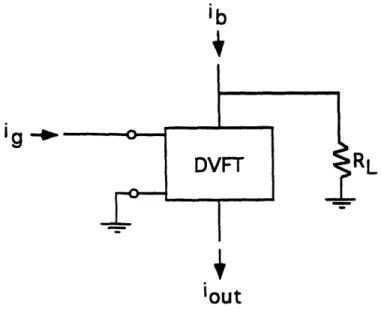
Consider an inverter shown in Fig. 4-1. The bias current ib can be thought of as a supply current. The gate current ig is assumed to be fed by other DVFT circuits. If ib
ib
ig41b
iout
Figure 4-1: A schematic drawing of a DVFT based inverter.
is biased below i,, of the DVFT, then for a zero ig, the i of the DVFT is unsupressed
and remains at i. In this case, the entire bias current ib is flowing through the DVFT, resulting in a zero voltage across the resistor. Therefore, there is an output current, iot = ib, for a zero gate current. Thus, a logic "1" on the output corresponds
to a logic "0" on the input.
Now, suppose there is a gate current corresponding to a logic "1" that suppresses
the i, of the DVFT. Since the bias current exceeds the critical current of the DVFT,
the bias current will flow through both the DVFT and the load resistor, RL. Since there is a finite current flowing through the resistor, there is a voltage across the
parallel combination of the DVFT and RL. Therefore, the DVFT must be in the resistive state. We can solve this problem either graphically by combining the it-v, relationship of the DVFT and the load line of the resistor, or by simultaneously
solving the system of equations for the output current it:
va
=-it2
(4.1)
Va = RL (ib-it) (4.2)
42
The solution of this system of equations is:
-ibR2 i reqic (r2 - R) + ibR
it r - (4.3)
Consider the limit of i = 0. The expression for it reduces to:
it
=ib ri RL
r,q RLIn this, expression, the upper sign is the only physically realizable situation, since the lower sign would give us a current opposite in sense to ib, unless req < RL, in which case we get a current that is larger than ib, which is impossible. Thus, if we are able to conceive a situation where i is suppressed to zero, the expression for it simplifies
to a simple current divider relation:
it = ib L (4.5)
req + RL
Ideally, we would like it, which is the output current, to be zero in this case, since we are trying to invert an input of logic "1". Thus, from the above argument, it is evident that for this particular implementation it is necessary not only to be able to
suppress i to zero, but make RL < rq.
From the simulations shown in Fig. 2-6, we know that i, does not go to zero for
small Aj. In order to divert current from the output, it has to be greater than i. If the minimum level of i increases, then the amount of current diverted from the
output decreases. Thus, the logic "O" output current is increased, which is a very undesirable effect. In other implementations, that do not use a shunting resistor,
the maximum suppression of i, still remains a critical problem that must be solved, because the degradation of output logic "0" can potentially create errors, since a nonzero current can be interpreted as a logic "1" by the subsequent stages. There are several possible solutions to this problem.